

Saved Bookmarks
| 1. |
Two cars A and B are moving west to east and south to north, respectively, along crossroads. A moves with a speed of 20 m s^-1 and is 500 m away from the point of intersection of cross roads and B moves with a speed of 15 ms^-1 and is 400 m away from the point of intersection of cross roads. Find the shortest distance between them. |
|
Answer» Solution :Method I (USING the concept of relative velocity) Let us assume the velocity of `A w.r.t. B`. To do this, we PLOT the resultant, `vec V_( A B)`. `vec V_(A B) = vec V_A - vec v_B = vec V_A + (- vec V_B)` As the accelerations of both the cars is zero, so the relative acceleration between them is also zero. Hence, the relative velocity will remain constant. So the path of `A` with respect to `B` will be straight line and ALONG the direction of relative velocity of `A` with respect to `B`. The shortest DISTANCE between `A and B` is a perpendicular from `B` on the line of motion of `A` with respect to `B`. (Fig. 5.128). `tan theta = (V_B)/(V_A) = (15)/(20) = (3)/(4)` ....(i) This `theta` is the angle made by the resultant velocity vector `|vec V_(A B)|` with the x - axis. Also we know that from (Fig. 5.128), `O C = (x)/(500) = (3)/(4)` ...(ii) From equation (i) and (ii), we get `x = 375 m`. `:. AB = OB - OC = 400 - 375 = 25 m` But the shortest distance is `BP`. From diagram, it is clear that `BP = BC cos theta = 25 xx (4)/(5)` `:. BP = 20 m` Method II (Using the concept of relative velocity of approach) At any time `t`, us plot the components of velocity of `A and B` in the direction along `AB`. From these components, we can find the velocity of approach between them at any time which is the relative velocity between them along line joining between instantaneous positions. When the distance between the two is minimum, the relative velocity of approach is zero. `:. V_A cos phi_t + V_B sin phi_t = 0` (where `prop_f` is the angle made by the line `A'B'` with the x - axis) `20 cos phi_t = -15 sin phi_t` `:. tan phi_t = - (20)/(15) = -(4)/(3)` Here we should not confuse this angle `(phi)` with the angle `theta` in method (I) because that `theta` is the angle made by the net relative velocity with x - axis, bit `phi` is the angle made by the line joining the two cars with x - axis when the velocity of apprroach is zero. `(400 - 15 t)/(500 - 20 t) = -(4)/(3)` `t = (128)/(5)s` So, `OB' = 16 m and OA' = -12 m` `A' B' = sqrt(16^2 + (-12)^2) = 20 m`. 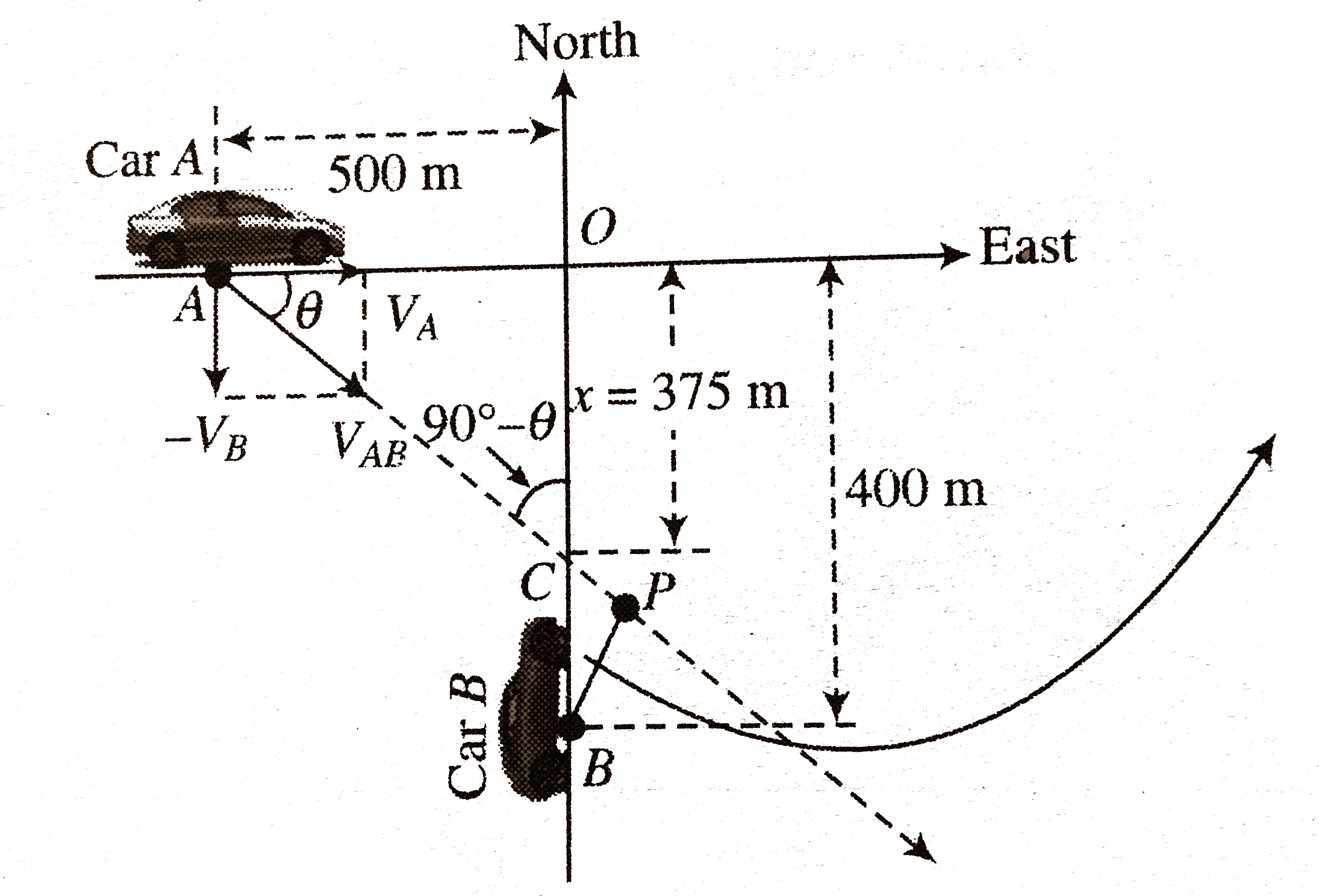 , ,  . .
|
|