

Saved Bookmarks
This section includes 7 InterviewSolutions, each offering curated multiple-choice questions to sharpen your Current Affairs knowledge and support exam preparation. Choose a topic below to get started.
| 1. |
Formation of a neutron star is explained on the basis of |
|
Answer» conservation of LINEAR momentum |
|
| 2. |
A sapceship nears the Moon along a parabolic trajectory that almost toches the Moon's surface. In order to transfer closest approach. The engine ejects gas ata speed of u = 4 km//s realtive to the spaceship In its direction of motion. If v_(1) = velocity of spaceship in parabolic trajectory, when it almost touches the earth and v_(2) = velocity of spaceship in circular orbit when it almost to'uches the earth. Then what friction of total mass should the fuel burn to transfer space ship to circular orbit? |
|
Answer» |
|
| 3. |
Explain the motionof a raindrop from acloud |
| Answer» SOLUTION :WHENA raihdropgetsdetachedfromthe cloudit experiencesbothdownwardgravitationalforceand UPWARD airdragforce.Fromthenonthe raindropmovesat CONSTANT velcoitytill ittouches the SURFACEOF theEargh . | |
| 4. |
A car is moving towards a high cliff. The car driver sounds a horn of frequency f. The reflected sound heard by the driver has frequency 2f . If v is the velocity of sound , what will be the velocity of the car ? |
|
Answer» Solution :If ` u_(S) and u_(o) ` are the velocities of the source of sound and the listener respectively, ` frequency of the echo, ` f. = (V + u_(0))/( v - u_(s) )xx f ` Here, ` u_(s) = u_(0) ` = U (say) and f. =2f ` THEREFORE 2f = (v + u)/(v-u) xx f " or " , v + u = 2 (v - u) ` or . 3u = v or , u = `v/3 ` . |
|
| 5. |
A clock with an iron pendulum keeps correct time at 20^(@)C. How much will it lose or gain per day if cubical expansion of iron =36xx10^(-6).^(@)C^(-1) . |
|
Answer» `Delta T=(Delta L)/(Lalpha)=(5xx10^(-4))/(1xx1.32xx10^(-5))=37.8^(@)C` |
|
| 6. |
The magnitudes of two vectors vecP and vecQ differ by 1. The magnitude of their resultant makes an angle of tan^(-1)(3//4) with P. The angle between P and Q is |
|
Answer» `45(0)` |
|
| 7. |
A string is warapped around a cylinder of mass m and radius r. The string is also connected to a block of same mass m with the help of another pulley as shown in figure. The angular acceleration of the cylinder is ( friction is sufficient for rolling ) ( all pulleys are ideal) |
|
Answer» `(G(2- sin theta))/(16 R)` |
|
| 8. |
A person is sitting in aboat floating in a lake . This person fills a bucket of water from lake and puts in the boat , then will the water level go down in the lake ? |
| Answer» SOLUTION :No, when the person OUTS the bucket in boat then the INCREASED weight ALSO rises thewater LEVEL . But , as the same amount of water is reduced from lake the height of water level doesn .t change. | |
| 9. |
If |veca+vecb|=|veca-vecb|, then what is the angle between veca "and"vecb? |
| Answer» SOLUTION :`0=pi//2` | |
| 10. |
A projectile has the maximum range of 400m. If it is pushed up smooth inclined plane of angle 30^@with the same speed, the distance travelled by it along the inclined plane will be |
|
Answer» 200m |
|
| 11. |
Average densities of two planets is same but their radii are R_1 and R_2. If the acceleration of gravity on planets are g_1 and g_2respectively, then |
|
Answer» `g_1/(g_2 )= R_1/R_2` `:.g_1/ g_2 = R_1/R_2` |
|
| 12. |
The vectors vecAandvecB to be mutually orthogonal when |
|
Answer» `vecA+vecB=0` |
|
| 13. |
A particle is performing SHM. If its displacement from mean position is x, corresponding resultant force on it is F and acceleration is a, which of the following graphs is correct? |
|
Answer»
|
|
| 14. |
1 second of arc is equal to............ |
|
Answer» `57.27^(@)` |
|
| 15. |
A hollow sphere rolls down a 30^(0) incline of length 6m without slipping. The speed of centre of mass at the bottom of plane is |
|
Answer» `6" ms"^(-1)` |
|
| 16. |
Assertina: In spring ball model. displace any ball form the its |
|
Answer» |
|
| 17. |
A mas of air is saturated with water vapour at 100^(@)C. Onl raising the temperature to 200^(@)C without change of volume, the mixture exerts a pressure of 2xx10^(5) pascals (Pa). What was the pressure of air alone in the ilnitial conditions? (Saturated vapour pressure of water at 100^(@)C=10^(5)Pa) |
|
Answer» |
|
| 18. |
An astronomical telescope has an angular magnification of magnitude 5 for distant objects. The seperation between the objective and the eyepiece is 36cm and the final image is formed at infinity, The focal length f_0 of the objective and the focal length f_e of the eye piece are |
|
Answer» `f_0=45cm, f_e=9cm` |
|
| 19. |
A stone is dropped freely, while another thrown vertically downward with an initial velocity of 2ms^(-1) from the same point, simultaneously. The time required by them to have a distance of separation22 m between them is |
|
Answer» 11 s |
|
| 20. |
a, b are the magntidues of vectors vec(a)" & " vec(b). If vec(a) xx vec(b) = 0 the value of vec(a). vec(b) is |
| Answer» Answer :C | |
| 21. |
Many great rivers flow towards the equator, what effect does the sediment they carry. To sea have on the rotation of the earth |
|
Answer» the ROTATION of the earth slows down |
|
| 22. |
Select the correct answer: Light year is the unit of_____. |
|
Answer» time |
|
| 23. |
The displacement of an object varies with time according to the equation, ty = ((3)/(8) t ^(2) 0 3t + 5) m.Find the instataneous velocity at t = 4s. |
|
Answer» `45 MS ^(-1)` `therefore v = (dy)/(dt) = (3 xx 2 )/(8) t -3 = 3/4 t -3` Put `t =4S, v = 3/4 (4) - 3 =0 ms ^(-1)` |
|
| 24. |
Corresponding to two circular motions, the radius of the circle , the period of revolutionthe initial position, and the sense of revolution (i.e. clockwise or anti-clockwise ) are indicated on each figure. Obtain the corresponding simple harmonic motions of the x-projection of the radius vector of the revolving particle P. in each case. |
|
Answer» SOLUTION :a) At t=0 OP makes an angle of `pi/2` with positive x-AXIS in the clockwise direction. After time t is covers an angle `(2pi)/(T)` t in the clock wise SENSE and make an angle of `(2pi)/(T) t + pi/2` with positive x-axis . The projection of OP on the axis at time .t. is given by `X = A cos ((2pi)/(T)t + pi/2) ""X= -A SIN ((2pi)/(T)t)` `X=-3sin ((2pi)/(2)t) ""therefore Z=-3sin pit` B) At t=0 OP makes an angle of `pi` with positive x-axis in the anti clockwise direction. After time t is covers an angle `(2pi)/(T)t` in the anti clock wise sence and makes an angle of `(2pi)/(T) t+ pi` with positive x-axis . The projection of OP on the axis at time .t. is `X= A cos ((2pi)/(T)s+ pi) , ""X=-A cos ((2pi)/(T)t)` `X=-2cos ((2pi)/(T)t) , ""X=-2cos((pi)/2 t)` |
|
| 25. |
A liquid occupies half of a vessel at a particular temperature. The volume of the unoccupied part remains constant at all temperatures. If alpha and gamma are the coefficients of linear and real expansions of a vessel and liquid, then gamma= |
|
Answer» `3 ALPHA` |
|
| 26. |
A stone is projected horizontally with a velocity 9.8 ms^(-1) from a tower of height 100 m. Its velocity one second after projection is |
|
Answer» `9.8 MS^(-1)` |
|
| 27. |
29.4 N force is required to compress a spring by 1 cm. How much work should be done to compress the spring by 20 cm? |
|
Answer» |
|
| 28. |
A physical quantity is represented by X = M^(a) L^(b) T^( - c) . If the percentage error in the measurement of M, L and T are 2 alpha% , beta %, 3 gamma %, respectively then maximum percentage error in X is |
|
Answer» `( a alpha + B BETA - C gamma) %` |
|
| 29. |
The wheels of vehicles are provided with mudguards. Why? |
| Answer» Solution : When the wheel rotates at a HIGH speed, the mud sticking to the wheel flies off tangentially, this is due to INERTIA of direction. In ORDER that the flying mud does not spoil the CLOTHES of PASSER by the wheels are provided with mudguards. | |
| 30. |
In the above problem the resultant force on the body is |
|
Answer» 56.6 N |
|
| 31. |
Given : vecA =2 hati + 3hatj+hatk andvecB = 6 hati + 9hatj+3hatkwhich of the following statements is correct ? |
|
Answer» `vec A and vecB` are EQUAL vectors `:. vecB = 3 (2 hati + 3hatj + hatk), " As" vecB = 3vecA :. vecB ||vecA` |
|
| 32. |
Ideal monoatomic gas is taken through a process dQ=2dU . What is the molar heat capacity for the process ? (where dQ is heat supplied and dU is change in internal energy) |
| Answer» Solution :`C=(dQ)/(NDT)=(2dU)/(ndT)=(2nC_(V)dT)/(ndT)=2C_(v)=3R` | |
| 33. |
Centripetal force is called a real force, but centrifugal force is called a pseudo force. Give reasons in support of this statement. |
|
Answer» Solution :The force that arises due to mutual ACTION- reaction process is called a real force.we know that in the absence of any external force, a moving body continues to move wit uniform velocity. So, with respect to any inertial frame of reference, when a body moves along a circular path, at EVERY moment its direction of the MOTION changes. This change in direction of motion is possible when an external force acts on the body. this external force is the centripetal force. As centripetalforce is an external force acting on a rotating body, it is a real force. On the other hand, in an accelerated or rotating frame of reference, i.e., in a non-inertial frame of reference, a body is acted UPON by a force whose direction is opposite to the direction of the centripetal acceleration of the frame. since this force is not generated due to mutual action-reaction process between different BODIES, it is a pseudo force. this force has no existance bodies, in any inertial frame of reference. This force, which arises due to an acceleration of the reference frame, can be felt only in the non-inertial frame of reference. In a rotating frame of reference, the pseudo force, which acts on a body and is equal but opposite to the centripetal force is called centrifugalforce. |
|
| 34. |
A projective of 2kg was velocities 3m/s and 4m/s at two points its flight in the uniform gravitational field of the earth. If these two velocities are _|_ to each other than the minimum KE of the particle during its flightis |
|
Answer» Solution :`V_(1)cosalpha = V_(2)cos(90-alpha)` `3cosalpha = 4sinalpha` `TAN alpha = (3)/(4) `  `KE_(min) = (1)/(2)mv_(1)^(2)cos^(2)alpha` `= (1)/(cancel2)xxcancel(2)xx3xx((4)/(5))^(2) = (9xx16)/(25) =` 5.76J |
|
| 35. |
The root mean square and most probable speed of the molecules in a gas are |
|
Answer» same |
|
| 36. |
If mu_(s )is coefficient ofstatic friction and mu_(k) is coefficent of kinetic friction then |
|
Answer» there is no relation between `mu_(s)` and `mu_(k)` |
|
| 37. |
Rain is falling vertically with a speed of 30 ms^(-1)A woman rides a bicycle with a speed of 12 ms^(-1)in east to west direction. What is the direction in which she should hold her umbrella? |
|
Answer» At an ANGLE of `tan-^(-1) (2/3)` (with the vertical TOWARDS the east. |
|
| 38. |
Give the expression for resultant displacement of two waves producing beats. |
| Answer» SOLUTION :`y ( t)= 2 a COS [ ((omega_(1)-omega_(2))t)/(2)]cos[((omega_(1)+omega_(2))/(2))t]` where `y_(1)= acos omega_(1) t ` and `y_(2) a cos OMEGA _(2) t ` and `y =y_(1)+y_(2)` | |
| 39. |
It is claimed that two atomic clocks if allowed to run for 100 years, free from any disturbance, may differ by only about 0.02 second. In measuring a time interval of second what is the accuracy? |
| Answer» SOLUTION :ACCURACY of 1 part in `10^(11) "to" 10^(12)` | |
| 40. |
Set the following vectors in the increasing order of their magnitude. (a)3hat(i)+4hat(j)""(b)2hat(i)+4hat(j)+6hat(k) ( c) 2hat(i)+2hat(j)+2hat(k) |
| Answer» Answer :B | |
| 41. |
A gas at 10^(@)C temperature and 1.013xx10^(5)Papressure is compressed adiabatically to half of its volume. If the ration of specific heats of the gas is 1.4, what is its final temperature?[2^(0.4)=1.32] |
|
Answer» `101^(@)C` |
|
| 42. |
Assertion :All oscillatory motions are necessarily periodic motion but all periodic motion are not oscillatory. Reason : Simple pendulum is an example of oscillatory motion. |
|
Answer» Both are ture and the REASON is the correct EXPLANATION of the assertion. |
|
| 43. |
The x-t graph shown in figure represents. |
|
Answer» CONSTANT velocity |
|
| 44. |
The earth rotates from west to east. A wind mass begains moving due north from the equator, along the earth.s surface Neglect all effects other than the rotation of the earth. The wind mass will |
|
Answer» always MOVE due north |
|
| 45. |
A body having a moment of inertia about its axis of rotation equal to 3 "kg-m"^(3) is rotating with angular velocity of 3 "rad s^(-1). Kinetic energy of this rotating body is same as that of a body of mass 27 kg moving with a velocity v. The value of v is |
|
Answer» `1 ms^(-1)` where, `m = 27 kg` (mass of the BODY) `omega = 3 "rads"^(-1)` (angular VELOCITY) `I = 3 "kg-m"^(2)` (moment of INERTIA) `v = ? or mv^(2)=I omega^(2)` `rArr v^(2)=(I omega^(2))/(m)rArrv^(2)=(3xx3^(2))/(27)rArrv^(2)=(27)/(27)=1` `rArr` Velocity of body, `v = sqrt(1) = 1 ms^(-1)`. |
|
| 46. |
A small particle of mass m is released from a height h on a large smooth sphere kept on a perfectly smooth surface as shown in the figure. Collision between particle and sphere is perfectly inelastic. Determine the velocities of particle and sherre after collision. |
|
Answer» Solution :Collision takes lace between smooth bodies, therefore, tangential velocity of particle is unchanged. `v_(r)=usintheta` and `u=sqrt(2gh)` when `sintheta=(R/2)/R=1/2` or `theta=30^(@)` `v_(t)=u/2` …………i 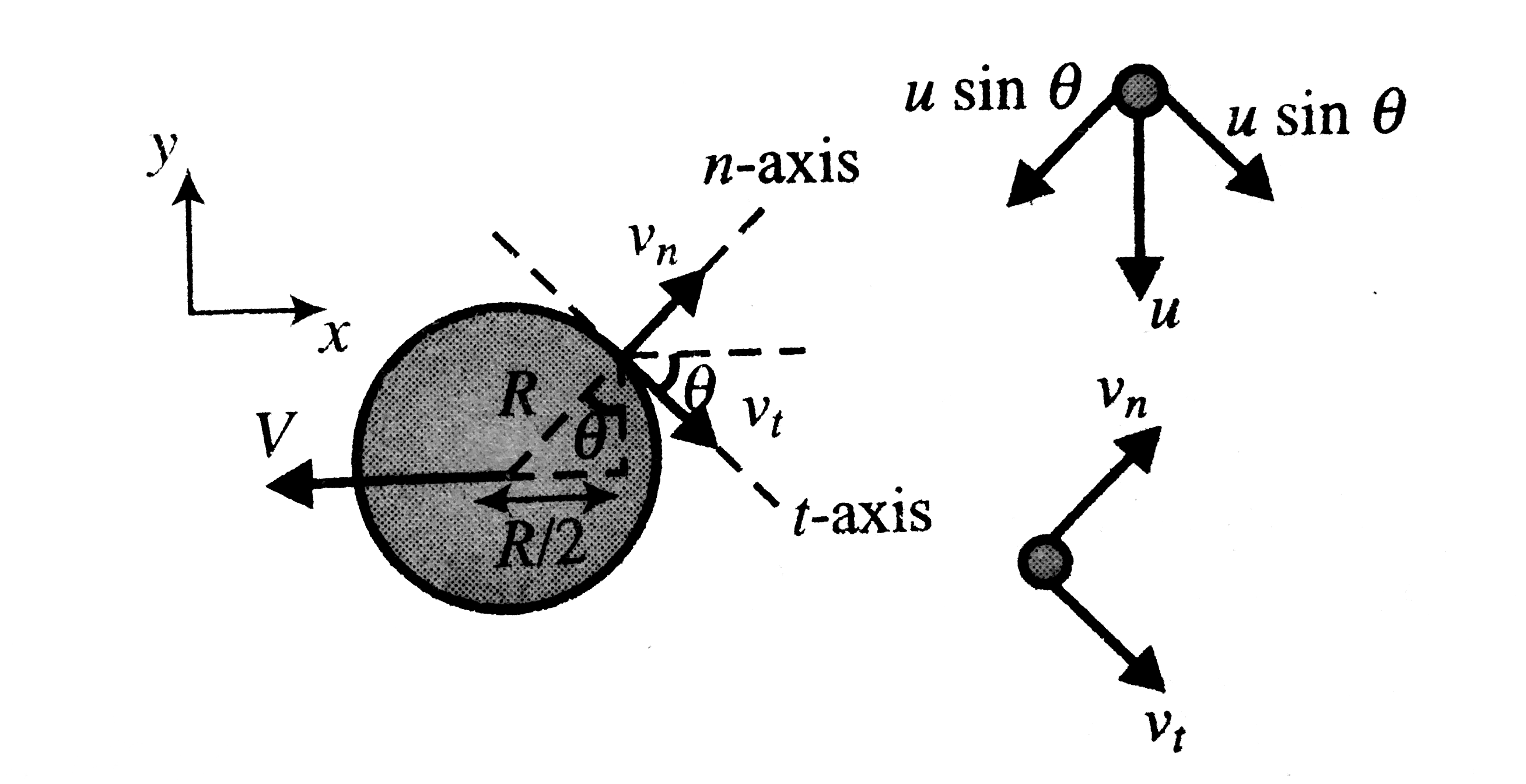 From conservation of MOMENTUM along `X`-axis, `P_(i)=P_(f)` `0+0=MV+mv_(n)sintheta+mv_(t)costheta`..............iii from the definitation of coefficient of restitution. `e=(Vsintheta-(-v_(n)))/(ucoshteta-0)=0` [`e=0,` for a perfectly inelastic collision] or, `Vsintheta=-v_(n)` `v_(n)=-V/2` .............iii On substitution expression for `v_(n)` and `v_(t)` in eqn ii we obtain `MV=m(-V/2)1/2+m(u/2)(sqrt(3))/2` `(M+m/4)V=m(usqrt3)/4` where `u=sqrt(2gh)` or `V=(msqrt(6gh))/((4M+m))` `v=sqrt(v_(n)^(2)+v_(t)^(2))=sqrt((6m^(2)gh)/(4(4M+m)^(2))+(gh)/2)` |
|
| 47. |
The length of a metallic sheet is measured as10.0 cm using a metre scale of L.C. 0.1cm and its breadth is . measured as 1.00 cm using a vernier callipers of L.C. 0.01cm, the error in area is |
|
Answer» `PM 0.01 "CM"^(2)` |
|
| 48. |
Earth can be treated as a sphere of radius R and mass M. The acceleration due to gravity at Earth's surface is g. If we move from equator to pole, the value of g. |
|
Answer» INCREASE |
|
| 49. |
A force vecF=8hati + 3hatk displaces a body through 2 m along x-axis. Work done by the force in joules is |
|
Answer» 5 J |
|
| 50. |
A truck weighing 1000 kg is moving with velocity of 50 km/h on smooth horizontal roads. A mass of 250 kg is dropped into it. The velocity with which it moves now is |
|
Answer» 12.5 km/h `m_1 v_1 = (m_1 + m_2) v_2` ` v_2 = (m_1v_1)/(m_1 + m_2) = (1000 xx 50)/(1250) = 40 km//h` |
|


