Saved Bookmarks
This section includes 7 InterviewSolutions, each offering curated multiple-choice questions to sharpen your Current Affairs knowledge and support exam preparation. Choose a topic below to get started.
| 1. |
The measured value of physical quantity expressed to infinite number of decimals places is called |
|
Answer» PRACTICAL value |
|
| 2. |
Why a metal ball rebounds better than a rubber ball? |
| Answer» Solution :When a rubber ball hits a massive object, say, earth, the ball is distorted. A large amount of heat is generated in the ball by the rubbing of the rubber molecules against each other. This EFFECT is essentially ABSENT in a hard material. So, a metal ball would often lose LESS energy UPON COLLISION than would a rubber ball. | |
| 3. |
A 400 gm block B is suspended with uniform string S of mass 100gm and length 20cm as shown. Variation of tension T with distancex from the end block is hanging is T=4+4x, where T is (mN) anad x in meters. Find the value of K (in N//m).(g=10m//s^(2) |
|
Answer» |
|
| 4. |
Assertion : When an ideal fluid flows through a pipe of non-uniform cross-section, then pressure is more at that section where area is more if the pipe is horizontal. Reason : According to Bernoulli's theorem speed at broader cross-section will be less. |
|
Answer» If both ASSERTION and REASON are CORRECT and Reason is the correct explanation of Assertion. |
|
| 5. |
Angular acceleratoin of object rotating with constant angular speed is always zero. |
|
Answer» |
|
| 6. |
A stone is dropped into a well of 20 m deep. Another stone is thrown downward with velocity 'v' one second later. If both stones reach the water surface in the well simultaneously, v is equal to (g=10ms^(-2)) |
| Answer» Answer :B | |
| 7. |
A motor vehicle travelled the first third of a distance s at a speed of v_(1)=10 kmph , the second third at a speed of v_(2)=20kmph and the last third at a speed of v_(3)=60kmph Determine the mean speed of the vehicle over the entire distances . |
|
Answer» |
|
| 8. |
A person walks up a stationary escalator in time t_(1). If the remains stationary on the escalator, then it can take him up in time t_(2). How much time would it take him to walk up the moving escalator ? |
|
Answer» Solution :Let L be the LENGTH of ESCALATOR. Speed of MAN w.r.t. escalator is `v_("me") = (L)/(t_(1))`. Speed of escalator `v_(E) = (L)/(t_(2))`. Speed of man with respect to ground would be `v_(m) = v_("me") + v_(e) = L((1)/(t_(1)) + (1)/(t_(2)))` `therefore` The desired TIME is `t = (L)/(v_(m)) = (t_(1)t_(2))/(t_(1) + t_(2))` |
|
| 9. |
In the above problem, the frictional force on the body is |
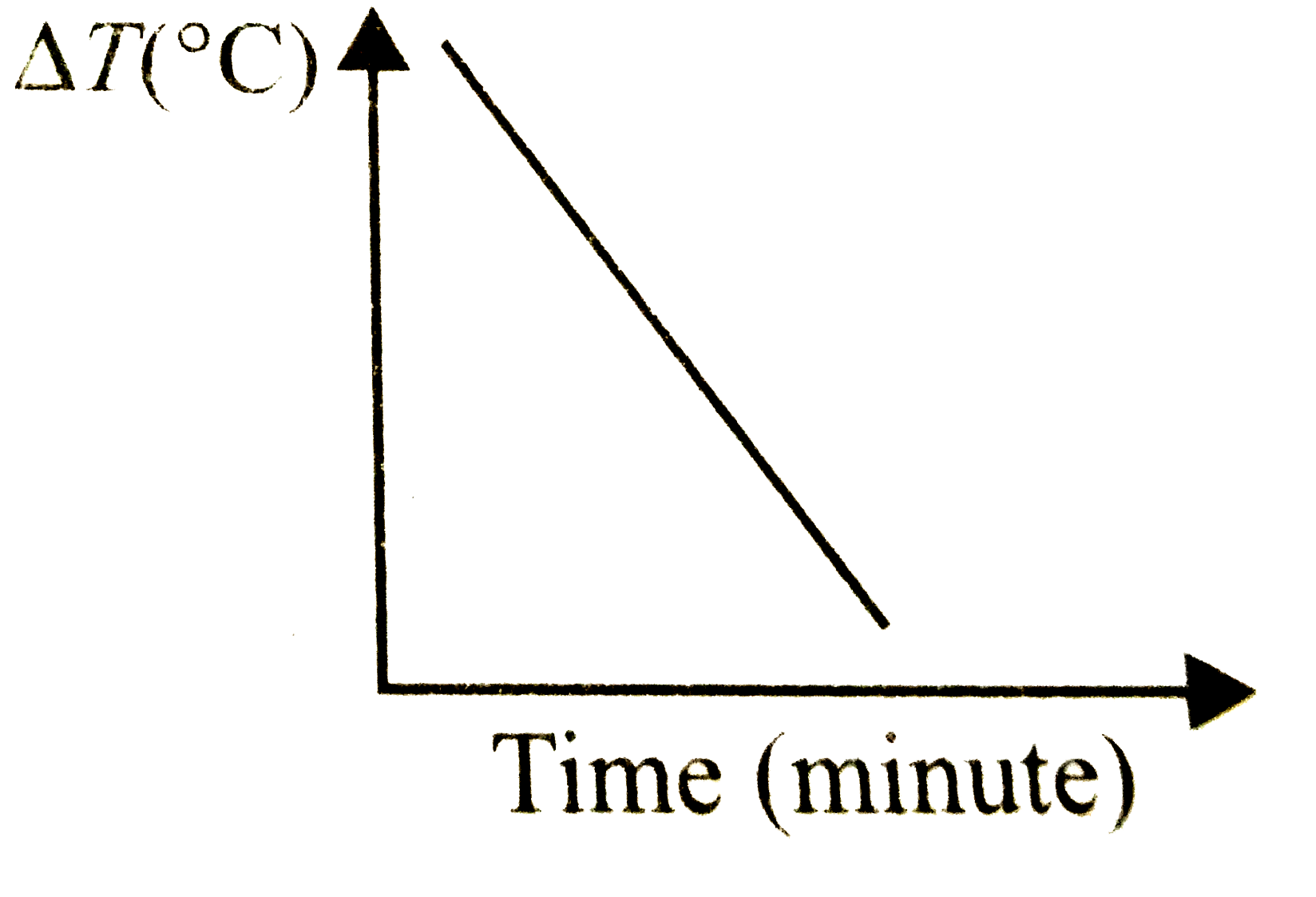
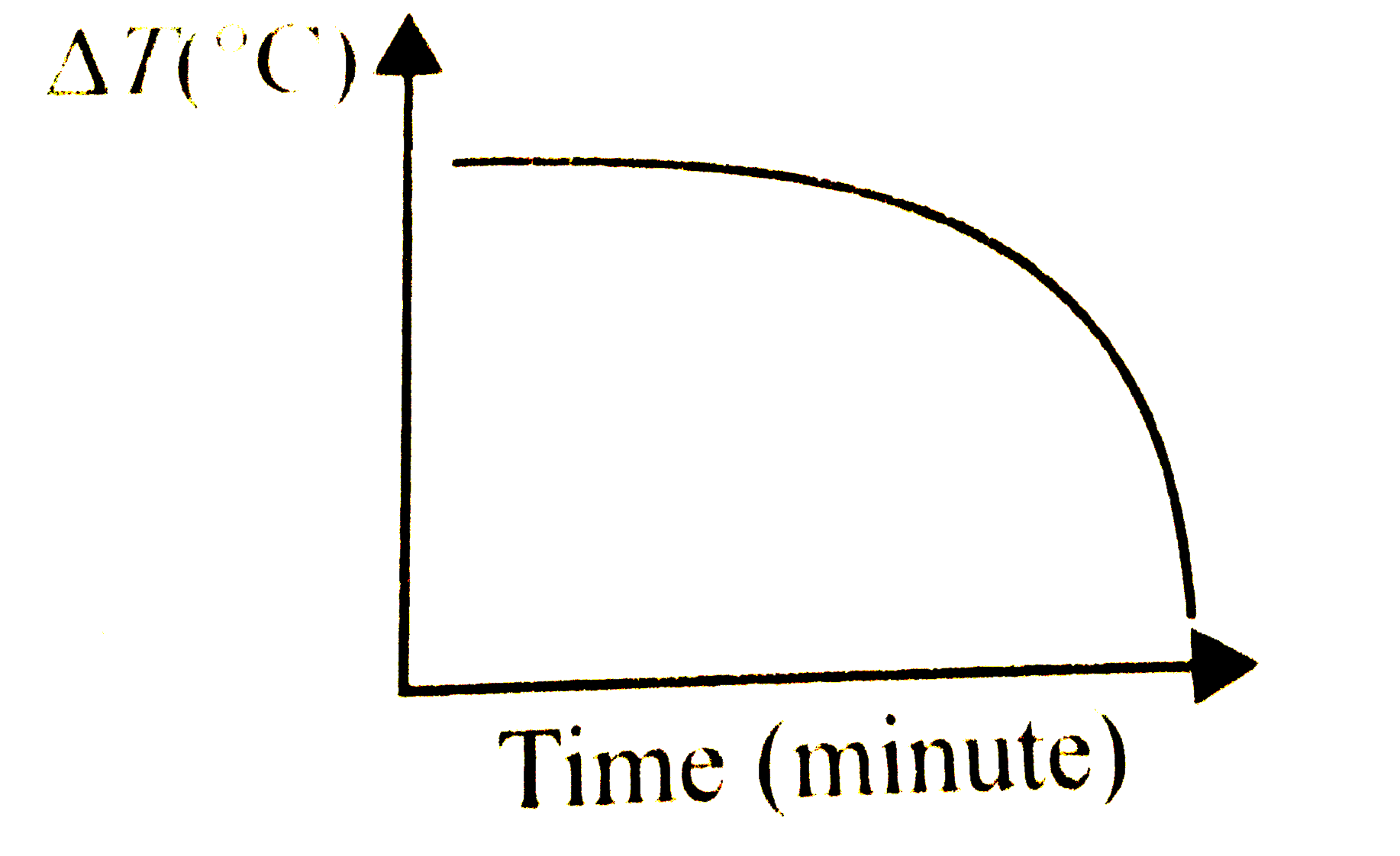
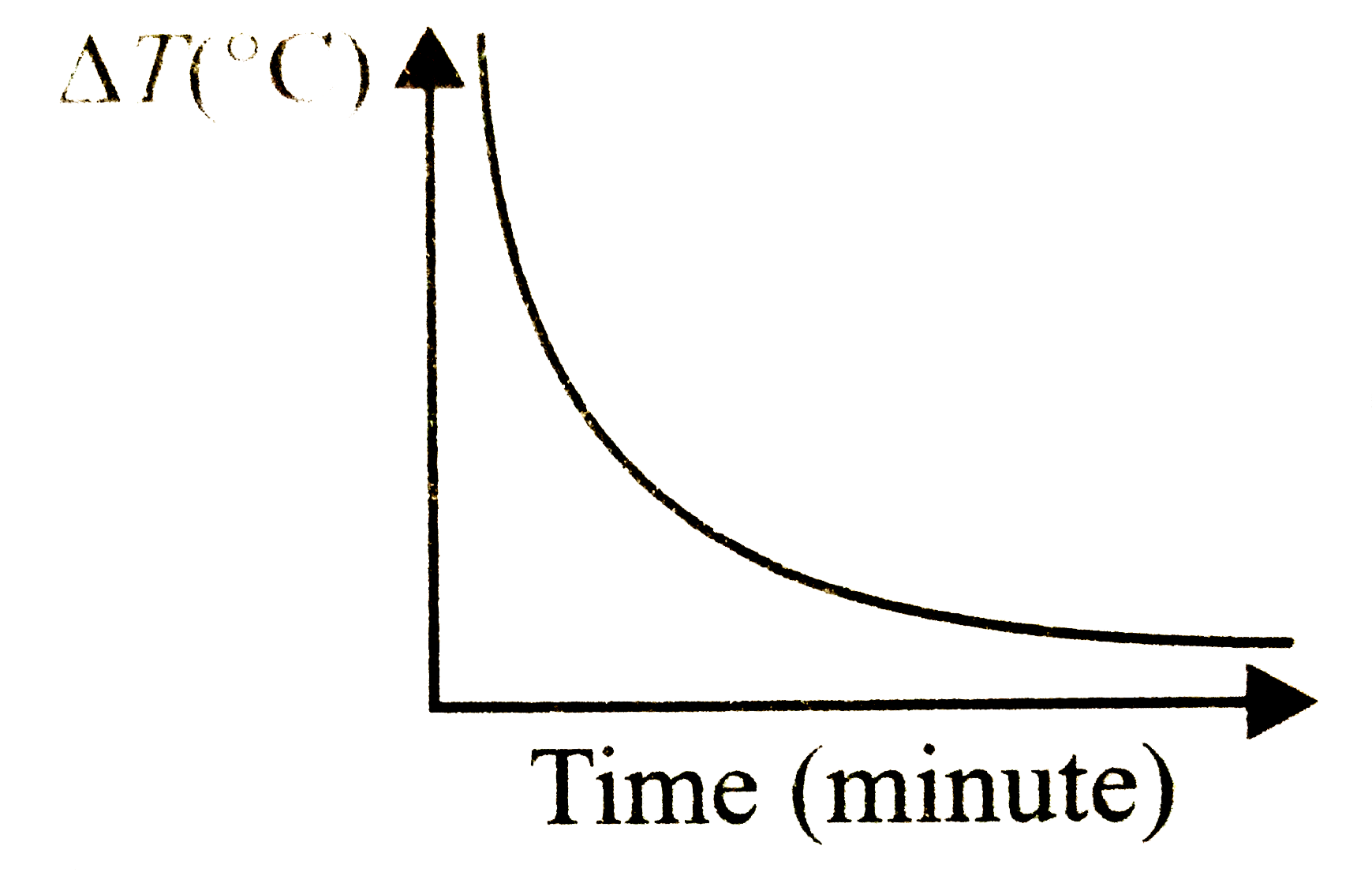
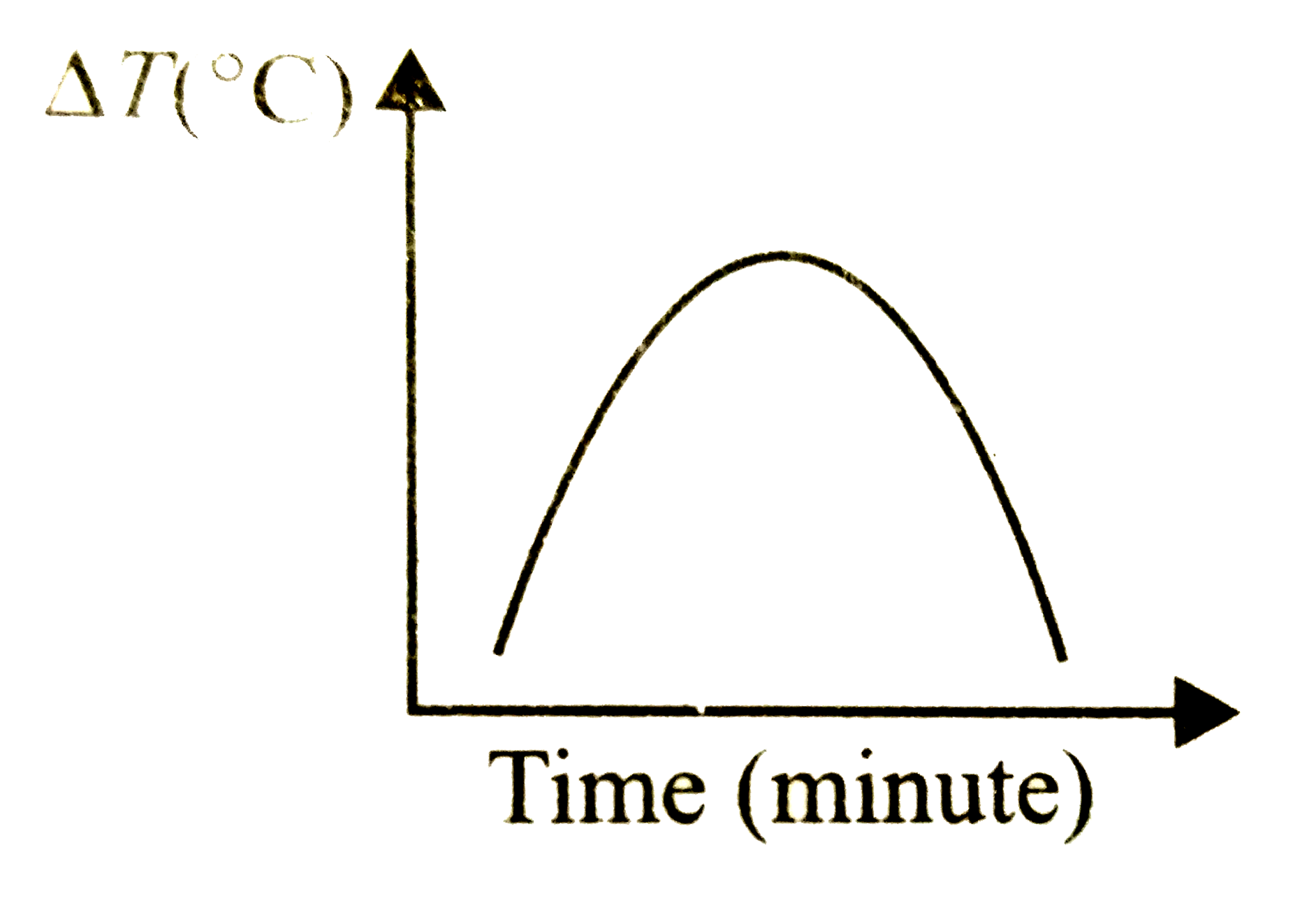
|
Answer» Zero |
|
| 10. |
During forced vibration of a particle |
|
Answer» only the RESTORING force acts on the particle |
|
| 11. |
Consider two wires X and Y. The radius of wire X is 3 times the radius of Y. If they are stretched by the same load then the stress on Y is |
|
Answer» equal to that on X Stress on `X = (F_x)/(A) = (F_x)/(pir_x^2), "Stress on" Y = (F_y)/A = (F_y)/(PI r_y^2)` If `F_x = F_y`, so, `r_x = 3r_y` `(("Stress")_x)/("Stress")_(y) = (pi r_y^2)/(pi r_x^2) = (r_y^2)/(9 r_y^2)` `("Stress")_(y) = 9 ("Stress")_(x)` |
|
| 12. |
A body of mass 10 kg at rest is applied with perpendicular force of 4 N and 3 N at the same time, then at the end of 10 seconds its kinetic energy = ......... |
|
Answer» Solution :RESULTANT force `F= [(4)^(2) + (3)^(2) ]^(1/2) =5` `a=(5)/(m ) = (5)/(10) = 0 .5 m//s^(2)` `v=v_(0) at` `v=0 + 0.5 xx 10` `v= 5m//s` `k=(1)/(2) mv^(2)` `=(1)/(2) xx 10 xx (5)^(2)` `=5 xx 25 ` `=125 J` |
|
| 13. |
A copper plate and an iron plate of the same volume are riveted together. Explain the likely observations, when the system is heated. |
|
Answer» Solution :On heating, the strip will bend, instead of remaining STRAIGHT. SINCE coefficient of linear expansion of copper `(alpha_(Cu))` is more than that of iron `(alpha_(Fe))`, the plates EXPAND differently and THUS the system bends. The copper plate forms the outer surface due to a greater expansion, and the iron plate forms the inner surface of the arc. If the coefficients of linear expansion would have been the same for copper and iron, then the strip would remain straight. |
|
| 14. |
A particle moving with a velocity equal to 0.4ms^(-1) is subjected to an acceleration of 0.15 ms^(-2) for 2 seconds in a direction at right angles to the direction of motion. The magnitude of the final velocity is |
|
Answer» `0.3 MS^(-1)` |
|
| 15. |
A mass is at the centre of a square, with four masses at corners as shown Rank the choice according to the magnitude of the gravitational force of the centre mass Rank the choice according to the magnitude of the gravitational force of the centre mass- |
|
Answer» `F_(A)=F_(B)ltF_(C)=F_(D)` 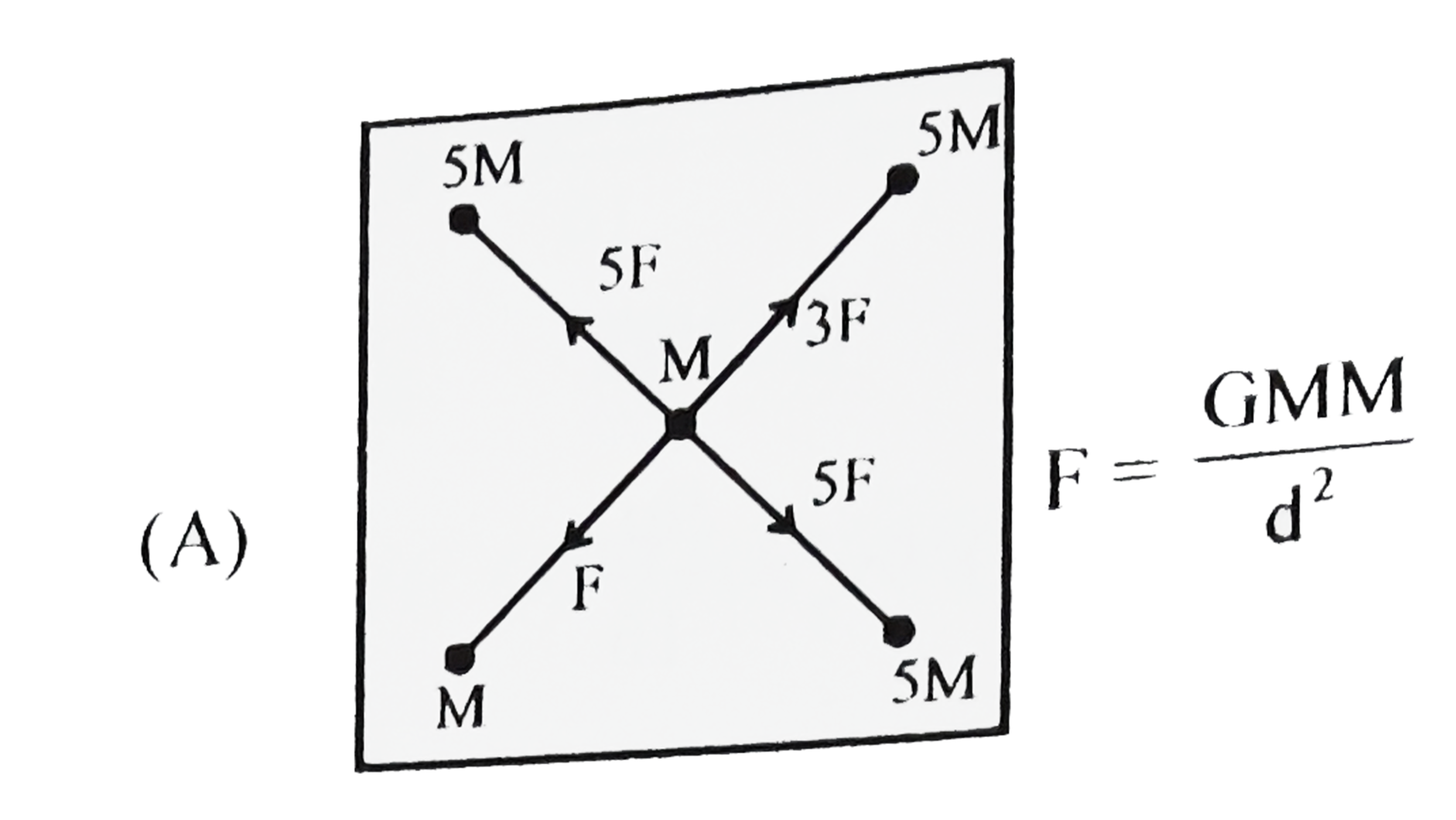 `F=(GMM)/(d^(2))` `F_(A)=2F` 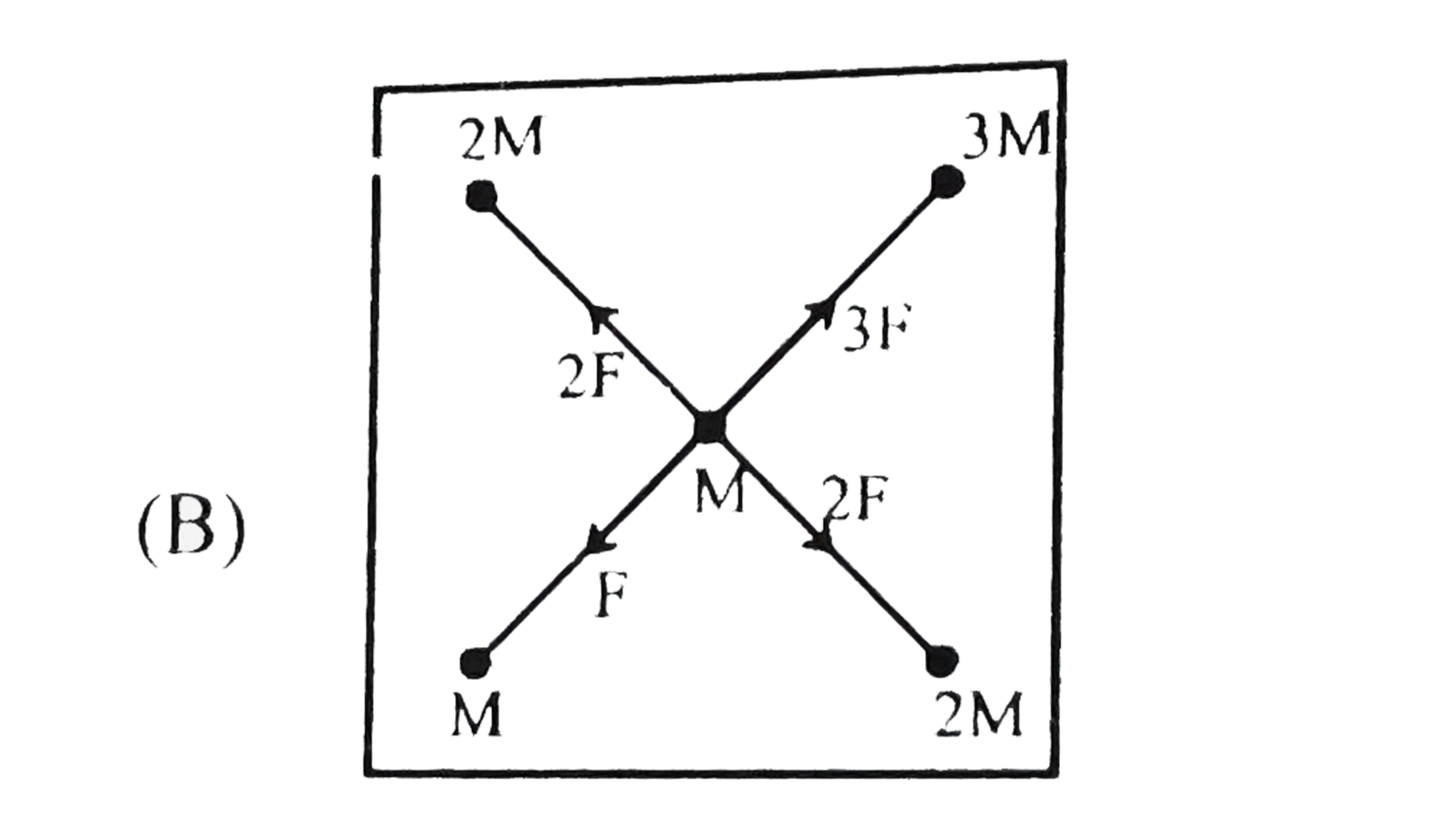 `F_(B)=2F` 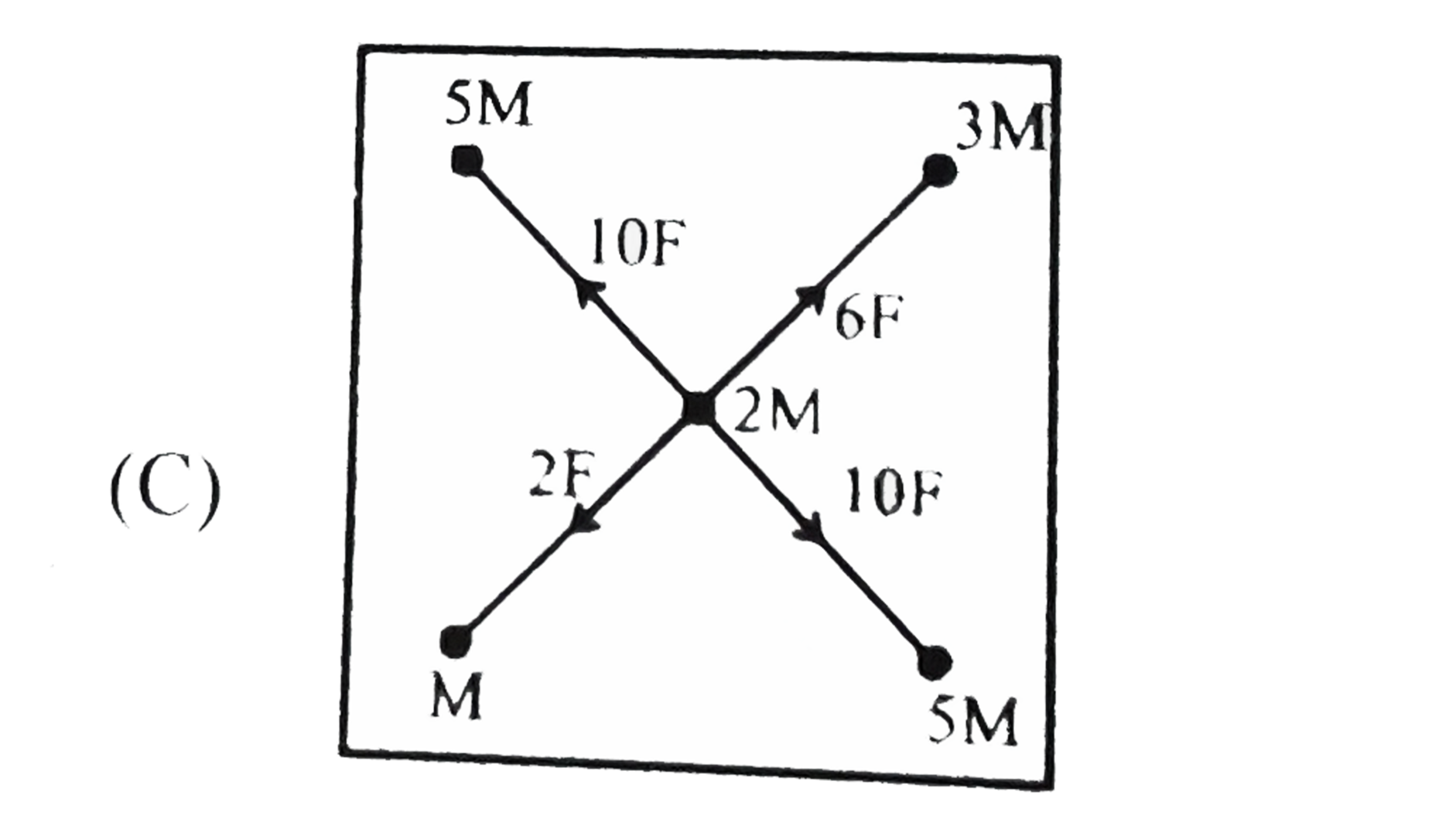 `F_(C)=2F` 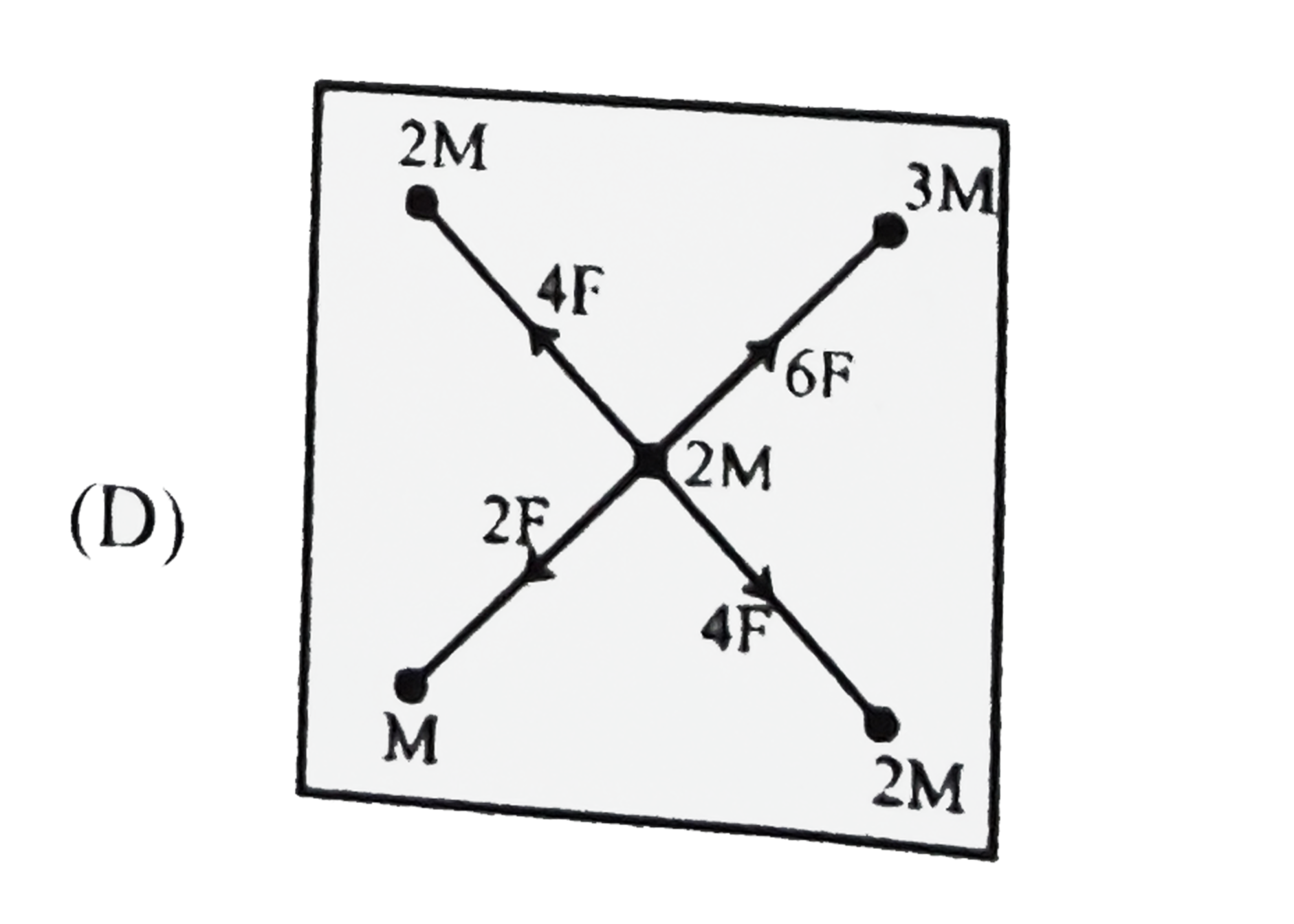 `F_(D)=4F` `F_(A)=F_(B)ltF_(C)=F_(D)` |
|
| 16. |
A metal rod of Young's modulus 2 xx 10 ^(10) Nm ^(-2),undergoes longitudinal strain of 1%, the potential energy per unit volume stored in rod is ....... Jm^(-3). |
|
Answer» `10 ^(6)` `u = 1/2 xx` stress `xx` STRAIN `=1/2 xx` Young modulus `xx("strain")^(2)` `(because` stress `= Y xx` strain) `=1/2 xx Y ((Delta l )/(l )) ^(2) ` ` therefore u = 1/2 xx 2 xx 10 ^(10) xx (0.01) ^(2)` `therefore u = 1 xx 10 ^(6)` `=10^(6) Jm^(-3)` |
|
| 17. |
At every second, phase of body executes simple harmonic motion increases to………. (Fill in the blank). |
| Answer» SOLUTION :`OMEGA IMPLIES [THEREFORE = omega t+phi]`. | |
| 18. |
Shows (x,t),(y,t) diagram of a particle moving in 2 dimensions If the particle has a mass of 500g find the force (direction and magnitude) acting on the particle . |
|
Answer» Solution :As `(X,t)` diagram of particle is a st line , motion along X-axis is UNIFROM From ` x = UT, u = (x)/(t) = (2)/(2) = 1m//s` FORCE along X-axis is zero The `(y,t)` diagram is a parabola. If a is unifrom acceleration along Y-axis then from ` y = (1)/(2)at^(2)` `4 = (1)/(2) a x 2^(2), a = 2 m//s^(2) ` As `F = ma :. F = (500)/(1000) xx 2 = 1 N` along Y-axis . |
|
| 19. |
A body of mass m, is attached to a vertical rod of mass M nad length L, hung from a pivoted supprot. A springs of constant K fixed to a support on the left as shown and is attached to the rod at a distance form the pivot. The frequency of the oscillation is: |
|
Answer» `(1)/(2pi) sqrt((K)/((M+2m)))` 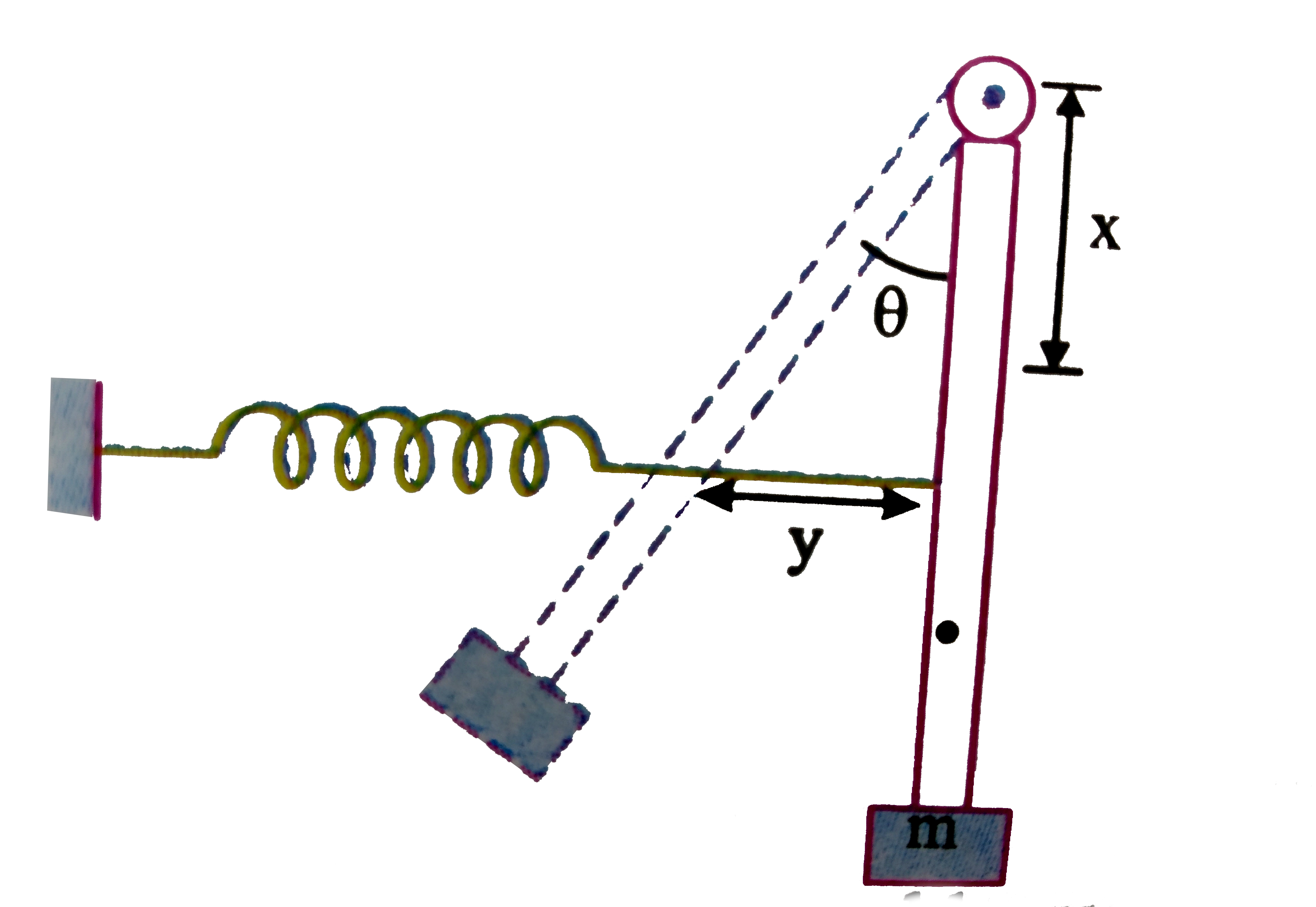 As the rod is displaced by `y` towards the spring, the spring will GET compressed by `y` and the angular shift, `tan theta = (y)/(x), (1)/(2)I omega^(2) +(1)/(2)Ky^(2) +(1)/(2)mv^(2) =Constant` `(1)/(2) [(ML^(2))/(3) +mL^(2)]omega^(2) +(1)/(2)Ky^(2) +(1)/(2)mv^(2)=Constant` `(1)/(2) [(M)/(3)+m] v^(2) +(1)/(2)Ky^(2) +(1)/(2)mv^(2) =Constant` Differentitating w.r.t. TIME, we get, `(1)/(2)[(M)/(3)+m]2va +(1)/(2)K2yv +(1)/(2)m2va = 0` `a = (Ky)/([(M)/(3)+m+m]) :. omega =sqrt((K)/(((M)/(3)+2m)))` So, choice (c ) is correct and CHOICES (a) and (b) are incorrect. Choice (d) is not possible since, it is incorrect dimensionally. |
|
| 20. |
The resultant of two forces at right angle is 17N. If the maximum resultant is 23N, the greater force is |
|
Answer» 15N |
|
| 21. |
What is triple point of a substance? |
| Answer» Solution :TRIPLE point of a substance is the pressure and TEMPERATURE at which the three PHASES (SOLID, liquid and vapour) coexist simultaneously. | |
| 22. |
The wettability of a surface by a liquid depends primarily on …….. |
|
Answer» DENSITY |
|
| 23. |
A hole is bored along a diameter of the earth and a particle is dropped into it. If R is the radius of the earth and g is the acceleration due to gravity at the surface of the earth, then the time period of oscillation of the particle is |
|
Answer» `2pisqrt(R/g)` |
|
| 24. |
Two particles of masses 1kg and 3kg movetowards each other under their mutual force of attraction. No other force acts on them. When the relative velocity of approach of the two particles is 2ms^(-1), the velocity of centre of mass is 0.5ms^(-1). When the velocity of approach becomes 3ms^(-1) the velocity of centre of mass is |
|
Answer» `0.75 MS^(-1)` |
|
| 25. |
(A) The stars twinkle while the planets do not. (R ) The stars are much bigger in size than the planets. |
|
Answer» Both A and R are true and R is the CORRECT explanation of A |
|
| 26. |
How long does it take a brick to reach the ground if dropped from a height of 65m ? What will be its velocity just before it reaches the ground ? |
|
Answer» 2S, 10m |
|
| 27. |
What is projectile ? Give it's examplees. |
|
Answer» Solution :When an object is thrown in the air with some INITIAL velocity and then allowed to move under the action of GRAVITY alone the object is known as a projectile Example : A BULLET fired from a rifle. A BALL thrown in any DIRECTION |
|
| 28. |
Assertion : Good absorbers of radiation are weak emitters. Reason : Ratoi of emissivity and absorptivity is constant for all substances at any temperature for same wavelength radiation. |
|
Answer» Both are true and the reason is the CORRECT explanation of the ASSERTION. And `a=e`, then `(a)/(e)=` constant. Hence, reason is correct explanation of assertion. |
|
| 29. |
An ideal gas at NTP is enclosed in an adiabatic vertical cylinder having area of cross section A=27 cm^2, between two light movable pistons as shown in the figure. Spring with force constant k = 3700 N/m is in a relaxed state initially. Now the lower piston is moved upwards a height h/2, h being the initial length of gas column. It is observed that the upper piston moves up by a distance h/16. Find h taking gammafor the gas to be 1.5. Also find the final temperature of the gas. |
| Answer» SOLUTION :`1.6k, 365 K` | |
| 30. |
A body executes S.H.M under influence of a force with a time period of 1.0s. It has a time period of 1.5s under theaction of a force of different magntitude. What will be the period of oscillation of the body when these two force are impressed simultaneously in the same direction upon the same body? |
|
Answer» Solution :We know that `Tprop (1)/(sqrta)` where T - period of oscillation and a = acceleration ALSO `F=ma THEREFORE a prop " FORCE"` `therefore prop (1)/(sqrtF),""T_(1)prop (1)/(F_(1))"………….(1)"` `T_(2)prop (1)/(sqrt(F_(2)))"............(2)"` i.e. `(T_(1))/(T_(2))=sqrt((F_(2))/(F_(1)))"i.e. "((1)/(1.5))^(2)=(F_(2))/(F_(1))` `"or"(F_(1))/(F_(2))=2.55""F_(1)=2.25F_(2)` When the combined forces act on the body then, `T prop (1)/(sqrt(F_(1)+F_(2)))".........(4)"` `(4)+(1)" gives "(T)/(T_(1))=sqrt((F_(1))/(F_(1)+F_(2)))` i.e. `(T)/(T_(1))=sqrt((F_(1))/(F_(1)(1+(F_(2))/(F_(1)))))=sqrt((1)/(1+((F_(2))/(F_(1)))))=sqrt((1)/(1+((1)/(2.25))))=sqrt((1)/(1.444))` `therefore""T=0.8322T_(1)` `"i.e."T=0.8322xx1s=0.8322s.` |
|
| 31. |
The ring R in the arrangement shown can slide along a smooth fixed, horizontal rod XY. It is attached to the block B by a light string. The block is released from rest, with the string horizontal. Then which of the following are true. |
|
Answer» ONE point in the STRING will have only vertical motion |
|
| 32. |
In the case of railway tracks, which rail is to be kept at a slightly higher level near a bend? |
|
Answer» |
|
| 33. |
Find the value of .g(i).at a height of 100 km(ii) at height 6400km from the surface of the earth. (Radius of the earth = 6400 km , g on the surface of the earth = 9.8 ms^(-2)) |
|
Answer» Solution :(i)USING `g_h=g(1-(2h)/R)` with h=100 KM and R=6400 km , `g_h=9.494m//s^2` (ii)using `g_h=g/(1+h/R)^2` with h=R g =2.45 `MS^(-2)` |
|
| 34. |
The KE of a satellite in its orbit around the earth is E. The KE of the satellite so as to enable to escape from gravitational pull of the earth is |
|
Answer» 4E |
|
| 35. |
The value of universal gravitational constant G = 6.67 xx 10^(-11) N m^(2) kg^(-2). The value of G in units of g^(-1) cm (^(3)s^(-2) is |
|
Answer» `6.67xx 10^(-8)` `= 6.67 xx 10^(-11) xx (kgms^(-2)) xx (m^(2)) xx (kg)^(-2)` `= 6.67 xx 10^(-11) xx[(1000g) xx (100cm) xx s^(-2)] xx(100cm)^(2) xx (1000g)^(-2)` `= 6.67 xx 10^(-11) xx 10^(5) xx10^(4) xx10^(-6)g^(-1)cm^(3)s^(-2)` `= 6.67 xx 10^(-8) g^(-1)cm^(3)s^(-2)` |
|
| 36. |
Find the ratio of escape velocities from the earth and the moon. (Mass of the earth =6.0 xx10^(24)kg , Radius of the earth = 6400km, Mass of the moon = 7.4xx10^(22)kg Radius of the moon = 1740km.) |
|
Answer» SOLUTION :Hint: `V_(e) prop sqrt(M/R)` `V_(E1)/V_(E2)=sqrt(((6.0xx10^(24))/(7.4xx10^(22)))((1740)/(6400)))=(4.695)/1` |
|
| 37. |
A meniscus lens is made of a material of refractive index mu_(2).Both its surfaces have radii of curvature R.It has two different media of refractive indices mu_(1)and mu_(3)respectively ,on its two sides (See figure) .Calcualte its focal length for mu_(1)ltmu_(2)ltmu_(3),when light is incidence on it as shown |
Answer» 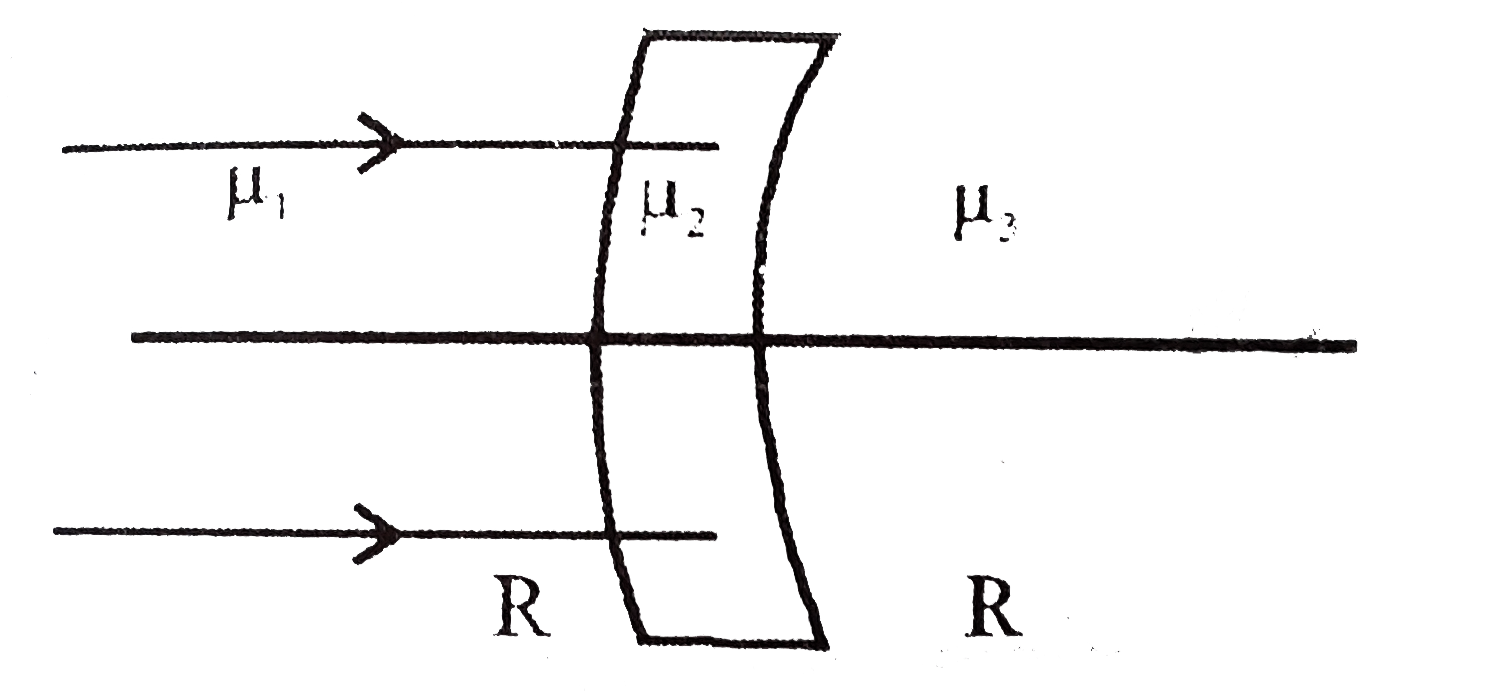 `(mu_(2))/(v)-(mu_(1))/(OO)=(mu_(2)-mu_(1))/(R )` `v=(mu_(2)R)/(mu_(2)-mu_(1))`this IMAGE will act as OBJECT for second refraction. `(mu_(3))/(v)-(mu_(2)(mu_(2)-mu_(1)))/(mu_(2)R )=(mu_(3)-mu_(2))/(R ) RARR (mu_(3))/(v)=(mu_(2)-mu_(1))/(R )+(mu_(2)-mu_(1))/(R )` `(mu_(3))/(v)=(mu_(3)-mu_(1))/(R ) rArr v=(mu_(3)R)/((mu_(3))-mu_(1))` `f=(mu_(3)R)/((mu_(3)-mu_(1))` |
|
| 38. |
Define longitudinal strain. |
|
Answer» Solution :Longitudinal strain can be classified into TWO TYPES : (i) Tensile strain : If the LENGTH is increased from its natural length then it is known as tensile strain . (ii) COMPRESSIVE strain : If the length is decreased from its natural length then it is known as compressive strain. |
|
| 39. |
An optical fibre is made of glass fibre of refractive index 1.68. The outer coating of the glass fibre is made of material of refractive index1.44. What is the range of angles of the incident rays with the axis of the pipe for which total internal reflection inside the optical fibre takes place? |
|
Answer» Solution :We know the MAXIMUM launching angle in case of optical fibre as `i_(max)=sin^-1 (sqrt(mu_2^2-mu_1^2))` `=sin^-1 (sqrt((1.68)^2-(1.44)^2)=sin^-1(0.8653)=59^@ 55.` This is the maximum VALUE of i. Alllight rays with angle of incidence between `0^@ and 59^@.55.` will UNDERGO total internal reflection. |
|
| 40. |
A hot liquid is kept in a bog room. Accoding to Newton's law of cooling rate of cooling liquid (represented as y) is plotted against its temperature T. Which of the following curves may represent the plot? |
|
Answer»
The temperature difference `DeltaT = T_(2) - T_(1) = ce^(-Kt)` where c and K are positive constant. From the above expression the temperature difference is exponentially decreasing with TIME. Hence the curve (c ) is CORRECT option. |
|
| 41. |
In determining viscosity (eta) by poiseuille.s method the formula used eta = (pi p r^4)/( 8 v1). Which of the quantities in the formula must be measured more accurately |
| Answer» ANSWER :B | |
| 42. |
A man of mass 85kg stands on a lift of mass 30kg When he pulls on the rope he exerts a force of 400N on the floor of the lift Calculate acceleration of the lift Given g =10 m//s^(2) . |
|
Answer» Mass of LIFT, `m = 30kg` When pf man PULLS the rope with a force `F=400 N` let the upwards ACCELERATION of the lift be a let `T` be the tension in the rope The equation of motion of the man is `85 a = T +F - Mg` As` F' = F = 400 N` `:. 85 a = T + 400 - 85 xx 10 = T - 450` where `400N` is upward REACTION of floor on the man. The equation of motion of the lift is `30 a = T - 400 - mg - T - 400 - 30 xx 10` `=T - 700` On solving (i) and (ii) we get `a = 4.55m//s^(2)` 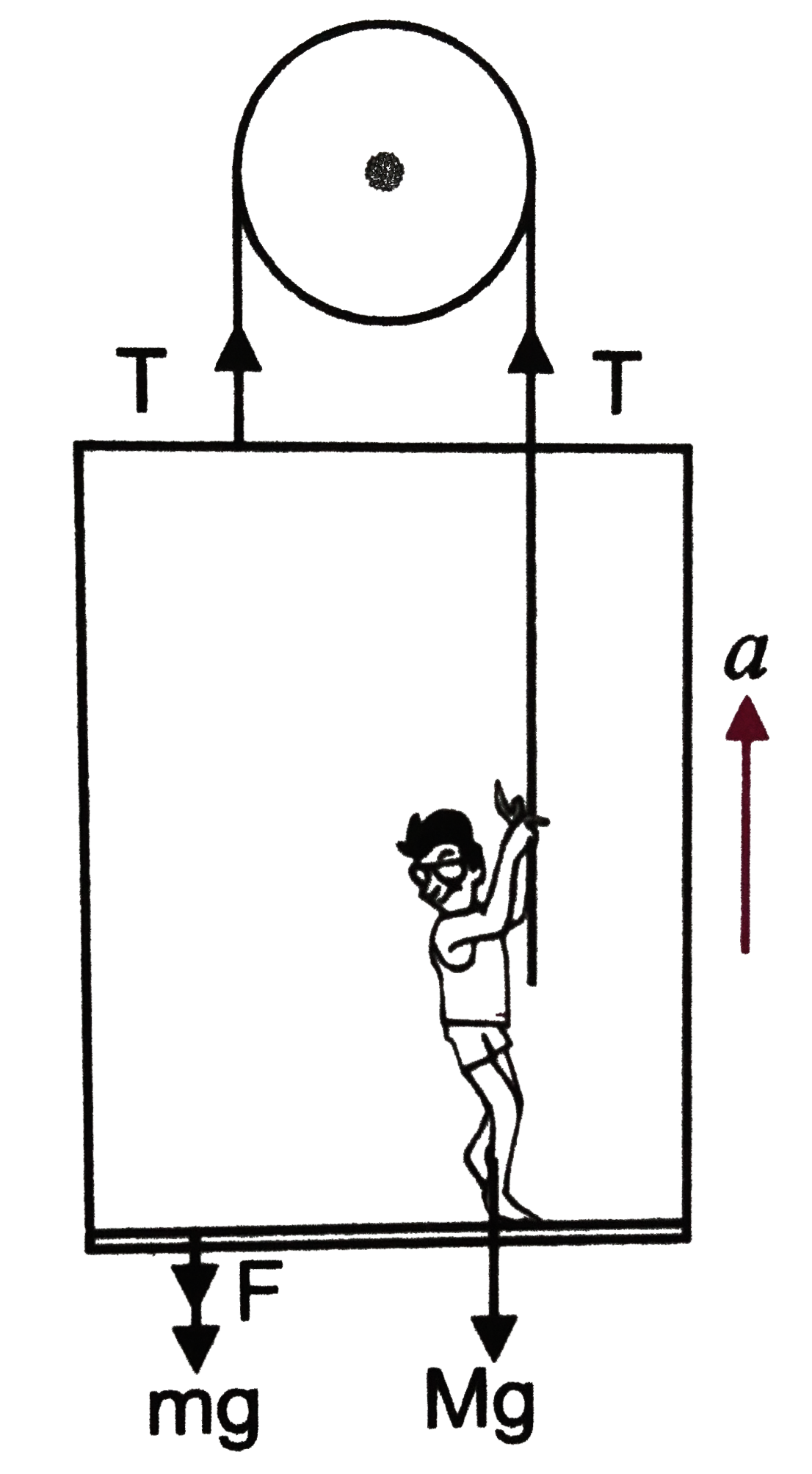 . .
|
|
| 43. |
For a body in S.H.M the velocity is given by the relation v = sqrt(144-16 x^(2))m//sec. The maximum acceleration is |
|
Answer» `12 m//sec^2` |
|
| 44. |
A piece of brass (Cu and Zn) weighs 12.9 gin air. When completely immersed in water, it weights 11.3 g. The relative densities of Cu and Zn are 8.9 and 7.1 respectively. Calculate the mass of copper in the alloy |
|
Answer» 6.6 gm |
|
| 45. |
Is the tangential acceleration of a particle moving along a fixed circle be always zero? When it will be zero? |
| Answer» Solution :No, when the ANGULAR SPEED of PARTICLE is not constant then its tangential accelertion can not be zero but if the angular speed is constant then its tangential acceleration be zero. | |
| 46. |
When a tuning fork is vibrated , another in the neighbourhood begins to vibrate . This is due to the phenomenon of |
|
Answer» gravitation |
|
| 47. |
A particle of mass 0.1 kg moving with an initial speed v collides with another particle of same mass kept at rest. If after collision total energy becomes 0.2J, then the minimum and maximum value of 'v' are |
|
Answer» Solution :In case of PERFECTLY inelastic collision the velocity of combined mass will be `v//2` `therefore KE = (1)/(2) (2M) ((v^(2)),(4))` i.e., `(0.2) = (1)/(2) (0.2) ((v^(2))/(4)) rArr v= 2 sqrt2 m//s` In case of perfectly elastic collision, FIRST particle stops and the SECOND acquires the same velocity v `KE = (1)/(2) mv^(2)` i..e., `0.2 = (1)/(2) (0.1)v^(2)rArr v= 2 m//s` Therfore, MINIMUM value of v is 2m/s in case of perfectly elastic collision and maximum value of v is `2 sqrt2 m//s` in case of perfectly inelastic collision. |
|
| 48. |
A): Number of air molecules in a room in winter is more than the number of molecules in the same room in summer.(R) : At a given pressure and volume, the number of molecules of a given mass of a gas is inversely proportional to the absolute temperture. |
|
Answer» Both (A) and ( R) are true and (R ) is the CORRECT EXPLANATION of (A) |
|
| 49. |
A smooth ball A of mass m is attached to one end of a light inextensible string, and is suspended form fixed point O. Another identical ball B, is dropped from a heigh h, so that the string just touches the surface of the sphere. {:(,"Column I",,"Column I",),((A),"If collision between balls is completely elastic then speed of ball A just after collision is",(P),(3m)/(5) sqrt(2gh),),((B),"If collision between balls is completely elastic then impulsive tension provided by string is",(Q),(sqrt6gh)/(5),),((C ),"If collision between balls is completely inelastic then speed of ball A just after collision is",(R ),(6m)/(5) sqrt(2gh),),((D),"If collision between balls is completely inelastic then impulsive tension provided by string is",(S),(2sqrt(6gh))/(5),),(,,(T),"None of these",):} |
Answer» 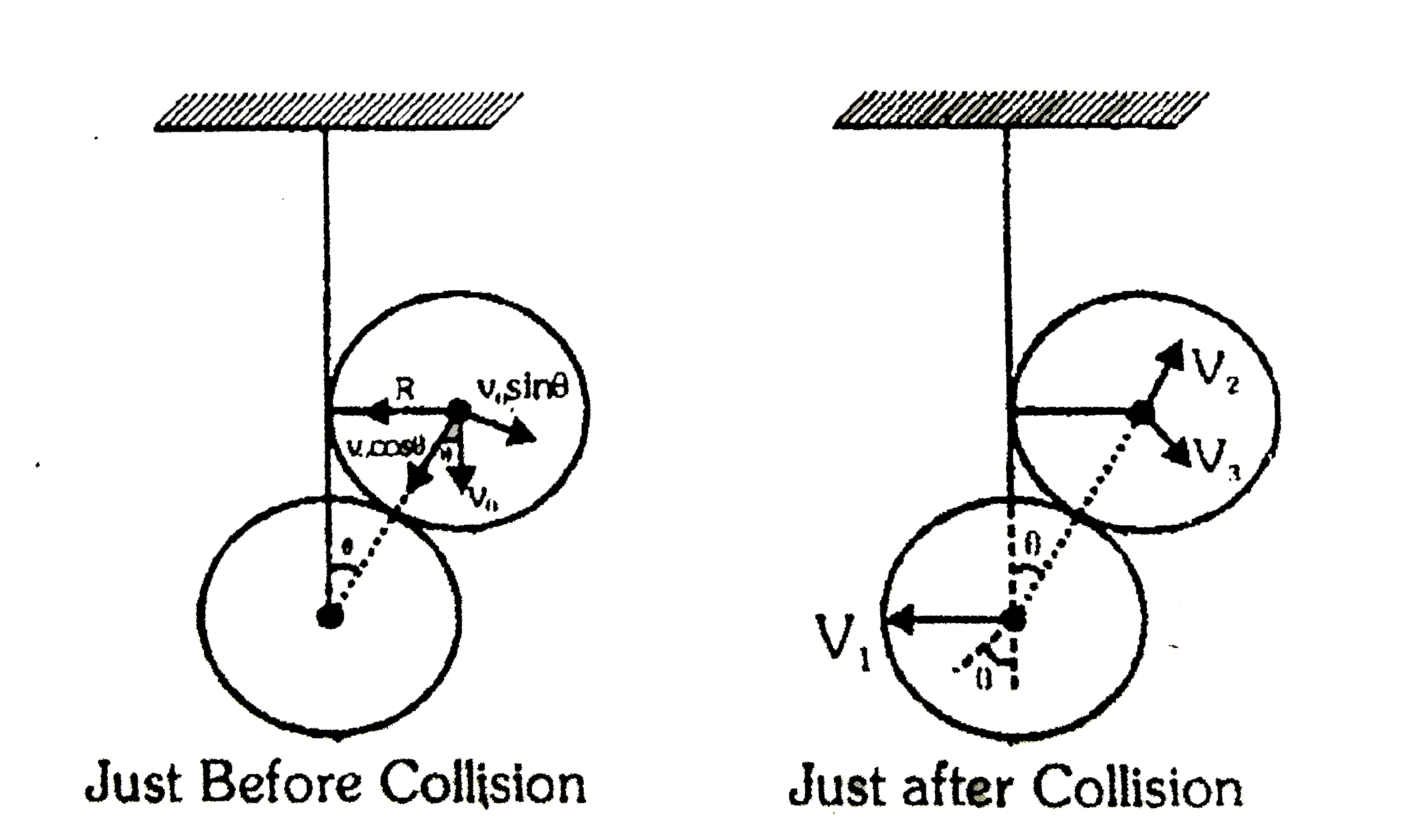 Let impulse given by BALL B be N. then by impulse momentum theorem `N = m(v_(2) + v_(0)costheta)` & `Nsin theta = mv_(1)` `rArr v_(1) = (2v_(0) sin theta cos theta)/(1 + sin^(2) theta) = ((2sqrt2gh) ((1)/(2)) ((sqrt3)/(2)))/(1 + ((1)/(2))^(2)) = (2sqrt(6gh))/(5)` For (B)Impulsive tension `= N cos theta = ((mv_(1))/(sin theta)) cos theta = mv_(1) cottheta = (6m)/(5) sqrt(2gh)` For(C )For COMPLETELY inelastic COLLISION `e = 0`, so `v_(1) sin theta + v_(2) = 0 rArr v_(1) = (v_(0) sin theta cos theta)/(1 + sin^(2) theta) = (sqrt6gh)/(5)` For (D)Impulsive tension `= Ncostheta = ((mv_(1))/(sin theta)) costheta = mv_(1) cottheta = (3m)/(5)sqrt(2gh)` |
|
| 50. |
A light string of length 20 cm is carrying a bob of mas 100 gm. If is pulled through an angle 60^(@) and released. Its maximum velcoity is |
| Answer» Answer :C | |