

Saved Bookmarks
| 1. |
A smooth ball A of mass m is attached to one end of a light inextensible string, and is suspended form fixed point O. Another identical ball B, is dropped from a heigh h, so that the string just touches the surface of the sphere. {:(,"Column I",,"Column I",),((A),"If collision between balls is completely elastic then speed of ball A just after collision is",(P),(3m)/(5) sqrt(2gh),),((B),"If collision between balls is completely elastic then impulsive tension provided by string is",(Q),(sqrt6gh)/(5),),((C ),"If collision between balls is completely inelastic then speed of ball A just after collision is",(R ),(6m)/(5) sqrt(2gh),),((D),"If collision between balls is completely inelastic then impulsive tension provided by string is",(S),(2sqrt(6gh))/(5),),(,,(T),"None of these",):} |
Answer» 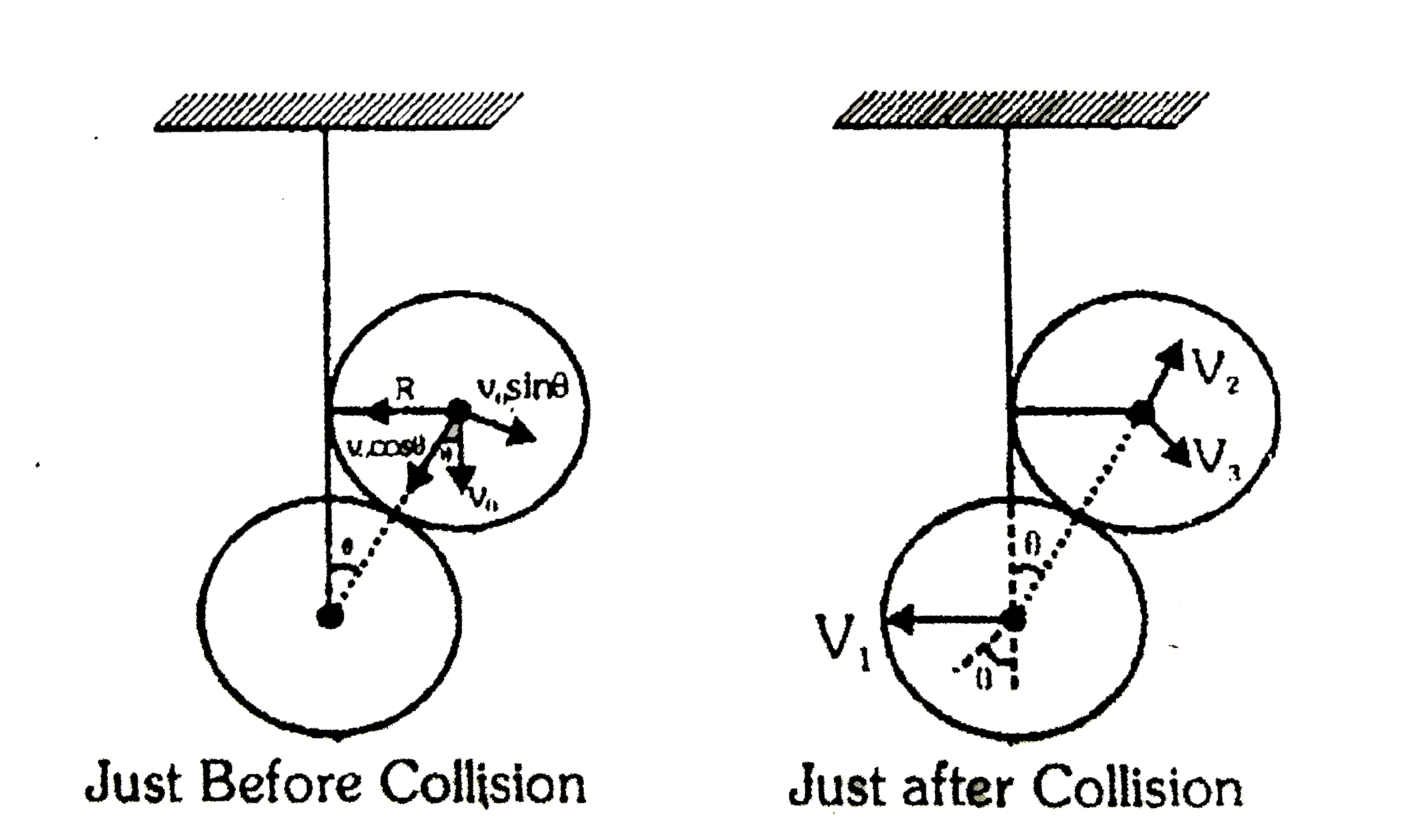 Let impulse given by BALL B be N. then by impulse momentum theorem `N = m(v_(2) + v_(0)costheta)` & `Nsin theta = mv_(1)` `rArr v_(1) = (2v_(0) sin theta cos theta)/(1 + sin^(2) theta) = ((2sqrt2gh) ((1)/(2)) ((sqrt3)/(2)))/(1 + ((1)/(2))^(2)) = (2sqrt(6gh))/(5)` For (B)Impulsive tension `= N cos theta = ((mv_(1))/(sin theta)) cos theta = mv_(1) cottheta = (6m)/(5) sqrt(2gh)` For(C )For COMPLETELY inelastic COLLISION `e = 0`, so `v_(1) sin theta + v_(2) = 0 rArr v_(1) = (v_(0) sin theta cos theta)/(1 + sin^(2) theta) = (sqrt6gh)/(5)` For (D)Impulsive tension `= Ncostheta = ((mv_(1))/(sin theta)) costheta = mv_(1) cottheta = (3m)/(5)sqrt(2gh)` |
|