

Saved Bookmarks
This section includes 7 InterviewSolutions, each offering curated multiple-choice questions to sharpen your Current Affairs knowledge and support exam preparation. Choose a topic below to get started.
| 1. |
Calorific value is in the order |
|
Answer» FATS GT CARBOHYDRATES gt PROTEINS |
|
| 2. |
Calomel reacts with ammonium hydroxide to form : |
| Answer» Answer :A | |
| 3. |
Calomel is the name of : |
|
Answer» `HgCl_(2)` `underset("Base")(Zn(OH)_(2))+underset("Acid")(2H^(+)) to underset("Salt")(Zn^(2+)+underset("Water")(2H_(2)O)` |
|
| 4. |
Calomel electrode is reversible to |
|
Answer» `HG^(+2)` ions |
|
| 5. |
Calomel electrode is an example of |
|
Answer» indicator electrode |
|
| 7. |
Can all the disaccharides are reducing sugars ? |
|
Answer» Solution :Sucrose is a non reducing sugar. This is because glycosidic linkage takes place between anomeric HYDROXYL ofglucose `(C_1)` and anomeric hydroxyl GROUP of FRUCTOSE `((C_1))` and anomeric hydroxyl group of fructose `(C_2)` Maltose and LACTOSE are examples of reducing sugars. |
|
| 9. |
Calgon(a water softener) is: |
|
Answer» `Na_2[Na_4(PO_3)_6]` |
|
| 10. |
Calgon used as a water softener is |
|
Answer» `Na_(2)[Na_(4)(PO_(4))_(5)]` |
|
| 11. |
Calgon is an industrial name given to : |
|
Answer» NORMAL sodium phosphate |
|
| 12. |
Calgon causes the softening of hard water by |
|
Answer» perecipitating `Ca^(2+)` and `Mg^(2+)` IONS as phosphates |
|
| 13. |
Calculte the number of molecules of molecules of oxalic acid in 100 mL of 0.02 N oxalic acidsoliution. |
|
Answer» `"Molarity"=("No. of moles of oxalic acid")/("Volume of solution in litre")` `(0.01" MOL L"^(-1))=("No. of moles of oxalic acid")/(1L)` No. of moles = 0.01 mol. Step II. Calculation of no. of molecules of oxalic acid per 100 ML of solution. 1000 mL of oxalic acid solution contains moles = 0.01 `"100 mL of oxalic acid solution contains moles"=(0.01)/(1000)xx100=0.001 mol` `therefore "Molecules of oxalic acid"=0.001xxN_(0)=10^(-3)xx6.022xx10^(23)=6.022xx10^(20)" molecules".` |
|
| 14. |
Calculation the mole fraction of ethylene glycol (C_(2)H_(6)O_(2)) and water in a solution containing 20% of C_(2)H_(6)O_(2) by mass. |
|
Answer» Solution :`20%` of `C_(2)H_(6)O_(2)` by MASS means that 20 g of `C_(2)H_(6)O_(2)` are PRESENT in 100 g of the solution, i.e., Mass of solute `(C_(2)H_(6)O_(2))=20G",Mass of solvent "(H_(2)O)=100-20g=80g` `"MOLAR mass of "C_(2)H_(6)O_(2)="62 g mol"^(-1)",Molar mass of "H_(2)O="18 g mol"^(-1)` `therefore"No. of moles of "C_(2)H_(6)O_(2)=(20)/(62)=0.322",No. of moles of "H_(2)O=(80)/(18)=4.444` `therefore"Mole fraction of "C_(2)H_(6)O_(2)" in the solution "=(n_(C_(2)H_(6)O_(2)))/(n_(C_(2)H_(6)O_(2))+n_(H_(2)O))=(0.322)/(0.322+4.444)=0.068` Mole fraction of `H_(2)O`in the solution `=1-0.068=0.932` |
|
| 15. |
Calculation the molarity and normality of a solution containing "9.8 g of "H_(2)SO_(4) in "250 cm"^(3) of the solution. |
|
Answer» Solution :Mass of `H_(2)SO_(4)` dissolved = 9.8 g,`"Volume of the solution = 250 cm"^(3)="0.250 L"` Calculation of molarity : MOLAR mass of `H_(2)SO_(4)="98 g MOL"^(-1)` `therefore"No. of moles of "H_(2)SO_(4)=("Mass in g")/("Molar mass")=("9.8 g")/("98 g mol"^(-1))="0.1 mole"` Calculation of normality : Eq. mass of `H_(2)SO_(4)=("Mol. mass of "H_(2)SO_(4))/("Basicity of "H_(2)SO_(4))=(98)/(2)=49` `therefore"No. of g equivalent of "H_(2)SO_(4)=("Mass in g")/("Eq. mass")=(9.8)/(2)=0.2` `"Noramlity "=("No. of g eq of the SOLUTE")/("Volume of solution in LITRES")=("0.2 g eq")/("0.250 L")="0.8 g eq L"^(-1)="0.8 N".` |
|
| 16. |
calculateth resonance energy of N_(2)O Delta_(f)H^(-) of N_(2)O = 82 kJ mol ^(-1) bond energy of N=O = 607 kJmol ^(-1) bond energy of O=O = 498 kJ mol ^(-1) nond energy of N = N = 418 kJ mol^(-1) bond energy of N= N = 946 kJ mol ^(-1) |
|
Answer» `82 kJ mol ^(-1)` calculated value of `Delta_(F)H^(Theta)=` `Delta_(f)H^(-)=[BE(NequivN)+1/2BE(=O)]` `[BE(N=N)+BE(N=O)]` `[946+1/2(498)]- [418+607]=170 kJ mol^(-1)` Respmace energy = observed `Delta_(f)H^(Theta)` - calculated `Delta_(f)H^(Theta)` = 82 -170 =-88 kJ `mol^(-1)` |
|
| 17. |
Calculated the mass urea (H_2NCONH_2)required to dissolved in 2.5 kg of water to form a 0.25 molal aqueous solution. |
|
Answer» Solution :Molar mass of urea = `60G mol^(-1)` Molality (m) =(mass of urea)/(Molar mass of urea xxMass of WATER in kg) `THEREFORE` Mass of urea = (Molalityxx Molar lass of urea xxMass of water in kg) = `0.25xx 60 XX 2.5 =37.5g` |
|
| 18. |
Calculated the osmotic pressure in pascals exerted by a solution prepared by dissolving 1.0g of polymer of molar mass 185000 in 450 mL of water at 37^@C. |
|
Answer» Solution :`pi= (W_2RT)/(M_2V)` `W_2 = 1.0g1, T=273+37=310K` `M_2` = 185000 V = 450mL = 0.450 L R = 0.083 L bar `mol^(-1) K^(-1)` `THEREFORE pi = (1xx0.083xx310)/(185000xx0.45) = 0.000309`bar 1 bar = `10^5` pascal OSMOTIC pressure, `pi = 0.000309xx10^5 = 30.9 Pa` |
|
| 19. |
Calculated spin only magnetic moment of Cr^(x+) is 4.9 BM. Find the 'x' value. |
|
Answer» Solution :Magnetic moment `mu= 4.9 BM = sqrt(n(n+2))` Number of unpaired ELECTRONS `= n = 4` with FOUR unpaired electrons, the configuration is `3d^(4)4s^(0)`. `Cr^(2+)` ion posses 4 unpaired electrons, THUS .X. value is 2. |
|
| 20. |
Calculate % yeild of the reaction if 200 g KHCO_(3) produces22 g of CO_(2) upon strong heating. |
|
Answer» |
|
| 21. |
Calculate x+y+z for H_(3)PO_(3) acid, where x is no. of lone pairs, y is no. of sigma bonds and z is no. of pi bonds. |
|
Answer» |
|
| 22. |
Calculate workdone in adiabatic compression of one mole of an ideal gas (monoatomic) from an initial pressure of 1atm to final pressure of 2 atm. Initial temperature = 300 K. (a) If process is carried out reversibly (b) If process is carried out irreversible against 2 atm external pressure. Computer the final volume reached by gas in two cases and describe the work graphically. |
|
Answer» Solution :(a) `T_(2)=395.8,V_(2)=16.24L,w_("REV")=1194.72J`, `V_(2)^(')=17.24L,T_(2)^(')=420K,w_("irrev")=1496.52J` 
|
|
| 23. |
Calculate work done for an ideal gas( In 2=0.7) |
|
Answer» |
|
| 24. |
Calculate wedge_(m)^(0)" for "CaCl_(2) and MgSO_(4). lambda_(Ca^(2+))^(0)=119.0S cm^(2)" mol"^(-1) lambda_(Cl^(-))^(0)=76.3S cm^(2) mol^(-1) lambda_(Mg^(2+))^(0)=106 Scm^(2) mol^(-1) lambda_(SO_(4)^(2-))^(0)=160 Scm^(2) mol^(-1) |
|
Answer» Solution :`wedge_(m)^(0) (MgSO_(4))=lambda_(Mg)^(0)+lambda_(SO_(4)^(2-))^(0)` `=106+160=266 S cm^(2) MOL^(-1)` `wedge_(m)^(0) (CaCl_(2))=lambda_(Ca^(2+))^(0)+2lambda_(Cl^(-))^(0)=119+2 xx 76.3 =271.6Scm^(2) mol^(-1)` |
|
| 25. |
Calculatew=?(In 2=0.7) |
|
Answer» |
|
| 26. |
Calculate wedge_(m)^(@) for CaCl_(2) and MgSO_(4) from the following data: lamda^(@) (S cm^(2)mol^(-1)):Ca^(2+)=119.0,Mg^(2+)=106.0,Cl^(-)=76.3,SO_(4)^(2-)=160.0. |
|
Answer» Solution :By Kohlrausch law, `wedge_(m)^(@)(CaCl_(2))=lamda_(Ca^(2+))^(@)+2lamda_(Cl^(-))^(@)=119.0" S "cm^(2)MOL^(-1)+2xx76.3" S "cm^(2)mol^(-1)` `=(119.0+152.6)" S "cm^(2)mol^(-1)=271.6" S "cm^(2)mol^(-1)` `wedge_(m)^(@)(MgSO_(4))=lamda_(Mg^(2+))^(@)+lamda_(SO_(4)^(2-))^(@)=106.0" S "cm^(2)mol^(-1)+160.0" S "cm^(2)mol^(-1)=266" S "cm^(2)mol^(-1)`. |
|
| 27. |
Calculate wavelength of photon emitted when an electron goes from n=3 to n=2 level of hydrogen atom. |
|
Answer» |
|
| 28. |
Calculate W and DeltaU for the conversion of 1 mole of water into 1 mole of steam at a temperature of 100^(@)C and at a pressure of 1 atmosphere. Latent heat of vaporisation of water is 9720 cal/"mole". |
|
Answer» SOLUTION :p=1 atm =76 cm =76xx13.6xx981 "dynes//cm"^(2)` =1.013xx10^(6) "dymes//cm"^(2). `V_(1)`= volume of 1 "mole" of water at `100^(@)C=18` mL. `V_(2)` = volume of 1 "mole"of steam at `100^(@)C` `=(373)/(273)xx22400=30605 mL`. (Charles.s law) Now we have, `W=-p(V_(2)-V_(1))` ...(Eqn.2) `=-1.013xx10^(6)XX(30605-18) ergs `=(-1.013xx10^(6)xx30587)/(4.18xx10^(7))"calories"` =-741 "calories". Again we have, `DeltaU=q+W` `=9720+(-741)` `=8979 "calories"`. |
|
| 29. |
Calculate w and DeltaU for the conversion of 0.5 mole of water at 100^(@)C to steam at 10 atm pressure. Heat of vaporisation of water at 100^(@)C is 40670Jmol^(-1) |
|
Answer» Solution :Volume of 0.5 MOLE of steam at 1 atm pressure `=(nRT)/(P)=(0.5xx0.0821xx373)/(1.0)=15.3L` Change in volume `=Vol. ` of steam-vol. of water `=15.3-"negligible"=15.3L` WORK done by the system `W=P_(ext)xx`volume change `=1xx15.3=15.3` litre-atm `=15.3xx101.3J=1549.89J` 'w' shoud be negative as the work has been done by the system on the surroundings. `w=-1549.89J` heat requird to convert 0.5 MOLEOF water at `100^(@)C` to steam `=0.5xx40670J=20335J` Accoridng to first LAWOF thermodynamics. `DeltaU=q+w=20335-1549.89=18785.11J` |
|
| 30. |
Calculate volume of O_(2) liberatd when 2.5 A current is passed for 1 hour through aqueous solution of Na_(2)SO_(4) having inert electrode at 1 bar pressure and 300 K temperature. [Volume of 1 mole of O_(2) at STP=22 Litre] |
|
Answer» |
|
| 31. |
Calculate volume of H_(2) gas kept at STP if it contains as many H atoms as in 98 gm H_(3)PO_(4). [atomic mass of p =31 ] |
|
Answer» |
|
| 32. |
Calculate vapour pressure of a 5% (by weight ) solution of water in glycerol (mol.wt.92.1) at 100^(@)C, assuming Raoult's law to be valid and neglecting the vapour pressure of glycerol. |
|
Answer» Solution :Since pure water boils at `100^(@)C` and b.p. is defined as that temperture at which the vapour pressure of the liquid is equal to atmospheric pressure , i.e. 760MM, the vapour pressure of pure water at `100^(@)C` is 760mm. In this problem since glycerol `(92.1)` is the solute and water is the solvent and their weight PER cents are `95%` and `5%` respectively, Raoult.s law cannot be applied as the solution is not at all DILUTE. But according to the question, we apply Raoult.s law `(p^(0)-p)/(p^(0))=(n_(1))/(n_(1)+n_(2))`............[Eqn.1) `{:("Here" p^(0)=760mm,,n_(1)="mole of glycerol"=(95)/(92.1)),(,,n_(2)="mole of water"=(5)/(18)):}}"SUPPOSING the weight of the solution as 100g"` SUBSTITUTING in Eqn. (1), we get `p=161.2mm` |
|
| 33. |
Calculate value of (X+Y+Z)/(10), here X is O-N-O bond angle in NO_(3)^(-) Y is O-N-O bond angle in NO_(2)^(+) and Z is F-Xe-F adjacent bond angle in XeF_(4). |
|
Answer» Y=180 (sp -hybridization) `Z=90(sp^(3)d^(2)` hybridization) `(120+180+90)/(10)=(390)/(10)=39` |
|
| 34. |
Calculate value of "x+y" if x is the total number of sigma bonds and y is total number of pi bonds in ligand EDTA and phenanthrolene. (EDTA Ethylene diamine tetraacetate, Phen=1,10-N,N-phenanthrolene) |
|
Answer» |
|
| 35. |
Calculate value of |x-y|, here x and y are the total number of bonds in benzene and benzyne respectively which are formed by overlapping of hybridized orbitals. |
Answer» 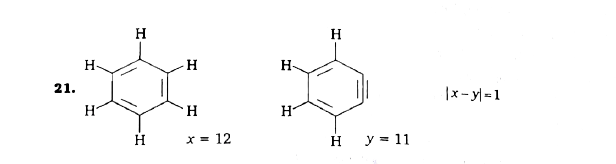
|
|
| 36. |
Calculate value of |x-y|, here x and y are the total number of bonds in benzene and benyne respectively which are formed by overlapping of hybridized orbitals . |
Answer» 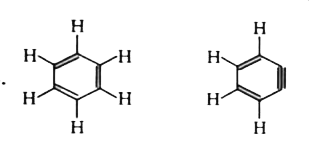 x=12, y=11 |x-y|=1 |
|
| 37. |
Calculate value of -U/100, for AB(s), from following data of Born-Haber's cycle. [where U is lattice energy in kJ/mol] |
|
Answer» `-424=+376+U` `U=-424-376=-800kJ`/mol `-((-800))/(100)=8` |
|
| 38. |
Calculate total number of possible isomers (structrural and stereoisomers) of the compound [Ir(en)_2(NH_3)(NO_2)]^(2+) |
Answer» 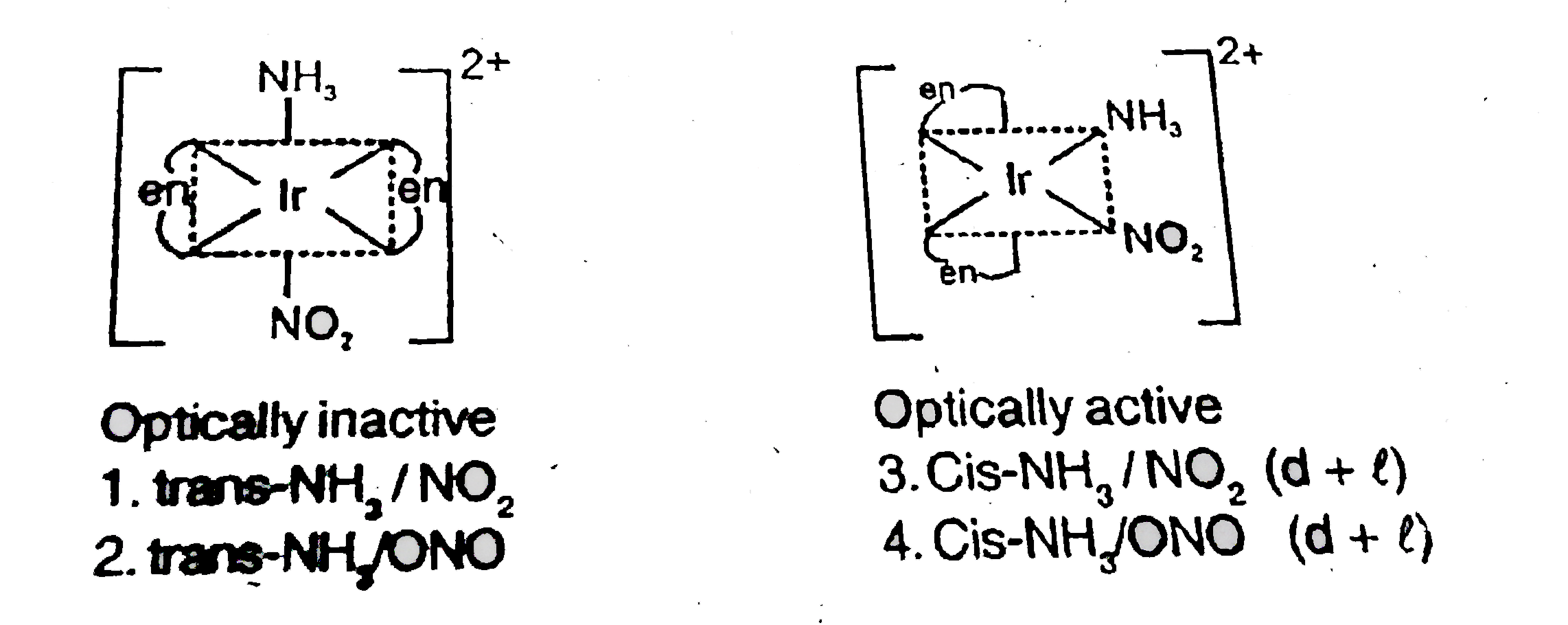
|
|
| 39. |
Calculate total number of orbitals having (n+l) value=8 and magnetic quantum number a nonzero quantity. [Divide answer by 6] |
|
Answer» SOLUTION :`(n+l)"VALUE"=8rArr 5f,6d,7p,8s` Total orbitals=16 Orbital having non-zero magnetic QUANTUM number =16-4=12 |
|
| 40. |
Calculate total number of electron present in Cr having n + l + m = 6 |
|
Answer» 3 Number of electrons having `n + L + m = 6` from `3d^(5) = 1` Total `=1` |
|
| 41. |
Calculate to the correct number of significant figures : 4.26 - (15.635/5.0) |
|
Answer» 1.13 |
|
| 42. |
Calculate thewavelength of carbondioxide molecule whose velocity is 440ms^(-1). |
| Answer» SOLUTION :`2XX10^(-11)m` | |
| 43. |
Calculate the % yield of monochloro products when isopentane is chlorinated, relative rates of reasction of reaction is 3^(@)H-5.0,2^(@)H-3.8and1^(@)H-1.0 |
Answer» SOLUTION :
|
|
| 44. |
Calculate the Zn-Cu cell (Daniell) potential. |
|
Answer» Solution :`(E_(Zn^(2+)|Zn)^(THETA)=-0.76V and E_(Cu^(2+)|Cu)^(Theta)=0.34V)` According to the convention, anode half-cell has less REDUCTION potential and CATHODE half-cell has high reduction potential so, oxidation reaction on the zinc electrode is available on left side of cell is as follows: `Zn_((S))toZn_((aq," 1M")^(2+)+2e^(-)`. . . (i) Reduction reaction on the copper electrode available on right side of cell is as follows: `Cu_((aq," 1M"))^(2+) +2e^(-) to Cu_((S))` . . . (ii) Sum of reaction (i) and (ii) gives redox reaction which is as follows: `Zn_((S))+Cu_((aq," 1M"))^(2+)=Zn_((aq," 1M"))^(2+)+Cu_((S))` Now emf of this cell `=E_(cell)^(Theta)=E_(R)^(Theta)E_(L)^(Theta)` `THEREFORE DeltaE_(cell)^(Theta)=-0.34V-(-0.76V)=1.10V` |
|
| 45. |
Calculate the work performed when 2 moles of hydrogen expand isothermally and reversibly at 25^(@)C from 15 to 50 litres. |
|
Answer» SOLUTION :We have, `W=-2.303"nRT"log.(V_(2))/(V_(1))`…. (EQN. 4b) `=-2.303xx2xx2xx298xxlog.(50)/(15)` `=-1436 calories. |
|
| 46. |
Calculate the work of an isothermal reversible expansion of three moles of watervapour from 5.0 xx 10^4 to 2.0 xx 10^4 Pa at 330 K. |
|
Answer» SOLUTION :`W = -2.303 NRT LOG p_1/p_2` =-7.54kJ |
|
| 47. |
Calculate the work of an isobaric reversible expansion of three moles of an idealgas while it is heated from 298 K to 400 K. |
|
Answer» SOLUTION :`W = -NR(T_2 - T_1)` ` -2.45kJ` |
|
| 48. |
Calculate the work done when 1 mol of an ideal gas is compressed reversible from 1 bar to 4 bar at a constant temperature of 300 K. |
|
Answer» 4.01 kJ `= - 2.303 xx 1 xx 8.314 xx 300 "log" (1)/(4)` `3458.3 J = 3.458 kJ mol^(-1)` |
|
| 49. |
Calculate the work done during combustion of 0.138 kg of ethanol, C_(2)H_(5)OH(l) at 300 K. Given : R=8.314 JK^(-1)mol^(-1), molar mass of ethanol =46g mol^(-1) |
|
Answer» `-7482J` `C_(2)H_(5)(L)+3O_(2)(g)to2CO_(2)+3H_(2)O` Given, Mass of ethanol `=0.138kg=138g` Temperature `=300K` `R=8.314JK^(-1)mol^(-1)` Molar mass of ethanol `=46gmol^(-1)` No. of moles of ethanol `=("Mass of ethanol")/("Molar mass of ethanol")` `=(138)/(46)=3` WORK done (W) during combustion of 0.138 Kg of `C_(2)H_(5)OH=nRT` `W=nRT` `W=3xx8.31JK^(-1)mol^(-1)xx300K` `W=7482.6J` `~~7482J` |
|
| 50. |
Calculate thework done during combustion of 0.138 kg of ethanol, C_(2)H_(5)OH_(1) at 300 K. Given: R= 8.314 JK^(-1) mol^(-1) molar mass of ethanol = 46 gm mol^(-1) |
|
Answer» `-7482` J Hence Mole `=138/46 =3 `moles of `C_(2)H_(5)OH`. `3C_(2)H_(5)OH(l) + 9O_(g) to 6CO_(2)(g) + 9H_(2)O (u)` `deltan = 6-9 =-3` WORK =`-deltanRT` `=-(-3) xx 8.314 xx 300` `=-7482` J |
|