

Saved Bookmarks
This section includes 7 InterviewSolutions, each offering curated multiple-choice questions to sharpen your Current Affairs knowledge and support exam preparation. Choose a topic below to get started.
| 1. |
Calculate the emf of the following cell at 298 K: Cr(s)//Cr^(3+) (0.1 m)//Fe^(2+) (0.01 M)//Fe(s) [Given: E_("cell")^(@) = +0.30 V] |
|
Answer» Solution :The REACTION is: `2Cr(s) + 3Fe^(2+)(s) (aq) to 3Fe(s) + 2Cr^(3+) (aq)` In this case number of electrons involved, n=6 Apply the equation, `E_("CELL") =E_("cell")^(@) -(2.303RT)/(NF) log ([Cr^(3+)]^(2))/([Fe^(2+)]^(3))` Substituting the values in the above equation, we have `E_("cell") =0.30 -0.059/6 log [10^(-1)]^(2)/[10^(-3)]^(3) = 0.30 -0.059/6 log 10^(4) = 0.30 -0.04 =0.26 V` |
|
| 2. |
Calculate the EMF of the following cell at 25^@C, Pt, H_2 (1 atm) / H^+(0.09 M) | | OH^– (0.075M)/ H_2 (1 atm), Pt (K_w of H_2O = 1 xx 10^(–14)) |
|
Answer» |
|
| 3. |
Calculate the emf of the following cell at 25^(@) C Zn| Zn^(2+) (0.001 M) || H^(+) (0.01 M) | H_(2) (g) (1 bar) | Pt (s) E_(Zn^(2+)//Zn)^(@) = -0.76 V, E_(H^(+)//H_(2))^(@) = 0.00 V |
|
Answer» Solution :The cell reaction is: `Zn(s) + 2H^(+) (aq) to Zn^(2+) (aq) + H_(2)`, Then n=2 `E = E^(@) - 0.059/2 LOG ([Zn^(2+)])/([H^(+)]^(2)` `=0.76 - 0.0295 log ([0.001])/([0.01]^(2)) = 0.76 - 0.0295 log 10` `=(0.76 - 0.0295) "VOLT" = 0.7305` volt |
|
| 4. |
Calculate the emf of the following cell at 25^@C H_2(g) (1atm)//H^+ (aq)|| OH^(-) (aq)//O_2(g) (1atm) from the following data: H_2+1/2O_2=H_2O,DeltaG^@=-226.8kJ//mol e |
|
Answer» SOLUTION :The electrodic process are, `1/2 O_2+H_2O +2e=2OH^-` ……….at cathode (RHS) `H_2=2H^+ +2e`…………at anode (LHS) The cell reaction is `1/2 O_2+ H_2O+ H_2=2H^+ + 2OH^(-)` for which, `E_(cell)=E_(cell)^@-.0591/2log[H^+]^2[OH^-]^2` `E_(cell)=E_(cell)^@-.05921/2 log (K_w)^2` `E_(cell)=E_(cell)^@+0.8274 (K_w=10^-14)` Now multiply the given eqn. (II) by 2 and add eqn. (i) we get the cell reaction `H_2+ 1/2O_2+H_2O=2H^+ +2OH^(-), Delta G^@=-226.8+2 times 76.8` `=-74.4 kJ` `=-74400J` Again we have, `Delta G^@=-2.303RT logk` `-74400=-2.303 times 8.314 times 298 times log k` `log k=13.04` `therefore E^@=(2.303 RT)/(n F) log k` `=.591/2times 13.04` `=0.3853` SUBSTITUTING the `E^@` values in eqn. (1) `E_(cell)= 0.3853+0.8274` `=1.2128V` |
|
| 5. |
Calculate the emf of the cells formed by the various combinations of the following standard half cells. Here [M^(n+)]=1 mol L^(-1), since we are considering standard cells. (i) Zn^(2+)(aq)//Zn(s) (ii) Cr^(3+)(aq)//Cr(s) (iii) Cu^(2+)(aq)//Cu(s) (IV) Ni^(2+)(aq)//Ni(s) (v) Co^(2+)(aq)//Co(s) (vi) Ag^(+)(aq)//Ag(s) also calculate the standard potentials of such cells. |
|
Answer» Solution :The `E^(@)` values (reduction potentials) for the given half -cells obtained from Table 8.3 are given below : `{:("Half-cell":Zn^(2+)//Zn, Cr^(3+)//Cr, Cu^(2+)//Cu,Ni^(2+)//Ni, Co^(2+)//Co,Ag^(+)//Ag),(E^(@) "value(v)": -0.76,-0.74,+0.34,-0.25,-0.28,+0.80):}` The increasing order of `E^(@)` value is : `Zn^(2+)//Zn lt Cr^(3+)//Cr lt Co^(2+)//Co lt Ni^(2+)//Ni lt Cu^(2+)//Cu lt Ag^(+)//Ag`. From the DATA it is evdent that (a) A cell with `Zn^(2+)//Zn` as anode can have all the FIVE other ELECTRODES acting as cathode. The emf of the cells in all the cases are : (i)`E_((Cr^(3+)//Cr))^(@)-E_((Zn^(2+)//Zn))^(@)=(-0.74)-(-0.76)=0.02 V` (ii) (ii)`E_((Co^(2+)//Cu))^(@)-E_((Zn^(2+)//Zn))^(@)=(-0.28)-(-0.76)=0.48 V` (III) `E_((Ni^(2+)//Ni))^(@)-E_((Zn^(2+)//Zn))^(@)=(-0.25)-(-0.76)=0.51 V` (iv) `E_((Cu^(2+)//Cu))^(@)-E_((Zn^(2+)//Zn))^(@)=(+0.34)-(-0.76) = 1.10 V` (v) `E_((Ag^(+)//Ag))^(@)-E_((Zn^(2+)//Zn))^(@)=(+0.80)-(-0.76) = 1.56 V` (b) A cell with `Cr^(3+)//Cr` as anode can have all the remaining four electrodes acting as cathode. The emf of the cells in all the cases are : (i)`E_((Co^(2+)//Co))^(@)-E_((Cr^(3+)//Cr))^(@)=(-0.28)-(-0.74)=0.46 V` (ii)`E_((Ni^(2+)//Ni))^(@)-E_((Cr^(3+)//Cr))^(@)=(-0.25)-(-0.74)=0.49 V` (iii)`E_((Cu^(2+)//Cu))^(@)-E_((Cr^(3+)//Cr))^(@)=(+0.34)-(-0.74)=1.08 V` (iv)`E_((Ag^(+)//Ag))^(@)-E_((Cr^(3+)//Cr))^(@)=(+0.80)-(-0.74)=1.54 V` (c ) A cell with `Co^(2+)//Co` as anode can have all the remaining three electrodes acting as cathode. The emf of the cells can be calculated as : (i)`E_((Ni^(2+)//Ni))^(@)-E_((Co^(2+)//Co))^(@)=(-0.25)-(-0.28)=0.03 V` (ii)`E_((Cu^(2+)//Cu))^(@)-E_((Co^(2+)//Co))^(@)=(+0.34)-(-0.28)=0.62 V` (iii)`E_((Ag^(+)//Ag))^(@)-E_((Co^(2+)//Co))^(@)=(+0.80)-(-0.28)=1.08 V` (d) A cell with `Ni^(2+)//Ni` as anode can have the remaining two elctrodes acting as the cathode. The emf of the cells can be calculated as : (i)`E_((Cu^(2+)//Cu))^(@)-E_((Ni^(2+)//Ni))^(@)=(+0.34)-(-0.25)=0.59 V` (ii)`E_((Ag^(+)//Ag))^(@)-E_((Ni^(2+)//Ni))^(@)=(+0.80)-(-0.25)=1.05 V` (e) A cell with `Cu^(2+)..Cu` as anode can have only `Ag^(+)//Ag` as cathode. (i)`E_((Ag^(+)//Ag))^(@)-E_((Cu^(2+)//Cu))^(@)=(+0.80)-(+0.34)=0.46 V` |
|
| 6. |
Calculate the emf of the cell. Zn|Zn^(2+)(0.001M)||Ag^(+)(0.1M)|Ag The standard potential of Ag//Ag^(+) half - cell is +0.80 V and Zn//Zn^(2+) is -0.76V. |
|
Answer» Solution :Step 1 : Write the half-cell reactions of the anode and the cathode. Then ADD the anode and cathode half reactions to obtain the cell reaction and the value of `E_("cell")^(@)` `{:("Cathode",:,2Ag^(+)+2e^(-),rarr,2Ag,E^(@)=+0.80),("Anode",:,""Zn,rarr,Zn^(2+)+2e^(-),E^(@)=-0.76V),("Cell",:,Zn+"2Ag"^(+),rarr,Zn^(2+)+2Ag,E^(@)=1.56V):}` Step 2. K for the cell reaction `=([Zn^(2+)])/([AG^(+)]^(2))` Substituting the given values in the Nernst equation and solving for `E_("cell")`, we have `E_("cell")=E_("cell")^(@)-(0.0591)/(n)logK` `=1.56-(0.0591)/(2)log""([Zn^(2+)])/([Ag^(+)]^(2))` `=1.56-(0.0591)/(2)log""([10^(-3)])/([10^(-1)]^(2))` `=1.56-0.02955` `=1.58955V` Calculation of Equilibrium constant for the cell reaction The Nernst equation for a cell is `E_("cell")=E_("cell")^(@)-(0.0591)/(n)logK` `"or"logK=(E_("cell")^(@))/(0.0591)` |
|
| 7. |
Calculate the emf of the cell Zn//ZnO_(2)^(-), OH_((aq))^(-), HgO //Hg given that E^(@) values of OH^(-), ZnO_(2)^(-)//Zn and OH^(-), HgO //Hg half cells are -1.216V and 0.098 V respectively. |
| Answer» SOLUTION :HINT : `E^(@)=E_(R)^(@)-E_(L)^(@),E^(@)=1.314V` | |
| 8. |
Calculate the emf of the cell Zn//ZnO_(2), OH^(-)""_(aq),-HgO""//Hg given that E^(@) values of OH^(-), ZnO and OH^(-), HgO""//Hg half cells are -1.216 V and 0.098 V respectively. |
|
Answer» SOLUTION :Given : `Zn//ZnO_(2)^(-), OH^(-)""_((aq)), HgO""//Hg` `""E^(@)""_(R)=0.098V, E_(L)=-1.216V` Formula : `therefore E^(@)""_(CELL)=E^(@)""_(R)-E^(@)""_(L)` Solution : `E^(@)""_(cell)=0.098-(-1.216)` `""=0.098+1.216=+1.314` `E^(@)=+1.314V`. |
|
| 9. |
Calculate the emf of the cell : Mg|Mg^(2+)(0.1 M)||Ag^(+)(1.0xx10^(-3) M)|Ag Given that E_(cell)^(@)=3.15" V". |
|
Answer» SOLUTION :`E_(cell)^(@)=E_(cell)^(@)-(0.0591)/(n)"LOG"([MG^(2+)])/([Ag^(+)]^(2))` `=3.15-(0.0591)/(2)"log"(0.1)/((1.0xx10^(-3))^(2))` `=3.15-0.02955" log "5` `=3.15-0.02955xx0.6989` `=3.15-0.0207=3.13~~3.0` |
|
| 10. |
Calculate the emf of the cell in which the following reaction takes place: Ni(s)+2Ag^(+)(0.002M)toNi^(2+)(0.160M)+2Ag(s) Given that E_(cell)^(@)=1.05V |
|
Answer» SOLUTION :Applying NERNST equation to the GIVEN cell REACTION, `E_(cell)=E_(cell)^(@)-(0.0591)/(n)"log"([Ni^(2+)])/([Ag^(+)]^(2))=1.05V-(0.0591)/(2)"log"(0.160)/((0.002)^(2))=1.05-(0.0591)/(2)log(4XX10^(4))` `=1.05-(0.0591)/(2)(4.6021)=1.05-0.14V=0.91V` |
|
| 11. |
Calculate the emf of the cell in which the following reaction takes place: Ni(s)+ 2Ag^+(0.002M) to Ni^2(0.160 M)+2Ag(s). Given that E_(cell)^0=1.05V |
|
Answer» SOLUTION :`E_(cell)=E_(cell)^0-0.059/nlog[NI^(2+)]/[AG^+]^2` `=1.05-0.059/2log0.160/(0.002)^2=1.05-0.059/2log(4xx10^4)` `1.05-0.0295xx4.6021=1.05-0.135=0.914V` |
|
| 12. |
Calculate the emf of the cell in which the following reaction takes place: Ni_((S))+2Ag^(+)(0.002M) to Ni^(2+)(0.160M)+2Ag_((S))""[E_(cell)^(Theta)=1.05V] |
|
Answer» Solution :* In given CELL FOLLOWING reaction is possible `Ni_((S))+2Ag^(+)(0.002M)toNi^(2+)(0.160M)+2Ag_((S))` Where, n=2, `[Ni^(2+)]=0.160M,[Ag^(+)]=0.002M,E_(cell)^(Theta)=1.05V`. * Note: Here, solid Ni and Ag is neglected `THEREFORE E_(cell)=E_(cell)^(Theta)-(0.059)/(n)"log"([Ni^(2+)])/([Ag^(+)]^(2))` `=1.05-(0.059)/(2)"log"((0.160)/((0.002)^(2)))` `=1.05-0.0295log(40000)` `=1.05-0.0295xx4.6021` `=1.05-0.1358` =0.9142 `~~0.91V` |
|
| 13. |
Calculate the emf of the cell in mV (atleast first two digits must match with correct answer) Ag(s),AgIO_(3)(s)|Ag^(+)(xM),HIO_(3)(1M)||Zn^(+2)(1M)|Zn(s) if K_(sp)=3xx10^(-8) for AgIO_(3) and K_(a)=(1)/(6) for HIO_(3) and E_(cell)^(0) for 2Ag+Zn^(+2)to2Ag^(+)+Zn is -1.56V. log3=0.48)Take(PT)/(F)=0.059) (giving your answer in magnitude only) |
|
Answer» `therefore[IO_(3)^(-)]=1xx(1)/(3)=(1)/(3)Mimplies[Ag^(+)]=(3xx10^(-8))/((1)/(3))=9xx10^(-8)M` Now `2Ag+Zn^(+2)overset(2e^(-))to2Ag^(+)+Zn` gives `E=-1.56+(0.059)/(2)LOG((1)/(9xx10^(-8))^(2))=-1.144V=-1144mV` |
|
| 14. |
Calculate the emf of the cell in which the following reaction takes place Ni(s) + 2Ag^(+)(0.002M) to Ni^(2+) (0.160 M)+ 2Ag(s) Given that E_("cell")^(@) = 1.05 V. |
|
Answer» SOLUTION :Applying Nernst equation to the given CELL reaction: `E_("cell") = E_("cell")^@ - (0.0591)/x LOG (NI^(2+))/([Ag^+]^2)= 1.05 V - (0.0591)/2 log (0.160)/((0.002)^2)` `= 1.05 - (0.0591)/2 log (4 xx 10^(4)) = 1.05 - (0.0591)/(2) xx 4.602` `= 1.05 - 0.14 V = 0.91 V`. |
|
| 15. |
Calculate the emf of the cell in which the following reaction takes place : Ni(s) + 2Ag^(+) (0.002 M) to Ni^(2+) (0.160 M) + 2Ag (s) Given that: E_("cell")^(@) = 1.05 V |
|
Answer» Solution :Applying Nernst equation and substituting the values, we GET `E_("cell") = E_("cell")^(@) -(0.0591)/N log ([Ni^(2+)])/([Ag^(+)])^(2) = 1.05 - 0.0591/2 (4.6021) = 1.05 - 0.14 V = 0.91 V` Thus emf of the cell = 0.91 V. |
|
| 16. |
Calculate the emf of the cell having the cell reaction 2Ag^(+)+Zn iff 2Ag+Zn^(2+) " and " E^(@)""_(cell)=1.56V " at " 25^(@)C when concentration of Zn^(2+)=0.1 M " and " Ag^(+)=10M in the solution. ""["Hint :" E_(cell)=E^(@)""_(cell)-(RT)/(nF)In([Zn^(2+)])/[Ag]^(2)] |
|
Answer» Solution :Given : `E^(@)""_(cell)=1.56V" "[Zn^(2+)]` `""=0.1 M [AG^(+)]=10M` Formula : `E_("Cell")=E^(@)""_(cell)-(RT)/(NF)In.([Zn^(2+)])/[Ag^(+)]^(2)` Solution : `""=1.56-0.02955 LOG 0.001,` `""=1.56-(-0.08865)` `""=1.56+0.08865=1.6486V` `E_("Cell")=1.6486V`. |
|
| 17. |
Calculate the EMF of the cell formd fromAg & Ni electrodes E^(@).Ag^(+)//Ag=(+0.799V) E^(@)Ni^(2+)//Ni= -0.250V |
|
Answer» |
|
| 18. |
Calculate the emf of the cell having the cell reaction 2Ag^(+)+ZnhArr 2Ag+Zn^(2+) and E_("cell")^(@)=1.56V" at "25^(@)C when concentration of Zn^(2+)=0.1M and Ag^(+)=10M in the solution. |
|
Answer» |
|
| 19. |
Calculate the emf of the cell Cr|Cr^(3+) (0.1 M) ||Fe^(2+) (0.01 M)|Fe ("Given: "E_(Cr^(3+)//Cr)^(@)=- 0.75" volt,"E_(Fe^(2+)//Fe)^(@)=-0.45" volt") |
|
Answer» |
|
| 20. |
Calculate the EMF of the cell Cu//Cu^(2+)(0.1M)"//"Cl^(-) (0.01)// 1/2 Cl_(2), Pt E^(@) Cu^(2+)//Cu = +0.33V E^(@) 1/2 Cl_(2)//Cl^(-) = +1.36V |
|
Answer» |
|
| 21. |
Calculate the EMF of the cell for the reaction Mg_((s))+2Ag_((aq))^(+)rarr Mg_((aq))^(2+)+2Ag_((s)). ("Given " :E^(@)Mg^(2+)//Mg=-2.37V, E^(@)Ag^(+)//Ag=0.80V, [Mg^(2+)]=0.001M[Ag^(+)]=0.001M and log10^(5)=5). |
|
Answer» SOLUTION :`E_("CELL")^(@)=E_("cathode")^(@)-E_("anode")^(@)` `E_("cell")^(@)=E_(Ag^(+)//Ag)^(@)-E_(Mg^(2+)//Mg)^(@)` `E_("cell")^(@)=0.80-(-2.37)` `E_("cell")^(@)=3.17V` `E_("cell")=E_("cell")^(@)-(0.059)/(n)log""([Mg^(2+)])/([Ag^(+)]^(2))` `E_("cell")=3.17-(0.059)/(2)log""([0.001])/([0.0001]^(2))` `E_("cell")=3.17-(0.059)/(2)LOG10^(5)` `E_("cell")=3.17-(0.059)/(2)xx5` `E_("cell")=3.022V` |
|
| 22. |
Calculate the EMF of the cell containing chromium and cadmium electrodes (Given E_(Cr^(3+)//Cr)^(@)=-0.74V,E_(Cd^(2+)//Cd)^(@)=-0.40V) |
|
Answer» |
|
| 23. |
Calculate the emf of the cell, Cd|Cd^(2+)(0.001M)||Fe^(2+)(0.6M)|Fe at 25^(@)C. The standard reduction potential of Cd//Cd^(2+) and Fe//Fe^(2+) electrodes are -0.403 and -0.441 volt respectively. |
|
Answer» Cell reaction: `Cd+Fe^(2+)(0.6M)toCd^(2+)(0.001M)+Fe` `E_(cell)=E_(cell)^(@)-(0.0591)/(n)"log"([Cd^(2+)])/([Fe^(2+)])=-0.038-(0.0591)/(2)"log"(10^(-3))/(0.6)=-0.038+0.0821=0.0441V` ALTERNATIVELY, CALCULATE electrode potentials of L.H.S. & R.H.S. ELECTRODES separately. then `E_(cell)=E_(RHS)-E_(LHS)`. |
|
| 24. |
Calculate the emf of given cell {:(Ag|AgNO_(3)||AgNO_(3)|Ag,,E_(Ag^(+)//Ag)=0.80V),(0.001 M, 0.1 M):} |
|
Answer» Solution :The GIVEN cell is concentrated cell. Hence, `E_("cell")^(@)=0` `E_("cell") = E_("cell")^(@) - 0.0591/n log [("PRODUCT")]/[("Reactant")]` `E_("cell") = 0-(0.0591)/1 log 10^(-3)/10^(-1) = 0.118` volt |
|
| 25. |
Calculate the EMF of cell Ni//Ni^(2+) (0.01M)"//"Cl^(-)0.1M//Cl_(2), Pt E^(@)Ni^(2+)//Ni= -0.250V : E^(@)Cl_(2)//Cl^(-)= +1.360V |
|
Answer» |
|
| 26. |
Calculate the emf and DeltaGof cell reaction for the following cell at 25 °C : Mg(s) | Mg^(2+) (0.001 M) || Cu^(2+) (0.0001 M) + Cu(s) [E_(Mg^(2+)//Mg)]^(@) = -2.37 V, E_(Cu^(2+)//Cu)^(@) =+0.34 V and 1F = 96500C mol^(-1) |
|
Answer» Solution :The following reactions take place in the cell: `Mg(s) to Mg^(2+) (aq) + 2e^(-)` `Cu^(2+) (aq) + 2e^(-) to Cu(s)` `Mg(s) + Cu^(2+) (aq) to Mg^(2+) (aq) + Cu(s)` Thus, n=2 APPLYING Nernst equation and substituting the values, we GET `E_("cell") = E_(Cu^(2+)//Cu)^(@) -E_(Mg^(2+)//Mg)^(@) -0.0591/2 LOG ([Mg^(2+)])/([Cu^(2+)])` `=0.34 V - (-2.37 V) - 0.0591/2 log 0.001/0.0001` `=2.71 V - 0.0591/2 log 10 = 2.71 V - 0.0295 V = 2.6805V` `DeltaG` can be OBTAINED as under: `DeltaG = -nFE =-2 xx 2.6805 xx 96500` `=-517336.5 J mol^(-1) = -517.34 kJ mol^(-1)` |
|
| 27. |
Calculate the e.m.f. of cell {:(Pt_(H_(2))),(1atm):}|{:(CH_(3)COOH),(0.1M):}||{:(NH_(4)OH),(0.01M):}|{:(Pt_(H_(2))),(1atm):} (K_(a) for CH_(3)COOH = 1.8 xx 10^(-5), K_(b) for NH_(4)OH = 1.8 xx 10^(-5)) |
|
Answer» |
|
| 28. |
Calculate the electronic velocity in the first Bohr orbit of hydrogen. |
|
Answer» Solution :For hydrogen, Z=1, n=1 `v_(1)= (2pi E^(2))/(h)` `=(2 xx (3.14) xx (4.8 xx 10^(-10))^(2))/(6.63 xx 10^(-27))` `=2.19 xx 10^(8) cm//s` |
|
| 29. |
Calculate the electronegativity of fluorine from the following data: E_(H-H)=10.4.2 kcal mol^(-1) E_(F-F)= 36.6 kcal mol^(-1) E_(H-P)= 134.6 kcal mol^(-1) Electronegativity of H= 2.05 |
|
Answer» Solution :ENERGY for 100% COVALENT bond (H-F)= `sqrt(E_(H-H) XX E_(F-F))` =`sqrt(104.2 xx 36.6)` =61.75 kcal Resonance energy `(Delta)=` acutal bond energy- energy for 100% covalent bond =134.6-61.75 =72.85 kcal Electronegativity difference= `0.18 sqrt(Delta)` Electronegativity of F- electronegativity of `H= 0.18 sqrt(Delta)` Electronegativity of `F= 0.18 xx sqrt(72.85) + 2.05` = 3.586 |
|
| 30. |
Calculate the electronegativity of fluorine from following data : F_(H-H) =104. 2 k cal mol ^(-1) E _(F-F) =36.6 kcal mol ^(-1) E _(H-F) = 134. 6 kcal mol ^(-1) Electronegativity ofH is 2.05 |
|
Answer» Solution :On Paulling SCALE: `x _(F) -x_(H) =0.182sqrt(Delta _(H)-F)` (using B.E. in kcal `mol ^(-1))` `Delta _(H-F) = E_(H-F) - SQRT( E_(H-H) xx E _(F -F))` `=13.45 - sqrt( 104.2 xx36.6) = 72.84` kcal From (i) `x_(F) -x_(H) = 0.182 sqrt(72.84)+ 1.5534` `x_(F)=x_(H) + 1.4434=2.05+ 1.5534=3.6034` |
|
| 31. |
Calculate the electron gain enthalpy of fluorine atom using the following data. Make Born – Haber's cycle. All the values are in kJ mol^(-1) at 25^(@) C , Delta H_("diss") (F_(2)) = 160 , Delta H_(f)^(0) (NaF(s)) = -571 , I.E. [Na (g) ] = 494 , DeltaH_("vap") [Na(s)] = 101 . Lattice energy of NaF (s) = -894. |
| Answer» SOLUTION :`-352 KJ MOL^(-1)` | |
| 32. |
Calculate the electrode potential of the electrode Zn//Zn^(2+) (conc. =0.1M) at 25^(@)C Given that E_(Zn//Zn^(2+))^(@)=0.7618 volt. |
|
Answer» |
|
| 33. |
Calculate the Electrode potential of single electrode.Cu^(2+)(0.01M)//Cu" "(E^(@)= +0.337V) |
|
Answer» |
|
| 34. |
Calculate the electrode potential forunderset(1 atm)((Pt)H_2) | H^(+) (c = 0.1) |
| Answer» SOLUTION :`-0.0591 V` | |
| 35. |
Calculate the electrochemical equivalent of the lightest element. |
|
Answer» |
|
| 36. |
Calculate the electrode potential of given electrode Pt, Cl_(2) (1.5 "bar") | 2Cl^(-) (0.01 M), Solu E_(Cl_(2)//2Cl^(-))^(@) = 1.36 V tion: |
|
Answer» Solution :The REACTION of electrode is `{:(Cl_(2)(g) + 2E^(-), to, 2Cl^(-)),(1.5 "bar",,0.01 M):}` `E = e^(@) -(0.0591)/n LOG ([Cl^(-)]^(2))/P_(Cl_(2))` `=1.36 - (0.0591)/2 log (0.01)^(2)/1.5 = 1.483 V` |
|
| 37. |
Calculate the electrode potential developed when a silver electrode in dipped in 0.025 M silver nitrate solution at 289K. |
|
Answer» SOLUTION :`E=E^@+0.0591/N LOG [M^(+n)]` `E=+0.8+0.0591/1 log (0.025)` `E=+0.8+0.0591/1 log 2.5 TIMES 10^-2` `E=+0.70531 V` |
|
| 38. |
Calculate the electrode potential at 25^@C of Cr_2O_7^(2–)//Cr^(3+) electrode at pOH = 11 in a solution of 0.01 M both in Cr^(3+) and (Cr_2O_7^(2–)) = 1.33 V. If this electrode is coupled with a hydrogen gaseous electrode at pH = 6, find the emf of the spontaneous cell. |
|
Answer» |
|
| 39. |
Calculate the packing efficiency in simple cubic lattice. |
|
Answer» Solution :Packing efficiency of metal crystal for simple CUBIC lattice. Let a be the edge length of the UNIT cell and r be radius of the sphere. Volume of the sphere `= (4)/(3) pi r^(3)` 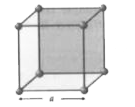 As the spheres at the corners are touching each other, the edge length a = 2r Volume of the cube `= a^(3) = 8r^(3)` % of the SPACE occupied by spheres `= ("Volume of sphere")/("Volume of cube") xx 100` `= ((4)/(3) pi r^(3) xx 100)/(8r^(3)) = 52.4%` Packing efficiency of simple cubic lattice is 52.4% EXAMPLE : Silicon and GERMANIUM (Any one). |
|
| 40. |
Calculate the efficiency [percentage of volume occupied and unoccupied] of packing in case of a metal crystal for simple cubic. |
|
Answer» Solution :For simple cubic `a=2r`. `"Efficiency "=("Volume OCCUPIED by all spheres")/("Total volume of cube")XX100` `"Efficiency "=((4)/(3)PIR^(3))/((2r)^(3))xx100 =(4xxpixxr^(3))/(3xx8xxr^(3))xx100=(pi)/(6)xx100=(22)/(7xx6)xx100=(2200)/(42)=52.4%` Percentage of volume occupied `=52.4%`. Percentage of volume UNOCCUPIED `=47.6%`. |
|
| 41. |
Calculate the efficiency of packing in case of a metal crystal for (i) simple cubic (ii) body-centred cubic (iii) face-centred cubic (with the assumptions that atoms are touching each other). |
|
Answer» Solution :(i) Simple CUBIC : Number of spheres in a unit cell `=8xx(1)/(8)=1` Volume of the sphere `=(4)/(3)pir^(3)"(r is the radius of the sphere)"` Volume of the cube `=a^(3)=(2r)^(3)=8r^(3)` Effciency of packing `=(4//3pir^(3))/(8r^(3))=(pi)/(6)=0.524 or 52.4%`. (ii) Body - centred cubic structure : Assuming that body centre touches the spheres at the corner. Body diagonal AD = 4r FACE diagonal `AC=sqrt(AB^(2)+BC^(2))=sqrt(a^(2)+a^(2))=sqrt2a` Body diagonal `AD=sqrt(AC^(2)+CD^(2))=sqrt(2a^(2)+a^(2))=sqrt3a` `sqrt3a=4r or a=(4r)/(sqrt3)`, Volume of unit cell `=a^(3)=((4r)/(sqrt3))^(3)=(64r^(3))/(3sqrt3)` 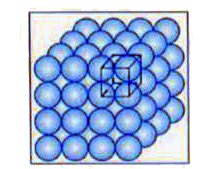 Number of spheres in unit cell `=8xx(1)/(8)+1=2` Volume of two spheres `=2xx(4)/(3)pir^(3)=(8)/(3)pir^(3)` Efficiency of packing `=(8pir^(3)//3)/(64r^(3)//3sqrt3)=(pisqrt3)/(8)=0.68 or 68%` (iii) Face - centred cubic : `AC=sqrt(AB^(2)+BC^(2))=sqrt(a^(2)+a^(2))=sqrt2a` `therefore""sqrt2a=4r or a=(4)/(sqrt2)xxr` Volume of the unit cell `=a^(3)=(32)/(sqrt2)r^(3)` Number of sphere in a unit cell `=8xx(1)/(8)+6xx(1)/(2)=4` Volume of four spehres `=4xx(4)/(3)pir^(3)=(16)/(3)pir^(3)` Efficiency of packing `=(16pir^(3)//3)/(32r^(3)//sqrt2)=0.74 or 74%`. 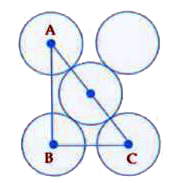
|
|
| 42. |
Calculate the effective nuclear charge experienced by the 4s electron in potassium atom. |
|
Answer» SOLUTION :The electronic configuration of K atom is `K_19 = (1s^2) (2s^2 2p^6) (3s^2 3p^6) 4s^(1)` Effective nuclear CHARGE (Z*) = Z – S Z* `=19 - [(0.85xx" No. of electron in "(n-1)^(TH)" shell" + (1.00" total number of electron in the INNER shells")]` `=19- [ 0.85 xx (8) + (1.00 xx 10)]` Z* `= 2.20` |
|
| 43. |
Calculate the effective neutron capture radius of a nucleus having a cross section of 1.0 barn. |
|
Answer» Solution :1 barn ` = 10^(-24)CM^2` and area of CIRCLE =`pi r^2` `5.6 xx 10^(-13) cm` |
|
| 44. |
Calculate the ebullioscopic constant for water. The heat of vaporization is 40.685 kJ mol^(-1) |
|
Answer» `0.512 K KG mol^(-1)` `=(8.314xx(373.15)^(2)xx18)/(1000xx40.685)xx10^(-3)=0.512 K kg mol^(-1)` |
|
| 45. |
Calculate the EAN of central atom in the following complexes: (i) [Cr(CO)_(6)] (ii) [Fe (eta^(5)-C_(5)H_(5))_(2)] |
|
Answer» EAN of `Fe= 26-2+2(6)=36` |
|
| 46. |
Calculate the E and E^(@) of the cell Ni | Ni^(2+) || Cu^(2+) | Cu from the following half-cell reactions: {:(Ni^(2+) + 2e^(-) rarr Ni,,E^(@) = - 0.25 " volt"),(Cu^(2+) + 2e^(-) rarr Cu,,E^(@) = + 0.34 " volt"):} (Given: [Ni^(2+)] = 1 M " and " [Cu^(2+)] = 10^(-3) M) |
|
Answer» |
|
| 47. |
Calculate the ebullioscopic constant for water. The heat of vaporisation is 40.685 kJmol^(-1) |
|
Answer» 0.512 K KG `MOL^(-1)` |
|
| 48. |
Calculate the dmole fraction of ethyl alcohol and water in a solution in which 46 g of ethlyl alcohl and 180g of water are mixed together. |
|
Answer» `"No. of moles of WATER"(n_(C_(2)H_(5)O))=("Mass of water")/("Molar mass")=((180G))/((18"g mol"^(-1)))=10 mol` `"MOLE fration of ethyl alcohol "(x_(C_(2)H_(5)OH))=n_(C_(2)H_(5)OH)/(n_(C_(2)H_(5)OH)+n_(H_(2)O))=((1 mol))/((1+10)mol)=0.09`. |
|
| 49. |
Calculate the DU of following compounds : (i) C_(6)H_(6)ClBrO, (ii) C_(5)H_(9)N |
|
Answer» |
|