Saved Bookmarks
This section includes 7 InterviewSolutions, each offering curated multiple-choice questions to sharpen your Current Affairs knowledge and support exam preparation. Choose a topic below to get started.
| 1. |
Which of the following ions is coloured iņ aqueous solution? i) Sc^(3+) ii)Co^(2+) iii) Cu^(+) |
|
Answer» Solution :`CO^(3+)` Due to the PRESENCE of umpaired ELECTRONS. |
|
| 2. |
(b) When river water meets the sea water |
| Answer» SOLUTION :(B) Delta formation takes PLACE due to coagulation of river water . | |
| 3. |
(b) What would be the molar mass of a compound if 6.21 g of it dissolved in 24.0 g of chloroform form a solution that has a boiling point of 68.04^(@)C. The boiling point of pure chloroform is 61.7^(@)C and the boiling point elevation constant K_(b) for chloroform is 3.63^(@)C//m. |
| Answer» SOLUTION :(B) `"148.1 G MOL"^(-1)` | |
| 4. |
(b) What volume of 0.6 M sodium formate solution is required to prepare a buffer solution is required to prepare a buffer solution of pH 4.0 by mixing it with 100 ml of 0.8 M formic acid . (Given pK_(a)for formic acid is 3.75). |
|
Answer» SOLUTION :(b) `pH=pK_(a)+LOG (["salt"])/(["acid")]` `4=3.75+log. (["Sodium FORMATE"])/(["formic acid"])` [ Sodium formate] = NUMBER of MOLES of `HCOONa` `=0.6xxVxx10^(-3)` `=80xx10^(-3)` `4=3.75+log.(0.6V)/(80)` `0.25 = log.(0.6V)/(80)` antilog of `0.25=0.6 V` `0.6V-1.778xx80` `=1.78xx80` `=142.4` `V=(142.4 mL )/(0.6)=237.33 mL ` |
|
| 5. |
b) What type of structural, isomerism is exhibited by the complex Co (NH_(3))_(5) NO_(2)]^(2+)? |
| Answer» Solution :Complexes having same molecular formula but different ligating, ATOMS to DONATE electrons towards the metal iop are called liukage işomers and the phenomenon is called LINKAGE isomerism. | |
| 7. |
(b) What is the action of bromine water on aniline? |
Answer» SOLUTION :Aniline reacts with bromine WATER and the orange colour of the bromine water disappears forming 2, 4, 6 tribromo aniline. 
|
|
| 8. |
(b) What is meant by shape selective catalysis? Give the an example of shape selective catalyst. |
| Answer» Solution :The catalytic REACTION that depends upon the PORE STRUCTURE of the catalyst and the size of the reactant and product molecules is CALLED shape selective CATALYSIS. | |
| 9. |
b) What is Hinsberg's reagent? Between CH_(3)NH_(2) and C_(6)H_(5)NH_(2) which is more basic? |
| Answer» SOLUTION :b) Benzene sulphonyl chloride `(C_(6)H_(5)SO_(2)Cl)` is KNOWN as Hinsberg.s reagent. | |
| 10. |
What is Frenkel defect?How does it affect density of solid? |
|
Answer» Solution :The DEFECT in which an ion (generally cation) leaves the original site and OCCUPIES the INTERSTITIAL site is CALLED frenkel defect. `Density=(ZM)/(a^(3)N_(a))=(2xx23xx10^(-3))/(420xx10^(-12)xx6.022xx10^(23))=3.73kgm^(-3)` |
|
| 11. |
What is Frenkel defect? Give an example. |
|
Answer» Solution :b) The smaller ion (USUALLY cation) is dislocated from its normal site to an interstitial site. It creates a vacancy DEFECT at its original site and an interstitial defect at its new LOCATION. This is known as Frenkel defect. Example: `ZNS, AgCl, AgBr` ETC. |
|
| 12. |
(b) What happens when chlorobenzene treated with NaOH? |
Answer» Solution :CHLOROBENZENE is HEATING with CONC.` H_(2) SO_(4)` GIVES 2-chorobenzene sulphonic acid and 4chlorobenzene sulphonic acid. 
|
|
| 13. |
What happens when the carbonly compounds are treated with hydrazine? Write the reaction. |
|
Answer» Solution :B) When CARBONYL compounds are TREATED with hydrazine, respective hydrazones are obtained. `-overset(|)C=O+H_(2)N-NH_(2)overset(H^(+))RARR -overset(|)C=N-NH_(2)+H_(2)O` |
|
| 14. |
(b) Transition metal exhibit higher enthalpies of atomization. Explain why ? |
| Answer» Solution :(b) Transition METAL contain large number of unpaired ELECTRONS, and they have STRONG INTERATOMIC attractions | |
| 15. |
(b) The vapour pressures of pure liquids A and B are 450 mm and 700 mm of Hg respectively at 350 K. Calcualte the composition of the liquid mixture if total vapour pressure is 600 mm of Hg. Also find the composition of the mixture in the vapour phase. |
|
Answer» <P> Solution :(b) If `x_(A)` is MOL FRACTION of A in liquid phase, then `x_(A)(450)+(1-x_(1))(700)=600 or x_(A)=0.4, x_(B)=0.6.` HENCE, `p_(A)=0.4xx450=180mm, p_(B)=0.6xx700=420mm, y_(A)=(180)/(600)=0.3, y_(B)=(420)/(600)=0.7` |
|
| 16. |
(b) Suggest a way to determine the Lambda_(m)^(@)" for "CH_(3)COOH. |
|
Answer» Solution :`Lambda^(@)CH_(3)COOH=?` `Lambda^(@)CH_(3)COO^(-)+Lambda^(@)H^(+)=Lambda^(@)NA^(+)+Lambda^(@)H^(+)+Lambda^(@)Cl^(-)-Lambda^(@)Na^(+)-Lambda^(@)Cl^(-)"….(i)"` `Lambda_(m)^(@)CH_(3)COOH=Lambda^(@)CH_(3)COONa+Lambda^(@)HCl-Lambda^(@)NaCl` |
|
| 17. |
(b) The E^(theta) values corresponding to the following two reduction electrode processes are : (i) Cu^(+)//Cu=0.52V"(ii) Cu^(2+)//Cu^(+)=0.16V Formulate the galvanic cell for their combination. Calculate the cell potential and DeltaG^(@) for the cell reaction. |
|
Answer» SOLUTION :`Cu^(2+)+e^(-)rarrCu` `Cu^(+)RARR Cu^(2+)+e^(-)` `"OVERALL cell reaction :"2Cu^(+)rarrCu+Cu^(2+)` `Cu^(+)//Cu^(2+)||Cu^(+)//Cu` `E_("cell")^(theta)=0.52-0.16=0.36V` `DELTAG^(@)=-mFE_("cell")^(theta)` `=-1xx96500xx0.36` `=-"24740 J MOL"^(-1)` |
|
| 18. |
State Henry's law. Write its mathematical form. |
|
Answer» Solution :b) The solubility of a gas in a LIQUID is directly proportional to the pressure of the gas at CONSTANT TEMPERATURE. The mathematical FORM is `p=K_(H)x`. |
|
| 19. |
b) Show that the half - life period of a first order reaction is independent of initial concentration of reacting species. |
|
Answer» SOLUTION :b) The integrated rate EQUATION for first order reaction is , `k=(2.303)/(t)log""([R]_(0))/([R])` `t=(2.303)/(k)log""([R]_(0))/([R])` When `t=t_(1)` then `[R]=([R]_(0))/(2)` `t_((1)/(2))=(2.303)/(k)log""([R])/(([R])/(2))` `t_((1)/(2))=(2.303)/(k)log2` `t_((1)/(2))=(0.693)/(k)` From above equation it is clear that half life of a first order reaction is inversely proportional to rate constant and is independent of initial concentration of the reactants. |
|
| 20. |
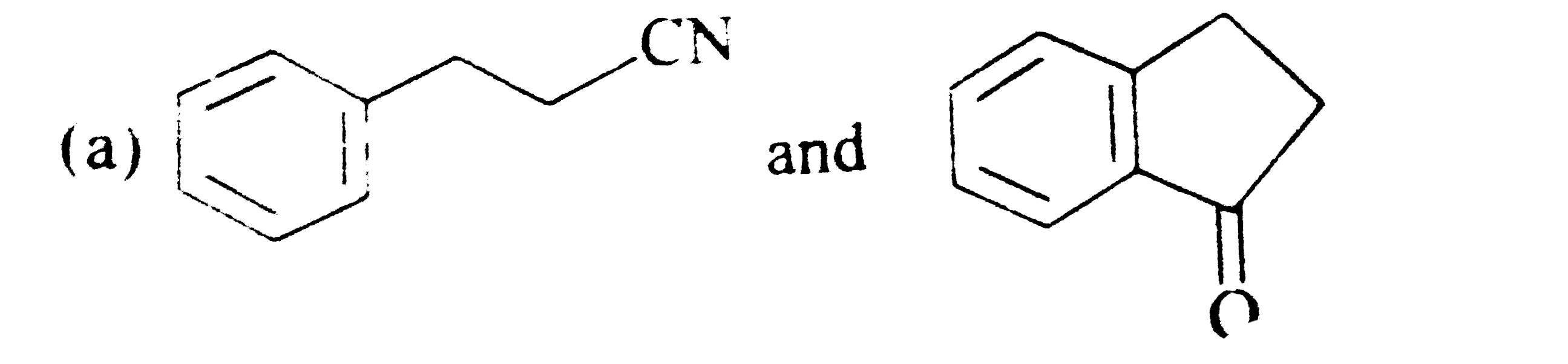
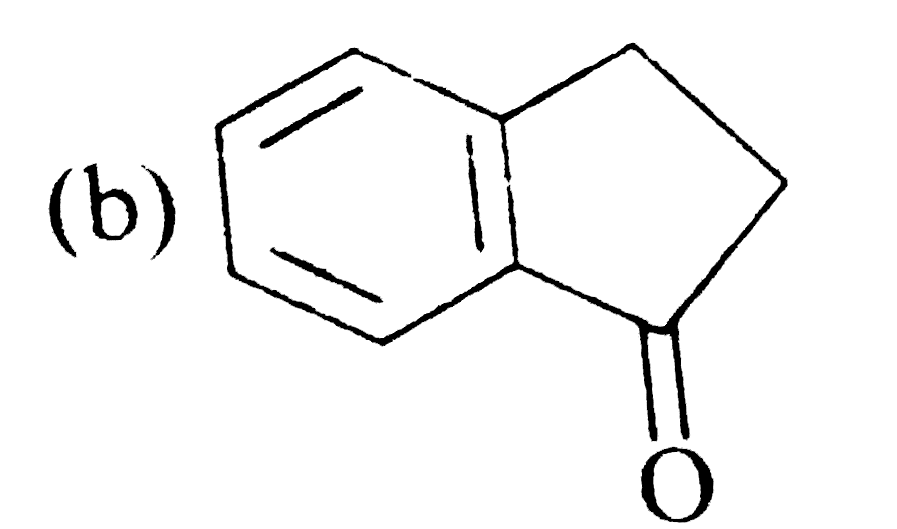
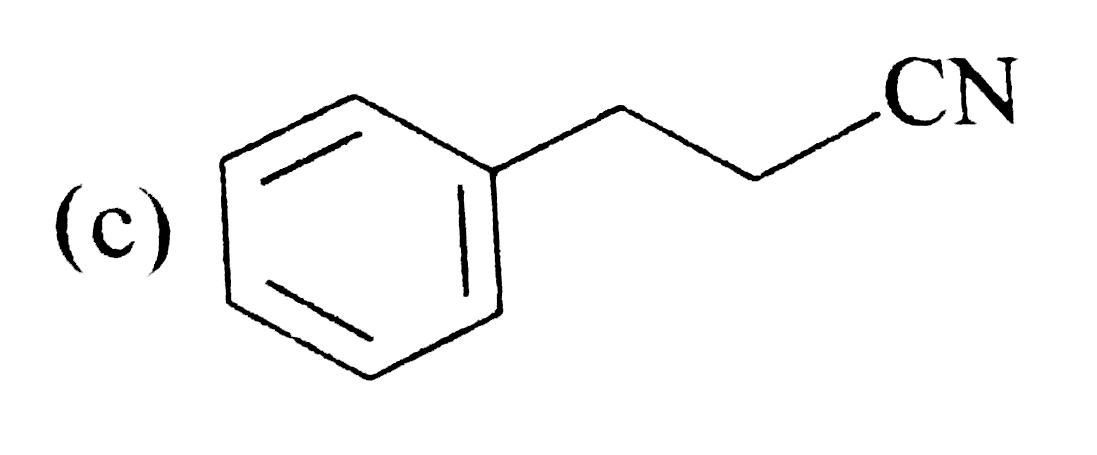
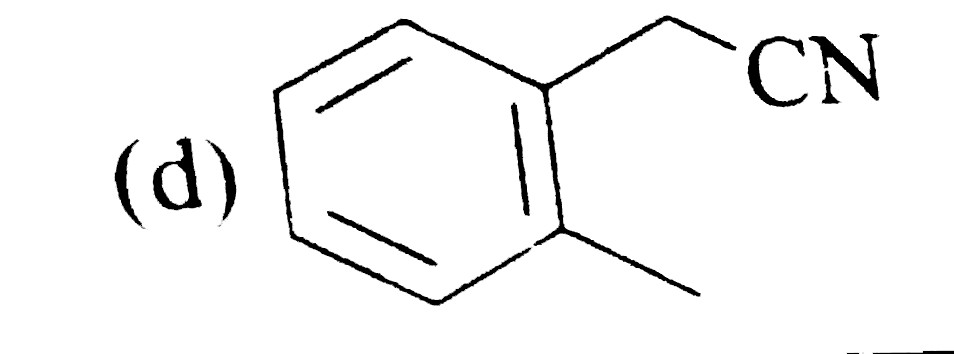
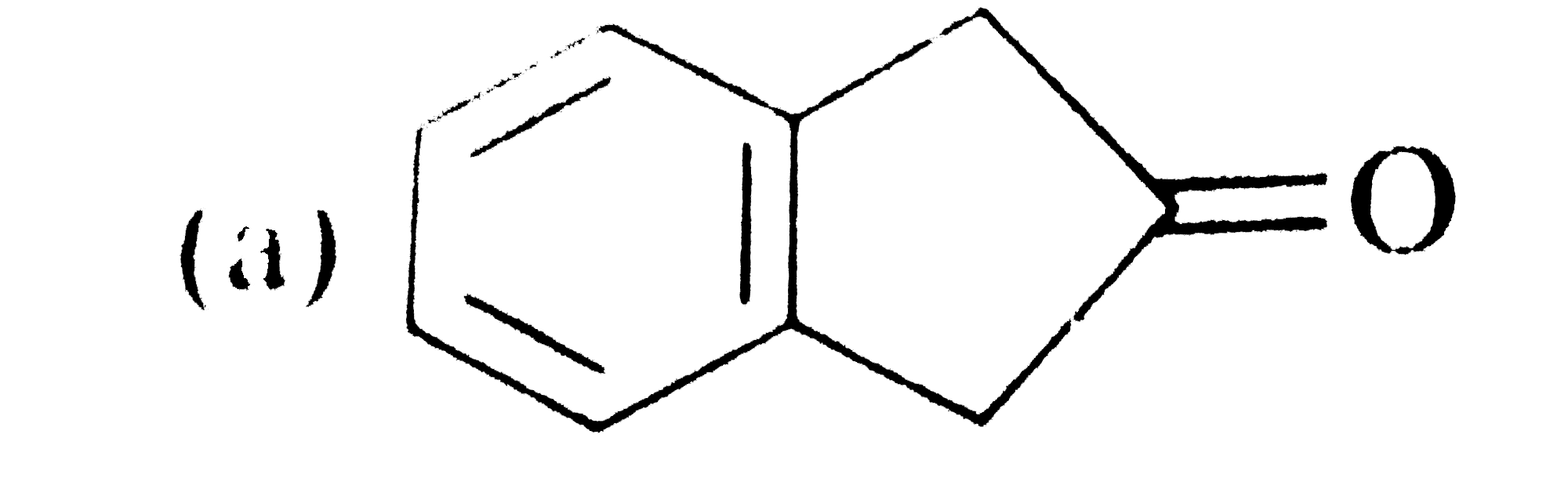
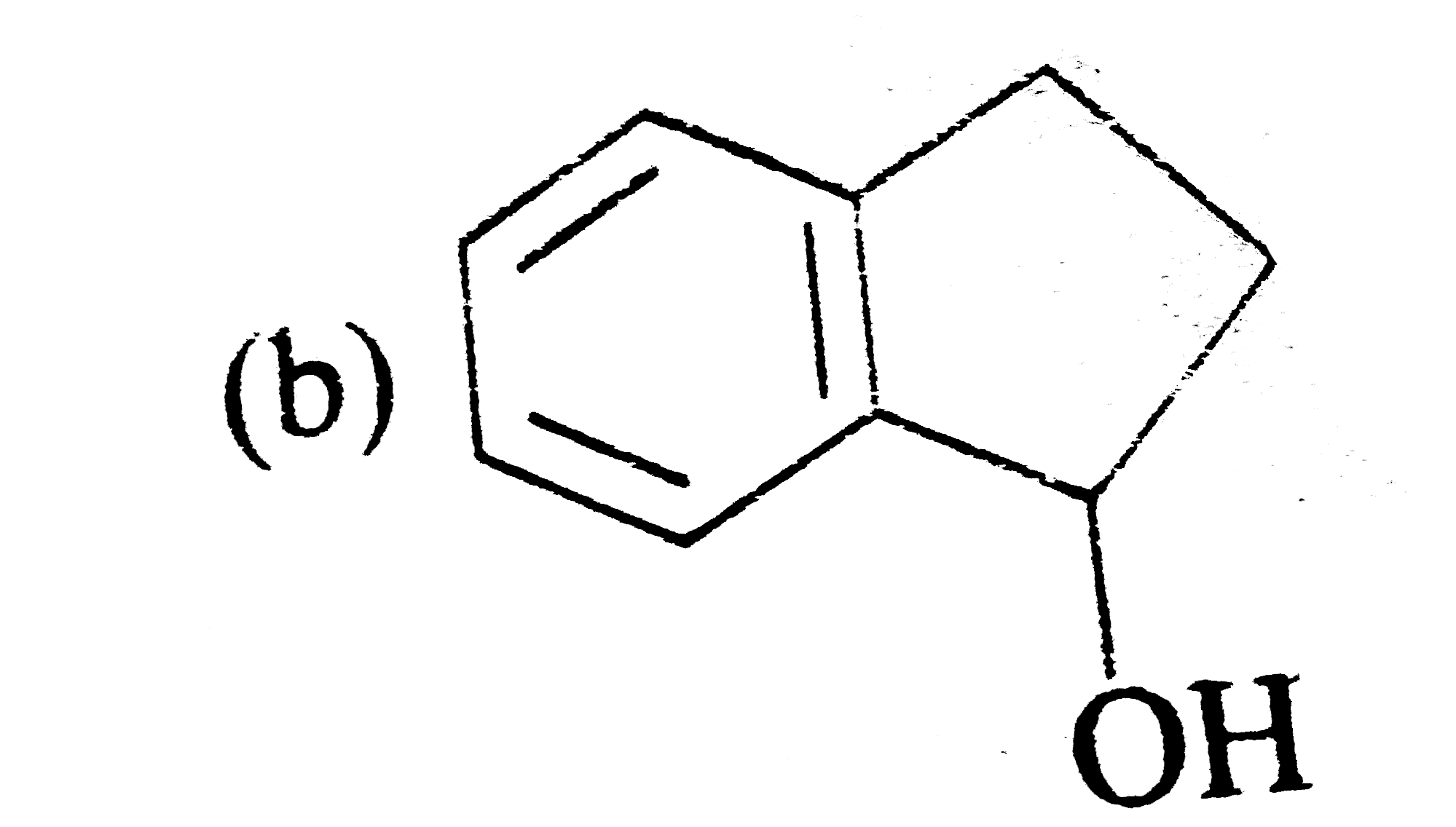
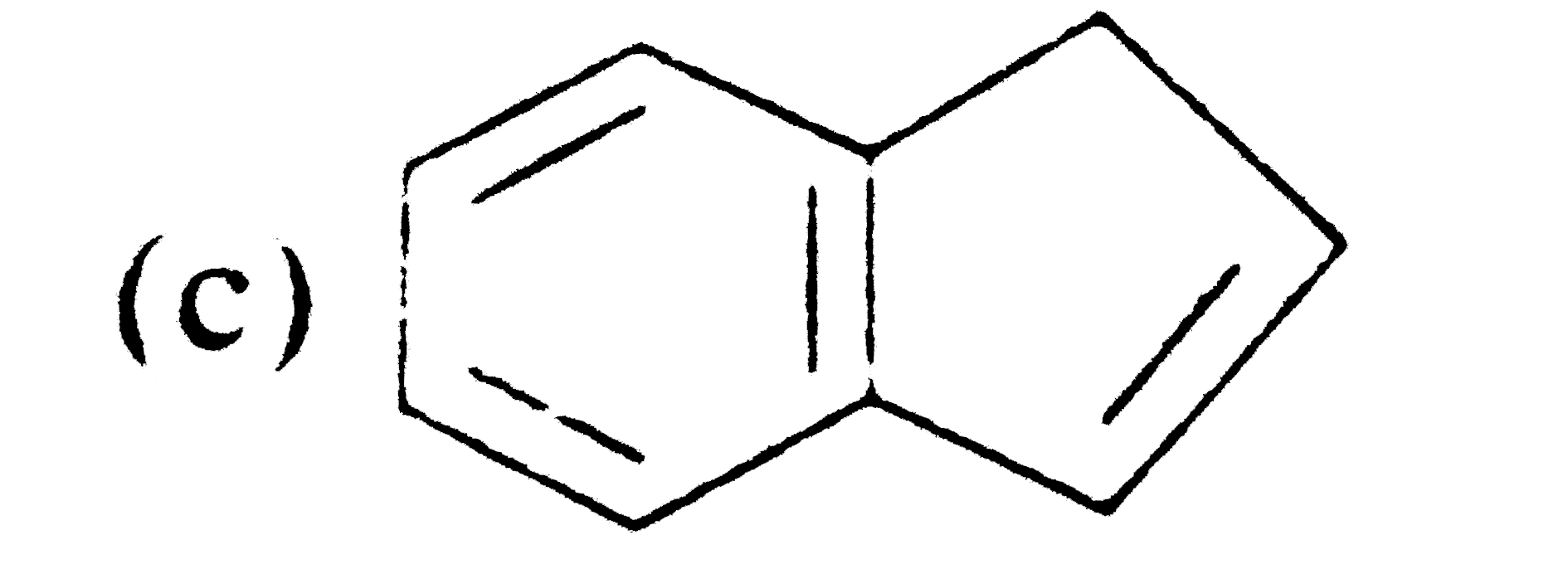
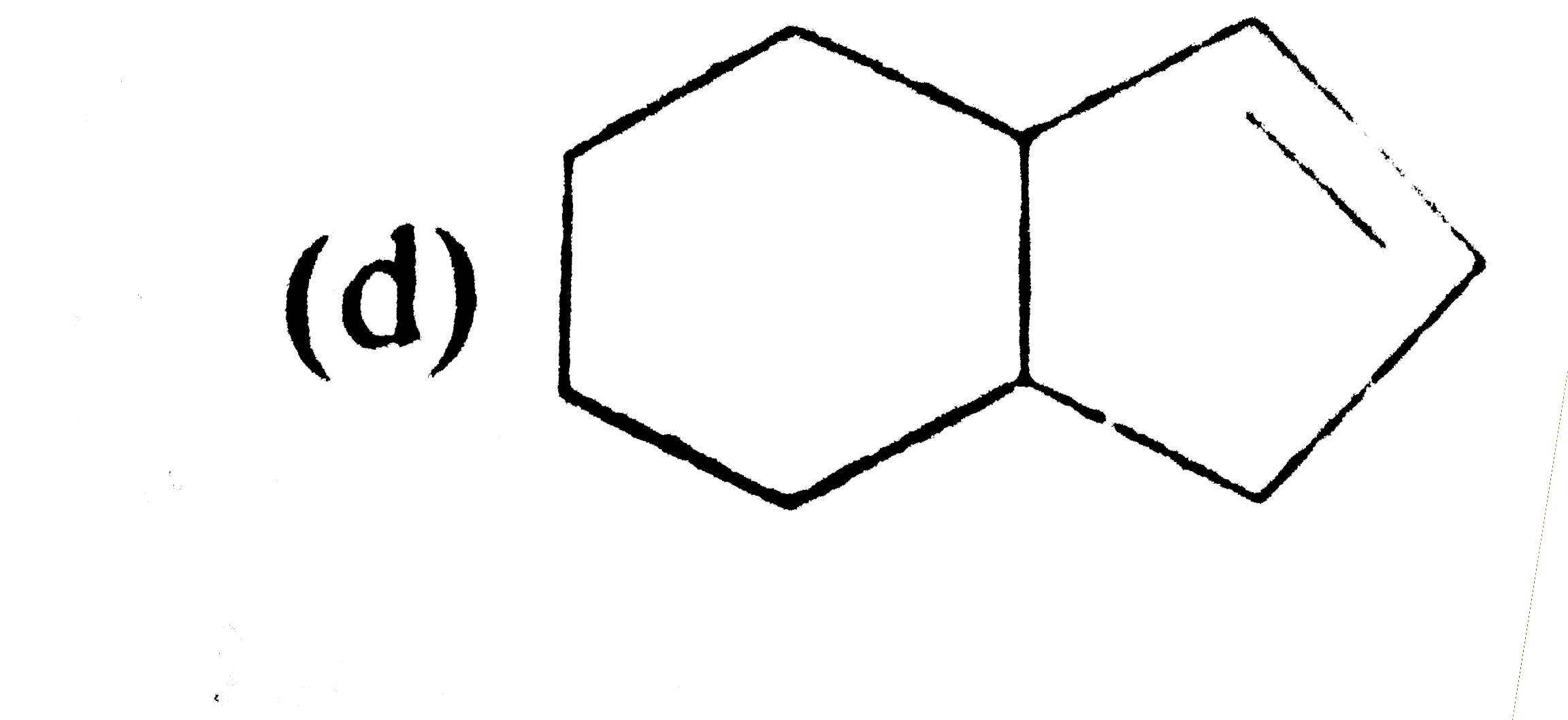
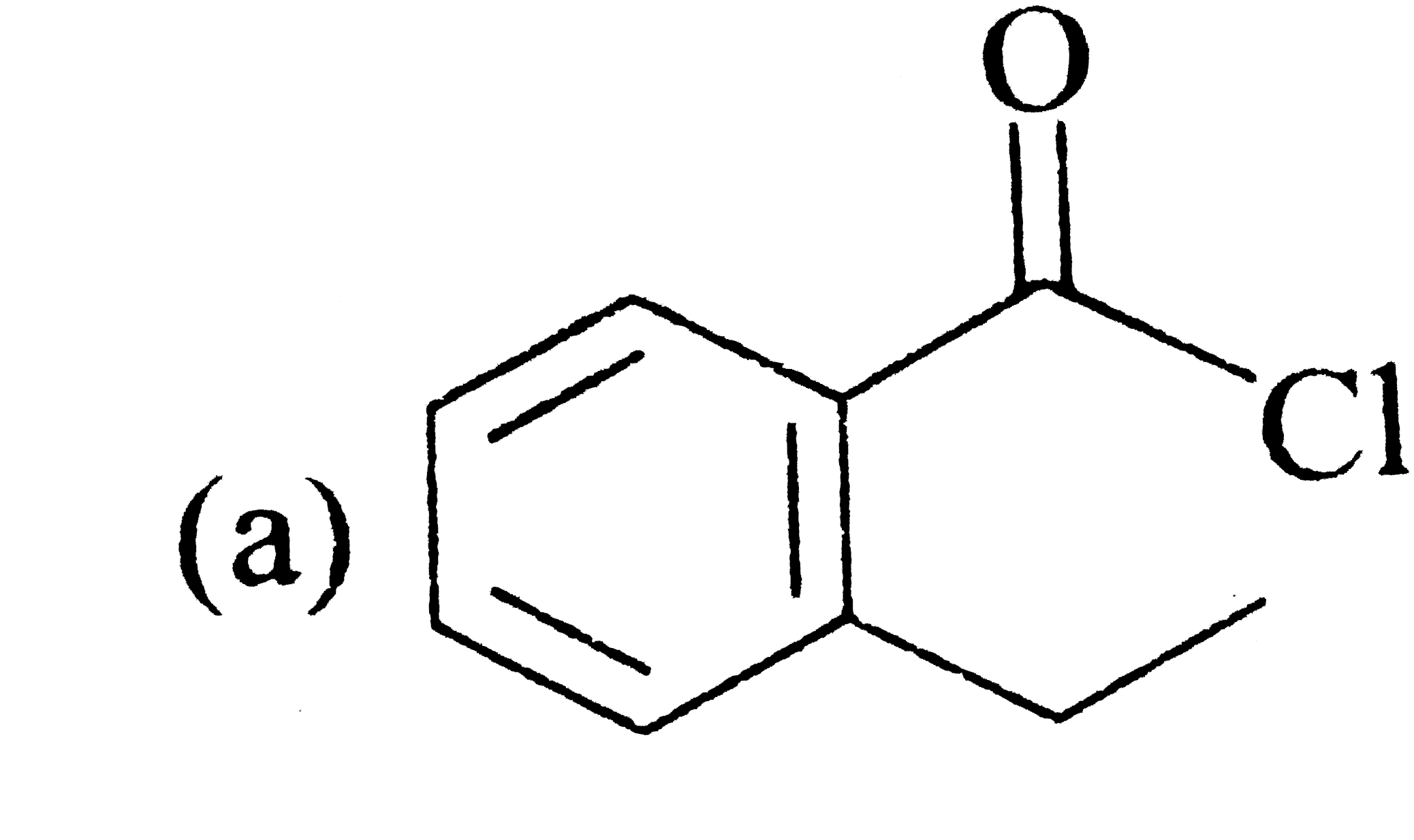
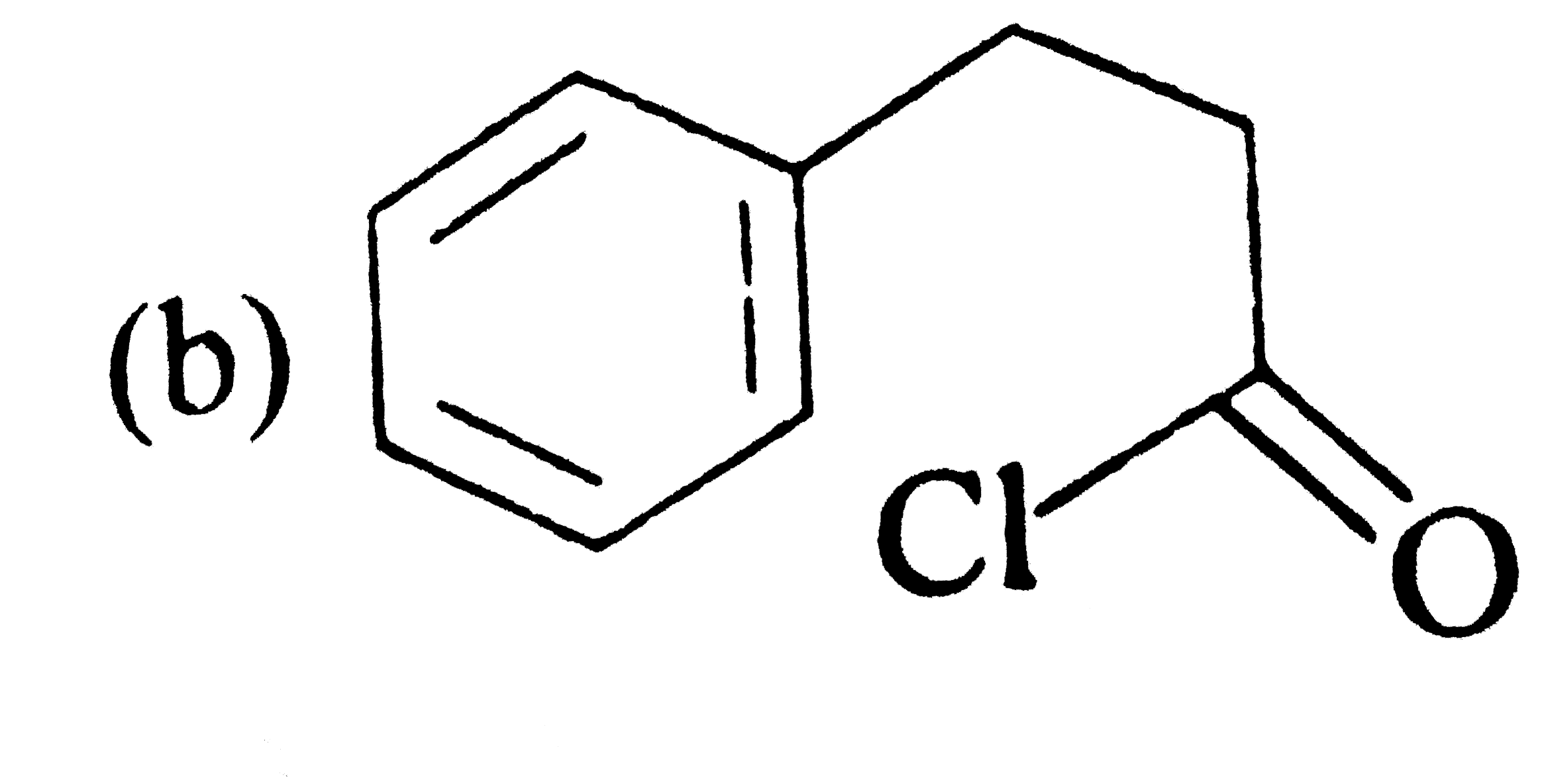
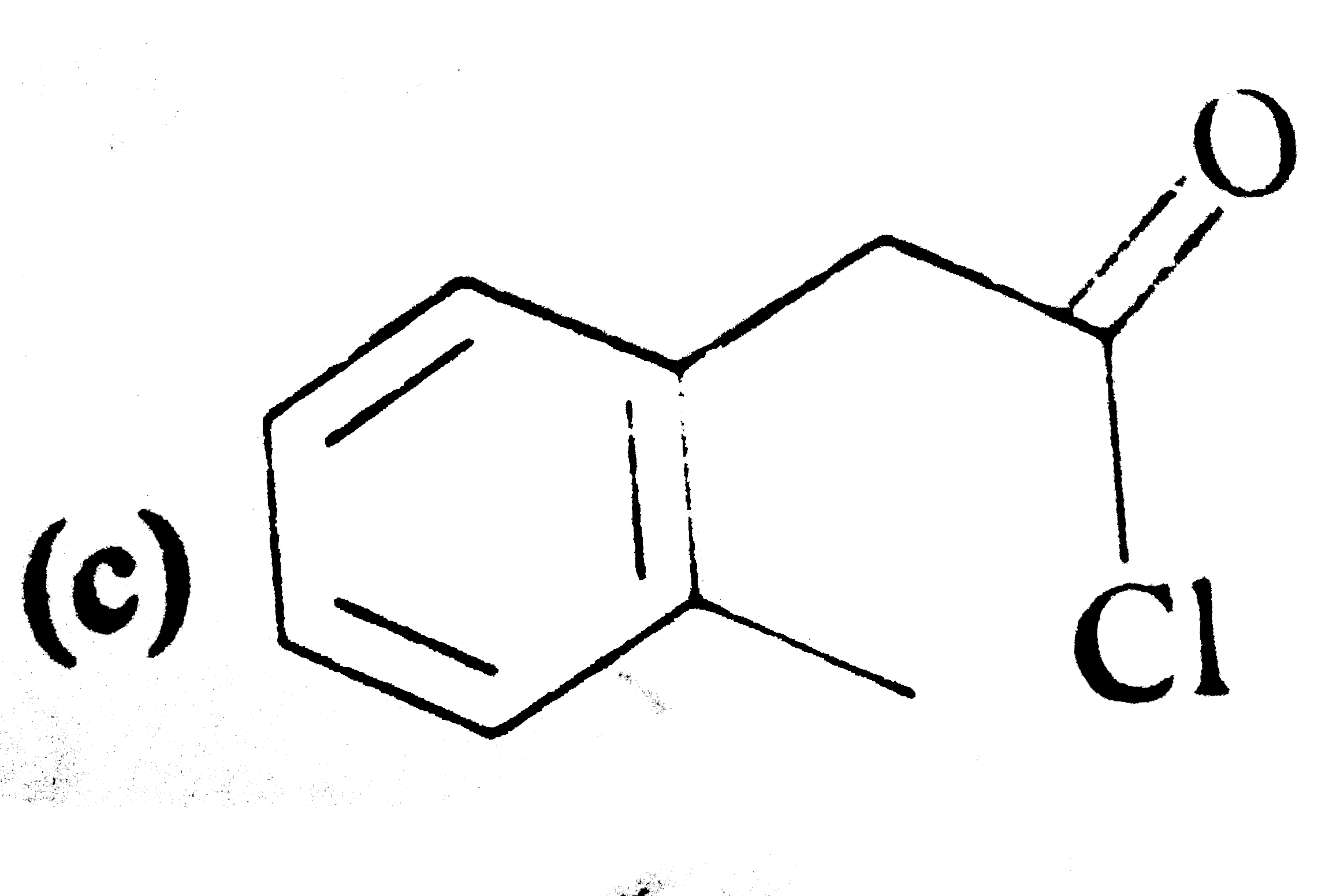
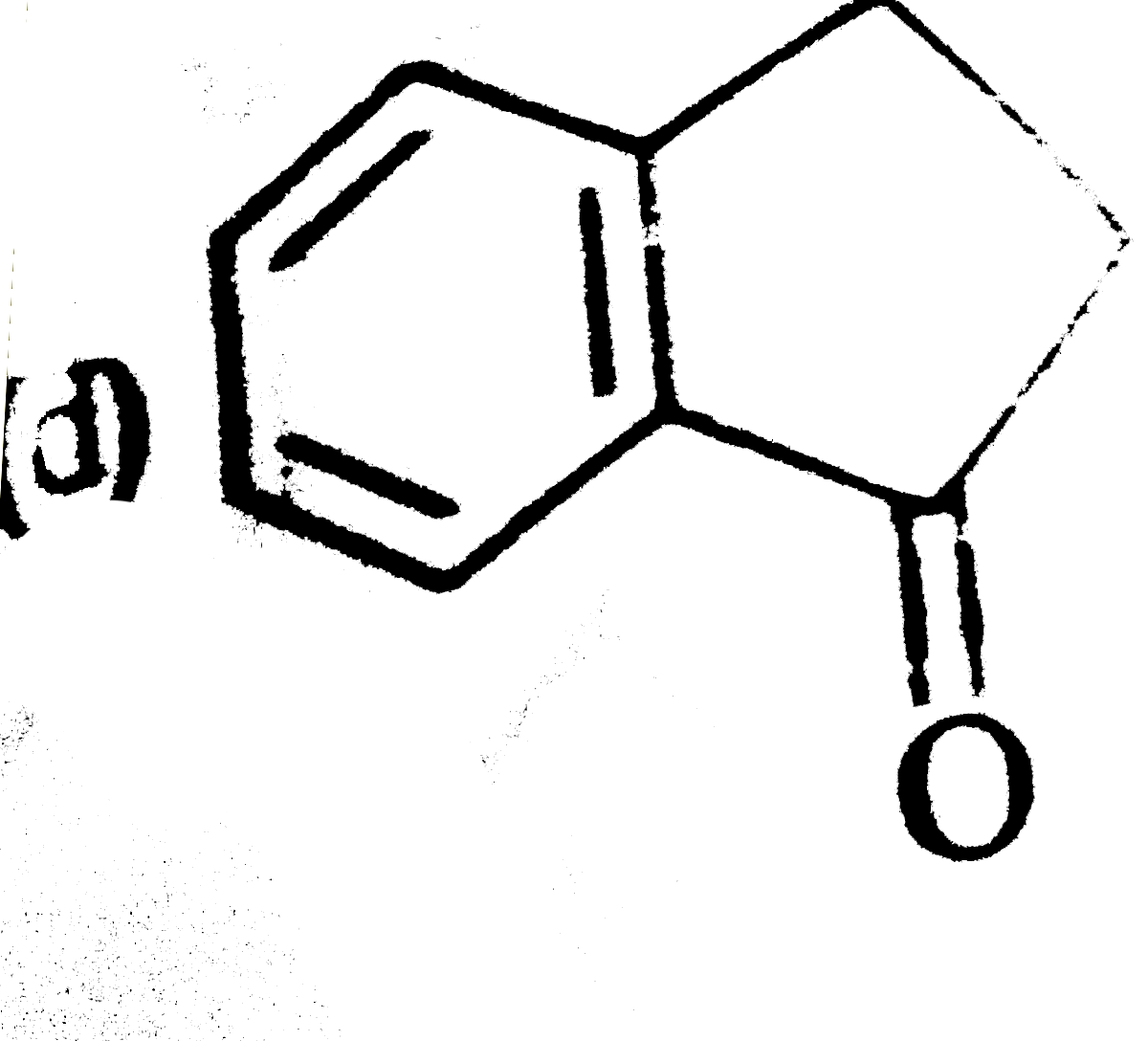
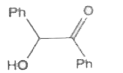
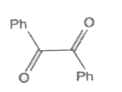
B+PBr_(3)rarrC C+NaCN rarrD D+H_(2)SO_(4)overset(Delta)rarrF(C_(9)H_(10)O_(2)) E+SOCl_(2) rarrF F+AlCl_(3) rarr G G overset(LiAlH_(4))rarrHoverset(H_(2)SO_(4))underset(Delta)rarrI The compounds D and F must be: |
|
Answer»
|
|
| 21. |
B+PBr_(3)rarrC C+NaCN rarrD D+H_(2)SO_(4)overset(Delta)rarrF(C_(9)H_(10)O_(2)) E+SOCl_(2) rarrF F+AlCl_(3) rarr G G overset(LiAlH_(4))rarrHoverset(H_(2)SO_(4))underset(Delta)rarrI Find out structure of I: |
|
Answer»
|
|
| 22. |
B+PBr_(3)rarrC C+NaCN rarrD D+H_(2)SO_(4)overset(Delta)rarrF(C_(9)H_(10)O_(2)) E+SOCl_(2) rarrF F+AlCl_(3) rarr G G overset(LiAlH_(4))rarrHoverset(H_(2)SO_(4))underset(Delta)rarrI The compound (F) must be : |
|
Answer»
|
|
| 23. |
(B) on treatment with HCl and potassium chlorate gives (A). |
|
Answer» |
|
| 24. |
Name the type of linkage between two nucleotides in nucleic acid. |
| Answer» SOLUTION :PHOSPHODIESTER is the type of linkage between TWO NUCLEOTIDES in nucleic ACID | |
| 25. |
Name the monomers used in the preparation of polythene and natural rubber. |
| Answer» SOLUTION :B) The MONOMERS USED in the preparation of polythene and natural rubber is ethene and ISOPRENE respectively. | |
| 26. |
Mention any two characteristic of enzyme catalysis. |
|
Answer» Solution :The CHARACTERISTICS of enzyme catalysis are 1) Highly efficient 2) Highly specific in ACTION 3) Highly ACTIVE under optimum TEMPERATURE and PH. |
|
| 27. |
Name the reaction to obtain benzaldehyde from: i) toluene ii) benzene iii) benzoyl chloride. |
Answer» Solution :i) Toluene : Toluene on oxisation with CHROMYL chloride `(CrO_(2)Cl_(2))` gives chromium complex, which on HYDROLYSIS gives benzaldehyde. This reaction is called Etard.s reaction.  ii) Benzene : Benzene REACTS with carbon monoxide and hydrogen chloride in the presence of anhydrous aluminium chloride and traces of cuprous chloride gives bnezaldehyde. This reaction is called GATTERMAN - Koch reaction.  iii) Benzoyl chloride : Benzoy: chloride on reduction with H, in presence of palladium catalyst supported by Barium sulphate gives benze aldehydes this reaction is called Rosenmund.s reduction. 
|
|
| 28. |
(b) Is lanthanum a f-block element ? |
| Answer» SOLUTION :`(B)` No , it is AD- BLOCKELEMENT | |
| 29. |
B is? |
|
Answer»
|
|
| 30. |
In the preparation of aryl halides by Sandmeyer's reaction, name the i) catalyst used ii) gas liberated. |
Answer» SOLUTION :Aromatic PRIMARY amines REACT with nitrous acid at low temperature [273-278K] to form diazonium salt. This reaction is called diazotisation. Freshly prepared diazoniun salt is treated with CUPROUS chloride to give aryl chloride. This reaction is called Sandmeyer.s reaction.  i) `Cu_(2)Cl_(2)" (Catalyst)"` ii) Nitrogen (gas is liberated). |
|
| 31. |
b) In the graph drawn what does A and the shaded region B represent? |
|
Answer» Solution :A is most probable kinetic energy B is FRACTION of MOLECULES having kinetic energy `GE` Ea. |
|
| 32. |
b) In the equation, rate =Z_(AB)xxe^((E_(a))/(R), what does the term e^((E_(a))/(RT) represent? |
| Answer» Solution :It repressents the FRACTION of MOLECULES having ENERGY equal to or greater than Ea. | |
| 33. |
Identify the missing reactant/product in each of the following: i) 2 -" Bromopentane "+ alc.KOH rarr A+KBr (where A is the major product) ii)2'B'+2Na overset("dry either")rarr C_(4)H_(10)+2NaBr |
|
Answer» Solution :Dehydrohalogenation reaction or `BETA-` elimination Alkyl halides undergo elimination reactions when they are heated with alcohol potash. In an elimination reactions, the electro negative halogen atom is removed along with a hydrogen from `beta-`carbon atom to forin an alkene. since `beta-`hydrogen atom is involved in the elimination, the reaction is called `beta-` elimination reaction. (i) `"2 BROMO pentane "+ alc KOH rarr" pent-2-en "+ KBr` ii) `2B+2Na overset("dry ether")rarr C_(4)H_(10)+2NaBr` `rarr 2C_(2)H_(5)Br+2Na overset("dry ether")rarr C_(4)H_(10)+2NaBr` |
|
| 34. |
(b) (i) Write a note on co-polymer. (ii) What is the difference between elastomers and fibres? Give one example of each |
|
Answer» Solution :(b) (i) 1. A polymer containing two or more different kinds of monomer units is called a co-polymer. 2. Co-polymers have properties quite different from the homopolymers. 3. The STRUCTURAL units of co-polymers are derived from the different MONOMERS may be present in REGULAR, alternation or in random order or strings of several units of one kind many alternate with strings of another. 4. For example, Buna- S, Buna-N, Nylng -6,6 ETC. Buna -S contains styrene and butadiene monomer units. 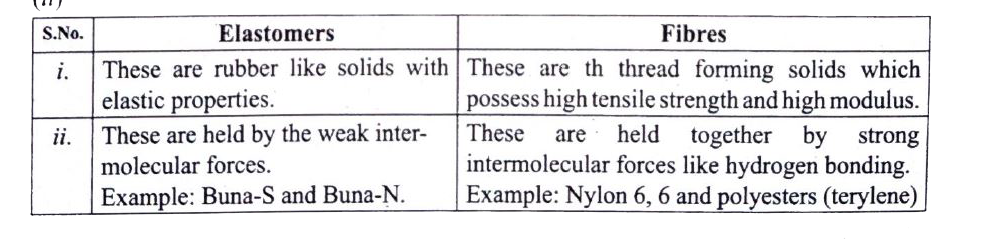
|
|
| 35. |
i) What is peptization? ii) What is the dispersed phase in a gel? iii) Which one of the following electrolyte is required in the smallest quantity to precipitate a negative sol? MgCl_(2). AICl_(3), NaCl. |
|
Answer» Solution :i) peptization: The PROCESS of CONVERSION of freshly prepared PRECIPITATE into a colloidal solution by adding an eiectrolyte containing the common ion is called peptisation. ii) Liquid is the dispersed phase in a gel. iii) `AICI_(3)` is the electrolyte that is required in the smallest quantity to precipitate a NEGATIVE SOL. |
|
| 36. |
What is the composition of the cathode in the lead storage battery? |
| Answer» SOLUTION :i) `PB, PbO_(2)` are the COMPOSITION of the cathode in lead storage BATTERY. | |
| 37. |
(b) (i) What happens when the following alkenes are subjected to reductive ozonolysis. 1. Propene, 2. Butene, 3. Isobutylene. (ii) What are reducing and non - reducing sugars? |
|
Answer» Solution :(i) 1. Propene: `underset("Propene")(CH_(3)-CH=CH_(2)) overset(O_(3)) underset(Zn//H_(2)O) to underset("Acetaldehyde")(CH_(3)CHO) + underset("Formaldehyde")(HCHO)` 2. 1- Butene: `CH_(3)-underset(1-"Butene") (CH_(2) -CH) = CH_(2) overset(O_(3)) underset(Zn//H_(2)O) to underset("Propanaldehyde")(CH_(3)-CH_(2)-CHO) + underset("Formaldehyde")(HCHO)` 3. ISOBUTYLENE: `underset("Isobutylene")(CH_(3)-underset(CH_(3))underset(|)C =CH_(2) overset(O_(3)) underset(Zn//H_(2)O) to underset("Acetone")(CH_(3)-underset(CH_(3))underset(|)C=O + underset("Formaldehyde")(HCHO)` (ii) Reducing sugars: Those carbonhydrates which contain free aldehyde or ketonic group and reduces Fehling’s solution and TOLLEN’s reagent are called reducing sugars.All monosacchaides whether aldose or ketone are reducing sugars. Non reducing agent: Cabohydrates which do not reduce Tollen’s reagent and Fehling’s solution are called non-reducing sugars. Example Sucrose. They do not have free aldehyde group. |
|
| 38. |
b) i) Pentaacetate of glucose does not react with hydroxyl amine. What does this indicate about the structure of glucose. ii) Which is the most abundant polysaccharide in plants? iii) Name the natural a-amino acid that is not optically active. |
|
Answer» Solution :i) Pentaacetate of glucose does not react with hydroxyl AMINE because of the absence of free aldehydric group. II) Cellulose is the most abundant polysaccharide in plants iii) Glycine is the NATURAL a-amino ACID that is not OPTICALLY active. |
|
| 39. |
(b) (i) Mention the uses of silicon tetrachloride. (ii) What are all the conditions that are necessary for catenation? |
|
Answer» Solution :(b) (i) Silicon tetrachloride is used in the PRODUCTION of semiconducting silicon. (II) It is used as a starting material in the synthesis of silica gel, silicic esters, a binder for ceramic materials. a) ESSENTIAL condition for CATENATION. (i) The valency of elements is greater than or equal to two. (ii) ELEMENT should have an ability to bond with itself. (iii) The self bond must be as strong as its bond with other elements. (iv) Kinetic inertness of catenated compound towards other molecules. |
|
| 40. |
i) Name the catalyst used in the manufacture of high density polythene. ii) What is the configuration at the carbon - carbon double bonds in natural rubber ? |
|
Answer» Solution :i) Zeigler Natta catalyst USED in the MANUFACTURE of high density POLYTHENE. ii) Cis configuration is present in the configuration at the CARBON carbon double BONDS in natural rubber. |
|
| 41. |
i) Mention the role of alum in the purification of drinking water. ii) Give an example for oil dispersed in water emulsion. |
|
Answer» SOLUTION :b) i) It COAGULATES the suspended impurities. ii) MILK is an example for OIL dispersed in water EMULSION. |
|
| 42. |
(b) (i) KF crystallizes in fcc structure like sodium chloride. Calculate the distance between K^(+) and F^(-) in KF . (given: density of KF is 2.48g cm^(-3)) (ii) How do concentration of the reactant influence the rate of reaction? |
|
Answer» Solution :(b) (i) Density of KF `2.48 g cm^(-3) " " rho = (nM)/(a^(3)N_(A))` n=4 (for FCC) `rho = (4 xx 58)/(a^(3) xx 6.023 xx 10^(23))` `2.48 = (4 xx 58)/(a^(3) xx 6.023 xx 10^(23))` `a^(3) = (4 xx 58)/(2.48 xx 6.023 xx 10^(23))` `a^(3) = (232)/(14.93 xx 10^(23))` `a^(3) = 15.54 xx 10^(-23)` a= 537.5 pm `d= (a)/(sqrt2)` (For fcc) `d= (537.5)/(1.414)` d= 380.12 pm (ii) The rate of a reaction increases with the increase in the concentration of the reactants. The effect of concentration is explained on the basis of collision theory of reaction rates. According to this theory, the rate of a reaction depends upon the number of collisions between the reacting molecules. Higher the concentration, GREATER is the possiblity for collision and hence the rate. |
|
| 43. |
i) How many peptide bonds are in a hexapeptide? ii) Write the general structure of the Zwiter ionic form of an alpha- amino acid. iii) Deficiency of which vitamin cause pernicious anemia? |
|
Answer» Solution :b i) The `-CO-NH-` bond formed b/w the `alpha` amino acids is called peptide bond (or) peptide LINKAGE Hence hexapeptide contains five (5) peptide linkages ii) General structure for the zwilter IONIC from of an `alpha` amino acids is `R-overset(NH_(3)^(+))underset("|")underset("H ")underset("|")"C "-COO^(-)` iii) DEFICIENCY of vitamin `B_(12)` CAUSE pernicious anemia. |
|
| 44. |
(b) (i) How is Aniline converted into Phenol? (ii) What is the action of HCN on (1) propanone (2) 2,4-dichlorobenzaldehyde. |
Answer» Solution :(b) (i) Aniline is diazotized with NITROUS acid (NANO2 + HCl) at 273-278K to GIVE benzene diazonium chloride which on further treatment with hot water in the presence of mineral acid gives phenol. 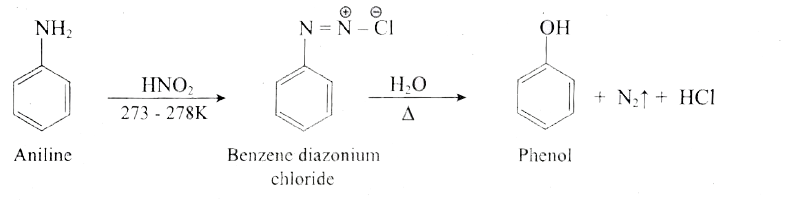 (ii) 1. Propanone reacts with HCN: `underset(underset(("Acetone"))(("Propanone")))(CH_(3) - underset(underset(O)(||))(C) - CH_(3) + HCN) rarr underset(underset(("Cyanohydrin"))(("Acetone")))(CH_(3) - underset(underset(OH)(|))overset(overset(CN)(|))(C) - CH_(3))` 2. 2,4-dichlorobenzaldehyde reacts with HCN: 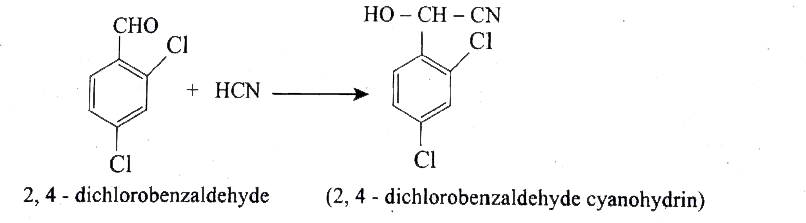
|
|
| 45. |
(b) (i) Give the uses of sulphuric acid.. (ii) How alloys are formed in d-block elements? |
|
Answer» SOLUTION :(b) (i) Sulphuric acid is used in the manufacture of fertilisers, ammonium sulphate and super phosphates and other chemicals such as hydrochloric acid, nitric acid etc. 2. It is used as a drying agent and also used in the preparation of pigments, explosives etc. (ii) 1. An alloy is formed by blending a metal with one or more other elements. The elements may be metals or non-metals or both. 2. The bulk metal is NAMED as SOLVENT, and the other elements in smaller portion is called solute. 3. According to Hume-Rothery rule to form an alloy, the difference between the atomic radii of the solvent and solute is LESS than 15%. Both the solvent and solute must have the same crystal structure and VALENCE and their electro negativity difference must be close to zero. 4. Since their atomic sizes are similar and one metal atom can be easily replaced by another metal atom from its crystal lattice to form an alloy. The alloys are hard and have high melting points. Examples: Gold- copper alloy |
|
| 46. |
i) Give reason: Aniline is a weaker base than ammonia. ii) C_(6)H_(5)NH_(2)overset(NaNO_(2))underset(HCl, 273K)rarr X overset(Cu_(2)Cl_(2))underset(HCl)rarr Y. |
|
Answer» Solution :B) i) Lone pair of electrons DENSITY on nitrogen less available in aniline due to delocalization so aniline is weaker base than ammonia. II) AROMATIC primary AMINES react with `NaNO_(2) & HCl` at low temperature `(273 - 278 K)` to form diazonium salt. This reaction is called diazotisation. Freshly prepared diazonium salt is treated with cuprous chloride or cuprous bromide to give aryl chloride or aryl bromide this reaction is called sandmeyer.s reaction. 
|
|
| 47. |
(b) (i) Describe about lithium-ion battery and its uses. (ii) Give reasons for the following (1) Rusting of iron is quicker in saline water than in ordinary water. (2) Aluminium metal cannot be produced by the electrolysis of aqueous solution of aluminium salt. |
|
Answer» Solution :(b) (i) 1. Lithium ion battery Anode: Porous GRAPHITE Cathode : Transition metal oxide as `CoO_(2)` Electrolyte: Lithium salt in an organic solvent 2. At the anode oxidation occurs `Li_((s)) RARR Li_((aq))^(+) + E^(-)` At the cathode reduction occurs. `Li^(+) + CoO_(2(s)) + e^(-) rarr LiCoO_(2(s))` 3. Overall reactions `Li_((s)) + CoO_(2) rarr LiCoO_(2(s))` 4. Both electrodes allow `Li^(+)` ions to move in and out of their structures. During discharge the `Li^(+)` ions produced at the anode moves towards cathode through the non-aquaeous electrolyte. 5. When a potential greater than the EMF produced by the cell is applied across the electrode, the cell reaction is reversed and now the `Li^(+)` ions move from cathode to anode where they become embedded on the porous electrode. This is known as intercalation. 6. Uses- This Li-ion battery is used in cellular phones, Laptop computer and digital CAMERA. (ii) 1. It is because in saline water, there are more `H^(+)` ions. Greater the number of `H^(+)` ions, quicker the rusting will take place. 2. It is because aluminium metal is more reactive than hydrogen and it will react with `H_(2)O`. |
|
| 48. |
b i) Aryl halide with sodium in dry ether undergoes Fitting reaction. Write the equation and name the product. ii) Arrange the following in the increasing order of their reactivity towards nuclelophilic substitution reaction. |
Answer» SOLUTION :i) TWO MOLECULES of aryl halides reacts with sodium METAL in dry ether to give biphenyl. This reaction is called fitting reaction. 
|
|
| 49. |
b) i) Between mercury cell and nickel-cadmium cell, which is a secondary cell? |
| Answer» SOLUTION :i) NICKEL - CADMIUM is a SECONDARY CELL | |
| 50. |
(b) (i) Calculate the magnetic moment of Ti^(3+) and V^(4+) (ii) Draw all possible isomers of the complex [Co(en)_(2)Cl_(2)]^(+) and identify the optically active isomer. |
|
Answer» Solution :(b) (i) `TI(Z =22) Ti^(3+) 3d^(1)` `V(Z=23) V^(4+) 3d^(1)` `therefore mu = SQRT(1(1+2)) = sqrt(3) = 1.73 mu_(B)`. So they are paramagnetic (ii) 1. Cis `[Co(en)_(2)Cl_(2)]` 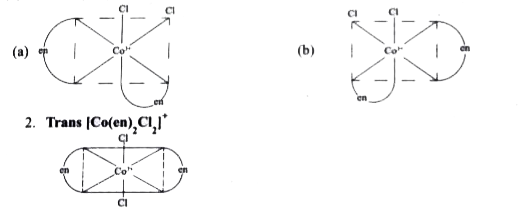 `[Co(en)_(2)Cl_(2)]^(+)` The coordination complex `[Co(en)_(2)Cl_(2)]^(+)` has three isomers TWO optically active cis forms and the optically inactive trans form. 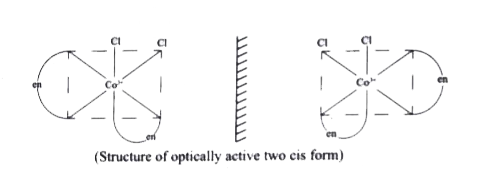
|
|