Saved Bookmarks
This section includes 7 InterviewSolutions, each offering curated multiple-choice questions to sharpen your Current Affairs knowledge and support exam preparation. Choose a topic below to get started.
| 2. |
An alloy of which pair of metals is liquid at ordinary temperature and is used in special thermometers used for finding temperatures above the boinding point of mercury. |
|
Answer» `Na and Hg` |
|
| 3. |
An alloy of which of the following metal is used in filling the cavity in the tooth? |
|
Answer» HG, AG, Sn, CU, Ni |
|
| 4. |
An alloy of Pb-Ag weighing 1.08g was dissolved in dilute HNO_(3) and the volume made to 100 mL.A ? Silver electrode was dipped in the solution and the emf of the cell dipped in the solution and the emf of the cell set-up as Pt(s),H_(2)(g)|H^(+)(1M)||Ag^(+)(aq.)|Ag(s) was 0.62 V . If E_("cell")^(@) is 0.80 V, what is the percentage of Ag in the alloy ? (At 25^(@)C, RT//F=0.06) |
|
Answer» |
|
| 5. |
An alloy of Pb(II) and TI(I) containing 70% Pb and 30% Ti by weight can be electroplated on to a cathode from a perchloric acid solution. How much time would be required to deposit 5.0 g of this alloy at a current of 1.1 amp? (Pb = 207.19, TI = 204.37) |
| Answer» SOLUTION :1 HOURS | |
| 6. |
An alloy of Pb Ag weighing 1.08 g was dissolved in dilute HNO_(3)and the volume made to 100 mLA silver electrode was dipped in the solution and the emf of the cell set up pt (s) H_(2)(g)|H^(+)(1M)||Ag^(+)(aq)|Ag(s) was 0.62 V if E_(cell)^(@)=0.80V what is the percentage of Ag in thealloy ? At 25^(@)C RT/F=0.6 |
|
Answer» 25 EMF of cell `=0.62 V E_(cell)^(@)=0.80 V` `H_(2) rarr 2H^(+) +2e^(-)` `2Ag^(+) +2e^(-) rarr 2AG` `H_(2) +2Ag^(+) rarr 2Ag+ 2H^(+)` `E_(cell) =E^(@) -(2.033 RT)/(2F)log [(H^(+))]/(Ag^(+))^(2)` `E_(cell) =E^(@) -(2.303 RT)/(2F) log (1)/(Ag^(+))^(2)` `0.62 =0.80 +(2xx2.303xx0.06)/(2)log Ag^(+)` `therefore`moleof `Ag^(+)`in 100 mL `=0.05 xx100/1000 xx108` %of Agin 1.08 g alloy`=(0.05 xx100xx108 )/(1000xx1.08)xx100=50%` |
|
| 7. |
An alloy of Pb-Ag weighing 1.08 g was dissolved in dilute HNO_(3) and th volume made to 100 ml. A silver electrode was dipped in the in the solution and the EMF of the cell set up Pt(s),H_(2)(g)|H^(+)(1M)||Ag^(+)(aq)|Ag(s) was 0.62 V. if E_(cell)^(@)=0.80V, what is the percentage of Ag in the alloy? [At 25^(@)C,2.303RT//F=0.6] |
|
Answer» 25 `H_(2)+2Ag^(+)to2H^(+)+2Ag` `E_(cell)=E_(cell)^(@)-(2.303RT)/(2F)"log"(1)/([Ag^(+)]^(2))` `0.62=0.0.80+0.06log[Ag^(+)]` or `log[Ag^(+)]=(-0.18)/(0.06)=-3` `therefore[Ag^(+)]="antilog"(-3)=1.0xx10^(-3)M` `=(1.0xx10^(-3))xx108" g "L^(-1)=0.108gL^(-1)`. `therefore` AMOUNT of Ag present in 100 ml solution `=0.0108g` `therefore%` of `Ag=(0.0108)/(1.08)xx100=1%` |
|
| 8. |
An alloy of Pb-Ag weighing 1.08 g was dissolved in dilute HNO_(3) and the value made to 100 mL. A silver electrode was dipped in the solution and EMF of the cell set up Pt_((s)),H_(2(g))|H^(+)(1M)||Ag_((aq))^(+)|Ag_((s)). was 0.62V. The percentage of Ag in the alloy is [E_(cell)^(@)=0.80V,2.303RT//F=0.06" at "25^(@)C] |
|
Answer» `E_(CELL)=E_(cell)^(o)-(2.303RT)/(nF)"log"(1)/([Ag^(+)]^(2))` `0.62=0.80+0.06log[Ag^(+)]` or log`[Ag^(+)]=(-0.18)/(0.06)=-3` or `[Ag^(+)]=1.0xx10^(-3)M` `=1.0xx10^(-3)xx108=0.108g" "L^-1` `therefore`AMOUNT of Ag in 100 mL solution=0.0108g `therefore%Ag=(0.0108)/(1.08)xx100=1` |
|
| 9. |
An alloy of Pb-Ag weighing 1.08 g was dissolved in dilute HNO, and the volume made to 100 mL. A silver electrode was dipped in the solution and the emf of the cell set-up Pt(s), H_2(g) |H^(+)(1 M)||Ag^(+) (ag)|Ag(s) was 0.62 V. If E_("cell")^@ is 0.80 V, what is the percentage of Ag in the alloy? (At 25^@C, RT//F =0.06) |
|
Answer» 25 |
|
| 10. |
An alloy of metals X and Y weighs 12 g and contains atoms X and Y in the ratio of 2:5. The percentage of metal X in the alloy is 20 by mass. If the atomic mass of X is 40, what is the atomic mass of metal Y ? |
|
Answer» SOLUTION :`"Mass of metal X in the alloy"=(20)/(100)xx12=2.40g` `"Mass of metal Y in the alloy"=12-2.4=9.6g` `"No. of atoms of X in 2.40 g of X"=(2.40)/(40)xx6.022xx10^(23)=3.61xx10^(22)` ltBrgt `"Ratio of atoms X and Y"=2:5` `therefore"No. of atoms of Y in the alloy"=(5)/(2)xx3.61xx10^(22)=9.025xx10^(22)` Thus, `9.025xx10^(22)` atoms of Y have mass = 9.6 g `therefore""6.022xx10^(23)" atoms of Y will have mass"=(9.6)/(9.025xx10^(2))xx6.022xx10^(23)g=64.0g` Hence, atomic mass of Y = 64 amu. |
|
| 11. |
An alloy of metals M and N, crystallises in ccp. Atoms of N occupy lattice points and atoms of M occupy one-third of tetrahedral voids. What is the composition of the unit cell? |
|
Answer» Solution :Unit CELL of ccp has 8 atoms of N at comers and 6 atoms of N at face centres. Number of atoms of `N= 8 xx (1)/( 8) +6 xx (1)/(2)=1 + 3=4` Number of tetrahedral voids `=2 xx 4=8` Number of atoms of M `=8 xx (1)/(3) = (8)/(3)` Ratio of number of atoms of M and number of atoms of N `=(8)/(3) : 4 = (8)/(3) : (8)/(2) = 2:3` Composition of ALLOY is `M_(2) N_(3)` |
|
| 12. |
An alloy of iron (54.7%), nickel (45.0%) and manganese (0.3%) has a density of8.17 g/cc. How many iron atoms are there in a block of alloy measuring 10.0 cm x 20.0 cm x 15.0 cm? |
| Answer» SOLUTION :`1.45 XX 10^26` | |
| 13. |
An alloy of copper, silver and gold is found to have copper constituting the ccp lattice. It gold atoms occupy the edge centres and silver is persent at body centre, the alloy has a formula |
|
Answer» `Cu_(4)Ag_(2)Au` `=(8xx(1)/(8))+(6xx(1)/(2))=4` Au atoms occupying the edge centres `=12XX(1)/(4)=3` Ag atom present at the body centre = 1. Hence, the FORMULA is `Cu_(4)Au_(3)Ag` . |
|
| 14. |
An alloy of iron (54.7%) nickel (45%) and manganese (0.3%) has a density of 8.17 g//cm^(3). How many iron atoms are there in a block of alloy measuring 10cmxx20cmxx15cm? |
|
Answer» Solution :Volume of the block of alloy`=10020xx15cm^(3)` =`3000cm^(3)` Mass of the block `=300xx8.17g=24510g` Mass of iron in the block `=(54.7)/(100)xx24510=13406.97g` Number of iron atoms in the block `=("Mass")/("Atomic mass")xx6.023xx10^(23)` `=1.442xx10^(26)` |
|
| 15. |
An alloy of copper, silver and gold is found to have copper constituting the ccp lattice . If silver atoms occupy the edge centre and gold is present at body centre, the alloy has a formula : |
|
Answer» `Cu_4Ag_2Au` |
|
| 16. |
An alloy of copper, silver and gold is found to have copper constituting the C.C.P. lattice. If silver atoms occupy the edge centres and gold is present at body centre, the alloy has a formula- |
|
Answer» `Cu_(4)Ag_(2)AU` |
|
| 17. |
An alloy of copper and zinc solidifies in ccp structure, where copper occupies lattice points and zinc occupies 50% of the tetrahedral voids and all octahedral voids. Calculate the weight percentage of copper in the alloy. |
|
Answer» SOLUTION : Lattice points of fee are, comers of the cube (8) and centre of the faces (6) Number of copper atoms present in the unit CELL = Number of tetrahedral voids = 8 and Number of octahedral voids = 4 Number of zinc atoms in the unit cellAtoms of Cu and Zn are in the ratio, 4:8 = 1:2 MOLE ratio of the atoms of constituent elements of the alloy, Cu and Zn = `2xx64.5 =129 g` MASS of Cu = 63.5g. Mass ofZn = 2X64.5 = 129 g percetnage weight of cu `=("weight of copper")/("weight of alloy") xx100` `=(63.5)/(63.5+129)xx100=(63.5)/(192.5)xx100=33%` |
|
| 18. |
An alloy of Al. Ni and Co used in permanent magnets is : |
|
Answer» Invar |
|
| 19. |
An alloy of Au and Cu crystallises with atoms of an occupying all lattice points at the corners of cubic and atoms of Cu occupying the centres of all faces. Write the empirical formula of the alloy. |
| Answer» SOLUTION :`AuCu_(3)` | |
| 20. |
An alloy is made up of metals X and Y. Atoms of X are in ccp arrangement. Atoms of Y occupy half of the tetrahedral and all octahedral voids. Write the composition of the alloy. |
| Answer» SOLUTION :`XY_(2)` | |
| 21. |
An alloy is : |
|
Answer» Intermetallic compound |
|
| 22. |
An allotrope X of group 14 element on oxidation with conc. HNO_(3) gives graphite acid. The X is |
|
Answer» Diamond |
|
| 23. |
An alloy consisting of 80% Ag + 20% Cu is: |
|
Answer» COINAGE SILVER |
|
| 24. |
An allotrope of phosphorus which is poisonous in character is :1) red P2) black P3) yellow P4) white P |
|
Answer» RED P |
|
| 25. |
An allotrope of phosphorus used in safety matches is |
|
Answer» WHITE phosphours |
|
| 26. |
An allotrope of phosphorus which is poisonous in character is : |
|
Answer» RED P |
|
| 27. |
An alkyne, when added to a solution of AgNO_3 in NH_3OH forms a precipitate. The alkyne is a: |
|
Answer» TERMINAL alkyne |
|
| 28. |
An alkyne ob ozonolysis produces 2,3-Butanedione. What is its possible structure? |
|
Answer» `underset("But-2-yne")(CH_(3)-C-=C-CH_(3))overset(OZONOLYSIS)rarrCH_(3)-overset(O)overset(||)(C )-overset(O)overset(||)(C )-CH_(3)` |
|
| 29. |
An alkyne combines with a conjugated diene to give an unconjugated cyclooctadiene. The most likely title of this reaction is |
|
Answer» Schotten-Baumann reaction 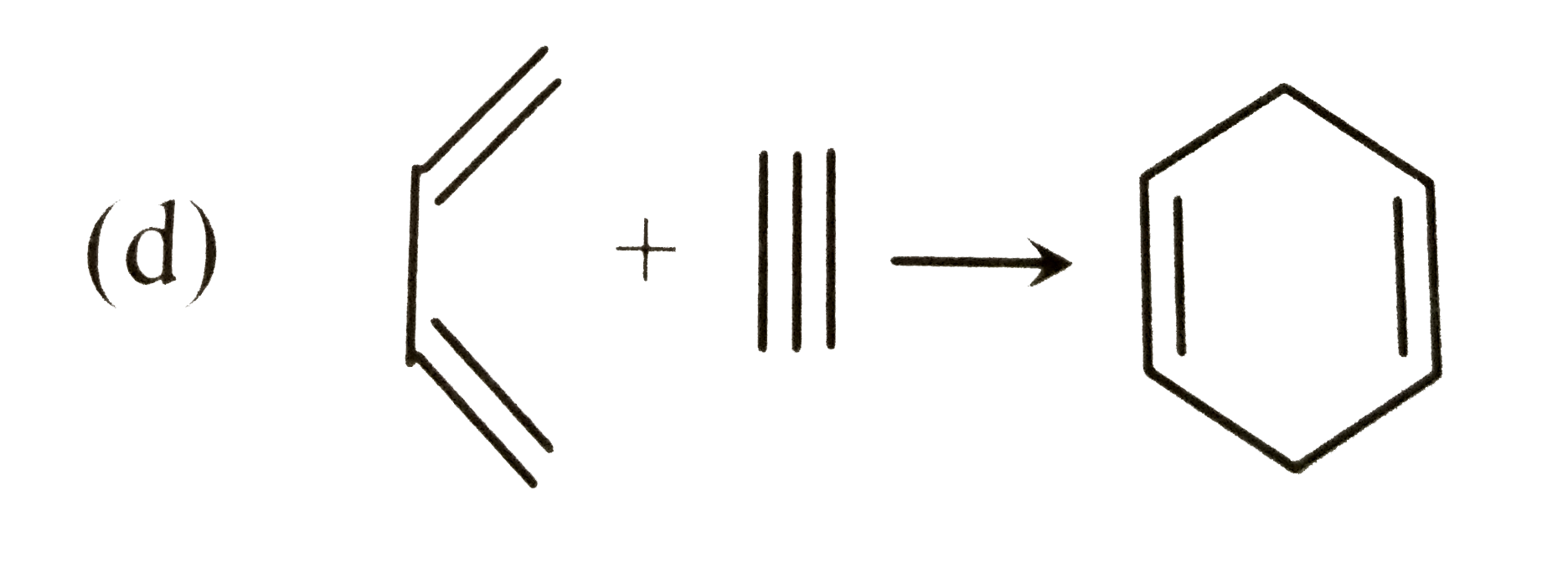
|
|
| 30. |
An alkyl iodide (X) reacts with sodium in ether to form 4,5-diethyloctane , the compound (X) is _________. |
|
Answer» `CH_(3)(CH_(2))_(3)I` |
|
| 31. |
An alkyl iodide on standing darkens due to: |
|
Answer» Hydrolysis |
|
| 32. |
An alkyl iodide on standing darkens due to |
|
Answer» hydrolysis |
|
| 33. |
An alkyl halide with molcular formula C_(6)H_(13)Br on dehydrohalogenation gave two isomeric alkenes X and Y with molecular formula C_(6)H_(12). O reductive ozonolysis, X and Y gave four compounds CH_(3)COCH_(3),CH_(3)CHO,CH_(3)CH_(2)CHO and (CH_3)_(2)CHCHO. the alkyl halide is. |
|
Answer» 2-Bromohexane.  . .
|
|
| 34. |
An alkyl halide with beta-hydrogen atoms when reacted with a base or a nucleophile has two competing routes: substitution (S_(N)1 and S_(N)2) and elimination. Which route will be taken up depends upon the nature of the alkyl halide, strength and size of the base/nucleophile and reaction conditions. thus, bulkier nucleophile prefers to act as a base and abstracts a proton rather than approaching a tetravalent carbon atom (steric reaction) and vice-versa. Q. 2-Bromopentane is heated with potassium in ethanol. the major product obtained is |
|
Answer» 2-Ethoxypentane |
|
| 35. |
An alkyl halide with beta-hydrogen atoms when reacted with a base or a nucleophile has two competing routes: substitution (S_(N)1 and S_(N)2) and elimination. Which route will be taken up depends upon the nature of the alkyl halide, strength and size of the base/nucleophile and reaction conditions. thus, bulkier nucleophile prefers to act as a base and abstracts a proton rather than approaching a tetravalent carbon atom (steric reaction) and vice-versa. Q. Isopropyl bromide on heating with a concentrated solution of alcoholic (ethanolic) KOH predominantly gives |
|
Answer» Propene |
|
| 36. |
An alkyl halide with beta-hydrogen atoms when reacted with a base or a nucleophile has two competing routes: substitution (S_(N)1 and S_(N)2) and elimination. Which route will be taken up depends upon the nature of the alkyl halide, strength and size of the base/nucleophile and reaction conditions. thus, bulkier nucleophile prefers to act as a base and abstracts a proton rather than approaching a tetravalent carbon atom (steric reaction) and vice-versa. Q. 2-Bromopropane is separately heated with aq. CH_(3)CO_(2)Na or with CH_(3)CH_(2)ON a//CH_(3)CH_(2)OH, the major product obtained in each case respectively are |
|
Answer» propene, isopropyl ethyl ether |
|
| 37. |
An alkyl halide with beta-hydrogen atoms on reaction with a base or a nucleophile has two competing paths. Substitutions (S_(N^(1)) and S_(N^(2))) and elimination (E_(1) and E_(2)). The path adopted by them depends upon the nature of the alkyl halide, strength and size of the base/nucleophile and reaction conditions. The bulkiers nucleophile prefers to act as a base and abstracts a proton rather than approaching a tetravalent carbon atom (due to steric reasons) and vise versa. A primary alkyl halide can react by any of the four mechanism (S_(N^(2)), S_(N^(1)), E_(2) and E_(1)) depending upon the stability or the intermediate carbocation or the substituted alkene formed and the reaction conditions and tertiary alkyl halide. The three possible paths (S_(N^(1)), E_(1) and E_(2)) Neopentyl bromide undergoes dehydrohalogenations to give alkene though it has no beta-hydrogen. This is due |
|
Answer» `E_(2)` mechanism `underset(3^(@)"carbocation")(overset(beta)(C )H_(3)-overset(Br)overset(|)underset(+)(C )-overset(beta)(C )H_(2))-CH_(3)overset(-H^(+))rarr underset("2-Methyl-2-butene")(CH_(3)-overset(CH_(3))overset("|")("C")=CHCH_(3))` |
|
| 38. |
An alkyl halide with beta-hydrogen atoms on reaction with a base or a nucleophile has two competing paths. Substitutions (S_(N^(1)) and S_(N^(2))) and elimination (E_(1) and E_(2)). The path adopted by them depends upon the nature of the alkyl halide, strength and size of the base/nucleophile and reaction conditions. The bulkiers nucleophile prefers to act as a base and abstracts a proton rather than approaching a tetravalent carbon atom (due to steric reasons) and vise versa. A primary alkyl halide can react by any of the four mechanism (S_(N^(2)), S_(N^(1)), E_(2) and E_(1)) depending upon the stability or the intermediate carbocation or the substituted alkene formed and the reaction conditions and tertiary alkyl halide. The three possible paths (S_(N^(1)), E_(1) and E_(2)) Isopropyl bromide on heating with a concentrated solution of alcoholic (ethanolic) KOH predominantly gives |
|
Answer» Propene |
|
| 39. |
An alkyl halide with beta-hydrogen atoms on reaction with a base or a nucleophile has two competing paths. Substitutions (S_(N^(1)) and S_(N^(2))) and elimination (E_(1) and E_(2)). The path adopted by them depends upon the nature of the alkyl halide, strength and size of the base/nucleophile and reaction conditions. The bulkiers nucleophile prefers to act as a base and abstracts a proton rather than approaching a tetravalent carbon atom (due to steric reasons) and vise versa. A primary alkyl halide can react by any of the four mechanism (S_(N^(2)), S_(N^(1)), E_(2) and E_(1)) depending upon the stability or the intermediate carbocation or the substituted alkene formed and the reaction conditions and tertiary alkyl halide. The three possible paths (S_(N^(1)), E_(1) and E_(2)) 2-Bromopropane is separately heated with aq CH_(3)CO_(2)Na or with CH_(3)CH_(2)ONa//CH_(3)CH_(2)OH. The majorproduct obtained in each caserespectively are |
|
Answer» ISOPROPYL acetate, propene |
|
| 40. |
An alkyl halide with beta-hydrogen atoms on reaction with a base or a nucleophile has two competing paths. Substitutions (S_(N^(1)) and S_(N^(2))) and elimination (E_(1) and E_(2)). The path adopted by them depends upon the nature of the alkyl halide, strength and size of the base/nucleophile and reaction conditions. The bulkiers nucleophile prefers to act as a base and abstracts a proton rather than approaching a tetravalent carbon atom (due to steric reasons) and vise versa. A primary alkyl halide can react by any of the four mechanism (S_(N^(2)), S_(N^(1)), E_(2) and E_(1)) depending upon the stability or the intermediate carbocation or the substituted alkene formed and the reaction conditions and tertiary alkyl halide. The three possible paths (S_(N^(1)), E_(1) and E_(2)) 2-Bromopentane is heated with potassium ethoxide in ethanol. The major product obtained is |
|
Answer» 2-Ethoxypentane |
|
| 41. |
An alkyl halide reacts with alkoxide to form ether. This is known as ________ synthesis. |
| Answer» SOLUTION :WILLIAMSON | |
| 42. |
An alkyl halide reacts with equivalent amount of NH_3 give: |
|
Answer» AMIDE |
|
| 43. |
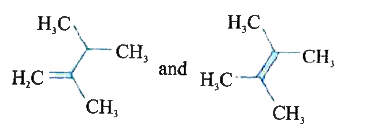
An alkyl halide of formula C_(6)CH_(13)Cl on treatment with potassium t-butoxide gives two isomeric alkenes (C_(6)H_(12)). Both alkenes on hydrogenation give 2,2-dimethylbutane. Isomeric alkenes are |
|
Answer» `CH_(2)=underset(CH_(3))underset(|)C-underset(CH_(3))underset(|)CH-CH_(3)andCH_(3)-underset(CH_(2))underset(|)C=underset(CH_(3))underset(|)C-CH_(3)` |
|
| 44. |
An alkyl halide reacts with alcoholic ammonia in a sealed tube, the product formed will be a |
|
Answer» TERTIARY amine `RX + NH_(3) rightarrow RNH_(2) + HX` `RNH_(2) + X-R rightarrow R_(2)NH+ HX` `R_(2)NH + X - R rightarrow R_(3)N + HX` `R_(3)N + X-R rightarrow R_(4)N^(+)X^(-)`. |
|
| 45. |
An alkyl halide on reaction with sodium in the presence of ether gives 2, 2, 5, 5, - tetramethyl hexane. The alkyl halide possibly |
|
Answer» 1- Chloropentane |
|
| 46. |
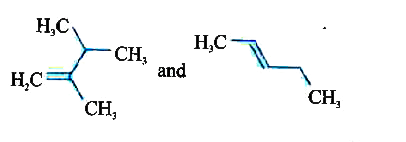
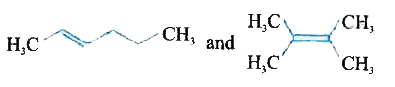
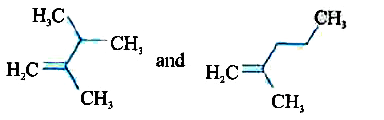
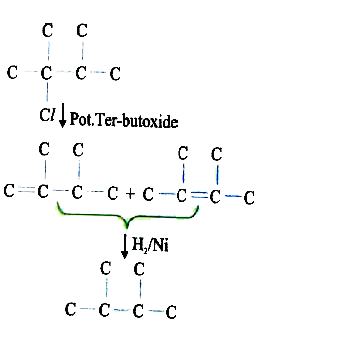
An alkyl halide of formula C_6H _(13)CIon treatment with potassium t-butoxide given two isomeric alkanes (C_6 H_12). Both alkenes on hydrogenation give 2,3 dimethyl butane. Isomeric alkanes are |
|
Answer»
|
|
| 47. |
An alkyl halide of formula C_(4)H_(9)Cl on treatement with alcoholic potash gives alkenes C_(4)H_(8). Both alkenes on tratment with HI gives 2-iodo butate. Isomeric alkenes are |
|
Answer» `CH_(3)CH_(2)CH=CH_(2) and CH_(3)CH=CHCH_(3)` (a) Molecular FORMULA `C_(4)H_(9)CL` has four isomers, thses are n-BUTYL chloride,sec. butyl chloride. Former twoon elimination gives 1-butene and 2-butene respectively and latter two on elimination gives siobutylene. 1-butene and 2-butene are treated withHI gives 2-iodobutane. 1-butene and 2-butene are POSITION isomers. Isobutylene is treated with HI gives t-butyl iodide hence answer is (a) |
|
| 48. |
An alkyl halide may be converted into an alcohol by |
|
Answer» ADDITION |
|
| 49. |
An alkyl halide may be converted into an alcohol by: |
|
Answer» ADDITION |
|