Saved Bookmarks
This section includes 7 InterviewSolutions, each offering curated multiple-choice questions to sharpen your Current Affairs knowledge and support exam preparation. Choose a topic below to get started.
| 1. |
An alkyl halide by the formation of its grignards reagent and heating with water gives butane. What is the original alkylhalide ? |
|
Answer» METHYL iodide |
|
| 2. |
An alkyl halide C_(4)H_(9)Br,[A] reacts with alcoholic KOH and formes an alkene [B] which reacts with bromine to give a dibromide [C]. The compound [C] is converted to a gas [D] upon reacting with sodalide. The gas when passed through ammoniacal silver nitrate solution, gives a white precipitate. give the structural formula of the compounds [A],[B],[C] and [D]. |
Answer» Solution :Since the gas [D] gives a PRECIPITATE upon possing through AMMONIACAL sivler nitrate (Tollen's REAGENT), it is a TERMINAL alkyne. The structures of the compounds and the reaction involved are listed.  . .
|
|
| 3. |
An alkyl halide by formation of formation of its Grignard reagent and heating with water yields propane. What is the original alkyl halide |
|
Answer» METHYL iodide  Here `RH=CH_(3)-CH_(2)-CH_(3)`. i.e., `R=-CH_(2)CH_(2)CH_(3)` Hence the ALKYL HALIDE is propyl halide. |
|
| 4. |
An alkyl chloride (RCI) reacts with aqueous KOH to form an alcohol predominantly while it reacts with alcoholic KOH to form an alkene predominantly. Explain these observations. |
| Answer» Solution :A STRONGER base and a less polar solvent favours ELIMINATION (E2) more than substitution `(S_(N)2)`. In such a condition, an alkene is formed predominantly. Alcohol is a much less polar solvent than water and the base `Oet^(Theta)` (formed by the reaction betweenEtOH and `OH^(-)`) PRESENT in alcoholic medium is stronger than `OH^(Theta)`. So, alkyl chloride reacts with alcoholic KOH to form an alkene predominantly by an `E_(2)` reaction. Since `OH^(Theta)` is a weaker base than `OEt^(Theta)` and water is more polar than alcohol, an alkyl chloride reacts with aqueous ALKALI to form an alcohol, predominantly by an `S_(N)2` reaction. | |
| 5. |
An alkyl chloride produces a single alkene when it reacts with sodium ethoxide and ethanol . This alkene on hydrogenation produces 2-Methylbutane. What is the identity of the alkyl halide ? |
|
Answer» 1-Chloro-2,2-dimethylpropane |
|
| 6. |
An alkyl halide after forming the corresponding Grignard reagent and heating with water yeilds propane. What is the original alkyl halide ? |
|
Answer» n-Propyl halide |
|
| 7. |
An alkyl bromide produces a single alkene when it reacts with sodium ethoxide and ethanol. This alkene undergoes hydrogenation and produces 2-methyl butane. What is the identity of the alkyl bromide |
|
Answer» 1-bromo-2,2-dimethylpropane |
|
| 8. |
An alkyl bromide (X) reacts with Na metal dissolved in anhydrous ether to form 4,5-diethyloctane.t he compound (X). |
|
Answer» `CH_(3)(CH_(2))_(3)Br`  . .
|
|
| 9. |
An alkyl bromide produces a single alkene when it reacts with sodium ethoxide and ethanol. This alkene on hydrogenation produces 2-methylbutane. What is the identify of the alkyl halide? |
|
Answer» 1-Bromo-2,2-dimethylpropane |
|
| 10. |
An alkyl bromide produces a single alkene when it reacts with sodium ethoxide and ethanol. The alkene undergoes hydrogenation and produces 2-methylbutane. What is the identity of the alkyl bromide? |
|
Answer» 1-bromo-2,2-dimethylpropane 
|
|
| 11. |
An alkene with molecular formula C_(6)H_(14) reacts with chlorine in the presence of light and heat to give four isomeric mono chlorides of molecular formula C_(6)H_(13)Cl. The most probable structure for the starting alkane is: |
|
Answer» `CH_(3)(CH_(2))_(4)CH_(3)` .)
|
|
| 12. |
An alkoxide is a stronger base than hydroxide ion. Justify. |
| Answer» Solution :Due to the presence of an alkyl GROUP higher ELECTRON densilty is FOUND in ALKOXIDE ION. | |
| 13. |
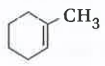
An alkene reacts with HCl in accordance with the Markownikoff's rule to give 1-chloro-1-methylcyclohexane. The alkene is- |
|
Answer»

|
|
| 14. |
An alkene reacts with HCl to yield only 1 - chloro-1-methyl cuclohezane. Idenfify the alkene, give reaction. |
Answer» SOLUTION :
|
|
| 15. |
An alkene onreductive ozonolysis gives two molecules of CH_(2)(CHO)_(2). The alkene is: |
|
Answer» 2,4-hexadiene 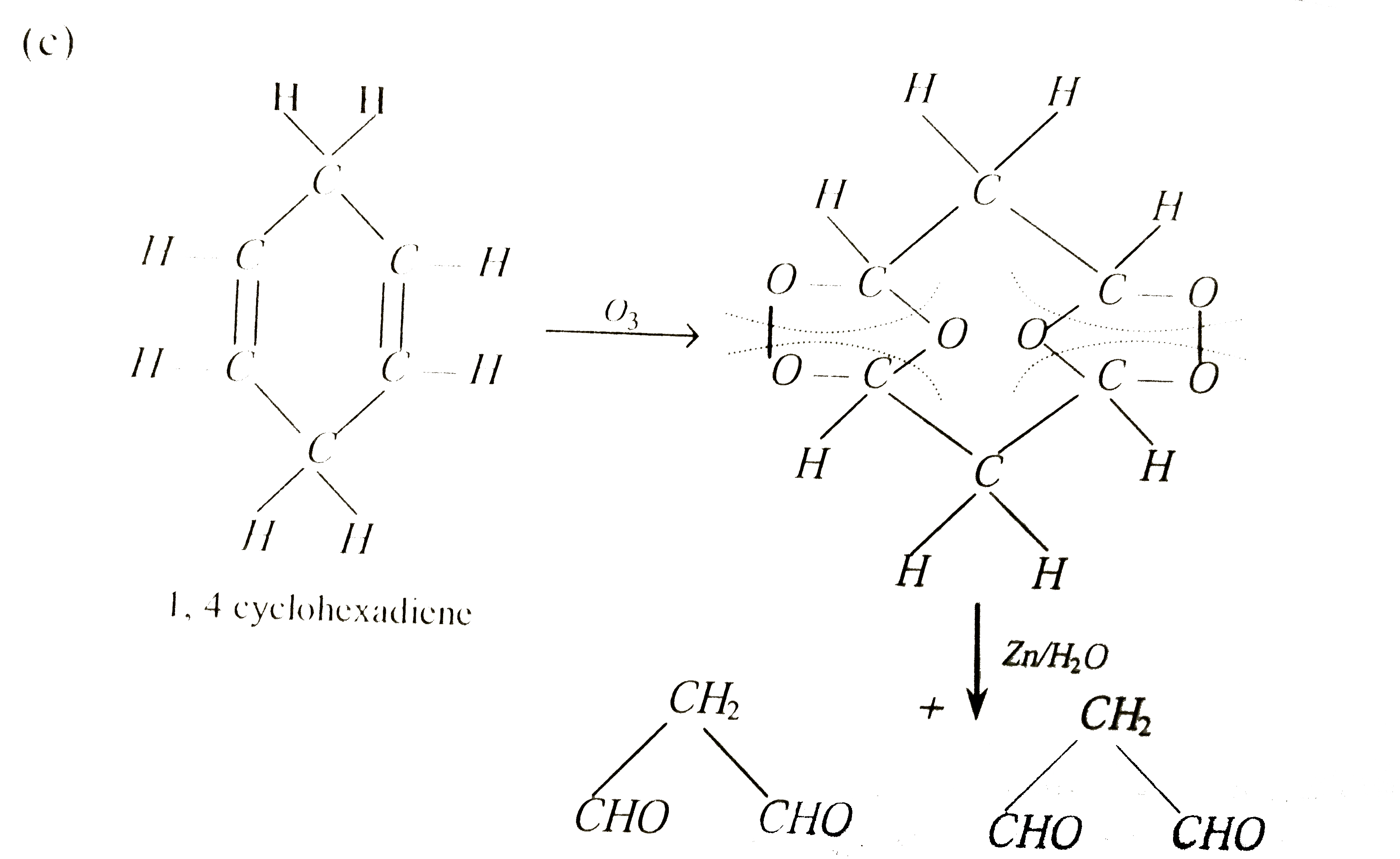
|
|
| 16. |
An alkene on ozonolysis gives acetaldehyde and acetone. The alkene in question is |
|
Answer» `CH_3-OVERSET(CH_3)overset(|)(CH)=C-CH_3` |
|
| 17. |
An alkene, on ozonolysis gives formaldehydeacetaldehyde. The alkene is |
|
Answer» ETHENE 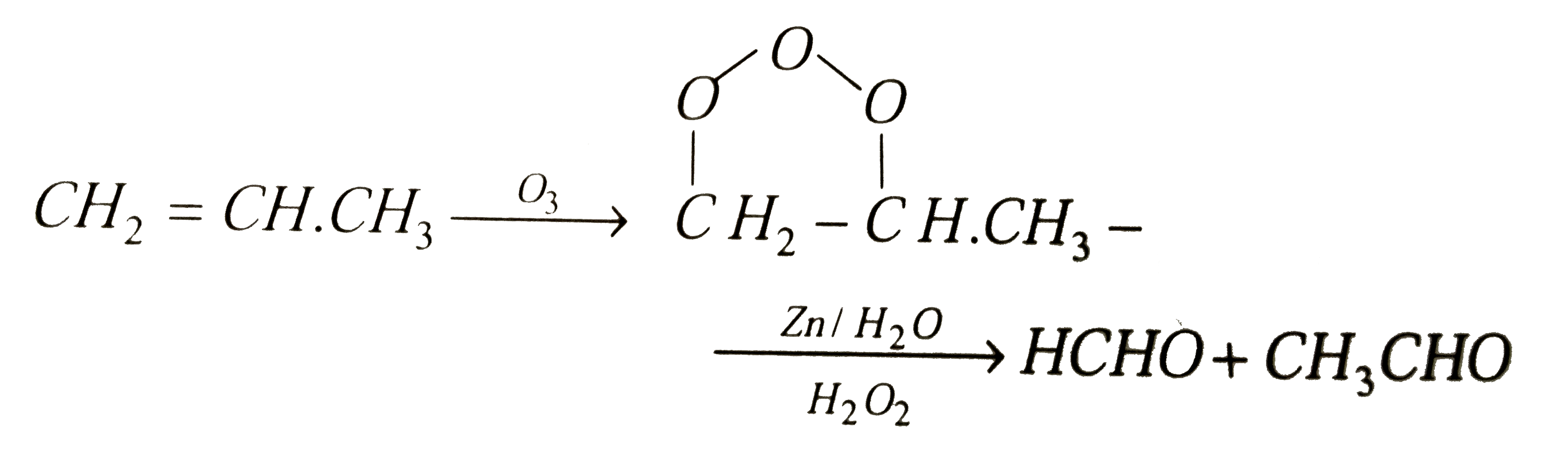
|
|
| 18. |
An alkene , on ozonolysis forms HCHO,CH_3COCHO and CH_3CHO. The alkene is - |
|
Answer» `CH_2=C(CH_3)-CH=CHCH_3` |
|
| 19. |
An alkene having molecular formula C_(2)H_(14) was subjected to ozonolysis in the presence of zinc dust. An equimolar amount of the following two compounds was obtained CH_(3)COCH_(3) and CH_(3)COC_(2)H_(5) The IUPAC name of the alkene is |
|
Answer» 3,4-dimethyl-3-pentene 
|
|
| 20. |
An alkene gives two moles of HCHO, one mole of CO_(2) and one mole of CH_(3)COCHO on ozonolysis. The structure of alkene is |
|
Answer» `CH_2=C=CH-CH_2-CH_3` |
|
| 21. |
An alkene C_6H_(12)reacts with HBr in the absenceas well as in the presence of peroxide to give the same product. Find its structure. |
Answer» SOLUTION :Symmetrical react with HBr in the presence or absence of PEROXIDE to give the same product. HENCE the GIVEN alkene may have the structure (I) or (II) . 
|
|
| 22. |
An alkene give two moles of HCHO, one mole of CO_(2) and one mole of CH_(3)-underset(O)underset(||)(C )-CHO on ozonolysis. What is its structure ? |
|
Answer» `CH_(2)=CH-UNDERSET(CH_(3))underset(||)(CH)-CH=CH_(2)` |
|
| 23. |
An alkene , C_6H_(12) after ozonolysis yielded two products. One of these gave a positive iodoform reaction but a negative Tollen's test. The other iodoform reaction. What is the name and structure of that alkene ? |
|
Answer» SOLUTION :One product is a METHYL ketone as it gives positive IODOFORM test, but a negative Tollen.s test. The other product is an aldehyde without methy group attached to CARBONYL carbon as it does not respond to iodoform test. Hence, the products of OZONOLYSIS are : `CH_(3)COCH_(3)` and `CH_(3)CH_(2)CHO`. Therefore, the alkene is 2-methylpent-2-ene. Its structure is `CH_(3)-overset(CH_(3))overset(|)(C)=CHCH_(2)CH_(3)`. |
|
| 24. |
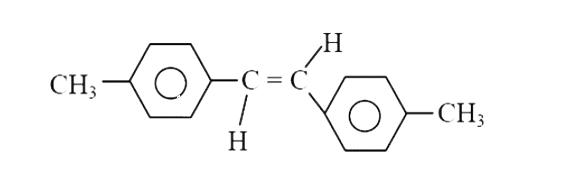
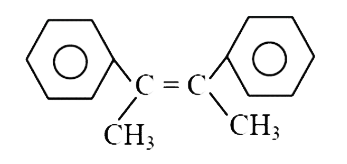
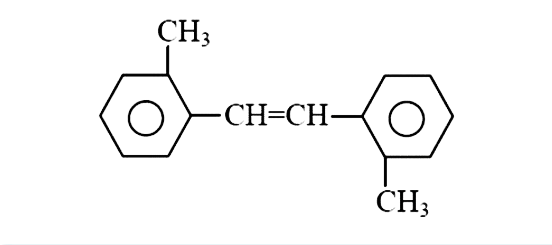
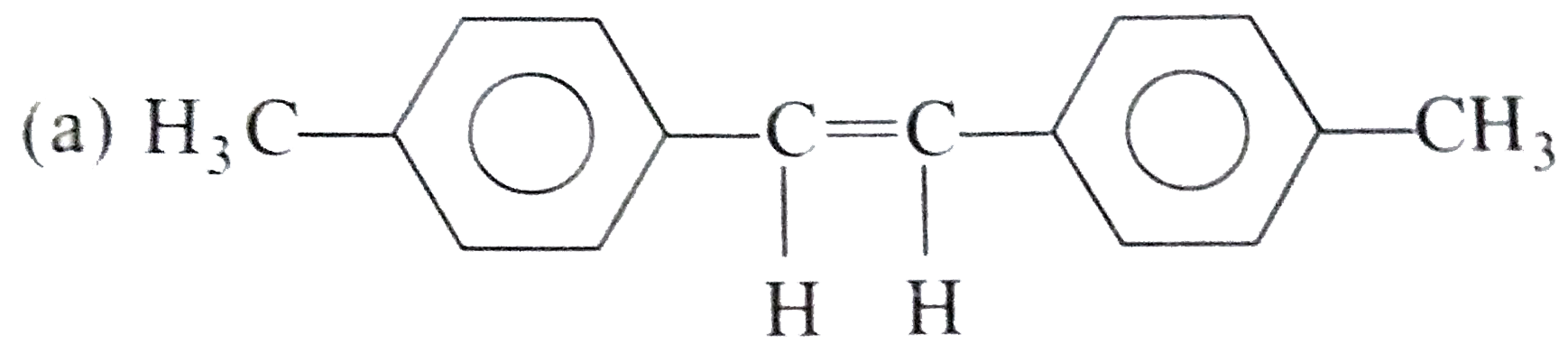
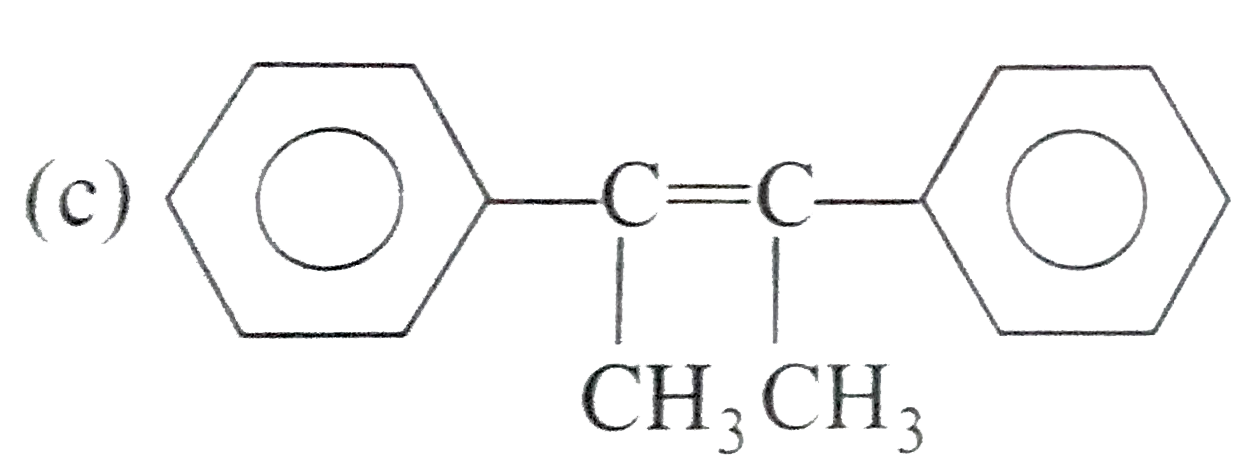
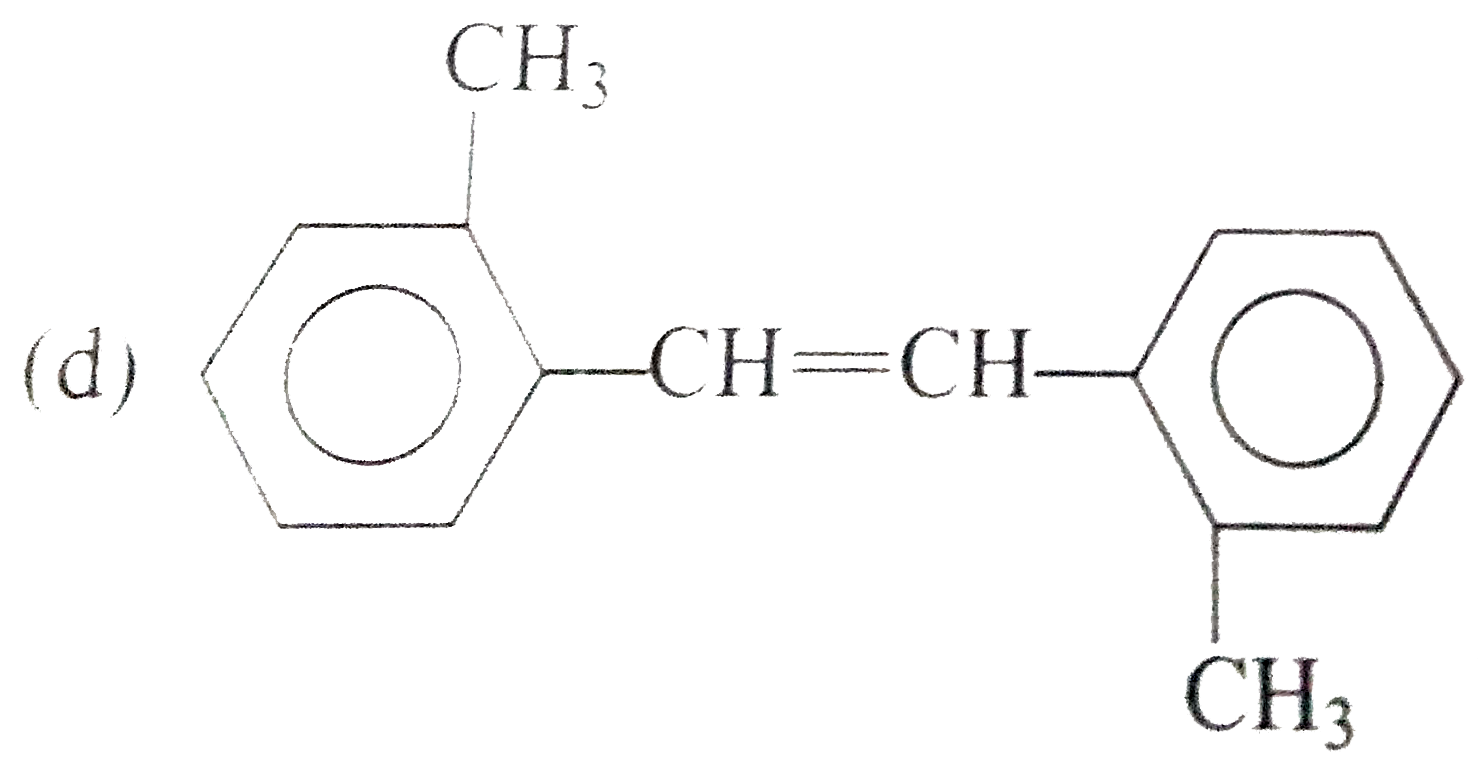
An alkene (A)C_(16)H_(16) on ozonolysis gives only one product (B)(C_(8)H_(8)O). Compound (B) on reaction with NH_(2)OH followed by reaction with H_(2)SO_(4), Delta gives N - methyl benzamide the compound 'A' is - |
|
Answer»
|
|
| 25. |
An alkene ,C_ 7 H_(14)on reductive ozonolysis gave propanal and a ketone. The probable formula of ketone is |
|
Answer» ACETONE |
|
| 26. |
An alkene ''A'' on reaction with O_(3) and Zn-H_(2)O gives propanone and ethanal in equimolar ratio. Addition of HCl to alkene ''A'' gives ''B'' as the major product. The structure of product ''B'' is ……………. |
|
Answer» `CL-CH_(2)-CH_(2)-overset(CH_(3))overset("|")underset(CH_(3))underset("|")"CH"` 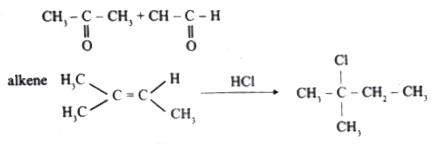
|
|
| 27. |
An alkene “A” on reaction with O_3and Zn - H_2Ogives propanone and ethanol in equimolar ratio. Addition of HCl to alkene “A” gives “B” as the major product. The structure of product “B” is |
|
Answer» `CL - CH_2 - CH_2 - undersetoverset(|)(CH_3)oversetunderset(|)(CH_3)( C)H` 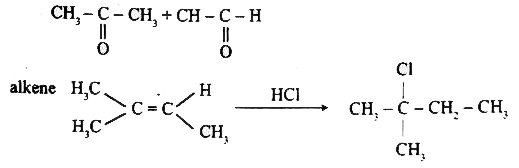
|
|
| 28. |
Analkene (A) on ozonolysis yieldsacetone and an aldehyde . Thealdehydeis easilyoxidized to an acid (B) . When(B)is treatedwithphosphours and bromine . It yieldsa compound(C)whichon hydrolysisgives a hydroysis acid (D) .Thisalso beobtainedformacetoneformacetonebyreactionwith HCK followedby hydrolysis. |
Answer» SOLUTION :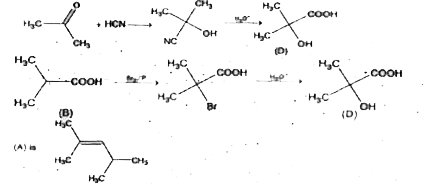
|
|
| 29. |
An alkene ''A'' on reaction with O_(3) and Zn-H_(2)O gives propanone and ehanal in rquimolar ratio. Addition of HCl to alkene ''A'' gives ''B'' as the major product. The structure of product ''B'' is : |
|
Answer» `H_(3)C-underset("Cl ")underset("| ")("C "H)-overset(CH_(3))overset("|")underset(CH_(3))underset("|")("C ")H` 
|
|
| 30. |
An alkene (A) on ozonolysis gives propanone and aldehyde (B). When (B) is oxidised (C) is obtained. (C) is treated with Bry/P gives (D) which on hydrolysis gives (E). When propanone is treated with HCN followed by hydrolysis gives (F). Identify A, B, C, D and E and F. |
Answer» Solution :(i)2 - methyl - but - 2 - ene (A) on OZONOLYSIS GIVES propanone and acetaldehyde (B) 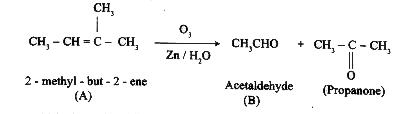 (ii) Acetaldehyde (B) is oxidised to give acetic acid (C), which on further TREATED with Br /P give monobromo acetyl bromide (D) which on hydrolysis gives monobromo acetic acid (E). 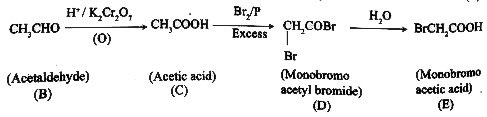 (iii) Propanone is treated with HCN followed by hydrolysis to gives 2 - methyl - 2 - hydorxy PROPANOIC acid (F) 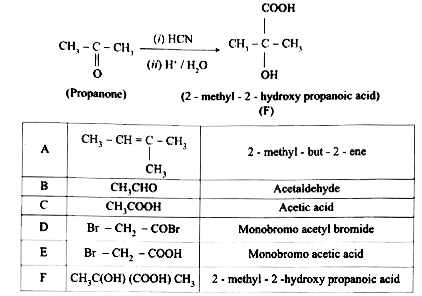
|
|
| 31. |
An alkene (A) on ozonolysis gives propanone and aldehyde (B). When (B) is oxidised ( C) is obtained. ( C) is treated with Br_(2)//P gives (D) which on hydrolysis gives ( E). When propanone is treated with HCN followed by hydrolysis gives ( E). Identify A, B, C, D and E. |
Answer» SOLUTION : A - 2, 4 dimethylpent - 2 - ene B - 2 - methyl propion aldehyde OZONIDE C - 2 - methyl propanoic ACID D - 2 - bromo - 2 - methyl propanoic acid E - 2 - methyl - 2 - hydroxy propanoic acid |
|
| 32. |
An alkene 'X' (molecular formula C_(5)H_(10)) on ozonolysis gives a mixture of two compounds 'Y'and 'Z'. Compound 'Y' gives positive Fehling's test and also forms iodoform on treatement with I_(2)" and "NaOH. Compound 'Z' does not give Fehling's test but forms iodoform. Identify the compounds X, Y and Z. Write the reaction for ozonolysis and formation of iodoform from Y and Z. |
|
Answer» `{:("X","Y","Z"),(C_(6)H_(5)COCH_(3),CH_(3)CHO,CH_(3)COCH_(3)):}` |
|
| 33. |
An alkene 'A' (Mol. formula C_5H_10) on ozonolysis gives a mixture of two compounds 'B' and 'C. Compound 'B' gives positive Fehling's test and also forms iodoform on treatment with I_2 and NaOH. Compound 'C does not give Fehling's test but forms iodoform. Identify the compounds A, B and C. Write the reaction for ozonolysis and formation of iodoform from B and C. |
|
Answer» Solution : Compounds A, B, C arc as follows : `a: CH_(3)-CH=underset(CH_(3))underset(|)C-CH_(3), B: CH_(3)-CHO, C: CH_(3) -underset(CH_(3))underset(|)C=O` `underset("2-Methylbut-2-ene")(CH_(3)-CH=underset(CH_(3))underset(|)C) - CH_(3) overset((i)O_(3))underset((II)Zn//H_(2)O)to underset((B))(H_(3)C -CHO) + O = underset((C ))underset(CH_(3))underset(|)C-CH_(3)` Compounds CONTAINING `CH_(3)CO`-group give the iodoform test. `CH_(3)CHO overset(NaOl) to HCOONa +CHl_(3)` `CH_(3) - overset(O)overset(||)underset(CH_(3))underset(|)C overset(NaCl)to CH_(3)COONa + CHI_(3)` |
|
| 34. |
An alkene 'A" (Mol. Formula C_(5)H_(10)) on ozonolysis gives a mixture of two compounds 'B' and 'C'. Compound 'B' gives positive Feling's test and also forms iodoform on treatment with I_(2) and NaOH. Compound 'C' does not give Fehling's test but forms iodoform. Identify the compounds A,B and C. Write the reaction for ozolysis and formation of iodoform from B and C. |
|
Answer» Solution :(i) SINCE compound 'B' gives fehling's test, therefore, it must be aldehyde. Further since aldehyde 'B' gives iodoform on treatment with `I_(2)` and NaOH, therefore, 'B' must be acetaldehyde `(CH_(3)CHO)`. (ii) Since alkene 'A' (`MFC_(5)H_(10))` contains five carbon atoms and one of the product of ozonolysis is 'B' `(CH_(3)CHO)` which contains two carbon atoms, therefore, the other product of ozonolysis, i.e., `'C'` must contain three carbon atoms. (iii) since compound 'C' does not GIVE fehling's test, it must be a ketone. further since ketone 'C' contains three carbon atoms and gives iodoform on treatment with `I_(2) and NaOH`, therefore, ketone 'C' must be acetone `(CH_(3)COCH_(3))`. (iv) Write the products of ozonolysis, i.e., 'B' `(CH_(3)CHO) and 'C' (CH_(3)COCH_(3))` side by side with their C=O groups facing each other. remove the OXYGEN atoms and join the remaining fragments by a double bond, the structure of alkene 'A' is 2-methylbut-2-ene. 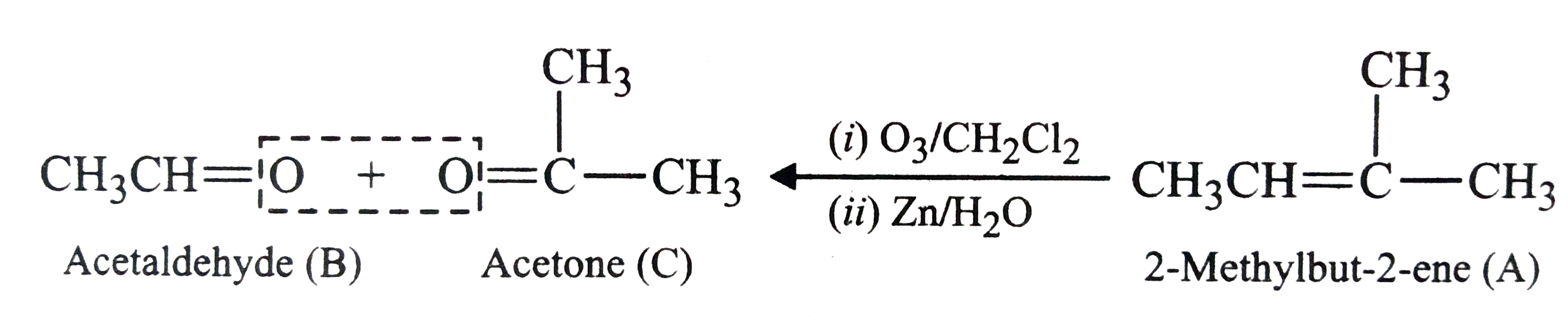 (v) Formation of iodoform from 'B' and 'C' may be explained as follows: `underset("Acetaldehyde (B)")(CH_(3)CHO)+3I_(2)+4NaOH overset(Delta)to underset("Iodoform")(CHI_(3))+ underset("Sod. formate")(HCOONa)+3NaI+3H_(2)` `underset("Acetone (C)")(CH_(3)COCH_(3))+3I_(2)+4NaOH overset(Delta)to underset("Iodoform")(CHI_(3))+ underset("Sod. ACETATE")(CH_(3)COONa)+3NaI+3H_(2)O` |
|
| 35. |
An alkene (A) C_(16)H_(16) on ozonolysis gives only one product (B) C_8H_8O. Compound (B) on reaction with NaOH/I_(2) yeilds sodium benzoate. Compound (B) reacts with KOH/NH_(2)NH_(2) yielding a hydrocarbn (C)C_(8)H_(10). Write the structure of compound (B) and (C). based on this information to isomeric structures can be proposed for alkene (A). write their structure and identify the isomer which one catalytic hydrogenation (H_(2)//Pd-C) gives a racemic mixture |
|
Answer» |
|
| 36. |
An alkene (A) C_(16)H_(16) on ozonolysis gives only one product (B) C_(8)H_(8)O. Compound (B) on reaction with NH_(2)OH, H_(2)SO_(4) and heating gives N-methyl benzamide. The compound (A) is: |
|
Answer»
|
|
| 38. |
An alkene (A) C_(10)H_(16) on ozonolysis gives only one product (B) C_(8)H_(8)O. Compound (B) on reaction with NaOH//l_(2) yiedls sodium benzoate. Compound (B) reacts with KOH//NH_(2)-NH_(2) yielding a hydrocarbon ( C ) C_(8)H_(10). Write the structure of (B) and ( C ) Based on this information give two isomeric structures of (A). |
Answer» SOLUTION :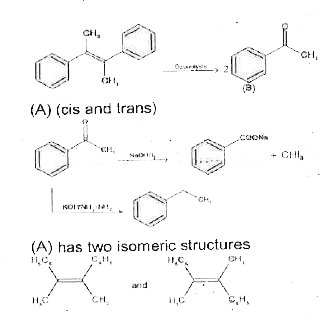
|
|
| 39. |
An alkene (A) C_(16)H_(16) on ozonolysis gives only one product (B) (C_(8)H_(8)O). Compound (B) on reaction with NaOH//I_(2) yields sodium benzoate. Compound (B) reacts with KOH//NH_(2) yielding a hydrocarbon (C_(8)H_(10)). Write the structures of compounds (B) and (C ). Based on this information, two isomeric structures can be proposed for alkene (A). write thair structures and identify the isomer which on catalytic hydrogenation (H_(2)+Pd+C) gives a recemic mixture. |
|
Answer» Solution :Alkene `(A)` is symmetrical since on ozonolysis gives `2 mol` of `(B)` `(C_(8)H_(8)O)`. `DU` in `B=((2n_(C )+2)-n_(H))/2=((2xx8+2)-8)/2=5^(@)` Since, `C:H~~1:1`, B contains benzene ring. Moreover, `B` gives iodoform test, it must contain `(MeCO-)` group). So the STRUCTURE of B may be `(PhCOMe)` (acetophenone). Reactions: 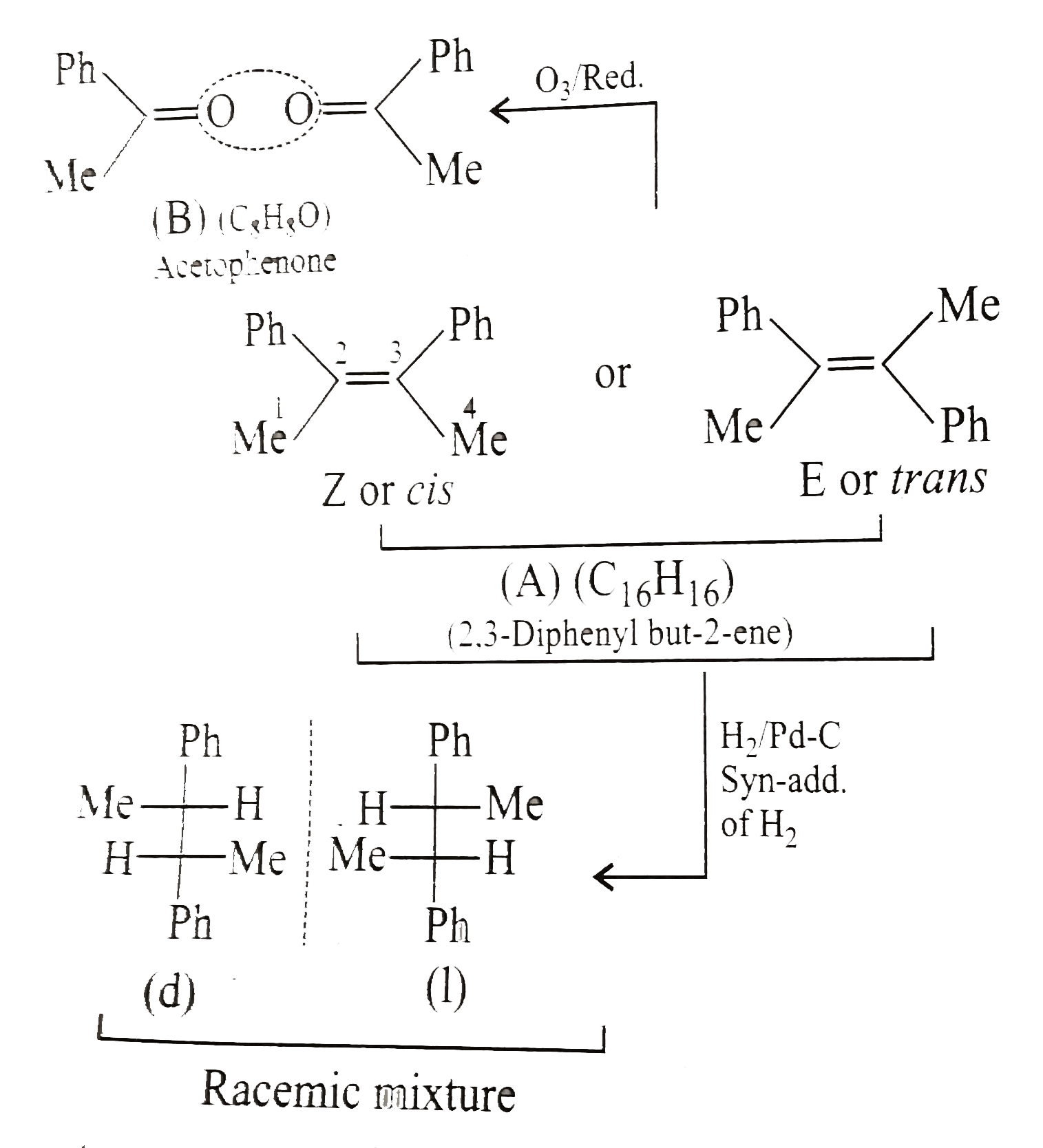
|
|
| 40. |
An alkane (A) C_(16)H_(16) on ozonolysisi gives only one products (B) C_(8)H_(8)O. Compound (B) or reaction with NaOH//I_(2) yields sodium benzoate. Comopund (B) reacts with KOH//NH_(2)NH_(2) yielding a hydrogen (C) C_(8) H(10)^(.) Write the structures of compounds (B) and (C). Based on this infromation two their structures and identify the isomer which on catalytic hydrpgenation (H_(2)//Pd-C) gives a racemic mixture. |
Answer» SOLUTION :
|
|
| 41. |
Analkane withtheformulaC_(6) H_(14)can beprepared by thehydrohengationof onlytwoalkanes (C_(6)H_(12))IUPAC nameof thealkaneis : |
|
Answer» 2,2-dimehtylbutane |
|
| 42. |
An alkane with molecular weight 72 upon chlorination gives only one monochlorination product. The alkane is |
|
Answer» 2-methylbutane |
|
| 43. |
An alkane with molecular formula C_(6)H_(14) reacts with chlorine in the presence of light and heat to give two constitutionally isomeric monochlorides of molecular formula C_(6)H_(13)Cl. Which is the most reasonable starting alkane? |
|
Answer» n-Hexane 
|
|
| 44. |
An alkane withmolecularmass 72 formed only one substitution product .Suggest a structure for thealkane . |
|
Answer» Solution :Letthemolecularformula of thealkane be`C_(n)H_(2n+2).` Molecular mass of thealane `nC+(2n+2)H` `=nxx12+(2n+2)xx1` `=14n+2` `thus,14n+2=72` or `14n=72-2=70` SO, `n=(70)/(14)=5` thus , the molecularformulaof thealkane is `C_(5)H_(12). ` It canthavethreeisomers . `underset("n- Pentane")(CH_(3)CH_(2)CH_(2)CH_(3)),CH_(3)underset(("isopentane"))underset("2-Methylbutane ")OVERSET(CH_(3))overset(|)(CH_(3)CHCH_(2)CH_(3)),CH_(3)-underset(("NEOPENTANE "))underset("2,2 Dimehtylpropane")underset(CH_(3))underset(|)overset( CH_(3))overset(|)(C)-CH_(3)` |
|
| 45. |
An alkane with moelcular mass 30 a. m. u. when brominate gives only on monobromiated product. The alkane is |
|
Answer» pentane |
|
| 46. |
An alkane with formula C_6H_14 can be prepared by reduction (with Zn and H_+) of only two alkyl chorides (C_6H_13Cl) and by the hydrogenation of only two alkenes (C_6H_12) write structure of this alkane. |
Answer» SOLUTION : 
|
|
| 47. |
An alkane witheven number of carbononly, can result in : |
|
Answer» Sagatier senderens REACTION |
|
| 48. |
An alkane with a molecular formula C_(6)H_(14) reacts with chlorine in the presence of light and heat to give two constitutionally isomeric monochlorides of molecular formula C_(6)H_(13)Cl. What is the most reasonable starting alkane ? |
|
Answer» n-Hexane |
|
| 49. |
An alkanewitha molcularformula, C_(6)H_(14) reacts withclorinein thepresenceof lightand head and heat to givetwoconstitionally C_(6)H_(13)Cl . Whatis themostresonbalestartingalkane ? |
|
Answer» N- HEXANE |
|
| 50. |
An alkane of mol. Weight 72 gives on monochlorination only one product. Name the alkane: |
|
Answer» 2-methylbutane |
|