

Saved Bookmarks
| 1. |
An alkene 'A" (Mol. Formula C_(5)H_(10)) on ozonolysis gives a mixture of two compounds 'B' and 'C'. Compound 'B' gives positive Feling's test and also forms iodoform on treatment with I_(2) and NaOH. Compound 'C' does not give Fehling's test but forms iodoform. Identify the compounds A,B and C. Write the reaction for ozolysis and formation of iodoform from B and C. |
|
Answer» Solution :(i) SINCE compound 'B' gives fehling's test, therefore, it must be aldehyde. Further since aldehyde 'B' gives iodoform on treatment with `I_(2)` and NaOH, therefore, 'B' must be acetaldehyde `(CH_(3)CHO)`. (ii) Since alkene 'A' (`MFC_(5)H_(10))` contains five carbon atoms and one of the product of ozonolysis is 'B' `(CH_(3)CHO)` which contains two carbon atoms, therefore, the other product of ozonolysis, i.e., `'C'` must contain three carbon atoms. (iii) since compound 'C' does not GIVE fehling's test, it must be a ketone. further since ketone 'C' contains three carbon atoms and gives iodoform on treatment with `I_(2) and NaOH`, therefore, ketone 'C' must be acetone `(CH_(3)COCH_(3))`. (iv) Write the products of ozonolysis, i.e., 'B' `(CH_(3)CHO) and 'C' (CH_(3)COCH_(3))` side by side with their C=O groups facing each other. remove the OXYGEN atoms and join the remaining fragments by a double bond, the structure of alkene 'A' is 2-methylbut-2-ene. 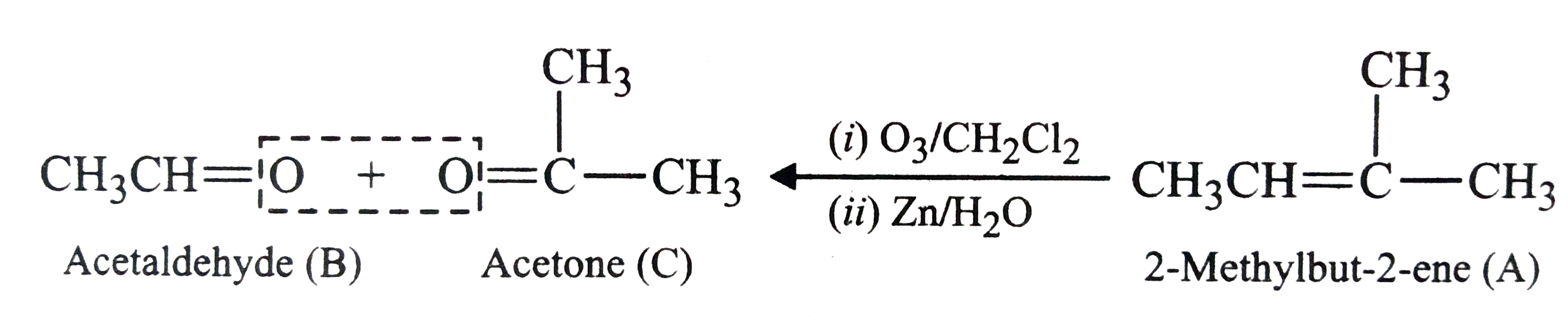 (v) Formation of iodoform from 'B' and 'C' may be explained as follows: `underset("Acetaldehyde (B)")(CH_(3)CHO)+3I_(2)+4NaOH overset(Delta)to underset("Iodoform")(CHI_(3))+ underset("Sod. formate")(HCOONa)+3NaI+3H_(2)` `underset("Acetone (C)")(CH_(3)COCH_(3))+3I_(2)+4NaOH overset(Delta)to underset("Iodoform")(CHI_(3))+ underset("Sod. ACETATE")(CH_(3)COONa)+3NaI+3H_(2)O` |
|