

Saved Bookmarks
This section includes 7 InterviewSolutions, each offering curated multiple-choice questions to sharpen your Current Affairs knowledge and support exam preparation. Choose a topic below to get started.
| 1. |
Calcination and roasting are : |
|
Answer» Different NAMES of the same operation |
|
| 2. |
Calcination and raosting are treatments in metallurgy before metal extraction. Differentiate calcination and roasting. |
|
Answer» |
|
| 3. |
Calcaulte the standard free energy change taking place in H_(2)//O_(2) fuel in which the following reactions occurs: (i) O_(2)+4H^(+) to 4e^(-)to2H_(2)O,E^(@)=1.229V (ii) 2H_(2)to4H^(+)+4e^(-),E^(@)=0.000V |
|
Answer» SOLUTION :`E_(CELL)^(@)=E_(O_(2)//H_(2)O)^(@)(RED)+E_(H_(2)//H^(+))^(@)(Ox)=1.229+0=1.229V` `DeltaG=-nFE_(cell)^(@)=-4xx96500xx1.229J=-474.4kJ`. |
|
| 4. |
calcaulate the bond enthalpy of Xe - F bond as given in the equation , XeF_(4) (g) to Xe^(+)(g) + F^(-) (g) + f_(2)(g)+ F(g) Delta_(r)H= 292 kcal mol ^(-1) lonisation energy of Xe = 279 kcal mol ^(-1) bond energy (F--F) = 38 kcal / mol Electronaffinity of F = 85 kcal / mol |
|
Answer» 8.5 kcal/MOL `292 = (x+ 279)-(38+85) , x= 34 kcal mol^(-1) |
|
| 5. |
Calculate the electrode potential of a copper wire dipped in 0.1 M CuSO_(4) solution at 25^(@)C. The standard electrode potential of copper is 0.34 volt. |
|
Answer» Solution :The electrode reaction WRITTEN as REDUCTION reaction is `CU^(2+) +2e^(-)toCu` so that n=2 Applying NERNST eqn. we get `E=E^(@)-(0.0591)/(2)"log"(1)/([Cu^(2+)])` `=0.34-(0.0591)/(2)"log"(1)/(0.1)=0.34-0.02955=0.31045`volt. |
|
| 6. |
Calamine is which type of ore ? |
|
Answer» CARBONATE ores of CALCIUM |
|
| 9. |
Calamine is |
|
Answer» `CaCO_(3)` |
|
| 12. |
Caffeine is found in tea leaves. It contains four nitrogens. Correct sequence of basic strength of these nitrogens is : |
|
Answer» `1gt2gt3gt4` |
|
| 13. |
Caffeine has a molecular weight of 194. if it contains 28.9% by mass of nitrogen. Number of atoms of nitrogen in one molecular of caffeine is: |
|
Answer» 4 =56 amu |
|
| 14. |
CaF_(2) used in HF "prep"^(n) must be free from SiO_(2) . Explain |
|
Answer» Solution :`CaF_(2)+H_(2)SO_(4)toCaSO_(4)+HF` If `SiO_(2)` prsent as impurity `{:(4HF+SiO_(2)SiF_(4)+2H_(2)O),(SiF_(4)+2HFtoH_(2)[SiF_(6)]):}}` Hence PRESENCE of one MOLECULE `SiO_(2)` Consumer 6 molecule of HF |
|
| 15. |
CaF_2 possesses: |
|
Answer» FACE CENTRED cubic |
|
| 16. |
CaF_(2) is used in metallurgy of aluminium. Give reasons. |
|
Answer» SOLUTION :(1) Aluminium is obtained by electrometallurgical processby carrying out an electrolysis of fused alumina `Al_(2)O_(3)` in cryolite `Na_(3)AlF_(6)`. (2) This mixture has a very high melting point and RELATIVELY less electrical conductivity. (3) To lower the melting point of the mixture and increases the electrical conductivity `CaF_(2)` is added. |
|
| 17. |
Cesium and chloride ions are in contact along the body diagonal in a body-centred cubic lattice. The edge lenth of the unit cell is 350 pm and Cs^+ has a radius of 133pm. Hence, the radius of Cl^- ion is approximately |
|
Answer» 170 |
|
| 18. |
Caesium oxide will be: |
|
Answer» STRONGLY basic |
|
| 19. |
Cadmium rods are used for which purpose |
|
Answer» EMIT electrons |
|
| 20. |
Cadmium amalgam is prepared by electrolysis of a solution of CdCl_2using Hgcathode. For how long should electrolysis be carried out in order to prepare 12% by weight of cadmium amalgam using 22.0 g of Hg as cathode and a current strength of 5 ampere? (Cd = 112) |
| Answer» SOLUTION :17 MIN 14 s | |
| 21. |
Cadmipone is a mixture of: |
|
Answer» CDS and `BaSO_4` |
|
| 22. |
Caculatethe ionic radius of a Cs^(+)ion, assuming that the cell edge length forCsCl is 0.4123nm and that the ionic radius of a Cl^(-) ion is0.81 nm |
|
Answer» `0.352` nm or`d_("body")=SQRT(3)xx0.4123` nm `=0.7147` nm Ionic RADIUS of`CS^(+)=0.3571-0.1761` nm |
|
| 23. |
Caculate [H^(+)] in a solution that is 0.1 M both in CH_(3)COOHandCH_(3)COONa(pK_(a)CH_(3)COOH=4.7):- |
|
Answer» `1.2xx10^(9)` |
|
| 24. |
Cacodyl test is used for identification of: |
|
Answer» HCOOH |
|
| 25. |
CaCO_(3)(s)hArrCaO(s)+CO_(2)(g),DeltaH=110kJ The pressure of CO_(2) |
|
Answer» INCREASES on adding catalyst |
|
| 26. |
CaCO_(3)(s) + CH_(2)COOH underset(Na_(2)C_(2)O_(4) "solution") to? Comment on the product of this reaction |
|
Answer» No reaction 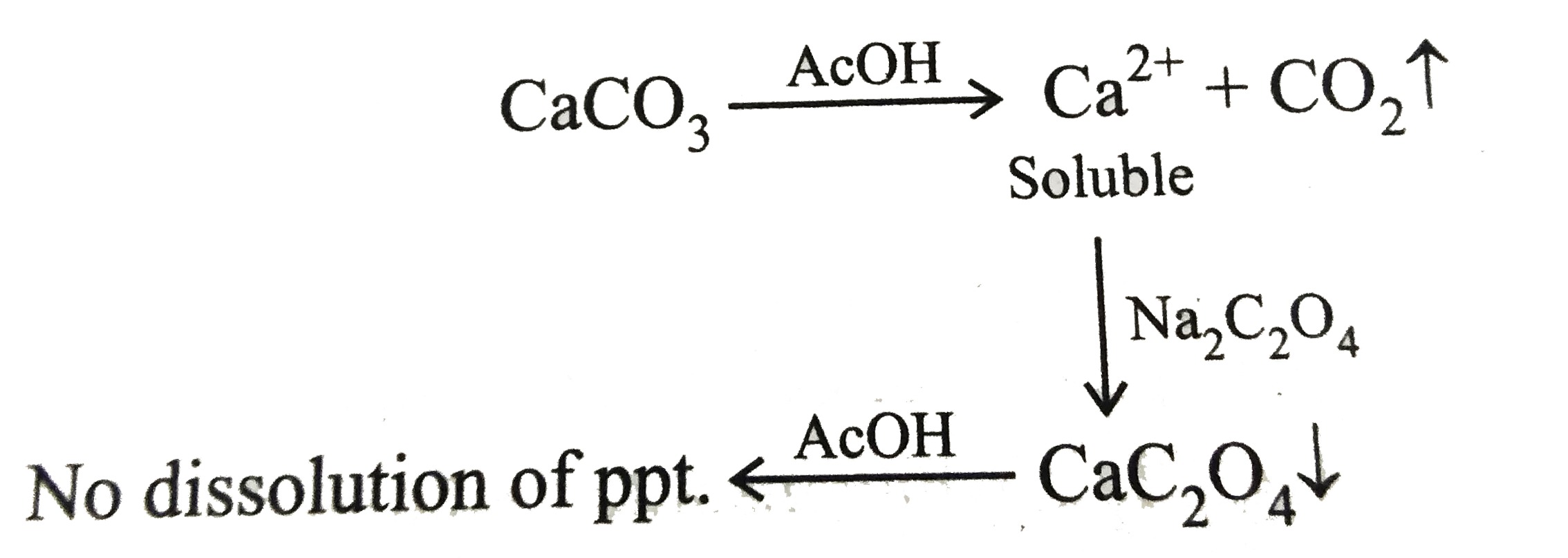
|
|
| 27. |
CaCO_(3) rarr A + B(gas) A + H_(2)O rarr C C + B rarrunderset(("White ppt."))(D) +H_(2)O D+B (gas) rarr underset(("Water soluble"))(E) overset(Boil)underset(BaCI_(2))rarr underset(("White ppt."))(F) Select the correct options (s) for whitge ppt. shown in the above reactions. |
|
Answer» `CaCO_(3)` 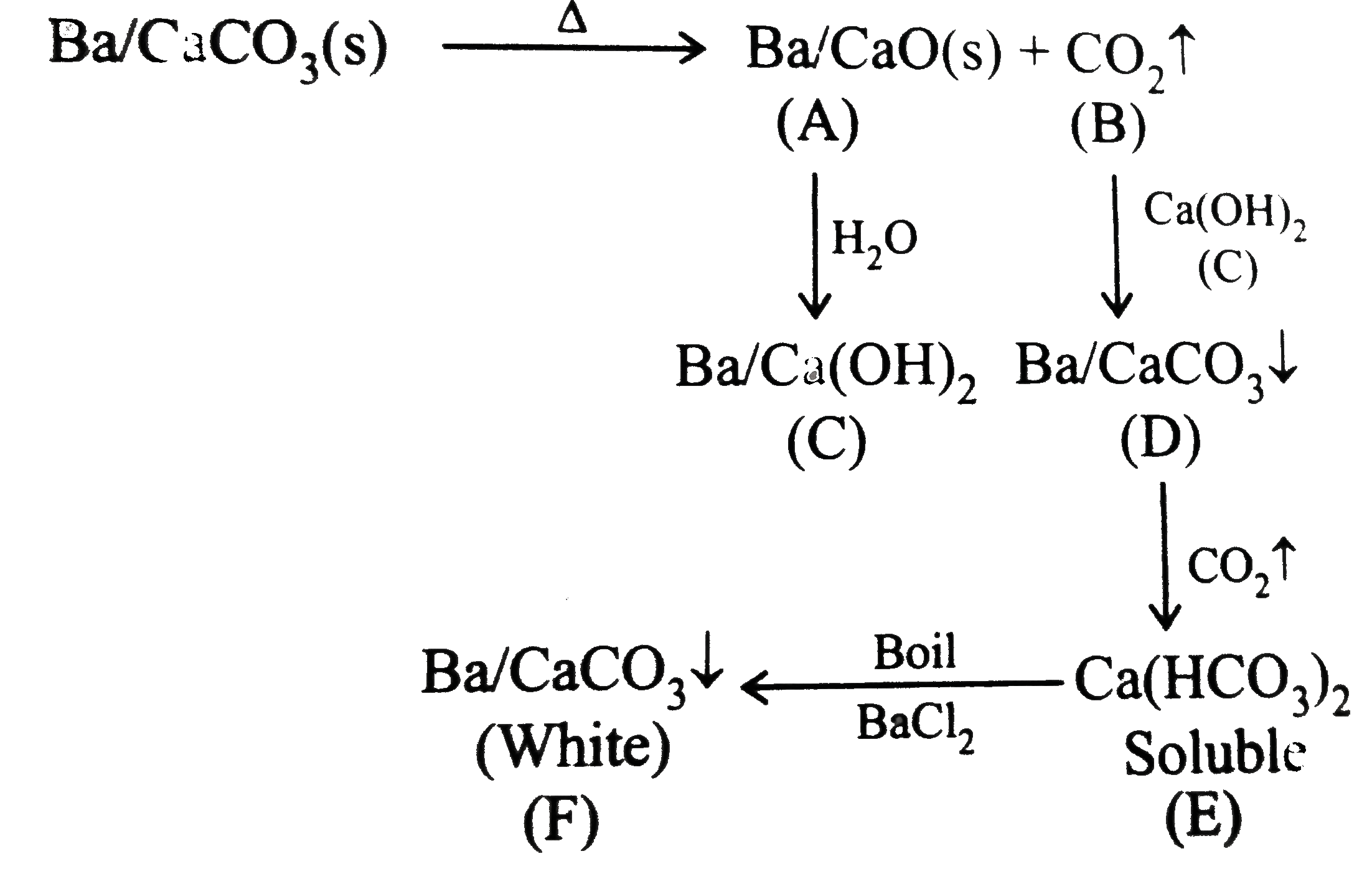
|
|
| 28. |
CaCO_3 decomposes to give CaO and CO_2, if the masses of CaO and CO_2 produced are 5.6 g and 4.4 g respectively by heating 12 g of an impure CaCO_3 sample then the % impurity of the sample will be |
|
Answer» `33.33%` |
|
| 29. |
CaCO_(3) + 2HCl to CaCl_(2) + H_(2)O + H_(2)O + CO_(2) 0.2 mole CaCO_(3) is reacted with excess of HCl. Find mass of CO_(2) produced? |
|
Answer» `8.8 GM` |
|
| 30. |
CaCl_(3), xNH_(3) is a complex compound obtained by dissolving CoCl_(3)in ammonia . The complexcompound is denoted at [Co(NH)36-x]Cl_(3)-x (soluble 100% insible The chlorides shown inside the square breackets are not ionisable . The salt ioniss as [Co(NH_(3))_(6-x)Cl_(x)]Cl_(3-x)rarr[Co(NH_(3))_(6-x)Cl_(x)]^(+(3-x))+(3-x)Cl 66% of choride content of the complex CoCl_(3). nNH_(3) can be precipitated by excess of aq. AgNO_(3) . What in the Vanthoff factor of the complex for 50% inisation? |
|
Answer» 2 |
|
| 31. |
CaCl_(3), xNH_(3) is a complex compound obtained by dissolving CoCl_(3)in ammonia . The complexcompound is denoted at [Co(NH)36-x]Cl_(3)-x (soluble 100% insible The chlorides shown inside the square breackets are not ionisable . The salt ioniss as [Co(NH_(3))_(6-x)Cl_(x)]Cl_(3-x)rarr[Co(NH_(3))_(6-x)Cl_(x)]^(+(3-x))+(3-x)Cl 0.1M CoCl_(3).nNH_(3) solution has same osmatic pressure as 0.1M glucose solution . What is 'n' |
|
Answer» 2 |
|
| 32. |
CaCl_(3), xNH_(3) is a complex compound obtained by dissolving CoCl_(3)in ammonia . The complexcompound is denoted at [Co(NH)36-x]Cl_(3)-x (soluble 100% insible The chlorides shown inside the square breackets are not ionisable . The salt ioniss as [Co(NH_(3))_(6-x)Cl_(x)]Cl_(3-x)rarr[Co(NH_(3))_(6-x)Cl_(x)]^(+(3-x))+(3-x)Cl 0.1M CoCl_(3).xNH_(3) solution is found to boil t 100.104^(@)C (Kb "of water "=0.52K Kg "mol"^(-1)) What x? 'alpha' of salt =1) |
|
Answer» 2 |
|
| 33. |
CaCl_(2) is used to clear snow from roads on hill stations, explain. |
| Answer» Solution :`CaCl_(2)` is used to clear SNOW because it CAUSES depression in freezing point, so, ice MELTS. | |
| 34. |
CaCl_(2) is preffered to NaCl for clearing snow on roads particularly in very cold countries. This is because |
|
Answer» `CaCl_(2)` is less SOLUBLE in `H_(2)O` than NaCl |
|
| 35. |
CaCl_(2) + C_(2)H_(5)OH rarr CaCl_(2).xC_(2) H_(5) OH. 'x' is |
|
Answer» 3 |
|
| 36. |
CaC_(2) overset(H_(2)O)to A overset(Cu_(2)Cl_(2))underset(NH_(4)Cl)to B overset((1)1 eqv. HCl)underset((2)Mg//"ether"(3)CO_(2)//H_(2)//OH)to C In above reaction product (C ) is |
|
Answer» `CH_(2)=CH-COOH` |
|
| 37. |
CaC_2overset( H_2O) to A+B . A overset( HgSO_4+H_2SO_4) to C. C overset( K_2Cr_2O_7+H_2SO_4) to DHere A, B , C and D are respectively . |
|
Answer» `CH -= CH , CA(OH)_2, CH_3 CHO and CH_3 COOH` |
|
| 38. |
CaC_(2)+N_(2) to A , product A is |
|
Answer» `CaCN_(2)` `CaC_(2) +N_(2) OVERSET(1000^(@)C)to UNDERSET("Calcium cyanide")(CaCN_(2)+C)` |
|
| 39. |
CaC_(2)+N_(2) to A, "Product A is " |
|
Answer» `CaCN_(2)` `CaC_(2)+N_(2) OVERSET(1000^(@)C)to underset("Calcium cyanide")(CaCN_(2)+C)` |
|
| 40. |
CaC_(2) molecule has |
|
Answer» ONE `sigma`BOND and one `pi`bond between the two carbon atoms 
|
|
| 41. |
CaC_2+H_2O to X overset(O_3//H_2O // OH^(+))to HCOOH X is |
|
Answer» `C_2H_4` |
|
| 42. |
CaC_2+H_2O to A overset(H_2SO_4//HgSO_4)toB. Identify A and B in the given reaction |
|
Answer» `C_2H_2` and `CH_3CHO` `CaC_2 + 2H_2O to C_2H_2 + CA(OH)_2` `underset"Acetylene"(C_2H_2)underset(60^@C)OVERSET(dil. H_2SO_4//HgSO_4)to underset"UNSTABLE"([CH_2=CHOH]) to underset"Acetaldehyde"(CH_3CHO)` |
|
| 43. |
Cabotundum is |
|
Answer» `Al_(2)(SO_(4))_(3)` |
|
| 44. |
Cabon dioxide contains 27.27% carbon , carbon disulphide contains 15.97% carbon and sulphur dioxide contains 50% sulphur. Show that these figures illustrate the law of reciprocal proportions |
| Answer» SOLUTION :The MASSES of OXYGEN and sulphur which combine with PART of carbon are in the ratio of 2.667:5.25,i.e, 1:2, In sulphur dioxide, the masses of sulphur and oxygen are in the ratio of 1:1 which is a simple multiple of first. Hence, LAW of reciprocal proportions is illustrated. | |
| 45. |
Ca_(3)(PO_(4))_(2) is |
|
Answer» Thomas slag |
|
| 46. |
Ca_2B_6O_11+Na_2CO_3oversetDeltato[X]+CaCO_3+NaBO_2(unbalanced equation) Correct choice for [X] is/are: |
|
Answer» structure of anion of crystalline [X] has one boron atom `sp^3` hybridised and other THREE boron atoms `sp^2` hybridised. (A)two boron atoms are `sp^2` while other two boron atoms are `sp^3` hybridised (B) product is sodium peroxoborate which is used as brightner in soaps. (C ) `H_3BO_3` is FORMED which HF gives `HBF_4` (D)Green bead in oxidising as WELL as in reducing flame in cold. |
|
| 47. |
Ca_(2)B_(6)O_(11)+Na_(2)CO_(3) overset(Delta)rarr[X]+CaCO_(3)+NaBO_(2) ( unbalanced equation) correct choice for [X] is : |
|
Answer» Structure of ANION of crystalline [X] has one BORON atom `sp^(3)` hybridised and other three boronatoms `sp^(2)` hybridised. |
|
| 48. |
Ca^(2+) the first ionisation energies of elements along a period do not vary in a regular manner with increase in atomic number |
|
Answer» |
|
| 49. |
Ca on exposure in moist air forms a layer on surface of: |
|
Answer» `CaCO_3` |
|
| 50. |
C_8H_9NO_2 is an _____ drug . |
| Answer» SOLUTION :ANTIPYRETIC | |