

Saved Bookmarks
This section includes 7 InterviewSolutions, each offering curated multiple-choice questions to sharpen your Current Affairs knowledge and support exam preparation. Choose a topic below to get started.
| 2. |
Calcium phosphide gets hydrolysedand give |
|
Answer» `Ca_(3)(PO_(4))_(2)` |
|
| 3. |
Calcium oxalate is soluble in dilute HCl. Explain. |
Answer» Solution :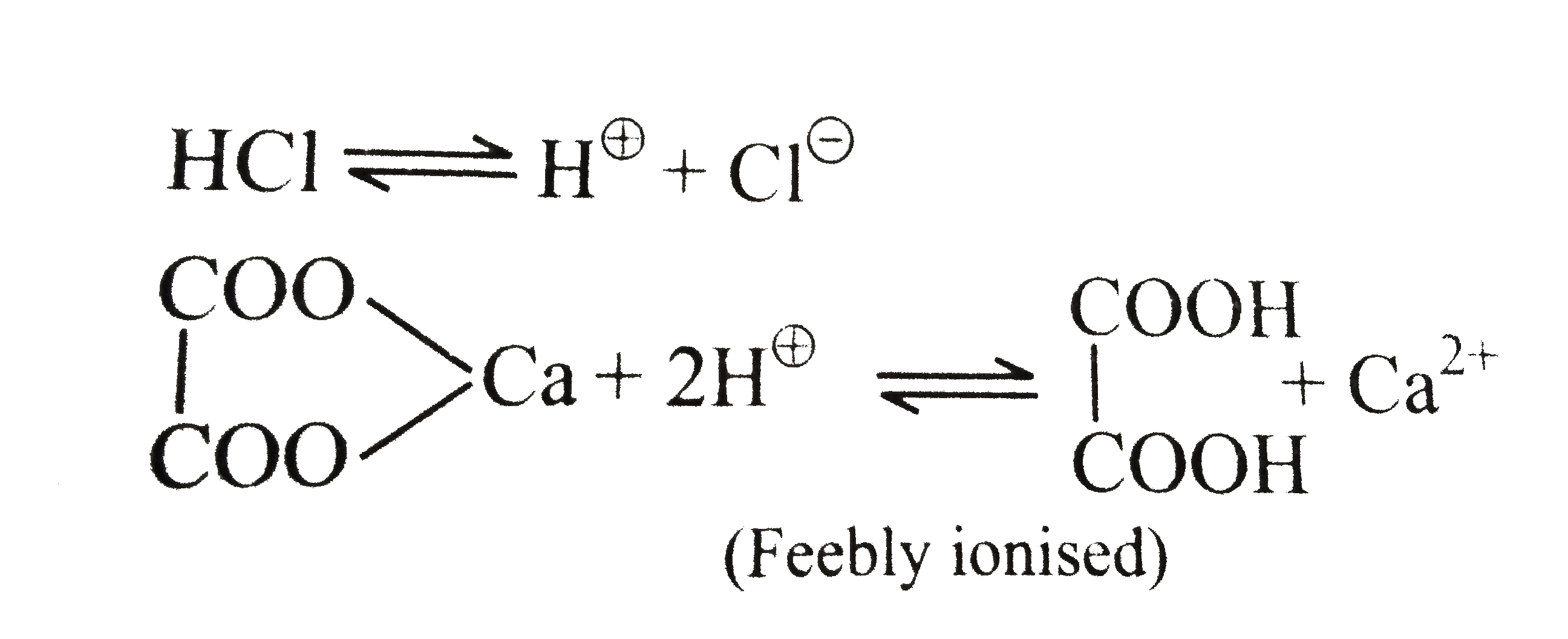 When dilute HCl is ADDED to calcium oxalate the oxalate ions will combine with `H^(o+)` ions of HCl to give feebly ionised soluble oxalic ACID. `HClhArrH^(o+)+CL^(ɵ)` |
|
| 4. |
Calcium occurs in nature as: |
|
Answer» Limestone |
|
| 5. |
Calcium lactate is a salt of a weak organic acid and is represented as Ca(Lac)_2. A saturated solution of Ca(Lac)_2 contains 0.13 mol of this salt in 0.5 litre solution. The pOH of this solution is 5.6. Assuming complete dissociation of the salt, calculate K_a for latic acid. |
|
Answer» Solution :`Ca(LAC)_2(s) to Ca(Lac)_2(aq) TOCA^(2+)(aq) + 2LAC^(-) (aq) ` `Lac^(-) (aq)+ H_2O hArrLaCH(aq) + OH^(-) (aq)` Since it is salt of strong base and weak acid, its PH is CALCULATED as pH=14-pOH=14-5.6=8.4 `8.4= 1/2[14+pK_a + log 0.52]` (`therefore`c = 2 × 0.13/0.5) `pK_a`=(2 × 8.4) – 14 – log 0.52 = 3.08 `thereforeK_a=8.31xx10^(-4)` |
|
| 6. |
Calcium is obtained by- |
|
Answer» Roasting of LIME stone |
|
| 7. |
Calcium is extracted by the electrolysis of: |
|
Answer» FUSED mixture of `CaCl_2 and CaF_2` |
|
| 8. |
Calcium is obtained by : |
|
Answer» Electrolysis of solution of `CaCl_(2)` in water |
|
| 9. |
Calcium imide on hydrolysis will give gas (B) which on oxidation by beaching powder gives gas (C) gas (C) on reaction with magnesium give compound (D). (D) on hydrolysis gives gas (B). (B), (C) and (D) are |
|
Answer» `NH_(3), N_(2),Mg_(3)N_(2)` |
|
| 10. |
Calcium formate on .................. gives methanal and CaCO_3 |
| Answer» SOLUTION :DRY DISTILLATION | |
| 11. |
Calcium has face-centred cubic lattice and radius of calcium atom is 195.6 picometre. Determine the number of Ca atoms present on surfaces of a mm3 block of calcium metal assuming that atoms in the closest packing calcium metal assuming that atoms are in the closest packing. |
Answer» Solution : In FCC, the relation is 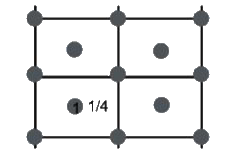 `4r=sqrt(2a) impliesa=2sqrt(2r)=553.24xx10^(-9) mm` `implies` Area of a face pf unit cell `=a^(3)=3.06xx10^(-13)mm^(2)` `implies` SURFACE area of metal BLOCK =6 `mm^(2)` `implies` Total number of FACES of unit CELLS present on surface `=(6)/(3.06xx10^(-13))=1.96xx10^(13)` Each face contributes two two Ca atoms on surface as `implies` Total number of Ca atoms present on surface `=2xx1.96xx10^(13)=3.92xx10^(13)` |
|
| 12. |
Calcium formate, on dry heating, produces |
|
Answer» acetone `(HCOO)_(2)CA overset(DELTA) toHCHO + CaCO_(3)`. Thus in this REACTION, formaldehyde (HCHO) is PRODUCED. |
|
| 13. |
Calcium does not combine directly with |
|
Answer» Oxygen |
|
| 15. |
Calcium cyanamide reacts with steam to form ammonia and……… |
|
Answer» `CA(OH)_2` |
|
| 16. |
Calcium cyanamide on treatment with steam produce |
|
Answer» `CaCO_(3)+NH_(3)` |
|
| 17. |
Calcium cyanamide on treatment with steam under pressure gives ammonia and |
|
Answer» Calcium CARBONATE |
|
| 18. |
Calcium cyanamide on treatment with steam produes |
|
Answer» `NH_3+CaO` |
|
| 19. |
Calcium crystallizes in Face-centred cubic lattice with edge length equals to 556 pm. calculate the density if : (i) There is 0.1% Schottky defect (ii) There is 0.1 % Frenkel defect |
|
Answer» |
|
| 21. |
Calcium carbonate reacts with aqueous HCl to give CaCl_(2) and CO_(2) according to the reaction : CaCO_(3)(s)+2HCl(aq) rarr CaCl_(2)(aq)+CO_(2)(g)+H_(2)O(l) What mass of CaCl_(2) will be formed when 250 mL of 0.76 M HCl react with 1000 g of CaCO_(3)? Name the limiting reagent. Calculate the number of moles of CaCl_(2) formed in the reaction. |
|
Answer» Solution :`"1000 g of CaCO"_(3)="1000/100 MOL = 10 mol "("Molecular mass of "CaCO_(3)="100 g mol"^(-1))` `"250 mL of 0.76 M HCl "=250xx0.76" millimole = 190 millimole = 0.19 mol"` According to the given equation, 1 mol of `CaCO_(3)` REACTS with 2 mol of HCl `therefore" 10 mol of "CaCO_(3)" will react with 20 mol of HCl"` But we have only 0.19 mol HCl. Hence, HCl will be limiting reagent. 2 mol of HCl produce `CaCl_(2)` = 1 mol `therefore " 0.19 mol of HCl will produce "CaCl_(2)=(1)/(2)xx0.19" mol"=" 0.095 mol"= 0.095xx111g=10.54h` `""("Molar mass of "CaCl_(2)=40+71="111 g mol"^(-1))` |
|
| 22. |
Calcium carbonate used in the extraction ofiron acts as: |
| Answer» Answer :D | |
| 23. |
Calcium carbonate reacts with aqueous HCl according to the reaction : CaCO_(3)(s)+2HCl(aq) rarr CaCl_(2)(aq)+CO_(2)(g)+H_(2)O(l). What mass of CaCO_(3) is required to react completely with 25 mL of 0.75 M HCl ? |
|
Answer» SOLUTION :Step 1. To calculate mass of HCl in 25 mL of 0.75 M Hcl 1000 mL of 0.75 M HCl contains HCl = 0.75 moles `=0.75xx36.5g=24.375g` `therefore"25 mL of 0.75 HCl will contain HCl"=(24.375)/(1000)xx25g=0.6844g.` Step 2. To calculate mass of `CaCO_(3)` reacting completely with 0.9125 G of HCl `CaCO_(3)(s)+2HCl(aq) rarr CaCl_(2)(aq)+CO_(2)(g)+H_(2)O(l)` 2 moles of HCl, i.e., `2xx36.5 g=73g HCl` REACT completely with `CaCO_(3) = "1 MOLE = 100 g"` `therefore " 0.6844 g HCl will react completely with "CaCO_(3)=(100)/(73)xx0.6844g=0.938g` |
|
| 24. |
Calcium carbonate is naturally available as limestone and can also be synthesized from quick lime. It is seen that the compositions of the elements in both the natural and synthetic calcium carbonate are same. The validity of which one among the following lawsis confirmed by this observation ? |
|
Answer» LAW of conservation of mass |
|
| 25. |
Calcium carbonate decomposes completely. On heating into lime (CaO) and carbon dioxide (CO_(2)). 1kg of calcium carbonate is completely decomposed by heat, when 560gof lime are obtained. How much quantity of carbon dioxide in grams, moles and litres at NTP is produced in the process? |
|
Answer» Solution :According to law of conservation of mass, mass of lime+ Mass of carbon dioxide=Mass of calcium 560g+mass of `CO_(2)=1000g` Molecular mass of `CO_(2)=12+32=44g` (1 mole) No. of MOLES in 440 G of `CO_(2)=(440)/(44)=10` 1 mole of `CO_(2)` occupies volume at NTP=22.4 LITRE 10 moles `CO_(2)` will occupy volume at NTP `=22.4xx10=224` litre. |
|
| 26. |
Calcium carbide when heated with nitrogen forms: |
|
Answer» `Ca_3N_2` |
|
| 28. |
Calcium carbide on reacting with water gives |
|
Answer» Methane |
|
| 29. |
Calciumburns innitrogento produce a whitepowder whichdissolveinsufficientwaterto produce a gas A and analkline solution .The solutionon esposureto air produces a thissolidlayer of Bon the surface identifythecompound A and B. |
|
Answer» Solution :A is ammonia and B is calcuimcarbonate `CA+N_(2) rarr underset("White powder")(Ca_(3)N_(2))` `Ca_(#) +H_(2)O rarr Ca(OH)_(2) +underset((A))(NH_(3))` `Ca(OH)_(2) OVERSET(COO_(2))rarr underset((B))(CaCO_(3))+H_(2)O` |
|
| 30. |
Calcium bums in nitrogon to produce a white powder which dissolves in sufficient water to produce a gas (A) and an alkaline solution. The solution on exposure to air produces a thin solid layer of (B) on the surface. Identify the compounds A and B. |
|
Answer» Solution :`NH_(3),CaCO_(3)` `3Ca+N_(2)toCa_(3)N_(2)overset(6H_(2)O)tounderset(Alkali)(Ca(OH)_(2))+underset(A)(2NH_(3))` `Ca(OH)_(2)overset(CO_(2))tounderset(SOLID)(CaCO_(3))+H_(2)O` |
|
| 31. |
Calcium ammonium nitrate (CAN) is a popular nitrogen fertilization because it is |
|
Answer» slow supplier of nitrogen |
|
| 32. |
Calcium formate on heating forms _____. |
|
Answer» `CO_2, H_2O` |
|
| 33. |
Name the product formed when calcium acetate is heated with calcium formate. |
| Answer» SOLUTION :ACETALDEHYDE | |
| 34. |
Calcium acetate to acetaldehyde |
|
Answer» Solution :Calcium ACETATE to acetaldehyde `UNDERSET("Calcium acetate")((CH_(3)COO)_(2)Ca)+underset("Calcium FORMATE")((HCOO)_(2)Ca) underset("dry distillation")(overset("heat")to ) underset("Acetaldehyde")(2CH_(3)CHO+2CaCO_(3))` |
|
| 35. |
Calcium Acetate on heating under distillation gives |
|
Answer» Acetaldehyde and CALCIUM oxide `(RCOO)_(2)CA overset(Delta)rarr RCOR + CaCO_(3)` |
|
| 37. |
Calcium acetate , on dry distillation with calcium formate gives : |
|
Answer» Acetaldehyde |
|
| 38. |
Calcium acetate on dry distillation gives ............. |
|
Answer» ACETIC acid |
|
| 39. |
Calcite is example of .......... system. |
|
Answer» RHOMBOHEDRAL |
|
| 40. |
Calcium acetate on distillationn gives : |
|
Answer» ACETONE 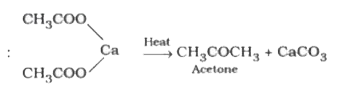
|
|
| 41. |
Calcite belongs to |
|
Answer» TETRAGONAL SYSTEM |
|
| 42. |
Calcinations is carried out in a : |
|
Answer» Blast furnace |
|
| 43. |
The role of calcinationin metallurgical operations is: |
|
Answer» MAGNESITE ore |
|
| 44. |
Calcination is used in the metallurgy of: |
|
Answer» MAGNESITE ore |
|
| 45. |
Calcination of an ore means : |
|
Answer» STRONG HEATING in presence of AIR |
|
| 46. |
Calcination is used in metallurgy for removal of |
|
Answer» water and sulphide |
|
| 47. |
Calcinationistheprocess ofheatingthe orestronglyin the………….. ofair. |
|
Answer» |
|
| 48. |
Calcination is the process of heating the ore : |
|
Answer» in INERTGAS |
|
| 49. |
Calcination is the peccess of heating the ore |
|
Answer» `Cu_(2)O+FeS` |
|
| 50. |
Calcination is a thermal treatment process of ores which can not bring : |
|
Answer» Thermal decomposition |
|