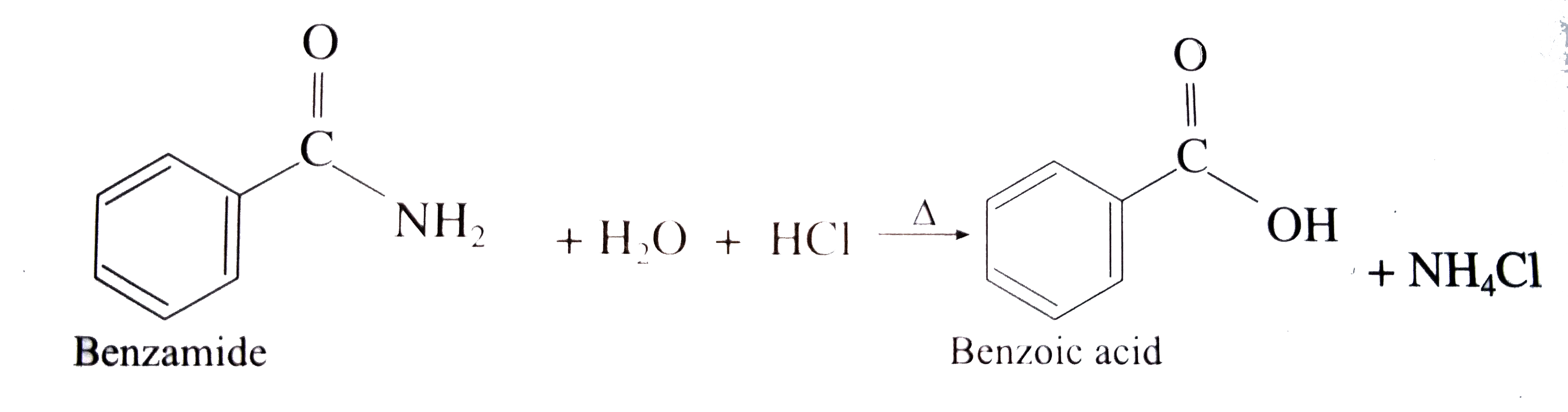
Saved Bookmarks
This section includes 7 InterviewSolutions, each offering curated multiple-choice questions to sharpen your Current Affairs knowledge and support exam preparation. Choose a topic below to get started.
| 1. |
Benzene can be obtained by heating either benzoic acid with Xor phenol with Y. X and Yare respectively |
|
Answer» ZINC DUST and SODA LIME 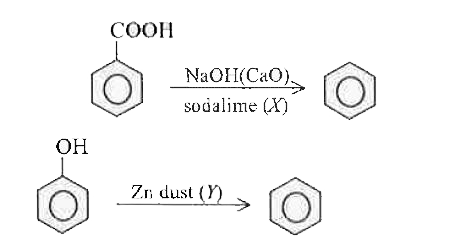
|
|
| 2. |
Benzene can be converted to isopropyl benzene (Cumene) by the following reagent. |
|
Answer» `CH_(3) CH_(2) CH_(2)` Cl + ANHY. `AlCl_(3)` |
|
| 3. |
Benzene can be converted into toluene by |
|
Answer» KOLBE's REACTION |
|
| 4. |
Benzene can be converted into toluene by : |
|
Answer» WURTZ REACTION |
|
| 5. |
Benzene (C_(6)H_(6)) and toluene (C_(7)H_(8)) from a nearly ideal solution at 313 K. The vapour pressure of pure benzene and toluene are 160 mm of Hg and 60 mm of Hg respectively. Calculate the partial pressure of benzene and toluene and the total pressure over the following solutions : (iii) containing equal molecules of benznen and toluene. |
|
Answer» |
|
| 6. |
Benzene (C_(6)H_(6)) and toluene (C_(7)H_(8)) from a nearly ideal solution at 313 K. The vapour pressure of pure benzene and toluene are 160 mm of Hg and 60 mm of Hg respectively. Calculate the partial pressure of benzene and toluene and the total pressure over the following solutions : (ii) containing 1 mole of benzene and 4 moles of toluene. |
|
Answer» |
|
| 7. |
Benzene can be converted into acetophenone by treating it with : |
|
Answer» acetone in the presence of HCl |
|
| 8. |
Benzene (C_(6)H_(6)) and toluene (C_(7)H_(8)) from a nearly ideal solution at 313 K. The vapour pressure of pure benzene and toluene are 160 mm of Hg and 60 mm of Hg respectively. Calculate the partial pressure of benzene and toluene and the total pressure over the following solutions : (i) containing equal weights of benzene and toluene. |
|
Answer» Molar mass of benzene, `C_(6)H_(6)="78 g mol"^(-1)," Molar mass of toluene, "C_(7)H_(8)="92 g mol"^(-1)` `therefore"Moles of benzene "=(w)/(78)" and Moles of toluene "=(w)/(92)` `"Total no. of moles in the solution "=(w)/(78)+(w)/(92)=(92w+78w)/(78xx92)=(170w)/(78xx92)` `therefore"Moles FRACTION of benzene,"x_(B)=(w//78)/(170w//(78xx92))=(92)/(170)=0.541` `"and MOLE fraction of toluene, "x_(T)=1-0.541 = 0.459` |
|
| 9. |
Benzene (C_6 H_6) and toluene (C_7 H_8) form a nearly ideal solution. At 313 K, the vapour pressure of pure benzene is 150 mm Hg and of pure toluene is 50 mm Hg. Calculate the vapour pressure of a mixture of these two containing their equal masses at 313 K. |
|
Answer» Solution : Let the mass of both benzene and toluene=Wg ` therefore `Moles of benzene`= (W )/(78) ,`Moles of toluene `=(W)/(92)` Mole fraction of benzene` =((w)/(78))/((w/(78)+W/(92)))=0.541` Mole fraction of toluene = 1-0-541 = 0.459 partialvapourpressureof benxzene`(P_A ) =P_(A)^(@)X_A` `=150 XX 0.541 = 81.15m m` Particalvapourpressureof toluene `(P_B) =P_(B)^(@)X_B` `=50 xx 0.459 =22.95 m m` totalvapourpressureof MIXTURE=`81.15 +22.95= 104.1 m m` |
|
| 10. |
Benzene burns according to the following equation 2C_(6)H_(6)(l)+15 O_(2)(g) rarr 12 CO_(2) (g)+6H_(2)O(l)""DeltaH^(@)= -6542 KJ What is the DeltaE^(@) for the combustion of 1.5 mol of benzene |
|
Answer» `-3271 KJ` `DeltaH^(@)=DeltaE^(@)+(Deltan_(G))RT` `rArr ""-6542=DeltaE^(@)+(-3)(8.31)(298)xx10^(-3)""rArr""DeltaE^(@)=-6534 kJ` |
|
| 11. |
Benzene and toluene from nearly ideal solutions. If at 300k, p_("toluene")^(0)=32.06 mm and p_("benzene")^(0)=103.01mm (a) Calculate the vapour pressure of a solution containing 0.6 molefraction of toluene (b) Calculate the mole fraction of toluene in the vapour for this composition of liquid |
|
Answer» SOLUTION :(a) We have, `p=x_(A)*x_(A)^(0)+x_(B)*p_(B)^(0)`……………..(Eqn.3) Given that `x_("toluene")=0.6`, `x_("BENZENE")=1-0.6=0.4` `:.p=0.6xx32.06+0.4xx103.01` `=60.44mm` Again we have, `(1)/(p)=(x_(A).)/(p_(A)^(0))+(x_(B)^(.))/(p_(B)^(0))`...........(Eqn.5) `(1)/(60.44)=(x_("toluene")^(.))(32.06)+(x_("benzene").)/(103.01)` But `x_("toluene").+x_("benzene").=1` `:. (1)/(60.44)=(x_("toluene").)/(32.06)+(1-x_("toluene").)/(103.01)` `:.x_("toluene").=0.3182` |
|
| 12. |
Benzene and tolune from nearly ideal solution. At a certain temperature, the vapour pressure os pure benzene is 150 mm Hg and of pure toluene is 50 mm Hg. Calculate the vapour pressure of the solution containing equal weight of benzene andtolune. |
|
Answer» `"Molar mass of benzene" = 778 " g MOL"^(-1)` `"Molar mass of toluene"= 92" g mol"^(-1)` `"No. of MOLES of benzene"=((Wg))/((78" g mol"^(-1)))=W/78 mol` `"No. of moles of toluene"=((Wg))/((92" g mol"^(-1)))=W/92mol` `"MOLE fraction of benzene"=(W/78)/(W/78+W/92)=0.541` Mole fraction of toluene= 1-0.541=0.459 `"Pratial vapour pressure of benzene"=0.541xx150mm=81.15mm Hg` `"Partial vapour pressure of toluene"0.459xx50mm=22.95mmHg` `"Total vapour pressure of solution"=81.15+22.95=104.1 mm Hg`. |
|
| 13. |
Benzene and toluene have equal mole fractions in their mutual solution. What do you expect about their mole fraction n the vapour phase at the same temperature? Explain. (Given : p_("Benzene")^(@)=3xxp_("Toluene")^(@)) |
|
Answer» <P> Solution :`p_(B)//p_(T)=p_(B)^(@)//p_(T)^(@)(because x_(B)=x_(T)).` But `p_(B)^(@)//p_(T)^(@)=3` (GIVEN). Hence, `p_(B)//p_(T)=3.` But `p_(B)//p_(T)=3` implies that `y_(B)//y_(T))=3` in the VAPOUR phase because vapour pressure in the vapour phase are in the ratio of their no. of moles of mole fractions. |
|
| 14. |
Benzene and toluene from nearly ideal solutions. If at 300k, p_("toluene")^(0)=32.06 mm and p_("benzene")^(0)=103.01mm (a) A liquid mixture is composed of 3 moles of toluene and 2 moles of benzene. If the pressure over the mixture at 300K is reduced, at what pressure does the first vapour form ? (b) What is the composition of the first trace of vapour formed ? (c ) If the pressure is reduced further, at what pressure does the last trace of liquid disappear? (d) What is the composition of the last trace of liquid ? |
|
Answer» <P> SOLUTION :(a) `p=(3)/(5)xx32.06+(2)/(5)xx103.01`…………..(Eqn.3)`=60.44mm` (B) `(1)/(60.44)=(x_(t))/(32.06)+((1-x_(1))/(103.01))`…………(Eqn.5) `x_(t)=0.3181` (c ) `(1)/(p)=((3)/(5))/(32.06)+((2)/(5))/(103.01)`………….(Eqn5) `p=44.25mm` (d) `44.25=x_(t)xx32.06+(1-x_(t))103.01` ...........(Eqn 3) `x_(t)=0.8281` |
|
| 15. |
Benzene and toluene forms nearly an ideal solution. At 300 K, P_("toluene")^(@)=32.06" mm" and P_("benzene")^(@)=103.01" mm" (of Hg) (i) A liquid mixture is conposed of 3 mole of tolune and 2 mole of benzene. If the pressure over the mixture at 300 K is reduced, at what pressure does the first vapour form ? (ii) What is the composition of the first trace of vapour formed ? (iii) If the pressure is reduced futher,at what pressure does the last trace of liquid dissappear ? (iv) What is the composition of last trace of liquid ? |
|
Answer» (i)50.44mmg (ii) `x_("toluene")=0.3181` (iii) P=44.25 mmHg (iv)`x_("toluene")=0.8281` |
|
| 16. |
Benzene and toluene form nearly ideal solutions . If at 27^(@)C the vapour pressures of pure toluene and pure benzene are 32.06mm and 103.01mm respectively (a) Calculate the vapour pressure of a solution containing 0.60 mole fraction of toluene (b) Calculate the mole of fraction of toluene in vapour for this composition of the liquid |
|
Answer» |
|
| 17. |
Benzene and toluene form nearly ideal solution. At a certain temperature, the vapour pressure of the pure benzene is 150 mm Hg and of pure toluene is 50 mm Hg. For this temperature, calculate the vapour pressure of solution containing equal weights of two substances. Also calculate their composition in the vapour phase. |
|
Answer» |
|
| 18. |
Benzene and toluene form nearly ideal solutions. At 20^(@)C, the vapour pressure of benzene is 75 torr and that of toluene is 22 torr. The partial vapour pressure of benzene at 20^(@)C for a solution containing 78 g of benzene and 46 g of toluene in torr is |
|
Answer» <P>50 `=((78)/(78))/((78)/(78)+(46)/(92))=(1)/(1+0.5)=0.667` `p"(benzene)"=p^(@)"(benzene)"XX x"(benzene)"` `=75xx0.667=50` TORR |
|
| 19. |
Benzene and toluene form nearly ideal solution. At 20^(@)C, the vapour pressure of benzene is 75 torr and that of toluene ios 22 torr. The partial vapour pressure of benzene at 20^(@)C for a salution containing 78 g of benzene and 46 g of toluene in torr is : |
|
Answer» <P>50 `X_(B)=(((78g))/((78gmol^(-1))))/(((78g mol^(-1)))/((78g mol^(-1)))+((46G))/((92gmol^(-1))))` `P_(B)^(@)=P_(B)^(@)X_(B)=75"torr"xx1/1.5=50 "torr"` |
|
| 20. |
Benzene and toluene form ideal solution over the entire range of composition. The vapour pressures of pure benzeneand toluene at 300 K are 50.71 mm Hg and 32.06 mm Hg respectively. Calculate the mole fraction of benzene in the vapour phase if 80 g of benzene is mixed with 100 g of toluene. |
|
Answer» SOLUTION :Molar mass of benzene `(C_(6)H_(6))="78 g mol"^(-1),"Molar mass of toluene "(C_(6)H_(5)CH_(3))="92 g mol"^(-1)` `therefore"No. of moles in 80 g of benzene "=("80 g")/("78 g mol"^(-1))="1.026 mole"` `"No. of moles in 100 g of toluene "=("100 g")/("92 g mol"^(-1))="1.087 mole"` `therefore"In the solution, mole fraction of benzene "=(1.026)/(1.-26+1.087)=(1.026)/(2.113)=0.486` mole fraction of toluene `=1-0.486=0.514` `p_("Benzene")^(@)="50.71mm, "p_("Toluene")^(@)="32.06 mm"` `"Applying RAOULT's law,"p_("Benzene")=x_("Benzene")xxp_("Benzene")^(@)=0.486xx"50.71 mm = 24.65 mm"` `""p_("Total")=x_("Toluene")=0.514xx"32.06 mm = 16.48 mm"` `therefore"Mole fraction of benzene in the vapour phase"=(p_("Benzene"))/(p_("Benzene")+p_("Toluene")) =(24.65)/(24.65+16.48) =(24.65)/(41.13) = 0.60` |
|
| 21. |
Benzene and toluene form ideal solution over the entire range of composition. The vapour pressure of pure benzene and toluene at 300 K are 50.71 mm Hg and 32.06 mm Hg respectively. Calculate the mole fraction of benzene in vapour phase if 80 g of benzene is mixed with 100 g of toluene. |
|
Answer» Solution :MOLAR mass of `(C_(6)H_(5))` `= 6xx12+6xx1` `= 78 g mol^(-1)` Molar mass of toluene `(C_(6)H_(5)CH_(3))` `= 7xx12+8xx1` `= 92 g mol^(-1)` Now, no. of moles present in 80 g of benzene `= (80)/(78)=1.026` mol And, no. of moles present in 100 g of toluene `= (100)/(92)=0.087` mol Therefore, Mole FRACTION of benzene, `x_(b)=(1.026)/(1.026+1.087)` = 0.486 And, mole fraction of toluene, `x_(t)=1-0.486` = 0.514 It is given that vapour presure of PURE benzene, `p_(b)^(0)=50.71` mm Hg Therefore, partial vapour presure of benzene, `p_(b)=x_(b)xx p_(b)` = 24.645 mm Hg And, partial vapour pressure of toluene, `p_(1)=x_(t)xx p_(t)` `= 0.514xx32.06` = 16.479 mm Hg Hence, mole fraction of benzene in vapour PHASE is given by : `=(p_(b))/(p_(b)+p_(t))` `= (24.645)/(24.645+16.479)` `= (24.645)/(41.124)` = 0.599 =0.6 |
|
| 22. |
Benzene and toluene form an ideal solution. The vapour pressure of benzene and toluene are respectively 75mm and 22mm at 20^(@)C. If the mole fractions of benzene and toluene in vapour are 0.63 and 0.37 respectively, calculate the vapour pressure of the ideal mixture. |
|
Answer» <P> Solution :SINCE the mole fractions of the components GIVEN in the problem are of the vapour which is in equilibrium with the ideal mixture, we have,`(1)/(p)=(x_(A).)/(p_(A)^(0))+(x_(B).)/(p_(B)^(0))` …………..(Eqn.5) `(1)/(p)=(0.63)/(75)+(0.37)/(22)` `p=39.65mm` |
|
| 23. |
Benzene and toluene form ideal solution over the entire range of composition. The vapour pressure of pure benzene and toluene at 300 K are 50.71 mm Hg and 32.06 mm Hg, respectively, Calculate the mole fraction of benzene in vapour phase if 80 g of benzene is mixed with 100 g of toluene. |
|
Answer» <P> Solution :Molar mass of benzene `(C_6H_6) = 78 g "mol"^(-1)`Molar mass of toluene `(C_6H_3CH_3) = 92 g "mol"^(-1)` ` therefore ` Number of moles in 80 g of benzene`= (80g)/(78 g"mol"^(-1)) = 1.026` mole Number of moles in 100 g toluence ` = (100g)/(92 g "mol"^(-1)) = 1.087` mole Mole FRACTION of benzene ` = (1.026)/(1.026 + 1.087) = (1.026)/(2.113) = 0.486` Mole fraction of toluene = 1 - 0.486 = 0.514 `p_("benzene")^0 = 50.71 mm, p_("toluence")^0 = 32.06 mm` `p_("benzene") = x_("benzene") XX p_("benzne")^0 = 0.486 xx 50.71 mm= 24.65 mm` `p_("toluence")= x_("toluence") xx p_("toulence")^0 = 0.514 xx 32.06mm = 16.48 mm` Mole fraction of benzene in the vapour phase ` = (p_("benzene"))/(p_("benzene") + p_("toluence")) = (24.65)/(24.65+ 16.48) = (24.65)/(41.13) = 0.60` |
|
| 24. |
Benzene and toluene form an ideal solution at room temperature. Which Of the following is not true for this process? |
|
Answer» `DeltaV_(MIX)=0` |
|
| 25. |
Benzene and naphthalene from an ideal solution at room temperature. For this process, the true statement(s) is(are) |
|
Answer» `DeltaG` is posiotive |
|
| 26. |
Benzene and naphthalene form an ideal solution at room temeprature. For this processthe true statement(s) is (are) |
|
Answer» `DELTAG` is positive |
|
| 27. |
Benzene and naphthalein form an ideal solution at room temperature. For this process, the true statement (s) is (are) |
|
Answer» `DeltaG` is positive |
|
| 28. |
Benzenamine reacts with benzoyl chloride in presence of aqueous sodium hydroxide to form_____and the reaction is called____reaction. |
| Answer» SOLUTION :N-phenylbenzamide or BENZANILIDE, Schotten-Baumann. | |
| 29. |
Benzamide to toluene |
Answer» SOLUTION :
|
|
| 31. |
Benzamide on reaction with POCl_(3) gives |
|
Answer» ANILINE |
|
| 32. |
Benzamide reacts with nitrous acid with the evolution of : |
|
Answer» `N_(2)` 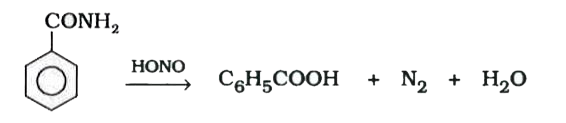
|
|
| 33. |
Benzamide on reduction with Na and C_(2)H_(5)OH gives: |
|
Answer» BENZYL alcohol 
|
|
| 34. |
Benzamide on reaction with POCl_(3) gives. |
|
Answer» aniline |
|
| 35. |
Benzamide on reaction with POCl_3 gives : |
|
Answer» ANILINE |
|
| 36. |
Benzamide is reacted with sodium metal in ethanol gives |
|
Answer» ANILINE |
|
| 37. |
Benzamide cam be converted into aniline by the action of |
|
Answer» <P>`Br_2//C Cl_4` |
|
| 38. |
Benzamide (A) is prepared by heating benzoic acid with ammonia. It undergoes the following reactions: A underset("reaction 1")overset(Br_(2),KOH, Delta)(to) B underset(273-278K "reaction 2")overset(NaNO_(2),HCl)(to) C underset(Delta "reaction 3")overset(H_(3)PO_(2),H_(2)O)(to) D underset(anhyd AlCl_(3) "reaction 4")overset(CH_(3)Cl)(to) E E on heating with acidic KMnO_(4) gives back benzoic acid. 3. Write the chemical reaction for reaction 2 if temperature is 298K. |
Answer» SOLUTION :
|
|
| 39. |
Benzalkonium chloride is a: |
|
Answer» cationic surfactant and antiseptic |
|
| 40. |
Benzalkonium chloride is a . |
|
Answer» CATIONIC SURFACTANT and antiseptic |
|
| 41. |
Benzalehyde can be obtained from benzal chloride. Write reactions for obtaining benzal chloride and then benzaldehyde from it. |
Answer» SOLUTION :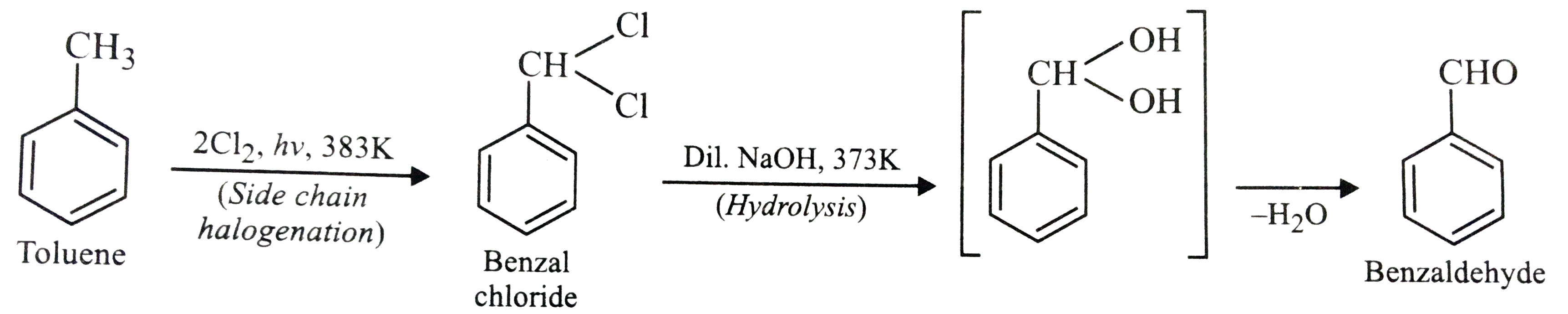
|
|
| 42. |
Benzaldoxime exists in how many forms ? |
|
Answer» 4 |
|
| 43. |
Benzaldoxime exists in how many forms : |
|
Answer» 1 |
|
| 44. |
Benzaldelhyde can be converted to styrene by the following reaction. |
|
Answer» PERKINS REACTION 
|
|
| 45. |
Benzaldehyde undergoes oxidation and reduction in the presence of |
|
Answer» `NaHCO_3` |
|
| 46. |
Benzaldehyde Undergoes Claisen condensation with another aldehyde to give cinnamaldehyde.The aldehyde is: |
|
Answer» Formaldehyde |
|
| 47. |
Benzaldehyde undergoesauto-oxidation and reduction in presence of |
|
Answer» CONC. NAOH |
|
| 48. |
Benzaldehyde to prop-hydroxyphenyl acetic acid |
Answer» SOLUTION :
|
|
| 49. |
Benzaldehyde to benzophenone |
Answer» SOLUTION :
|
|
| 50. |
Benzaldehyde reduces Tollens' reagent but not the Fehling's or the Benedict's solution. Explain. |
| Answer» Solution :The electron-donating resonance effect (+R-effect) of the benzene ring increases the electron density in the carbonly group of benzaldehyde. This, in turn, increases the electron density in the C-H bond of the aldehyde group. As a result, the C-H bond becomes STRONGER and hence only stronger oxidising agents like Tollens' reagent, `Ag(NH_(3))_(2)^(+)(E_(Ag^(+)//Ag)^(@)=+0.80V)` can oxidise C-H to C-OH toform carboxylic Acids but weaker oxidisinig agents like FEHLING's solution (`Cu^(2+)+` tartrate ion +base) and Benedict (`Cu^(2+)` + CITRATE ion+Base) solution `(E_(Cu^(2+)//Cu^(+))^(@)=0.18V)` fail to oxidise benzaldehyde to benzoic acid . Thus, in general, all these three reagents oxidise aliphatic aldehydes but only tollens' reagent oxidise aromatic aldehydes. | |