

Saved Bookmarks
This section includes 7 InterviewSolutions, each offering curated multiple-choice questions to sharpen your Current Affairs knowledge and support exam preparation. Choose a topic below to get started.
| 1. |
Based VB theory explain why[Cr(NH_3)_6]^(3+) is paramagnetic , while [Ni(CN_4) ^(2-)is diamagnetic. |
|
Answer» Solution :(a) `[Cr(NH_(3))_(6)]^(3+)` In this complex Cr is in the +3 oxidation STATE. Electronic configuration of Cr atom Electronic configuration of `Cr^(3+)` ion Hybridisation and formation of `[Cr(NH_(3))_(6)]^(3+)` complex * Due to the presence of three unpaired electrons in `[Cr(NH_(3))_(6)]^(3+)` it behaves as a PARAMAGNETIC substance * The spin magnetic moment, `mu s= sqrt(3(3+2)) = sqrt15 = 3.87BM` * `[Cr(NH_(3))_(6)]^(3+)` is an inner orbital octahedral complex. 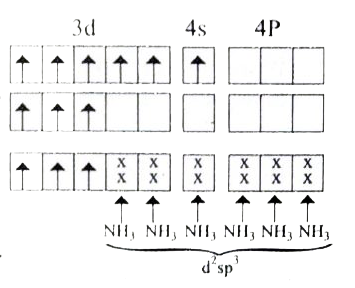 (b) `[Ni(CN)_(4)]^(2-)` In this complex Ni is the +2 oxidation state. Electronic configuration of Ni atom Electronic configuration of `Ni^(2+)` ion 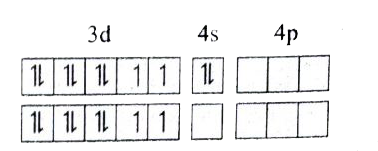 Hybridisation and formation of `[Ni(CN)_(4)]^(2-)` Complex 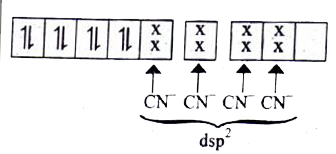 Since `CN^(-)` is strong field LIGAND, hence the electrons in 3d orbitals for forced to PAIR up and there is no unpaired electron in `[Ni(CN)_(4)]^(2-)`, hence it should be DIAMAGNETIC substance. |
|
| 2. |
Based on type of particles of dispersed phase, give one example each of associated colloid and multimolecular colloid. |
|
Answer» Solution :Associated colloid : SOAP solution. It may contain as many as 100 molecules or more. Multimolecular colloid : Sulphur sol. It CONSISTS of PARTICLES containing a THOUSAND or more `S_8` molecules. |
|
| 3. |
Based on the type of particles of dispersed phase and dispersion medium give an example each of associated colloid and mutimolecular colloid. |
| Answer» | |
| 4. |
Based on the structures how is the reduction ability of H_(3)PO_(2) or H_(3)PO_(3) accounted for? |
|
Answer» Solution :`H_(3)PO_(2)` has TWO P-H bonds. The two H atoms linked directly to central P atom IMPARTS reducingcharacter to the acid. SIMILARLY `H_(3)PO_(3)` has one P-H bond, imparting reduction asbility. |
|
| 5. |
Based on the nature of order present in the arrangement of the constituent particles, solid are classified into two crystalline and amorphous. List out any four points of difference between crystalline and amorphous solids. |
Answer» SOLUTION :
|
|
| 7. |
Classify the following as addition and condensation polymers: Terylene, Polyvinyl chloride, polythene |
|
Answer» Solution :ADDITION polymers-Polyvinyl chloride, polythene CONDENSATION polymers-Bakelite, TERYLENE |
|
| 8. |
Based on the given diagram, which of the following statements regarding the solutions of two miscible volatile liquids are correct? 1. Plots AD and BC show that Raoult's law is obeyed for the solution in which B is a solvent and A is the solute and as well as for that in which A is solvent and B is solute. 2. Plots CD shows that Dalton's law of partial pressures is observed by the binary solutions of components A and B. EF + EG=EH,and AC and BD corresponds to the vapour pressures of the pure solvents A and B, respectively. Select the correct answer using the codes given below: |
|
Answer» 1 and 2 |
|
| 9. |
Based on the given diagram, which of the following statements regarding the solutions of two miscible volatile liquids are correct ? |
|
Answer» Plots AD and BC show that Raoult's LAW is obeyed for the solution in which B is a solvent and A is the solute and as well as as for that in which A is solvent and B is solute. |
|
| 10. |
Based onthe following thermochemical equations H_(2)O(g)+C(s)rarrCO(g)+H_(2)(g), DeltaH=131 kJCO(g)+(1)/(2)O_(2)(g)rarrCO_(2)(g),DeltaH=-282 kJC(s) +O_(2)(g)rarrCO_(2)(g),DeltaH=X kJThe value of X is |
|
Answer» `-393 KJ` X=131-282-242=-393 kJ. |
|
| 11. |
Based on the following graph, mark the correct option for the reaction: A rarr P |
|
Answer» II order reaction |
|
| 12. |
Based on the following data for a reaction what is its order (Ato products) "Conc.A" ""2M""0.2M""0.02M""0.00 "Time in min"""0""10""20""prop |
| Answer» Answer :A | |
| 13. |
Based on the first law of thermodynamics, which one of the following is correct ? |
|
Answer» For an ISOTHERMAL process,`q=+omega` `therefore` q=-w |
|
| 14. |
Based on the first law of thermodynamics, which one of the following statement is correct? |
|
Answer» For an ISOTHERMAL PROCESS, q=+W For an isothermal process, `DeltaU=0,""q=-W` For an isochoric process, `W=0,""DeltaU=q` For an adiabatic process, `q=0,""DeltaU=W` For a cyclic process, `DeltaU=0,""thereforeq=-W` |
|
| 15. |
Based on the data given below, the correcy order of reducing power is: Fe_((aq.))^(3+) + e rarr Fe_((aq.))^(2+), E^(@) = +0.77 V Al_((aq.))^(3+) + 3e rarr Al_((s)), E^(@) = -1.66 V Br_(2(aq.)) + 2e rarr 2Br_((aq.))^(-), E^(@) = +1.08 V |
|
Answer» `BR^(-) lt Fe^(2+) lt Al` `Br^-` lt `Fe^(2+)` lt Al |
|
| 16. |
Based on the data given below , the correctorder of reducing power is : Fe_((aq))^(3+) + e to Fe_((aq))^(2+) , E^(@)= 077V Al_((aq))^(3+) + 3e to Al_((s)) , E^(@) = -1.66V Br_(2(aq)) + 2e to 2Br_((aq))^(-) : E^(@) = + 1.08 V |
|
Answer» `Br^(-) lt Fe^(2+) lt AL ` |
|
| 17. |
Based on the data given below , the correct order of reducing power is : Fe^(3+)(aq) +erarrFe^(2+)(aq),E^@=+0.77V AI^(3+)(aq)+3erarrAI(s),E^@=-1.66V Br_2(aq) +2e rarr2Br^-(aq),E^@ =+1.08V |
|
Answer» `Br^- LT Fe^(2+) lt AI` |
|
| 18. |
Based on solute - solvent interactions, arrange the following in order of increasing solubility in n - octane and explain.Cyclohexane, KCl, CH_(3)OH, CH_(3)CN. |
|
Answer» Solution :n - octane is a non - polar solvent. Therefore, the solubility of a non - polar SOLUTE is more than that of a polar solute in the n - octane as like dissolves in like. The order of increasing POLARITY is : Cyclohexane `lt CH_(3)CN lt CH_(3)OH lt KCl` Therefore, the order of increasing solubility is : `KCl lt CH_(3)OH lt CH_(3)CN lt` Cyclohexane. |
|
| 19. |
Based on solute-solvent interactions, arrange the following in order of increasing sobulity in n-otane and explain. Cyclohexane, KCl, CH_(3)OH, CH_(3)CN |
|
Answer» Solution :(i) Cyclohexane and n-octane both are non-polar. Hence, they mix completely in all proportions. (II) KCL is an ionic compound while n-octane is non-polar. Hence, KCl will no dissolve at all in n-octane. (iii) `CH_(3)OH and CH_(3)CN`both are polar but `CH_(3)CN` is less polar than `CH_(3)OH`. As the SOLVENT is non-polar, `CH_(3)CN` will dissolve more than `CH_(3)OH` in n-octane. THUS, the order of solubility will be `KCl lt CH_(3)OH lt CH_(3)CN lt "Cyclohexane."` |
|
| 20. |
Based on solute-solvent interactions, arrange the following in order of increasing solubilityin n-octane and explain : Cyclohexane, KCI, CH_3OH, CH_2CN . |
|
Answer» Solution :(i) Cyclohexane and n-octane both are non-polar. Hence, they MIX completely in all PROPORTIONS. LIKE dissolves like. (II) KCL is an ionic compound while n-octane is non-polar. Hence, KCl will not dissolve at all inn-octane. (iii) `CH_3OH` and `CH_3CN `both are polar but `CH_3CN`is less polar than `CH_3OH. CH_3CN`willdissolve more than `CH_3OH ` in n-octane. Thus, the order of solubility will be `KCl lt CH_3OH lt CH_3CN lt ` Cyclohexane. |
|
| 21. |
Based on particles of dispersed phase, collodidal systems are classified into multimolecular, macro molecular and associated colloids. Which of the following colloidal system is an example for multimolecular colloidal system? |
|
Answer» STARCH in water |
|
| 22. |
The bond order depends on the number of electrons in the bonding and antibonding orbitals. Which of the following statement is/are correct about bond order ? |
|
Answer» Can have a NEGATIVE quantity |
|
| 25. |
Based on Langmuir adsorption isotherm, the intercept in the graph (m/x "versus" 1/p) is equal to |
| Answer» ANSWER :B | |
| 26. |
Based on electron gas theory explain why metals are malleable. |
|
Answer» Solution :When force (stress) is applied to a metal Kernel (positive ions or lattice points LAYERS slide over one another. The shape of the metal gets deformed. Freely MOVING electrons also move around the deformed layers and the environment around the metal ions remains unchanged. OR According to electron gas THEORY a metal CONTAINS an ARRAY of positively charged metal ions in a Sea or mobile valence electrons and the bonding is non directional. When force (stress) is applied to a metal the Kernel layers slide one over ther other. The shape of the metal gets deformed. 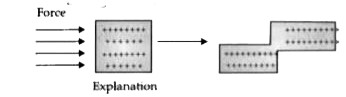
|
|
| 27. |
Based on data given below, match column-I and column II 3X(g)overset("250K,1atm")toX_3(g), DeltaH=-200 KJ//mol , DeltaS=-300 J//K//mol X(l)overset("1atm,250K")toX(g), DeltaH_(vap)=10 KJ//mol X_3(l)overset("500K,1atm")toX_3(g), DeltaH_(vap)=80 KJ//mol X_3(g,250 K , 1 atm )toX_3(g, 500 K, 1 atm) DeltaH=100KJ/mol,DeltaS=100 J/K/mol , DeltaG=60 KJ/mol Normal boiling point of X=250 K normal boiling point of X_3=500 K. Enthalpy change and entropy change of cooling X_3(l) to lower temperature is neglible. |
Answer»  OVERALL `DeltaH=3xx10-200+100-80+0=300-200+100-80=-150` kJ/mol `DeltaS=20-300+100-160+0=-240` J/mol/K `DeltaG=0+(-125)+60+0+0=-65` kJ/mol |
|
| 28. |
Based on Arrhenius concept, define acid and bases and give an example for each. |
|
Answer» Solution :According to Arrhenius, an ACID is a substance that dissociates to give hydrogen ions in water For example, `HCI, H_2SO_4` etc. are acids. Their DISSOCIATION in aqueous solution is expressed as `HCI_((g))overset(H_2O)(hArr) Ca_((aq))^(2+)+2OH_((aq))^(-)` Similarity a base is a substance that dissociates to give hydroxyl ions in water. For example, substance LIKE `NAOH,Ca(OH)_2` etc. are bases. `Ca(OH)_2 overset(H_2O)(hArr) Ca_((aq))^(2+)+2OH_((aq))^(-)` |
|
| 30. |
Base sugar phosphate unit of nuclic acid is known as ……………..... |
|
Answer» NUCLEOTIDE |
|
| 31. |
Base strength of |
|
Answer» `i gt iii gt ii` |
|
| 32. |
Base present in RNA and not in DNA is : |
|
Answer» Uracil |
|
| 33. |
Base-catalyzed aldol condensation occurs with |
|
Answer» PROPIONALDEHYDE |
|
| 34. |
Base-catalysed aldol condensation occurs with |
|
Answer» Propionaldehyde |
|
| 35. |
Base catalysed aldol condensation occurs with: |
|
Answer» Propionaldehyde |
|
| 36. |
Base catalysed aldol condensation occurs with |
|
Answer» propanal Compounds a,B, c have `alpha` - hydrogen atoms. |
|
| 39. |
Bartlett equation. |
|
Answer» Solution :The first orange COLOURED COMPOUND of noble GSES was prepared by Bartlett. `X_(e)+PtF_(6)RARR X_(e)^(+)PtF_(6)^(-)` This is KNOWN as Bartlett equation. |
|
| 40. |
Barium is extracted with its ore: |
|
Answer» Dolomite |
|
| 41. |
Barium ions, CN^(-) and Co^(2+) form an ionic complex.If this complex is 75% ionised in aqueous solution with Vant Hoff factor (i) equal to four and paramagnetic moment is found to be 1.73 BM (due to spin only) then the hybridisation state of Co (II) in the complex will be : |
|
Answer» `sp^3d` `i=1-alpha+xalpha-2alpha+2alpha` `(x-1)alpha=3 " " x-1=3/alpha` `alpha=0.75 , " " x=5` `:.` FORMULA of COMPLEX is `Ba_3[Co(CN)_5]_2` and HYBRIDISATION is `dsp^3` as it is a inner orbital complex with strong field ligand |
|
| 42. |
bar(C)H_(2) - underset(underset(..)O":")underset(||)(C) - CH_(3) harr CH_(2) = CH_(2) underset(underset(..)":O:"^(-))underset(|)(C) - CH_(3) |
|
Answer» RESONATING structures These structures INVOLVE only movement of electrons but not of atoms and hence are resonating structures . |
|
| 43. |
Barbituric acid is used as a ………….. |
| Answer» SOLUTION :TRANQUILIZER | |
| 44. |
Barbituric acid is used as |
|
Answer» An antipyretic |
|
| 45. |
Barbituric acid is a condensation product of A and B. A, B are : |
|
Answer» `1`. `H_2NCONH_2`, `HO_2C-CO_2H` |
|
| 46. |
Barbituric acid and its derivativesare well known as |
|
Answer» tranquilizers |
|
| 47. |
Barbituric acid and its derivatives are well known as |
|
Answer» TRANQUILLIZERS |
|
| 48. |
Barbituric acid and its derivatives are well known |
|
Answer» ANALGESICS |
|
| 49. |
Barbiturates exert deppressant action on …... |
|
Answer» GUT |
|
| 50. |
Barbiturates are used as : |
|
Answer» ANTIBIOTIC |
|