

Saved Bookmarks
This section includes 7 InterviewSolutions, each offering curated multiple-choice questions to sharpen your Current Affairs knowledge and support exam preparation. Choose a topic below to get started.
| 1. |
Barbiturates are the drugs which act on the____________. |
| Answer» Answer :A | |
| 2. |
Barbiturates acts as |
|
Answer» HYPNOTIC i.e., SLEEP producing AGENTS |
|
| 3. |
Ba(OH)_(2) solution , Which of the following reaction is incorrect for compound 'X', 'Y' and 'Z'. |
|
Answer» `Ba(OH)_(2)+Na_(2)SO_(3)RARR'X'` |
|
| 4. |
Ba(OH)_(3)+NaOH hArr Na[B(OH)_(4)]: To keep the above reaction on forward direction, which reagent should be used? |
|
Answer» CIS -1, 2 - diol |
|
| 6. |
Band theory predicts that magnesiums is an insulator. However, in practice it acts as a conductor due to |
|
Answer» presence of filled 3S - orbital |
|
| 7. |
Balz-Schiemann'sreactionis usedto convert |
|
Answer» Aromaticaldehydeto ALDOL |
|
| 8. |
Balance the following skeleton equation : Mg_(3)N_(2)+H_(2)OrarrMg(OH)_(2)+NH_(3). |
|
Answer» Solution :The biggest formula is `Mg_(3)N_(2)`. Hence, the various atoms are balanced in the order : Mg, N and H. (i) to equalise the number of Mg atoms on both sides, MULTIPLY Mg `(OH)_(2)` by 3. We get `Mg_(3)N_(2)+H_(2)Orarr 3Mg (OH)_(2)+NH_(3)` (ii) To balance the nitrogen atoms, multiply `NH_(3)` by 2 on the R.H.S. We get `Mg_(3)N_(2)+H_(2)Orarr 3Mg (OH)_(2)+2NH_(3)` (iii) to equalise the number of H and O atoms on both side of the above equation, multiply `H_(2)O` OCCURRING on L.H.S. of the equation by 6. We get `Mg_(3)N_(2)+6H_(2)Orarr 3Mg(OH)_(2)+2NH_(3)` This is the required balanced chemical equation. |
|
| 9. |
Balance the following skeleton equation by the method of Partial Equations : P+HNO_(3)rarr H_(3)PO_(4)+H_(2)O+NO_(2). |
|
Answer» Solution :This reaction is involves oxidation of phosphorus by nitric acid and takes place in the following steps : (i) Nitric acid decomposes to liberate nascent oxygen. `2HNO_(3)rarr 2NO_(2)+H_(2)O+(O)"…(1)"` (ii) Nascent oxygen oxidises phosphorus to phosphorus pentoxide. `2P+5(O)rarr P_(2)O_(5)"...(2)"` (iii) Phosphorus pentoxide, `P_(2)O_(5)`, dissolves in water to produce phosphoric acid. `P_(2)O_(5)+3H_(2)Orarr 2H_(3)PO_(4)"...(3)"` (iv) To cancel the intermediate products, multiply the partial EQUATION (1) by 5 and adding to eqns. (2) and (3), we have `10HNO_(3)+2Prarr 2H_(3)PO_(4)+2H_(2)O+10NO_(2)` Dividing by the common factor 2, we have `5HNO_(3)+Prarr H_(3)PO_(4)+H_(2)O+5NO_(2)` This represents the ATOMIC equation since phosphorus which is known to exist in the molecular form `(P_(4))` has been written in the atomic form. (V) To make the above atomic equaiton molecular, multiply it throughout by 4. Thus, we have the required balanced molecular equaiton : `20HNO_(3)+P_(4)rarr 4H_(3)PO_(4)+4H_(2)O+20NO_(2)` |
|
| 10. |
Balance the following skeleton equation by the method of Partial Equations : KMnO_(4)+H_(2)SO_(4)+(COOH)_(2) rarr K_(2)SO_(4)+MnSO_(4)+CO_(2)+H_(2)O. |
|
Answer» Solution :The oxidation of oxalic ACID, `(COOH)_(2)`, by potassium permaganate, `KMnO_(4)`, takes place in the FOLLOWING steps : (i) `KMnO_(4)` reacts with dil. `H_(2)SO_(4)` to produce nascent oxygen. `KMnO_(4)+H_(2)SO_(4)rarr K_(2)SO_(4)+MnSO_(4)+H_(2)O+(O)` By balancing this skeleton equation by Hit and Trial method, we ge `2KMnO_(4)+3H_(2)SO_(4) rarr K_(2)SO_(4)+2MnSO_(4)+3H_(2)O+5(O)"...(1)"` (ii) Oxalic acid is oxidised to `CO_(2)` and `H_(2)O` by the nascent oxygen produced in equation (1). The balanced partial equation for this reaction is : `(COOH)_(2)+(O)rarr 2CO_(2)+H_(2)O"...(2)"` To cancel the intermediate product, i.e., nascent oxygen, MULTIPLY equaiton (2) by 5 and ADDING to (1), we have `2KMnO_(4)+3H_(2)SO_(4)+5(COOH)_(2)rarr K_(2)SO_(4)+2MnSO_(4)+10CO_(2)+8H_(2)O` This represents the balanced chemical equation for the above reaction. |
|
| 11. |
Balance the following reactions by ion electron method : KMnO_(4) + H_(2) SO_(4) + HCl rarr K_(2) SO_(4) + MnSO_(4) + Cl + H_(2) O |
|
Answer» SOLUTION :Ionic FORM of the given reactionis Step I `:` Ionic form of the given reaction is or `MnO_(4) + H^(+) + Cl^(-) rarr Mn^(2-) + Cl_(2) + H_(2) O` Step II `:` Oxidation `Cl^(-) rarr overset( 0 ) ( C) l_(2)` REDUCTION `:``overset( + 7)(M) n O_(4)^(-) rarr Mn^(2+)` Step II `:` Oxidation `Cl^(-) rarr overset( 0 ) ( C) l_(2)` Reduction`: overset( +7)(M) nO_(4)^(-) rarr Mn^(2+)` Step III `:` Oxidation `2Cl^(-) rarr Cl_(2)` Reduction `: MnO_(4)^(-)rarr Mn^(2+)` Step IV ` :`Oxidation `2Cl^(-) rarrCl_(2)` Reduction `: MnO_(4)^(-) + 8 H^(+) rarr Mn^(2+)+ 4H_(2) O ` Step V `: ` Oxidation `2Cl^(-) rarr Cl_(2) + 2e` Reduction `MnO_(4) ^(_) + 8 H^(+) + 5e rarr Mn^(2+) + 4H_(2) O` Step VI` :` Oxidation `2Cl^(-) rarr Cl_(2) + 2e ]xx 5 ` Reduction `: MnO_(4)^(-) + 8 H^(+) +5e rarr Mn^(2+) + 4H_(2) O ] xx 2 ` Step VII `: 2KMnO_(4) + 10 HCl + 3H_(2) SO_(4) rarr 2MnSO_(4) + 8 H_(2)O + 5Cl_(2) + K_(2) SO(4)`is the balanced reaction. |
|
| 12. |
Balance the following reactions by ion electron method :Cl_(2) + OH^(-) rarr ClO_(3)+Cl + H_(2)O |
|
Answer» Solution :Step I `:` Oxidation`: Cl_(2) rarr ClO_(3)^(-)` Reduction`: Cl_(2) rarr CL^(-)` Step II `:` Oxidation `Cl_(2) rarr 2ClO_(3)^(-)` Reduction `:` `Cl_(2) rarr2Cl^(-)` Step III `:` Oxidation `: Cl_(2) +12OH^(-) rarr 2ClO_(3)^(-) + 6 H_(2) O` Reduction `:` `Cl_(2) rarr 2Cl^(-)` Sep IV `:` Oxidation `:` `Cl_(2) +12OH^(-) rarr 2ClO_(3) + 6 H_(2) O + 10E` Reduction `:Cl_(2) + 2e rarr 2Cl^(-)` Step V `:` Oxidation`:``Cl_(2) = 12OH^(-) rarr 2ClO_(3)^(-) + 6H_(2)O+10e ` Reduction `: Cl_(2) + 2e rarr 2Cl^(-) ] xx5` `6Cl_(2) = 12OH^(-) rarr 2ClO_(3)^(-) + 10 Cl ^(-) + 6H_(2) O` or `3Cl_(2) + 6 OH^(-) rarr ClO_(3) + 5Cl^(-) + 3 H_(2)O`is the balanced reaction. Step III onwards may be replaced as `:` Step III `:` Oxidation`: Cl_(2) +6H_(2)O rarr 2ClO_(3) + 12H^(+)` Reduction `: Cl_(2) rarr 2Cl^(-)` Step IV `:` Oxidation `: Cl_(2) +6 H_(2) O rarr 2ClO_(3) +12H^(+) + 10e` Reduction `: Cl_(2) + 2e rarr 2Cl^(-)` Step V `:` Oxidation`: Cl_(2) + 6 H_(2) rarr 2ClO_(3) ^(-) + 12H ^(+) + 10e` Reduction `: Cl_(2) + 2e rarr 2eCl^(-) ] xx5` `6 Cl_(2) + 12OH^(-) rarr 2eCl^(-) + 10Cl^(-) + 6 H_(2)O` or , `3Cl_(2) + 3H_(2) O rarr ClO_(3)^(-) + 5Cl^(-) + 6 H^(+)` To REMOVE `H^(+)` ion, and equal NUMBER of `OH^(-)` IONS in both sides. `3Cl_(2) + 3H_(2) O + 6 OH^(-) rarr ClO_(3) + 5Cl^(-) +6OH^(-)` or, `3Cl_(2) + 3H_(2) O + 6 OH^(-) rarr ClO_(3) + 5Cl+ 6 H_(2) O ` or, `3Cl_(3) + 6OH^(-) rarr ClO_(3)^(-) + 5Cl^(-) +3H_(2)O` is the balanced reaction. |
|
| 13. |
Balance the following reactionaZn+NO_(3)+bH_(2)Ooverset("OH")tocZn^(2+)+NH_(4)^(+)+dOH^(-) |
|
Answer» a = 4 , b = 7,C= 4, d = 10 |
|
| 14. |
Balance the following in basic medium KOH + K_(4) Fe(CN)_(6)+Ce(NO_(3))_(4) rarr Fe(Ohl)_(3) + Ce(OH)_(3) + K_(2) CO_(3) +KNO_(3) + H_(2)O |
| Answer» SOLUTION :`258KOH + K_(4) Fe(CN)_(6)+ 61Ce(NO_(3))_(4) rarr 61Ce(OH)_(3) + Fe(OH)_(3) + 36H_(2)O + 6 K_(2) CO_(3) + 250 KNO_(3)` | |
| 15. |
Balance the following in basic mediumCrI_(3) + H_(2)O_(2) + OH^(-)rarr CrO_(4)^(2-) + IO_(4)^(-) + H_(2)O |
| Answer» Solution :`2CrI_(3) + 27 H_(2)O_(2) + 10 OH^(-) rarr 2CrO_(4)^(2-) + 6 IO_(4)^(-) + 32 H_(2)O` | |
| 16. |
Balance the following equations : XeF_6 + H_2O to XeO_2F_2 + HF |
| Answer» SOLUTION :`XeF_6 + 2H_2O to XeO_2 F_2 + 4HF` | |
| 17. |
Balance the following equations using desired medium : SbCl_(3) + KIO_(3) + HCl rarr SbCl_(5) + ICI + H_(2) O + KCl |
| Answer» SOLUTION :`2SbCl_(3) + KIO_(3) + 6HCL rarr 2SbCl_(5) +ICI+3H_(2)O + KCL` | |
| 18. |
Balance the following equations using desired medium : FeC_(2)O_(4) + KMnO_(4) + H_(2)SO_(4) rarr Fe_(2) ( SO_(4))_(3) + CO_(2) + MnSO_(4) + K_(2)SO_(4) + H_(2)O |
| Answer» Solution :`10 FeC_(2) O_(4) + 6 KMnO_(4) + 24H_(2)SO_(4) RARR 5Fe_(2) ( SO_(4))_(3) + 20 CO_(2) + 6 MnSO_(4) + 3K_(2)SO_(4) + 24H_(2)O` | |
| 19. |
Balance the following equations using desired medium : Pb(N_(3))_(2) + Co(MnO_(4))_(3) rarr CoO +MnO_(2) + Pb_(3) O_(4) + NO |
| Answer» SOLUTION :`30Pb(N_(3))_(2) + 44Co(MnO_(4))_(3) rarr132MnO_(2) + 44CoO + 180 NO+ 10 Pb_(3) O_(4)` | |
| 20. |
Balance the following equations using desired medium : FeCr_(2)O_(4) + K_(2) CO_(3) + KCIO_(3) rarr Fe_(2) O_(3) +K_(2) CrO_(4) + KCl + CO_(2) |
| Answer» SOLUTION :`6FeCr_(2)O_(4) + 12K_(2)CO_(3) + 7 KClO_(3) RARR 3Fe_(2) O_(3) + 12K_(2) CrO_(4) + 7 KCl + 12CO_(2)` | |
| 21. |
Balance the following equations in proper mediumCr_(2)O_(7)^(2-) +C_(2)H_(4)O+H^(+) rarr C_(2)H_(4)O_(2) +Cr^(3+) |
| Answer» Solution :`Cr_(2)O_(7)^(2-) + 3C_(2) H_(4) O+ 8 H^(+) rarr 3C_(2) H_(4) O_(2) + 2Cr^(3+) + 4H_(2)O` | |
| 22. |
Balance the following equations in proper medium C_(2)H_(5)OH+ MnO_(4)^(-) rarr C_(2) H_(3) O^(-) +MnO_(2)(s) + H_(2)O |
| Answer» SOLUTION :`3C_(2)H_(5) OH + 2MnO_(4)^(-)+OH^(-) RARR 3C_(2) H_(3) O^(-) + 2MnO_(2)(s) + 5H_(2)O` | |
| 23. |
Balance the following equations in basic medium MnO_(4) + C_(2)O_(4)^(2-) +H^(+) rarr Mn^(2+ ) + CO_(2) + H_(2)O |
| Answer» Solution :`2MnO_(4)^(-) + 5C_(2) O_(4)^(2-) + 16H^(+) rarr 2MN^(2+) +10CO_(2) + 8 H_(2)O` | |
| 24. |
Balance the following equations in acidic medium [Fe(CN)_(6)]^(4-) + MnO_(4)^(-) rarr Fe^(3+) +CO_(2) + NO_(3)^(-) +Mn^(2+) |
| Answer» SOLUTION :`5[FE(CN)_(6)]^(4-) + 188 H^(+) + 61 MnO_(4)^(-) rarr 5Fe^(3+) + 30 CO_(2) + 30 NO_(3)^(-) + 61 Mn^(2+) + 94 H_(2)O` | |
| 25. |
Balance the following equations in acidic medium KClO_(3) + H_(2) SO_(4) rarr KHSO_(4) + HClO_(4) + ClO_(2) + H_(2)O |
| Answer» SOLUTION :`3KClO_(3) + 3H_(2)SO_(4) rarr 3KHSO_(4) + HClO_(4) + 2ClO_(2) + H_(2)O` | |
| 26. |
Balance the following equations in acidic medium H_(2) S+Cr_(2) O_(7)^(2-) + H^(+) rarr Cr_(2) O_(3) + S_(8) +H_(2)O |
| Answer» SOLUTION :`24H_(2)S+ 8Cr_(2)O_(7)^(2-) + 16 H^(+) RARR 8 Cr_(2)O_(3) + 3S_(8) + 32H_(2)O` | |
| 27. |
Balance the following equations in acidic medium Cu_(2)O +H^(+) +NO_(3) ^(-) rarr Cu^(2+) + NO + H_(2) O |
| Answer» SOLUTION :`3Cu_(2) O+ 14H^(+) + 2NO_(3)^(-) RARR 6Cu^(2+) + 2NO + 7 H_(2)O` | |
| 28. |
Balance the following equations in acidic medium Br^(-) + BrO_(3)^(-) + H^(+)rarr Br_(2) + H_(2)O |
| Answer» Solution :`5Br^(-) + BrO_(3)^(-) + 6 H^(+) rarr 3Br_(2) + 3H_(2)O` | |
| 29. |
Balance the following equations by Hit and Trial Method : (i) SO_(2)+H_(2)S rarr S+H_(2)O (ii) Al_(4)C_(3)+H_(2)Orarr Al(OH)_(3)+CH_(4) (iii) KMnO_(4)+HClrarrKCl+MnCl_(2)+H_(2)O+Cl_(2) (iv) KMnO_(4)+KOHrarrK_(2)MnO_(4)+MnO_(2)+O_(2) (v) FeS_(2)+O_(2) rarr Fe_(2)O_(3)+SO_(2) (vi) Zm+NaOH rarr Na_(2)ZnO_(2)+H_(2) (vii) Na_(2)S_(2)O_(3)+I_(2) rarr Na_(2)S_(4)O_(6)+NaI (viii) C_(2)H_(6)+O_(2) rarr CO_(2)+H_(2)O (ix) Ca_(2)P_(2)+H_(2)O rarr Ca(OH)_(2)+PH_(3) |
Answer» SOLUTION :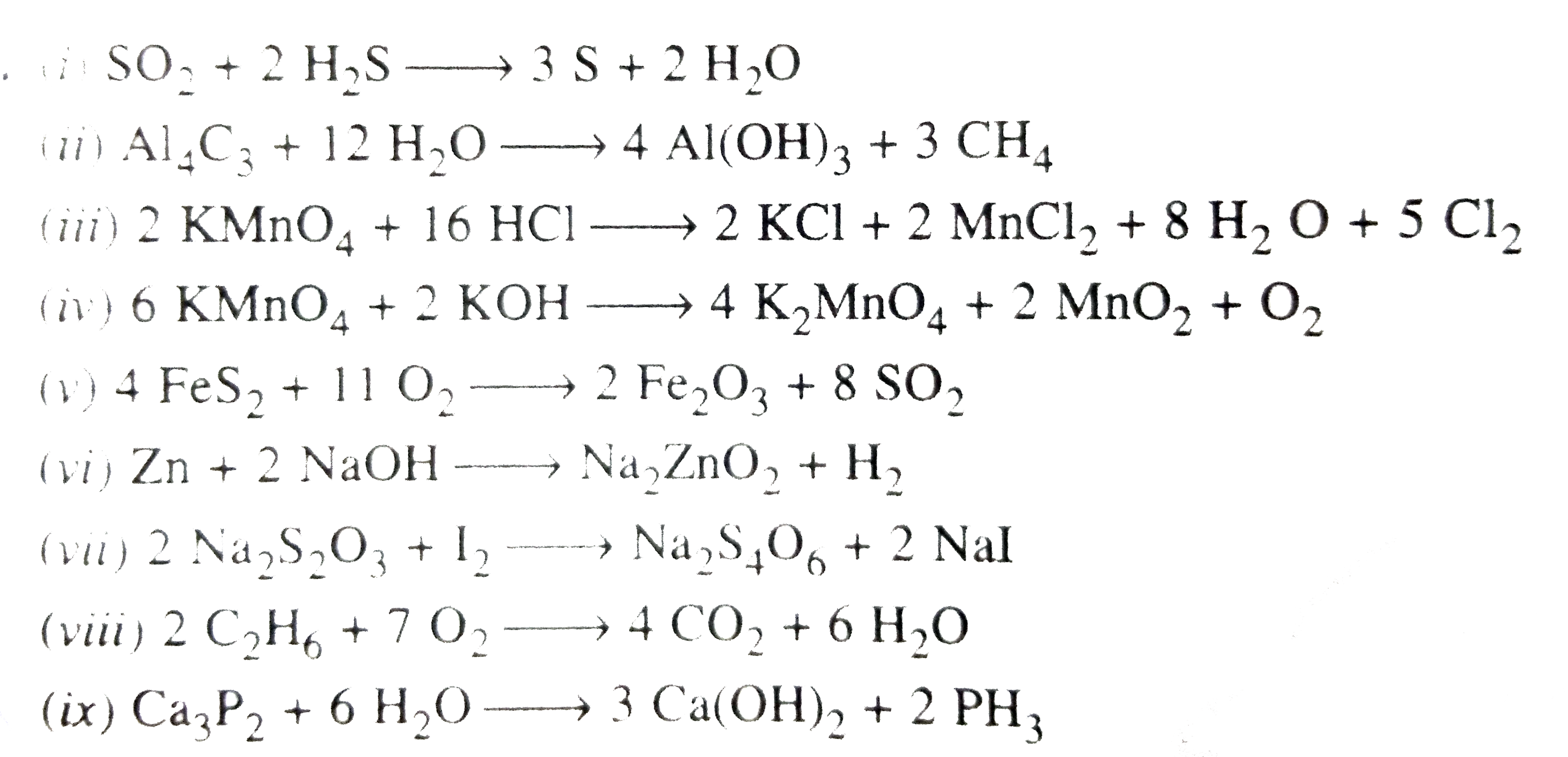
|
|
| 30. |
Balancethe followingequations (b )Cr_(2) O^(2-)+ Sn^(2+)+ H^(+) to |
| Answer» Solution :`(b)Cr_(3) O_(7)^(-2) + SN^(2+)+ H^(+)to CR^(+3)+ Sn^(+4)` | |
| 31. |
Balancethe followingequations (a )MnO_(4)^(-)+ Fe^(2+)+ H^(+)to |
| Answer» SOLUTION :(a) `MnO_(4) ^(-)+ Fe^(2+)H^(+) toMn^(+3) + Fe^(+3)` | |
| 32. |
Balance the following equation : XeF_(6) + H_(2)O to XeO_(2)F_(2) + 4HF |
| Answer» Solution :`XeF_(6) + 2H_(2)O to XeO_(2)F_(2) + 4HF` | |
| 33. |
Balance the following equation : XeF_(6) + H_(2)O rarr XeO_(2)F_(2) + HF |
| Answer» SOLUTION :`XeF_(6) + 2 H_(2)O rarr XeO_(2) F_(2) + 4 HF` | |
| 34. |
Balance the following equations in basic medium by ion-electron method and oxidation number methods and identify the oxidising agent and the reducing agent. (a) P_(4)(s) + OH^(-) (aq) rarr PH_(3) (g) + HPO_(2)^(-) (aq) (b) N_(2)H_(4)(I) + ClO_(3)^(-) (aq) rarr NO(g) + Cl^(-) (g) (c) Cl_(2)O_(7) (g) + H_(2)O_(2) (aq) rarr ClO_(2)^(-) (aq) + O_(2)(g) + H^(+) |
|
Answer» Solution :a) `P_(4)(s)+OH^(-)(aq)toPH_(3)(g)+H_(2)PO_(2)^(-)(aq)` Ion electron method : `underset(0)(P_(4))+underset(-2,+1)(OH^(-))tounderset(-3, +1)(PH_(3))+underset(+1, +1, -2)(H_(2)PO_(2)^(-))` 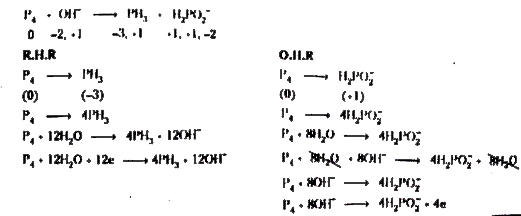 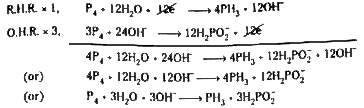 Note : Here `P_(4)` acts both as oxidant and reductant. Oxidation NUMBER method : `underset((0))(P_(4)(s))+OH^(-)(aq)tounderset((-3))(PH_(3)(g))+underset((+1))(H_(2)PO_(2)^(-)(aq))` 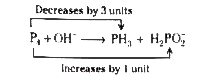 In order to balance the change in oxidation number `H_(2)PO_(2)^(-)` is to be multiplied by 3 `P_(4)+OH^(-)toPH^(3)+3H_(2)PO_(2)^(-)` Since the reaction is taking place in basic medium, `H_(2)O` is to be added on the side which has ledder H atom and `OH^(-)` are to be added on the side which has lesser O atoms. `P_(4)+3H_(2)O+3OH^(-)toPH_(3)+3H_(2)PO_(2)^(-)` b) `N_(2)H_(4)(l)+ClO_(3)^(-)(aq)toNO(g)+Cl^(-)(g)` 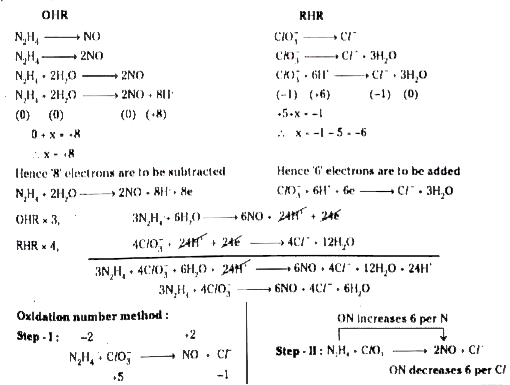 Step - III : EQUALISE the increase and decrease in ON by multiplying `N_(2)O_(4)` with 3 and `ClO_(3)^(-)` with 4. `3N_(2)O_(4)+4ClO_(3)^(-)to6NO+4Cl^(-)` Step - IV : Balance the atoms except H and O. Here they are balanced. Step - V : Balance O atoms by adding `OH^(-)` ions and H atoms by adding `H_(2)O` on the sides deficient of O and H atoms respectively `3N_(2)O_(4)+4ClO_(3)^(-)to6NO+4Cl^(-)+12OH^(-)` c) `Cl_(2)O_(7)(g)+H_(2)O_(2)(aq)toClO_(2)^(-)(aq)+O_(2)(g)+H^(+)` Ion electron method : 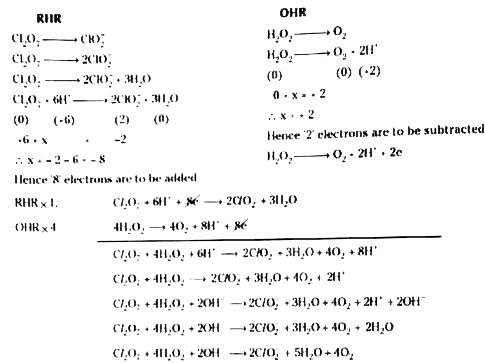 Oxidation number method : Step - I : Skeleton equation is 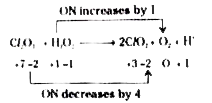 Step - II : Equalise the increases/decrease in ON by multipling `H_(2)O_(2)` with 4 since in each CHLORINE of `Cl_(2)O_(7)` decrease in ON is 4. For 2 Cl atoms it is 8. In `H_(2)O_(2)` increase in ON for each 0 is 1 and for two 0 atoms it is 2. `Cl_(2)O_(7)+4H_(2)O_(2)to2ClO_(2)^(-)+4H_(2)O+2O_(2)` Step - III : Balance the O atoms by adding `OH^(-)` and H atoms by adding `H_(2)O` to the sides deficient of O and H atoms respectively. `Cl_(2)O_(7)+4H_(2)O_(2)+2OH^(-)to2ClO_(2)^(-)+4H_(2)O+2O_(2)` |
|
| 35. |
Balance the following equation by partial Equation method: (i) PbS+O_(3)rarr PbSO_(4)+O_(2) (ii) K_(2)Cr_(2)O_(7)+H_(2)SO_(4)+SO_(2) rarr K_(2)SO_(4)+Cr_(2)(CO_(4))_(3)+H_(2)O (iii) KMnO_(4)+FeSO_(4)+H_(2)SO_(4) rarr K_(2)SO_(4)+MnSO_(4)+Fe_(2)(SO_(4))_(3)+Fe_(2)(SO_(4))_(3)+H_(2)O (iv) Mg+HNO_(3) rarr Mg(NO_(3))_(2)+NH_(4)NO_(3)+H_(2)O (v) Cu+HNO_(3) rarr Cu(NO_(3))_(2)+NO+H_(2)O (vi) C+H_(2)SO_(4) rarr CO_(2)+SO_(2)+H_(2)O (vii) P_(4)+HNO_(3) rarr H_(3)PO_(4)+NO_(2)+H_(2)O (viii) CuSO_(4)+KI rarr K_(2)SO_(4)+Cu_(2)I_(2)+I_(2) (ix) Fe_(2)(SO_(4))_(3)+NH_(3)+H_(2)O rarr Fe(OH)_(3)+(NH_(4))_(2)SO_(4) (x) I_(2)+HNO_(3) rarr HIO_(3)+NO_(2)+H_(2)O |
Answer» SOLUTION :
|
|
| 36. |
Balance the chemical reaction : (i) overset(+7)MnO_(4)^(-) + 3H_(2) overset(-2)O overset("noutral medium") to overset(+4)MnO_(2) + overset(0)O_(2) (ii)Write the balanced equation when ferrous sulphate is treated with acidified (H_(2)SO_(4)) potassium permanganate . (iii) Balance the equation MnO_(4) + C_(2)O_(4) + H^(+) toCO_(2) + Mn^(+2) + H_(2)O (iv) Balance the equation K_(2)Cr_(2)O_(7) + HCl to KCl + CrCl_(3) + H_(2)O + Cl_(2) |
|
Answer» Solution :(i) ` 2MnO_(4)^(-) + 3H_(2)O to 2MnO_(2) + 3O_(2) + 2OH^(-) + 2H_(2)O` (II) `10 FeSO_(4) + 2KMnO_(4) + 8H_(2)SO_(4) to 5Fe_(2)(SO_(4))_(3) + 2MnSO_(4) + K_(2)SO_(4) + H_(2)O` (iii) `2MnO_(4)^(-) + 5C_(2)O_(4)^(2-) + 16H^(+) to 2MN^(2+) + 10CO_(2) + 8H_(2)O` (iv) ` K_(2)Cr_(2)O_(7) + 14HCl to 2KCL + 2CrCl_(3) + 7H_(2)O + 3Cl_(2)` |
|
| 37. |
Balance the equation by lon-electron method (vi) Cl_(2) +OH^(-) to S^(2-) + S_(2)O_(3)^(2-) (In basic medium) |
| Answer» SOLUTION :`Cl_(2) + 2OH^(-) to CL^(-) + CLO^(-) + H_(2)O` | |
| 38. |
Balance following equations in proper medium Na_(2)S_(2)O_(2) + KMnO_(4)+H_(2)O rarr Na_(2) S_(4) S_(6) +MnO_(2) + KOH + NaOH |
| Answer» SOLUTION :`6Na_(2)S_(2)O_(3) + 2KMnO_(4) + 4H_(2)O rarr3Na_(2) S_(4) O_(6) + 2MnO_(2) + 2KOH + 6NaOH` | |
| 39. |
Balance given following half reaction for the unbalanced whole reaction : CrO_(4)^(2-)rarrCrO_(2)^(-)_OH^(-) is : |
|
Answer» `CrO_(4)^(-2)+2H_(2)O+3e^(-)rarrCrO_(2)^(-)+4H_(2)O^(-)` |
|
| 40. |
Balance following equations in proper medium S+OH^(-) rarr S^(2-) +S_(2)O_(3)^(2-) |
| Answer» SOLUTION :`4S+ 6OH^(-) rarr 2S^(2-) + S_(2) O_(3)^(2-)` | |
| 41. |
Balance following equations in proper medium P + OH^(-) +H_(2)O rarr H_(2)PO_(4)^(-) +PH_(3) |
| Answer» Solution :`8P + 3OH^(-) + 9 H_(2)O rarr 3H_(2)PO_(4)^(-) + 5PH_(3)` | |
| 42. |
Balance following equations in proper medium FeC_(2)O_(4) + KMnO_(4) + H_(2) SO_(4) rarr Fe_(2) ( SO_(4))_(3) + CO_(2) + MnSO_(4) + K_(2) SO_(4) + H_(2)O |
| Answer» Solution :`10FeC_(2)O_(4) + 6 KMnO_(4) + 24H_(2)SO_(4) rarr 5Fe_(2) ( SO_(4))_(3) + 20 CO_(2) +6 MnSO_(4) + 3K_(2) SO_(4) + 24H_(2)O` | |
| 43. |
Baking soda or baking powder is : |
|
Answer» WASHING Soda |
|
| 45. |
Bakelite plastic is formed, when phenol reacts with |
|
Answer» `CH_3CHO` |
|
| 46. |
Bakelite is the condensation polymer of formaldehyde and ................. |
|
Answer» |
|
| 47. |
Bakelite is the polymer of |
|
Answer» BENZALDEHYDE and phenol |
|
| 48. |
Bakelite is prepared by the reaction between |
|
Answer» UREA and FORMALDEHYDE |
|
| 49. |
Bakelite is _____ polymer. |
| Answer» SOLUTION :CONDENSATION | |
| 50. |
Bakelite is _____ . |
| Answer» SOLUTION :CONDENSATION | |