

Saved Bookmarks
This section includes 7 InterviewSolutions, each offering curated multiple-choice questions to sharpen your Current Affairs knowledge and support exam preparation. Choose a topic below to get started.
| 1. |
Bakelite is obtained from phenol by reaction with |
|
Answer» acetaldehyde |
|
| 2. |
Bakelite is obtained from phenol by reacting with |
|
Answer» `(CH_2OH)_2` 
|
|
| 3. |
Bakelite is obtained by the reaction between phenol and which of the following ? |
|
Answer» `HCHO` |
|
| 4. |
Bakelite is obtained by the condensation of phenol with : |
|
Answer» ACETALDEHYDE |
|
| 5. |
Bakelite is obtained by the reaction between phenol and ……………. |
|
Answer» CHLORO BENZENE |
|
| 6. |
Bakelite is obtained by substitution reaction. Is it true or false? |
| Answer» SOLUTION :POLYMERISATION REACTION | |
| 7. |
Bakelite is not a condensation polymer. Is it true or false |
| Answer» SOLUTION :TEFLON is not a CONDENSATION POLYMER. | |
| 8. |
Bakelite is formed when phenol reacts with ………………. . |
| Answer» Solution :Methanal | |
| 9. |
Bakelite is formed by the chemical combination of phenol and ______. |
| Answer» SOLUTION :FORMALDEHYDE | |
| 10. |
Bakelite is an example of |
|
Answer» LINEAR polymer |
|
| 11. |
Bakelite is a thermosetting plastic produced by ............. |
|
Answer» `HCHO + C_6H_5CH_2OH` |
|
| 12. |
Bakelite is a polymer of |
|
Answer» benzaldehyde and phenol |
|
| 13. |
Bakelite is a copolymer of: |
|
Answer» HCHO and MALAMINE |
|
| 14. |
Bakelite is a |
|
Answer» melamine formaldehyde polymer |
|
| 15. |
Bakelite is a/an |
|
Answer» ADDITION POLYMER |
|
| 16. |
Bakelite is a product of reaction between |
|
Answer» Formaldehyde resin |
|
| 17. |
Bakelite is : |
|
Answer» ADDITIONAL polymer |
|
| 18. |
Bakelite can be prepared from which monomer ? |
|
Answer» BENZALDEHYDE and phenol |
|
| 19. |
Bakelite. |
| Answer» SOLUTION :It is used in the MANUFACTURE of PHOTGRAPH records, electrical GOODS, fountain pen, BARRELS, etc. | |
| 20. |
Baeyer's reagent is used to detect………….. unsaturation in an organic compound. |
|
Answer» CHLORIDE ion |
|
| 21. |
Baeyer's reagent is used in the laboratory for |
|
Answer» DETECTION of DOUBLE BONDS |
|
| 22. |
Baeyer's reagent is used for detecting ......... in an organic compounds. |
| Answer» SOLUTION :UNSATURATION | |
| 23. |
Baeyer's reagent is: |
|
Answer» ALKALINE PERMANGANATE solution |
|
| 24. |
Baeyer's reagent is __________ |
|
Answer» Zn|Hg in Conc HCl |
|
| 25. |
Baeyer's process is used for the purification of bauxite containing ___________as chief impurity . |
|
Answer» `SiO_(2)` |
|
| 26. |
Bad conductor of electricity is: |
|
Answer» `H_2F_2` |
|
| 27. |
Bactericidal antibiotics among the following |
|
Answer» TETRACYCLINE |
|
| 28. |
Bacterial decomposition of cellulose material present in sewage water gives. |
|
Answer» `H_2` |
|
| 29. |
Bactericidal antibiotics among the following is |
|
Answer» OFLOXACIN |
|
| 31. |
BaCl_2 solution gives a white ppt. with a solution of a slat, which dissolves in dil. HCl with the evolution of a colourless, pungent smelling gas. The radical in the salt is |
|
Answer» `SO_(4)^(2-)` `BaSO_(3)+2HCL to BaCl_(2) +H_(2)O +underset("smelling gas")underset("Pungent")(SO_(2) uarr)` |
|
| 32. |
BaCl_2 lsolution gives a white ppt, with a solution of an acid radical which dissolves in dil. HCI with the evolution of a colourless, pungent smelling gas. The acid radical may be |
|
Answer» `SO_(4)^(2-)` `BaSO_(3) + 2 HCl to BaCl_2 + SO_2 uarr + H_(2) O` |
|
| 33. |
BaBr_(2) givesyellow ppt with AgNO_(3) as well aswith K_(2)CrO_(4). |
|
Answer» <BR> SOLUTION :`BaBr_(2) + AgNO_(3) rarr UNDERSET(YELLOW ppt )(AgBr darr (due to Br^(Theta))``BaBr_(2) + K_(2)CrO_(4) rarr underset(yellow ppt )(BaCrO darr (due to Ba^(2+))` Hence TRUE |
|
| 34. |
BaBr_(2) in aq solution giveyellow ppt ,with (a)____ as well as with (b)___. |
|
Answer» |
|
| 35. |
Ba, Sr, Ca and Mg may be arranged in order of decreasing first ionisation energy (IE_1) as: |
| Answer» Answer :A | |
| 36. |
B_2O_3is : |
|
Answer» Ionic |
|
| 37. |
B_2H_6+NH_3toAddition compound (X) overset(450 K)to Y+Z(g) In the above sequence Y and Z are respectively : |
|
Answer» Borazine and hydrogen |
|
| 38. |
B_(2)H_(6)+NH_(3) underset("Heating")overset("Slowly") to X overset(Delta) to Y Which of the following around X is correct. |
|
Answer» `X` is ionic in NATURE, Hybridisation state of `B` in both cationic and anionic PART is same. 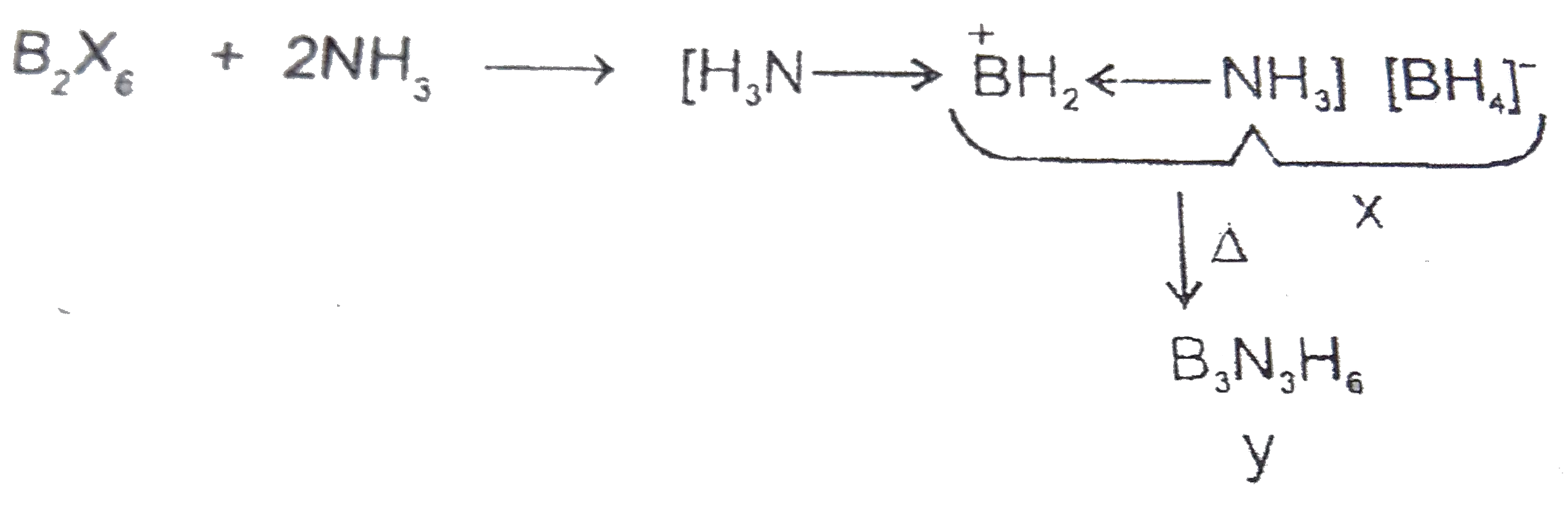 In `X` hybridisation state of both `B` is `sp^(3)` |
|
| 39. |
B_(2)H_(6) is symmetrically cleaved by: |
| Answer» Answer :D | |
| 40. |
B_(2)H_(6)+6CH_(3)OHtoA. Identify A |
|
Answer» `B_(2)O_(3)` |
|
| 41. |
B_(10)C_(2)H_(12) is isostructural & isoelectronic with borate ion of formula B_(x)H_(y)^(2-) give x+y+z. |
|
Answer» |
|
| 42. |
Write the structure of oleum (H_(2)S_(2)O_(7)) |
Answer» SOLUTION :
|
|
| 44. |
Write the relationship between equilibrium constant of the reaction and standard potential of the cell. |
|
Answer» Solution :The relationship between equilibrium constant of the reaction and standard POTENTIAL of the cell is w.r.t `E_("cell")=0=E_("cell")^(Theta)-(2.303RT)/(NF)LOG""([A])/([C])` `E_("cell")^(Theta)=(2.303RT)/(nF)log""([A])/([C])"….(1)"` `([A])/([C])=K_(C )"….(2)"` (2) in (1) `E_("cell")^(@)=(2.303 RT)/(nF)logK_(C )` `E_("cell")^(Theta)=(0.059)/(nF)logK_(C )` |
|
| 45. |
Write the name of monomers required to manufacture Buna-N rubber. Write the polymerization reaction for the same. |
|
Answer» Solution :MONOMERS required to MANUFACTURE Buna-N rubber is. i) 1,3-Butadiene ii) Acrylonitrite The polymerization reaction for the Buna. `- N` is `underset("1, 3 - Butadiane")(CH_(2)=CH-CH=CH_(2))+nCH_(2)underset("Acrylo nitrile")(=underset(CN)underset("|")"CH"OVERSET(Na)underset("Heat")rarr)underset("Buna - N")([-CH_(2)-CH=CH-CH_(2)-CH_(2)-underset(CN)underset(|)CH-]_(n))` |
|
| 46. |
b) Write the missing product: NH_(3)+3Cl_(2"(excess)")rarr?+3HCl. |
|
Answer» SOLUTION :`NH_(3)+3Cl_(2"(EXCESS)")rarrNCl_(3)+3HCl` `rArr" Nitrogen trichloride"` |
|
| 47. |
Write the equation for the formation of the polymer by the interaction of ethylene glycol and terephthalic acid. Name the polymer. |
Answer» Solution :DACRON or TERYLENE is manufactured by heating a mixture of ethylene GLYCOL and terepathalic acid at 420 to 460 K in the presence of zinc acetate - antimony TRIOXIDE catalyst it is one of the CONDENSATION polymerisation.  The polymer is Decron (or) Terylene (or) PETP |
|
| 48. |
Write the difference between physisorption and chemisorption with respect to i) type of attractive forces between adsorbate and adsorbent ii) number of layers of adsorption. |
|
Answer» Solution :The DIFFERENCE between physisorption and chemisorption with RESPECT to i) TYPE of attractive FORCES in physisorption vander waal.s forces in chemisorption chemical bonds formation II) number of layers of adsorption in physisorption :- Multi molecular layer in chemisorption :- Unimolecular layer |
|
| 49. |
Write the composition of copper matte. |
| Answer» SOLUTION :The COMPOSITION of COPPER matfe is `Cu_(2)S+FeS` | |
| 50. |
(b) Write any two differences between an electrolytic and a Daniell cell. |
Answer» SOLUTION :
|
|
