Saved Bookmarks
This section includes 7 InterviewSolutions, each offering curated multiple-choice questions to sharpen your Current Affairs knowledge and support exam preparation. Choose a topic below to get started.
| 1. |
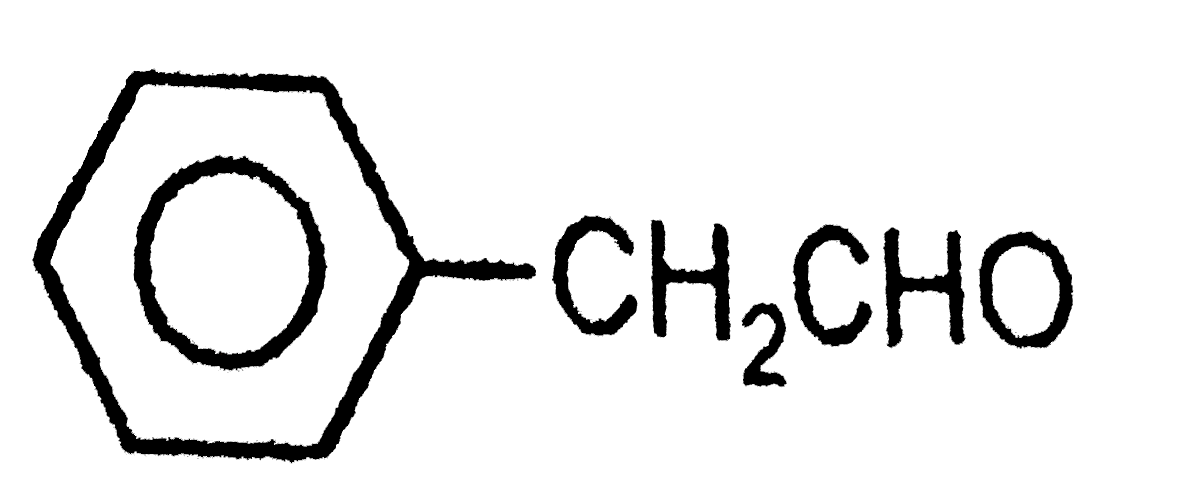
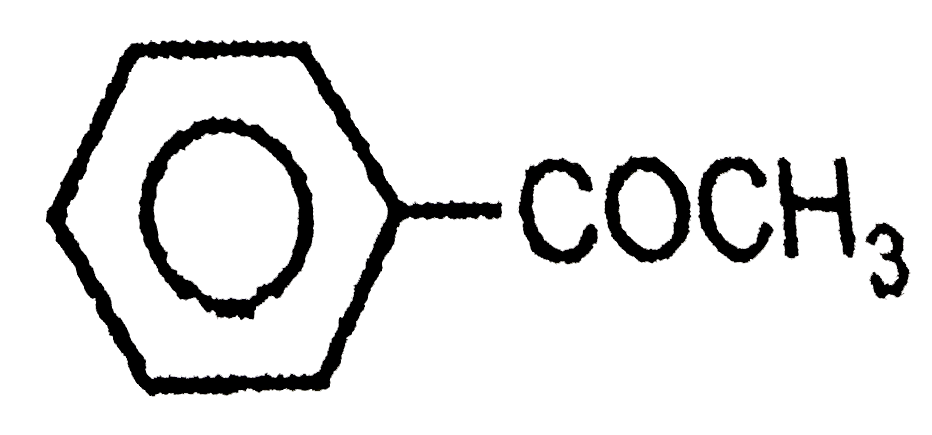
An organic compound (X)with molecular formula C_8H_8O forms an orange red precipitate with 2, 4 - DNP regent and resonds iodoform test. It neither decolourises Baeyer's reagent or bromine water and also it neither reduces Tollen's reagent or Fehling's reagent. Compound (X) gives a carboxylic acid (Y) with molecular formula C_7H_6O_2 on drastic oxidation with chromic acid . Give the equations. |
Answer» SOLUTION :
|
|
| 2. |
An organic compound Xwhen (C_(5)H_(12)O) which gives C_(5)H_(10) on heating with copper. The structure of 'X' will be : |
|
Answer» `CH_(3)CH_(2)CH_(2)CH=O` |
|
| 3. |
An organic compound (X) with molecular formula C_(3)H_(6)O is not readily oxidised. On reduction it gives C_(3)H_(8)O (Y) which reacts with HBr to give alkyl bromide (Z) which is converted to Grignardreagent. Grignard reagent reacts with (X) to give 2 , 3-dimethylbutan-2-ol.(X), (Y) and (Z)repectively are. |
|
Answer» `CH_(3)COCH_(3), CH_(3)CH_(2)CH_(2)OH, CH_(3)CH(BR)CH_(3)` 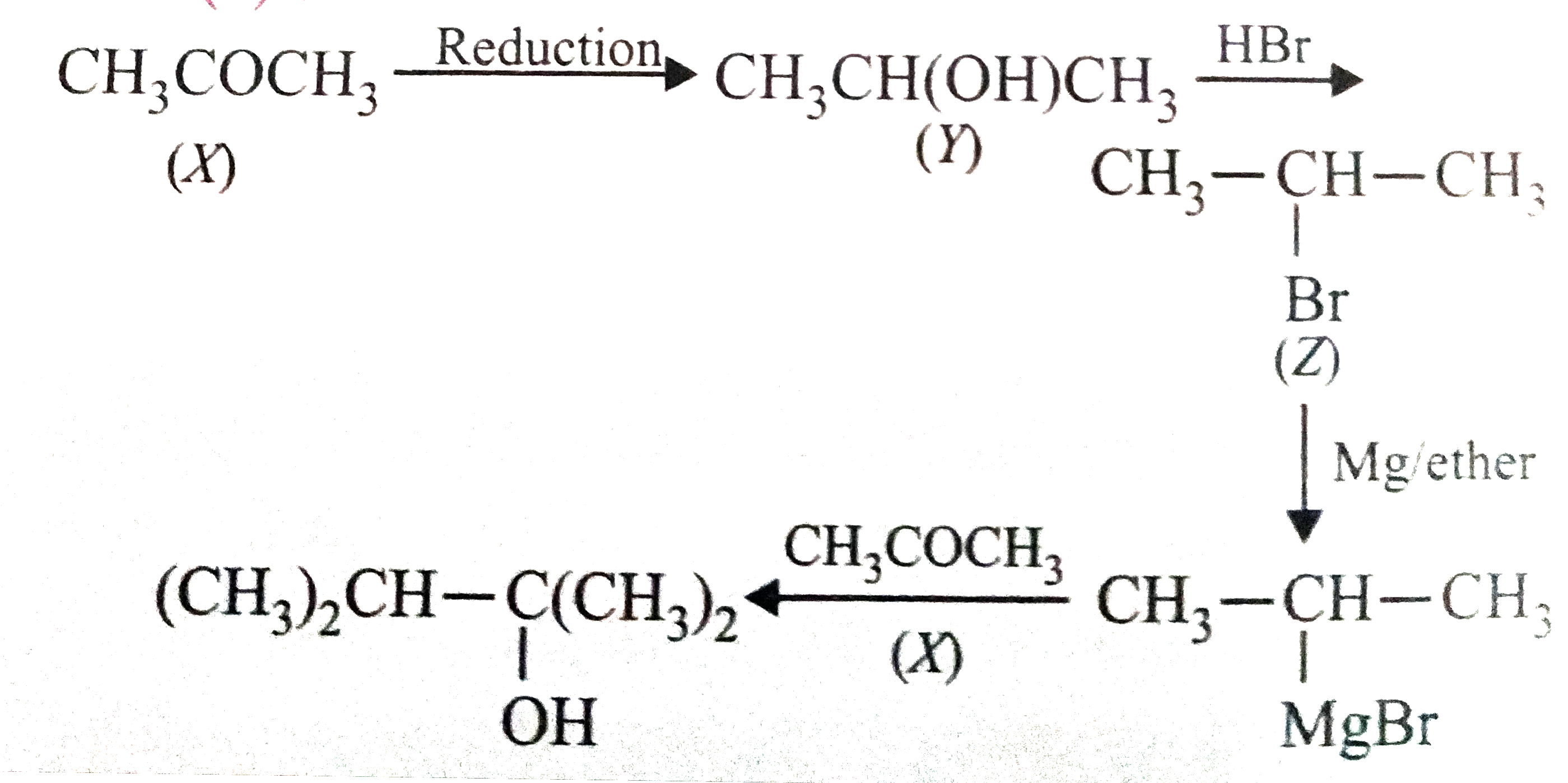
|
|
| 4. |
An organic compound (X) (vapour density= 37.5) contains C (32%), H (6.66%), N (18.67%) and O (42.67%). (X), on reduction, gave a primary amine (Y) which, on treatment with HNO_(2), gave C_(2)H_(5)OH. (Y), on warming with CHCl_(3) and KOH, gave (Z). (Z) having an offensive odour, on reduction, produced C_(2)H_(5)NHCH_(3). Assign structures of (X), (Y) and (Z) . |
|
Answer» Solution :For the compound (X): Moles of `C: H: N: O= (32)/(12): (6.66)/(1): (18.67)/(14): (42.67)/(16)` `=2.67: 6.66: 1.33: 2.67` `=2: 5: 1: 2` Empirical formula of (X) is `C_(2)H_(5)NO_(2)` (75) Mol wt of (X) `=2 xx 37.5=75`= empirical formula wt `therefore` the molecular formula of (X) is `C_(2)H_(5)NO_(2)`. Now, the reaction sequence may be REPRESENTED as `{:((X)overset("red")rarr,(Y),overset(CHCl_(3) and KOH)rarr,(Z)("offensive odour"),),(C_(2)HH_(5)NO_(2),"Primary amine",,darr,),(,darrHNO_(2)C_(2)H_(5)OH,,C_(2)H_(5)NHCH_(3),),(,,,("methyl ethyl amine"),):}` From the reaction sequence, we conclude that a primary amine (Y) is produced by the reduced of (X), (X) MUST be nitroethane `(C_(2)H_(5)NO_(2))` and as (Y) on treatment with `HNO_(2)` GAVE `C_(2)H_(5)OH`, (Y) must be ethylamine `(C_(2)H_(5)NH_(2))`. Further `C_(2)H_(5)NH_(2)`, on treatment with `CHCl_(3)` and KOH, gave (Z) (having an offensive odour) which on reduction gave `C_(2)H_(5)NHCH_(3)`, (Z) must be ethyl isocyanide `(C_(2)H_(5).NC)` |
|
| 5. |
An organic compound X reacts with sodium metal and evolve hydrogen gas, on oxidation of X by PCC give aldehyde. The formula of X could be |
|
Answer» `(CH_3)_2CH-OH` |
|
| 6. |
An organic compound X reacts with nitrous acid to form N-methyl-N-nitrosoethanamine. X can be obtained by reduction of |
|
Answer» Propanenitrile |
|
| 7. |
An organic compound X on treatment with pyridinium chlorochromate in dichloromethane gives compound Y. Compound Y reacts with I_(2) and alkali to form triiodomethane. Then compound 'X' is |
|
Answer» `C_(2)H_(5)OH` `CH_(3)CHO+4NaOH + 3l_(2) to underset("(triiodomethane)")underset("yellow PPT.")(CHI_(3))+ HCOONa+ 3H_(3)O+3NaI` |
|
| 8. |
An organic compound X on treatment with pyridinium chlorochromate in dichloromethane gives compound Y. compound Y reaccts with I_(2) and alkali to form triiodomethane. The compound 'X' is |
|
Answer» `CH_(30)CH_(2)OH` |
|
| 9. |
An organic compound X on treatment with acidified K_(2)Cr_(2)O_(7) gives a compound Y which reacts with I_(2) and sodium carbonate to form tri-iodomethane . The compound X is |
|
Answer» `CH_(3)OH` |
|
| 10. |
An organic compound X on analysis gives 2.90 g silver choride with acidified silver nitrate solution. The compound X may be represented by two isomeric structures Y and Z. Y on treatment withaqueous potassium hydroxide solution gives a dihydroxy compound while Z on similar treatment gives ethanal. Find out the molecular formula of Z and gives the structure of Y and Z. |
|
Answer» SOLUTION :Mass of chlorin in `1.0 g X = (35.5)/(143.5) xx 2.9 = 0.717 g` Now, the empirical formula can be derived as : 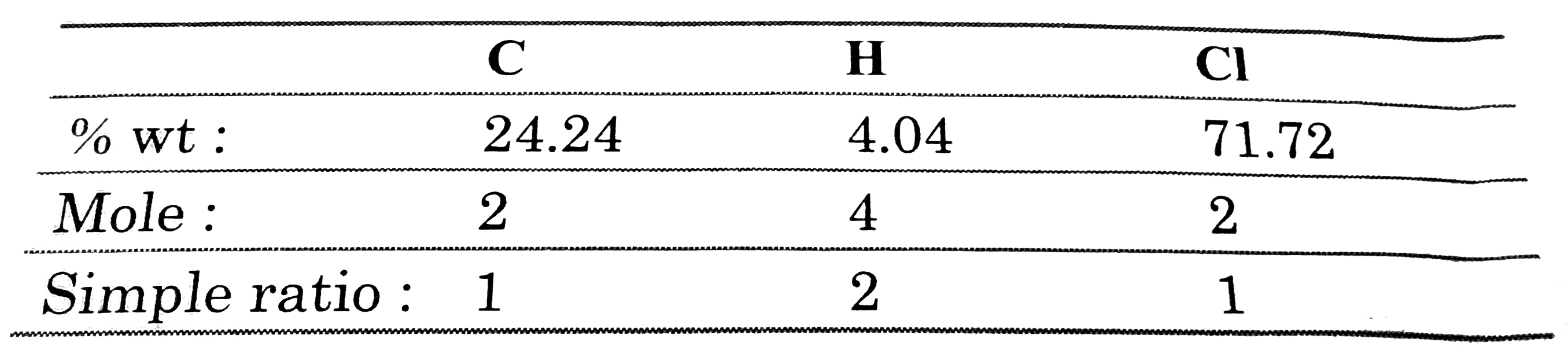 `rArr` Empirical formula `= CH_(2)Cl`. Because X canbe represented by two formula of which one GIVES a dihydroxy compound with `KOH` indicates that x has two chlorine atoms per molecules. `rArr X = C_(2)H_(4)Cl_(2)` with two of its structural isomers. `underset(I)(Cl-CH_(2)-CH_(2)-Cl)` and `underset(II)(CH_(3)-CHCl_(2))` On treatment with `KOH, I` will GIVE ethane -1,2-diol, hence it is Y, Z one treatment with `KOH` will give ETHANAL as `ClCH_(2)CH_(2)Cl+OH^(-)rarr underset((Y))(underset(OH)underset(|)(CH_(2))-underset(OH)underset(|)(CH_(2)))` `CH_(3)CHCl_(2)+KOH rarr underset("Unstable")(CH_(3)CH(OH)_(2))OVERSET(-H_(2)O)rarrunderset((Z))(CH_(3)CHO)` |
|
| 11. |
An organic compound [X] of the formula C_(7)H_(8)O is soluble in NaOH but not in NaHCO_(3). It gives colour with alcoholic FeCl_(3). On treatment with bromine water it gives a tribromo product. The compound (A) is : |
|
Answer» o-cresol 
|
|
| 12. |
An organic compound (X) (mol. Wt= 94) containing C, H and O gave on analysis 76.6% C, 6.38%% H and 17.02%O. A solution of (X) in aqueous NaOH with FeCl_(3) gave a violet colour while when heated with C Cl_(4), it produced an acid (Y) of molecular weight 138. Find (X) and (Y) |
|
Answer» Solution :Moles of `C: H: O= (76.60)/(12): (6.38)/(1): (17.02)/(16)` `=6.38: 6.38: 1.05` `=6:6:1` Empirical formula of (X) is `C_(6)H_(6)O` (94) As mol. Wt of (X) is ALSO 94, molecular formula of (X) is `C_(6)H_(6)O`. Further, since the solution of (X) in aqueous NaOH gives violet colour with `FeCl_(3)`, (X) must contain a phenolic group. Hence (X) is `C_(6)H_(50OH`. From the next given information, i.e., ALKALINE solution of (X) with `C Cl_(4)`, on heating,produces an acid of molecular weight 138, the acid (Y) must be 
|
|
| 13. |
An organic compound 'X' is used to prevent the corrosion of the electrolytic cell by the action of F_(2). The no. of pi bonds present in it is |
|
Answer» 0 |
|
| 14. |
An organiccompound X is oxidised by using acidified K_(2)Cr_(2)O_(7). The product obtained reacts with phenyl hydrazinebut does not answer silver mirror test . The sturcture of X is |
|
Answer» `CH_(3)COCH_(3)` Thus the compound X MUST be a `2^(@)`alcohol , as only secondary alcohols give ketones on oxidation and hence X is `(CH_(3))_(2)CHOH`. 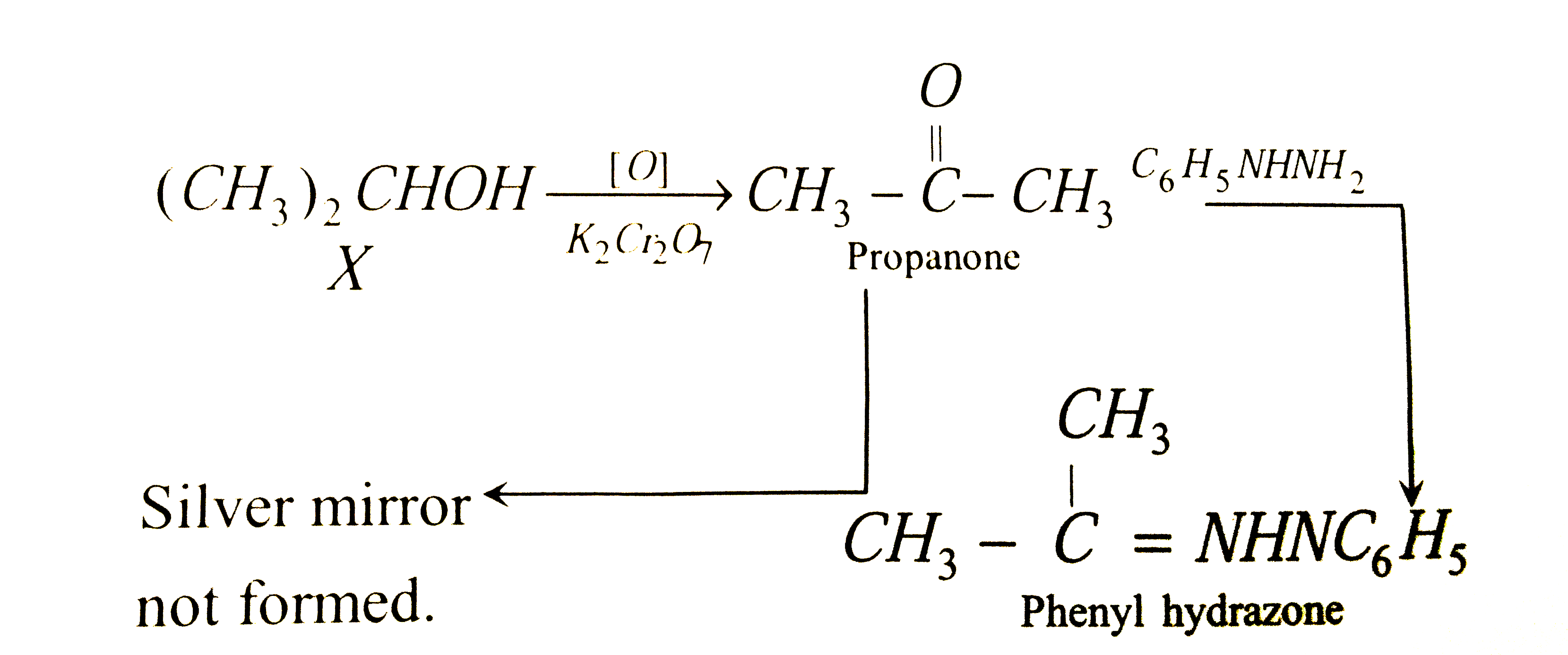
|
|
| 15. |
An organic compound X is oxidised by using acidified K_(2)Cr_(2)O_(7). The product obtained reacts with phenyl hydrazine but does not answer silver mirror test. The possible structure of X is |
|
Answer» `CH_(3)COCH_(3)` `gt C=0` group. The same product does not answer silver mirror test thus, it is a ketone, because only aldehydes GIVE this test. Thus the compound X must be a `2^(@)` alcohol, as only SECONDARY alcohols give KETONES on oxidation and hence X is `CH_(3))_(2)CHOH`. 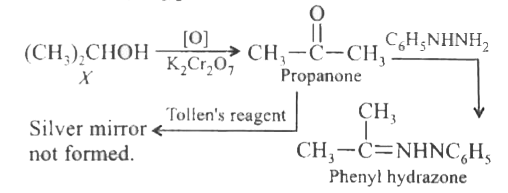
|
|
| 16. |
An organic compound X is oxidised by using acidified K_(2)Cr_(2)O_(7) solution.The product obtained reacts with phenyl hydrazine but does not answer silver mirror test.The compound X is |
|
Answer» 2- Propanol 
|
|
| 17. |
An organic compound X is boiled with KOH when it evolves a gas which gives white precipitate with MgSO_4 solution. The compound X also gives salicyclic acid on warming with phenol. X is likely to be: |
|
Answer» `C_(6)H_(5)Cl` |
|
| 18. |
An organic compound ("X") is a disubstituted benzene containing 77.8% carbon and 7.4 % hydrogen. Heating an alkaline solution of "X" with chloroform gives a steam volatile compound "Y" . Heating "Y" with acetic anhydride and sodium acetate gives a smelling crystalline solid "Z". "Z" is |
|
Answer»
|
|
| 19. |
An organic compound X having molecular formular C_(4)H_(8)O gives orange-red ppt. with 2,4-DNP reagent. It doesnot reduce Tollen's but gives yellow ppt.Of iodoform on heating with NaOI. Compound X on reaction with LiAlH_(4) gives compound Y which undergoes dehydration reaction on heating with conc. H_(2)SO_(4) to form but-2-ene. Identify the compounds X and Y. |
|
Answer» Solution :Compound `X=UNDERSET("Butan-2-one")(OVERSET(4)(C)H_(3)overset(3)(C)H_(2)overset(2)(C)Ooverset(1)(C)H_(3))` Compound `Y=CH_(3)-underset("Butan-2-ol")(CH_(2)-overset(OH)overset(|)(CH))-CH_(3)` The REACTION can be explained as under: 
|
|
| 20. |
An organic compound 'X' having molecular formula C_(5)H_(10)O yields phenylhydrazone and gives negative response to the iodoform test and tollens' test. It produces n-pentane on reduction. 'X' would be |
|
Answer» 3-pentanone `underset("3-Pentanone")(CH_(3)CH_(2)-overset(O)overset(||)(C)-CH_(2)CH_(3)) overset("Reduction")to underset("n-Pentanone")(CH_(3)CH_(2)CH_(2)CH_(2)CH_(3))` |
|
| 21. |
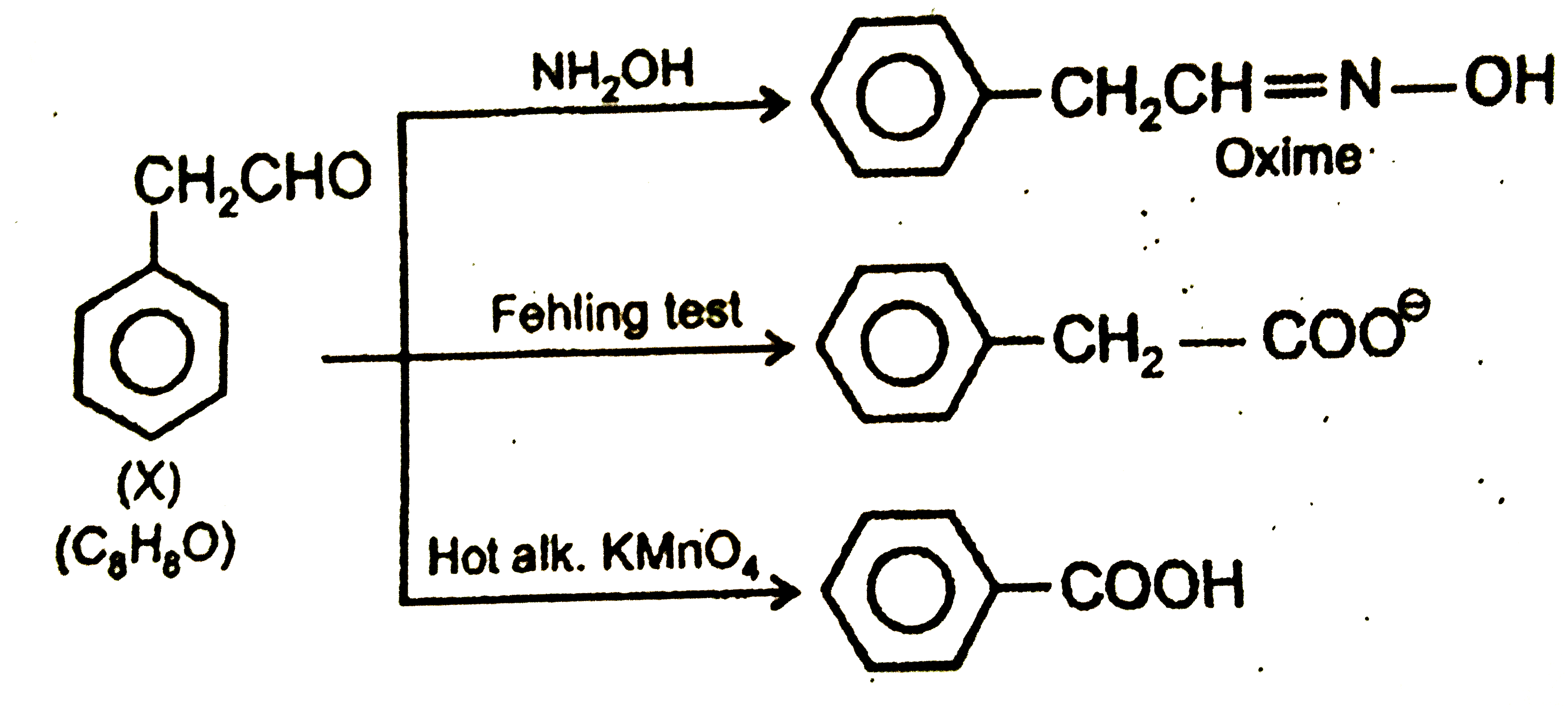
An organic compound (X) having molecular formula C_8H_8O yield oxime with NH_2OH and given positive response to Fehling test . It produces benzoic acid on oxidation with hot alkaline KMnO_4 . X could be |
|
Answer»
|
|
| 22. |
An organic compound 'X' having molecular formula C_(5)H_(10) yields phenylhydrazone and gives negative response to the iodoform test and Tollen's test. It produces n-pentane on reduction. 'X' could be |
|
Answer» 3-pentanone |
|
| 23. |
An organic compound X has molecular formula C_(5)H_(10)O. It does not reduce Fehling's solution but forms a bisulphite compound. It also gives positive Iodoform test. What are possible structure of X ? Explain your reasoning relating structure. |
| Answer» Solution :Ketone give +ve test with Iodoform. It is methyl-ketone. `CH_(3)-overset(O)overset(||)C-CH_(2)-CH_(2)-CH_(3) and CH_(3)-overset(O)overset(||)C-underset(CH_3)underset(|)CH-CH_(3)` are possible STRUCTURES of the COMPOUND. | |
| 24. |
An organic compound X having molecular formula C_(3)H_(11) N reacts with p-toluene sulphonyl chloride to form acompound Y that is soluble in aqueous KOH. Compound X is optically active and reacts with acetyl chloride to form compound Z . Identify the compound Z |
|
Answer» `CH_(3)CH_(2)CH_(2)CH_(2)NHCOCH_(3)` 
|
|
| 25. |
An organic compound X contains Y and Z impurities .Their solubility differs slightly. They may be separated by : |
|
Answer» SIMPLE crystallisation |
|
| 26. |
An organic compound X gives a red precipitate on heating with Fehling's solution. Which one of following reactions yields X as major product ? |
|
Answer» `HCHO OVERSET((i)CH_3Mgl)underset((ii)H_2O)rarr` |
|
| 27. |
An organic compound (X) containing C, H and O has a vapour density 37. 0.2750g of (X) produced 0.6540g of CO_(2) and 0.3375 of H_(2)O. The compound (X) on dehydration gave a hydrocarbon (Y) containing 85.71% of C. (Y) on treatment wit HI followed by hydrolysis, gave (Z) which was isomeric with (X). Give structural formulae of (X), (Y) and (Z) |
|
Answer» SOLUTION :Moles of C in (X) `=1 xx` moles of `C_(2)` `=1 xx (0.6540)/(44)=0.01486` Moles of H in (X) `=2xx` moles of `H_(2)O` `=2 xx (0.3375)/(18)=0.0375` Wt. of oxygen in (X) = 0.2750 - (wt. of C+ wt. of H) `=0.2750- (0.01486 xx 12 + 0.0375 xx 1)` =0.0592g `THEREFORE` MOLE of O in (X) `=(0.0592)/(16)= 0.0037` `therefore` mole of `C:H: O= 0.01486 : 0.0375: 0.0037` `=4:10:1` `therefore` empirical formula of (X) is `C_(4)H_(10)O` (74) As molecular WEIGHT of (X) `=2xx VD` `=2 xx 37= 74`, `therefore` molecular formula of X is `C_(4)H_(10)O` Now for the compound (Y) Moles of `C: H = (85.71)/(12): (14.29)/(1)` `=7.143: 14.29` `=1: 2` Empirical formula of (Y) is `CH_(2)` Since (Y) is produced from (X) by dehydration, (Y) must be `C_(4)H_(10)O- H_(2)O`, i.e., `C_(4)H_(8)` Further, as `C_(4)H_(8)` is an unsaturated hydrocarbon, (X), i.e., `C_(4)H_(10)O` must be an alcohol `therefore` (X) may be `CH_(3).CH_(2).CH_(2).CH_(2).OH` (primary) or `CH_(3).CH_(2).CH(OH).CH_(3)` (secondary) and (Y) may be `CH_(3).CH_(2).CH=CH_(2)` or `CH_(3).CH=CH.CH_(3)` But as given in the question, `underset((X))(CH_(3).CH_(2).CH_(2).CH_(2)OH) underset(-H_(2)O)overset(HI)rarr CH_(3).CH_(2).CHI.CH_(3)overset("hydrolysis")rarr underset((Z))(CH_(3).CH_(2).CH(OH).CH_(3))` [ISOMERIC to `CH_(3).CH_(2).CH_(2).CH_(2)OH` (X)] Thus, (X) is `CH_(3).CH_(2).CH_(2).CH_(2)OH` (Y) is `CH_(3).CH_(2).CH=CH_(2)` (Z) is `CH_(3).CH_(2).underset(underset(OH)(|))(CH).CH_(3)` |
|
| 28. |
An organic compound 'X' with molecularformulaC_7H_8O in insolublein aqueous NaHCO_3 but dissolved in NaOH. When treated with bromine water 'X' rapidly give 'Y' (C_7H_5OBr). The compound 'X' and 'Y' respectivelyare |
|
Answer» <P>o - CRESOL |
|
| 29. |
An organic compound [X]. C_(5)H_(8)O reacts with hydroxylamine to form [Y]. In the presence of conc. H_(2)SO_(4) gives delta-lactam. [X] neither give Benedicts test nor it respond positively towards haloform test. The compound [X] is |
|
Answer»
|
|
| 30. |
An organic compoundX (C_(4)H_(8)O_(2))gives positive test withNaOHand phenopthalein. Structure of X will be : |
|
Answer» `CH_(3)-CH_(2)-CH_(2)-underset(O)underset(||)(C)-OH` |
|
| 31. |
An organic compound with undergoes formula C_(9) H_(10) O forms 2,4-DNP derivattive, reduces Tollen's reagent ad undergoes Cannizzaro's reaction. On vigorous oxidation it gives 1,2-benzendicarboxylic acid. Identify the compound. |
Answer» Solution :The organic compoundis  Molecular formula `C_(9) H_(10) O`. The reaction can be EXPLAINED as under `:` 
|
|
| 32. |
An organic compound with the molecular formula C_(9)H_(10)O forms 2-4-DNP dervative, reduces Tollens' reagent and undergoes Cannizzaro reaction. On vigorous oxidation, it gives 1,2-benzenedicarboxylic acid. Identify the compound. |
|
Answer» Solution :(i) Since the given compound with M.F. `C_(9)H_(10)O` forms a 2,4-DNP derivative and reduces tollens' reagent, it must an aldehyde. (ii) Since it undergoes CANNIZZARO reaction, therefore, CHO group is DIRECTLY attached to the benzene ring. (III) Since on vigorous oxidation, it gives 1,2-benzenedicarboxylic acid, therefore, it must be an ortho-substituted benzaldehyde, the only o-substituted aromatic aldehyde having M.F. `C_(9)H_(10)O` is 2-ethylbenzaldehyde. All the reactions can now be EXPLAINED on the basis of the STRUCTURE. 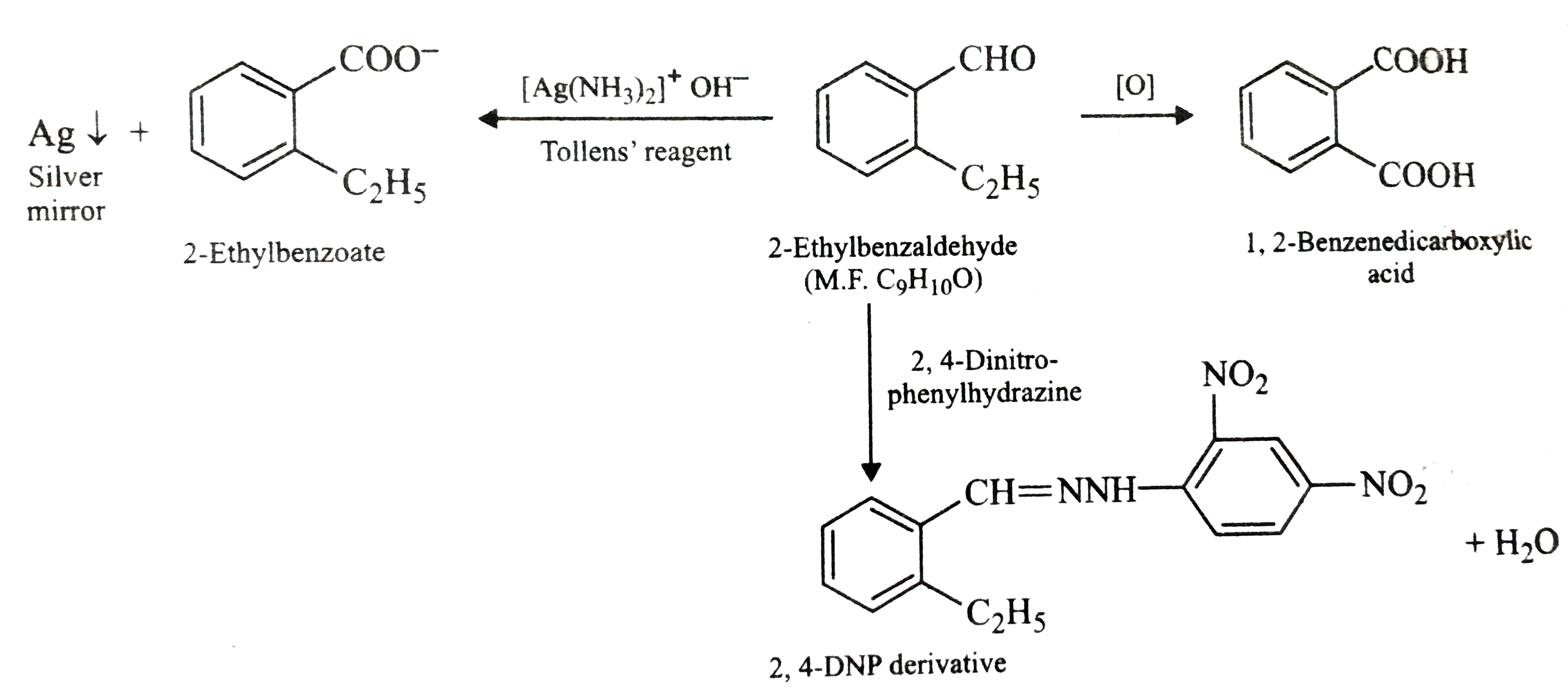 . .
|
|
| 33. |
An organic compound X (C_(4)H_(8)O_(2)) gives positive teast with NaOH positive test with NaOH and Phenopthalein. Structure of X will be: |
|
Answer» `CH_(3)-CH_(2)-CH_(2)-UNDERSET(O)underset(||)NH_(2)` |
|
| 34. |
An organic compound with the molecular formula C_(9)H_(10)O forms 2, 4 - DNP derivative, reduces Tollens' reagent and undergoes Cannizzaro reaction. On vigorous oxidation, it gives 1, 2 - benzenedicarboxylic acid. Identify the compound. |
|
Answer» Solution :(i) Since the given compound FORMS a 2, 4 - DNP derivative and reduces TOLLENS. reagent, it must be an aldehyde. As the molecular formula is `C_(9)H_(10)O`, this is PROBABLY an aromatic compound. (ii) Since it undergoes Cannizzaro reaction, THEREFORE, `CHO` group is directly attached to the benzene ring. (iii) On vigorous oxidation, it gives 1, 2 - benzenedicarboxylic acid, therefore, it must be an ortho substituted benzaldehyde. The only o - substituted aromatic aldehyde having molecular formula `C_(9)H_(10)O` is 2 - ethylbenzaldehyde. Al the reaction can now be explained on the basis of this structure. 
|
|
| 35. |
An organic compound with the molecular formula C_(8)H_(8)O forms 2,4-DNP derivative, reduces Tollens' reagent and undergoes Cannizzaro reaction. On vigorous oxidation, it gives 1,2-benzandicarboxylic acid. The organic compound is |
|
Answer» 2-ethylbenzaldehyde 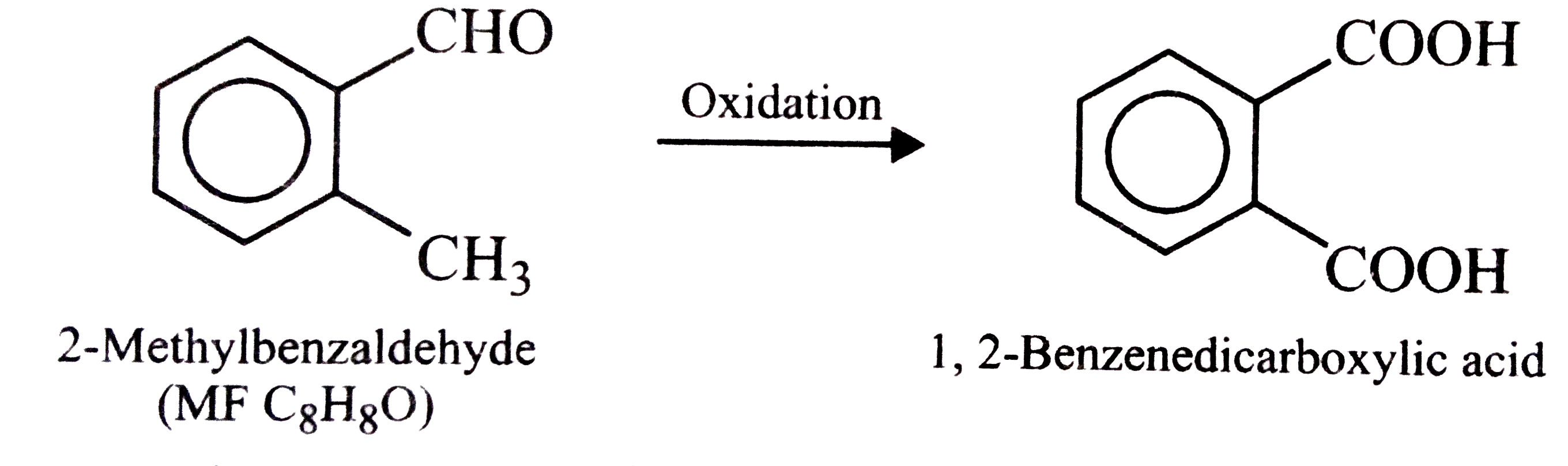
|
|
| 36. |
An organic compound with the formula C_(4)H_(10)O_(3) shows properties of ether and alcohol. When trated with an excess of HBr yield only one compound 1,2 dibromomethane. Write structural formula of ether and that of alcohol. |
|
Answer» Solution :When `C_(4)H_(10)O_(3)` is treated with excess of HBr, a single compound 1,2-dibromoethane is FORMED. `HO-H_(2)C-CH_(2)-O-CH_(2)-CH_(2)-Ohoverset("excess of HBr")rarrunderset("1-2-Dibromoethane")(Br-CH_(2)-CH_(2)-Br)` `:.` the structural formula of `C_(4)H_(10)O_(3)` is ltbRgt `HO-H_(2)C-CH_(2)-O-CH_(2)-CH_(2)-OH` |
|
| 37. |
An organic compound (A) with molecular formula C_(7)H_(8)O dissolves in NaOH and gives characteristic colour with FeCl_(3). On treatement with Br_(3), it gives a tribromo product C_(7)H_(5)Br_(3). The compound is: |
|
Answer» BENZYL alcohol |
|
| 38. |
An organic compound with molecular formula C_(6)H_(6)O gives white ppt with bromine water. Identify the functional group in the compound. Write the chemical equation for the reaction. |
Answer» SOLUTION :FUNCTIONAL GROUP is PHENOL 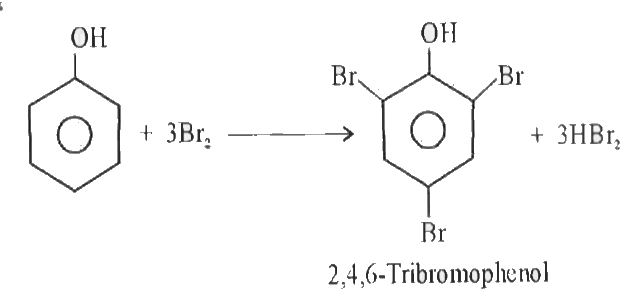
|
|
| 39. |
An organic compound with molecular formula C_6H_6O dissolves in NaOH and gives characteristics colour with neutral FeCl_3. On treatment with bromine waterit gives tribromoderivative. The compound is, |
|
Answer» alcohols |
|
| 40. |
An organic compound with molecular formula C_5H_5Clexists in two optically active forms A and B . A on hydrogenation in presence of a catalyst gives an optically inactive compound (C). While B gives an optically active compound D.Which of the following is the correct IUPAC name of compound C. |
|
Answer» 1-chloro-2-methylbutane 
|
|
| 41. |
An organic compound with molecular formula C_5H_5Clexists in two optically active forms A and B . A on hydrogenation in presence of a catalyst gives an optically inactive compound (C). While B gives an optically active compound D.Which of the following is the correct IUPAC name of compound D |
|
Answer» 1-chloro-2-methylpentane 
|
|
| 42. |
An organic compound with molecular formula C_5H_5Clexists in two optically active forms A and B . A on hydrogenation in presence of a catalyst gives an optically inactive compound (C). While B gives an optically active compound D.The structure of A is |
|
Answer»
 
|
|
| 43. |
An organic compound with molecular formula C_(3)H_(5)N on hydrolysis gives an acid. The acid on heating with N_(3)H and conc. H_(2)SO_(4) gives |
|
Answer» Propanamide |
|
| 44. |
An organic compound which produces a bluish green coloured flame can heating in presence of copper is |
|
Answer» Chlorobenzene |
|
| 45. |
An organic compound when treated with bleaching powder gave chloroform. The organic compound may be: |
|
Answer» ETHANE |
|
| 46. |
An organic compound undergoes first order decomposition. The time taken for the decomposition of 1//8 and 1//10 of its initial concentration are 1//8 and 1//10respectively. What is the value of [t_(1//8)]/([t_(1//10)]) xx 10 (take log_(10)2=0.3) |
|
Answer» `[A] = 1//8 [A]_(0)` at `t_(1//8)` `t_(1//8) = 2.303/k log ([A]_(0))/([A]_(0//8))` `=2.303/k LOG8` `[A] = 1/10 [A]_(0)` at `t_(1//10)`, `t_(1//10) = 2.303/k log ([A]_(0))/([A]_(0//10))` `=2.303/k log 10`...........(II) `([t_(1//8)])/([t_(1//10)]) xx 10 = (log 8)/(log 10) xx 10 = (3 log 2)/(log 10) xx 10` `= 3 xx (0.3010 xx 10) =9` |
|
| 47. |
An organic compound undergoes first order decomposition. The time taken for its decomposition to 1/8 and 1/10 of its initial concentration are t_(1/8) and t_(1//10) respectively. What is the value of ([t_(1//8)])/([t_(1//10)])xx10? (log_(10)2=0.3) |
|
Answer» |
|
| 48. |
An organic compound undergoes first-order decomposition. The time taken for its decomposition to 1//8 and 1//10 of its initial concentration are t_(1//8) and t_(1//10) respectively. What is the value of ([t_(1//8)])/([t_(1//10)])xx10?(log_(10)2=0.3) |
|
Answer» `k=(2*303)/t"log"C_0/C_t" or "t=(2*303)/k"log"C_0/C_t` `:.""1_(1//8)=(2*303)/t"log"C_0/(C_0//8)=(2*303)/k"log 8"` `=(2*303)/k"log 2"^3=(2*303xx3)/k"log 2"` `=(2*303xx3xx0*3)/k` `t_(1//2)=(2*303)/k"log"C_0/(C_0//10)=(2*303)/k" log 10"=(2*303)/k` `:.""t_(1//8)/t_(1//10)=3xx0*3=0*9" or "t_(1//8)/(t_(1//10))" or "t_(1//8)/t_(1//10)xx10=9` |
|
| 49. |
An organic compound undergoes first decompoistion. The time taken for its decompoistion to 1//8 and 1//10 of itsinitial concentration are t_(1//8) and t_(1//10), respectively. What is the value of ([t_(1//8)])/([t_(1//10)]) xx 10? (log_(10)2 = 0.3) |
|
Answer» 0.6 |
|