Saved Bookmarks
This section includes 7 InterviewSolutions, each offering curated multiple-choice questions to sharpen your Current Affairs knowledge and support exam preparation. Choose a topic below to get started.
| 1. |
An organic compound taken in a test tube and acetyl chloride is added to it. White fumes appeared when a glass rod dipped NH_(3) is placed at the mouth of test tube. This indicates that organic compound may contain. |
| Answer» Answer :C | |
| 2. |
An organic compound reacts with Cu_2Cl_2 and also decolourise Br_2 water is |
|
Answer» `CH_3-C-=C-CH_3` `CH_3-C-=Chunderset(H_2O)overset(Br_2)to CH_3-undersetunderset(Br)(|)C=CHBr UNDERSET(H_2O)overset(Br_2)to CH_3-undersetunderset(Br)(|)oversetoverset(Br)(|)C-undersetunderset(Br)(|)overset(Br)overset(|)C` `CH_3-C-=underset(Cu_2Cl_2)overset"ammonical"toCH_3-C-=C Cu` |
|
| 3. |
An organic compound reacts with metallic sodium to liberate hydrogen and with Na_2 CO_3 solution to liberate CO_2. The compound is |
|
Answer» ALCOHOL |
|
| 4. |
An organic compound (P) of molecular formula C_(5)H_(10)O is treeted with dil. H_(2)SO_(4) t give compounds (Q) and ( R ) both of which responds iodoform test The rate c reaction of (P) with dil. H_(2)SO_(4) is 10^(10) faster than the reaction of ethylene with di H_(2)SO_(4). Identify the organic compounds (P), (Q) and ( R ) and explain the extr reactivity of (P). |
Answer» SOLUTION :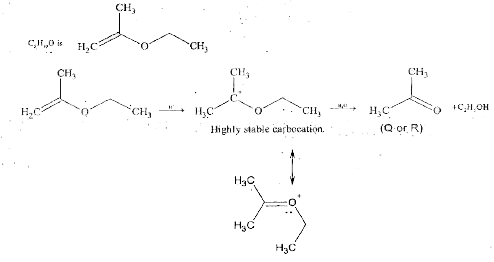
|
|
| 5. |
An organic compound 'P (mol mass -75) on reduction gives compound 'Q' which yields compound 'R' when treated with nitrous acid. Compound R responds to iodofonn reaction. Compound Q is |
|
Answer» ETHYL a lcohol `CH_(3)underset((P))(CH_(2))NO_(2)overset([H])underset(-H_(2)O)(rarr)CH_(3)underset((Q))(CH_(2))NH_(2)overset(HNO_(2))underset(-H_(2)O)(rarr)CH_(3)underset((R))(CH_(2))OH` The product (R ) ethyl alcoholn gives IODOFORM reaction. |
|
| 6. |
An organic compound P having molecular formula C_(6)H_(4)N_(2)O_(4) is insoluble in both dilute acid and base and its dipole moment is zero. Its structure is : |
|
Answer»
|
|
| 7. |
An organic compound (P) C_(4)H_(6) formsa precipitate with Tolles regent. (P) has an isomer (Q) which on Reductive ozonolysis forms only one product. (P) and (Q) are : |
|
Answer»
TERMINAL alkayne gives white ppt with TOLLEN's reagent. |
|
| 8. |
An organic compound P exists in two enantiomeric forms, which have specific optical rotation values [alpha] = +-100^(@). The optical rotation of a mixture of these two enantiomers is -50^(@). Calculate the percentage of that enantiomer which is in lower concentration in the mixture. |
|
Answer» `% " of LAEVOROTATORY isomer " = 50+25%` `% " of DEXTROROTATORY isomer " = 25%` |
|
| 9. |
An organic compound on treatment with conc. Sulphuricacid, gives an intermediate compound, which on furtherhydrolysis givesisopropanol. The organic compound is __________ and the process is called _____ |
|
Answer» `CH_3CH_2CH_3`, ELIMINATION |
|
| 10. |
An organic compound on qualitative analysis was found to contain C, H, N and O. 1.0g of it on oxidation with CuO and oxygen gave 1.239g of CO_(2) and 0.1269g of H_(2)O. 2g of the sample was digested with concentrated sulphuric acid and the residue was distilled after the addition of excess solution of sodium hydroxide. The ammonia evolved was absorbed in 50mL of 1.0N sulphuric acid. The resulting solution was diluted to 500mL in a measuring flask. 25mL of this solution required 21.8mL of 0.05N NaOH for complete neutralisation. Calculate the empirical formula of the compound. |
| Answer» SOLUTION :`(C_(2)HNO_(2))` | |
| 11. |
An organic compound on heating with CuO produces CO_(2) but not water. The organic compound may be |
|
Answer» Chloroform |
|
| 12. |
An organic compound on analysis gave the following results : C = 54.5% , O = 36.4 %, H = 9.1% . The Empirical formula of the compound is |
|
Answer» `C_(2)H_(4)` Hence `C_(2)H_(4)O`. |
|
| 13. |
An organic compound on analysis gave the following composition : C = 57.8% H = 3.6% and rest is oxygen. Its empirical formula is : |
|
Answer» `C_(4) H_(2)O_(3)` |
|
| 14. |
An organic compound of two gases are in the ratio of 1:3 Their molecular masses are in the ratio is: |
|
Answer» 200 |
|
| 15. |
An organic compound on analysis gaveC=48 g,H=8g and N=56 g. Volume of 1.0 g of the compound was foud to be 200ml at NTP. Molecular formula of the compound is |
|
Answer» `C_(4)H_(8)N_(4)` Empirical FORMULA ` = CH_(2)N` Empirical formula MASS `= 28` Now, `200ml` of compound `= 1 gm` `22400 ml` of compound `1/200 XX 22400 = 112` `n '(" Mol.mass")/(" Emp.formula mass") = 112/28 = 4` Therefore, molecularformula `= (CH_(2)N)_(4) = C_(4)H_(8)N_(4)`. |
|
| 16. |
An organic compound of structure CH_(3)CH_(2)CH_(2)CH_(2)Cl shows chain isomer of compound of structural formula, |
|
Answer» `(CH_(3))_(3)C Cl` |
|
| 17. |
An organic compound of moleular formula C_4H_10Odoes not react with sodium. With excess of HI, it gives only one type of alkyl halide. The compound is. |
|
Answer» ETHOXYETHANE 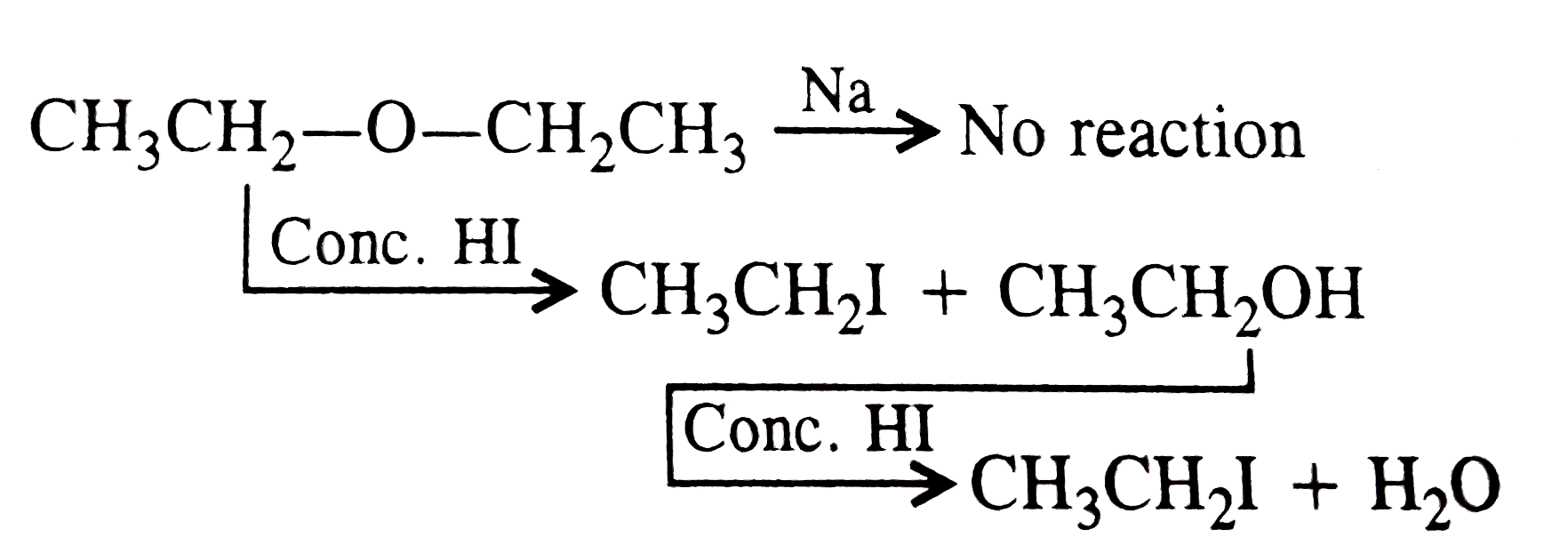
|
|
| 18. |
An organic compound of moleuular formula C_3H_6O dones not prduce any precipitate with 2,3- dinitrophenyl hydrazine and does not react with sodium metal. This compound is |
|
Answer» `CH_3COCH_3` 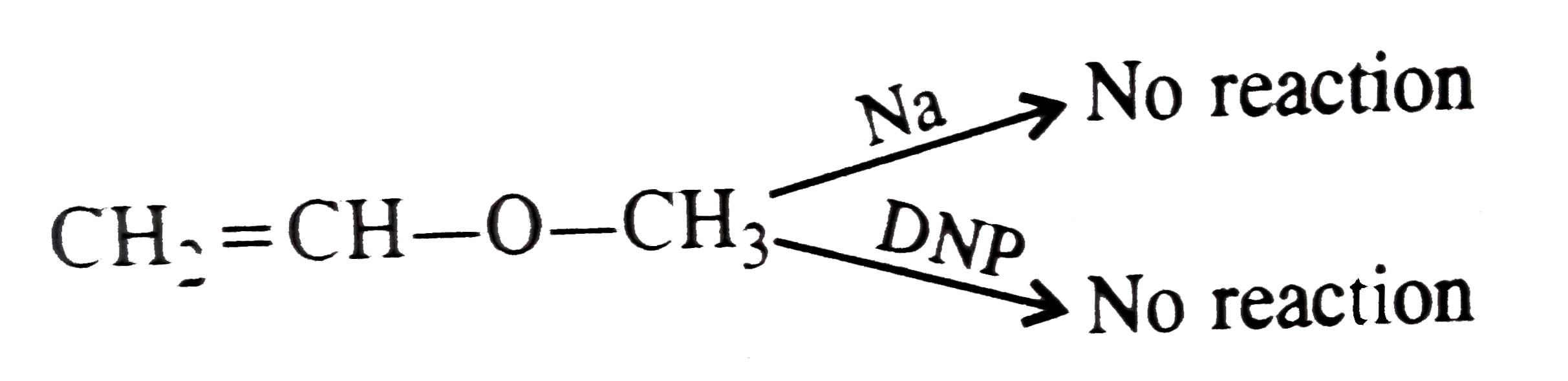
|
|
| 19. |
An organic compound of molecular formula C_(3)H_(7)N was analysed for nitrogen by Dumas method. Find the volume (in mL) of nitrogen evolved at NTP from 2g of the substance. |
|
Answer» |
|
| 20. |
An organic compound of molecular formula, C_3H_6O , forms 2,4 - dinitrophenylhydrazone, but gives negative Tollen's test . The compound is |
|
Answer» `CH_2=CH - CH_2-OH` |
|
| 21. |
An organic compound of molecular formula C_(3)H_(6)O did not give a silver mirror with with Tollens' reagent but give an oxime with hydroxylamine. It may be |
|
Answer» `CH_(2)=CH-CH_(2)-OH` |
|
| 22. |
An organic compound of molecula formula C_(6)H_(5)O"Na" is heated with CO_(2) at 400 K gives compound (A) of molecular formula C_(7)H_(5)O_(3)Na. Compound (A) on treating with HCl gives (B). B on further reactions wiith NaOH / CaO gives compound (C ) of molecular formula C_(6)H_(6)O which on treatment with nitrous acid at 200 K gives compound (D ). Identify (A), (B) , ( C) and (D) are explain the reactions. |
Answer» Solution :(i) When a sodium phenoxide is HEATED with carbon dioxide at 400 K under PRESSURE, sodium salicylate is formed.  (ii) Sodium salicylate is decomposed hydilute hydrochloric acid, when salicylic acid is formed.  (iii) On TREATMENT with NaOH/ CaO sodium salicyalte gives phenol.  (IV) Phenol reacts with nitrous acid to give p-nitrosophenol. 
|
|
| 23. |
An organic compound of formula, C_(3)H_(6)O forms phenyl hydrazone, but gives negative Tollen's test . The compound is |
|
Answer» `CH_(2) = CHOCH_(3)` |
|
| 24. |
An organic compound of carbon, hydrogen and nitrogen contains these elements having mass percentage 66.67%, 7.41% and 25.92% respectively. Calculate empirical formula |
|
Answer» `C_3H_4N` |
|
| 25. |
An organic compound must contain: |
|
Answer» Oxygen |
|
| 26. |
An organic compound (mol. Wt =44) (X) contains 54.54% of C and 9.09% of H. With PCl_(5), (X) gives a compound of molecular weight 99. On oxidation it gives an acid of molecular weight 60. What is (X)? |
| Answer» SOLUTION :`(CH_(3)CHO)` | |
| 27. |
An organic compound % of C and % of H in the ratio 6 : 1 and % of Cand % of O in the ratio 3 : 4. The compound is |
|
Answer» `HCHO` i.e., `x+6x+8x=100 rArr x = (100)/(15)` `C 600//15% rArr 40//12 = 3.3333 rArr 1` `H 100//15% rArr 100//15 = 6.6667 rArr 2` `O 800//15% rArr 50//15 = 3.333 rArr 1` `CH_(2)O` is the empirical formula. |
|
| 28. |
An organic compound made of C,H and N contain20% nitrogen.Its molecular weightI |
|
Answer» 70 |
|
| 29. |
An organic compound made of C , H and N contains 20% nitrogen. What will be its molecular mass if it contains only one nitrogen atom in it? |
|
Answer» 70 `20=(14)/(m)xx100` m=70 |
|
| 30. |
An organic compound made of C, H and N contain 20%nitrogen. Its minimum molecular weight is |
|
Answer» 70 the compound MUST CONTAIN at LEAST one N-atom. Hence, `20=(14)/("Molecular mass")xx100` `"or Molecular mass"=(14)/(20)xx100=70` Note. If two N atoms are present in the molecule, molecular mass would be 140. |
|
| 31. |
An organic compound is heated with HNO_(2) at 0^(@)C and then the resulting solution is added to a solution of beta-naphthol whereby a brilliant red dye is produced. The observations indicate that the compound possesses. |
|
Answer» `-NO_(2)` group 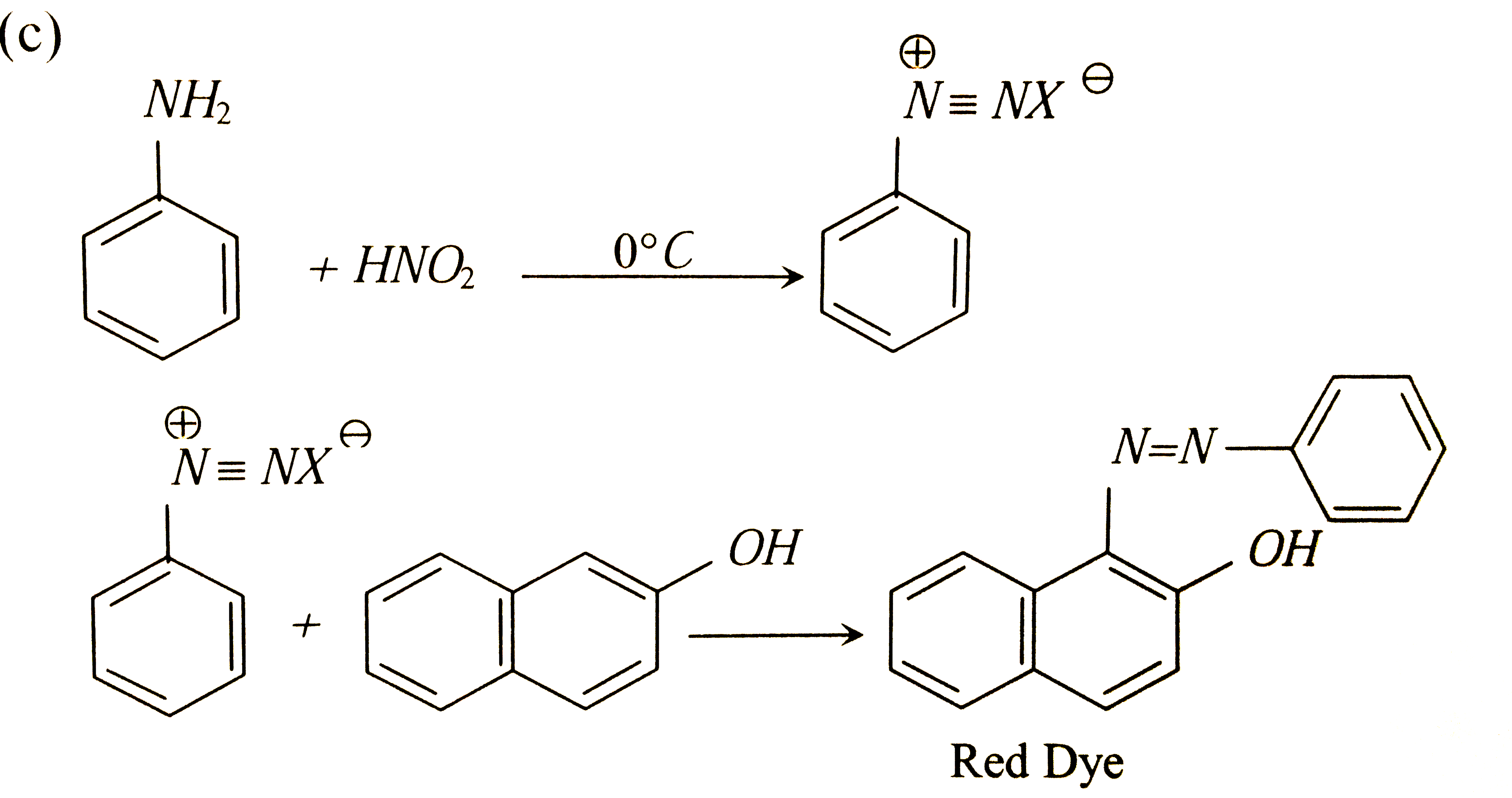 Hence choice (c ) is correct(a) is incorrect. Aliphatic p-and `s-NO_(2)` groups react with `HNO_(2)` but not with `BETA`-napththol. `-UNDERSET(O)underset(||)C-NH_(2)`group react with `HNO_(2)` and produces `N_(2)` gas and does not react with `beta`-naphthol. Hence choice(b) is incorrect An aliphatic amine reacts with `HNO_(2)` and produces alcohol. Here first an aliphatic diazonium SALT is formed which being unstable immediately reacts with `H_(2)O` to form alcohol. While aromatic amines when they form diazonium salts are highly STABLE and hence can be used to diazonium salts are highly stable and hence can be used to take part in dizonium caupling reactions. Hence choice (d) is incorrect. |
|
| 32. |
An organic compound is fused with sodium metal and crushed in water. The solution thus obtained when treated with freshly prepared ferric chloride solution gives blood red color solution. The test confirms |
|
Answer» Presence of `S` in the organic COMPOUND. `Fe^(3+) + SCN^(-) rarr [Fe(SCN)]^(2+)` |
|
| 33. |
An organic compound is fused with fusion mixture and extracted with HNO_3.The extract gives yellow precipitate with ammonium molybdate. It shows the presence of which element : |
|
Answer» <P>P |
|
| 34. |
An organic compound is boiled with alcoholic potash. The product is cooled and acidified with HCI. A white solid separates out. The starting compound may be |
|
Answer» ETHYL benzoate |
|
| 35. |
An organic compound is adsorbed on the surface of silica gel. Name the process of removing the organic compound from silica gel. |
| Answer» SOLUTION :DESORPTION. | |
| 36. |
An organic compound having the molecular formula C_5H_(10)O_3 on hydrolysis in the presence of Zn, gives acetone and acetaldehyde. Write the structure of the organic compound. |
|
Answer» Solution :The molecular formula of the compound is `C_(5)H_(10)O_(3) = C_(n)H_(2n) O_(3) (n=5)`, l.e., the compound is an addition compound of an ALKENE and `O_(3)`. The compound, on reductive hydrolysis, produces acetone and acetaldehyde. Hence, the compound must be an alkene ozonide. The STRUCTURE of the alkene obtained by writing the carbonyl compound side by side FACING carbonyl groups with RESPECT to each other followed by removing the two oxygen atoms and joining the two carbonyl CARBONS by a double bond. So the compound is 2-methylbut-2-ene. `underset("Acetone")(CH_(3) - overset(overset(CH_(3))(|))(C) = O) + underset("Acetaldehyde")(O = overset(overset(H)(|))(C) - CH_(3)) rArr underset("2-methylbut-2-ene")(CH_(3) - overset(overset(CH_(3))(|))(C) = CHCH_(3))` 
|
|
| 37. |
An organic compound having molecular mass 60 is found to be contain C=20%., H=6.67 % and N=46.67% while rest is oxygen. On heating it gives NH_(3) along with a solid residue. The solid residue give violet colour with alkaline copper sulphate solution. the compound is |
|
Answer» `CH_(3)CH_(2)CONH_(2)` |
|
| 38. |
An organic compound having the molecular formula C_(2)H_(4)O_(2) is |
|
Answer» formic ACID `(i) CH_(3)COOH,""(ii) HCOOCH_(3)` |
|
| 39. |
An organic compound having molecular mass 60 is fond to contain C=20%, H=6.67% and N=46.67% while rest is oxygen. On heating it gives NH_(3) alongwith a solid residue. The solid residue gives violet colour with alkaline copper sulphate solution. the compound is |
|
Answer» `CH_(3)NCO` Empirical FORMULA `=CH_(4)N_(2)O` Out of these urea on heating gives a solid residue called biuret which gives violet colour with alkaline `CuSO_(4)` solution. `underset("Urea")(NH_(2)CONH_(2)+H)NHCONH_(2) to underset("Biuret")(NH_(2)CONHCONH_(2))+NH_(3)` |
|
| 40. |
An organic compound having molecular formula C_(5)H_(10)O exixts in two chain ismors. (A) and (B). Iosomer (A) undergoes the Cannizzaro's reaction to give 2,2dimethyl propanic acid and 2,2dimethyl propan-1-ol. Compound (B) in the presence of dilute alkali undergoes aldol condensation to from 3-hydroxy-2-proplheptanal. Give graphi representation of (A) and (B) |
|
Answer» Solution :ISOMER have formula `C_(4)H_(9)CHO`. (A) undegoes Cannizaro' reaction, thus it does not have `alpha` hydrogen. The rstructure of f(A) is `(CH_(3))_(3)C CHO` `(CH_(3))_(3)underset((A))(C)-CHOoverset(NaOH)rarrunderset(2,2-"Dinethylpropanoic acid")((CH_(3))_(3)C-COOH)+underset(2,2-"Dimethylpropan-1-ol")((CH_(3))_(3)-CH_(2)OH)` (B) undergoes ALDOL CONDENSATION, it possesses `alpha`- hydrogen atom. The structure of (B) is `CH_(3)CH_(2)CH_(2)CHO` `CH_(3)CH_(2)underset((B))(CH_(2))CH_(2)CHO+H-underset(CHO)underset(|)(CH)CH_(2)CH_(2)CH_(3)rarrCH_(3)CH_(2)CH_(2)CH_(2)underset(3-"Hydroxy-2-propylheptanal")underset(OH)underset(|)(CH)-underset(CHO)underset(|)(CHCH_(2))CH_(2)CH_(3)` |
|
| 41. |
An organic compound having molecular formula C_5H_(10) O exists in two chain isomers, (A) and (B).Isomer (A) undergoes Cannizzaro reaction to give 2, 2- dimethyl propanoic acid 2,2- dimethyl propanol - 1. Compound (B) in the presecne of dilute alkali undergeos aldol condensation to form 3 - hydroxy -2- propyl heptanal. Give the structures of (A) and (B). |
|
Answer» Solution :ISOMERS have the FORMULA, `C_(4)H_(9)CHO`. Isomer (A) undergoes Cannizzaro reaction, thus it does not have `alpha`-hydrogen. The structure of (A) is `(CH_(3))_(3)C CHO`. `(CH_(3))_(3)C CHO overset(NaOH)RARR (CH_(3))_(3)C COOH+ (CH_(3))_(3)C CH_(2)OH` Isomer (B) undergoes aldol condensation as it possesses `alpha`-hydrogen ATOM. The structure of (B) is `CH_(3)CH_(2)CH_(2)CH_(2)CHO`. |
|
| 42. |
An organic compound having molecular, C_(4)H_(10)Odoes not react with metallic sodium. On heating this compound with excess of constant boiling HI (density 1.7 g/mL) in a sealed tube, yields ethyl iodide as the only organic compound. What is the organic compound? |
|
Answer» SOLUTION :(i) Since the compound with M.F. `C_(4)H_(10)O` does not REACT with metallic solution, it cannot be an alcohol (ii) Since on heating with excess of HI in a sealed TUBE, it gives ETHYL iodide as the only organic compound, therefore, it must be diethyl ether. `underset("Diethyl ether")(CH_(3)CH_(2)-O-CH_(2)CH_(3))+2HI overset(Delta)to underset("Ethyl iodide")(2CH_(3)CH_(2)-I)+H_(2)O` |
|
| 43. |
An organic compound having C,H and sulphur contains 4% of sulphur. The minimum molecular weight of compound is |
|
Answer» 200 `4 = (32)/(" Minimum mol.wt.") xx 100` Minimum mol. Wt =` 800 g mol^(-1)` (a) , (B) and (c ) are not POSSIBLE. Alternate Method: A compound MUST have at leat one atom of S i.e, `32g` of S. 4gof sulphur is PRESENT in 100 g of compound. `32g` of sulphur will be present in `(100)/(4) xx 32 = 800 g mol^(-1)`. |
|
| 44. |
An organic compound has the formula C4H10O. It reacts with metallic sodium liberating hydrogen. (i) Write down the formula of three possible isomers of the compound which are similar and react with sodium. (ii) What will be the product if any one of the isomers reacts with acetic acid ? |
|
Answer» Solution :The three ISOMERS are (i) `CH_(3)CH_(2)CH_(2)CH_(2)OH` `CH_(3)CH(OH)CH_(2)CH_(3)` `CH_(3)-underset(CH_(3))underset("|")"CH"-CH_(2)OH` (II) `CH_(3)CH_(2)CH_(2)CH_(2)OH +CH_(3)COOH rarr CH_(3)CH_(2)CH_(2)CH_(2)OOC CH_(3)` |
|
| 45. |
An organic compound has C and H percenatage in the ratio 6 : 1 and C and O percentage in the ratio 3 : 4 .The compound is : |
|
Answer» HCHO |
|
| 46. |
An organic compound does not reacts with Tollen's reagent but undergoes Baeyer Villiger oxidation. The compound is |
|
Answer» `CH-=C-CH_(2)COCH_(3)` |
|
| 47. |
An organic compound does not give a precipitate with 2,4 - DNP and does not react with sodium metal . It could be |
|
Answer» `CH_(3) - CH_(2) - CHO` |
|
| 48. |
An organic compound dissolved in dry benzene evolved hydrogen on treatment with sodium .It is |
|
Answer» A ketone (Alcohol) `R-OH+Na to R -O"N"a + H_(2)` |
|
| 49. |
An organic compound dissolved in dry benzene evolved hydrogen on treatment with sodium. It is : |
|
Answer» A ketone |
|