Saved Bookmarks
This section includes 7 InterviewSolutions, each offering curated multiple-choice questions to sharpen your Current Affairs knowledge and support exam preparation. Choose a topic below to get started.
| 1. |
An organic compound contains hydrogen and oxygen and a single carbon atom and responds positively to Tollen.s reagent. The compound is : |
|
Answer» HCHO |
|
| 2. |
An organic compound contains H_(2)O and single carbon. It responds positive to Tollens' reagent . The compound is |
| Answer» Answer :A | |
| 3. |
An organic compound contains C,H,N,S and Cl. For the detection of chlorine the sodium extract of the compound is first heated with a fewdropsof concentrated HNO_(5) and then AgNO_(3) is added to get a white ppt of AgCl. The digestion with HNO_(3) beforethe addition of AgNO_(3) is |
|
Answer» To prevent the FORMATION of `AgNO_(3)` is Both `NaCN` and `Na_(2)S` will react with `AgNO_(3)` to form `AgCN` (white ppt.) and `Ag_(2)S` (black pt.) They must be removed before performing `AgNO_(3)` test for halogens Thus, on adding `HNO_(3),NaCN` and `Na_(2)S` `NaCN + HNO_(3) rarr NaNO_(3) + HCN UARR` `Na_(2)S + 2HNO_(3) rarr 2 NaNO_(3) + H_(2)S uarr` Hence, `CN^(-)` and `S^(2-)`are removed as HCN and `H_(2)S` by adding `HNO_(3)`. Hence, CHOICE (c) is correct while (a), (b) and (c)incorrect. |
|
| 4. |
An organic compound contains C=40% , H=13.33% and N=46.67%. Its empirical formula would be |
|
Answer» `CHN` Relative No. of atoms `C=(3.33)/(3.33)=1, H=(13.33)/(3.33)=4, N=(3.34)/(3.33)=1` `therefore` Empirical formula`=CH_(4)N` |
|
| 5. |
An organic compound contains C(30.6%), H(1.7%) and Br(67.7%). 0.706 g of this compound, when dissolved in 10g of acetone, increased the b.p. of acetone by 0.5^(@). If K_(b) for acetone is 1.67, find the molecular formula of the compound (Br=80). |
|
Answer» Solution :We have, `DeltaT_(b)= K_(b).m` `0.51.67 xx (0.706)/(M) xx (1000)/(10)` or M = 236 `{{:("M is the mol. wt. of the "),("ORGANIC COMPOUND"):}}` Now, in the given compound, moles of `C: H: Br= (30.6)/(12): (1.7)/(1): (67.7)/(80)` `=2.55 : 1.7: 0.84` `=3:2:1` `THEREFORE` empirical formula is `C_(3)H_(2)Br` (118) As the molecular weight is twice the empirical formula weight, molecular formula of the organic compound is `C_(6)H_(4)Br_(2)` |
|
| 6. |
An organic compound contains C, H and S.WhenC and H are estimated the combustion tube at the exit should contain a : |
|
Answer» COPPER spiral |
|
| 7. |
An organic compound contains C, H, N and O. 0.135g of this compound on combustion produced 0.198g of CO_(2) and 0.108g of H_(2)O while the same amount gave 16.8 mL of nitrogen at 0^(@)C and 76cm of pressure. Calculate the percentage of oxygen in the compound. |
|
Answer» |
|
| 8. |
An organic compound contains C, H ‘and S. An organic compound contains C, H ‘and S. |
|
Answer» copper spiral |
|
| 9. |
An organic compound contains C, H and S. When C and H are estimated, the combustion tube at the end should contain a |
|
Answer» A)LEAD chromate |
|
| 10. |
An organic compound contains C, H and O 0.30g of this compound on combustion yielded 0.44g of CO_(2) and 0.18g of H_(2)O. If the weight of 1 mole of the compound is 60, show that the molecular formula is C_(2)H_(4)O_(2) |
|
Answer» SOLUTION :Moles of C in `CO_(2)=1 xx` moles of `CO_(2)= (0.44)/(44)=0.01` Weight of `C+ 0.01 xx12g = 0.12g` Moles of H in `H_(2)O=2 xx` moles of `H_(2)O= (2 xx 0.18)/(18)=0.02` Weight of `H= 0.02 xx 1= 0.02g` Weight of O= weight of compound -(wt. of C + wt. of H) `=0.30 -(0.12+ 0.02)g` =0.16g `THEREFORE` mole of `O= (0.16)/(16)=- 0.01` `therefore` mole of `C: H: O = 0.01 : 0.02 : 0.01 =1:2:1` `therefore` EMPIRICAL formula = `CH_(2)O` Now, since the weight of 1 mole is the molecular weight in grams, the molecular weight of the compound is 60. `therefore ("molecular formula weight")/("empirical formula weight") = (60)/(30)=2` Thus, the molecular formula is `(CH_(2)O)_(2)` i..e, `C_(2)H_(4)O_(2)` |
|
| 11. |
An organic compound contains 69.77% carbon, 11.63% hydrogen and rest oxygen. The molecular mass of the compound is 86. It does not reduce Tollens' reagent but forms an addition compound with sodium hydrogensulphite and gives positive iodoform test. On vigorous oxidation, it gives ethanoic and propanoic acid. Write the possible structure of the compound |
|
Answer» Solution :Step 1. To find out the molecular formula of the compound. Percentage of carbon = 69.77 Percentage of hydrogen = 11.63 Percentage of oxygen = 100 - (69.77 + 11.63) = 18.6 (By difference) Calculate atomic ratio as under: `C: H : O = (69.77)/12 : (11.63)/1 : (18.6)/16 = 5.88 : 11.63 : 1.16 = 5 : 10 :1` The empirical formula of the GIVEN compound is `C_(5)H_(10)O` `therefore` Empirical formula mass `= 5 xx 12 + 10 xx 1 + 1 xx 16 = 60 + 10 + 16= 86` Molecular mass=86 (given) Molecular formula = `C_(5)H_(10)O xx 86/86 = C_(5)H_(10)O` Thus, molecular formula of the given compound `=C_(5)H_(10)O` Step 2. To determine the structure of the compound. (i) As the given compound forms sodium hydrogen sulphite addition product, it is an aldehyde or ketone., (II) As the compound does not reduce Tollens. reagent, it is not an aldehyde and hence it MUST be a ketone. (ii) As the compound gives positive iodoform test, the given compound is a methyl ketone. (iv) As the given compound on vigorous oxidation gives a mixture of ethanoic acid and propanoic acid, the methyl ketone is pentan-2-one, i.e., `underset("Pepton-2-one"[C_(5)H_(10)O])(CH_(3)-overset(O)overset(||)C - CH-(2)CH_(2)CH_(5))` The reactions can be explained with the above structure.  `underset("Pentan -2- one")(CH_(3)-overset(O)overset(||)C-CH_(2)CH_(2)CH_(3))+3I_(2)+4NaOH overset("Iodoform")underset("reaction")rarr underset("Iodoform")(CHI_(3))+underset("Sodium Butanoate")(CH_(3)CH_(2)CH_(2)COONa)+3NaI+3H_(2)O` `underset("Pentan-2- one")(CH_(3)-overset(O)overset(||)C-CH_(2))CH_(2)CH_(3)overset(K_(2)Cr_(2)O_(7))underset (H_(2)SO_(4))rarr underset("Ethanoic acid")(CH_(3)COOH)+underset("Propanoic acid")(CH_(3)CH_(2)COOH)` |
|
| 12. |
An organic compound contains 69.77% carbo, 11.63% hydrogen and rest oxygen. The molecular mass of the compound is 86. it does not reduce tollens' reagent but forms an addition compound with sodium hydrogen sulphite and gives positive iodoform test. On vigorous oxidation, it gives ethanoic acid and propanoic acid. writer the possible structure of the compound. |
|
Answer» Solution :Step 1. To FIND out the MOLECULAR formula of the compound. `%C=69.77%,%H=11.63%` `therefore%O=100-(69.77+11.63)=18.6%` `C:H:O=(69.77)/(12):(11.63)/(1)=(18.6)/(16)=5.88:11.63:1.16=5:10:1` `therefore`The E.F. of the given compound is `C_(5)H_(10)O` E.F. mass`=5xx12+12xx1+1xx16=86` Since, mol. mass=86 (Given) `thereforeM.F.=C_(5)H_(10)Oxx(86)/(86)=C_(5)H_(10)O` Step 2. To determine the structure of the compound (i) Since the givenc ompound forms sodium hydrogen sulphite ADDITION product, therefore, it must be either an aldehyde or methyl ketone. (ii) Since the compound does not reduce tollens' reagent, therefore, it cannot e an aldehyde and hence it must be a methyl ketone. (iii) Since the given compound on vigorous oxidation gives a mixture of ETHANOIC acid and propanoic Acid, therefore, the methyl ketone is pentan-2-one, i.e., `underset("Pentan-2- one ")(M.F.C_(6)H_(10)O)(CH_(3)-overset(O)overset(||)(C)-CH_(2)CH_(2)CH_(3))` Step 3. To explain the reactions involved in the given questions. 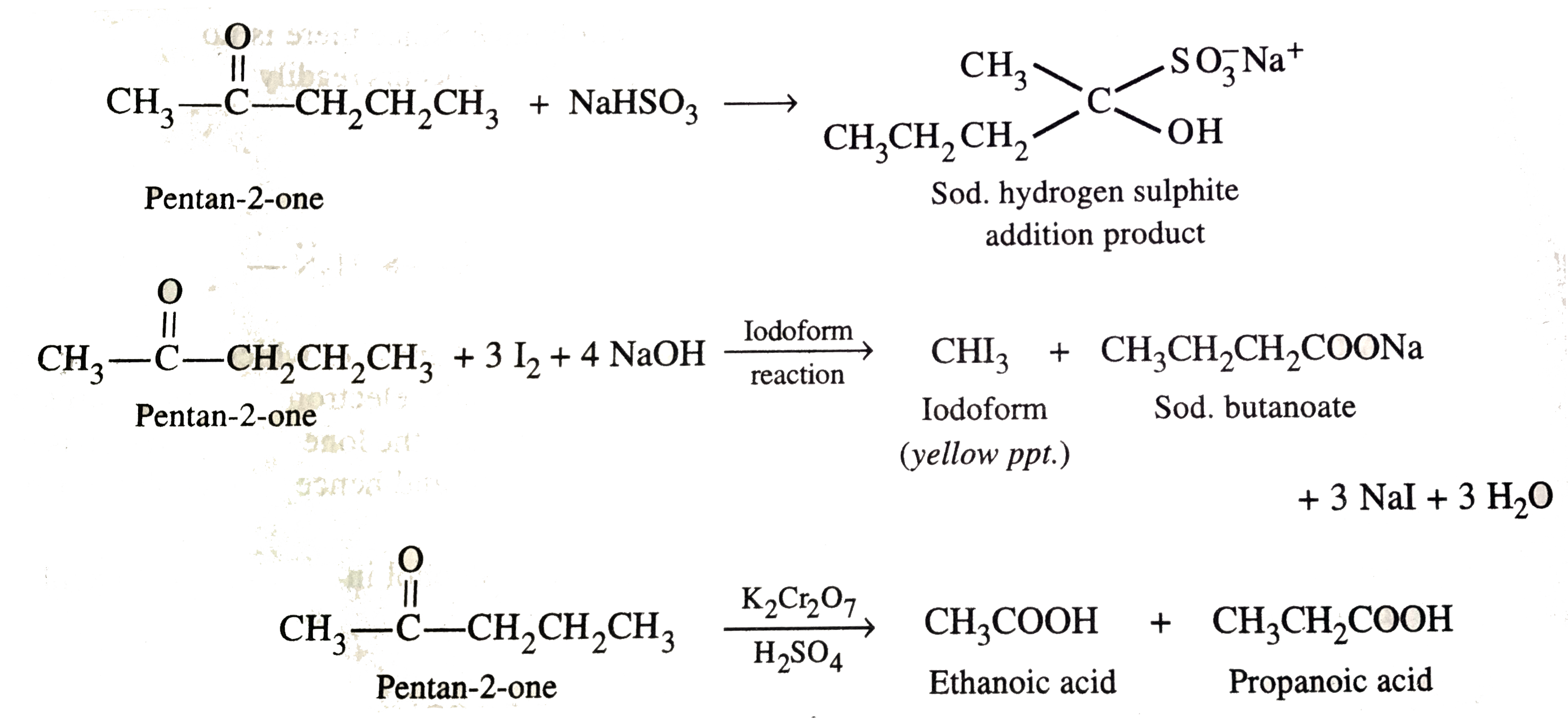 . .
|
|
| 13. |
An organic compound contains 69.4%C, 5.8% H. A sample of 0.303g of this compound gave NH_(3) which was absorbed by 50 ml of 0.05 M H_(2)SO_(4). The excess of acid required 25 ml of 0.1 M NaOH. Determine the empirical formula weight of organic compound. |
|
Answer» |
|
| 14. |
An organic compound containing one oxygen gives red colour with cerric ammonium nitrate solution, decolorises alkaline KMnO_(4) solution, responds iodoform test and shows geometrical isomerism. It should be: |
|
Answer» `C_(6)H_(5)-CH=CH-CH_(2)OH` |
|
| 15. |
An organic compound contains 4% sulphur by mass. Its minimum molecular weight is : |
|
Answer» 200 |
|
| 16. |
An organic compound containing C,H and N have the percentage 40,13.33 and 46.67 respectively. Its empirical formula may be : |
|
Answer» `C_2H_7N` |
|
| 17. |
An organic compound containing C,H and O can be : |
|
Answer» ALCOHOL |
|
| 18. |
An organic compound containing C,H and Ngavefollowing analysis : C = 40%, H = 13.33% and N = 46.67%. It empirical formula would be |
|
Answer» `C_(2)H_(7)N_(2)` THUS formula `CH_(4)N`. |
|
| 19. |
An organic compound containing C, H, O and S gave the following data on analysis: 0.1254g of the compound on heating with HNO_(3) and BaCl_(2) yielded 0.1292g of BaSO_(4) Calculate the empirical formula of the organic compound |
| Answer» SOLUTION :`(C_(14)H_(10)SO)` | |
| 20. |
An organic compound containing C, H and O gives following observations: (i) It exists in two isomeric forms (A) and (B). (ii) 0.108 g of one of the isomers on combustion gave 0.308 g of CO_(2) and 0.072 g of H_(2)O (ii) 0.108 g of one of the isomers on combustion gave 0.308 g of CO_(2) and 0.072 g of H_(2)O (iii) (A) is insoluble in NaOH and NaHCO_(3) while (B) is soluble in NaOH. (iv) (A) reacts with Hl to give compound (C ) and (D). (C ) can be separated from (D) by ethanolic AgNO_(3) solution and (D) is soluble in NaOH. (v) (B) readily reacts with bromine water to give compound (E) of molecular formula C_(7)H_(5)OBr_(3) Compound (C)overset("Moist"Ag_(2)O)rarr(P)underset(CH_(2)Cl_(2))overset(PC C)rarr(Q) The product (Q) is |
|
Answer» FORMALDEHYDE |
|
| 21. |
An organic compound containing C, H and O gives following observations: (i) It exists in two isomeric forms (A) and (B). (ii) 0.108 g of one of the isomers on combustion gave 0.308 g of CO_(2) and 0.072 g of H_(2)O (ii) 0.108 g of one of the isomers on combustion gave 0.308 g of CO_(2) and 0.072 g of H_(2)O (iii) (A) is insoluble in NaOH and NaHCO_(3) while (B) is soluble in NaOH. (iv) (A) reacts with Hl to give compound (C ) and (D). (C ) can be separated from (D) by ethanolic AgNO_(3) solution and (D) is soluble in NaOH. (v) (B) readily reacts with bromine water to give compound (E) of molecular formula C_(7)H_(5)OBr_(3) The empirical formula of (A) and (B) is |
|
Answer» `C_(7)H_(8)O` |
|
| 22. |
An organic compound containing C, H, N and CI is fused with exces of metallic sodium and the fused mass is extracted with distilled water, Which radicals are expected to be present in the resulting aqueous solution? |
|
Answer» Solution :The radicals which are EXPECTED to be present in the resulting AQUEOUS solution are (i) `HO^(-)` (hydroxyl) `CN^(-)` (CYANIDE) (iii) `CI^(-)` (Chloride) (iv) `Na^(+)` (SODIUM). |
|
| 23. |
An organic compound containing C, H and O gives following observations: (i) It exists in two isomeric forms (A) and (B). (ii) 0.108 g of one of the isomers on combustion gave 0.308 g of CO_(2) and 0.072 g of H_(2)O (ii) 0.108 g of one of the isomers on combustion gave 0.308 g of CO_(2) and 0.072 g of H_(2)O (iii) (A) is insoluble in NaOH and NaHCO_(3) while (B) is soluble in NaOH. (iv) (A) reacts with Hl to give compound (C ) and (D). (C ) can be separated from (D) by ethanolic AgNO_(3) solution and (D) is soluble in NaOH. (v) (B) readily reacts with bromine water to give compound (E) of molecular formula C_(7)H_(5)OBr_(3) Compound (B) in the above passage is |
|
Answer» ANISOLE |
|
| 24. |
An organic compound containing C, H and O gives following observations: (i) It exists in two isomeric forms (A) and (B). (ii) 0.108 g of one of the isomers on combustion gave 0.308 g of CO_(2) and 0.072 g of H_(2)O (ii) 0.108 g of one of the isomers on combustion gave 0.308 g of CO_(2) and 0.072 g of H_(2)O (iii) (A) is insoluble in NaOH and NaHCO_(3) while (B) is soluble in NaOH. (iv) (A) reacts with Hl to give compound (C ) and (D). (C ) can be separated from (D) by ethanolic AgNO_(3) solution and (D) is soluble in NaOH. (v) (B) readily reacts with bromine water to give compound (E) of molecular formula C_(7)H_(5)OBr_(3) Compound (D)underset((iii)HCl)underset(4-7" atm,"125K)overset((i)NaOH)overset((ii)CO_(2))rarr(X)overset(CH_(3)COCl)rarr(Y) The product (Y) is |
|
Answer» an ANTISEPTIC |
|
| 25. |
An organic compound containing C, H and O gives following observations: (i) It exists in two isomeric forms (A) and (B). (ii) 0.108 g of one of the isomers on combustion gave 0.308 g of CO_(2) and 0.072 g of H_(2)O (ii) 0.108 g of one of the isomers on combustion gave 0.308 g of CO_(2) and 0.072 g of H_(2)O (iii) (A) is insoluble in NaOH and NaHCO_(3) while (B) is soluble in NaOH. (iv) (A) reacts with Hl to give compound (C ) and (D). (C ) can be separated from (D) by ethanolic AgNO_(3) solution and (D) is soluble in NaOH. (v) (B) readily reacts with bromine water to give compound (E) of molecular formula C_(7)H_(5)OBr_(3) Compound (A) is |
|
Answer» a PHENOL |
|
| 26. |
An organic compound contains C = 40%, H = 13.33% and N-46.67%. Its emperical formula is |
|
Answer» `C_(2)H_(7)N` |
|
| 27. |
An organic compound containing C = 38.8%, H = 16% and n = 45.2%. Empirical formula of the compound is |
|
Answer» `CH_(3)NH_(2)` THEREFORE, Empirical formula `= CH_(5)N` or `CH_(3)NH_(2)`. |
|
| 28. |
An organic compound containing 92.3% of C, 7.7% of H had the molecular weight 26. When treated with bromine, it gave a product containing 92.5% of bromine but when treated with HBr, it gave a product containing 85.1% of bromine. What is the structural formula of the organic compound ? |
|
Answer» |
|
| 29. |
An organic compound contain 54% carbon. It could be |
|
Answer» Ethanol `%` of `C = (24)/(46) xx 100 = (2400)/(46) = 52%` |
|
| 30. |
An organic compound C_(8)H_(10) (A) on treatment with alkalineKMnO_(4)givesa compoundC_(6)H_(6)O_(4). (B) whichon strongheatinggives C_(6)H_(4)O_(3) (C). Thecompound(D) in drybenzene in presen of AlCl_(3)givescompound(E). The compound (E) on treatmentwith PCl_(5)followed by reactionwith H_(2)//Pd,BaSO_(4)givescompound(F). Identify (A) to(F). |
Answer» SOLUTION :The GIVEN REACTIONS SUGGEST thatstructure of(A) should be . 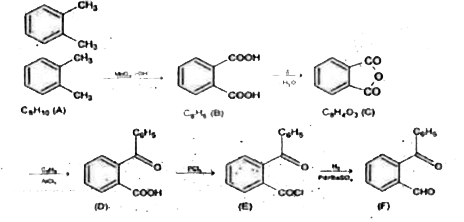
|
|
| 31. |
An organic compound C_7H_9N anwers carbylamine reaction but produces primary alcohol with nitrous acid. The compound may be |
|
Answer» p-toludine |
|
| 32. |
An organic compound C_5H_11X an dehydro-halogenation gives pentene-2 only. What is halide ? |
|
Answer» `CH_3CH_2CHXCH_2CH_3` |
|
| 33. |
An organic compound C_5H_10O forms phenylhydrazone, gives negative iodoform test and undergoes Wolff-Kishner reaction to give isopentane. It is: |
|
Answer» Pentanol |
|
| 34. |
An organic compound (C_(3)H_(9)N) (A), when treated with nitrous acid, gave an alcohol and N_(2) gas was evolved. (A) on warming with CHCI_(3) and caustic potash gave (C) which on reduction gave isopropylmethylamine. Predict the structure of (A) |
|
Answer»
|
|
| 35. |
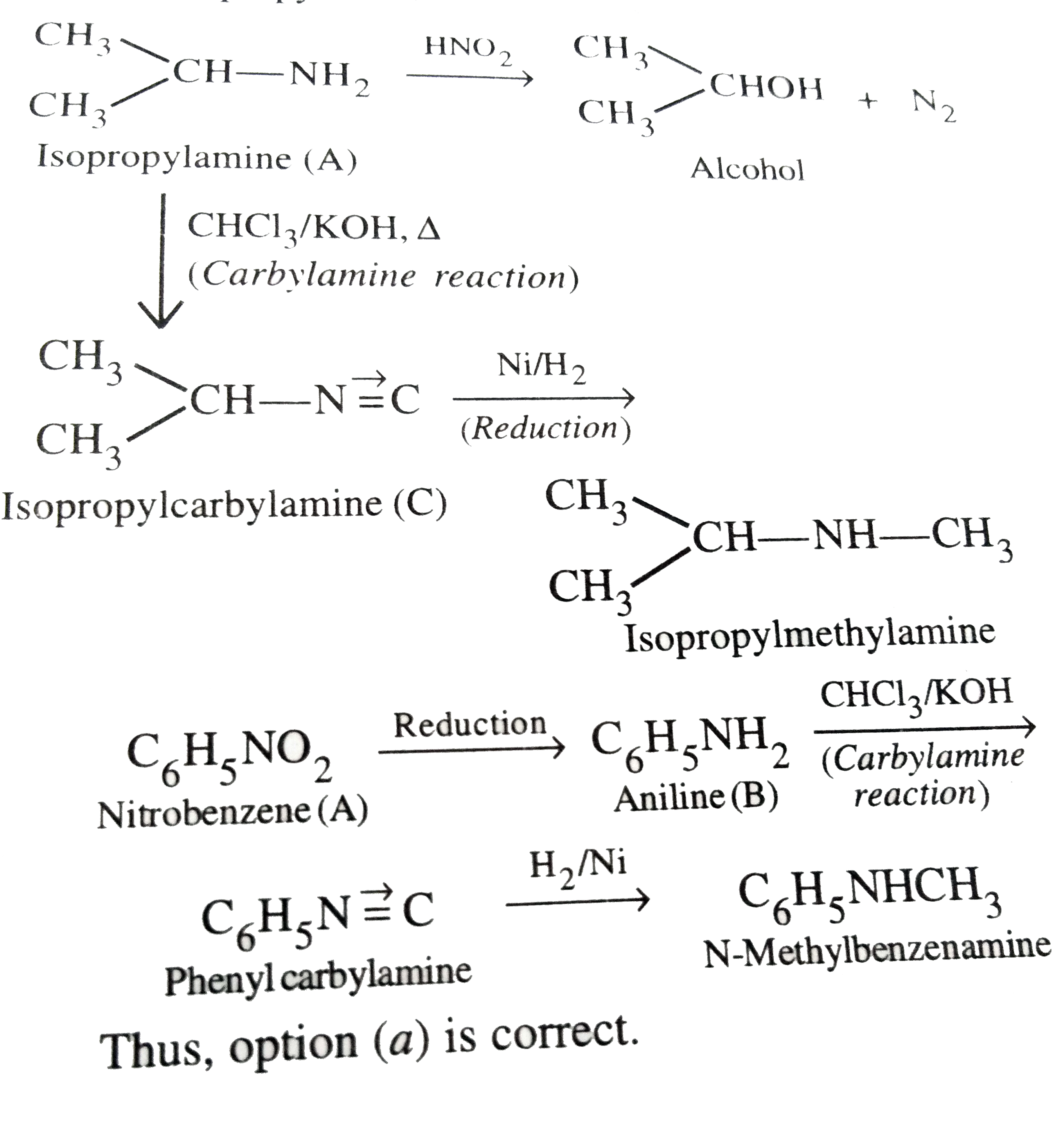
An organic compound (C_(3)H_(9)N)(A) when treated with nitrous acid, gave an alcohol and N_(2) gas was evolved. (A) on warming with CHCl_(3) and caustic potash gave (C) which on reduction gave isopropylmethylamine. Predict the structure of (A). |
|
Answer»
|
|
| 36. |
An organic compound (C_(3)H_(9)N) (A) when treated with nitrous acid, gave an alcohol and N_(2) gas was evolved (A) on warming with CHCl_(3) and caustic potash gave (C) which onreduction gave isopropyl methylamine. Predict the structure of (A) |
|
Answer»
 
|
|
| 37. |
An organic compound C_3H_6O does not give a precipitate with 2,4-dinitrophenyl hydrazine reagent and does not react with sodium metal. It could be : |
|
Answer» `CH_3-CH_2-CHO` |
|
| 38. |
An organic compound, C_(2)H_(4)O gives a red precipitate when warmed with Fehling’s solution. It also undergoes aldol condensation in presence of alkali. (i) Write IUPAC name of the compound. (ii) What is the hybridization of carbon atoms in the compound ? (iii) Write equation for the reaction. |
|
Answer» SOLUTION :(i) Ethanal (ii) `sp^(2)` (III) `CH_(3)CHO+2Cu^(2+)+3OH^(-)toCH_(3)COO^(-)+2Cu^(+)+2H_(2)O` `CH_(3)CHO+CH_(3)CHOoverset(NAOH)tounderset("Aldol")(H_(3)C-underset(OH)underset(|)overset(H)overset(|)(C)-CH_(2)-CHO)` |
|
| 39. |
An organic compound answers Molisch's test as well as Benedict's test but it does not answer Seliwanoff's test. Most probably, it is |
|
Answer» sucrose |
|
| 40. |
An organic compound answers Molisch's test as well as Benedict's test. But it does not answer Seliwanoff's test. Most probably, it is |
|
Answer» sucrose |
|
| 41. |
An organic compound answers Molisch's test as well as Benedict's test. But it does not answer Scliwanoff's test. Most probably, it is |
|
Answer» Sucrose |
|
| 42. |
An organic compound (A),C_(8)H_(4)O_(3) in dry benzene in the presence of anhydrous AlCl_(3) gives ,compound (B). The compound (B) on treatement with PCl_(5) followed by reaction with H_(2)//Pd-BaSO_(4) gives compound C, which on reaction with hydrazine gives a cyclised compound (D) of formula C_(14)H_(10)N_(2). Identify (A),(B),(C ) and (D). Explain the formation of (D) and (C ). |
Answer» SOLUTION :
|
|
| 43. |
An organic compound A(C_(6)H_(10)) on reduction first gives B(C_(6)H_(12)) and finally C(C_(6)H_(14)). Compound A on ozonolysis followed by hydrolysis gives two aldehydes D(C_(2)H_(4)O) and E(C_(2)H_(2)O_(2)). Oxidation of B with acidified KMnO_(4) gives the acid F(C_(4)H_(8)O_(2)). determine the structures of the compounds A to F with reasoning. |
Answer» SOLUTION :
|
|
| 44. |
An organic compound A(C_(4)H_(9)Cl) on the reaction with Na/diethly ether gives a hydrocarbon which on monochlorination gives only one chloro derivative then, A is |
|
Answer» t-BUTYL CHLORIDE |
|
| 45. |
An organic compound A,C_(5)H_(8)O reacts with H_(2)O, NH_(3) and CH_(3)COOH as described below A is |
|
Answer» `CH_(3)-CH-underset(CH_(3))underset(|)(C)-CHO` |
|
| 46. |
An organic compound A(C_4 H_7 C_(13)) yields (B) when treated with aq. KOH. (B) upon treatment with C_2 H_5 OH in presence of acid gave (C) which upon reducing with LiAIH_4 gave (D) and (E). (B) upon treatment with NH_3 followed by heating with P_4 O_(10) and subsequent hydrolysis gives back (B). Sodium salt of (B) on Kolbe's electrolysis gave 2, 3-dimethylbutane at anode. The dehydration of compound (D) gives |
|
Answer» 2-methyl 1-butane |
|
| 47. |
An organic compound A(C_(4)H_(9)Cl) on reaction with Na/diethyl ether gives a hydrocarbon, which one monochlorination gives only one chloro derivative. A is |
|
Answer» t-butyl chloride 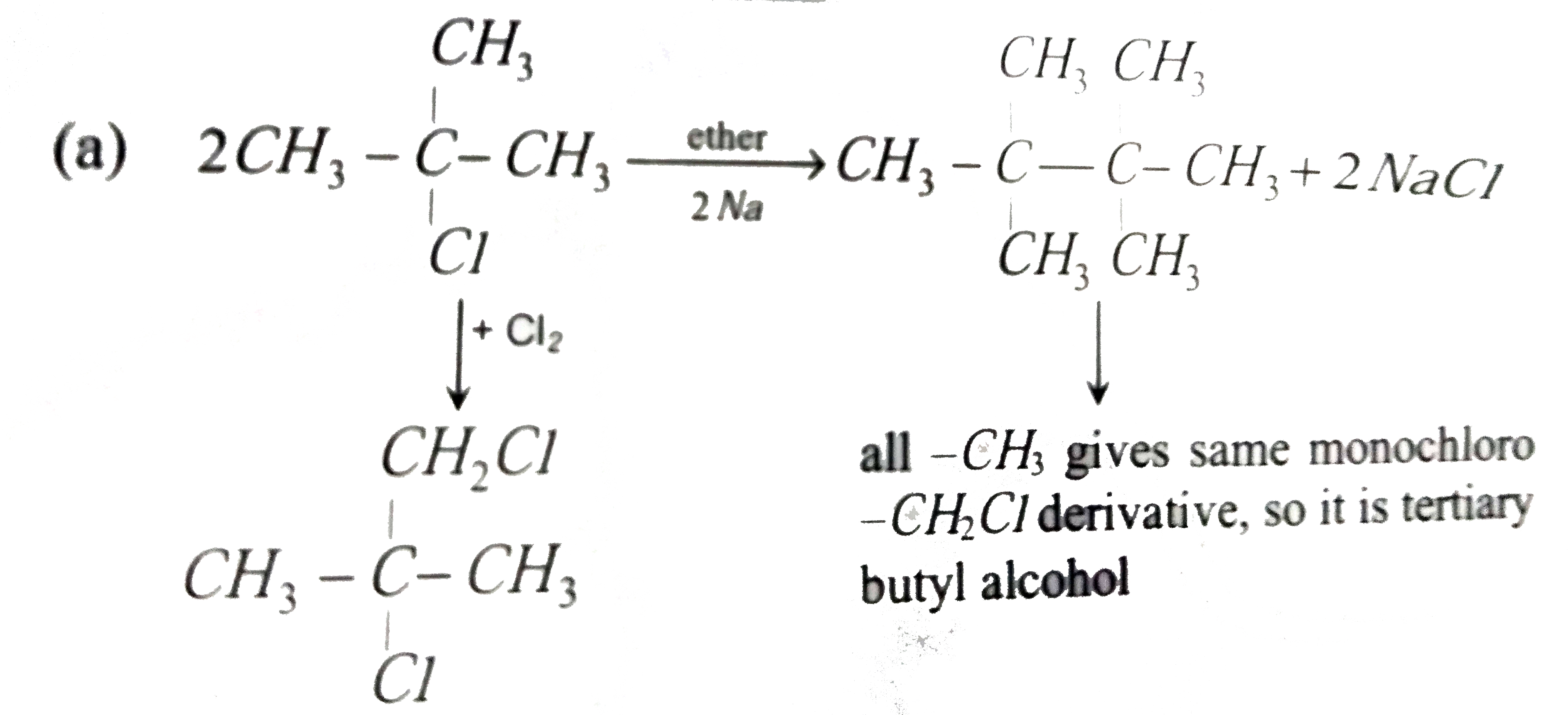
|
|
| 48. |
An organic compound A(C_4 H_7 C_(13)) yields (B) when treated with aq. KOH. (B) upon treatment with C_2 H_5 OH in presence of acid gave (C) which upon reducing with LiAIH_4 gave (D) and (E). (B) upon treatment with NH_3 followed by heating with P_4 O_(10) and subsequent hydrolysis gives back (B). Sodium salt of (B) on Kolbe's electrolysis gave 2, 3-dimethylbutane at anode. Compound (D) and (E) respectively are |
|
Answer» `CH_3 CH_2 CH_2 OH, C_2 H_5 OH` |
|
| 49. |
An organic compound A(C_(2)H_(6)O) reacts with sodium to form a compound B with the evolution of H_(2) and gives a yellow compound C when treated with iodine and NaOH. When heated with conc. H_(2)SO_(4) at 413 K, it gives a compound D(C_(4)H_(10)O) which on treatment with cone. HI at 873 K gives E. D is also obtained when Bis heated with E. Identify A, B, C, D and E and write equations for the reactions involved. |
Answer» SOLUTION :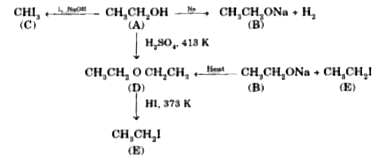
|
|
| 50. |
An organic compound A(C_4 H_7 C_(13)) yields (B) when treated with aq. KOH. (B) upon treatment with C_2 H_5 OH in presence of acid gave (C) which upon reducing with LiAIH_4 gave (D) and (E). (B) upon treatment with NH_3 followed by heating with P_4 O_(10) and subsequent hydrolysis gives back (B). Sodium salt of (B) on Kolbe's electrolysis gave 2, 3-dimethylbutane at anode. Structural formula of compound (C) is |
|
Answer» `CH_3 OVERSET(CH_3)overset(|)CHCOOC_2 H_5` 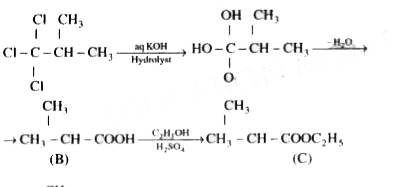
|
|