

Saved Bookmarks
This section includes 7 InterviewSolutions, each offering curated multiple-choice questions to sharpen your Current Affairs knowledge and support exam preparation. Choose a topic below to get started.
| 1. |
An alkane is most likely to react with |
| Answer» Answer :A | |
| 2. |
An alkene is most likely to react with: |
| Answer» Answer :A | |
| 3. |
An alkane has a C/H-ratio (by mass) of 5.1428. Its molecular formula is |
|
Answer» `C_(5)H_(12)` Alkanes have General formula `C_(n)H_(2n+2)` The MASS ratio of `(C)/(H)` is `(12n)/(2n+2)` or `(6n)/(n+1)` `(6n)/(n+1) = 5.1428` `6n = 5.1428n + 5.1428 rarr 0.8572n = 5.1428` `n = (5.1428)/(0.8572) = 6` Molecular formula `= C_(6)H_(2n+2) = C_(6)H_(14)`. |
|
| 4. |
An alkane forms isomers if the number of least carbon atom is |
| Answer» Solution :`UNDERSET("n-butane")(CH_(3)-CH_(2)-CH_(2)-CH_(3))` and `{:(CH_(3)-CH-CH_(3)),("|"),(""underset("Iso-butan")(CH_(3))):}` | |
| 5. |
An alkane forms isomers if the number of carbon atoms is: |
|
Answer» GE 1 |
|
| 6. |
An alkane ,C_(7)H_(16) , is produced by thereaction oflitthium di-(3 -pentyl ) cuprate with ethyl bromide ,. Whatis thestructure of akane ? |
|
Answer» Solution : Thisis a corey-Hpouse SYNTHESIS `[(CH_(3)CH_(2))CH_(2)]CuLi+CH_(3)CH_(2)Brto UNDERSET("3- Ethylpentane")((CH_(3)CH_(3))_(3)CH]` |
|
| 7. |
An alkane C_(6)H_(14) gives onlt twomonochloroalkanes on chlorination. What is the structure of the original alkane ? |
|
Answer» |
|
| 8. |
An alkane, A on ozonolysis gives two products propanal and propanone. Which of the given statements is incorrect for A? |
|
Answer» COMPOUND A is pent-2-ene |
|
| 9. |
An alkane (A), C_5H_15, on chlorination at 300^@C gives a mixture of four different monochloro derivatives (B), (c ) , (D) and (E). Two of these derivatives give the same stable alkene (F) on dehydrohlogeantion. On oxidation with hot alkaline KMnO_4 followed by acidification, (F) gives two products (G) and (H). Give structures of (A) to (H) with proper reasoning. |
Answer» Solution :As ALKANE (A), `C_5H_12`, on chlorination gives four monochloroproduct and THUS (A) is ISOPENTANE. 
|
|
| 10. |
An alkaloidcontains 17.28% of nitrogen and its molecular mass is 162. The number of nitrogen atoms present in on molecule of alkaloid is |
|
Answer» five `:.` No. of nitrogen atoms per molecule `=(162xx17.28)/(100x24)=2`(APPROX.) |
|
| 11. |
An alkaloid contains 17-28% of nitrogen and itsmolecular mass is 162. The number of nitrogen atoms present in one molecule of alkaloid is : |
|
Answer» five ` = (162 XX 17.28)/(100)` no. of N atoms present in 1molecule ` = (162 xx 17.28)/(100 xx 14) = 2 ` APPROX |
|
| 12. |
An alkaline solution of ......... and citrate ions is called .......... |
|
Answer» SILVER nitrate , Fehling's solution |
|
| 13. |
An alkaline metal oxide which is soluble in NaOH has |
|
Answer» `NACL` STRUCTURE |
|
| 14. |
An alkalie is titrated against an acid with methyl orange as indicator, which of the following is a correct combination |
|
Answer» `{:("Base","Acid","End point"),("Strong","Strong","Pinkish red to yellow"):}` At end point pH will be LESS than 7 as strong acid weak base salt have `pH=7-((pK_(b)+logc))/(2)` `therefore`Methyl ORANGE will change colour from yellow to pinkish red at the end point. |
|
| 15. |
An alkali salt of palmitic acid is known as : |
|
Answer» An alkoxide |
|
| 16. |
An alkali metal hydride (NaH) reacts with diborane in .A. to give a tetrahedralcompound .B. which is extensively used as reducing agent in organic synthesis. The compounds. The compound .A. and .B. respectively are |
|
Answer» `(C_2H_5)_2O and NaBH_4` Sodium Bromohydride .B.. |
|
| 17. |
An alkali metal crystallises in bcc lattice. What is the radius of an atom of the metal ? |
| Answer» SOLUTION :`1.86 A^(@)` | |
| 18. |
An alkali is titrated against an acid with methyl orange as indicator. Which of the following is a correct combination- |
|
Answer» Base-WEAK, Acid-Strong, End point- Colourless to pink |
|
| 19. |
An aliphatic nitrocompoundturnred withthe addition of conc. NaOH , followedby additionof excess HNO_(2). Thecolour disapperwith theadditionof excessacidbutreapear if thesolutionis made alkaline. The aliphaticnitrocompoundis . |
|
Answer» `CH_(3) -CH_(2) - NO_(2)` |
|
| 20. |
An aliphaticprimaryaminereactswith HNO_(2)in coldto form |
|
Answer» a nitrile |
|
| 21. |
An aliphatic hydroxy acid is : |
|
Answer» Malonic acid |
|
| 22. |
An aliphatic amine (X) contains C (61.01%), H (15.25%) and N (23.74%). (X), on treatment with HNO_(2), gave an alcohol (Y) having C(60%) and H(13.33%). (Y), on careful oxidation gave (Z) of vapour density 29. (Z) gave iodoform test. Assign structural formulae to (X), (Y) and (Z). |
Answer» SOLUTION :
|
|
| 23. |
An aliphatic compound (A) with a molecular formula C_3H_6O reacts with phenylhydrazine to give compound (B). Reaction of (A) with I_2 in alkaline solution on warming gives a yellow precipitate (C). Identify the compounds A, B and C. |
|
Answer» Solution :Identification of COMPOUNDS A, B and C is done as under : `underset("Acetone")(CH_(3)-overset(O)overset(||)C-CH_(3) + C_(6)H_(5)NHNH_(2)) to CH_(3) -underset(CH_(3))underset(|)C= N NHC_(6)H_(5) + H_(2)O` `CH_(3) -underset(A)overset(O)overset(||)C -CH_(3) + 3I_(2)+ 4NaOH to underset("Iodoform")(CHI_(3)) + CH_(3)COONa + 3NaI + 3H_(2)O` |
|
| 24. |
An aliphatic amine on treatment with alcoholic carbon disulphide and mercuric chloride forms ethyl isothiocyanate, the reaction is known as |
|
Answer» HOFFMANN's Reaction |
|
| 25. |
An aldose is converted into its next higher homologue by : |
|
Answer» Ruff.s METHOD |
|
| 26. |
An aldehyde which undergoes Cannizzaro's reaction and reduces Schiff's reagent but does not reduce Fehling's solution is : |
|
Answer» CH_3CHO |
|
| 27. |
An aldohexose (e.g., glucose) and 2 - oxohexose (e.g., fructose) can be distinguished with the help of |
|
Answer» TOLLEN's reagent<BR>Fehling's SOLUTION |
|
| 28. |
An aldehyde reacts with KCN to form cyanohydrin. In this reaction |
|
Answer» `CN^-` ACTS as NUCLEOPHILE and does nucleophilic ADDITION |
|
| 29. |
An aldehyde on treatment with Zn/HCl yields: |
| Answer» Answer :A | |
| 30. |
An aldehyde on treatment with Zn/HCl yields |
|
Answer» `2^@ ` alcohol |
|
| 33. |
An aldehyde is obtained when an alcohol is : |
|
Answer» Oxidised |
|
| 34. |
An aldehyde can undergo the aldol condensationhaving |
|
Answer» an AROMATIC ring |
|
| 35. |
An aldehyde group can be present |
|
Answer» in between carbon chain |
|
| 36. |
An aldehyde can be distinguished from a ketone by the use of the reagent: |
|
Answer» GRIGNARD's reagent |
|
| 37. |
An alcoholic solution of dimethylglyoxime is added to an aqueous solution of nickel(II) chloride.Slow addition of ammonium hydroxide led to the precipitation of a bright-red coloured metal complex. Find out the number of hydrogen bonds present in the structure of the complex. |
Answer» 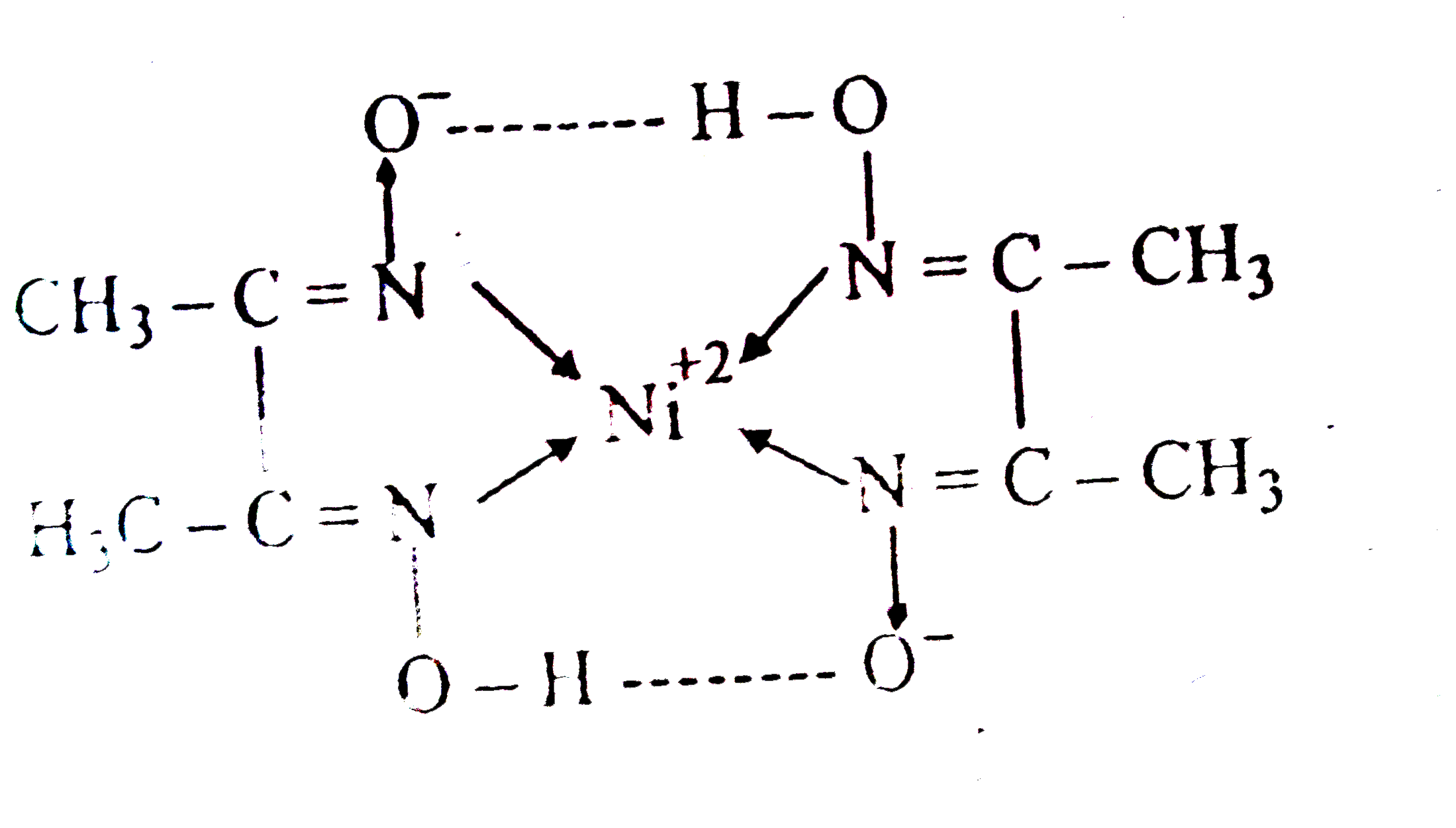
|
|
| 38. |
An alcoholic solution of dimethylglyoxime is added to an aqueous solution of nickel(II) chloride.Slow addition of ammoniam hydroxide led to the precipitation of a bright red colured metal complex. Find out the number of hydrogen bonds present in the structure of the complex. |
Answer» 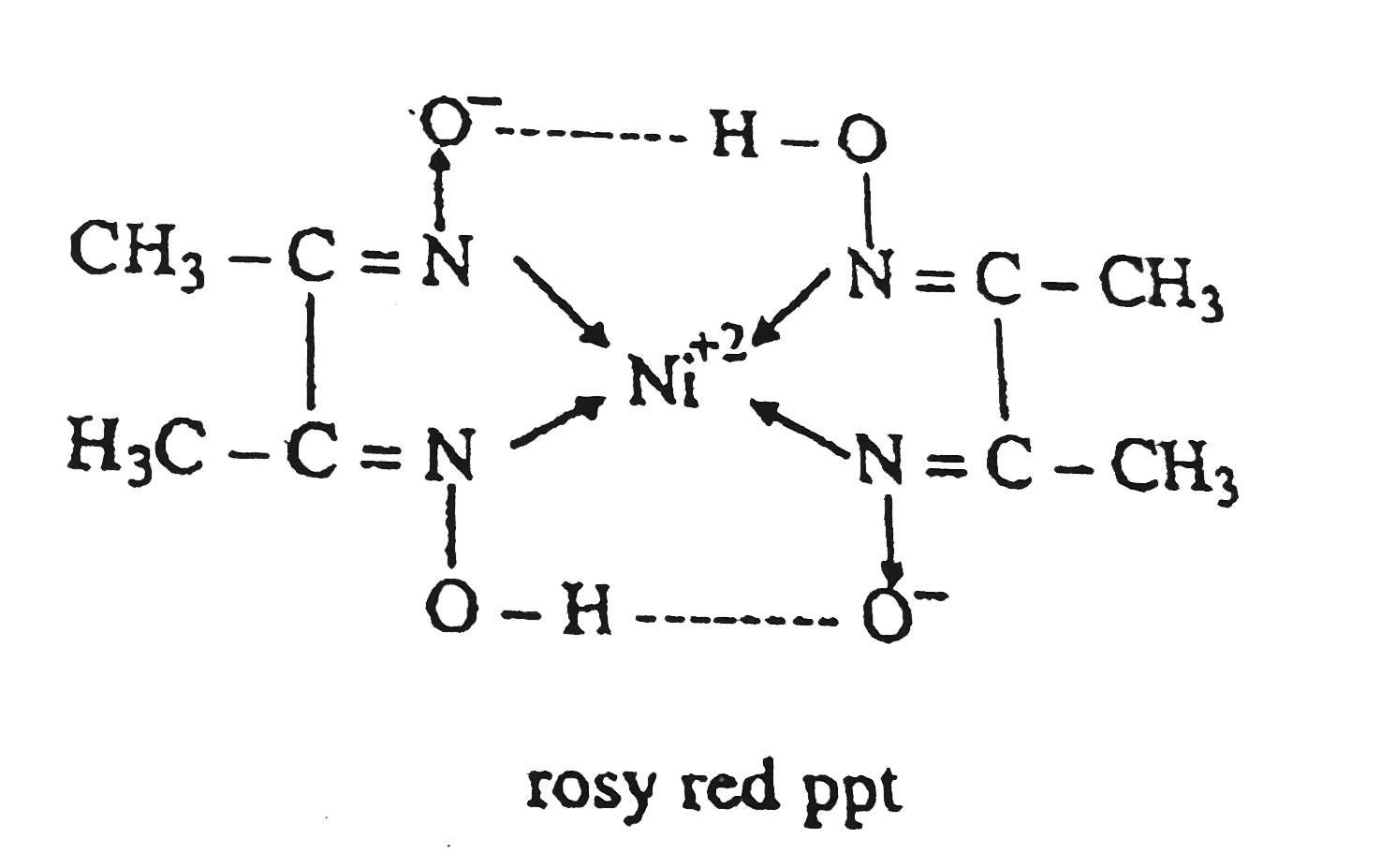
|
|
| 39. |
An alcohol X on heating with concentrated H_(2)SO_(4) gives an alkene Y which can show geometrical isomerism . The alcohol X is |
|
Answer» `CH_(3)CH_(2)CH(OH)CH_(3)` |
|
| 40. |
An alcohol (x) gives blue colorin Victormayer's test and 3.7g of X when treated with metallic sodium liberates 560 mL of hydrogen at 273 K and 1 atm pressure what will be the possible structure of X? |
|
Answer» `CH_(3)CH(OH)CH_(2)CH_(3)` `therefore` number of moles of alcohol = `(2"moles of "R-OH)/(22.4L" of "H_(2))xx560mL=0.05`moles `therefore` number of moles = `"mass"/("molar mass")RARR"molar mass"=3.7/0.05=74gmol^(-1)` General formula for `R-OHC_(n)H_(2n+1)-OH` `thereforen(12)+(2n+1)(1)+16+1=74` 14n = 74 - 18 14n = 56 `thereforen=56/4=4` The `2^(@)` alcohol which contains 4 carbon is `CH_(3)CH(OH)CH_(2)CH_(3)` |
|
| 41. |
An alcohol (x) gives blue colour in victormayer's test and 3.7 g of X when treated with metallic sodium liberates 500 mLof hydrogen at 273 K and 1 atm pressure what will be the possible structure of X ? |
|
Answer» `CH_3CH(OH) CH_2CH_3` 22.4 L at 273 K and 1 ATM `:.` number of moles of alcohol `=(2"mole of R - OH")/(22.4L " of "H_2)xx560 mL = 0.05"moles"` `:.` number of moles `=("mass")/("molar mass")rArr "molar mass " = 3.7/0.05 = 74 g MOL^(-1)` GENERAL formual for `R - OH C_n H_(2n+1)-OH` `:.n (12) + (2n + 1) (1)+ 16 + 1= 74` `14n= 74 - 18` `14 n = 56` ` :. n = 56/4 = 4` The `2^@` alcohol which contains is `CH_2 CH(OH) CH_2 CH_3` |
|
| 42. |
An alcoholic drink substance pH = 4.7 then OH ion concentration of this solution is (K_(w) = 10^(-14) mol^(2)//l^(2)) |
|
Answer» `3 XX 10^(-10)` pH + pOH = 14, pH = 14- 4.7 , pOH = 9.3 `[OH^(-)] = "ANTILOG" [-9.3] [OH^(-)] = 5 xx 10^(-10)`. |
|
| 43. |
An alcohol produced during the manufacture of snop is : |
|
Answer» Butanol |
|
| 44. |
An alcohol on oxidation is found to give CH_(3)COOH and CH_(3)CH(OH)CH_(2)CH_(2)CH_(3) The structure of the alcohol is : |
|
Answer» `CH_(3)CH_(2)CH_(2)OH` |
|
| 45. |
An alcohol on oxidation is found to give CH_(3)COOH and CH_(3)CH_(2)COOH. The structure to the alcohol is |
|
Answer» `CH_(3)CH_(2)CH_(2)OH` |
|
| 46. |
An alcohol on oxidation is found to give CH_3COOH and CH_3CH_2COOH.The alcohol is : |
|
Answer» `CH_3,CH_2CH_2OH` |
|
| 47. |
An alcohol on alk. KMnO_4 oxidation gives first acetone and on further oxidation acetic acid. It is : |
|
Answer» ETHYL alcohol |
|
| 48. |
An alcohol of molecular formula C_(5)H_(11)OH on dehydration gives an alkene, which on oxidation yields a mixture of ketone and an acid. The alcohol is |
|
Answer» `CH_(3)CH_(2)(OH)CH_(2)CH_(3)` |
|
| 49. |
An alcohol is not oxidised in alkaline or netural solution but in acidic solution it is turned first to acetone and then to acetic acid . It is a : |
|
Answer» PRIMARY alcohol |
|
| 50. |
An alcohol C_4H_9OH on dehydration gives an alkene, which on oxidation yield a acetone. The alcohol is |
|
Answer» `(CH_3)_3COH` `(CH_3)_2C=CH_2+4[O] UNDERSET(+dil. H_2SO_4)OVERSET(K_2Cr_2O_7)to CH_3COCH_3 + CO_2 + H_2O` |
|