Saved Bookmarks
This section includes 7 InterviewSolutions, each offering curated multiple-choice questions to sharpen your Current Affairs knowledge and support exam preparation. Choose a topic below to get started.
| 1. |
An alcohol (A) on treatment with conc. H_(2)SO_4 gave an alkene (B). The compound (B), on reacting with Br_(2) wate and subsequent dehydrobromination with NaNH_(2) produced a compound (C). The compound (C) with dil. H_(2)SO_(4) in presence of HgSO_(4) gave a compound 'D'. the compound D can also be obtained by oxidation of A by acidified KMnO_(4) or from distillation of calcium acetate. calculate molecular weight of 'C'. |
|
Answer» |
|
| 2. |
An alcohol (A) on dehydration gives (B) which on ozonolysis gives two products C & D (D) gives positive iodoform test and on heating with dilute alkali gives alpha . beta -unsaturated carbonyl compound (E) which does not gives positive iodoform test. (C) on oxidation gives a mono basic acid (F) Agsalt of (F) contains 59.6% Ag. Oxime of (D) contains 16.09% nitrogen. the structureof (E )is givenreaction is |
|
Answer» `(CH_3)_2CC HCOCH_2 CH_3` 
|
|
| 3. |
An alcohol (A) on dehydration gives (B) which on ozonolysis gives two products C & D (D) gives positive iodoform test and on heating with dilute alkali gives alpha . beta -unsaturated carbonyl compound (E) which does not gives positive iodoform test. (C) on oxidation gives a mono basic acid (F) Agsalt of (F) contains 59.6% Ag. Oxime of (D) contains 16.09% nitrogen. structureof Dis |
|
Answer» `CH_3CH_2COCH_3` 
|
|
| 4. |
An alcohol (A) on dehydration gives (B) which on ozonolysis gives two products C & D (D) gives positive iodoform test and on heating with dilute alkali gives alpha . beta -unsaturated carbonyl compound (E) which does not gives positive iodoform test. (C) on oxidation gives a mono basic acid (F) Agsalt of (F) contains 59.6% Ag. Oxime of (D) contains 16.09% nitrogen. the structureof (A)is |
|
Answer» `CH_3(CH_2)_2 C(CH_3)(OH)CH_2 CH_3` 
|
|
| 5. |
An alcohol (A ) on dehydration gives (B) which adds bromine molecule to give (C ), (C ) on heating with sodamide gives (D) which on hydration in the presence of Hg^(++)//H_(2)SO_(4) gives (E ). E on reduction by lithium aluminium hydride gives (A). (E ) is also obtained on dry distillation of calcium salt of acetic acid. How many enolisable proton present in the product (E) ? |
|
Answer» 2 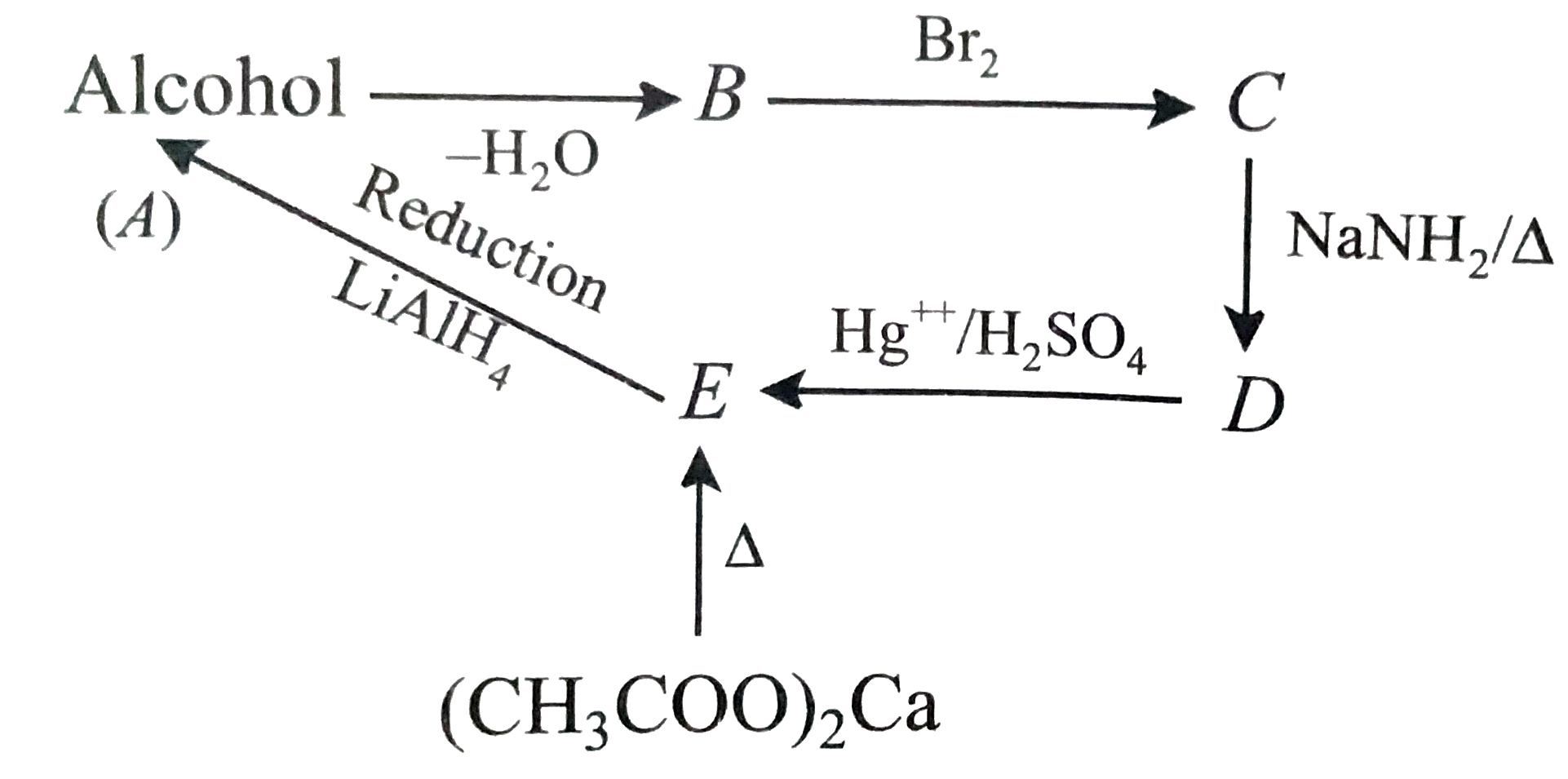 By GIVEN HINT, it is clear that E is ACETONE HENCE overall sequences of reactions will be 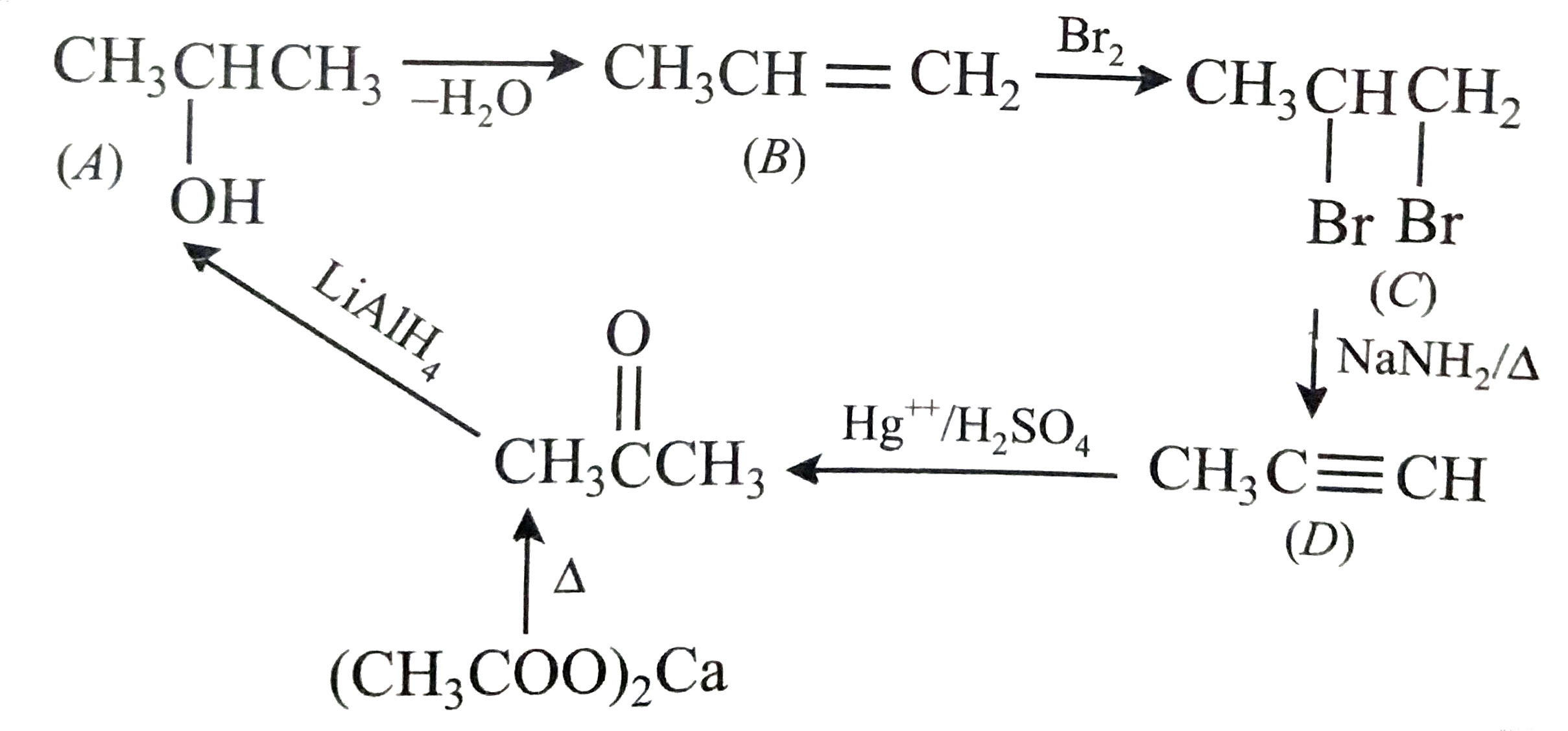
|
|
| 6. |
An alcohol (A) gives Lucas test within 5 min. 7.4 g of alcohol when treated with sodium metal liberates 1120 mL of H_2 at STP. What will be alcohol (A)? |
|
Answer» `CH_(CH_2)_3OH` We have to get molecular mass of alcohol corresponding to half mole of `H_(2)` only. No .of moles of `H_(2)` =No.of moles of alcohol `1120/11200=7.4/(MM) rArr MM=74` `C_(n)H_(2N+1) OH=rarr C_(n)H_(2n+1)=74-17=57` `rArr C_(n)H_(2n)=57-1=56``i.e.12n+2n=14n=56` `rArr n=56//14=14` Thus molecular formula of (A) is `C_(4)H_(9)OH`. As (A) gives Lucas test within 5 min, thus `2^@`alcohol corresponding to molecular formula `C_(4)H_(9)OH` is `CH_(3)CH(OH)CH_(2)CH_(3)` (butan -2-ol). |
|
| 7. |
An air bubble formed under water at temperature 17^oC and the pressure 1.8 atm started to move upwards and reaches the surface where temperature is 27^oC and pressure in 1 atm. The volume of the bubble at the surface will become |
|
Answer» 2.32 TIMES of the INITIAL volume |
|
| 8. |
An aerosol is a colloidal system of : |
|
Answer» a LIQUID dispersed in a solid |
|
| 9. |
An aeroplane weighing 63,000 kg flies up from sea level to a height of 8000 metre. Its engine run with pure normal octane (C_(8)H_(18)) has a 30% of efficiency. Calculate the fuel cost of the flight, if octane sells at Rs 3/- per litre. Given density of octane = 0.705 g mL^(-1), heat of combustion of octane = 1300 kcal "mol"^(-1) (g = 981 cm/"sec"^(2) ) |
|
Answer» |
|
| 10. |
An adiabatic reversible process is one in which? |
|
Answer» Temperature of the SYSTEM is not CHANGE |
|
| 11. |
An adiabatic process occurs in |
|
Answer» OPEN system |
|
| 12. |
An adiabatic process is one in which: |
|
Answer» The system is not closed to ENERGY transfer |
|
| 13. |
An adiabatic process is one in which : |
|
Answer» `Delta U = q` |
|
| 14. |
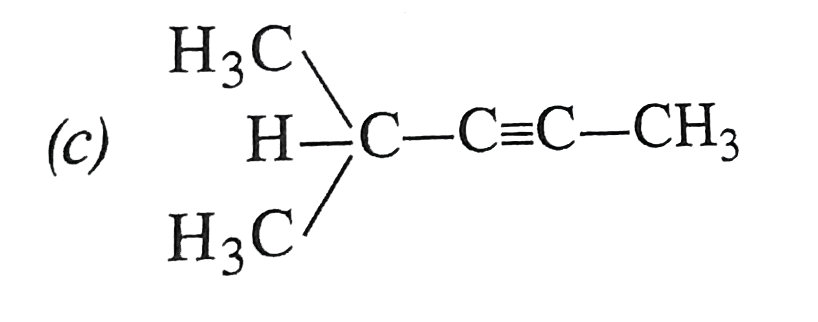
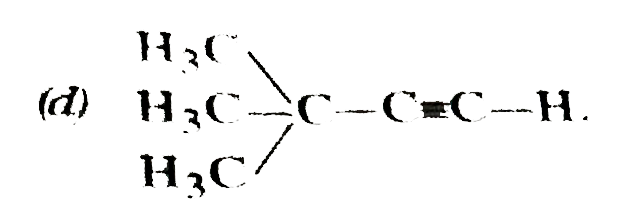
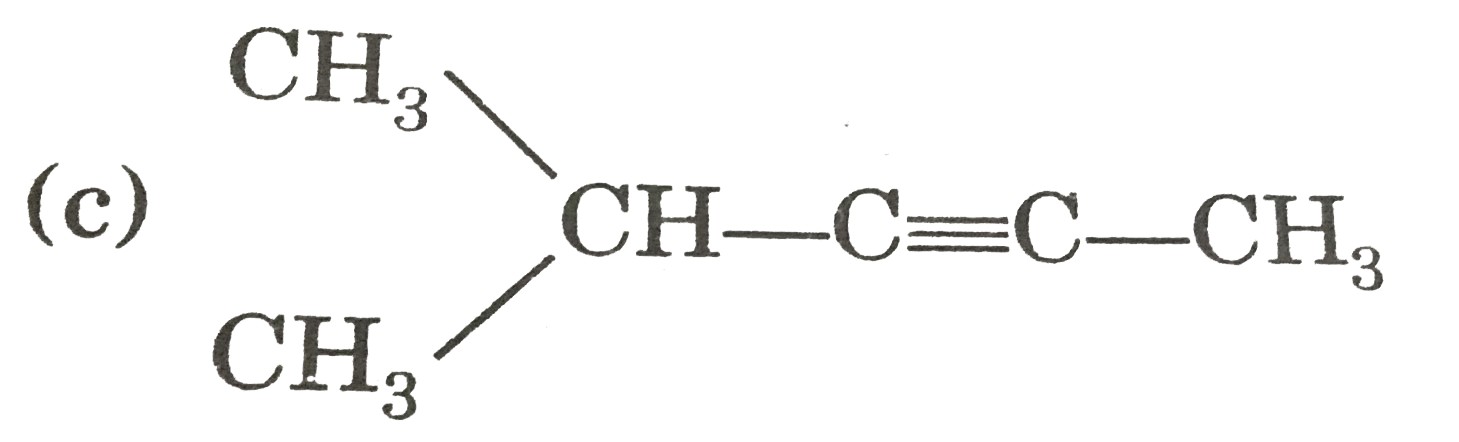
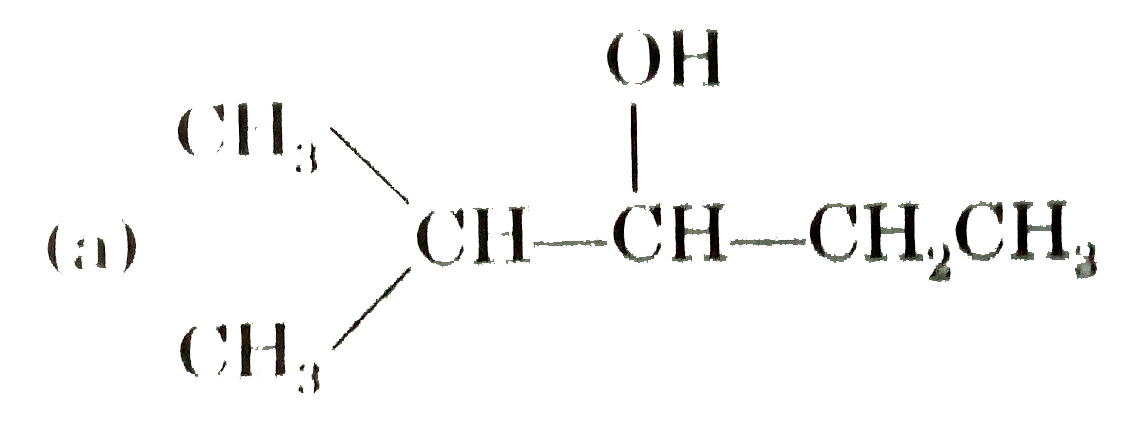
An acylic hydrocarbon P, having molecular formula C_(6)H_(10), gives acetone as the only organic product through the following sequnence of reactions in which Q is an intermediate organic compound The structure of compound P is |
|
Answer» <P>`CH_(3)CH_(2)CH_(2)CH_(2)-C=C-H` |
|
| 15. |
An acylic hydrocarbon P, having molecular formula C_(6)H_(10), gives acetone as the only organic product through the following sequnence of reactions in which Q is an intermediate organic compound The structure of the compound Q is |
|
Answer»
EXPLANATION. The product ot ozonlysis gives the following structre for the ALKENE. 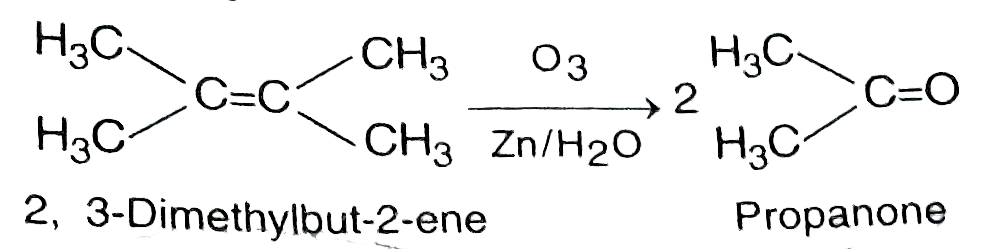 The alkene has been formed the secondary alcohol (Q) by the acid catalysed dehydration. The alcohol (Q) has the structure. 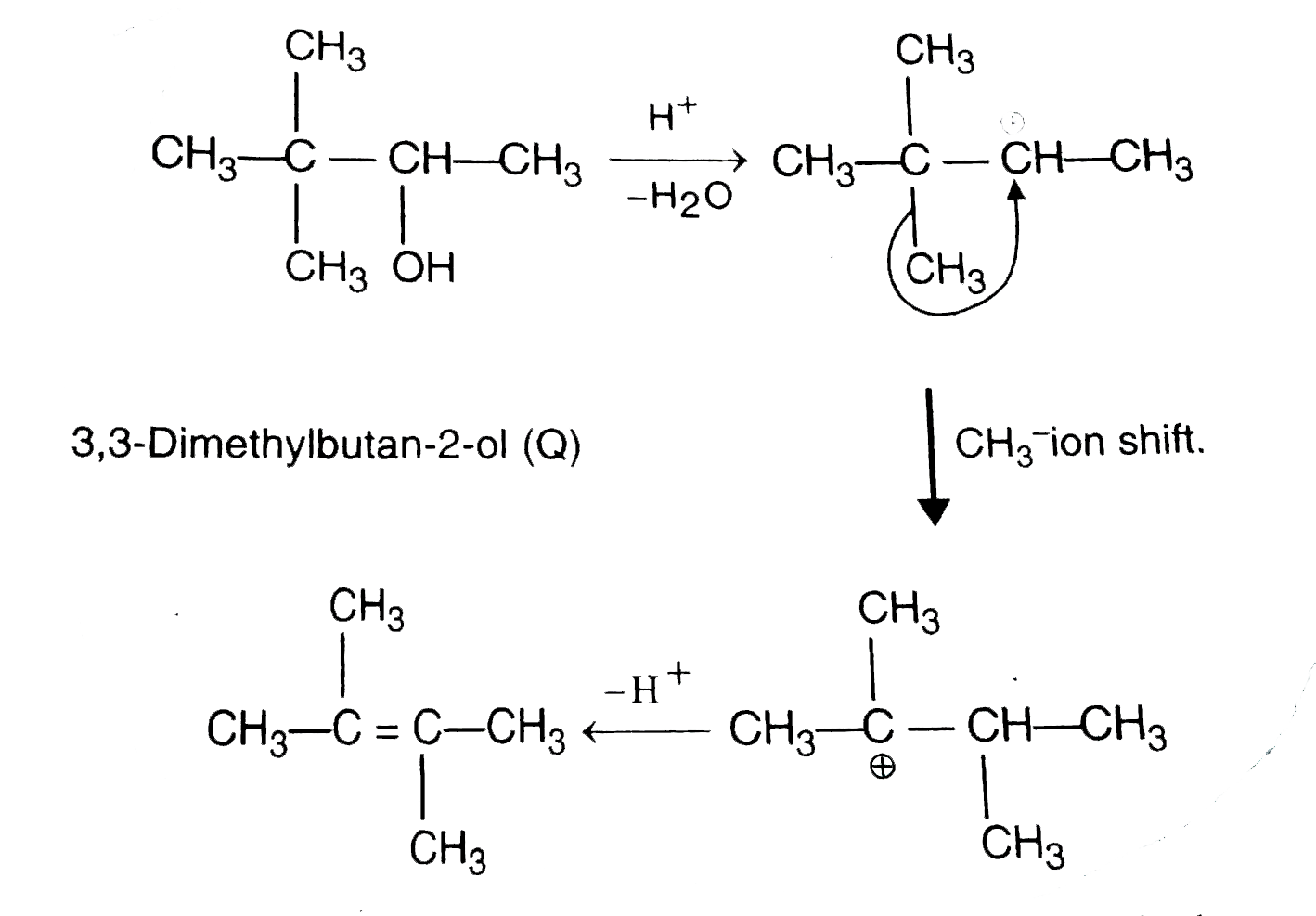 Since the compound (Q) has been formed the unsatured hydrocarbnon `(C_(6)H_(10)`( by oxymercurtion DEMERCURATION. This shows that the compound (P) is an alkyne. It gives compound (Q) as FOLLOWS : 
|
|
| 16. |
An addition reaction over alkene causes |
|
Answer» Increase of unsaturation NUMBER in product W.r.t. reactant |
|
| 17. |
An acyl halide is formed when PCl_5 reacts with an: |
|
Answer» ACID |
|
| 18. |
An acyclic hydrocarbon P,having molecular formula C_(6)H_(10)' gave acetone as the only organic product through thefollowing sequenceof reactions, in which Q is an intermediate organic compound The structure of the compound P is : |
|
Answer» `CH_(3)CH_(2)CH_(2)CH_(2)-C-=CH` |
|
| 19. |
An acyl halide is formed when PCl_(5) reacts with |
|
Answer» Solution :Acid halides are formed when `PCl_(5)` REACTS with carboxylic acids. e.g., `CH_(3)COOH+PCl_(5)to CH_(3)COCl+POCl_(3)+HCl` |
|
| 20. |
An acyclic hydrocarbon P,having molecular formula C_(6)H_(10)' gave acetone as the only organic product through thefollowing sequenceof reactions, in which Q is an intermediate organic compound The structure of the compound Q is : |
| Answer» Solution :N//A | |
| 21. |
An activating group |
|
Answer» <P>ACTIVATES only o- and p- positions |
|
| 22. |
An acidified solution of which of the following is changed to orange red by adding H_2O_2 |
|
Answer» `BaO_2` |
|
| 23. |
An acidified solution of potassium permanganate oxidizes |
|
Answer» sulphates |
|
| 25. |
An acidified solution of KMnO_4 oxidises : |
|
Answer» SULPHATES |
|
| 26. |
An acidic solution of 'X' does not give percipitate on passing H_(2)S throught it. 'X' gives white precipitate when NH_(4)OH is added to it. The white precipitate dissolves in excess of NaOH soluion. Pure 'X' fumes in air and dense white fumes are obtained when a glass rod dipped in NH_(4)OH is put in the fumes. Compound 'X' can be : |
|
Answer» `SnCl_(2)` |
|
| 27. |
An acidic solution of Cu^(2+) salt containing 0.4 g of Cu^(2+) is electrolysed until all the copper is deposited. The electrolysis is continued for seven more minutes with the volume of the solution kept at 100 mL and the current at 1.2 amp. Calculate the volume of gases evolved at NTP during the entire electrolysis. |
|
Answer» Solution :Let us suppose that the acidic solution of `Cu^(2+)` salt contains `H_(2)SO_(4)`. In the beginning of electrolysis, Cu will be deposited at the cathode and `O_(2)` will DISCHARGED at ANODE. `Cu^(2+) + 2e rarr Cu` (at cathode) `{:(2OH^(-) rarr 2OH + 2e),(2OH rarr H_(2)O + (1)/(2)O_(2)):}}` (at anode) `therefore` equivalent of oxygen evolved = eq. of Cu deposited `= (0.4)/(31.8)` `therefore` volume of `O_(2)` (at NTP) evolved`= (0.4)/(31.8) xx 5600 = 70.44 mL`. (1 eq. of oxygen at NTP = 5600 mL) During another even minutes (420 s) of electrolysis, `H_(2)` and `O_(2)` will evolve at cathode and anode RESPECTIVELY. Now, CHARGE `= 1.2 xx 420 = 504` COULOMBS `= (504)/(96500)F`. `therefore` eq. of `H_(2)` evolved `= (504)/(96500)`. (at cathode) Volume of `H_(2)` evolved at NTP `= (504)/(96500) xx 11200 = 58.49 mL`. (1 eq. of `H_(2)` at NTP = 1200 mL) Eq. of `O_(2)` evolved `= (504)/(96500)` (at anode) `therefore` volume of `O_(2)` evolved at NTP `= (504)/(96500) xx 5600 = 29.24 mL`. Thus, during the entire electrolysis, `H_(2)` evolved = 58.49 mL `O_(2)` evolved = (70.44 + 29.24) mL = 99.68 mL. |
|
| 28. |
An acidic solution of Cu^(2+) salt containing 0.4 g of Cu^(2+) is electrolysed until all the copper is deposited. The electrolysis is continued for seven more minutes with the volume of solution kept at 100 ml and the current at 1.2 amp. Calculate the volume of gases evolved at NTP during the entire electrolysis. |
|
Answer» `O_2 = 99.79 ml, H_2 = 48.45 ml` `V_(O_2)(1) = 2 xx (0.0504)/(2) xx 22.4 = 35.27 ml = 70.55 ml` But ` aq. CuSO_4 ("prolonged")/("ELECTROLYSIS") H_2 + (1)/(2) O_2 = 70.55 mm` ` 2 xx 96500 "coul" to 22.4 ltrs " of " H_2 & 11.2 ltrs " or "O_2 , (1.2 xx 7 xx 60) " coul" to V_(H_2) =? & V_(O_2(2)) =?` ` V_(H_2) = (1.2 xx 7 xx 60 xx 22.4)/( 2 xx 96500) = 58.495 ml " of" H_2 , V_(O_2(2)) = (1.2 xx 7 xx 60 xx 11.2)/(2 xx 96500) = 29.248 ml` ` V_(O_2(1)) iff 70.55 ml , V_(O_2)(1) + (2) = 99.799 ml HO_2 , V_(H_2) = 58.5ml , V_(O_2) = 99.8 ml " of " O_2` |
|
| 29. |
An acidic hydride of nitrogen is: |
|
Answer» `NH_3` |
|
| 30. |
An acidic compound (A) C_(4)H_(8)O_(3) loses its optically activity on strong heating yielding (B), C_(4)H_(6)O_(2) which reacts readily with KMnO_(4). (B) forms a derivative (C ) with SOCl_(2), which on reaction with (CH_(3))_(2)NH gives (D). The compound (A) on oxidation with dilute chromic acid gives an unstable compound (E) hich decarboxylates readily to give (F), C_(3)H_(6)O. The compound (F) gives a hydrocarbon (G) on treatment with amalgamated Zn and HCl. Give the structures of (A) to (G) with proper reasoning. |
|
Answer» Solution :Compound (A) is a HYDROXY compound and is optically ACTIVE `CH_(3)-underset(OH)underset(|)overset(H)overset(|)C-CH_(2)COOH` On heating it gives an UNSATURATED compound which reacts with `KMnO_(4)` 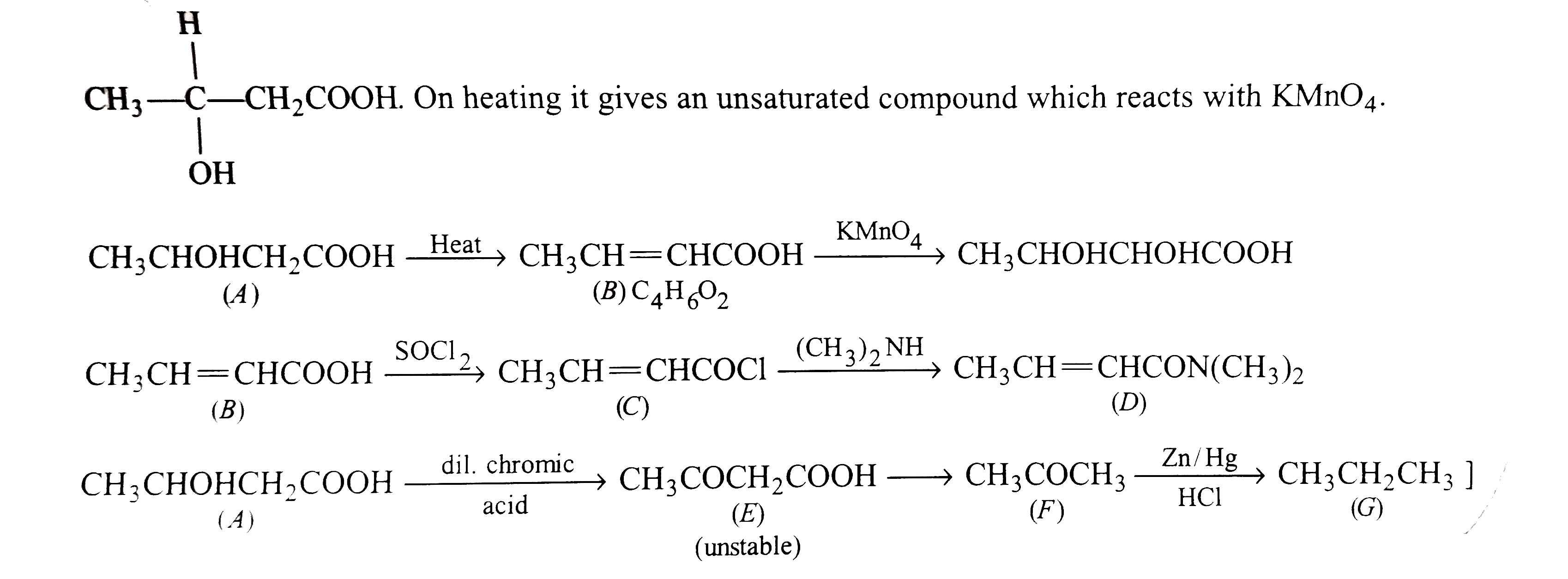
|
|
| 31. |
An acidic buffer's solution is made up of: |
|
Answer» a STRONG acid + its salt of WEAK base (May be form `CH_(3)COONa` or form `CH_(3)COONH_(4)`) |
|
| 32. |
An acidic buffer solution can be prepared by mixing the solutions of |
|
Answer» Sodium CHLORIDE and sodium hydroxide |
|
| 33. |
An acidic buffer solution can be prepared by mixing solution : |
|
Answer» `CH_(3)COOH`and `CH_(3)COONa` |
|
| 34. |
An acidic buffer can be prepared by makingsolution of : |
|
Answer» HCL and NaCl |
|
| 35. |
An acidic amino acid among the following is |
|
Answer» glycine |
|
| 36. |
An acidtypeindicator , Hindiffers in colourfrom itsconjugatebase(In^(-)). Thehumaneyeis sensitiveto colourdifferenceonly whenthe ratio[In^(-)] /[Hin]is greaterthan10 or smaller than0.1What shouldbe the minimum changein the pHof the solution to observea complete colourchange(K_() = 1.0 xx 10^(-5)) ? |
| Answer» SOLUTION :Changeon PH = 2 | |
| 37. |
An acid type indicator Hin differ in colour from its conjugate base (In^-) The human eye is sensitive to the colour of differences only when the ratio [In^-]/[HIn]isgreater than 10 or smaller than 0.1. What should be the minimum change in the PH of the solution to observe a complete colour change (K_a= 1 xx 10^(-5))? |
|
Answer» 4 |
|
| 38. |
An acid solution of pH 6 is diluted 100 times . The pH of solution . |
|
Answer» INCREASES by 2 |
|
| 39. |
An acid solution of a KReO_4sample containing 26-83 mg of combined rhenium was reduced by passage through a column of granulated zinc. The effluent solution, including the washings from the column, was then titrated with 0.1 N KMnO_4 . 11.45 mL of standard permanganate was required for the reoxidation of all the rhenium to the perrhenate ion, ReO_4^- .Assuming that Re was the only element reduced, what is the oxidation state to which Re was reduced by the zinc column? (Re = 186.2) |
| Answer» SOLUTION :-1 OXD. STATE | |
| 40. |
An acid solution may have the pH |
|
Answer» 1 |
|
| 41. |
An acid reats with an isotopically labelled methanol to produce |
|
Answer» methyl acetate having all the labelled oxygen |
|
| 42. |
An acid of molecular formula, C_(5)H_(10)O_(2) is optically active. What is its structure? |
| Answer» Solution :`CH_(3)CH_(2)-OVERSET(CH_(3))overset(|)(.^(**)C)H-COOH`2-Methylbutanoic acid | |
| 43. |
An acid is a compound which furnishes (Bronsted-Lowery concept) |
|
Answer» An ELECTRON |
|
| 44. |
An acid HA ionises as HA hArr H^(+)+A^(-)The pH of 1.0 M solution is 5. Its dissociation constant would be : |
|
Answer» 5 `[H^(+)]=10^(-5) ""[H^(+)]=SQRT(K_(a)C)` or `K_(a)=([H^(+)]^(2))/(C )=((1xx10^(-5))^(2))/(1.0)=1xx10^(-10)` |
|
| 45. |
An acid-base indicator has a K_(a) of 3.0 xx 10^(-5). The acid form of the indicator is red and the basic form is blue. (a) By how much must the pH change in order to change the indicator from 75% red to 75% blue? |
|
Answer» 0.95 |
|
| 47. |
An acid (A) which is an important constituent of vinegar, on reaction with red P_4 and Br_2 gives a monobromoderivative (B) which on reaction with NH_3 gives a white solid (C). However, ethanal on reaction with a mixture of ammonium chloride and sodium cyanide undergoes strecker synthes is to give a product which on acidic hydrolysis gives another high melting solid (D). The dipolar ion is formed by |
| Answer» Answer :B | |
| 48. |
An acid (A) which is an important constituent of vinegar, on reaction with red P_4 and Br_2 gives a monobromoderivative (B) which on reaction with NH_3 gives a white solid (C). However, ethanal on reaction with a mixture of ammonium chloride and sodium cyanide undergoes strecker synthes is to give a product which on acidic hydrolysis gives another high melting solid (D). The intermediate involves in the conversion of (A) and (B) is |
|
Answer» `H -OVERSET(O)overset(||)C-BR` |
|
| 49. |
An acid (A) which is an important constituent of vinegar, on reaction with red P_4 and Br_2 gives a monobromoderivative (B) which on reaction with NH_3 gives a white solid (C). However, ethanal on reaction with a mixture of ammonium chloride and sodium cyanide undergoes strecker synthes is to give a product which on acidic hydrolysis gives another high melting solid (D). The total number of optical iosmers of (C) and (D) are |
|
Answer» 4 |
|
| 50. |
An acid (A) contains carbon =40.7%, Hydrogen =5.1% and its silver salt contains 65.1% silver. The ethyl ester of (A) has VD of 87. What structure (A) may have ? How would you distinguish between isomers? |
Answer» Solution :(A) may have TWO STRUCTURES, these can be distinguish on the BASIS of heating only. 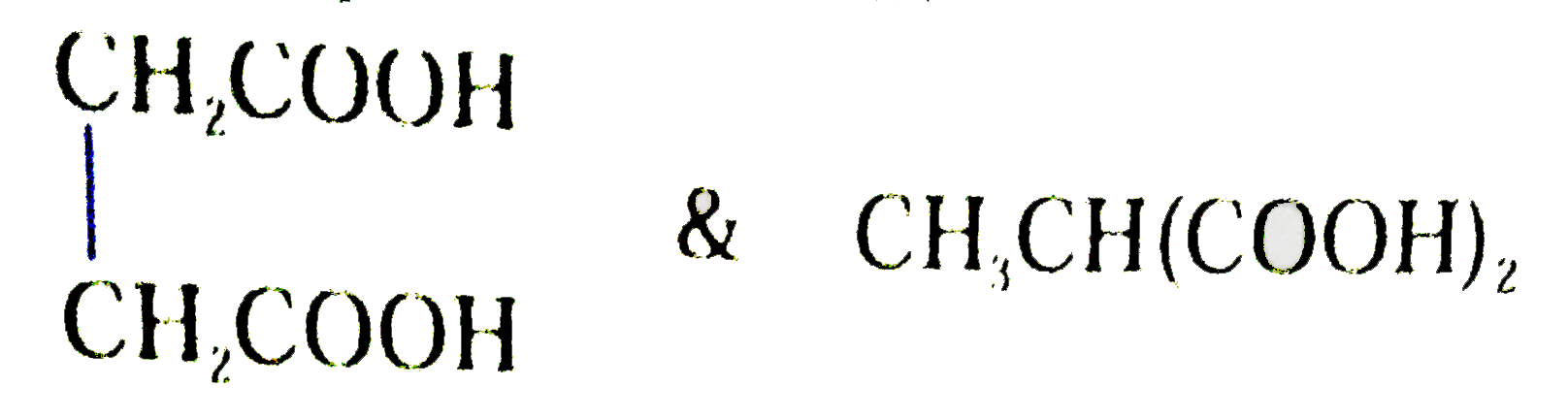
|
|