Saved Bookmarks
This section includes 7 InterviewSolutions, each offering curated multiple-choice questions to sharpen your Current Affairs knowledge and support exam preparation. Choose a topic below to get started.
| 1. |
An acid (A) which is an important constituent of vinegar, on reaction with red P_4 and Br_2 gives a monobromoderivative (B) which on reaction with NH_3 gives a white solid (C). However, ethanal on reaction with a mixture of ammonium chloride and sodium cyanide undergoes strecker synthes is to give a product which on acidic hydrolysis gives another high melting solid (D).The structure of the compound (D) is |
|
Answer» `CH_3 (OH)CHCOOH` |
|
| 2. |
Amylose is a polymer of: |
|
Answer» `ALPHA`-D glucopyranose |
|
| 3. |
Orlon is a polymer of |
|
Answer» `ALPHA`-D glucopyranose |
|
| 4. |
Amyloseis a polymerof |
|
Answer» `ALPHA` - D - GLUCOSE |
|
| 5. |
Amylose contain |
|
Answer» C-1`to`C-4 `BETA`-D-glycosidic bond |
|
| 6. |
Amylose and amylopectin are costituent of |
|
Answer» `ALPHA`-D-fructose |
|
| 7. |
Amylose consists of |
|
Answer» BRANCHED CHAIN of `alpha-D-` glucose UNITS |
|
| 9. |
Amylopectin is a polymer of |
|
Answer» `beta-D` GLUCOSE |
|
| 10. |
Amylopectin is |
|
Answer» WATER SOLUBLE |
|
| 11. |
AmtchList I withList I andselectthecorrectanswer fromthe givencodes{:("List I","List II"),("Reaction ", "Metals used "),("A. Wurtz reaction ","1.Ni"),("B.Sabatiersenderen's reaction ","2. Zn"),("c.Frankland reaction ","e. Li"),("D.Corey -Housesynthesis ","4. Na"):} |
|
Answer» `{:(A,B,C,D),(1,2,3,4):}` |
|
| 12. |
Ampicillin and amoxycillin are synthetic modifications of penicillin and have ________________. |
| Answer» SOLUTION :BROAD SPECTRUM | |
| 13. |
Ampicillin is _____. |
| Answer» SOLUTION :ANTIBIOTICS | |
| 14. |
Amphoterism Amphoteric oxides, such as aluminium oxide, are soluble both in strongly acidic and in strongly base solutions : In acid:Al_2O_3(s)+6H_3O^(+)(aq)hArr2Al^(3+)(aq)+9H_2O(l) In base:Al(OH)_3(s)+OH^(-)(aq)hArr Al(OH)_4^(-)(aq) Dissolution of Al(OH)_3 in excess base is just a special case of the effect of complex-ion formation on solubility.Al(OH)_3 dissolves because excess OH^(-) ions convert it to the soluble complex ion Al(OH)_4^(-)(aluminate ion)The effect of pH on the solubility of Al(OH)_3 is shown in figure. Other examples of amphoteric hydroxides include Zn(OH)_2,Cr(OH)_3,Sn(OH)_2 and Pb(OH)_2, which react with excess OH^(-) ions to form the soluble complex ion Zn(OH)_4^(2-)(zincate ion),Cr(OH)_4^(-)(chromite ion),Sn(OH)_3^(-) , Fe(OH)_2 and Fe(OH)_3 , dissolve in strong acid but not in strong base. Zn(OH)_2 is a amphoteric hydroxide and is involved in the following two equilbria in aqueous solutions Zn(OH)_2(s)hArrZn^(2+)(aq)+2OH^(-)(aq),K_(sp)=1.2xx10^(-17) Zn(OH)_2(s)+2OH^(-)(aq)hArr[Zn(OH)_4]^(2-)(aq),K_(@)=0.12 At what pH the solubility of Zn(OH)_2 be minimum ? |
|
Answer» 4 `S_1(10^(-14)/10^(-x))^2=1.2xx10^(-17) `...(i) `S_2/(10^(-14)/10^(-x))^2=0.12` [`S_1+S_2`=total solubility] So , `S_1S_2=1.2xx1.2 10^(-18)` Now we want `S=S_1+S_2` to be minimum we will have `S_1=S_2` So, `S_1=S_2=1.2xx10^(-9)M` Hencefrom `1^(st)`equation we GET `(10^(-14)/10^(-x))^2=(1.2xx10^(-17)) /(1.2xx10^(-3))=10^(-10)` Hence, x=10 |
|
| 15. |
Amphoteric oxide (X) + 3C+ Cl_(2) to Poisonous gas + anhydrous chloride (Y) Hydrated chloride overset(Delta)to Z Element forming 'Y' other than 'CI' reacts with concentrated HCI but leads to passivation with conc. HNO_(3). Select the correct option. |
|
Answer» `X=Z` and `Y` on reacting with `LiH` FORMS strong OXIDISING AGENT |
|
| 16. |
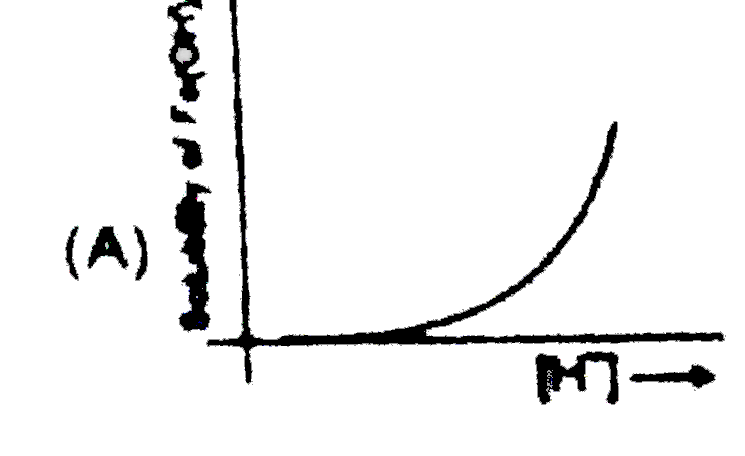
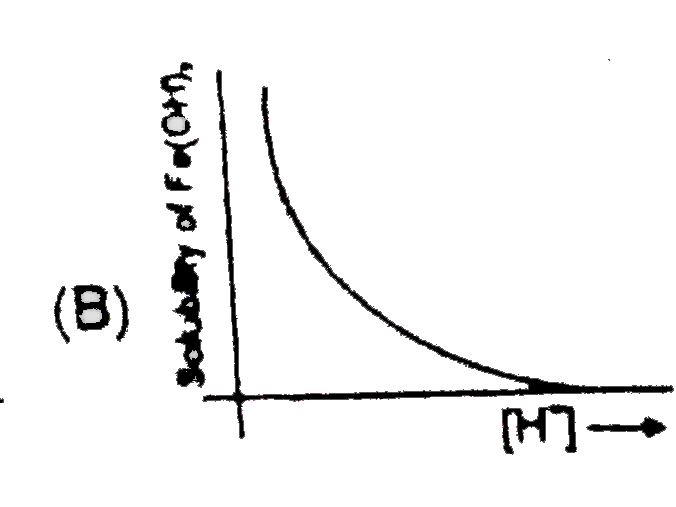
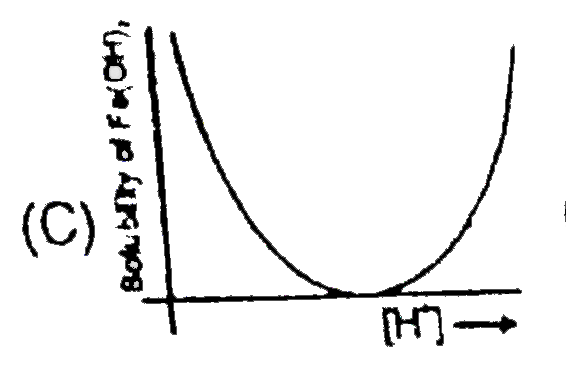
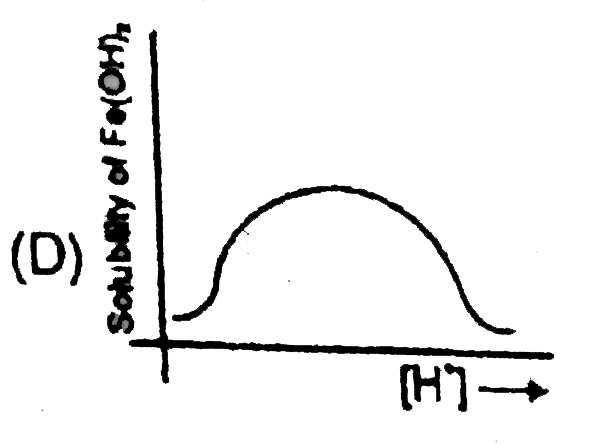
Amphoterism Amphoteric oxides, such as aluminium oxide, are soluble both in strongly acidic and in strongly base solutions : In acid:Al_2O_3(s)+6H_3O^(+)(aq)hArr2Al^(3+)(aq)+9H_2O(l) In base:Al(OH)_3(s)+OH^(-)(aq)hArr Al(OH)_4^(-)(aq) Dissolution of Al(OH)_3 in excess base is just a special case of the effect of complex-ion formation on solubility.Al(OH)_3 dissolves because excess OH^(-) ions convert it to the soluble complex ion Al(OH)_4^(-)(aluminate ion)The effect of pH on the solubility of Al(OH)_3 is shown in figure. Other examples of amphoteric hydroxides include Zn(OH)_2,Cr(OH)_3,Sn(OH)_2 and Pb(OH)_2, which react with excess OH^(-) ions to form the soluble complex ion Zn(OH)_4^(2-)(zincate ion),Cr(OH)_4^(-)(chromite ion),Sn(OH)_3^(-) , Fe(OH)_2 and Fe(OH)_3 , dissolve in strong acid but not in strong base. Which of the following curves best represents the variation of solubility of ferrous hydroxide Fe(OH)_2 with the concentration of [H^(+)] ions in the solution: |
|
Answer»
|
|
| 17. |
Ampicillin, amoxicillin, methiceillin, cetrizine, cephalosporin. |
| Answer» Solution :CETRIZINE .It is an antihistamine WHEREAS OTHERS belongs to penicillin group. | |
| 18. |
Amphoteric nature of aluminum is employed in which of the following process for extraction of Aluminum ? |
|
Answer» BAEYER's process |
|
| 19. |
Amphoteric oxide is: |
|
Answer» `Sb_4O_6` |
|
| 20. |
Amphiphilic molecules are normally associated with |
|
Answer» ISOPRENE based polymers |
|
| 21. |
Amoxycillin is semi synthetic modification of |
|
Answer» Penicillin |
|
| 22. |
Amoxillin is semi-synthetic modification of |
|
Answer» PENICILLIN |
|
| 23. |
Amoxicillin is semi-synthetic modification of |
|
Answer» Penicillin |
|
| 24. |
Amount of oxygen required for complete combustion of 27 g Al IS : |
| Answer» Answer :A | |
| 25. |
Amount of oxygen (in g) in 32.2g of Na_(2)SO_(4).10H_(2)O is |
|
Answer» Solution :1 mol `Na_(2)SO_(4).10H_(2)O = 14 g` atoms of OXYGEN i.e. 32.2 g `Na_(2)SO_(4).10H_(2)O=22.4` g of oxygen. |
|
| 26. |
Amount of oxygen required for combustion of 1 kg of a mixture of butane and isobutane is : |
|
Answer» 1.8 kg |
|
| 27. |
Amount of oxalicacid present in a solution can bedetermined by its titration with KMnO_(4)solution in the presenceof H_(2)SO_(4) . The titration gives unsatisfactory rasult when carried out the presence of HCl because HCl |
|
Answer» reducs permanganate to `Mn^(2+)` |
|
| 28. |
Amount of oxalic acid present in a solution can be determined by its titration with KMnO_(4) solution in the presence of H_(2)SO_(4). The titration gives unsatisfactory result when carried out in the presence of HCl, because HCl |
|
Answer» FURNISHES `H^(+)` ions in addition to those from oxalic acid |
|
| 29. |
Amount of oxalic acid present in a solution can be determined by its titration with KMnO_(4) solution in the presence of H_(2)SO_(4) . The titration gives unsatisfactory results when carried out in the presence of HCl because HCl |
|
Answer» OXIDISES oxalic ACID to CARBON dioxide and water |
|
| 30. |
Amount of oxalic acid present in a solution can be determined by its titration with KMnO_(4) solution in the presence of H_(2)SO_(4) . The titration gives unsatisfactory result when carried out in the presence of HCl because HCl: |
|
Answer» oxidises OXALIC acid to carbon dioxide and water |
|
| 31. |
Amount of gas adsorbed per gram of adsorbent increases with pressure but after certain limit is reached, adsorption becomes constant. It is when |
|
Answer» MULTI layers are formed |
|
| 32. |
Amount of Br_2 required to react with 5g pentene to form monobromo derivative is: |
|
Answer» 11.11 g |
|
| 33. |
Amount of80% pure NaOH sample which is required to completely react with 42.6 gm Chlorine in hot condition according to given reaction NaOH + Cl_(2) rarrNaCl + H_(2)O + O_(2) is - |
|
Answer» 48 `1.2` mole `0.6` mole `n_(NaOH "pure required") = 1.2` `W_(NaOH "pure") = 1.2 XX 40 = 48 gm` `W_("impure sample") xx (80)/(100) = W_(NaOH "pure")` `W_("sample") = 60 gm` |
|
| 34. |
Amount (in g) of sample containing 80% NaOH required to prepare 60 litre of 0.5 M solution is |
|
Answer» 1000 |
|
| 35. |
Amoung the following , the formula of saturated fatty acid is |
|
Answer» `C_(17)H_(29) COOH` Among the given acids , only `C_(17)H_(35) COOH` SATISFY this formula , HENCE it is a saturated fatty acid. |
|
| 36. |
Amoungthe followingstatementson thenitrationofaromaticcompoundsthe falseone is |
|
Answer» the rateof NITRATIONOF benzeneis almostthe same asthat ofhexadeuterobenzne Nitration in the toluene inis greaterbecauseof electron- repelling(+ 1) N/Atureof `-CH_(3)`group . Innitrationthe ratedetermining stepis the attackof `NO_(2) ^(+)`on benzeneand not thecleavageof `C- H ( orC- D^(2))` bond . the ratesof nitrationare almostsame. |
|
| 37. |
Amospheric air has 78% N_(2): 21% O_(2): 0.9% Ar and 0.1% CO_(2) by volume. What is the molecular mass air in the atmosphere? |
|
Answer» SOLUTION :MOLECULAR mass of mixture `=(SUM %"of each")/(100)XX"Molar mass"` `=(78)/(100)xx28+(21)/(100)xx32+(0.9)/(100)xx40+(0.1)/(100)=28.-964` |
|
| 38. |
Amorphous solids do not have sharp melting points. Explain. |
|
Answer» Solution :(1) Amorphous solids do not have perfectly ordered crystalline structure. (2) They have short range order of REGULAR pattern hence periodically repeating regular pattern is over a short distance. (3) Hence the temperature needed to melt the solid is not same, THEREFORE amorphous solids do not have SHARP melting points but melt over a range of temperature. |
|
| 39. |
Amorphous solids: |
|
Answer» Possess SHARP melting points |
|
| 40. |
An amorphous solid is: |
|
Answer» POSSESS SHARP MELTING points |
|
| 41. |
Amorphous solids - |
|
Answer» Possess sharp MELTING points |
|
| 42. |
Amorphous solid is : |
|
Answer» Rubber |
|
| 43. |
Amorphous solid can also be called ......... |
|
Answer» pseudo SOLIDS |
|
| 44. |
Amorphous boron is extracted from borax by following steps. "Borax" overset((A))(rarr)H_3BO_3overset((B))(rarr) B_2O_3 overset((C))(rarr) "Boron" (A) and (C) are |
|
Answer» `H_2SO_4, Al` `H_2B_4O_7 + 5H_2O to 4H_3BO_3` `3H_4BO_3 overset("HEAT (B)")(rarr)B_2O_3 + 3H_2O` `B_2O_3 + overset((C))(3 Mg) rarr 2B + 3MgO`. |
|
| 45. |
Amont the following the most reactive towards alcoholic KOH is |
|
Answer» `CH_(2)=CHBr` |
|
| 47. |
Amonst the following the most stable complex is |
|
Answer» `[Fe(H_(2)O)_(6)]^(3+)` |
|
| 48. |
Amongt the following, the total number of thermoplastics is___________. Polyester, bakelite, polyethene, PVC, teflon, PAN, PMMa nylon-6, melamine-formaldehyde. |
| Answer» | |
| 49. |
Amongst TiF_(6)^(2-), CoF_(6)^(3-), Cu_(2)Cl_(2) and NiCl_(4)^(2-) the colourless species are: |
|
Answer» `CoF_(6)^(3-) and NiCl_(4)^(2-)` |
|
| 50. |
Amongst the various ores of a metal (M) (sulphide, carbonates, oxides, hydrated or hydroxides) two ores [X] and [Y] show the following reactivity. (i)[X] on calcination gives a black solid (S), carbon dioxide and water. (ii)[X] Dissolved in dilute HCl, on reaction with Kl gives a white precipitate (P) and iodine. (iii)[Y] on roasting gives metal (M) and a gas (G_(1)) which turns acidified K_2Cr_2O_7 solution green. (iv)[Y] on reaction with dil.HCl givesa white precipitate (Q) and another gas (G_2) which turns lead acetate solution black, and also reacts with gas (G_1) to precipitate colloidal sulphur in presence of moisture. Reaction involved: (i)CuCO_3. Cu(OH)_2oversetDeltatoCuOdarr("black")+CO_2+H_2O CuCO_3.Cu(OH)_2+4HCl to2CuCl_2+3H_2O+CO_2 (ii)2Cu^(2+)+4I^(-)toCu_2l^2 darr (P)("white")+l_2uarr (iii)2Cu_2S+3O_2to2Cu_2O+2SO_2(G_1) Cu_2S+2Cu_2O to6Cu+SO_2 (iv)Cu_2S+2HCl to2CuCldarr(Q)("white")+H_2S(G_2) Pb^(2+)+H_2StoPbSdarr("black")+2H^(+) (v)SO_2(G_1)+2H_2S(G_2)overset("moisture")to3Sdarr+2H_2O The gas (G_1) acts as |
|
Answer» OXIDISING AGENT |
|