

Saved Bookmarks
This section includes InterviewSolutions, each offering curated multiple-choice questions to sharpen your knowledge and support exam preparation. Choose a topic below to get started.
| 42451. |
A pointcharge causes an elelctric flux of -1.0 xx10^(3) Nm^(2) /C to pass through a spherical gaussioan of 10.0 cm radiuscentred on the charge (a) if the radius of the gaussian surface wrere doubledhow much flux would pas through the surface (b) what is the value of the pointcharge |
| Answer» SOLUTION :`1.9 xx10^(5) N m^(2) //C` | |
| 42452. |
A cylindrical capacitor has two co-axial cylinders of length 15 cm and radii 1.5 cm and 1.4 cm. The outer cylinder is earthed and the inner cylinder is given a charge of 3.5 µC. Determine the capacitance of the system and the potential of the inner cylinder. Neglect end effects (i.e., bending of field lines at the ends). |
| Answer» Solution :`1.2 XX 10^(-10) F, 2.9 xx 10^(4)` V | |
| 42453. |
What is modulation ? Write the block diagram of the receiver. |
Answer» Solution :MODULATION: The process of SUPERIMPOSING the low FREQUENCY message signal on a high frequency WAVE. Block diagram : 
|
|
| 42454. |
In an n-type silicon, which of the following statement is true: |
|
Answer» Electrons are MAJORITY carriers and TRIVALENT atoms are the dopants. |
|
| 42455. |
Assertion:Heat is generated continuously is an electric heater but its temperature becomes constant after some time. Reason: At the stage when heat produced in heater is equal to the heat dissipated to its surrounding the temperature of heater becomes constant. |
|
Answer» If both assertion and reason are TRUE and the reason is the CORRECT explanation of the assertion. |
|
| 42456. |
The binding energy per nucleon of deuterium and helium nuclei are 1.1 MeV and 7.0 MeV respectively. When two deuterium nuclei fuse to form a helium nucleus the energy released in the fusion is |
|
Answer» 13.9 MeV |
|
| 42457. |
Wave theory of light is not initially accepted because |
|
Answer» It does not EXPLAIN REFLECTION and refraction |
|
| 42458. |
0.4 |
|
Answer» 0.02 |
|
| 42459. |
What is meant by thermoelectric effect? |
| Answer» Solution :Conversion of temperature DIFFERENCES into electrical VOLTAGE and VICE versa is known as THERMOELECTRIC effect. | |
| 42460. |
The wavelength of max. emission for moon is 14 micron. Estimate the temp. of moon if b=28.84xx10^(-4) mK is |
|
Answer» 150 K Thus CORRECT CHOICE is (b). |
|
| 42461. |
An electric dipole is placed parallel to a uniform electric field. Find the correct one of the following statements : |
|
Answer» (A) net force is maximum, but torque is zero. |
|
| 42462. |
Light of wavelength is 7200 Å in air. Ithas a wavelength in glass (mu=1.5) equal to |
|
Answer» 7200 Å |
|
| 42463. |
The period of revolution of an electron in the ground state of hydrogen atom is T. The period of revolution of the electron in the first excited state is |
|
Answer» 2T `rpropn^(2)` `vprop1/nrArrTpropn^(3)` |
|
| 42464. |
A wire of length 2l is bent at mid point so that the angle between two halves is 60^@ . If it moves as shown with a velocity v in a magnetic field B find the induced emf. |
| Answer» SOLUTION :E = BLV. Here L = EFFECTIVE length=PQ. | |
| 42465. |
A particle oscillates according to the law s=(1+cos^(2)t+cos^(4)t)sin500t Expand this motion into its harmonic components and plot its spectrum. |
|
Answer» Solution :We have `1+cos^(2)t+cos^(4)t=1+(1)/(2)(1+cos2t)+(1)/(4)(1+cos2t)^(2)=` `=(1)/(4)[7-4cos2t+(1)/(2)(1cos4t)]=(1)/(8)(15+8cos2t+cos4t)` HENCE `s=(1)/(8)(15-8cos2t-cos4t)sin500t(15)/(8)sin500t+cos2tsin500t+` `+(1)/(8)cos4t.sin500t=(15)/(8)sin500t+(1)/(2)sin502t+(1)/(2)sin498+(1)/(16)sin504t+(1)/(16)sin496t` The spectrum of the vibrations CONSIDERED above is SHOWN in FIG 
|
|
| 42466. |
A light string passing over a smooth light pulley connects two blocks of masses m_(1) and m_(2) (vertically). If the acceleration of the system is g//8, then the ratio of the masses is: |
|
Answer» 2N `(g)/(8)=((m_(1)-m_(2))/(m_(1)+m_(2)))g, (1)/(8)=(m_(1)-m_(2))/(m_(1)+m_(2))` `8m_(1)-8m_(2)=m_(1)+m_(2)` `7m_(1)=9m_(2)(m_(1))/(m_(2))=(9)/(7)` `m_(1):m_(2)::9:7` Hence choice is (b) |
|
| 42467. |
Two satellites A and B of the same mass are revolving around the earth in concentric orbits such that the distance of B from the centre of earth is thrice as compared to the distance of A from the centre. The ratio of centripetal force acting on B as compared to A is : |
| Answer» Answer :A | |
| 42468. |
A child, playing with a long rope, ties one end and holds the other. The rope is stretched taut along the horizontal. The child shakes the end he is holding, up and down, in a sinusoidal manner with amplitude 10 cm and frequency 3Hz. Speed of the wave is 15 m/s and, at t=0, displacement at the child's end is maximum positive. Assuming that there is no wave reflected from the fixed end, so that the waves in the rope are plane progressive waves, answer the following questions (also assume that the wave propagates along the positive x-direction) Velocity of the child's end at t = 0 is |
|
Answer» 3m/s |
|
| 42469. |
A child, playing with a long rope, ties one end and holds the other. The rope is stretched taut along the horizontal. The child shakes the end he is holding, up and down, in a sinusoidal manner with amplitude 10 cm and frequency 3Hz. Speed of the wave is 15 m/s and, at t=0, displacement at the child's end is maximum positive. Assuming that there is no wave reflected from the fixed end, so that the waves in the rope are plane progressive waves, answer the following questions (also assume that the wave propagates along the positive x-direction) Phase difference between the child's end and a point 2.5m from the child's end will be |
| Answer» ANSWER :D | |
| 42470. |
A child, playing with a long rope, ties one end and holds the other. The rope is stretched taut along the horizontal. The child shakes the end he is holding, up and down, in a sinusoidal manner with amplitude 10 cm and frequency 3Hz. Speed of the wave is 15 m/s and, at t=0, displacement at the child's end is maximum positive. Assuming that there is no wave reflected from the fixed end, so that the waves in the rope are plane progressive waves, answer the following questions (also assume that the wave propagates along the positive x-direction) Equation of displacement of a point 2.5m from the child's cnd can be expressed as |
|
Answer» y = -(0.1 m) COS (18.8 RAD / s) t |
|
| 42471. |
A child, playing with a long rope, ties one end and holds the other. The rope is stretched taut along the horizontal. The child shakes the end he is holding, up and down, in a sinusoidal manner with amplitude 10 cm and frequency 3Hz. Speed of the wave is 15 m/s and, at t=0, displacement at the child's end is maximum positive. Assuming that there is no wave reflected from the fixed end, so that the waves in the rope are plane progressive waves, answer the following questions (also assume that the wave propagates along the positive x-direction) A wave function that describe the wave in the given situation is |
|
Answer» y = (0.1m) COS[(2 RAD / m) x - (12.5 rad / s) t] |
|
| 42472. |
The antenna current of an AM transmitter 8A when only the carrier is sent but it increases to 8.93A when the carrier is modulated. Find percent modulation. |
|
Answer» <P> Solution :The modulated or total power carried by AM WAVE `P_(T)= P_(C)( 1+ (m^(2))/(2))` If R is load resistance , `I_(m)` is the current when carrier is modulated and `I_(c)` the current when unmodulated then,`(P_(T))/(P_(C))= (I_(m)^(2)R)/(I_(C)^(2)R)` `:. I +(m^(2))/(2)= (I_(m)^(2)R)/(I_(C)^(2)R)` Given `I_(m)= 8.93 A, I_(c)= 8A` `:. m^(2)= 2[((8.93)/(8.0))^(2)-1]:. m= 0.7` THEREFORE, PERCENTAGE modulation=70% |
|
| 42473. |
The refractive index of glass is 1.520 for red light and 1.525 for blue light. Let D 1, and D 2, be angles of minimum deviations for red and blue light respectively in a prism of this glass. Then, |
|
Answer» `D_1gt D_2` `thereforeD prop mu` and `mu_("violet") GT mu_("red")` `therefore D_2 gt D_1` HENCE, `D_1 lt D_2` |
|
| 42474. |
A parallel plate capacitor ofcapacitance C is charged to a potential V. It is then connected to another uncharged capacitor having the same capacitance. Find out the ratio of the electrostatic energy stored in the combined system to that stored initially in the single capacitor. |
|
Answer» Solution :Let parallel plate capacitor of capacitacne C be charged to a POTENTIAL V. Then the ENERGY stored in this capacitor `u_i = 1/2 CV^2` Now, let the charged capacitor is connected to another uncharged capacitor of same capacitance C. OBVIOUSLY TWO capacitors SHERE the charge of first capacitor and as a result the common potential of capacitors `= V. = Q/(2C) = (CV)/(2C) = V/2` `:.` Total energy stored by the capacitors `u_f = 2[1/2 CV._2] = 2 xx 1/2 C xx (V/2)^2 =1/4 CV^2` `rArr u_f/u_i = (1/4CV^2)/(1/2CV^2) =1/2` |
|
| 42475. |
A car accelerates from rest at constant rate of 2m/s^2 for some time. Then it retards at constant rate of 4m/s^2 and comes to rest . If the total time for which it remains in motion is 3 seconds, what is the distance travelled ? |
|
Answer» 2m |
|
| 42476. |
A pin is placed 0.1 m in front of a convex lens of focal length 0.2 m and refractive index 1.50. The surface of the lens farther away from the pin is silvered and has a radius of curvature of 0.22 m. How far from the lens is the final image formed ? |
|
Answer» Solution :(b) `|(1)/(F)| = (2)/(f_(1))+(1)/(f_(m))=(2)/(20)+(2)/(22)` `therefore "" |F| = (110)/(21) cm` The convex lens with a silvered surface behaves as a concave mirror of effective focal length. `therefore "" F = (-100 cm)/(21)` and mu = - 10 cm By mirror formula, `(1)/(v) + (1)/(u) = (1)/(F)` `rArr "" (1)/(v) = - (21)/(110) + (1)/(10)` v = - 11 cm. |
|
| 42477. |
An electron (mass m)with an initial velocity vecv=v_(0)hati is in an electric field vecE=E_(0)hatj . If l,ambda_(0)=h..mv_(0).it's de-Broglie wavelength at time t is given by |
|
Answer» `(lambda_(0))/((1+(eE_(0))/(m)-(t)/(v_(0)))` `v=v_(0)+((F)/(m))t` `THEREFORE v=v_(0)+((eE_(0))/(m))t` `therefore v=v_(0)(1+(eE_(0))/(mv_(0))t)`…..(1) `therefore VECF=qvecE` `therefore vecF=(-e)(-E_(0)hati)` `therefore vecF=eE_(0)hati` `therefore F=eE_(0)` de-Broglie wavelength ,`lambda=(h)/(mv)implieslambdaprop(1)/(v)` `therefore (lambda)/(lambda_(0))=(v_(0))/(v)` (where `lambda_(0)`=initial de-Broglie wavelength ,`lambda`=final de-broglie wavelength) `therefore lambda=(lambda_(0)v_(0))/(v)` `=(lambda_(0)v_(0))/(v_(0)(1+(eE_(0))/(mv_(0))t)` [From equation(1)] `therefore lambda=(lambda_(0))/(1+(eE_(0))/(mv_(0))t)` |
|
| 42478. |
When a diamagnetic substance is brought near N or S pole of a bar magnet, it is _____. |
| Answer» SOLUTION :REPELLED | |
| 42479. |
(a) Write the relation for binding energy (in MeV) of a nucleus " "_(Z)^(A)X of atomic number ‘Z’ and mass number ‘A’ in terms of the masses of its constituents — neutrons and protons. (b) Draw a plot of binding energy per nucleon versus mass number ‘A’ for 2 le A le 240. Use this graph to explain the release of energy in the process of nuclear fusion of two light nuclei. |
|
Answer» Solution :(a) If `m_(n)` and `m_(p)` be the masses of neutron and proton respectively and m(`" "_(Z)^(A)X`) be the mass of given nucleus, all expressed in ATOMIC mass units, then the binding energy of the nucleus is given as per relation: BE =[`Zm_(p) + (A-Z)m_(n) - m(" "_(z)^(A)X )] xx 931.5 MeV` (b) When we consider fusion of two very light nuclei (A < 10) fusing to forma single heavier nucleus, the binding energy per nucleon of the fused heavier nuclei is more than the binding energy per nucleon of the lighter nuclei. THUS, the fused nuclei is more tightly bound than the initial lighter nuclei and as a result energy is RELEASED in the fusion process. |
|
| 42480. |
(a) For the telescope described in Exercise 9.28(a), what is the separation between the objective lens and the eyepiece ? (b) If this telescope is used to view a 100 m tall tower 3 km away, what is the height of the image of the tower formed by the objective lens ? ( c) What is the height of the final image of the tower if it is formed at 25 cm ? |
|
Answer» Solution :(a) SEPARATION between the objective lens and eyepiece = `f_0+f_e= 140 + 5 = 145 cm` or 1.45 m. (B) Angle subtended at the TELESCOPE objective by the 100 m tall tower situated 3 km (= 3000 m) AWAY `alpha = 100/(3000 = 1/30` rad If image formed by objective lens in its focal plane be of height h, then `alpha = h/f_(0)` or `h =alpha f_(0) = 1/30 xx 140 cm = 4.67 cm` (c) When final image is formed at d = 25 cm, the magnification produced by the eyepiece: `m_( e) = 1+ D/f_(e) = 1+ 25/5 = 6` `therefore`Height of final image of the tower `h. = hm_(e) = 4.67 xx 6 = 28 cm` |
|
| 42481. |
Unpolarised light is incident on a plane glass surface. What should be the angle of the incidence so that the reflected and refracted rays are perpendicular to each other? |
| Answer» Solution :For i+r to be equal to `pi//2`, we should have tan `i_(B)=mu=1.5`. This GIVES `i_B=57^(@)`. This is the Brewster's ANGLE for air to GLASS SURFACE. | |
| 42482. |
The balancing length for a cell is 560cm in a potentiometer experiment . When an externalresistance of 10 ohm are connected in parallel to the cell, the balancing length changes by 60cm. find the internal resistance of the cell in ohm , is |
|
Answer» 3.6 |
|
| 42483. |
Figure represents a crystal unit of cesium chloride, CsCl. The cesium atoms, represented by open circles are situated at the corners of a cube of side 0.40nm, whereas a CI atom is situated at the centre of the cube. The Cs atoms are deficient in one electron while the CI atom carries an excess electron. (i) What is the net electric field on the CI atom due to eight Cs atoms ? (ii) Suppose that the Cs atom at the corner A is missing. What is the net force now on the CI atom due to seven remaining Cs atoms ? |
|
Answer» Solution :(i) The cesium atoms are situated at the corners of a cube and CI atom is situated at the centre of the cube. From the GIVEN figure, we can analyses that the chlorine atom is at equal distance from all the eight corners of cube where cesium atoms are PLACED. Thus, due to SYMMETRY the electric field due to all CS atoms, on CI atom will cancel out. Hence, `E = F/q, F=0` (ii)We define force on a charge particle due to external electric field as F = qE. If eight cesium atoms are situated at the corners of a cube, the net force on CI alom is situated at the centre of the cube will be zero as net electric field at the centre of cube is zero. But, force acting on `Cl^(-)` ion by each Cs+ ion, `F =(ke^(2))/r^(2)`........(1) From Pythagoras theorem, `r = sqrt((0.2 xx 10^(-9))^(2) + (0.2 xx 10^(-9))^(2) + (0.2 xx 10^(-9))^(2))` `=sqrt(4+4+4) xx 10^(-10)` `=sqrt(12) xx 10^(-10)` `=3.46 xx 10^(-10)`m `therefore` From equation (1), `F = (9 xx 10^(9) xx (1.6 xx 10^(-19))^(2))/(3.46 xx 10^(-10))^(2)` `therefore F = 1.92 xx 10^(-9)` N |
|
| 42484. |
A resistor has bands with colours orange, green , silver and gold . Then, the resistance of the resistor is. |
|
Answer» `(350pm5) m Omega` 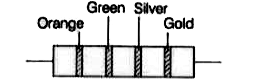 Given , orange=3, Green =5 Silver=`10^(-2)` GOLD (tolerance)=`(pm5%)` From colour code , RESISTANCE value is `[35xx10^(-2)pm5%]` `=350xx10^(-3)pm5%`ohms `350m-Omegapm17.5m-Omega` |
|
| 42485. |
What is the meaning of the term prejudice? |
|
Answer» To think evil |
|
| 42486. |
Draw a graph of E versus r fro r gt gt a. |
Answer» SOLUTION :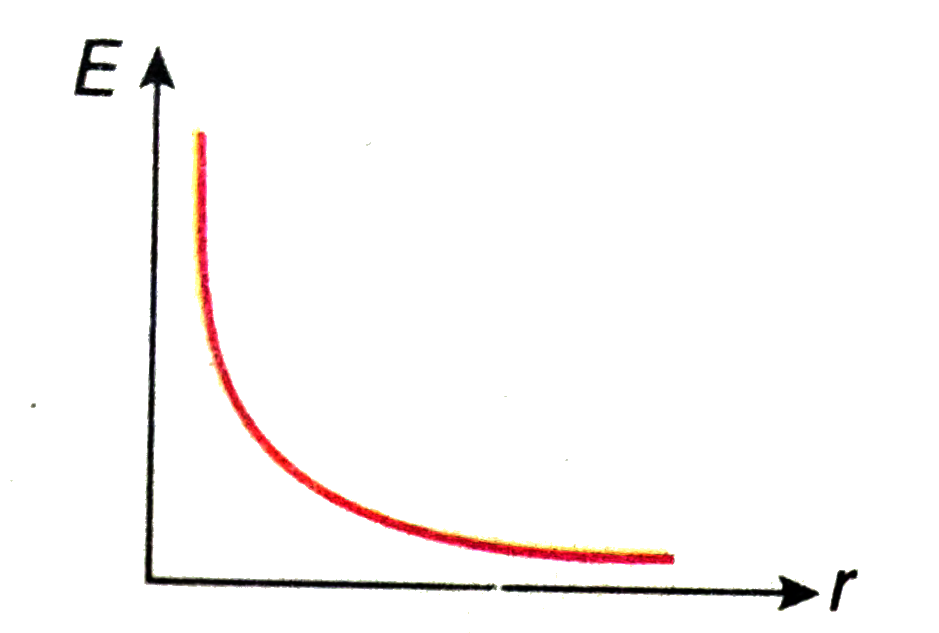
|
|
| 42487. |
Which of following waves are used for satellite communication ? |
|
Answer» (A) Microwave |
|
| 42488. |
Time standards are now based on atomic clocks. A promising second standard is based on pulsars, which are rotating neutron stars (highly compact stars consisting only of neutrons). Some rotate at a rate that is highly stable, sending out a radio beacon that sweeps briefly across Earth once with each rotation, like a lighthouse beacon. Pulsar PSR 1937 + 21 is an example, it rotates once every 1.557 806 448 872 75 pm3 ms, where the trailing pm3 indicates the uncertainty in the last decimal place (it does not mean pm3 ms). (a) How many rotations does PSR 1937 + 21 make in 8.00 days? (b) How much time does the pulsar take to rotate exactly one million times and (c ) what is the associated uncertainty? |
| Answer» Solution :(a) `4.44xx10^(8)` rotations, (B) 1557.80644887275s, (C ) `pm3xx10^(-11)s` | |
| 42489. |
(A) : In point - to point communication mode communication takes place over a link between a signal transmitter and a receiver. (R) : Telephony is one example of such a mode of communication |
|
Answer» Both 'A' and 'R' are true and 'R' is the correct EXPLANATION of 'A'. |
|
| 42490. |
(A): A current continues to follow in super conducting coil even after switch is off. (R): Superconducting coils show Meissner effect. |
|
Answer» Both 'A' and 'R' are TRUE and 'R' is the correct explanation of 'A' |
|
| 42491. |
Find the equivalent resistance between the points A and B of the circuit shown in the fig. |
|
Answer» Solution :Supposing a SOURCE is connected between the terminals A and B . The current DISTRIBUTION is shown in fig. At junction A , `i= i_1 + i_2` Resistance between A and B , `R_(AB)= V/i = V/(i_1 +i_2)` In close loop ACDA, -`5i_1 - 5i_3 + 10i_2 =0` or `-i_1- i_3 + 2i_2 =0"".....(i)` In close loop C B D E `-10(i_1 - i_3) + 5(i_2 + i_3)+ 5i_3 =0` or `-2i_i + i_2 + 4i_3 =0""....(3)` Now in close loop A C B E F A `-5i_1 - 10(i_1- i_3) + V= 0 ` or ` -3i_1 + 2i_3 = - V/5 "".......(iii)` From equations (i) and (iii), we GET `-5i_1 + 4i_2 = - V/5""......(iv)` From equations (ii) and (iii), we get `4i_1 + i_2 = (2V)/(5)""...(v)` Solving equations (iv) and (v) , we get `i_1 = (9V)/(105)` `i_2 = (6V)/(105)` `i_3= (V)/(35)` `R_(AB) = (V)/(i_1 + i_2)=(V)/(((9V)/(105) + (6V)/(105)))+ 7 Omega` |
|
| 42492. |
A circular loop of radius R carries a current I. Obtain an expression for the magnetic field at a point on its axis at a distance x from its centre. |
|
Answer» Solution :Consider a circular loop of radius R, carrying a current I. Plane of the coil is Y-Z plane (i.e., perpendicular to the plane of paper), while the AXIS of the loop OX LIES in the plane of paper. Consider the circular loop to be divided into large number of current elements `Ivecdl`. Two such elements `N_(1)M_(1) and N_(2)M_(2)` diametrically opposite to each other, produce the magnetic fields `vec(dB)_(1)` and `vec(dB)_(2)` perpendicular to both `vecr and vecdl` and given by right hand RULE as, `|vec(dB)_(1)|=|vec(dB)_(2)|=(mu_(0))/(4pi)*(I dlsin90^(@))/(r^(2))=(mu_(0))/(4pi) (Idl)/((R^(2)+x^(2)))` These fields may be resolved into components along x-axis and y-axis. Obviously components along y-axis balance each other but components along x-axis are all summed up. Hence, magnetic field due to whole current loop will be: `B=oint dB sin phi= oint (mu_(0))/(4pi) (Idl)/((R^(2)+x^(2)))*(R )/(sqrt((R^(2)+x^(2))))= (mu_(0)IR)/(4pi (R^(2)+x^(2))^(3//2)) oint DL` `=(mu_(0)IR)/(4pi (R^(2)+x^(2))^(3//2))* 2pi R= (mu_(0)IR^(2))/(2(R^(2)+x^(2))^(3//2))` 
|
|
| 42493. |
The blue print for making ultra durable synthetic material is mimicked from |
|
Answer» LOTUS leaf |
|
| 42494. |
Why are Si and GaAs are preferred materials for solar cells? |
Answer» Solution :The solar radiation spectrum received by us is SHOWN in Fig. 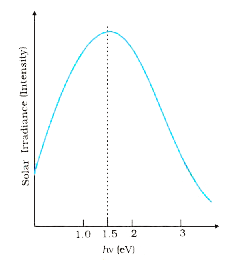 The maxima is near 1.5 eV. For photo-excitation, hν > Eg . Hence, semiconductor with band gap ~1.5 eV or lower is likely to give better solar conversion efficiency. Silicon has Eg ~ 1.1 eV while for GaAs it is ~1.53 eV. In fact, GaAs is better (in spite of its higher band gap) than Si because of its relatively higher absorption coefficient. If we choose materials like CdS or CdSe (Eg ~ 2.4 eV), we can use only the high energy component of the solar energy for photo-conversion and a significant part of energy will be of no use. The question arises: why we do not use material like PBS (Eg~ 0.4 eV) which satisfy the condition hν > Eg for ν maxima corresponding to the solar radiation spectra? If we do so, most of the solar radiation will be absorbed on the top-layer of solar cell and will not reach in or near the depletion region. For EFFECTIVE electron-hole separation, due to the JUNCTION field, we want the photo-generation to occur in the junction region only. |
|
| 42495. |
If an electron and proton are propagating in the form of waves having the same lambda, itimplies that they have the same |
|
Answer» <P>energy Momentum, ` p = (h)/(LAMBDA)` As bothelectron andproton havesame `lambda`so they have the samemomentum . |
|
| 42496. |
Value of dielectric strength of air is………Vm^-1 |
|
Answer» `3xx10^(4)` |
|
| 42498. |
There are two sources of light each emitting with a power of 100 W. One emits X-rays of wavelength 1nm and the other visible light at 500nm. The ratio of number of photons of visible light to the photons of X-rays of the given wavelengths is 100 k . Find the value of K. |
|
Answer» |
|
| 42499. |
An audio signal of amplitude one half the carrier amplitude is used in an amplitude modulation. The modulation index is |
|
Answer» 2 |
|
| 42500. |
Answer the following questions: (d) Every metal has a definite work function. Why do all photoelectrons not come out with the same energy if incident radiation is monochromatic? Why is there an energy distribution of photoelectrons? |
| Answer» Solution :Work function merely indicates the minimum energy REQUIRED for the electron in the highest level of the conduction band to get out of the metal. Not all ELECTRONS in the metal belong to this level. They OCCUPY a continuous band of levels. Consequently, for the same INCIDENT radiation, electrons knocked off from different levels come out with different energies. | |