

Saved Bookmarks
This section includes 7 InterviewSolutions, each offering curated multiple-choice questions to sharpen your Current Affairs knowledge and support exam preparation. Choose a topic below to get started.
| 1. |
Two open pipes with lengths 25 cm and 25.5 cm produce 10 beat/second when resonated in fundamental mode. Find speed of sound in them. |
|
Answer» `225m//s` `THEREFORE (v)/( 2L ) - (v)/(2L.) = 10` `therefore (v)/(2) [ (L.-L)/(LL.)]=10` `therefore v= 20 XX (LL.)/(L.-L)` `= 20 xx [ ((25.5 ) (25))/( (25.5) - (25))]` `therefore v = 255 m//s` |
|
| 2. |
(A) The images formed by total internal reflections are much brighter than those formed by mirrors or lenses by reflection or refraction. ( R) There is no loss of intensity in total internal reflection. |
|
Answer» Both A and R are true and R is the CORRECT EXPLANATION of A |
|
| 3. |
A plane is flying at a speed of 720kmh^(-1) with respect to air. The wind is blowing at a speed of 54kmh^(-1) from west to east. With respect to ground the plane is found to be movig northwards. In which direction is the plane heading? |
|
Answer» North-West at ANGLE `sin^(-1)(3/40)` to north |
|
| 4. |
A copper wire and an aluminium wire have lengths in the ratio 3:2, diameters in the ratio 4:3,Forces in the ratio 4:5. Find the ratio of increase in length of the two wires. (Y_(cu)=1.1xx10^(11)N//m^(-2),Y_(AI)=0.7xx10^(11)Nm^(-2) |
|
Answer» `110:189` |
|
| 6. |
A ceiling fan is rotating about its own axis with uniform angular velocity omega. The electric current is switched off then due to constant opposing torque its angular velocity is reduced to 2omega//3 as it completes 30 rotations. The number of rotations further it makes before coming to rest is |
|
Answer» 18 |
|
| 7. |
A thin lens of focal length f and its aperture has a diameter d. It forms an image of intensity 1. Now the central part of the aperture upto diameter (d//2) is blocked by an apaque paper. The focal length and image intensity would change to |
|
Answer» Solution :Focal length of lens does not depends on the aperture of lens, It only depends on the (i) Refractive index of material lens and SURROUNDING medium and (ii) Radius of curvature For intensity `I prop (aperture DIAMETER)^2` `implies I_(BLOCKED) prop (d/2)^2 and I_2 prop d^2` Hence, `I_(blocked)=I_0/4` Final image intensity `=I_(origi NAL)-I_(blocked)=I_0-I_0/4=(3I_0)/4` |
|
| 8. |
0.3 kg of hot coffee , which is at 70^@Cis poured into a cap of mass 0.12 kg. Find the final equilibrium temperature . Take room temperature as 20^(@)C , S_("coffee") = 4080J//kg - K and S_("cup")=1020J//kg - K |
| Answer» Answer :C | |
| 9. |
Two bodies of masses m_(1) and m_(2) have equal momentum. Their K.E. are in the ratio |
|
Answer» `SQRT(m_(2)) : sqrt(m_(1))` |
|
| 10. |
Consider two processes on a system as shown in figure. The volumes in the initial states are the same in the two processes and the volumes in the final states are also the same. Let DeltaW_(1) and DeltaW_(2) be the work by the system in the processes A and B respectively. |
|
Answer» `DeltaW_(1)gtDeltaW_(2)` |
|
| 11. |
On a planet a body is left fall freely from a height 2m reaches the ground sqrt(2) seconds. If the length of a simple pendulum is 2m on that planet, its time period is |
|
Answer» 3.14 sec |
|
| 12. |
A sonometer wire of length 0.95 m can bear a maximum stress of 9 xx 10^(8) N//m^(2). Calculate the fundamental frequency produced in the wire if density of wire is 8 xx 10^(3) kg//m^(3). |
|
Answer» |
|
| 13. |
A train is moving on a straight track with speed 20 ms^(-1). It is blowing whistle at the frequency of 1000 Hz. The percentage change in the frequency heard by a person standing near the track as the train passes him is close to (speed of sound = 320 ms^(-1)). |
|
Answer» `6%`  `(f _(L))/( v + v _(L)) = (f _(S))/( v + v _(S))` `therefore (f _(L))/( 320 + 0) = (1000)/(320 - 20) implies f _(L) = 1000 xx (320)/(300)` `therefore f _(L) = 1067 Hz` (ii) When train moves away from stationary listener  `(f ._(L))/( v + v _(L)) = (f _(S))/( v +v _(S))` ` therefore (f ._(L))/( 320 +0) = (1000)/( 320 + 20) implies f._(L) = 1000 xx (320)/(340) ` `therefore f._(L) = 941 Hz` Percentage DECREASE in frequency of sound heard by listener, `(f _(L)-f ._(L))/( f _(L)) xx 100 %= (1067 - 941)/( 10 67) xx 100 %` `= 11. 8 % = 12%` |
|
| 14. |
A hockey player is moving northward and suddenly turns westward with the same speed to avoid an opponent. The force that acts on the player is |
|
Answer» frictional force ALONG westward Asshow in diagram  LET OA = `p_(1)`initialmomentumof PLAYERIN northdirection AB= `p_(2) - ` Finalmomentumof playerin westdirection Bytrianglelawof VECTOR addition OB = OA+ Ab  changein momentum `=P_(2) =p_(1)` Fromdiagramit isclearthat AR isin south- westdirection |
|
| 15. |
The three vessels shown in figure have same base area. Equal volumes of a liquid are poured in the three vessels. The force on the base will be |
|
Answer» MAXIMUM in VESSELS A |
|
| 16. |
Discuss the laws of transverse vibration in stretched strings. |
|
Answer» Solution :Laws of transverse vibrations in stretched strings: There are three laws of transverse vibrations of stretched strings which are given as follows: (i) The law of LENGTH: For a given wire with TENSION T (which is fixed) and mass per unit length `mu` (fixed) the frequency varies inversely with the vibrating length. Therefore, `f prop (1)/(L) IMPLIES f = (C)/(l)` `implies "" l xx f = C ` where C is a constant The law of tension: For a given vibrating length l (fixed) and mass per unit length `mu`(fixed) the frequency varies directly with the square root of the tension T, `f prop sqrtT` `implies "" f = A sqrtT` , where A is constant (iii)The law of mass: For a given vibrating length/ (fixed) and tension T (fixed) the frequency varies inversely with the square root of the mass per unit length `mu` , `f prop (1)/(sqrtmu)` `implies "" f = (B)/(sqrtmu)` , where B is a constant |
|
| 17. |
If distance between two objects m_1=m_2=1kg 1 mm, then gravitational force between them is …... [G=6.67xx10^-11 SI unit] |
|
Answer» `F=(Gm_1m_2)/r^2` `=(6.67xx10^-11xx1xx1)/(10^-3)^2` `:. F=6.67xx10^-5N` |
|
| 18. |
Which is greater, the attraction of the earth on a 1 kg body or the attraction of the 1 kg body on the earth? |
| Answer» SOLUTION :Both are EQUAL | |
| 19. |
A body projected vertically from the earth reaches a height to earth's radius before returning to the earth . The power exterted bythe gravitational force is greatest ……….. |
|
Answer» at maximumheight of BODY |
|
| 20. |
Two metal plates of area 2 xx10^(-4) m^(2)each, are kept in water and one plate is moved over the other with a certain velocity. The distance between the plates is 2 xx 10^(-4) m. If the horizontal force applied to move the plate is 10^(-3)N, calculate the velocity of the plate. Given etaof water is 10^(-3) decapoise. |
|
Answer» |
|
| 21. |
An object of length 10 cm is place at right angles to the principal axis of a mirror of radius of curvature 60 cm such that its image is virtual, erert and has a length 6 cm. What kind of mirror is it and also determine the positions of the object. |
Answer» Solution :Since the image is virtual, erect and of a smaller size, the given MIRROR is convex (concave mirror does not form an image with the said DESCRIPTION)  Given R=+60 cm `f=R/2=30 cm` Transverse magnification `m=I/O=6/10= pm3/5` Further `m=-v/u =3/5 therefore v=- (3u)/5` Using `1/v+1/u=1/f (-5)/(3u)+1/u= 1/30` `(-5+3)/(3u)=1/30 therefore u=-20 cm` THUS the object is at a distance 20 cm (from the pole) in front of the mirror). |
|
| 22. |
Which has less angular speed, hour hand of clock or the angular speed of earth on its own axis? |
|
Answer» Solution :Angular SPEED of earth is LESS For earth angular speed `omega_(e)=(2pi)/(24xx3600)" rad/s"` `omega_(h)=(2pi)/(12xx3600)" rad/s"` `THEREFORE (omega_(e))/(omega_(h))=(1)/(2)` `therefore 2omega_(e)=omega_(h)` `therefore omega_(e)ltomega_(h)` |
|
| 23. |
The system of mass A and B shown in the figure is released from rest with x=0, determine the velocity of mass B when x=3m. Also find the maximum displacement of mass B. |
|
Answer» Solution :Constraint relation gives `2sqrt(X^(2)+16)+y=c` Differentiating w.r.t. time, we GET `(dy)/(dt)= -(x)/(sqrt(x^(2)+dt))(dx)/(dt)` Let `(dx)/(dt)=v=` velocity of `B` `:. (dy)/(dt)=` velocity of `A=-(x)/(sqrt(x^(2)+16))v` Minus sign indicates that it in upward direction. `:.` Using energy conservation `MG.3-(mg)/(sqrt(2)).2=(1)/(2)mv^(2)+(1)/(2)(m)/(sqrt(2))(v.(3)/(5))^(2)` `RARR (3-sqrt(2))g=(v^(2)(25sqrt(2)+9))/(50sqrt(2))` `rArr v=sqrt(((3-sqrt(2))(50sqrt(2)))/(25sqrt(2)+9))g=5 m//s` Let `x_(1)` be the maximum displacement of `B`, then `mgx_(1)-(mg)/(sqrt(2))2[sqrt(x_(1)^(2)+16)-4]=0` `rArr x_(1)=8sqrt(2)m`. 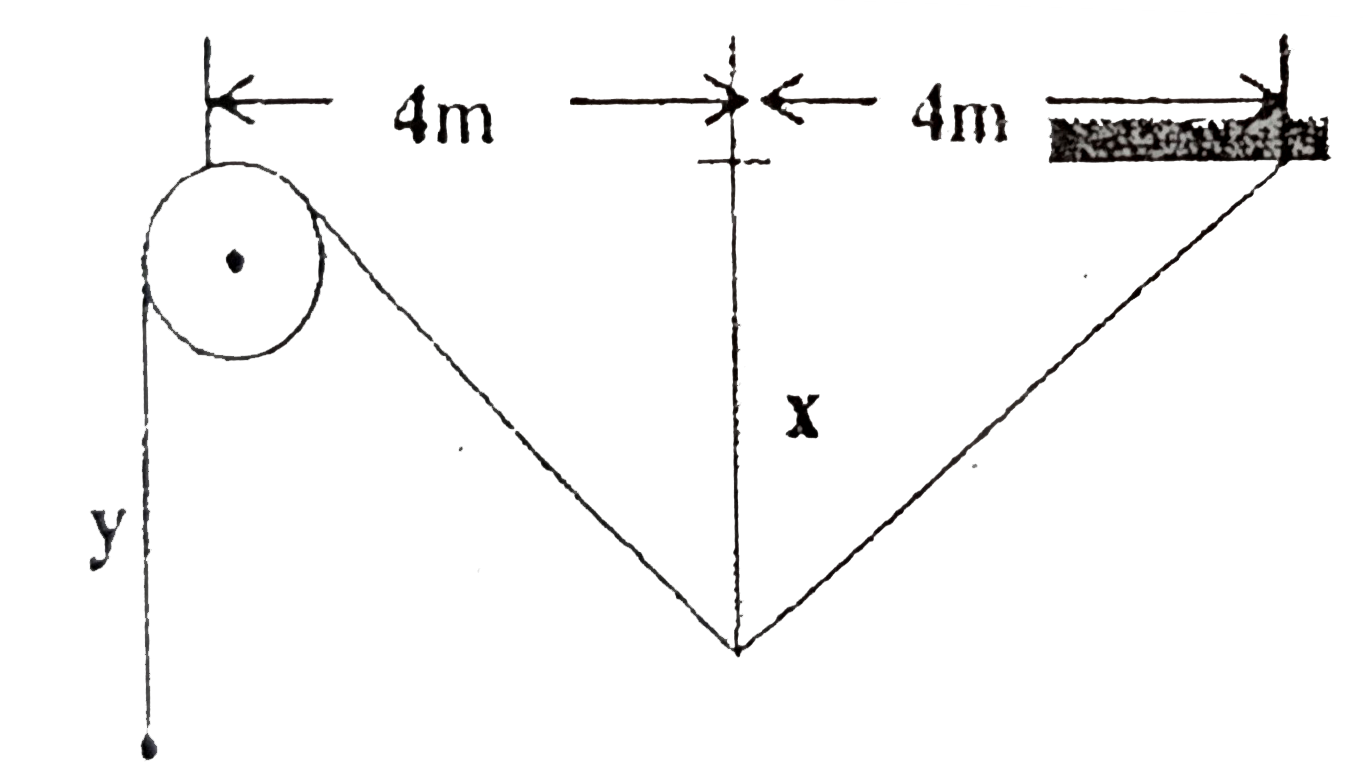
|
|
| 24. |
Dry air at 23^(@)C" and "10^(5)mm^(3) volume is heated to 87^(@)C under constant pressure. Calculate the new volume. |
|
Answer» |
|
| 25. |
What is the basis of the principle of homogeneity of dimensions? |
| Answer» Solution :The principles of homogeneity of DIMENSIONS is based on the fact that only the physical QUANTITIES of the same KIND can be added, substracted or COMPARED. | |
| 27. |
If V_(CM) is velocity of C.M. of system and M is the total mass of system. Pick up the wrong statement |
|
Answer» `MV_(CM)` represent Vector sum of the linear momenta of particles of the system |
|
| 28. |
The mass density of a spherical body is given by rho( r) =k/r of r le R where r is the distance r from the centre. The correct graph that describes qualitatively the acceleration, a, of . a test particle as a function of r is : |
|
Answer»
|
|
| 29. |
A body describes SHM with an amplitude of 0.05 m and a period of 0.2 s. Find the acceleration and velocityof the body when the displacement is (a) 5cm (b) 3 cm (c ) zero cm. |
|
Answer» Solution :Given, `A=0.05m, T = 0.2s` We know that `v=omega sqrt(A^(2)-y^(2))` and `a=-omega^(2)y` Hence (i) for `y=0.05m, omega=(2PI)/(T)=(2xx3/142)/(0.2)="31.42 rads"^(-1)` and `omega^(2)=(31.42)^(2)=987.2` `v=31/42sqrt(5^(2)-5^(2))xx10^(-2)=-49.36ms^(-2)` (ii) for `y=0.03m, v=31.42xx10^(-2)sqrt(5^(2)-3^(2))=1.2568ms^(-1)` `a=-987.2xx0.03=-29.616ms^(-2)` (iii) `y=0, a=0` `v=31.42sqrt(5^(2))xx10^(-2)=1.571ms^(-1)`. |
|
| 30. |
A neutron of mass 1.67Xx10^(-27) kg moving with a velocity 106 ms-. collides with a duteron of mass 3.34Xx10^(-27) kg at rest. After collision, if both move as a single particle, find its velocity. |
|
Answer» |
|
| 31. |
Statement : Position of centre of mass of a body is independent of the shape and size of the body. Statement II: The centre of mass of a body may be in a position where there is no mass. |
|
Answer» STATEMENT I is true, statement II is true, statement II is a CORRECT explanation for statement I. |
|
| 32. |
Measure of two quantities along with the precision of respective measuring instrument is A = 2.5 ms^(-1) + 0.5 ms^(-1) B = 0.10 s +- 0.01 s . The value of AB will be |
|
Answer» `(0.25+-0.08)m` `A=(2.5+-0.5) ms^(-1), B=(0.10s+-0.01)`s `x=AB=(2.5)(0.10)=0.25 m` `(DELTAX)/(x)=(DeltaA)/(A)+(DeltaB)/(B)` `=(0.5)/(2.5)+(0.01)/(0.10)=(0.05+0.025)/(0.25)(0.075)/(0.25)` `Deltax=0.075=0.08` m (By rounding off to two SIGNIFICANT figures) `AB=(0.25+-0.08)m` |
|
| 33. |
An electric pump on the ground floor of a building taken 15 minutes to fill a tank of volume 30ms^(3) with water. If the tank is 40m above the ground and the efficiency of pump is 30% find the electira power consumed by the pump in filling the tank. [density of water = 10^(3) kg//m^(3) |
|
Answer» SOLUTION :mass of the water to be filled = `("VOLUME of the tank") xx "density of water m = 30 xx 10^(3)kg` h = 40m, `t = 15 xx 60 = 900sec`. EFFICIENCY `ETA = 30%` Inputpower `P_(1) = (100)/(eta) xx (mgh)/(t)` `=(100xx30xx10^(3)xx9.8xx40)/(30xx900)=43.56KW` |
|
| 34. |
(A) : The bodies in the satellites revolving round the eart are in the state of weightlessness (R) : In a satellite the reaction of the supporting surface is zero. |
|
Answer» Both (A) and (R) are TRUE and (R) is the correct explanation of (A) |
|
| 35. |
Discuss the ideal gas laws. |
|
Answer» Solution :Boyle.s law: For a given gas at low pressure (density) kept in a container of volume V experiments revealed the following information. When the gas is kept at constant temperature, the pressure of the gas is inversely proportional to the volume `P prop (1)/(V)` Charles. law: When the gas is kept at constant pressure, the volume of the gas is direaly proportional to absolute temperature `V prop T`. By combining these two equations we have `PV = CT.` Here C is a positive constant. We can infer that C is proportional to the number of particles in the gas container by considering the following argument, If we take two containers of same type of gas with same volume V, same pressure P and same temperature T, then the gas in each container obeys the above equation. `PV = CT`. If the two containers of gas is considered as a SINGLE system, then the pressure and temperature of this combined system will be same but volume will be twice and number of particles will also be double.  For this combined system, V BECOMES 2V, so C should also double to match with the ideal `(P(2V))/(T)=2C`. It implies that C must depend on the number of particles in the gas equation gas and also should have the dimension of `[(PV)/(T)]=JK^(-1)`, So we can write the constant C as k times the number of particles N. Here k is the Boltzmann constant `(1.381 xx 10^(-23)JK^(-1))`and it is found to be a universal constant So the ideal gas law can be stated as follows `PV = NkT"...(1)"` The equation (1) can also be expressed in terms of mole. Suppose if a gas CONTAINS `mu` mole of particles then the total number of particles can be written as `N = muN_(A)"...(2)"` where `N_(A)` is Avogadro number `(6.023 xx 10^(23)" mol"^(-1))` Substituting for N from equation (2), the equation (1) becomes `PV = muN_(A) kT`. Here `N_(A)k=R` called universal gas constant and its value is `8.314 J//mol`. K So the ideal gas law can be written for `mu` mole of gas as `PV = muRT"...(3)"` This is called the equation of state for an ideal gas. It RELATES the pressure, volume and temperature of thermodynamie system at equilibrium. |
|
| 36. |
Using dimensional analysis show that if the units of length and force are each doubled, the units of energy is increased four times? |
| Answer» Solution :ENERGY `=FxxS=MLT^(-2)xxL` when DOUBLED `E^(1)=2MLT^(-2)xx2L=4ML^(2)T^(-2)` | |
| 37. |
Two cars X and Y start off to a race on a straight path with initial velocities of 8 m//s and 5m//s respectively . Car X moves with uniform acceleration of 1 m//s^(2)and car Y moves with unifrom acceleration of 1.1 m//s ^(2) . If both the cars reach the winningpost together find the length of the track. |
|
Answer» |
|
| 38. |
Which of the following options is correct for having a straight line motion represented by t-s graph |
|
Answer» The OBJECT moves with constantly increasing velocity from O to A then it moves with CONSTANT velocity. |
|
| 39. |
The gravitational field due to a mass distribution is E=A/x^(2) in x-direction. Here A is a constant. Taking x the gravitational potential to be zero at infinity, potential at x is |
| Answer» Answer :C | |
| 40. |
The following bodies have same mass and radius. The body with large moment inertia about geometric axis is |
|
Answer» SOLID sphere |
|
| 41. |
(A) : Solid angle is a dimensionless quantity and it is a supplementary quantity (R) : All supplementary quantities are dimensionless |
|
Answer» Both (A) and (R) are TRUE and (R) is the correct explanation of (A) |
|
| 42. |
A body freely falling from a height h describes (7h)/(16) in the last second of its fall. The height h is (g=10ms^(-2)) |
|
Answer» 80 m |
|
| 43. |
What is the torque exerted by the gravitational force of sun on the earth ? Explain. |
| Answer» SOLUTION :ZERO. Because the gravitational FORCE, is a central force, directed towards the centre, along the radius of EARTH. | |
| 44. |
A uniform solid sphere of diameter 0.2m and mass 10kg is rotated about its diameter with an angular velocity of 2rads^(-1). Then its angular momentum is kgm^(2)s^(-1) is |
|
Answer» `0.01` |
|
| 45. |
A perfectly elastic particle is projected with a velocity v on a vertical plane through the line of greatest slope of an inclined plane of elevation alpha.If after striking the plane, the particle rebounds vertically show that it will return to the point of projection at the end of time equal to |
|
Answer» `(6v)/(gsqrt(1+8sin^(2)alpha))` Let particle is projected at an angle `theta` with the plane.Its displacement along `y`-axis becomes zero in time `T`.Then we have `y-u_(y)T+1/2a_(y)T^(2) or T=(2v sin theta)/(g cos alpha)`....(i) Let `v` is the velocity with which particle strikes the plane `alpha` is the angle which it makes with this vertical.Then `alpha` is the angle which it makes with the vertical. Then we have, `v sin alpha=v cos theta-g cos theta T`..(ii) and `v cos alpha=v sin theta-g sin alphaxx(2v sin theta)/(g cos alpha)` or `v=(v cos theta)/(sin alpha)-(2v sin theta)/(cos alpha)`...(iv) Substituting the VALUE of `T` in equation (ii) and (III), `v cos alpha=v sin theta-g cos alpha[(2v sin theta)/(g cos alpha)]`...(vi) Dividing equation (v) by (vi), we have `tan alpha=(cos theta2sin theta tan alpha)/(sin theta)=cot theta-2 tan alpha` `:. cos theta=(3 tan alpha)/(sqrt(1+9 tan ^(2)) alpha)` `sqrt(1+9 tan ^(2) alpha)` Total time taken by particle is equal to the sum of time taken from `O` and `P` and `P` to `Q` and then from `Q` to `P` to `Q`.Thus total time `=2T+2t=2(T+t)` For `t`, we have `0=v` `-"gt" or t=v/g` `:.` Total time `=2[(2v sin theta)/(g cos alpha)+v/g]` `=2[(2v sin theta)/(g cos alpha)+1/g]((v cos theta)/(sin alpha)-(2v sin theta)/(cos alpha))]` `=(2v cos theta)/(g sin alpha)=(2v[(3tan alpha)/(sqrt(1+9 tan^(2)alpha))]]/(g sin alpha)` After solving, we get Total times `=(6v)/(gsqrt(1+8 sin ^(2) alpha))` `T_(1)=(2v_(y))/a_(y)=(2v_(1)sin theta)/(g cos theta),T_(2)=(2v_(2))/( g cos theta)` 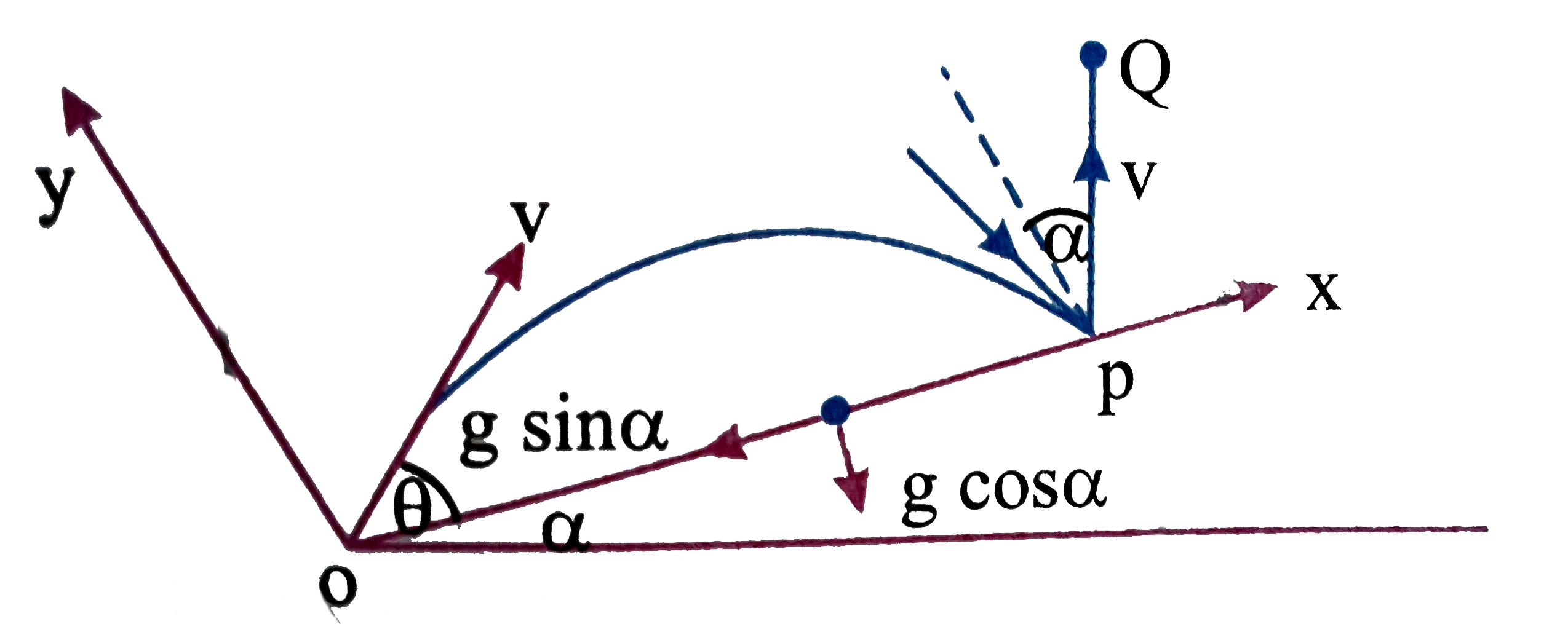 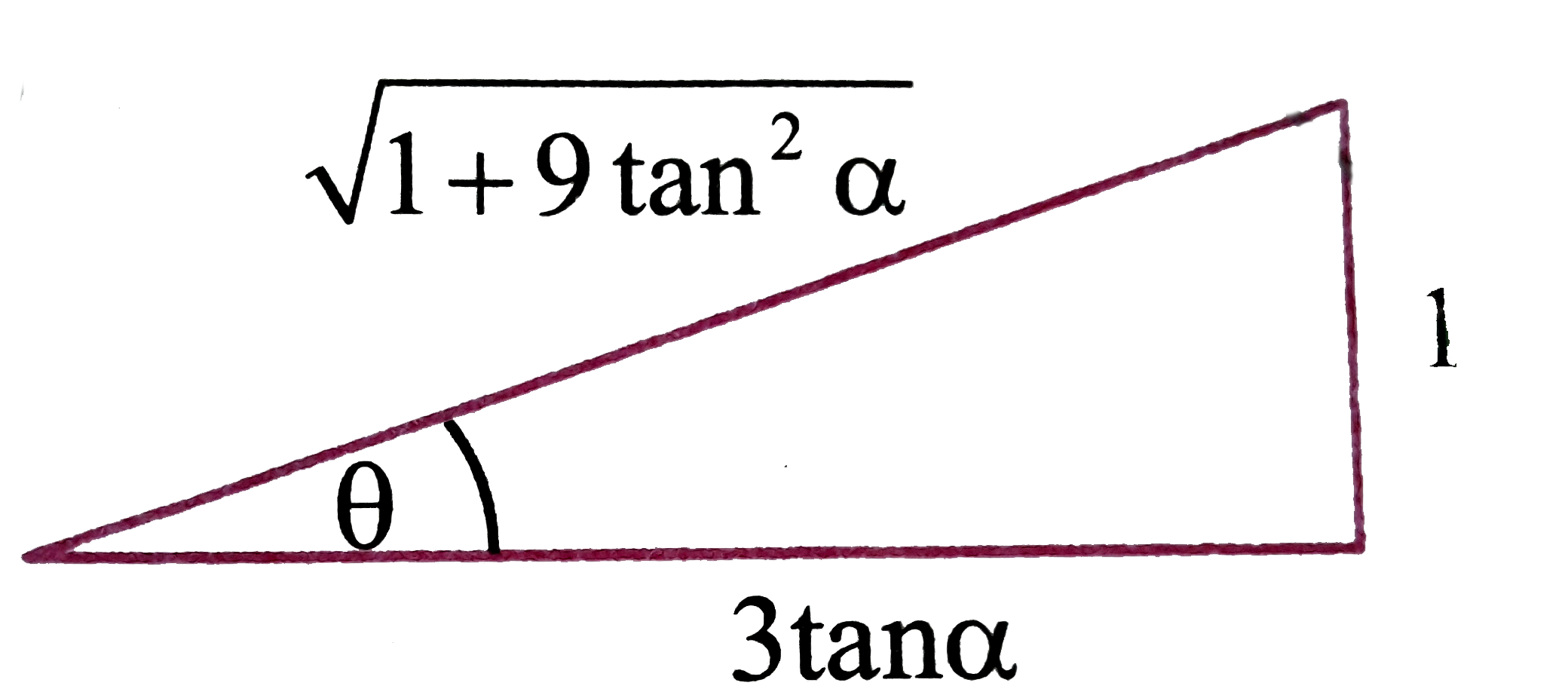
|
|
| 46. |
A drum of 40 cm radius has a capacity of 440 dm^(3) of water. Itcontains 396 dm^(3) of water and is placed on a solid block of exactly the same size as of drum. If a small hole is made at lower end of the drum perpendicular to its length, find the horizontal range of water on the ground in the beginning. Given g=10m//s^(2) |
|
Answer» Solution :Radius of drum, `r=40cm` VOLUME of the drum `=440dm^(3)` `=4.4xx10^(5)cm^(3)` `[thereforedm=0.1m=10cm]`  If h is the HEIGHT of the drum, then `pir^(2)h=4.4xx10^(5)` (or)`h=(4.4xx10^5)/((22//7)xx40xx40)` `=87.5cm`Height of block, `h_(1)=h=87.5cm` Volume of water `=396dm^(3)` `=3.96xx10^(5)cm^(3)` Let `h_(2)` be the height of the water column in the drum. Then `pir^(2)h^(2)=3.96xx10^(5)` `h_(2)=(3.96xx10^(5))/((22//7)xx(40)^(2))=78.75cm` Time taken by water to reach the GROUND, `t=sqrt((2h_1)/(g))` Velocity of efflux of water, `V=sqrt(2gh_2)` Horizontal range, `R=Vt=sqrt(2gh_2)xxsqrt((2h_1)/(g))` `=2sqrt(h_(1)h_(2))` `=2sqrt(87.5xx78.75)=166cm` |
|
| 47. |
Acceleration time graph of a particle is shown. Workdone by all the force acting on the particle of mass m in time interval t_(1) and t_(2), while a_(1) and a_(2) is the acceleration at time t_(1) and t_(2). Then find the value of a_(1) is (ma_(1)^(2))/(m_(1)^(2))[t_(2)^(4)-t_(1)^(4)]. Then the value of n is |
| Answer» | |
| 48. |
Two rods A and B of same length and radius are joined together. The thermal conductivity of A and B are 2K and K. Under steady state conditions, if temperature difference between the open ends of A and B is 36^(@)C, the temperature difference across 'A' is |
|
Answer» `12^(0)C ` |
|
| 49. |
The diameter and height of a narrow cylindrical vessel are 10 cm and 15 cm respectively. The vessel contains 200cm^(3) of water and the mass of the vessel is 114 g. The vessel is then placed inside a large vessel and water is poured into it. For what maximum level-height of water in the large vessel, will the cylindrical vessel just float up? |
|
Answer» |
|
| 50. |
Three equal masses of m kg each are fixed at the vertices of an equilateral triangle ABC. (a) What is the force acting ona mass 2 m placed at the centroid G of the triangle ? (b) What is the force if the mass at the vertex A is doubled ? (Take AG = BG = CG = 1 m ) |
Answer» Solution :(a)  As shown in figure, by taking co-ordinate system such that the centroid of triangle will be origin. `angle"XGC" = angleX.GB=30^@` Distance of EVERY vertice from the centroid G of a triangle is l = 1 m The forces on particles A, B and C at the G by the particle on G are respectively `vecF_(GA)=(Gm(2m))/l^2.hatj` `vecF_(GB)=(Gm(2m))/l^2(-(1)cos30^(@)hati-(1)sin30^(@) hatj)` `vecF_(GC)=(Gm(2m))/l^2((1)cos30^(@)hati-(1)sin30^(@) hatj)` `:.` The resultant force on particle at G, `VECF=vecF_(GA)+vecF_(GB)+vecF_(GC)` `= Gm(2m) [(hatj- cos 30^(@) hati + cos 30^(@) hatj- sin 30^(@) hatj-sin30^(@) hatj)]` `[ :. l = 1 implies l^(2) =1 ]` `=2 Gm^(2)[hatj-0-2xx1/2hatj][:.sin30^(@) =1/2]` `= 2 Gm^(2) [ hatj-hatj]` = 0 `implies` (b) If mass of A is doubled then Resultant force `F.=vecF_(GA)+vecF_(GB)+vecF_(GC)` `= 4 Gm^(2) hatj-2Gm^(2) (2 sin 30^(@))hatj` `F.=4Gm^(2) hatj- 2Gm^(2) hatj-2Gm^(2) hatj"" [:. sin 30^(@) = 1/2]` `:. F. = 2Gm^(2) hatj` |
|


