

Saved Bookmarks
| 1. |
The system of mass A and B shown in the figure is released from rest with x=0, determine the velocity of mass B when x=3m. Also find the maximum displacement of mass B. |
|
Answer» Solution :Constraint relation gives `2sqrt(X^(2)+16)+y=c` Differentiating w.r.t. time, we GET `(dy)/(dt)= -(x)/(sqrt(x^(2)+dt))(dx)/(dt)` Let `(dx)/(dt)=v=` velocity of `B` `:. (dy)/(dt)=` velocity of `A=-(x)/(sqrt(x^(2)+16))v` Minus sign indicates that it in upward direction. `:.` Using energy conservation `MG.3-(mg)/(sqrt(2)).2=(1)/(2)mv^(2)+(1)/(2)(m)/(sqrt(2))(v.(3)/(5))^(2)` `RARR (3-sqrt(2))g=(v^(2)(25sqrt(2)+9))/(50sqrt(2))` `rArr v=sqrt(((3-sqrt(2))(50sqrt(2)))/(25sqrt(2)+9))g=5 m//s` Let `x_(1)` be the maximum displacement of `B`, then `mgx_(1)-(mg)/(sqrt(2))2[sqrt(x_(1)^(2)+16)-4]=0` `rArr x_(1)=8sqrt(2)m`. 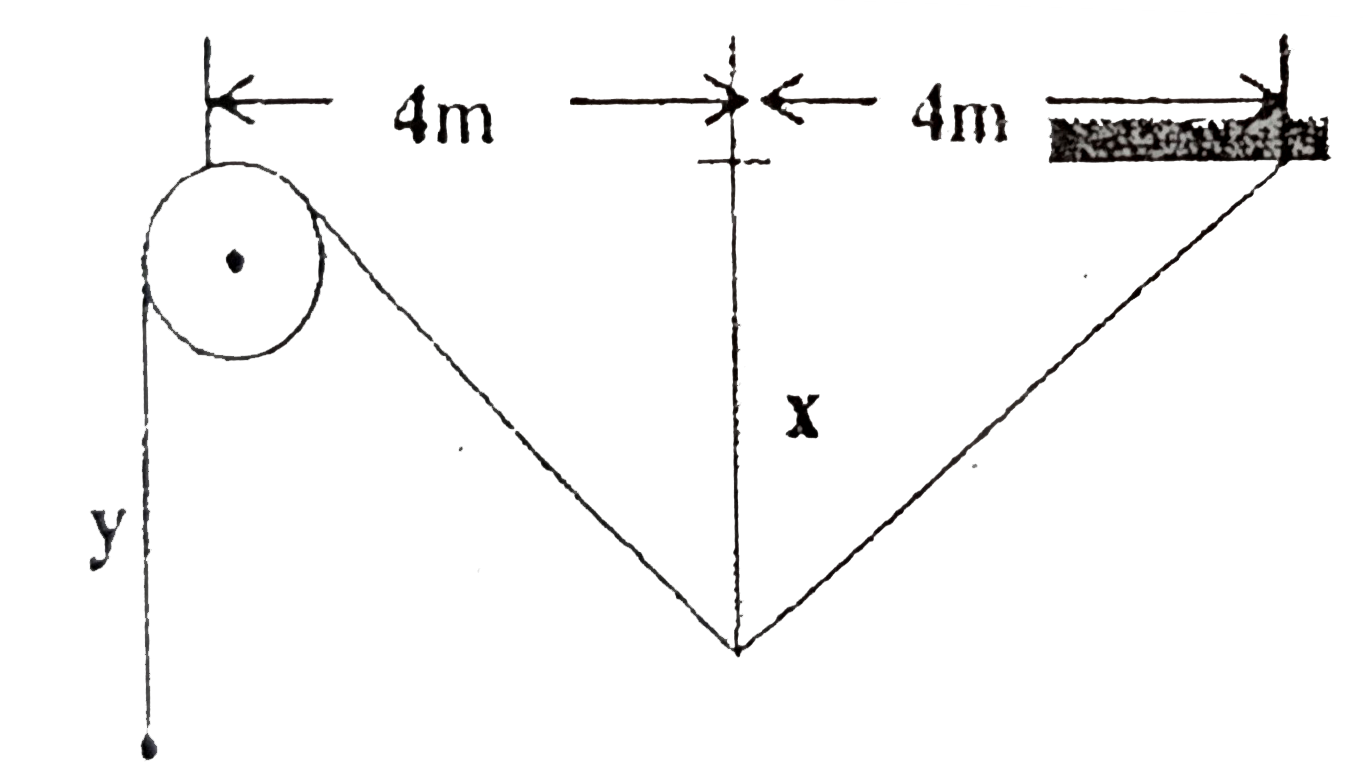
|
|