

Saved Bookmarks
This section includes 7 InterviewSolutions, each offering curated multiple-choice questions to sharpen your Current Affairs knowledge and support exam preparation. Choose a topic below to get started.
| 1. |
(A) : In javelin throw, the athlete throws the projectile at an angle slightly more than 45^(@) ( R) : The maximum range does not depend upon angle of projection. |
|
Answer» Both (A) and ( R) are ture and ( R) is the CORRECT explanation of (A) |
|
| 2. |
A light body and a heavy body have equal kinetic energies. Which one has larger momentum? |
|
Answer» Solution :`K= P^2/(2M)` `therefore P= sqrt(2mK)` For the same kinetic energy, `P prop sqrtm`. So the heavy body has LARGER MOMENTUM. |
|
| 3. |
If a gas occupies 25 lit under a pressure of 72 cm of Hg at 37^(@)C,what is its volume when a pressure of 75 cm of Hg is applied at 27^(@)C. |
|
Answer» SOLUTION :`P_(1)=72cm` of Hg , `P_(2) = 75` cm of Hg , `T_(1)=37+273=310K, T_(2)=27+273=300K` `V_(1)=25"lit",V_(2)=?` From GAS equation, `(P_(1)V_(1))/(T_(1))=(P_(2)V_(2))/T_(2) RARR (P_(1)V_(1)T_(2))/(P_(2)T_(1))=(72 times 25 times 300)/(75 times 310)=720/310=23.23` litres. |
|
| 4. |
What happens to the acceleration due to gravity on account of rotation? |
| Answer» SOLUTION :The ACCELERATION DUE to GRAVITY DECREASES due to rotation of the earth. | |
| 5. |
The torque acting on a body is the rotational analogue of |
|
Answer» mass of the BODY |
|
| 6. |
When a bicycle is in motion, the force of friction exerted by the ground on the two wheels is such that it acts |
|
Answer» in the backward DIRECTION on the front wheel and in the FORWARD direction on the REAR wheel |
|
| 7. |
Consider a rectangular block of wood moving with a velocity v_(0) in a gas at temperature T and mass density roh. Assume the velocity is along X-axis and area of cross section of the block perpendicular to v_(0) is A. Show that the drag force on the block is 4(roh) A v_(0) (sqrt(KT))/(m), where m is the mass of the gas molecule. |
|
Answer» Solution :In fig., we have shown a rantangular wooden block of cross sectional area A moving with velocity `upsilon_(0)` ALONG X-axis. m is mass of gas molecules moving with velocity `upsilon` along X-axis. Number of collisions//sec = collision frequency `f =1/2 ` (surface area `xx` velocity `xx` number of molecules//vol.) `1/2 A (upsilon+upsilon_(0))xxn` (The factor 1/2 is due to molecules moving away from the block ) Momentum transferred by a molicule during one collision with face `1 = 2 m(upsilon+upsilon_(0))` `:.` Total force ACTING on face 1 of block `F_(1) = 2m(upsilon+upsilon_(0)) xx f = 2m (upsilon+upsilon_(0)) 1/2 A(upsilon+upsilon_(0)) xxn` `= rho A(upsilon+upsilon_(0))^(2)` similary, force acting on face 2 of block, `F_(2) =rho A (upsilon+upsilon_(0))^(2)` Where `(upsilon+upsilon_(0))` is relative speed of molecules w.r.t. face 2 of block `:.` net force acting on the block (i.e., drag force), `F =F_(1)-F_(2) = rho A(upsilon+upsilon_(0))^(2) - rho A (upsilon+upsilon_(0))^(2) = rho A (4upsilon upsilon_(0)) = 4 rho A upsilon_(0) upsilon` ...(i) As motion is along X-axis only, therefore, from law of equipartition of energy `1/2 m upsilon^(2) = 1/2 k_(B)T` or `upsilon = sqrt((k_(B)T)/(m))` Putting in (i) we get ` F =4 rho A upsilon_(0)sqrt((k_(B)T)/(m))`. 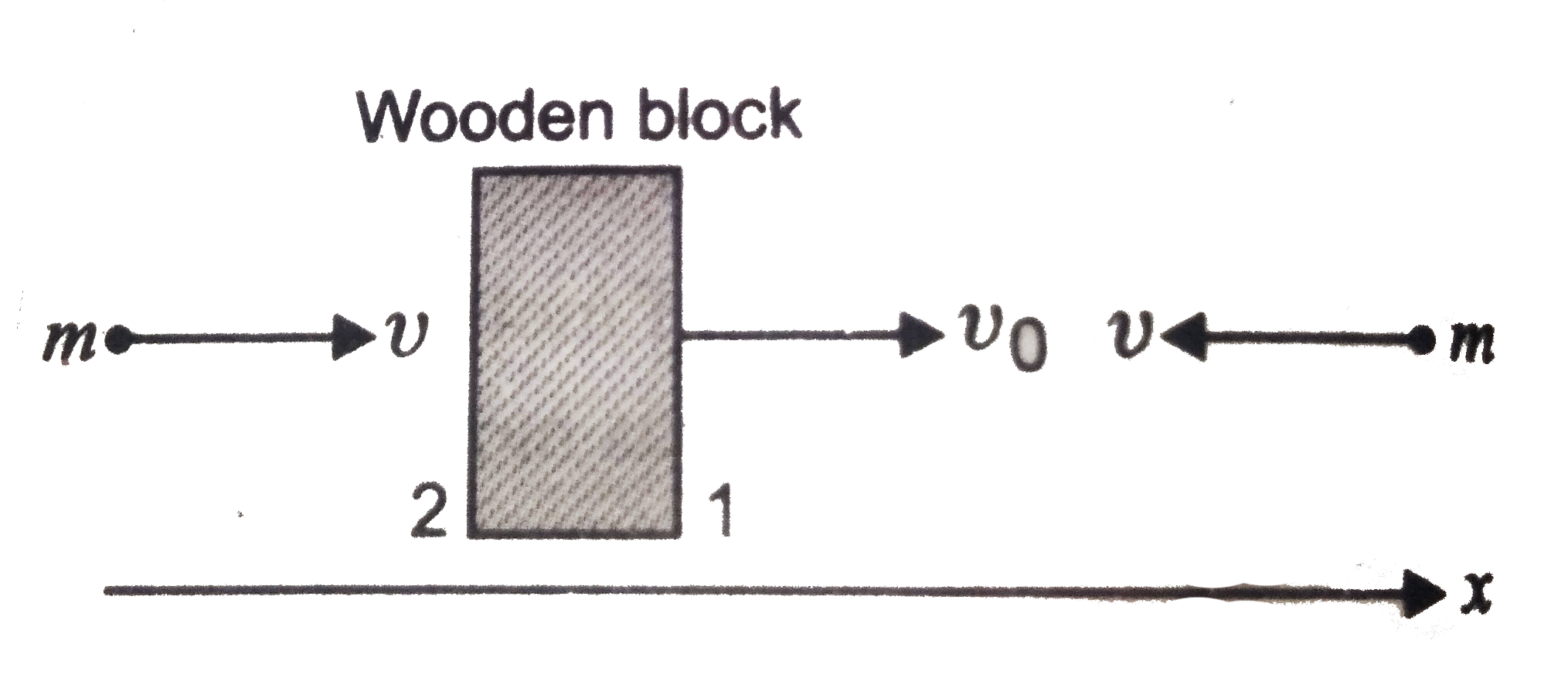
|
|
| 8. |
In an experiment, the percentage of error occurred in the in the measurement of physical quantities A,B,C and D are 1%, 2%,3% and 4% respectively. Then the maximum percentage of error in the measurement X, where X=(A^(2)B^(1//2))/(C^(1//3)D^(3)), will be |
|
Answer» `10%` Maximum percentage ERROR in X `((dX)/(X)) xx 100= (2(dA)/(A)+ (1)/(2)(dB)/(B)+ (1)/(3)(dC)/(C)+ 3(DD)/(D)) xx 100= 2 xx 1+ (1)/(2)xx2 + (1)/(3) xx 3+ 3 xx 4= 16%` |
|
| 9. |
Prove Bernoulli 's Principle .OR Obtain Bernoulli's equation for steady incompressible irrotational and viscous liquid. |
|
Answer» Solution :A pipe is shown in figure. At point B of left end of pipe Cross sectional area `=A_(1)`. Pressure EXERTED on fluid `P_(1)=(F_(1))/(A_(1))`.  At point D , of right end of pipe , Fluid speed `=v_(2)` Cross esctional area `=A_(2)` Pressure exerted on the fluid `P_(2)=(F_(2))/(A_(2))`. Force `F_(1)=P_(1)A_(1)` exerted onfluid at point B, covers distance `v_(1)Deltat` and reaches at point C. the work done on fluid `W_(1)=` (Force)(displacement) `W_(1)=P_(1)A_(1)v_(1)Deltat` `thereforeW_(1)=P_(1)(DeltaV_(1))` ....(1) where `DeltaV=A_(1)v_(1)Deltat=` volume of fluid) Fluid at point d, covers distance `v_(2)Deltat` and reaches at point E, the work done by the fluid. `W_(2)=-P_(2)A_(2)v_(2)Deltat` `thereforeW_(2)=-P_(2)DeltaV` ....(2) where `DeltaV=A_(2)v_(2)Deltat`= volume of fluid) According to equation of continuity both fluids have same volume. Total work done on the fluid `W=W_(1)+W_(2)` `W=P_(1)DeltaV-P_(2)DeltaV` `W=(P_(1)-P_(2))DeltaV` ....(3) Part of this work goes into changing the kinetic energy of the fluid and part goes into changing the gravitational potential energy. `W=DeltaK+DeltaU` .... (4) The mass flowing fluid of density `RHO` at TIME `Deltat`. `Deltam="Volume"xx"Density"` `Deltam=rho(DeltaV)` ...(5) This liquid when moves from B to D its velocity becomes `v_(1)` to `v_(2)` . Hence change in its kinetic energy `DeltaK=(1)/(2)m(v_(2)^(2)-v_(1)^(2))` `DeltaK=(1)/(2)rhoDeltaV(v_(2)^(2)-v_(1)^(2))`.....(6) When fluid of mass `Deltam` move from B to D , it posses HEIGHT from `h_(1)` to `h_(2)(h_(2)gth_(1))` . Hence its potential energy is botained as below `DeltaU=mg(h_(2))-mg(h_(1))` `DeltaU=mg(h_(2)-h_(1))` `DeltaU=(rhoDeltaV)g(h_(2)-h_(1))`....(7) The values of W , `DeltaK,DeltaU` in equation (4) from equation (3),(6),(7) `(P_(1)-P_(2))DeltaV=(1)/(2)rhoDeltaV(v_(2)^(2)-v_(1)^(2))+(rhoDeltaV)g(h_(2)-h_(1))` Dividing each by `DeltaV` `P_(1)-P_(2)=(1)/(2)rho(v_(2)^(2)-v_(1)^(2))+rhogh_(2)-h_(1))` `thereforeP_(1)-P_(2)=(1)/(2)rhov_(2)^(2)-(1)/(2)rhov_(1)^(2)+rhogh_(2)-rhogh_(1)` `thereforeP_(1)+(1)/(2)rho_(1)^(2)+rhogh_(1)=P_(2)+(1)/(2)rhov_(2)^(2)+rhogh_(2)` ....(8) Equation (8)is called Bernoulli.s equation In general `P+(1)/(2)rhov^(2)+rhogh=` constant ....(9) In words the Bernoulli.s equation may be stated as follows : As moving along a streamline the sum of the pressure (P) , the kineticenergy per unit volume `((1)/(2)rhov^(2))` and the potential energy per unit volume `(rhogh)` remains a constant. |
|
| 10. |
Name two physical changes that occur on heating a body. |
| Answer» SOLUTION :VOLUME and ELECTRICAL RESISTANCE. | |
| 11. |
Inside a uniform spherical shell a) the gravitational potential is zero b) thegravitational field is zero c) the gravitational potential is same everywhere d) the gravitational field is same everywhere |
|
Answer» only a & B are TRUE |
|
| 12. |
A light ray travels from a denser medium to a rarer medium. IF the critical angle of the denser medium with respect to rarer medium is C. the maximum possible deviation of any ray will be: |
|
Answer» `pi-C` |
|
| 13. |
In the phase diagramshowns, the point Qcorrespondsto the triple pointof water.The regionI, IIand III respectivelycorrespond to phases |
|
Answer» liquid, SOLID,vapour REGION I - Liquid Region II - Solid Region III - Vapour |
|
| 14. |
Is it possible to realize whether a vessel kept under the tap is about to fill with water? |
|
Answer» SOLUTION :The frequency of the note produced by an air column is inversely proportional to its length. As the level of water in the vessel RISES, the length of the air column above it decreases. It produces sound of DECREASING frequency. i.e., the sound becomes SHORTER. From the SHRILLNESS of sound, it is possible to realize whether the vessel is filled with water. `v_("min") = 11.71 ms^(-1)`. |
|
| 15. |
An object describes 225 m in the first 3s and 400m in the next 2s . Calculate the velocity after 5s . From the start |
|
Answer» |
|
| 16. |
On a smooth inclined plane a body of mass M is attached between two springs. The other ends of the spring are fixed to ffirm supports. If each spring has a force constant k, the period of oscillation of the body is: (assuming the spring as massless) |
|
Answer» `2pisqrt(M/(2K))` |
|
| 17. |
A drunkard is walking along a straight road.He takes 5 steos forward and 3 step backward and so on.Each step is 1m long and takes 1s.There is a pit on the road 11m away fro the starting point.The drunked will fall into the pit after |
|
Answer» 21s |
|
| 18. |
If accidently the calorimeter remained open to atmosphere for some time during the experiment, due to which the steady state temperature comes out to be 30^(@)C, then total heat loss to surrounding during the experiment, is (Use the specific heat capacity of the liquid from previous questions). |
|
Answer» `20 kcal` `=(1000)(1//2)(80-30) = 25000 cal` Heat absorbed by the water calomiter SYSTEM `=(900)(1)(30-20)+(200)(1//2)(30-20)` `=10,000 cal` So heat loss to surrounding =`15000 cal`. |
|
| 19. |
A solid copper cylinder of length L = 0.65m is placed on a horizontal surface and subjected to a vertical compressive force F=1000Ndirected down-ward and distributed uniformly over the end face. What will be the resulting change in volume of the cylinder if Young.s modulus of copper is 1.3xx10^(11)Nm^(2) and Poissons ratio sigma=0.34 |
|
Answer» Solution :`sigma=(-(dr)/(r))/((DL)/(L)) (dr)/(r)=-(sigmadl)/(l) , V= pi r^(2)L, (DV)/(V)=(2dr)/(r)+(dL)/(L) RARR (dV)/(V)=-2 sigma (dL)/(L)+(dL)/(L)` `(dV)/(V)=(dL)/(L)[1-2sigma] rArr dV=V(dL)/(L) [1-2sigma],dV= PIR^(2)L "strin" [1-2sigma] , dV=A.L.F//AY[1-2 sigma]` `dV=(FL)/(Y)[1-2sigma], dV=(100xx0.65)/(1.3xx10^(11))[1-2xx0.34]=1.6xx10^(-9)m^(3) rArr dV=1.6 mm^(3)` |
|
| 20. |
The angle between the vectors (i + j + k) and (i- j - k) is |
|
Answer» `"SIN"^(-1) (sqrt8)/(3)` |
|
| 21. |
The van der Waal.s equation for a gas is (P + (a)/( V^2) ) (V-b) ="nRT" where P, V, R, T and n represent the pressure, volume, universal gas constant, absolute temperature and number of moles of a gas respectively. a and b are constants. the ratio b/a will have the following dimensional formula |
|
Answer» `M^(-1) L^(-2) T^(2)` |
|
| 22. |
If the ice at the poles melts and flows towards the equator, how will it affect the duration of day-night? |
|
Answer» Solution :By the LAW of conservation of angular momentum, no external TORQUE acts on EARTH. So its angular momentum is a constant ie., `I omega =a` constant. As ICE meits there is redistribution of mass. Hence the MX of earth increases. So the angular velocity decreases i.e., theperiod ofrotation rincreases. i.e, duration of a day will increase. `T = (2pi)/omega` duration of a day will increase. |
|
| 23. |
The thickness of icein a lakeis 5 cm and theatmospherictemperatureis- 10^(@)C. Calculate the timerequired for the thickness of ice to growto 7 cm . Thermal conductivityof ice= 4 xx 10^(-3)cal//cm-s-""^(@)C , density of ice= 0.92 g //cm^(3) and specific latentheat of fusion for ice= 80cal/g. |
|
Answer» Solution :Here `x_(1) = 5 CM , x_(2) = 7 cm , T = - 10^(@)C , k = 4 XX 10^(-3) CAL//cm -s-""^(@)C , L = 80 cal//g ` and`rho = 0.92 g //cm^(3)` Using`Delta t = (rho L)/(2kT) (x_(2)^(2)- x_(1)^(2))` we have , the required `Delta t ` as` = (92 xx 10^(-2))/(2 xx 4 xx 10^(-3) cakl//cm-s-""^(@)C)(g)/(cm^(3)) xx (80)/(10^(@)C) (cal)/(g)(7^(2) - 5^(2)) cm^(2) = (92 xx 80 xx 24)/(8) s = 22080s` =6.13 hr . |
|
| 24. |
Internal energy of a gram molecule of ideal gas depends on |
|
Answer» PRESSURE alone |
|
| 25. |
A mixture of a gas consists of 2 moles of oxygen and 4 moles of argon at the temperature 27^@C. Find the total internal energy of the system(Neglect all vibrational modes) |
|
Answer» SOLUTION :OXYGEN is DIATOMIC and ARGON is monatomic. Total internal energy U = `U_O + U_(Ar) = 2xx5/2 RT + 4xx3/2 RT = 11RT = 11xx8.31xx300` = 27423J. |
|
| 26. |
50 grams of ice at 0^@Cis mixed with 40 gm of water at 60^@CThen the ratio of ice and water at equilibrium is |
|
Answer» `2:7` |
|
| 27. |
ABCDECA is planar body of mass m of unifrom thickness and same material. The dimensions are as shown in the figure. The moment of inertia of the body about an axis passing through point A and perpendicular to planar body is I_(1) and that of about an axis passing through C and perpendicular to planar body is I_(2). If I_(1)//I_(2) is k Find the value of k. |
|
Answer» |
|
| 28. |
Two rods A and B of same material and length have their radii r_(1) and r_(2) respectively. When they are rigidly fixed at one end and twisted by the same couple applied at the free end, the ratio ( cancel(O)_(A))/( cancel(O)_(B))= ( "angle of twist at the end of A")/( "angle of twist at the end of B") |
|
Answer» `(r_(1)^(2))/( r_(2)^(2) )` |
|
| 29. |
(A): The root mean square velocity of molecules of a gas having Maxwellian distribution of velocities is higher than their most probable velocity, at any temperature.(R): A very small number of molecules of gas possess very large velocities |
|
Answer» If both (A) and (R) are TRUE and (R) is the CORRECT explanation of (A) |
|
| 30. |
A thin rod of mass 'm' and length 2L is made to rotate about a normal axis through centre of rod. If its angular velocity changes from 'O' to 'omega in time 't'. The torque acting on it is |
|
Answer» `ML^(2)omega//12t` |
|
| 31. |
See Fig. A mass of 6 kg is suspended by aropeoflength 2 m from the ceiling.A force of 50 N in the horizontal direction isappliedatthe mid- point P of the rope, as shown. What is the angle the rope makes with the vertical in equilibrium ?(Take g = 10 m s^(-2) ). Neglect the mass of the rope. |
|
Answer» Solution :Figures (b) and (c) are known as free-body DIAGRAMS. Figure (b) is the free-body diagram of W and Fig. (c) is the free-body diagram of POINT P. Consider the equilibrium of the weight W. Clearly `T_2 = 6 XX 10 = 60 N` Consider the equilibrium of the point P under the action of three forces - the tensions `T_1` and `T_2`, and the horizontal force 50 N.The horizontal and vertical components of the resultant force must vanish separately : `T_1 cos theta = T_2 = 60 N` `T_1 sin theta = 50 N` which gives that `tan theta = 5/6 ortheta = tan^(-1) (5/6) = 40^@` |
|
| 32. |
A' and 'B' are the two pegs separated by 13 cm. A body of 169 Kgwt is suspended by thread of 17 cm connecting to A & B, such that the two segments of strings are perpendicular. Then tensions in shorter and longer parts of string having are |
|
Answer» 100 kgwt, 69 kgwt |
|
| 33. |
Three vectors satisfy the relation vec(A).vec(B)= 0 and vec(A).vec(C )= 0, " then " vec(A) is parallel to |
|
Answer» `VEC(C )` |
|
| 34. |
A particle leaves the origin with an initial velocity hatv=(3.00hati) m//s and a constant acceleration When the particle reaches its maximum x coordinate what are (a) its velocity and (b) its position vector ? |
|
Answer» |
|
| 35. |
A rifle of 20 kg mass can fire 4 bullets/s. The mass of each bullet is 35xx10^(-3)kg and its final velocity is 400ms^(-1). Then, what force must be applied on the rifle so that it does not move backwards while firing the bullets |
|
Answer» Solution :Law of conservation of MOMENTUM, `MV+4mv=0` `RARR V=-(4mv)/(M)=(4xx35xx10^(-3)xx400)/(20)=-2.8ms^(-1)` Force APPLIED on the rifle `F=(MV)/(t)=-(20xx2.8)/(1)=-56N` |
|
| 36. |
Obtain and expression for thework done by a torque. |
Answer» Solution : LET `F_1` be the force on `P_1` at a DISTANCE `r_1` from O. The are distance `P_1P_2=ds_1` i.e. `ds_1=r_1dtheta` Work done by the force `dW_1=F_1ds_1cosphi_1` i.e `dW_1=F_1(r_1dtheta)sinprop_1` `:'phi_1+prop=90^(@)` `cosphi_1=cos(90-prop)=sinprop` i.e `dW_1=tau_1dtheta. :.tau_1=F_1r_1sinprop_1` If there are more than one force acting at DIFFERENT points on the body, then the total work done by the torque `dW=dW_1+dW_2+dW_3+.......dW_n` i.e., `DQ=(tau_1+tau_2+...+tau_n)dtheta` i.e `dW=taudtheta` where `tau=sumtau_i` |
|
| 37. |
Spherical balls of radius R are falling in a viscous fluid of viscosity eta with a velocity v. The retarding viscous force acting on the spherical ball is |
|
Answer» DIRECTLY proportional to R but INVERSELY proportional to V |
|
| 38. |
Select the correct cause for the given situation when a horse pulls a wagon the force that causes the horse to move forward is the force |
|
Answer» the GROUND EXERTS on him |
|
| 39. |
A mass attached to a spring is free to oscillate, with an angular velocity omega in a horizontal plane without friction or damping. It is pulled to a distance x_(0) and pushed towards the centre with a velocity v_(0) at tmet t=0. Determine the amplitude of the resulting oscillations in terms of the parameter omega, x_(0), v_(0) (Hint : Start with the equation x=a cos (omega t+theta) and note that the initial velocity is negative.) |
|
Answer» Solution :Given `x=a cos (omegat+THETA)` velocity `v=(dx)/(dt)=-(a omega)sin(omegat+theta)` `"i.e."x_(0)=a cos theta` `"i.e."v_(0)=-(a omega)sin(0+theta)"……(1)"` `v_(0)=-omega sin(theta)` or `a sin theta=-(v_(0))/(omega)".........(2)"` Solving (1) and (2) and adding we get `a^(2)=x_(0)^(2)+(v_(0)^(2))/(omega^(2))` or `a=sqrt(x_(0)^(2)+((v_(0)^(2))/(omega^(2))))` |
|
| 40. |
When an air bubble of radius r rises from the bottom (the to the surface of a lake. Its radius becomes (5r)/4 pressure of the atmosphere is equal to the 10 m height of water column). If the temperature is constant and the surface tension is neglected the depth of the lake is |
|
Answer» `3.53`m |
|
| 41. |
A and B are two objects-moving with velocities oversettoV_Aand oversettoV_B.Assertion: The range of a projectile remains the same for the angle of projection 30^@ and 60^@.Reason: The range does not depend on the angle of projection. Choose the correct answer: |
|
Answer» Both ASSERTION and REASON are CORRECT. |
|
| 42. |
Two discs have same mass and thickness. Their materials are of densities d_(1) and d_(2). The ratio of their moments of inertia about an axis passing through the centre and perpendicular to the plane is |
|
Answer» `d_(1) : d_(2)` `R^(2)=(m)/(PID)` Now, `I=(1)/(2)mR^(2)=(m^(2))/(2pitd)or I prop (1)/(d)` `:.` The RATIO of moments of inertia, `(I_(1))/(I_(2))=(d_(2))/(d_(1))`. |
|
| 43. |
A jet plane usually fllies at a considerable height but a propeller plane fllies at a low altitude. Explain. |
|
Answer» Solution :A jet plane function on the principle of CONSERVATION of linear momentum. GAS is ejected from the rear end of the plane ata high speed and thus the plane moves forward. At high altitudes, though the density of air is low, it is sufficient for providing oxidants to the fuel of the plane. Moreover, as the density of air is low at higher altitudes, the production of heat due to friction is reduced. On the other hand, a PROPELLER plane exerts a backward thrust on the air by rotating its blades. the reaction causes the plane to MOVE. This thrust depends on the density of air and therefore this plane flies at LOWER altitudes where the air density is higher. |
|
| 44. |
An engine consumes 20 kg of fuel per hour. The calorific value of the fuel is 12 Kcal g^(-1). Calculate the efficiency of the engine if the power of the engine is 42 kW. |
|
Answer» Solution :CALORIFIC value `= 12xx 10 ^(6) CAL //kg.` Input power `= 240 xx 4.6 // 60 xx 60 W` OUTPUT power `= 42 xx 10 ^(3) W. ` Efficiency = output/input `= 0.15=15%` |
|
| 45. |
A small ball strikes a stationery uniform rod, which is free to rotate, in gravitiy free space. The ball does not stick to the rod The rod will rotate about |
|
Answer» its CENTRE of mass |
|
| 46. |
Under isothermal condition, a soap bubble of radius R is converted into a large soap bubble of radius 2R . If the surface tension of soap solution is T, then calculate the amount of energy spent. |
| Answer» SOLUTION :`24piR^2 T` | |
| 47. |
A particle of mass 'm' is attached to a spring of spring constant K and has a natural frequency omega_0.An external force F(t) proportional to cos (omega t)(omega != omega_0) is applied to the oscillator. The maximum displacement of the oscillator will be proportional to |
|
Answer» `m/((omega_0 - omega^2))` |
|
| 48. |
Two identical blocks 1 and 2, each of mass m, are kept on a smooth horizontal surface, connected to three springs as shown in the figure. Each spring has a force constant k. Under suitable initial conditions, the two blocks oscillate in phase and their respective displacement from the mean position is given by x_(1)=A sin omega t " and " x_(2)=A sin omega t (i) Suggest one such initial condition that will result in such oscillation. (ii) Find omega |
|
Answer» |
|
| 49. |
A hollow sphere of radius 2 cm is attached to an 18 cm long thread to made a pendulum. Find the time period of oscillation of this pendulum. How does it differ from the time period calculated using the formula for a simple pendulum? |
| Answer» SOLUTION :0.89 s , it about 0.3% LARGER than the CALCULATED VALUE | |
| 50. |
If L=2.06cm+-0.02cm, B=1.11cm+-0.03cm. What are (L+B)"and "(L-B)equal to ? |
|
Answer» Solution :`L+B =3.17cm+-0.05cm,L-B=0.95cm+-0.05cm` Please NOTE that actual values i.e., `2.06cm"and "1.11`CM are added in case of `(L+B)`and subtracted in case of `(L-B)`, but ABSOLUTE ERRORS are added in both CASES.. |
|