

Saved Bookmarks
This section includes 7 InterviewSolutions, each offering curated multiple-choice questions to sharpen your Current Affairs knowledge and support exam preparation. Choose a topic below to get started.
| 1. |
An ideal liquid flows through a horizontal tube of variable diameter. The pressure is lowest where the ……………. . |
|
Answer» VELOCITY is hightest |
|
| 2. |
What is the condition for the collision of two bodies to be one-dimensional? |
| Answer» Solution :The speeds of the centres of MASS of the two particles before COLLISION must be along the same STRAIGHT LINE. | |
| 3. |
For solids with elastic modulus of rigidity, the shearing force is proportional to shear strain. On what factor does it depend in case of fluids ? |
| Answer» SOLUTION :RATE of SHEAR STRAIN. | |
| 4. |
A nucleusis atrestin thelabortoryframeof referenceshowthat ifitdisintegratesintotwosmallernuclei. Theproductsmust be emitted in oppositedirections . |
|
Answer» Solution :Let`m_1 : m_2`are bethe massesof productand `v_1 , v_2` are thevelocitiesof it. `THEREFORE `linearmomentumafterdistantegration`- m_1 v_1 +m_2 +v_2` Before.Accordingto theprincipleof conservationof LINEARMOMENTUM `m_1 v_1 + m_2 v_2 =0` `V_2=-(m_1V_1)/(m_2)` |
|
| 5. |
Find the position of instantaneous centre of rotation and angular velocity of the disc in the following cases as shown. Radius of disc is R in each case. |
|
Answer» <P> SOLUTION :a. `(v_(P))/(v_(Q))=(2R+x)/x``=(2V)/v=(2R+x)/x x x` `implies2x=2R+x:. x=2R` `:. Omega=v_Q/x=v/(2R)` `b. v_P/v_Q=(2R-x)/x` `(2v)/v=(2R-x)/x` `:. x=2R//3` and `omega=(v_(Q))/x=(3v)/(2R)` 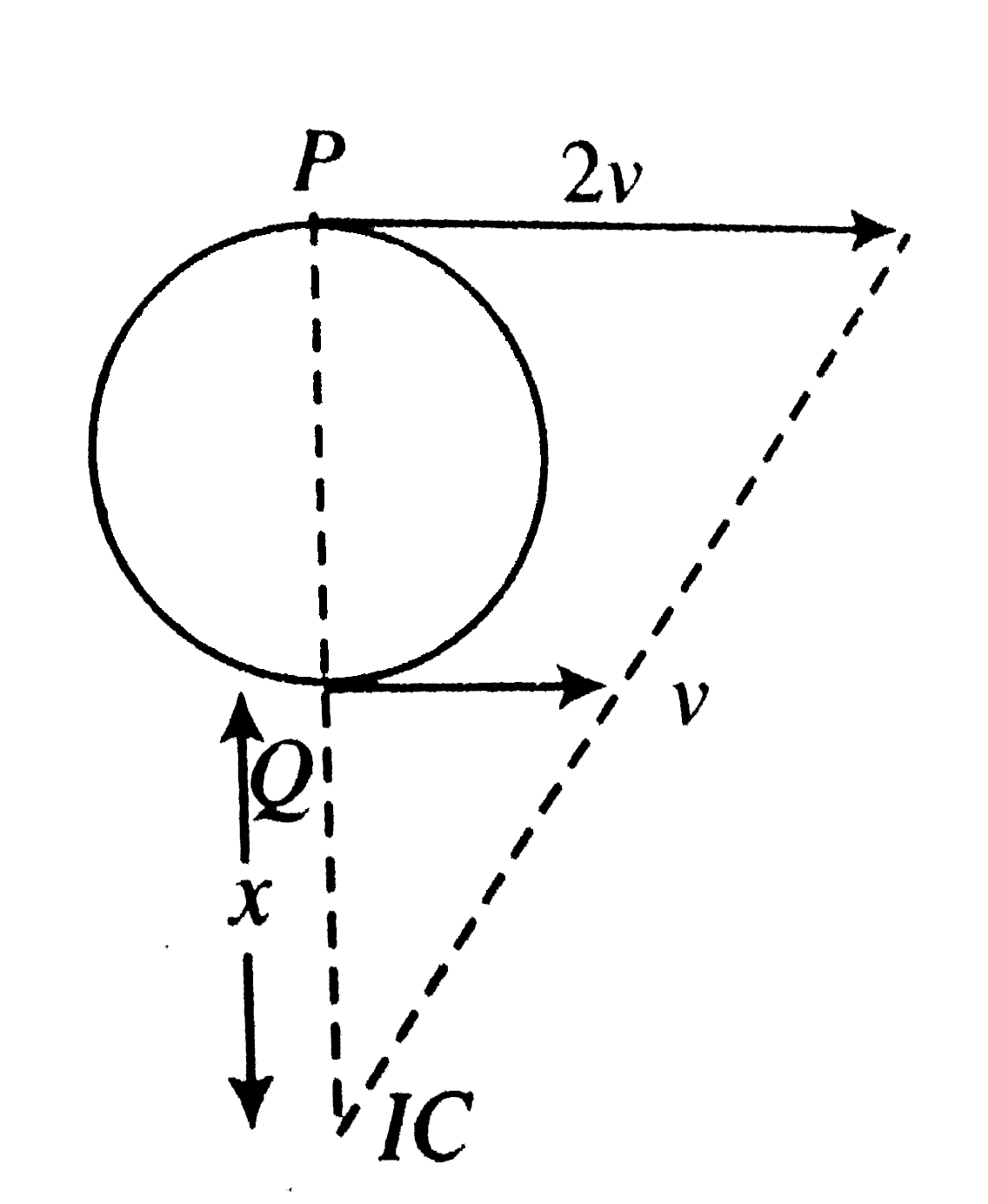 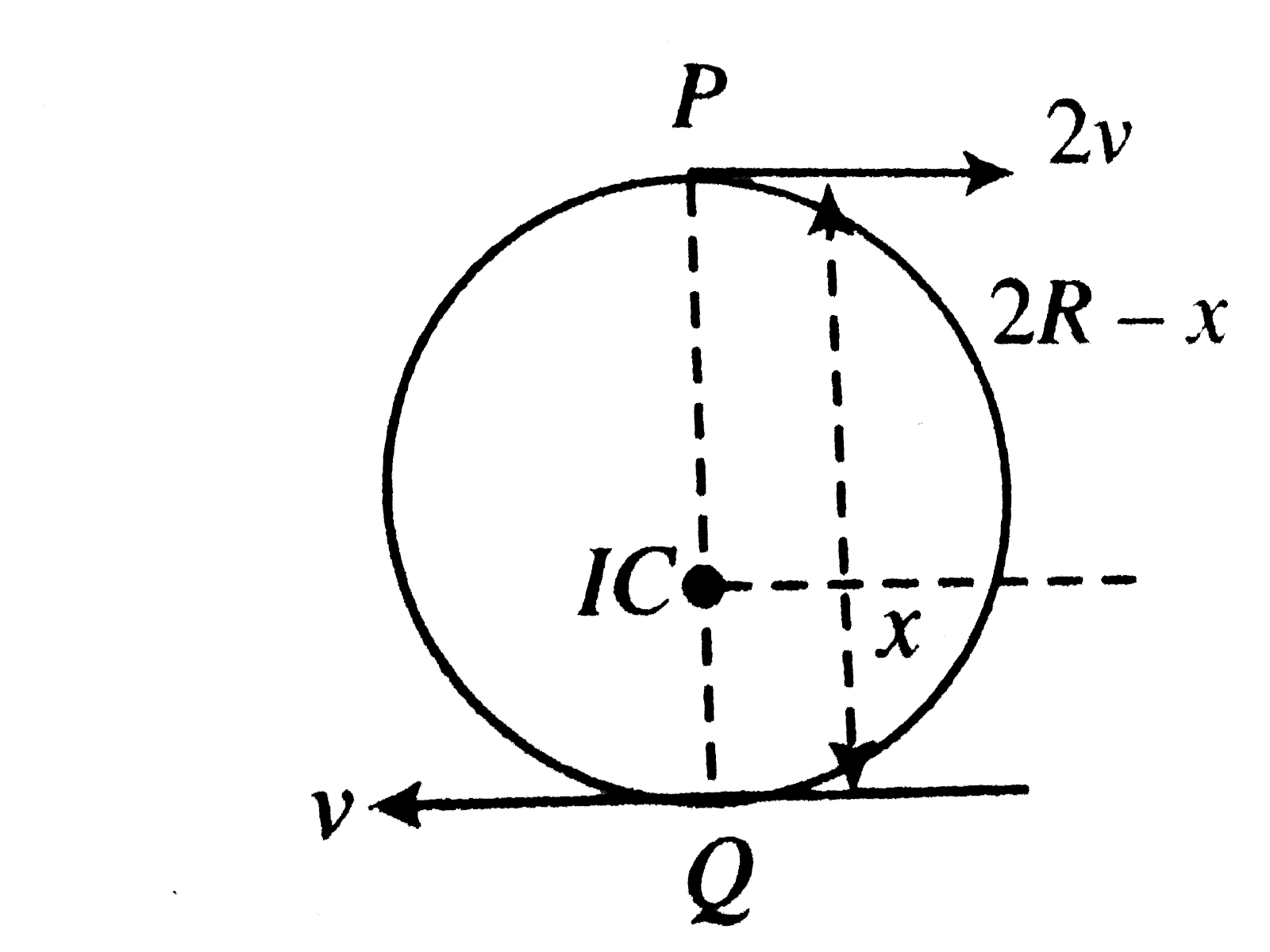
|
|
| 6. |
Two masses m and M are suspeded together by a massless spring of force constant K. When the mass are in equilibrium, M is removed with out disturbing the system The amplutude of oscillation is |
|
Answer» `( MG)/K` |
|
| 7. |
The law which governs the working of a spring balance is |
|
Answer» Kepler.s law |
|
| 8. |
What do you understand by the term parallax angle ? |
| Answer» SOLUTION :In the diagram `angleLOR` is CALLED the PARALLAX ANGLE or PARALLACTIC angle. | |
| 9. |
Two balloons are filled, one with pure He gas and the other with air. If the pressure and temperature in both the balloons are same the number of molecules per unit volume is |
|
Answer» more in both the balloon. |
|
| 10. |
A string passing over a smooth pulley carries a stone at one end, while its other end is attached to a vibrating tuning fork and the string shows 8 loops. When the stone is immersed in water 10 loops are formed. Calculate the specific gravity of the stone. |
|
Answer» |
|
| 11. |
2N molecules of an ideal gas X, each of mass m, and 4N molecules of another ideal gas, Y, each of mass 3m are maintained at the same absolute temperature in the same vessel. The root mean square speed of molecules of X type is v and the root mean square of the component of velocity of molecules of gas Y, along the X axis is u, then (u)/( v)is |
|
Answer» `SQRT(3) :1` |
|
| 12. |
Consider a simple pendulum of length l = 0.9 m which is properly placed on a trolley rolling down on a inclined plane which is at 0 = 45°with the horizontal. Assuming that the inclined plane is frictionless. Assuming that the time period of oscillation of the simple pendulum is T.Find the value of T. |
|
Answer» Solution :LENGTH of the pendulum `l=0.9m` Inclined ANGLE `theta=45^(@)` TIME period of a SIMPLE pendulum `T=2pisqrt((l)/(G.))` `g.=gcostheta` `T=2pisqrt((l)/(gcostheta))=2xx3.14sqrt((0.9)/(9.8xxcos45^(@)))=6.28xxsqrt(0.1298)` `T=2.263s` |
|
| 13. |
Define torque and mention it’s unit. Give any two examples of torque in day-to-day life. |
|
Answer» Solution :TORQUE is defined as the moment of the external applied force about a point or axis of ROTATION. `vec(tau)=vec(r)+vec(F)=(rFsintheta)hat(n)`, Unit is Nm. Examples of torque in day-to-day life:- (i)Opening and closing of a door about the hinges. (ii) Turning of a NUT using a WRENCH. (iii) Opening a bottle cap (or) water top. |
|
| 14. |
There is a tall cylindrical building standing in a field. Radius of the cylinder is R = 8 m. A boy standing at A (at a distance of 10 m from the centre of the cylindrical base of the building) knows that his friend is standing at B behind the building. The line joining A and B passes through the centre of the base of the building. Distance between A and B is 50 m. A wants to throw a ball to B but he realizes that the building is too tall and he cannot throw the ball over it. He throws the ball at a speed of 20 m//s such that his friend at B has to move minimum distance to catch it. (a) What is the minimum distance that boy at B will have to move to catch the ball? (b) At what angle to the horizontal does the boy at A throws the ball?Assume that the ball is released and caught at same height above the ground. [Take g = 10 m//s^(2) and sin^(-1) (0.75) ~= 48.6^(@) |
|
Answer» |
|
| 15. |
A body is projected with velocity u such that its horizontal range and maximum vertical height are same. The maximum heights is |
|
Answer» `(U^(2))/(2G)` |
|
| 16. |
A small ball is projected up a smooth inclined plane with an initial speed of 10m//s at 30^(@) from the bottom edge of the slope. It returns to the edge after 2s. The ball is in contact with the inclined plane throughout the process. The inclination angle (in degree) of the plane is N. The value of N//6 is |
|
Answer» |
|
| 17. |
A gas bubble from an explosion under water oscillates with a period T proportional to p^(a) d^(b)E^(c)where p is the static pressure d is the density of water and E is the total energy of explosion. Find the value of a,b and c. |
|
Answer» Solution :`Tprop p^(a)d^(b)E^(c)` `T=kp^(a)d^(b)E^(c)` TAKING dimensions on both sides `T=[ML^(-1)T^(-2)]^(a)[ML^(-3)]^(b)[ML^(2)T^(-2)]^(c)` `M^(0)L^(0)T=M^(a+b+c)L^(-a-3b+2c)T^(-2a-2c)` Equating the dimensions of M,L and T `a+b+c=0, ""-a-3b+2c=0,""-2a-2c=1` Solving `a=-5/6, b=1/2` and `c=1/2` So we GET `T=kp^(-5//6)d^(1//2)E^(1//2)` or `Tprop p^(-5//6)d^(1//2)E^(1//2)` |
|
| 18. |
When 1 kg of ice at 0^@ C melts to water at 0^@ C, the resulting change in its entropy, taking latent heat of ice to be 80 "cal/".^@C is ____ |
|
Answer» `273 "cal"/K` `THEREFORE DeltaS=(DeltaQ)/T=(mL_f)/273` `therefore DeltaS=(1000xx80)/273`=293 cal/K |
|
| 19. |
A pulling force making an angle theta with the horizontal is applied on a block of weight W placed on a horizontal table. If the angle of friction is phi, the magnitude of the force required to move the body is equal to |
|
Answer» `(W COS phi)/(Cos (theta-phi))` |
|
| 20. |
The specific heat of air at constant pressure is1.005 kJ/kg K and the specific heat of air at constant volume is 0.718 kJ/kgK. Find the specific gas constant. |
|
Answer» 0.287 kj/kg K |
|
| 21. |
A faulty thermometer reads melting point of ice as -5 ^@Cand it reads 70^@Cinstead of 60^@C . What will be temperature of boiling point of water on this scale? |
| Answer» SOLUTION :`120^@C` | |
| 22. |
The value of 117.3 xx 0.0024 with due regard to significant figures is |
|
Answer» 0.2808 |
|
| 23. |
When a small ice crystal is placed into supercooled water, it begins to freeze instant aneously. What amount of ice is formed from 1 kg of water supercooled to -8^(@)C ? |
|
Answer» SOLUTION :`mL=m^(1)s*thetarArrmxx80=(1000-m//2)xx1xx8` On SIMPLIFICATION, m = 95.2 G. |
|
| 24. |
Which of the following will have the dimensions of time? |
|
Answer» `LC` |
|
| 25. |
An open vessel containing water is given a constant acceleration a in the horizontal direction. Then the free surface of water gets sloped with the horizontal at an angle theta given by |
|
Answer» `theta=tan^(-1)(a/g)` |
|
| 26. |
In a spring gun having spring constant 100 N/m, a small ball of mass 0.1 kg is put in its barrel by compressing the spring though 0.05 m as shown in Figure. The ball leaves the gun horizontally at a height of 2 m above the ground. Find(a) The velocity of the ball when the spring is released.(b) Where should a box be placed on the ground so that that ball falls in it.(g=10 m//s^(2)) |
|
Answer» Solution :(a) When the spring is released its ELASTIC potential energy `(1//2)kx^(2)` is converted into kinetic energy `(1//2)mv^(2)` of the BALL, so, by conservation of MECHANICAL energy `(1)/(2) mv^(2)=(1)/(2)kx^(2)rArr v = x sqrt((k)/(m))` So `v = 0.05 sqrt((100)/(0.1))m//s = sqrt((5)/(2))m//s` (b) As initial vertical component of velocity of ball is zero, time taken by the ball to reach the ground,  `t = sqrt((2h)/(g))=sqrt((2xx2)/(10))=sqrt((2)/(5))s` So the horizontal DISTANCE TRAVELLED by the ball in this time `d=vt = sqrt((5)/(2))xx sqrt((2)/(5))=1m` |
|
| 27. |
Write down the postulates of kinetic theory of gases. |
|
Answer» SOLUTION :ACCUMULATE to kinetic theory, (i) The molecules of a gas are in a state of continuous random motion. (ii) They COLLIDE with one another and also with the walls of the VESSEL. Whenever a MOLECULE collides with the wall. It returns with a changed momentum and an equal momentum is transfused to the wall (conservation of momentum). Accumulate to Newton's law, (i) The transfer of momentum to the wall is equal to the fore excited on the wall. (ii) The force excited per unit area of the wall is the pressure of the gas. Hence a gas excites pres. due to the continuous call of its molecules with the walls of the vessel. |
|
| 28. |
When an object be in mechanical equilibrium? |
| Answer» Solution :A RIGID body is SAID to be in mechanical equilibrium when both its linear MOMENTUM and angular momentum remain constant | |
| 29. |
A heavy block kept on a frictionless surface and being pulled by two ropes of equal mass m. At t = 0, the force on the left rope is withdrawn but the force on the right end continues to act. Let F_(1) and F_(2) be the magnitude of the forces by the right rope and the left rope on the block respectively |
|
Answer» `F_(1)=F_(2)=F` for `t lt 0` |
|
| 30. |
A disc rotating about its axis with angular speed ω_(o) is placed lightly (without any translational push) on a perfectly frictionless table. The radius of the disc is R. What are the linear velocities of the points A, B and C on the disc shown in Fig. 7.41? Will the disc roll in the direction indicated ? |
| Answer» SOLUTION :VELOCITY of `A = ω_(o)R` in the same direction as the ARROW, velocity of `B = ω_(o)R` in the opposite direction to the arrow, velocity of `C = ω_(o)R//2` in the same direction as the arrow.The disc will not roll on a frictionless PLANE. | |
| 31. |
A uniform ring of mass m and radius R is released from top of an inclined plane. The plane makes an angle theta with horizontal. The cofficent of friction between the ring and plane is mu. Initially, the point of contact of ring and plane is P. Angular momentum of ring about an axis passing from point P and perpendicular to plane of motion as a function of time t is |
|
Answer» `mgR(SINTHETA)t-mumgR(COSTHETA)t` |
|
| 32. |
A body of mass 10kg is on a rough inclined plane having an inclination of 30° with the horizontal. If coefficient of friction between the surfaces of contact of the body and the plane is 0.5. Find the least force required to pull the body up the plane. |
|
Answer» `80.5N` |
|
| 33. |
Define wave number and angular wave number and give their S.I. Units. |
| Answer» Solution :Wave number is the number of waves present in a unt distance of medium.`(v=1//lambda)`S.I. UNITOF `K` is rad `m^(-1)` Angular wave number or propagation constant is`k=2pi//lambda`It represents phase change per unit path difference and DENOTED byk = 2 π/λ. S.I. unit of k is rad `m^(-1)`. | |
| 34. |
Figure depicts the working diagram (P-V graph) of a process corresponding to an ideal gas. Suppose U_A=10J, U_B = 50 J and heat given to the gas during the process BC is 40 J. Determine Work done during the entrie process ABCA. |
|
Answer» Solution :Work done during the PROCESS ABCA `= W_(AB) + W_(BC)+W_(CA)= (6-2)m^3xx 20 Nm^(-2) - 1401 + 0 `[from (a) and (b)] = -60J |
|
| 35. |
Figure depicts the working diagram (P-V graph) of a process corresponding to an ideal gas. Suppose U_A=10J, U_B = 50 J and heat given to the gas during the process BC is 40 J. Determine heat extracted from the system in going from C to A |
|
Answer» Solution :For the process to A, APPLYING FIRST law of thermo-dynamics, we have `Delta Q = Delta U+Delta W = (U_A-U_C) +Delta W =(10-230)J + (0) [:.Delta V = 0,soDelta W =0] =-220J` SINCE, `Delta Q` is-ve heat is actually absorbed from the system. HENCE, heat EXTRACTED = 220J |
|
| 36. |
Figure depicts the working diagram (P-V graph) of a process corresponding to an ideal gas. Suppose U_A=10J, U_B = 50 J and heat given to the gas during the process BC is 40 J. Determine Heat supplied to the system during the change of state from A to B. |
|
Answer» SOLUTION :For the change of STATE from A to B, ` DELTA Q =Delta U +Delta W =(U_B -U_A ) +Delta W = (50 - 10)J +(+80J) = 40 J` Thus, heat supplied to the system is 40 J. |
|
| 37. |
In a series of successive measurements in an experiment, the readings of the period of oscillation of a simple pendulum were found to be 2.63s, 2.56s, 2.42, 2.71s and 2.80 s. Calculate (i) the mean value of the period of oscillation (ii) the absolute error in eah measurement (iii) The men absolute error (iv) the relative error (v) the percentage error. Expresss the results in proper form. |
|
Answer» SOLUTION :`T_(m)= (t_(1)+ t_(2)+ t_(3)+……t_(N))/(n)= (t_(1)+t_(2)+t_(3)+t_(4))/(4)` `= (2.15+2.25+2.28+2.32 )/(4)` `T_(m)= 2.25s` Absolute error: `|DeltaT|= |T_(m)- t|` `|DeltaT_(1)|= |.25 2.15|=0.10 s` `|DeltaT_(2)| = |2.25-2.25|=0 s ` `|DeltaT_(3)| = |2.25-2.28|=0.03 s` `|DeltaT_(4)|=|2.25-2.32=0.07 s ` (iii) Mean absolute error:`DeltaT_(m)= (Sigma|DeltaT_(i)|)/(n)` `=(0.10+0+0.03 +0.07)/(4)= (0.20)/(4)` `DeltaT_(m)=0.05` (iv) Relative error:`S_(T)= (DeltaT_(m))/(T_(m))= (0.05)/(2.25)= 0.022` (v) Percentage error`T= S_(T) xx 100= 0.022 xx 100` T= 2% |
|
| 38. |
As shwon in figure , a planet revolves round the sun in Elliptical orbit the sun at the focus.The shaded area can be assumed to be equal. If t_1 and t_2 represent the time takenfor the planet to move from A to B and C to D respectively, then |
|
Answer» `t_1 LT t_2` |
|
| 39. |
The maximum value of magnitude of (vec(A) - vec(B)) is |
|
Answer» A-B |
|
| 40. |
Figure depicts the working diagram (P-V graph) of a process corresponding to an ideal gas. Suppose U_A=10J, U_B = 50 J and heat given to the gas during the process BC is 40 J. Determine Internal energy of the gas in the state C. |
|
Answer» Solution :WORK done by the gas during the process BC = AREA below the graph `= -1/2 (20+50) (N )/(m^2) xx(6-2)m^3=-140 J` Now, APPLYING first law of thermodynamics to the process BC, `Delta Q =Delta U+ Delta W` `40J = Delta U+(-140J)` ` thereforeDelta U = 180J` i.e., `(U_c-50 J) = 180 J, or U_c = 230J` |
|
| 41. |
A uniform magnetic needle of strength of each pole is 98.1 amp, cm, is suspended from its centre by a thread. When a mass of 50 mg is loaded to its upper end, the needle becomes horizontal, then the vertical component of earth's magnetic induction is (g=981 cm//s^(2)) |
|
Answer» 0.50 gauss  Taking MOMENT about O, `Mgl=mB_(V)L+mB_(v)L` `Mg=2mB_(v)` `(50)/(1000)xx981 = 2xx98.1xxB_(v)` `B_(v)=0.25` gauss |
|
| 42. |
A) Collision doesn.t require physical contact B) Collision between sub atomic particles is elastic C) Collision between macroscopic bodies is generally inelastic |
| Answer» Answer :C | |
| 43. |
Explain how a vector canbe resolved into its rectangular components components in two dimension . |
|
Answer» SOLUTION :In a two dimensional Cartesian COORDINATE system the vector `vec(A) `is GIVEN by `vec(A) = A_(x) hat(i) + A_(y) hat(j)` If`vec(A) `makes an angle `theta`with x - axis, and `A_(x) and A_(y)`are the components of along x-axis and y-axis respectively , then as shown in figure. `A_(x) = A cos theta, A_(y) = A sin theta` Where 'A' is the magnitude (length) of the vector `vec(A), A = SQRT(A_(x)^(2) +A_(y)^(2))` 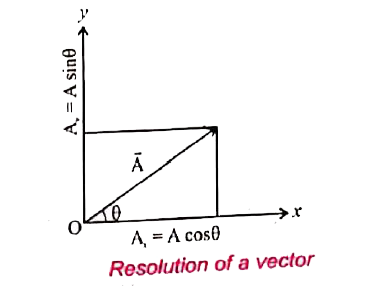
|
|
| 44. |
The radius of a circle is 1.22 m. Area enclosed by it upto correct significant figures is |
|
Answer» `4.6778 m^(2)` As PER rule, the area will have three significant figures. Rounding off, we get, `A=4.68 m^(2)` |
|
| 45. |
Obtain an expression for the position vector of centre of mass of a system of n particles in one dimension. |
Answer» Solution :According to as shown in figure. Let the distances of the two particles be `x_(1)andx_(2)` respectively from ORIGIN O. Let `m_(1) and m_(2)` be respectively the masses of the two particles on X-axis.  The centre of mass of the system is that point C which is at a DISTANCE X from O, then `X=(m_(1)x_(1)+m_(2)x_(2))/(m_(1)+m_(2))` [X is denoted by `r_(cm)` also] where X is the mass-weighted mean of `x_(1)andx_(2)`. If the two particles have the same mass `m_(1)=m_(2)=m`, then `X=(mx_(1)+mx_(2))/(m+m)=(x_(1)+x_(2))/(2)` Hence, for two particles of EQUAL mass the centre of mass lies exactly midway between them. Similarly, n particles of masses `m_(1),m_(2),m_(3),...,m_(n)` their respectively, distances `x_(1),x_(2),x_(3),...,x_(n)` from origin on X-axis then centre of mass of system of particles is given by, `X=(m_(1)x_(1)+m_(2)x_(2)+m_(3)x_(3)+...m_(n)x_(n))/(m_(1)+m_(2)+m_(3)+...m_(n))` `=(Sigmam_(i)x_(i))/(Sigmam_(i))` But `Sigmam_(i)=m_(1)+m_(2)+m_(3),...,m_(n)` `Sigma=m` = TOTAL mass of system `therefore (Sigmam_(i)x_(i))/(M)` (where `i=1,2,3,...,n`) |
|
| 46. |
A SONAR system fixed in a submarine operates at a frequency 40.0kHz. An enemy submarine moves towards the SONAR with a speed of 360km h^(-1). What is the frequency of sound reflected by the submarine ? Take the speed of sound in water to be 1450ms^(-1). |
Answer» Solution :(i) When source of ultrasonic (SONAR system) is at REST and DETECTOR (enemy submarine) moves towards STATIONARY source.  We have `(f _(L))/( v + v _(L)) = (f _(S))/(v + v _(S))` `therefore (f _(L))/( 14 50 + 100) = (40)/(1450 + 0)` `therefore f _(L) = (1550 )/(1450) xx 40 = 42.7886kHz` (ii) When ultrasonic waves are reflected by enemy submarine, it becomes imaginary source of reflected waves of frequency `f _(L) = 42.7586kHz,` moving towards stationary detector (SONAR system).  We have, `(f._(L))/(v + v _(L)) = (f ._(S))/( v + v ._(S))` `therefore (f ._(L))/(v + v _(L)) = (f ._(L))/( v + v._(S)) (because f ._(S) = f _(L))` `therefore (f ._(L))/( 1450 +0) = (42.7586)/(1450 -100)` `implies f._(L) = (1450)/(1350) xx 42 .7586 =45.93` kHz |
|
| 47. |
Displacement vectors vec(A) = (3i + 3j)m, vec(B) = (1-4j)m and vec(C )= (-2i + 5j)m. Use the components method to determine the magnitude and direction of vec(E )= - vec(A) - vec(B) + vec(C ) |
|
Answer» `5 sqrt2, 60^(@)` CLOCKWISE with +ve x-axis |
|
| 48. |
What is retardation ? |
| Answer» SOLUTION :The time RATE of decrease of VELOCITY is called RETARDATION and its direction is in the direction of decrease in velocity, | |
| 49. |
The resultant of vec(A) and vec(B) is perpendicular to vec(A). What is angle between vec(A) and vec(B) ? |
|
Answer» `COS^(-1)((A)/(B))` |
|
| 50. |
A satellite in free space sweeps stationary interplanetary dust at a rate dM//dt=alphav where M is the mass and v is the velocity of the satellite and alpha is a constant. What is the deceleration of the satellite? |
|
Answer» `-alphav^(2)` `therefore"RETARDATION"=-(F)/(M)=-(alphav^2)/(M)` |
|