

Saved Bookmarks
This section includes 7 InterviewSolutions, each offering curated multiple-choice questions to sharpen your Current Affairs knowledge and support exam preparation. Choose a topic below to get started.
| 1. |
A boy is standing inside a train moving with constant velocity of magnitude 10 m/s. He throws a ball vertically up with in speed of 5m/s relative to the train. Find the radius of curvature of the path of the ball just at the time of projection. |
|
Answer» Solution :The ball continues to move HORIZONTALLY with `(v_(x))_(0)=10`m/sec. It begins to move up with `(v_(y))=5`m/sec. Therefore `theta_(0)` is given as `theta_(0)=tan^(-1)((v_(y^(@)))/(v_(x^(2))))` or `theta_(0)=tan^(-1)(5//10)=tan^(-1)(1//2)`  Now the required radius of CURVATURE is give as `R=(v^(2))/(G cos theta)` Putting `v=v_(0)=sqrt((v_(x))_(0)^(2)+(v_(y))_(0)^(2)),sqrt(10^(2)+5^(2))=5sqrt(5)`m/s `g=10m//s^(2)` and `theta=tan^(-1)(1//2)` we obtain `r~=14m` |
|
| 2. |
Water is coming out of an orifice made in the wall of tank containing water . If the size of the orifice is increased , how does the velocity of efflux change ? |
| Answer» SOLUTION :`A PROP 1/v (A_1 V_1 = A_1 V_2)` | |
| 3. |
Convert a velocity of 72 km h^(1-) into ms^(-1) with the help of dimensional analysis. |
|
Answer» Solution :`n_1 = 72 KM h^(-1) ` ` n_2 = ? ` ` L_1= 1km ` ` L_2= 1M` ` T_1 = 1H` ` T_2 = 1s` ` n_2 = n_1 [L_1/L_2]^a [T_1/T_2]^b` The DIMENSIONAL formula for velocity is ` [LT^(-1) ]` a = 1b = 1 `n_2 = 72 [ (1km)/(1m) ] [ (1h)/(1s) ]^(-1)` ` = 72 [ (1000 m )/(1m) ]^1 [ (3600s)/(1s) ]^(-1) = 72 XX 1000 xx 1//3600 = 20 ms^(-1)` ` = 72 km h^(-1) = 20 ms^(-1)` |
|
| 4. |
A force is inclined at 60^(@)to the horizontal. If the horizontal component of force is 40N. Calculate the vertical component . |
|
Answer» Solution :Let the force be `vec(F)`. Let angle of INCLINATION be `theta` `:.`Horizontal component `F_(H) = F COS theta` Vertical component`F_(v) = F sin theta` Given :`F_(H) = 40 kg . wt.` Angle ` theta = 60^(@)` `F_(H) = F cos 60^(@) = 40 kg wt` . `:. F = (40)/(cos 60^(@)) = (40)/((1)/(2)) = 80 kg wt` Vertical component `F_(v) = F sin theta` ` = 80 sin 60^(@) = 80 xx (sqrt(3))/(2)` `= 40 sqrt(3)` `= 40 xx 1.732 = 69 . 28 ` kg wt `{:("Vertical"),("component"),("of the force"):}} = 69 . 28 `kg wt . |
|
| 5. |
A ball with a velocity of 5 ms^(-1) impinges at angle of 60^(@) with the vertical on a smooth horizontal plane. If the coefficient of restitution is 0.5, find the velocity and direction after the impact. |
|
Answer» Solution :Given : velocity of ball: `5ms^(-1)` Angle of INCLINATION with vertical : `60^(@)` Cofficient of restitution =0.5 Notes:Let the angle reflection is and the speed after collision is `v^(.)` the floor exerts a FORCE on the ball along the normal during the collision. There is no force parallel to the surface. Thus, the parallel component of the velocity of the hall remains unchanged . Tihis gives `v^(.)SINTHETA^(.)=vsintheta` ...(1) Vertical component with respect to floor `=v^(.)costheta^(.)` (velocity of separation) `velocity of approach=vcostheta` `"coefficient of restituting e" =("velocity of separation")/("velocity of approach")` `e=(v^(.)costheta^(.))/(v COS theta) therefore v^(.)costheta^(.)=evcostheta` ...(2) from (1) and (2) (ii)`v^(.)sqrt((1-sin^(.2)theta))=evcostheta` `v^(2)(1-sin^(.2)theta)=e^(2)v^(2)cos^(2)theta` `v^(.2)-v^(.2)sin^(.2)theta=e^(2)v^(2)cos^(2)theta` `v^(.2)-v^(.2)sin^(2)theta=e^(2)v^(2)cos^(2)theta [v^(.)sintheta^(.)=vsintheta]` `v^(.)=sqrt(v^(2)sin^(2)theta+e^(2)v^(2)cos^(2)theta)` `v^(.)=vsqrt(sin^(2)theta+e^(2)cos^(2)theta)` The speed after collision `v(.)sqrt(sin^(2)theta+e^(2)cos^(2)theta)` `v^(.)=5sqrt(sin^(2)(60^(@))+(0.5)^(2)cos^(2)60^(@))=5sqrt(3/4+0.25xx1/4)` `=5/2-sqrt(3.25)=2.5xx1.8=4.5ms^(-1)` `"Angle of reflection" theta^(.)=TAN^(-1)((tantheta)/e)=tan^(-1)((tan60^(@))/0.5)=tan^(-1)(sqrt3/0.5)` `=tan^(-1)(3.464)=73.9^(@)` 
|
|
| 6. |
A particle of mass 2kg is moving such that at time t, its position, in meter, is given by barr(t)=5hati-2t^(2)hatj The angular momentum of the particle at t=2s about the origin in kg m is |
|
Answer» `-80 HATK` |
|
| 7. |
A Carnot engine takes 3 xx 10^(6) cal of heat from a reservoir at 627^(@)C and gives it to a sink 27^(@)C. The work done by the engine is |
|
Answer» `4.2 xx 10^(6) J` `T_(2) = 27 + 273 = 300 K` As `(Q_(1))/(Q_(2)) = (T_(1))/(T_(2)) :. Q_(2) = (T_(2))/(T_(1)) xx Q_(1) = (300)/(900) xx 3 xx 10^(6) = 1 xx 10^(6) cal` `:.` Work done `= Q_(1) - Q_(2) = 3 xx 10^(6) - 1 xx 10^(6) = 2 xx 10^(6) cal` `= 2 xx 4.2 xx 10^(6) J = 8.4 xx 10^(6) J` |
|
| 8. |
In an experiment on surface tension, water rises up to a height of 0.1 m in a capillary tube. If the same experiment is performed in a satellite moving around the earth, what will be the rise in the capillary tube? |
| Answer» Solution :The weight of the water column in the CAPILLARY TUBE will be ZERO in an orbiting satellite, Hence, due to surface TENSION, water will rise up to the TOP of the tube, and the capillary tube will be completely filled with water. | |
| 9. |
A rod of length 'l' is inclined at an angle 'theta' with the floor against a smooth vertical wall. If the end A moves instantaneously with velocity v_(1), what is the velocity of end B at the instant when rod makes 'theta' angle with the horizontal. |
Answer» Solution :Let at any instant, end B and A are at a DISTANCE x and y respectively from the point .O..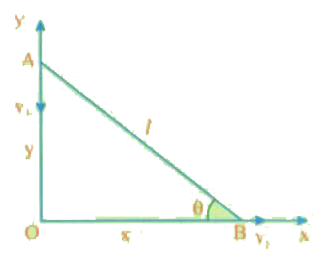 Thus we have, `x^(2)+y^(2)=l^(2)"…………..(1)"` Here l is the length of the rod, which is CONSTANT. Differentiating eq (1) with RESPECT to time, we get `(d)/(dt)(x^(2)+y^(2))=(d)/(dt)(l^(2)), 2x(dx)/(dt)+2y(dy)/(dt)=0` If `(dx)/(dt)=v_(2) and (dy)/(dt)=-v_(1)` `x(v_(2))+y(-v_(1))=0` `rArr v_(2)=((y)/(x))v_(1)=v_(1)tan theta` |
|
| 10. |
Match the physical quantities given in column I with dimensions expressed interms of mass (M), length (L), time (T) and charge (Q) given in column II and wire the correct answer against the match quantity in labourar form. |
Answer» SOLUTION :The CORRECT DIMENSIONS are 
|
|
| 11. |
A body of mass 10 kg is rotating on a circular path of radius 1 m with time period 3.14S. Calculate its angular momentum and rotational kinetic energy. |
|
Answer» SOLUTION :ANGULAR momentum = 20 `kgm^2s^(-1)` KE = 20J |
|
| 12. |
A 10 kW drilling machine is used to drill a bore in a small aluminium block of mass 8.0 kg. How much is the rise in temperature of the block in 2.5 minutes, assuming 50% of power is used up in heating the machine itself or lost to the surroundings. Specific heat of aluminium =0.91" Jg"^(-1)K^(-1). |
|
Answer» Solution :If the consumed energy to DRILL is Q, then `Q=Pt` `=10^(4)xx2.5xx50` `=15xx10^(5)J` Energy OBTAINED by Aluminium block is `Q.=50%` of Q `:.Q.=(15xx10^(5)xx50)/(100)` `:.Q.=75xx10^(4)J` If increase in TEMPERATURE of block is `Deltatheta` then, `Q.="MC"Deltatheta` `:.Deltatheta=(Q.)/("mc")` `=(75xx10^(4))/(8xx0.91xx10^(3))` `=103.2^(@)C` `~~103^(@)C` |
|
| 13. |
A rain drop of radius r is falling through air startin from rest the work done by all the forceson the drop when it attains terminal velocity is proportional to |
|
Answer» `r^5` |
|
| 14. |
Name two coherent systems of units. |
|
Answer» SOLUTION :The TWO coherent systems of UNITS are : M.K.S S.I. (System International). |
|
| 15. |
In which situation, distance and magnitude of displacement are same? |
| Answer» SOLUTION :When object is MOVING in a straight LINE and in one direction then both are same. | |
| 16. |
Two bodies of masses m_1 and m_2 initially at rest at infinite distance apart move towards each other under gravitational force of attraction. Their relative velocity of approach when they are separated by a distance r is (G= universal gravitational constant.) |
|
Answer» `[2G(m_(1)-m_(2))/r]^(1//2)` |
|
| 17. |
A liquid is contained in a vertical tube a semicircular cross section the contact angle is zero. The force of surface tension on the curved part & on the flat part are in ratio |
| Answer» ANSWER :C | |
| 18. |
Why do we have different units for the same physical quantity ? |
| Answer» Solution :The VALUE of any given physical quantity may vary over a wide range, so that, different units for same physical quantity are required. E.g. : Speed of a cycle can be MEASURED in m/s, speed of a CAR can be measured in km/h and speed of a satellite can be measured in km/s. | |
| 19. |
Photon is quantum of radiation with energy E= hv where v is frequency and h is Planck's constant . The dimesions of h are the same as that of A) Linear impulse B) Angular impulse C) Linear momentum D) Angular momentum |
| Answer» Answer :B | |
| 20. |
(A) : The graph of potential energy and kinetic energy of a particle in SHM with respect to position is a parabola. (R) : Potential energy and kinetic energy do not vary linearly with position. |
|
Answer» Both 'A' and 'R' are TURE and 'R' is the correct EXPLANATION of 'A' |
|
| 21. |
The specific heat of air at constant pressure is1.005 kJ/kg K and the specific heat of air at constant volume is 0.718 kJ/kg K. If the universal gas constant is 8.314 kJ/kmole K find the molecular weight of air. |
|
Answer» 28.97 |
|
| 22. |
A rod AB of l is such that its linear density (mass per unit length) mu vasries as mu = (a)/(b-x), where x is the distance of the section from end A (and b gt l). The distance of the centre of mass from end A is b-(zl)/(ln((b)/(b-l))) where z is |
|
Answer» |
|
| 23. |
Two billiard balls each of mass 0.05kg moving in opposite direction with speed 6ms^(-1)collide and rebound with the same speed. What is the impulse imparted to each ball due to the other? |
|
Answer» 0.5 KG m/s |
|
| 24. |
If a vector vecA=3hati+2hatj then what is 4A? |
|
Answer» `12hati+8hatj` |
|
| 25. |
A steel bar of cross sectional area 1 cm square and 50 cm long at 30^(0)C fits into the space between two fixed supports. If the bar is now heated to 280^(0)C, what force will it exert against the supports ? (alpha " for steel " = 11 xx 10^(-6)//^(0)C " and Young's modulus for steel " = 2 xx 10^(11) N//m^(2)) |
|
Answer» Solution :Theory: We have coefficient of LINEAR expansion `alpha = (l_(2)- l_(1))/(l_(1) (t_(2) - t_(1)))` `(l_(2) - l_(1))/(l_(1)) = alpha (t_(2) - t_(1)) ` But `(l_(2) - l_(1))/(l_(1))` is the CHANGE in length per unit original length of the bar which is equal to the straim `[ (Delta l)/(l ) ] ` `THEREFORE` Strain = `alpha (t_(2) - t_(1)) ""` ............. (1) By the definition of Young.s modulus, `Y = ("Stress")/("Strain")` Stress = Y `xx ` Strain = Y `alpha(t_(2) - t_(1)) .`........ (2) This is called thermal Stress Stress = `("Force")/("Area of CROSS section")` `therefore ` Force EXERTED on the supports = Stress x Area of cross section = Y `alpha (t_(2) - t_(1)) A = Y alpha A (t_(2) - t_(1))`.......... (3) In this problem, `Y= 2 xx 10^(11) N//m^(2), alpha = 11 xx 10^(-6) //^(0)` C, A = ` 1 xx 1cm^(2) = 1 xx 10^(- 4) m^(2)`, `t_(1) = 30^(0)C , t_(2)= 280^(0) C `. The force exerted on the supports `= 2 xx 10^(11) xx 11 xx 10^(-6) xx 10^(-4) xx 250 = 55000` N. |
|
| 26. |
When a copper sphere is heated , maximum percentage change will be observed in |
|
Answer» RADIUS |
|
| 27. |
A soap bubble is blown to a radius of 3 cm.If it is tob be further blown to a radius of 4 cm what is the work done ? (Surface tension of soap solution =3.06xx10^(-2)Nm^(-1)) |
|
Answer» Solution :Initial RADIUS of the soap bubble `R_(1s)=3cm=3xx10^(-2)m` Final radius of the soap bubble `R_(2)=4cm=4xx10^(-2)m` WORK done in blowing a soap bubble from radius `R_(1)` to `R_(2)=W=8pi(R_(2)^(2)-R_(1)^(2))S` `=8xx22/7xx3.06xx10^(-2)(16-9)xx10^(-4)` `176xx3.06xx10^(-6)J=539.6xx10^(-6)J` |
|
| 28. |
A ball is thrown vertically upwards with a velocity of 20 ms^(-1) from the top of a multistorey building. The height of the point from where the ball is thrown is 25.0 m from the ground. (a) How high will the ball rise ? and (b) how long will it be before the ball hits the ground ? Take g = 10 ms^(-2). |
|
Answer» SOLUTION :(a) Let us take the y-axis in the vertically upward direction with zero at the ground, as shown in Fig. Now`upsilon_(0)=+20 ms^(-1)`, `a=-g=-10 ms^(-2)`, `upsilon = 0 ms^(-1)` If the ball RISES to height y from the POINT of launch, then using the equation `upsilon^(2)=upsilon_(0)^(2)+2(y-y_(0))` we get `0=(20)^(2)+2(-10)(y-y_(0))` Solving, we get,`(y-y_(0))=20m`. (b)We can solve this part of the problem in two ways. 
|
|
| 29. |
Find the ratio of escape velocities of two planets if values of g on the two planets are 9.8m//s^2 and 3.3m//s^2 and their radii are 6400km and 3400km respectively. |
|
Answer» Solution :The escape velocity in TIMES of G and R is The RATIO of escape velocities `V_(e1)/V_(E2)=sqrt((g_1R_1)/(g_2R_2))` `V_(e1)/V_(e2)=sqrt((9.8/3.3)(6400/3400))=2.364/1` `V_(e1):V_(e2)`=2.364:1 |
|
| 30. |
A particle of mass 0.3 kg is subjected to a force of F = -kx with k = 15 Nm^(-1). What will be its initial acceleration if it is released from a point 20 cm away from the origin? |
|
Answer» Solution :F = ma , so F= - KX = ma `a = (-kx)/(m)` For x = 20 cm ` RARR a =-10 m//s^2` |
|
| 31. |
A man is coming down an incline of angle 30^@. When he walks with speed 2(sqrt(3)) m s^-1 he has to keep his umbrella vertical to protect himself from rain. The actual speed of rain is 5 ms^-1. At angle with vertical should he keep his umbrella when he is at rest so that he does not getb drenched ? . |
|
Answer» SOLUTION :Velocity of rain w.r.t man `vec v_(r,m) = X hat j = vec v_r - vec v_m` `vec v_m = 2 sqrt(3) [COS 30 hat i + sin 30 hat j]` =`3 hat I + sqrt(3) hat j` `vec v_r = -3 hat i + (x - sqrt(3)) hat j` `5 = sqrt(3^2 + (x - sqrt(3))^2)` `16 = (x - sqrt(3))2 rArr 4 + sqrt(3) = x` `vec v_r = - 3 hat i + 4 hat j` `tan theta = (3)/(4) rArr theta = 37^@`. 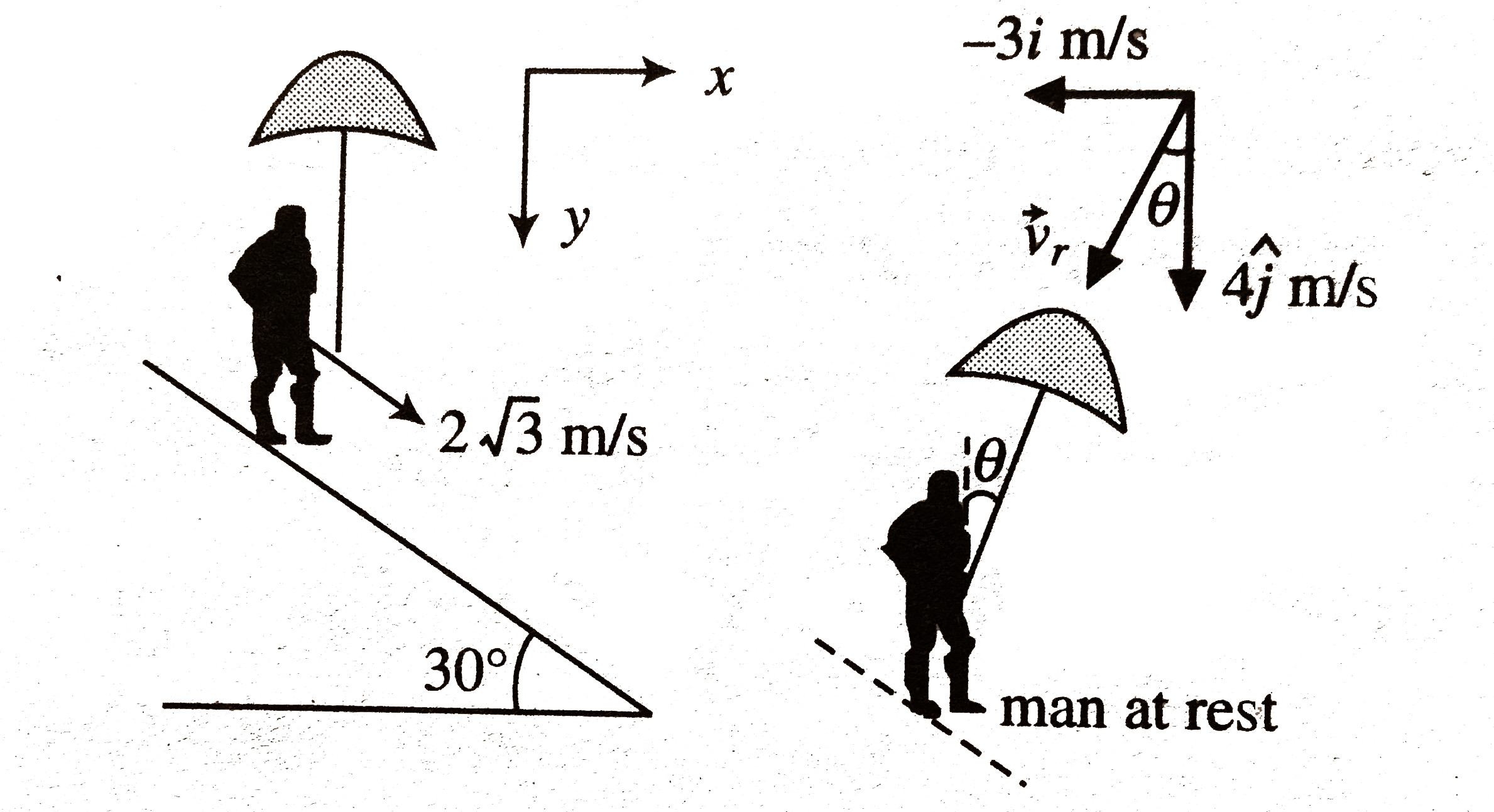
|
|
| 32. |
When a body is weighed in a liquid the apparent loss in it.s weight is equal to a. the upthrust of liquid on the body b. weight of the liquid displaced by the body c. the difference in weights of the body in air and liquid d. weight of water displaced by the body |
|
Answer» a,B,C are correct |
|
| 33. |
A floating body always diplaces its own ………….. . |
|
Answer» mass of liquid |
|
| 34. |
Let the two springs A and B be such thatK_(A)gtK_(B) , On which spring will more work has to be done if they are stretched by the same force ? |
|
Answer» SOLUTION :`F=K.x` so `x=(F)/(K)` for same `F,W_(A)=(1)/(2)(F^(2))/(K_(A))` and `W_(B)=(F^(2))/(2K_(B)` `therefore (W_(A))/(W_(b))=(F^(2))/(2K_(B))` `AsK_(A)gtK_(B) so W_(A) lt W_(B)`. |
|
| 35. |
On what factors does orbital velocity depend ? |
|
Answer» SOLUTION :Orbital velocity `V_0 = sqrt((GM)/(R+h))` i.e., it DEPENDS the mass of the planet, radius of the planet and HEIGHT of the object from the surface. |
|
| 36. |
in the question number 4, if the horizontal displacement of the particle as seen by an observer on the ground is zero, the speed of the box with respect to the ground at the instant when particle was projected is |
|
Answer» ` U cos alpha ` 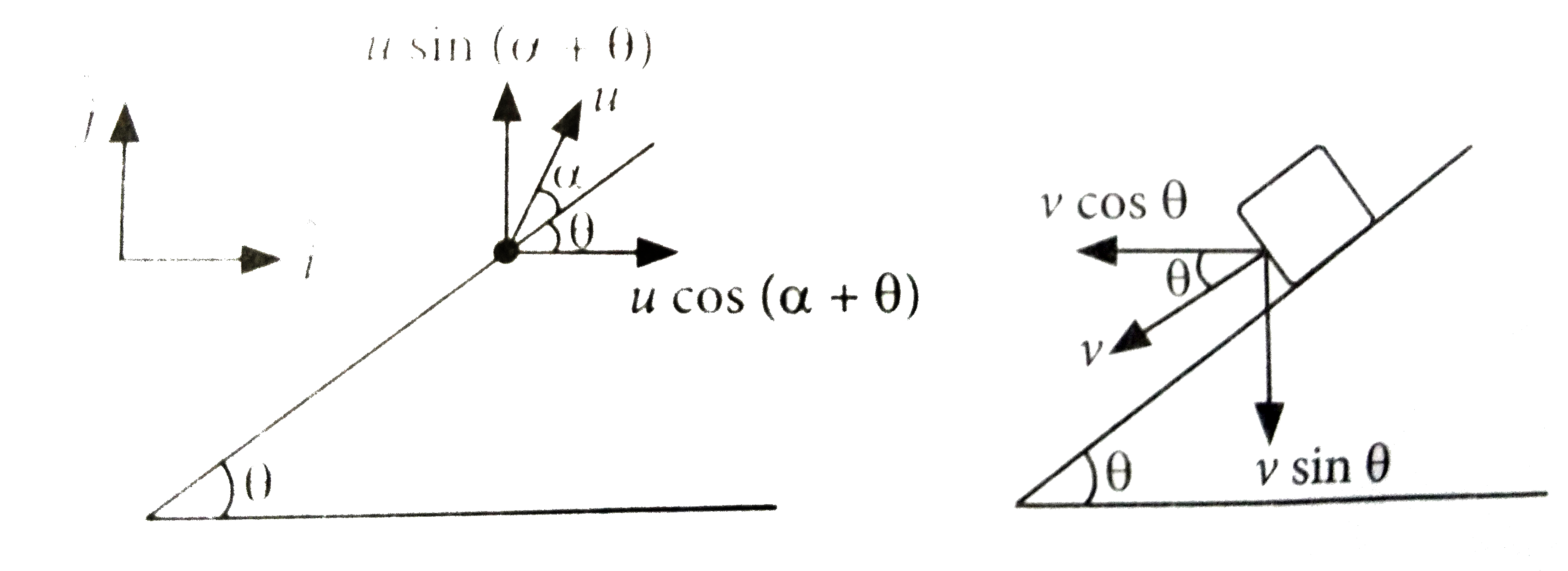 Let v be the velocity of the block down the plane. Velocity of particle `=ucos(alpha+theta)hati+USIN(alpha+theta)hatj` Velocity of block `=-vcosthetahati-vsinthetahatj` `:.` Velocity of particle with respect to ground `=[ucos(alpha+theta)-vcostheta]hati+[usin(alpha+theta)-vsintheta]hatj` Now, as said EARLIER that horizontal compoent of absolute velocity should be zero. Therefore, `ucos(alpha+theta)-vcostheta=0` or `v=(ucos(alpha+theta))/(costheta)` (down the plane) |
|
| 37. |
Rockets are launched in eastward direction to take advantage of............. . |
|
Answer» the clear sky on EASTERN SIDE |
|
| 38. |
One end of an unstretched vertical spring is attached to the ceiling and an object attached to the other end is slowly lowered to its eqilibrium position. If S be gain in spring energy and G be loss in gravitational potential energy in the process, then |
|
Answer» `S = G` |
|
| 39. |
Referring to figure calculate the downward acceleration of mass m_(1). Assume the surfaces are frictionless and pullyes ar massless. |
|
Answer» Solution :Let a be the acceleration of mass M and `a_(1)"and" a_(2)`, the acceleration of `M_(1)"and " M_(2)` relative to fixed pulley , P. Then from shown in figure. `M_(1)G-T_(2)=M_(1)a_(1)`….(1) `M_(2)g-T_(2)=M_(2)a_(2)`////(2) and `T_(1) =Ma`....(3) Also `T_(1)=2T_(2)`....(4) Acceleration of `M_(1)` relative to movable pulley Q is `(a_(1)-a)`. Acceleration of `M_(2)` relative to pulley Q`=(a_(2)-a)` The acceleration of `M_(1) "and" M_(2)` relative to pulley Q are equal and opposite . `:. a_(1)-a=-(a_(2)-a)` or ` a=(a_(1)+a_(2))/2`....(5) substracting (2) from (1) `(M_(1)-M_(2)) g = M_(1)a_(1)-M_(2)a_(2)`....(6)Adding (1) and (2) , we get `(M_(1)+M_(2))g-2T_(2)=M_(1)a_(1)+M_(2)a_(2)` From (3) and (4) , 2T_(2)=T_(1)=Ma Using (5), `2T_(2)=(M(a_(1)+a_(2))/2`....(7) SUBSTITUTING this value in (7), we get `(M_(1)+M_(2))g-(M(a_(1)+a_(2)))/2=M_(1)a_(1)+M_(2)a_(2)` or` 2(m_(1)+M_(2))g-Ma_(1)-Ma_(2) =2M_(1)a_(1)+2M_(1)a_(1)+2M_(2)a_(2)` or `2(M_(1)+M_(2))g=(2M_(1)+M)a+(2M_(2)+M)a_(2)`....(8)Eliminating `a_(2)` from (6) and (8) , we get `a_(1)=[(4M_(1)M_(2)+M(M_(1)-M_(2))/(4M_(1)M_(2)+M(M_(1)+M_(2))]g` 
|
|
| 40. |
According to Newton, the viscous force acting between liquid layers of area A and velocity gradient (Delta v)/(Delta z) is given by F= - eta A (dv)/(dz), where eta is constant called coefficient of viscosity. The dimensional formula of is |
|
Answer» `[ML^(2)T^(-2)]` |
|
| 41. |
A ball moving with velocity 2 m/s collides head on with another stationary ball of double the mass. If the coefficient of restitution is 0.5, then their velocities (in m/s) after collision will be |
|
Answer» 0,1 `u_1 = 2 m//s , u_2 = 0` Coefficient of restitution , e = 0.5 Let `v_1 and v_2` be their respective VELOCITIES after collision. Applying the LAW of CONSERVATION of linear momentum, we get `m_1u_1 + m_2u_2 = m_1 v_1 + m_2v_2` `:. m xx 2 = 2m xx 0 = m xx v_1 + 2m xx v_2` Or `2m = mv_1 + 2mv_2 " or " 2 = (v_1 + 2v_2) "" .....(i)` By definition of coefficient of restitution, `e = (v_2 - v_1)/(u_1 - u_2)` or `e (u_1 - u_2) = v_2 - v_1` `0.5 (2 - 0) = v_2 - v_1 " or " 1 = v_2 - v_1 "" ......(ii)` Solving equations (i) and (ii), we get `v_1 = 0 m//s , v_2 = 1 m//s`. |
|
| 42. |
Two cars left place A simultanecously and reachedthe place B in 2 hrs. Thefirst car travelled half the distance with a speed of 30 km/hr and the other half at a speed of 45 km/hr. The second car at the same time covered the entire distance with a constant acceleration starting from rest . Find the acceleration of the second car. |
|
Answer» `36 km//hr^(2)` |
|
| 43. |
A body of weight 10N attached to one end of s tring of length 1m is rotated in a vertical plane. At the instant when the string makes an angle of 60^(@) with the downward vertical, the speed of the bob is sqrt(9.8) ms^(-1). The tension in the string at that instant is equal to |
|
Answer» 10N |
|
| 44. |
One end of a cylindrical rod is kept in steam chamber and the other end in melting Ice. Now 0.5 gm of ice melts in 1 sec. If the rod is replaced by another rod of same length, half the diameter and double the conductivity of the first rod, then rate of melting of ice will be |
|
Answer» 0.25 gm/sec |
|
| 45. |
One end of a light spring of spring constant k is fixed to a wall and the other end is tied to a block placed on a smooth horizontal surface. In a displacement, the work done by the spring is (1)/(2)kx^(2). The possible cases are(a) the spring was initially compressed by a distance x and was finally in its natural length(b) it was initially streched by a distace x and finally was in its natural length(c ) it was initially in its natural length and finally in a compressed position(d) it was initially in its natural length and finally in a stretched position. |
|
Answer» a, B are CORRECT |
|
| 46. |
Whatis thermal expansion ? |
| Answer» Solution :Thermal EXPANSION is the TENDENCY of matter to change in SHAPE, area, and volume due to a change in TEMPERATURE. | |
| 47. |
The dimensions of Planck's constant are the same as that of |
|
Answer» TORQUE |
|
| 48. |
The dispersive powers of crown and flint glasses are 0.03 and 0.05 respectively. The difference in refractive indices for blue and red colour is 0.015 for crown glass and 0.022 for flint glass. Calculate the angles of the two prisms for a deviation of 2^@ without dispersion. |
|
Answer» `mu_b - mu_r = 0.015` `omega = 0.03` for flint glass : `mu_b' - mu'_r = 0.022` `omega' = 0.05` Net deviation `= (mu - 1) A + (mu' - 1) A' = 2^@` =`(A(mu_b - mu_r)(mu - 1))/((mu_b - mu_r))+(A'(mu' - 1)(mu_b' - mu_r'))/(mu_b' - mu_r')` =`(A(mu_b - mu_r))/(omega)+(A'(mu_b' - mu_r'))/(omega')` =`(A xx 0.015)/(0.03) + (A' xx 0.022)/(0.05)` `2^@ = (1)/(2) A + (11)/(25) A'` For no DISPERSION, `(mu_b - mu_r)_A + (mu_b' - mu_r') A' = 0` `A(0.015) + A' (0.022) = 0` `A = -(22)/(15) A'` ...(ii) Put in (i) `(1)/(2)(- (22)/(15) A') + (11)/(25) A' = 2` `-(44)/(150) A' = 2, A' = (-300)/(44) = -6.82^@` From (ii), `A = -(22)/(15) xx ((-300)/(44)) = 10^@` Negative sign of `A'` IMPLIES that two prisms must be placed in opposition. |
|
| 49. |
If the velocity of separation is equal to the velocity of approach , then the collision is |
|
Answer» (a) conservative force |
|