

Saved Bookmarks
This section includes 7 InterviewSolutions, each offering curated multiple-choice questions to sharpen your Current Affairs knowledge and support exam preparation. Choose a topic below to get started.
| 1. |
A string passes over a weightless pulley and has two weights of 1 kg and 4 kg tide at its two ends. The pulley is hung from the hook of a spring balance. When the attached weights start moving due to the action of gravity, what will be the reading on the spring balance? |
|
Answer» |
|
| 2. |
At a given instant of time two particles are having the position vectors 4 hati -4hatj + 7 hatk metre and 2 hat i +2 hatj + 5hatk respectively. If the velocity of the first particle be 0.4 hati ms^-1, the velocity of second particle in metre per second if they collide after 10 s is |
|
Answer» |
|
| 3. |
Volume and total surface area of a cube is equal. Find volume of cube. Let I be length of cube. |
|
Answer» SOLUTION :LET L belength of CUBE. `V=A` `:. beta=6l^(2)` `:. l=6` |
|
| 4. |
A truck is moving at a speed of 54 km/h. The radius of its wheels is 50 cm. On applying the brakes the wheels stop after 20 rotations. What will be the linear distance travelled by the truck during this? Also find the angular acceleration of the wheels. |
|
Answer» Solution :`v_(2)=0`, for stop Here, `v_(1)=54km//h=15ms^(-1)`, `r=50cm=0.5m`, `theta=20` rotations = `40pi` rad, `d=?, ALPHA=?` `omega_(1)=(v_(1))/(r)=(15)/(0.5)=30" rad/s"` `omega_(2)=(v_(2))/(r)=(0)/(0.5)=0" rad/s "(because" It stops, so "v_(2)=0)` `alpha=(omega_(2)^(2)-omega_(1)^(2))/(2THETA)=(0-(30)^(2))/(2xx40pi)` `therefore alpha=-(900)/(80pi)=-3.5828" rad s"^(-2)` `therefore alpha=-3.58" rad s"^(-2)` now, 1 rotation = `2pir` linear DISTANCE `therefore 20` rotations `=20xx2pir` distance Linear distance travelled by the truck `therefore d=40xx3.14xx0.5` `therefore d=62.8m` |
|
| 5. |
(A) If objective and eye lenses of a microscope are interchanged then it can work as telescope. ( R) The objective of telescope has smaller focal length than its eye piece. |
|
Answer» Both A and R are true and R is the correct explanation of A |
|
| 6. |
A circular discof mass 4 kg and radius 1 m rolls on a smooth table with a uniform velocity of 0.5 ms^(-1). Calculate its (a) rotating K.E. (b) translational K.E. |
| Answer» Solution :ROTATIONAL K.E. `=(1//2)Iomega^(2) =(1//2) (1//2)mr^(2) xx (V^(2)//R^(2)) =(1//4) mv^(2) = 0.25 J` Trans. K.E. =`(1//2) mv^(2) = 0.5 J` | |
| 7. |
The mass of a box measured by grocer's balance is 4.2 kg. Two additional masses 10.20 g and 15.25 g are added to the box. What is the total mass of the box? |
|
Answer» |
|
| 8. |
A vertically projected body attains the maximum height in 6s. The ratio of kinetic energy at the end of 3rd second to decrease in kinetic energy in the next three seconds is |
| Answer» ANSWER :A | |
| 9. |
Viscous force is similar to frictioon in solids, but viscous force a. is independent of area but riction depends on area b. is temperature dependent while friction force between solids depends upon normal reaction c. is velocity dependent while fricton is not d. is velocity independent while friction is velocty dependent |
|
Answer» a,B,C are correct |
|
| 10. |
A compound microscope has a magnifying power 30. The focal length of its eyepiece is 5cm. Assuming the final image to be at a least distance of distinct vision (25cm) calculate the magnification produced by objective. |
|
Answer» Solution :In CASE of compound microscope `M=m_0 times m_e`…….(1) And in case of final image at least distance of distinct vision `m_e=[1+D/f.]` So from eqs. (1) and (2) `M=m_0[1+D/f]` Here M=-30, D=25cm and `f_e=5cm` So, `-30=m_0[1+25/5]` i.e., `m_0=(-30)/6=-5` Negative sign implies that image FORMED by OBJECTIVE is INVERTED. |
|
| 11. |
The position vector of a particle is given vecr= 2thati+3t^(2)hatj-5hatk calculate the velocity and speed of the particle at any instant 't'. |
|
Answer» SOLUTION :`vecr = 2thati + 3t^2 hatj - 5hatk` Velocity `vecv = (dvecr)/(dt) =(d)/(dt) (2t hati + 3t^2 hatj - 5 hatk)` `vecv = (2hati + 6T hatj) MS^(-1)` Speed `|vecv| = sqrt((2)^2 + (6)^2) = sqrt(40) = 2sqrt(10) ms^(-1)` |
|
| 12. |
(A) : To unscrew a rusted nut, we need a wrench with longer arm. (R ) : Wrench with longer arm reduces the torque of the arm. |
|
Answer» Both 'A' and 'R' and TRUE and 'R' is the correct EXPLANTATION of 'A' |
|
| 13. |
A light string of length 20 cm is carrying a bob of mass 100 gm. It is pulled through an angle 60^(@) and released. Its maximum velocity is, |
|
Answer» `1ms^(-1)` |
|
| 14. |
Linear velocity of particles of rigid body in rotational motion is same. |
|
Answer» |
|
| 15. |
The cylindrical tube of a spray pump has radius R, one end of which has 'n' fine holes each of radius r. If the speed of the liquid in the tube is v, then what is the speed of the ejection of the liquid through the hole ? |
|
Answer» `(v^(2)R)/(NR)` `thereforepiR^(2)v=npir^(2)v_(1)` `thereforev_(1)=(vR^(2))/(nr^(2))` 
|
|
| 16. |
A chain is on a smooth horizontal tablewith 1/3 of its length hanging off the edge. If mass and length of the chain are M and l respectively , work done to pull up the hangingpart of thechain will be [g= acceleration due to gravity] |
|
Answer» MGL |
|
| 17. |
From the following units, select the odd man out. |
|
Answer» LIGHT year |
|
| 18. |
A block of mass m is pulled along a horizontal surface by applying a force at an angle theta, with the horizontal. If the block k travels with a uniform velocity and has a displacement d and the coefficient of friction is mu. Then find the workdone by the applied force? |
|
Answer» `(MU mgd)/((cos theta+mu SIN theta))` |
|
| 19. |
A fat hose pipe is held horizontally by a fireman. It delivers water through a constricting nozzle at 1 litre/sec. If by increasing the pressure, the water is delivered at 2 litre/sec, the fireman now has to |
|
Answer» push forward twice as HARD |
|
| 20. |
A rolling wheel has velocity of its center of mass as 5 ms. If its radius is 1.5 m and angular velocity is 3 "rad s"^(-1) , then check whether it is in pure rolling or not. |
|
Answer» Solution :Tanslational velocity `(V_("TRANS"))` or velocity of CENTER of MASS, `V_(CM)= 5 ms^(-1)` The radius is, R-1.5 m and the angular velocity is, `omega=3"ra s"^(-)`. Rotational velocity, `v_("NOT")= R omega` `V_("NOT"=1.5xx3` `V_("NOT")=4.5 ms^(-1)` As `V_(CM) gt R omega (or)v_("TRANS") gt R omega`, It is not pure rolling. but silding. |
|
| 21. |
A body projected with velocity 30 ms^(-1)reaches its maximum height in 1.5 s. Its range is (g=10ms^(-2)) |
| Answer» Answer :C | |
| 22. |
A block A can slide on a frictionless incline of angle theta and length l inside an elevator giving up with uniform acceleration a_0 as shown in figure. Find the time taken by the block to slide down the length of the incline if it is released from the top of the incline? |
|
Answer» |
|
| 23. |
A mass of 2kg rests on a horizontal plane. The plane is gradually inclined until at an angle theta=20^(@) with the horizontal, the mass just begins to slides. What is the coefficient of static friction between the block and the surface ? |
|
Answer» |
|
| 24. |
An ideal gas undergoes four different processes from the same initial state. Four processes are adiabatic, isothermal, isobaric, andisochoric. Ot of 1,2,3 and 4 which one is adiabatic |
|
Answer» 4 |
|
| 25. |
Assertion : The maximum height of a mountainon earth can be estimated from the elastic behaviour ofrocks. Reason : At the base of mountain, the pressure less than elastic limit of earths supporting material. |
|
Answer» |
|
| 26. |
On the basis of kinetic theory of gases, explain how does a gas exert pressure. |
|
Answer» Solution :In RANDOM motion , the molecules collide with each other and also with the walls of the container. As the collisions are elastic in NATURE, there is no loss of energy , but a change in momentum occurs due to the force created. During each COLLISION , the molecules impart certain momentum to the walls of the container. By hte transfer of momentum , the walls experienced per unit area of the walls of the container the pressure exerted by the GAS. |
|
| 27. |
The phase is always the same for all particles between two consecutive nodes of a stationary wave . Is the statement ture or false ? |
|
Answer» |
|
| 28. |
In a hydel power project, 2000 kg of water passes through the turbine every second. Water is falling from a height of 240 m above ground. If the power output is 3.6 MW, the efficiency of the power house is (g=10 ms^(-2)) |
| Answer» Answer :B | |
| 29. |
Electric current has both magnitude and direction. Is it a vector quantity? |
| Answer» SOLUTION :No. It is treated as a SCALAR quantity since it does not OBEY the vector ALGEBRA. | |
| 30. |
An aluminium wire and a steel wire of the same length and cross section are joined end to end. The composite wire is hung from a rigid support and a load is suspended from the free end. If the increase in length of the composite wire is 1.35 mm, find the ratio of the i) stress in the two wires and ii) strains in the two wires. (Y_("AI" ) = 7 xx 10^(10) "Nm"^(-2) , Y_("steel") = 2 xx 10^(11) "Nm"^(-2) ) |
|
Answer» `1:1, 20:7` |
|
| 31. |
In the indicator diagram, we have (a) Change in internal energy along ABC is 10 J. (b) Work done along path AB = 20 J. U_(C ) = 5 J. (d) Heat absorbed by the system along path AD is 5J. (i) Change in internal energy along the path CDA. (ii) Heat given to the system along path ABC. (iii) Value of U_(A). (iv) change in internal energy along AD. |
|
Answer» Solution :(iv) `U_(C )- U_(A) = 10 J:> U_(A) - U_(C ) = -10 J` (II) `Delta Q = Delta U + Delta W = (U_(C ) - U_(A)) + Delta W` or `Delta Q = 10 + 20 = 30 J` (iii) `Delta Q = (U_(C ) - U_(A)) + Delta W` or `U_(A) = U_(C ) + Delta W - Delta Q = 5+20 - 30 = -5J` or `U_(A) = -5J` (d) `U_(D) - U_(A) = DeltaQ_((AD).) - 5 - 0 = 5J`. |
|
| 32. |
A mass of 2 kg oscillates on a spring with constant 50 N//m. By what factor does the frequency of oscillation decrease when a damping force with constant b = 12 is introduced? |
|
Answer» SOLUTION :`w= sqrt((50)/(2))= 5 r//s` `w= sqrt(w^(2)- ((B)/(2m))^(2))= sqrt(5^(2)-3^(2))= 4` FORCE reduces by `1 r//s` or 20% |
|
| 33. |
A metal rod of length 1m is clamped at two points as shown in the figure. Distanceof the clamp from the two ends are 5 cm and 15 cm, respectively. Find the minimum and next higher frequency of natural longitudinal oscillation of the rod. Given that Young's modulus of elasticity and density of aluminium are Y= 1.6 xx 10^(11) Nm^(-2) and rho = 2500 kgm^-3 , respectively. |
|
Answer» `v =sqrt(Y/rho) =sqrt(1.6 xx (10^11))/ (2500)) = 8000 m//s` At the clamped position nodes will be formed. Between the clamps integer number of LOOPS will be formed. Hence, `n_1 lambda/2 = 80` or ` n_1lambda = 160`.......(i) 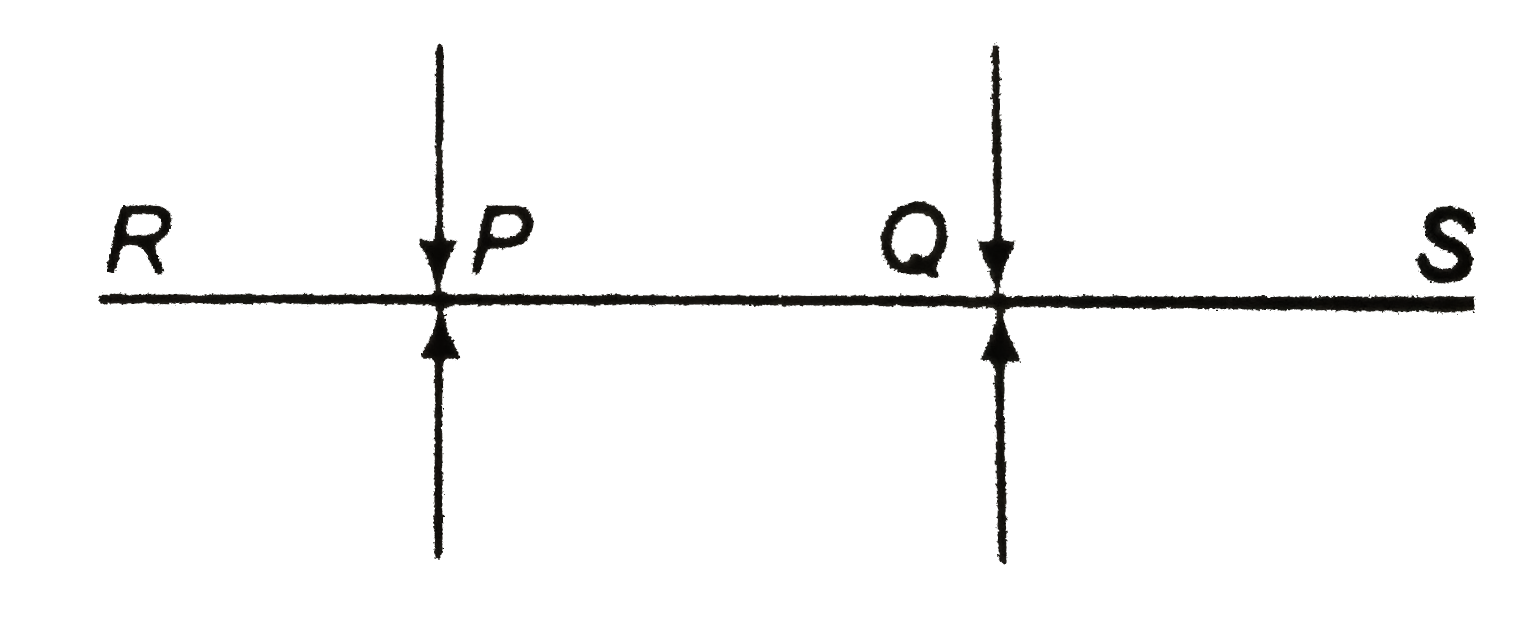 Between P and R, P is a FIXED end and R is the free end. It MEANS the number of loops between P and R will be odd multiple of `lambda/4` . Then, `(2n_2 -1)/2 lambda/2 = 5 ` or ` (2n_2 -1)lambda = 20` ...... (ii) Also between Qand S,lt brgt ` (2n_3 - 1) lambda = 60` ..........(iii) From EQS. (i) and (ii), we get `n_1/ (2n_2 -1) = 160/20 = 8` ........ (iv) and from Eqs. (i) and (iii). `(n_1)/(2n_3 - 1) = 160/60 = 8/3` .......(v) For minimum frequency `n_1 n_2 and n_3` should be least from Eqs.(iv) and (v). We get,`n_1 = 8, n_2 = 1, n_3 = 2` `lambda = 20/(2n_2 -1) = 20 cm ` [from Eq.(ii)] = 0.2 m `:. f_(min) = v/lambda = 8000/0.2` = 40 kHz. Next higher frequency corresponds to `n_1 = 24, n_2 = 2 ` and`n_3 = 5 ` `f= 120 kHz` |
|
| 34. |
Most people interpret a 9.0 dB increase in sound intensity level as a doubling in loudness. By what factor must the sound intensity be increase to double the loudness? |
|
Answer» `1 m//s` or `10 = 1700 ((340)/(340 + nu_(2))) - 1700 ((340)/(340 + nu_(1)))` `= 1700(1 + (nu_(2))/(340))^(-1) - 1700 (1 + (nu_(1))/(340))^(-1)` USING Binomial therefore, we get `10 = 1700(1 - (nu_(2))/(340)) - 1700 (1 - (nu_(1))/(340))` `= (nu_(1) - nu_(2)) ((1700)/(340))` :. `nu_(1) - nu_(2) = 2 m//s` |
|
| 35. |
Conservation of energy holds good even when substances in different states are mixed. When they are mixed, the change in state consumes energy of the high temperature substance without any change in temperature and then the mixture works for a common temperature. Sometimes, the energy lost by the container also to be accounted. When 1 g ice turns into water 80 calories of energy is consumed. After the change of state, the water formed will increase its temperature (Neglect heat capacity of the container) When 80 g water at 40^@Cis mixed with 40 g ice at 0^@C , the cominon temperature is |
| Answer» Answer :A | |
| 36. |
Conservation of energy holds good even when substances in different states are mixed. When they are mixed, the change in state consumes energy of the high temperature substance without any change in temperature and then the mixture works for a common temperature. Sometimes, the energy lost by the container also to be accounted. When 1g ice turns into water 80 calories of energy is consumed. After the change of state, the water formed will increase its temperature (Neglect heat capacity of the container) If in the first question, only 40 g water at 40^@Cisavailable with the container of water equivalent 80 g, then |
|
Answer» All ICE will MELT |
|
| 37. |
Conservation of energy holds good even when substances in different states are mixed. When they are mixed, the change in state consumes energy of the high temperature substance without any change in temperature and then the mixture works for a common temperature. Sometimes, the energy lost by the container also to be accounted. When 1 g ice turns into water 80 calories of energy is consumed. After the change of state, the water formed will increase its temperature (Neglect heat capacity of the container) If in the previous question, the water equivalent of the container is 40 g, the common temperature will be |
| Answer» Answer :B | |
| 38. |
On what factors does escape velocity depend ? |
| Answer» Solution :ESCAPE VELOCITY depends on the MASS of the PLANET and radius of the planet. | |
| 39. |
If E and B respectively, represent electric field and magnetics induction field, then the ratio E and B has the dimensions of |
|
Answer» angle |
|
| 40. |
In the above problem what is the pressure necessary to accomplish this task (g = 9.8m/s^(2) ) |
|
Answer» `1.87xx10^(5)N//s^(2)` |
|
| 41. |
A long capillary tube of radius 0.2mm is placed vertically inside a beaker of waterIf the tube is now pushed into water so that only 5.0 cm of its length is above the surface. Then determine the angle of contact between the liquid and glass surface |
|
Answer» `cos^(-1) ""((4)/(5))` |
|
| 43. |
In which of the following cases the potential energy is defined |
|
Answer» both CONSERVATIVE and non-conservative FORCES |
|
| 44. |
Assume that the law of gravitiontion changes from inverse square to inverse cube. Does the angular momentum of a planet about the sun will remain constant? |
| Answer» SOLUTION :The TORQUE on a planet is zero. The ANGULAR MOMENTUM of planet remains constant as long as torque remains zero. | |
| 45. |
A partcle rests on the top of a hemisphere of radiu R. Find the smallest horizontal velocity that must be imparted to the particle if it is to leave the hemisphere without sliding down it- |
|
Answer» `SQRT(GR)` |
|
| 46. |
A ballon moves up vertically such that if a stone is thrown from it with a horizontal velocity V_(0) relative to it the stone always hits the ground at a fixed point (2V_(0)^(2))/(g) horizontally aways from it. The height of balloon as a function of time is y=(kV_(0)^(2))/(g) (1- e^((-g t)/(2V_(0)))). The value of 'k' is |
|
Answer» |
|
| 47. |
{:("List - 1","List - 2"),("a) Pressure","e)" ML^(2) T^(-2) I^(-1) ),("b) Latent heat","f)" M^(0) L^(0) T^(-1) ),("c) Velocity gradient","g)" ML^(-1) T^(-2) ),("d) Magnetic flux","h)" M^(0) L^(2) T^(-2) ):} |
|
Answer» a-h b-f C-g d-e |
|
| 48. |
An ice block contains a glass ball when the ice melts within the water containing vessel, the level of water |
|
Answer» RISES |
|
| 49. |
Two equal masses m_(1) and m_(2) are moving along the same straight line with velocities 5ms^(-1) and -9 ms^(-1) respectively. If the collision is elastic, then calculate the velocities after the collision of m_(1) and m_(2), respectively |
|
Answer» `-9 ms^(-1) "and" 5 ms^(-1)` |
|
| 50. |
The reading of pressure meter attached with a closed water pipe is 3.5 xx 10^(5) Nm^(-2) . On opening the valve of the pipe, the reading of pressure meter is reduced to 3 xx 10^(5) Nm^(-2). Calculate the speed of water flowing out of the pipe. |
|
Answer» |
|