

Saved Bookmarks
| 1. |
A metal rod of length 1m is clamped at two points as shown in the figure. Distanceof the clamp from the two ends are 5 cm and 15 cm, respectively. Find the minimum and next higher frequency of natural longitudinal oscillation of the rod. Given that Young's modulus of elasticity and density of aluminium are Y= 1.6 xx 10^(11) Nm^(-2) and rho = 2500 kgm^-3 , respectively. |
|
Answer» `v =sqrt(Y/rho) =sqrt(1.6 xx (10^11))/ (2500)) = 8000 m//s` At the clamped position nodes will be formed. Between the clamps integer number of LOOPS will be formed. Hence, `n_1 lambda/2 = 80` or ` n_1lambda = 160`.......(i) 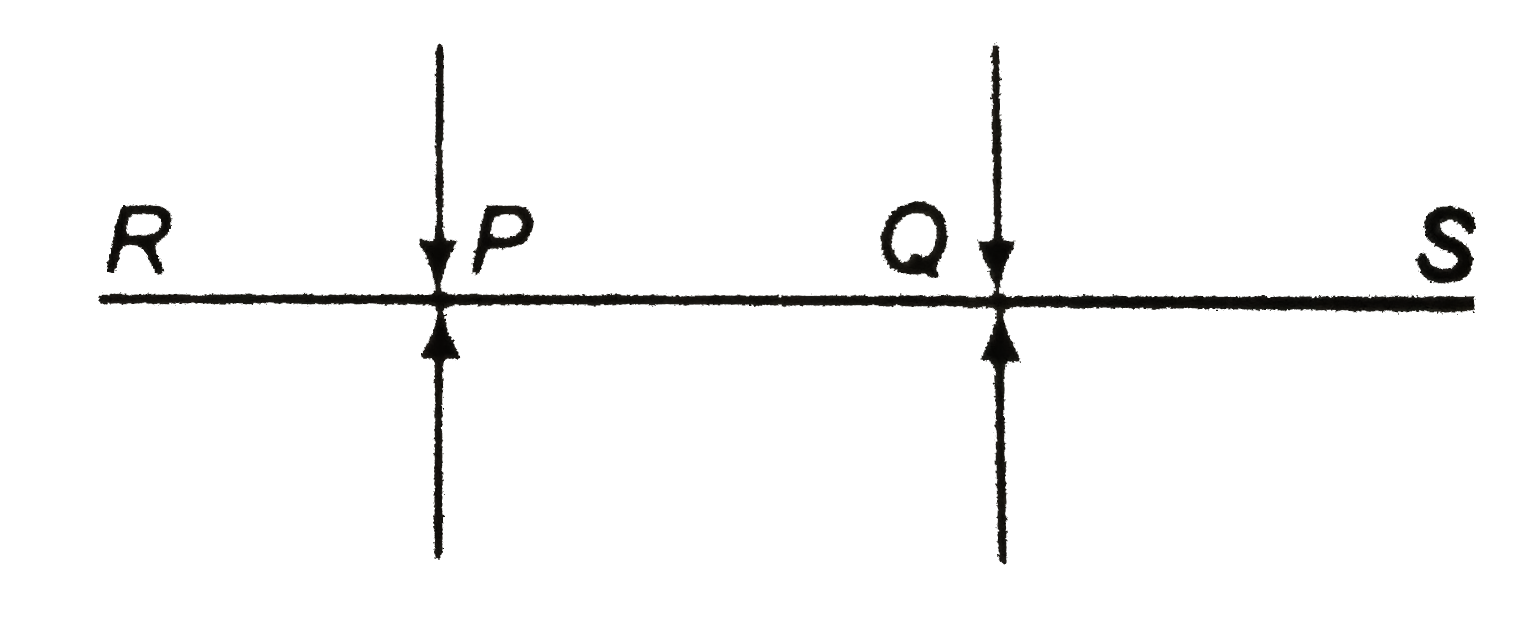 Between P and R, P is a FIXED end and R is the free end. It MEANS the number of loops between P and R will be odd multiple of `lambda/4` . Then, `(2n_2 -1)/2 lambda/2 = 5 ` or ` (2n_2 -1)lambda = 20` ...... (ii) Also between Qand S,lt brgt ` (2n_3 - 1) lambda = 60` ..........(iii) From EQS. (i) and (ii), we get `n_1/ (2n_2 -1) = 160/20 = 8` ........ (iv) and from Eqs. (i) and (iii). `(n_1)/(2n_3 - 1) = 160/60 = 8/3` .......(v) For minimum frequency `n_1 n_2 and n_3` should be least from Eqs.(iv) and (v). We get,`n_1 = 8, n_2 = 1, n_3 = 2` `lambda = 20/(2n_2 -1) = 20 cm ` [from Eq.(ii)] = 0.2 m `:. f_(min) = v/lambda = 8000/0.2` = 40 kHz. Next higher frequency corresponds to `n_1 = 24, n_2 = 2 ` and`n_3 = 5 ` `f= 120 kHz` |
|