

Saved Bookmarks
This section includes 7 InterviewSolutions, each offering curated multiple-choice questions to sharpen your Current Affairs knowledge and support exam preparation. Choose a topic below to get started.
| 1. |
The acceleration which will not give the value of acceleration at any instant of tine 't' is _________ |
|
Answer» INSTANTANEOUS acceleration |
|
| 2. |
A particle moves according to the law x = a cos(pit)/(2). The distance covered by it in the time 2 interval between t = 0 to t = 3 sec is |
|
Answer» 2a |
|
| 3. |
What is the gravitational potential energy of the Earthand sun ? The Earth to sun distance is arouund 150 million Km . The mass of the Earth is 5.9 xx 10^(24)kg and the mass of the sun is 1.9 xx 10^(30) kg. |
|
Answer» Solution :Given:r = 150 million KM `r=150xx10^(6)km=150xx10^(9)m` `M_(e)=5.9xx10^(24)kg` `M_(s)=1.9xx10^(30)kg` To find: Potential energy=?? Formula:`{:("Potential"),("energy"):}}=-(GM_(e)M_(s))/(r)` `=-(6.67xx10^(-11)xx5.9xx10^(24)xx1.9xx10^(30))/(150xx10^(9))` `=-0.4984xx10^(-11-9+24+30)` `=-0.4984xx10^(34)` `{:("Potential"),("energy"):}}=-49.84xx10^(32)J` |
|
| 4. |
Two balls are dropped to the ground from different heights. One ball is dropped 2s after the other, but both strike the ground at the same time 5s after the Ist is dropped. a) What is the differencein the heights from which they were dropped? b) From what height was the first ball dropped? |
|
Answer» Solution :a) for the first ball `s=h_(1),u=0,t=5s` `THEREFORE h_(1)=0xx5+(1)/(2)9.8xx5^(2)=122.5m` For the second ball `s=h_(2),u=0,t=3s` `therefore h_(2)=(1)/(2)g t^(2)=(1)/(2)xx9.8xx9=4.9xx9=44.1m` DIFFERENCE in HEIGHTS `H=h_(2)-h_(1)=122.5-44.1=78.4m` b) The first ball was dropped from a height of `h_(1)=122.5m` |
|
| 5. |
An air bubble rises from the button of a lake to its upper surface.The diameters of the bubble at the bottom and the surface are 3.6mm and 4 mm respectively.Depth of the lake is 2.5m and the temperature at the upper surface is 40^@C. Find the temperature at the bottom of the lake. Ignore the change in density of water with height. (Atmospheric pressure =76 cmHg and g=980 cm.s^-2) |
|
Answer» Solution :PRESSURE at the BOTTOM of the lake `p_1=76 times 13.6 times 980+250 times 1times 980` `=(76 times 13.6+250) times 980 dyn.cm^-2` Volume of AIR BUBBLE at the bottom `V_1=4/3pi(0.18)^3 cm^3` Let the temperature at the bottom of the lake =`T_1` Now at the surface pressure `p_2=76 times 13.6 times 980 dyn.cm^-2`. Volume of air bubble `V_2=4/3pi (0.2)^3 cm^3`, temperature `T_2=273+40=313K` Now using `(p_1V_1)/T_1=(p_2V_2)/T_2`, we get `((76times13.6+250)times980times4/3pi(0.18)^3)/T_1=(76times13.6times980times4/3pi(0.2)^3)/313` or,`T_1=283.37K=283.37-273^@C=10.37^@C` |
|
| 6. |
Match the Column I with Column II. |
|
Answer» A - p, B - Q, C - r, D - s |
|
| 7. |
The pair containing a scalar quantity and vector quantity is |
|
Answer» IMPULSE and ANGULAR momentum |
|
| 8. |
If a spring of force constant 'K' is cut into three equal parts, then the force constant of each part |
| Answer» ANSWER :C | |
| 9. |
The maximum speed of a car on a curved path of radius 'r' and the coefficient of friction mu_(k) is |
|
Answer» `v=sqrt((mu_(K))/(GR))` |
|
| 10. |
A body is projected at an angle 30^(@) with a kinetic energy of 80J. The ratio of its potential to kinetic energies at half the maximum height is |
| Answer» ANSWER :D | |
| 11. |
A large container with a cylindrical mouth is filled with water and closed with a piston. A vertical tube is now inserted through the piston. The radius of the tube is 5 cm, the radius of the piston is 10 cm and the mass of the pistoon is 20 kg. To what height will the water rise insdie the tube? |
|
Answer» Solution :AREA of the piston `=pi(r_(2)^(2)-r_(1)^(2))=pi(10^(2)-5^(2))=75picm^(2)`. Weight of the piston = `20xx1000xx`g dyn Let the height of the water COLUMN in the TUBE be h cm. Now, pressure of the piston = pressure of the water column in the tube or, `(20xx1000xxg)/(75pi)=hxx1xxg` `therefore" "h = (20000)/(75pi)=84.88cm`. |
|
| 12. |
A uniform rod of length 4m and mass 0.5kg is suspended vertically so that it can be rotated freely. Find the work done in raising the other end of the rod until it makes an angle of 60^(@) with the vertical. (g = 10 ms^(-2)) |
|
Answer» |
|
| 13. |
A motorboay is racing towards north at 25 km/h and the water current in that region is 10km/h in the direction of 60^(@)east ofsouth . Findthe resultant velocity of the boat. |
Answer» SOLUTION :The VECTOR `v_(b)` representing the velocity of the motorboat and the vector `v_(e)` representing the water current are shown in Fig . 4.11 in direstions specifiedby the problem . Usingthe parallelogram METHOD of addition , the resultantR isobtained in the direction shown in the figure . We can obtain the magnitude of R using the Law of cosine : `R=sqrt(v_(b)^(2)+v_(c)^(2)+2v_(b)v_(c)cos120^(@))` `=sqrt(25^(2)+10^(2)+2xx25xx10(-1//2))~=22km//h` To obtain the direction , we apply the Law of SINES `(R)/(sintheta)=(v_(c))/(sinphi)or,sinphi=(v_(c))/(R)sintheta` `=(10xxsin120^(@))/(21.8)=(10sqrt(3))/(2xx21.8)~=0.397` `phi~=23.4^(@)` |
|
| 14. |
A planet revolves about the sun in elliptical orbit of semimajor axis 2 xx 10^(12) m the areal velocity of the planet when it is nearst to the sun is 4.4 xx 10^(15)m^(2)//s. The least distance planet and the sun is 1.8 xx 10^(12)m(2)//s. Then find the minimum speed of the panet in km/s. |
|
Answer» |
|
| 15. |
Schematic diagram of a device is shown below Write the name of the four processes in the working cycle of the device. |
| Answer» SOLUTION :ISOTHERMAL EXPANSION, ADIABATIC expansion, isothermal COMPRESSION, adiabatic compression | |
| 16. |
A heavy steel ball of mass greater than 1kg moving with a speed of 2m/s collides head on with a stationary ping-pong ball of mass less than 0.1gm. The collision is elastic. After the collision the ping pong ball moves approximately with speed of |
|
Answer» 2m/s |
|
| 17. |
Two moles of an ideal monoatomic gas at 27^(@)Coccupies a volume of V.If the gas is expanded adiabatically to the volume 2V, then the work done by the gas will be (gamma=5//3) |
|
Answer» `-2767.23J` |
|
| 18. |
A spherical ball of mass m and radius r rolls without slipping on a rough concave surface of large radius R(R=9/7m).It makes small oscillations about the lowest point. Finds the time period. (Take g=10 m//"sec"^(2)) |
|
Answer» `5 PI` SEC |
|
| 19. |
An artificial satellite moving in a circular orbit around the earth has a total energy E_0 (PE+KE) its potential energy is |
|
Answer» `E_0` |
|
| 20. |
if the process of transfer of heat is slow, then it can be…………. Process. |
| Answer» SOLUTION :CONDUCTION or CONVECTION. | |
| 21. |
Infinite number of masses, each of mass m are placed along a straight line at a distance , r, 2r, 4r ….. Etc. from reference point O. Then gravitational field intensity at .O. will be equal to (XGm)/(3r^(2)). Find the value of x |
|
Answer» |
|
| 22. |
Three different objects of masses m_(1), m_(2) andm_(3) are allowed to fall from rest and from the same point O along three different frictionless paths. The speed of three objects, on reaching the ground, will be in the ratio of |
|
Answer» `m_(1) : m_(2) : m_(3)` |
|
| 23. |
If vehicle is moving on banked curved road and v lt v_(0), then what will be direction of frictional force ? |
| Answer» SOLUTION :Frictionforceis directiontowardtop of SLOPE | |
| 24. |
When the elevator is moving uniformly in the upward and then in downward directions, which of the following pairs is a correct pair? |
|
Answer» APPARENT WEIGHT = Actual weight and Apparent weight `gt` Actual weight |
|
| 25. |
Consider the telecommunication through optical fibres. Which of the following statements is not true? |
|
Answer» OPTICAL FIBRES can be of graded REFRACTIVE index |
|
| 26. |
A particle of mass m is whirled in a vertical circle with the help of a thread. If^(-) the maximum tension in the thread is double its minimum value then the value of minimum tension in the thread will be: |
|
Answer» 6 mg |
|
| 27. |
A student measures the time period of 100 oscillations of a simple pendulum four times. The data, set is 90s, 91s, 95s and 92s. If the minimum division in the measuring clock is 1s, then the reported mean time should be |
|
Answer» `92 +- 3S` |
|
| 28. |
The apparent weight of man inside a lift moving up with certain acceleration is 900N. When the lift is coming down with the same acceleration apparent weight is found to be 300N. The mass of the man is (g = 10 ms^(-2)) |
|
Answer» 45 kg |
|
| 29. |
Assertion - (AxxB) .(BxxA) "is" - a^(2) B^(2) Sin^(2)theta Here there is the between A and B. Reason (AxxB) and (BxxA) are two anti - paralle3l vectors provided A and B are neither parallel nor anti - parallel . |
|
Answer» If both Assetion and Reason are correct but Reason is the correct explanation of Assertion. THEREFORE `(AxxB).(BxxA)=(ABsin THETA)(ABsintheta)(cos180^(@))` ` =-A^(2)B^(2) SIN ^(2) theta` |
|
| 30. |
Two men of masses M and (M + m) climb a massless and inextensible rope from either end over a hanging pulley, from the same ground level with different uniformaccelerations starting at the same instant. If the acceleration of the lighter man is 'g' units, greater than twice the acceleration of the heavier man, then m is equal to (take g = 10 ms^(-2)) |
|
Answer» `M/2` |
|
| 31. |
For a vector vec(a) in 3D space if the value of the expression |hat(i) xx vec(a)|^(2) + |hat(j) xx vec(a)|^(2) + |hat(k) xx vec(a)|^(2) is na^(n) find n |
|
Answer» |
|
| 32. |
Assertion : Change in pressure at constant temperature causes change in the speed of sound. Reason : Speed of sound in air is directly proportional to square of pressure. |
|
Answer» Assertin and reason both are CORRECT and reason is the correct EXPLANTION of assertion. `= sqrt (( gamma mu RT)/( mu M _(0)))= sqrt((gamma RT)/( M _(0)))=` constant `(M _(0)=` molecular weight, `mu = no.` of moles) Speed of sound is not affected by change in pressure at constant temperature. |
|
| 33. |
A thin glass (refractive index 1.5) lens has optical power of -8D in air. Its optical power in a liquid medium with refractive index 1.6 will be |
| Answer» ANSWER :C | |
| 34. |
In the question number 20, a unit vector perpendicular to the direction of vecA and vecBis |
|
Answer» `(-2hati-hatj-hatk)/(sqrt(6))` `vecA xx vecB = |{:(hati,,hatj,,hatk),(-2,,3,,1),(1,,2,,-4):}|` ` = hati (-12-2) + hatj(1-8) + hatk(-4-3) = -14hati - 7hatj - 7hatk` `|vecAxxvecB| = sqrt((1-14)^(2) + (-7)^(2) +(-7)^(2)) = 7sqrt(6)` `THEREFORE hatn = (-14hati - 7hatj -7hatk)/(7sqrt(6)) = (-2hati-hatj -hatk)/(sqrt(6))` |
|
| 35. |
A pendulum is taken 1 km inside the earth from sea level. Then the approximate gain or loss of time of pendulum is |
|
Answer» it loss of 13.5 sec per day |
|
| 36. |
When the temperature of a gas in a rigid container is raised, the pressure exerted by the gas on the walls of the container increases because |
|
Answer» The molecules have HIGHER average SPEED, so strike the walls more often |
|
| 37. |
What will be the density of lead at a pressure of 2 times 10^4 N.m^-2? (Density of lead=11.4 g.cm^-3 atSTP and bulk modulus of lead =0.8 times 10^10 N.m^-2) |
|
Answer» |
|
| 38. |
The potential energy U between two molecules as a function of the distance X between them has been shown in the Fig. The two molecules are |
|
Answer» Attracted when X lies between A and B and are REPELLED when X lies between B & C |
|
| 39. |
When two waves of almost equal frequencies n_(1) and n_(2) reach at a point simultaneously, what is the time interval between successive maxima ? |
|
Answer» SOLUTION :Time INTERVAL between two successive maxima when two WAVES having slighly different frequencies `n _(1) and n_(2).` Superpose at some point at some instant of time is, `T = (1)/( f _(b)) = (1)/( n _(1) - n_(2)) (if n _(1) GT n _(2))` OR `T =(1)/( f _(b)) = (1)/( n _(2) - n _(1)) (if n _(2) gt n _(1))` |
|
| 40. |
A small bar A resting on a smooth horizontal plane is attached by threads to a point P and by means of weightless pulley, to a weight B possessing the same mass as the bar itself. The bar is also attached to a point O by means of a light non-deformed spring of length l_0=50cm and stiffness k=mg//l_0, where m is the mass of the bar. The thread PA having been burned, the bar starts moving to the right. Find its velocity at the moment when it is breaking off the plane. |
|
Answer» Solution :LET `theta` be the angle between spring and vertical at the instant when block A breaks off the plane `(N=0)`. `implies cos theta=(l_0)/(l_0+x)` (i) `N+KX cos theta=mg` `implies kx cos theta=mg` (as `N=0`) (ii) Let d is the distance COVERED by A and B till this instant and V is the speed acquired by A and B. (same because they are connected) From (i) and (ii), using `k=(5mg)/(l_0)` `implies (5mg)/(l_0)xx(l_0)/(l_0+x)=mg` `impliesx=l/4l_0impliesd=sqrt((l_0+x)^2-l_0^2)=(3l_0)/(4)` Using energy CONSERVATION: 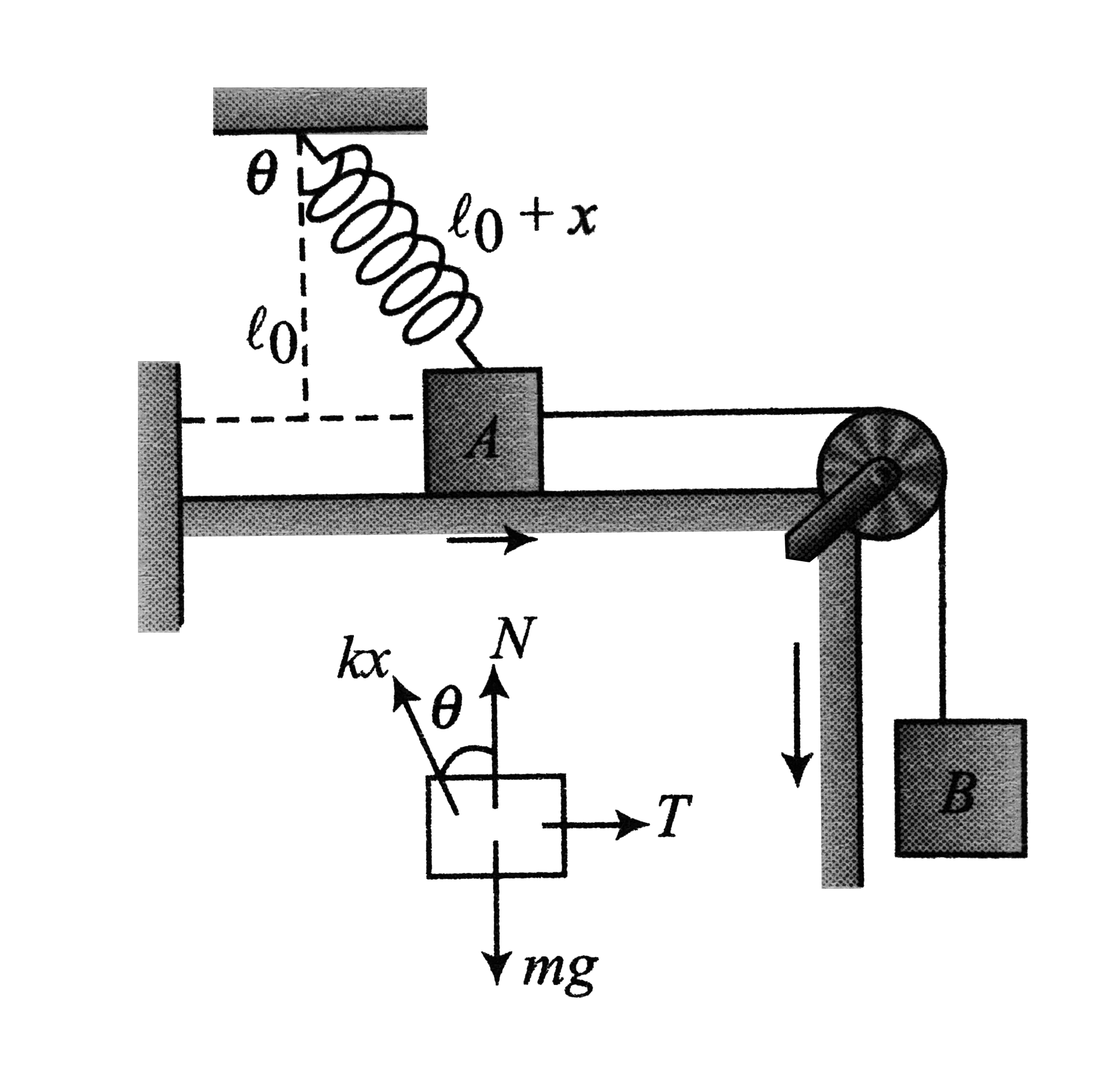 `mgd=2(1/2mv^2)+1/2kx^2` `impliesmg(3l_0)/(4)=mv^2+1/2(5mg)/(l_0)(l_0^2)/(16)` `implies v^2=(3gl_0)/(4)-(5)/(32)gl_0impliesv=sqrt((19gl_0)/(32))` |
|
| 41. |
If a monoatomic ideal gas of volume 1 litre at N.T.P is compressed adiabatically to half of its volume, find the work done on the gas. Also find the work done if the comression is isothermal. |
|
Answer» Solution :i) During an adiabatic process `T_(1)V_(1)^(gamma-1) = T_(2)V_(2)^(gamma-1)` Here, `T_(1)=273K, V_(2)=V_(1)/2 , gamma=5/3` ` :. 273xxV_(1)^(5/3-1) = T_(2)[V_(1)/2]^(5/3-1)` `T_(2)= (2)^(2/3)xx273= 431.6 K` number of moles,` n=(1" LITRE")/(22.4 " litre")=1/22.4` Work DONE = `(nR)/(gamma-1) (T_(1)-T_(2))` ` = 8.314/(22.4[5/3-1])(273-431.6)=(8.34xx3)/(22.4xx2)(-158.6)=-89J` ii) Work done during isothermal compression is `W=2.3026nRT log_(10)[V_(2)/V_(1)]` n=number of moles = `1/22.4` , `T=273K, R =8.314 "J mol" ^(-1)K^(-1) RARR V_(2)/V_(1)=1/2=0.5` ` :. W= (2.3026xx8.314xx273 log_(10) (0.5))/22.4 = W= -70J` |
|
| 42. |
Three identical solid sphere moves down three incline A, B and C - all of the sme dimensions. A is without friction, the friction between B and sphere is sufficient to cause rolling without slipping, the friction between C and sphere causes rolling with slipping. The kinetic energies A,B,C at the bottom of the inclines are E_(A),E_(B),E_(C) |
|
Answer» `E_(A)=E_(B)=E_(C)` |
|
| 43. |
A body of mass M kg is on the .top point of a smooth hemisphere of radius 5 m. It is released to slide down the surface of the hemisphere. It leaves the surface when velocity is 5 ms^-1, At this instant the angle made by the radius vector of the body with the vertical is (acceleration due to gravity =10 ms^-2) |
|
Answer» `30^(@)` |
|
| 44. |
The second derivative of position vector with respect to time is |
|
Answer» velocity |
|
| 45. |
A block of mass 5 kg is at rest on a smooth horizontal surface. Water coming out of a pipe horizontally at the rate of 2 kg s^(-1) , hits the block with a velocity of 6ms^(-1)The initial acceleration of the block is, |
|
Answer» ZERO |
|
| 46. |
A load of 4 kg is suspended from a ceiling through a steel wire of length 2 m and radius 2 mm. It is found that the length of the wire increase by 0.032 mm as equilibrium is achieved. What would be the Young's modulus of steel ? (Take , g=3.1 pi m s^(-2)) |
|
Answer» `2.0 xx 10^(11) Nm^(-2)` LENGTH of wire, l=2 m Radius of wire (cross-section)`=2 mm = 2 xx 10^(-3)` m and change in length, `Deltal=0.031xx 10^(-3) m` Young's modulus, `Y=("Stress")/("STRAIN")=((mg)/(A))/(((Deltal)/(l)))=((4xx3.1pi)/(pi(2xx10^(-3))^(2)))/((Deltal//l))` `IMPLIES Y=(4xx3.1pi)/(pixx4xx10^(-6))xx(2)/(0.031xx10^(-3))` `=(3.1xx2)/(0.031)xx10^(9)=2xx10^(11) Nm^(-2)` |
|
| 47. |
Consider PT graph of cyclic process shown in the figure. Maximum pressure during the cycle is twice the minimum pressure. The heat received by the gas in the process 1-2 is equal to the heat received in the process 3-4. The process is done on one mole of monoatomic gas. Correct PV diagram for the process is- |
|
Answer»
`1rarr2`, isobaric `2rarr3`, ISOCHORIC `3rarr4`, Isobaric `4rarr1` , Isothermal Option (d) depicts the correct P-V diagram for the given cyclic process. |
|
| 48. |
A transverse harmonic wave on a string is described by y(x,t)=3.0sin(36t+0.018x+(pi)/(4)) where x and y are in cmand 't' is in sec. The positive direction of 'x' is from left to right Which of the following are true (a) the wave is travelling from right to left (b) the speed of the wave is 20m//s (c ) frequency of the wave is 5.7Hz (d) the least distance between two successive crests in the wave is 2.5cm. |
|
Answer» `a,b` |
|
| 49. |
Find the centre of mass of the letter F which is cut from a uniform metal sheet as shown. Take lower left corner as origin. |
|
Answer» |
|
| 50. |
Prove that the length of a day becomes T' = 6 h instead of T = 24 h if the earth suddenly contracts to half its present radius (consider earth as a spherical body), without having any change in its mass. |
|
Answer» Solution :Since the earth is a SOLID sphere its moment of inertia `I PROP R^(2)` (R= radius of the earth ) [` :.` moment of inertia of solid sphere `= (2)/(5) "MR"^(2)`] So, if the present radius is R and the CHANGED radius is `(R )/ (2)` then, `(I)/(I). =(R^(2))/(((R)/(2))^(2))=4` Again if the present angular velocity is `omega` and the changed angular velocity is `omega` , then according to the PRINCIPLE of conservation of angular momentum, `Iomega=I.omega.or,omega.=(I)/(I.)omega=4omega` `:. (2pi)/(T.)=4. (2pi)/(T)or,T.=(T)/(4)=(24)/(4)=6h`. |
|


