

Saved Bookmarks
This section includes 7 InterviewSolutions, each offering curated multiple-choice questions to sharpen your Current Affairs knowledge and support exam preparation. Choose a topic below to get started.
| 1. |
In apetrolengine(internal combustionengine )air atatmosphericpressureandtemperatureof 20^(@)Cis compressedin thecylinder by thepistonto 1//8 of itsoriginalvolume. Calculatethetermperature of thecompressedair . |
|
Answer» Solution :`T_(1)=20^(@)C=20+273K, V_(1)=1m^(3), V_(2)=(1)/(8)V_(1)m^(3), gamma=1.4` FORM equation of adiabatic process `TV^(gamma-1)="constant"` `T_(1)V_(1)^(gamma-1)=T_(2)V_(2)^(gamma-1)` `T_(2)=((V_(1))/(V_(2)))^(gamma-1)T_(1)` `T_(2)=((1)/(((1)/(8))))^(1.4-1)xx298=(8)^(0.4)xx293` `=673.1K=673.1-273,T_(2)=400^(@)C` |
|
| 2. |
A stone of mass 2 kg is projected upward with kinetic energy of 98 J. The height at which the kinetic energy of the stone becomes half its original value, is given by |
|
Answer» 5 m `K= 1/2m U^2` where m is the mass of the stone and u is the velocity of the projection. or `mu^2 = (2K)/(m) = (2 xx 98)/(2) = 98` Let h be the maximum height attained by the stone. `:. h = (u^2)/(2g) or h = (98)/(2 xx 9.8) = 5 m "" .....(i)` Also, `K = 1/2 m (2gh) "" `(Using (i)) Let h. be the height at which the kinetic energy of hte stone becomes half. `:. K. = 1/2 m (2 gh.)` `:. (K.)/K = (h.)/h ` But `K. = K/2 :. K/(2K) = (h.)/(h)` or `h. = h/2 = 5/2 m = 2.5 m`. |
|
| 3. |
A particle of mass 100 g is thrown vertically upwards with a speed of 5 ms^(-1). The work done by the force of gravity during the time the particle goes up is |
|
Answer» `-0.5J` `h = (u^2)/(2g) = (25)/(2 xx 9.8)""….(i)` The force of gravity (= mg) is opposite to the displacment . So the work done by the force of gravity is `W = - mgh = -0.1 xx 9.8 xx 25/(2 xx 9.8)"(USING (i))"` ` = -0.1 xx 25/2 = -1.25 J` 
|
|
| 4. |
A block of weight 200 N is pulled along a rough horizontal surface at constant speed by a force 100 N acting at an angle 30^(@) above the horizontal. The coefficient of friction between the block and the surface is |
|
Answer» `0.43` |
|
| 5. |
A ball of mass m is pushed down the wall of hemispherical bowl from point A. It just rises up to edge Q of the bowl. Find the speed at which ball is pushed down. |
Answer» Solution :From law of conservation of ENERGY 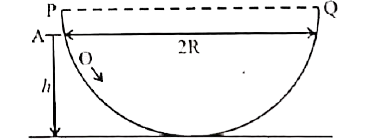 Total energy at A = Total energy at Q `(1)/(2)MV^(2)+mgh=0+mgR` `(1)/(2)mv^(2)=mg(R-h)` `therefore v^(2)=2g(R-h)` or `v=sqrt(2g(R-h))` |
|
| 6. |
A capillary tube of radius 'r' is lowered into water whose surface tension is 'a' and density ‘d'. The liquid rises to a height. Assume that the contact angle is Zero. Choose the correct statement(s), |
|
Answer» MAGNITUDE of work DONE by force of surface TENSION is -`(4 pi alpha^2)/( d G)` |
|
| 7. |
The specific heat at constant volume of a certain metal is 420 J kg^(-1). Write the chemical formula of its chloride, if contains 0.345 fraction of the metal (NCERT). |
|
Answer» Solution :Given S = 420 `Jkg^(-1)K^(-1)`. From Dulong - Petit's law (Atomic mass) (specific heat) = 25200 `JkgK^(-1)`. Hence ATOMICMASS of the metal `=(25200)/(420) = 60` 60 g combine with (35.5) n g of CHLORINE To produce (60 + n(35.5))g of metal chloride, FRACTION of metal in its chloride `= (60)/(60 + 35.5n) = 0.34.5)`. Fraction of metal that combines with 35.5n of chlorine `= (X)/(x + 35.5n) = 0.345` Solving x = 56.1 = 56 which is the atomic mass of iron. `therefore` Chemical formula of metal chloride is `FeCI_(3)`. |
|
| 8. |
Obtain the equation of frequency observed by stationary observer and moving source. |
|
Answer» Solution :For this, we have to use below given sign convention. Let us choose the convention to take the DIRECTION from the observer to the source as the positive direction of velocity. Consider a source S moving with velocity v, and an observer who is stationary in a frame in which the MEDIUM is also at rest. Let the speed of a wave of angular frequency `OMEGA` and period `T_(0),`both measured by an observer at rest with respect to the medium be v.  As shown in figure, at time `t =0` the source is at point `S_(1),` located at a distance L from the observe and emits a crest. This reaches the observer at time `t _(1) = (L)/(v)""...(1)` At time `t = T_(0)1 `the source has moved a distance `v _(s) T_(0) and ` is at point `S _(2),` located at a distance `L+v _(2) T _(0)` from the observer. At `S _(2),` the source emits a second crest. This reaches the observer at, `t _(2) = T _(0) + (L+ v _(s) T _(0))/(v )` At time `n T _(0)` the source emits its `(n+1) ^(TH)` crest and this reaches the observer at time, `t _(2) =T_(0) = n T_(0) + (L+ n v _(s) T _(0))/( v ) ""...(2)` `t _(n+1) -t _(1) = ( n T _(0) + (L + n v _(s) T _(0))/( v )- (L )/(v))/( n )` `[because` From equation (1) and (2)] `= (n T _(0))/( n ) + (L + nv _(s) T _(0) - L)/( nv)` `= (n T_(0))/( n ) + (nv _(s) T _(0))/( nv)` `T =T_(0) [1 + (v _(s))/(v ) ] ""...(3)` Equation (3) may be rewritten in TERMS of the frequency `v _(0)` thta would be measured if the source and observer ware stationary and the frequency v observed wien the source is moving as, `v = v _(0) (1+(v _(s))/( v )) ^(-1) [ (1)/(T) = v ]` If `v _(s)` is small complared with the wave speed v, taking b inomial expansion to terms in first order in `v _(s) //v` nd neglecting higher power may be approximated, giveng, `v = v _(1) [1- (v _(s))/(v ) ] ""...(4)` For a source approching the observer, we replace `v _(s) ` by `- v _(s)` to get, `therefore v = v _(0) [1 + (v _(s))/( v ) ]""...(5)` The observer thus measures a lower frequency when the source recedes from him than he does when it is at rest, He measures a higher frequency when the source approaches him. |
|
| 9. |
(A) : Direction of angular velocity is always perpendicular to plane of rotation.(R ) : If the axis of rotation is fixed direction of angular velociy does not change. |
|
Answer» Both (A) and (R ) are TRUE and (R ) is the CORRECT EXPLANATION of (A) |
|
| 10. |
For a system to follow the law of conservation of linear momentum during a collision, the condition is a) total external force acting on the system is zero b) total external force acting on the system is finite and time of collision is negligible c) total internal force acting on the system is zero |
|
Answer» (a) only |
|
| 11. |
A ball of mass1 kgis projected with a velocityof 20sqrt(2) m/sfromthe originof anxyco ordinateaxissystemat an angle 45^(@)witha xis( horizontal)the angular momentum [ inSI inits ]of the ball about thepointofprojection ater2 s of projectionis [ takeg = 10 m//s^(2)]( y - axisis takenas vertical |
|
Answer» <P>`-400 BAR(k)` |
|
| 12. |
The pressure on the top surface of an aeroplane wing was 0.90xx10^(5)Pa and at the bottom surface is 0.91x10^(5)Pa. If the area of each surface is 40m^(2), the net lift force on the wing is |
|
Answer» `2xx10^(4)N` |
|
| 13. |
A thin spherical shell of mass 'M' and radius 'R' has a small hole. A particle of mass 'm' is released at the mouth of them. Then |
|
Answer» the particle will execute S.H.M. inside the shell |
|
| 14. |
A transparent solid cylindrical rod has a refractive index of 2//sqrt3 It is surrounded by air. A light ray is incident at the midpoint of one end of the rod as shown in the figure. The incident angle theta for which the light ray grazes along the wall of the rod is |
|
Answer» `sin^-1 (sqrt3/2)` |
|
| 15. |
If earth suddenly contracts by 1/2 of its present radius by how much would the day be decreased ? |
| Answer» Solution :`I_(1)omega_(1) = I_(2)omega_(2), (2//5) mr_(1)^(2) XX (2pi //T_(1)) = (2//5) mr_(2)^(2) xx (2pi//T_(2)), T_(2)=(r//2)^(2) xx 24lr^(2), T_(2) = 6` HOURS. The day would be DECREASED by 24-6 = 18 hours | |
| 16. |
Two metal spheres each of radius 'r' are kept in contact with each other. If d is the density of the meterial of the sphere, then the gravitational force between those spheres is propositional to |
|
Answer» `d^(2)R^(6)` |
|
| 17. |
Any phenomenon that…………. Can serve as a …………… . |
|
Answer» |
|
| 18. |
If a body is perfectly incompressible what will be its value of Poisson.s ratio? |
| Answer» SOLUTION :If a body is to be perfectlyincompressibile, `(DeltaV)/(V)=0`, From example 16 it can be seen that`1-2sigma=0 RARR sigma=0.5` | |
| 19. |
The range of attraction between molecules is of the order is |
|
Answer» `10^(-6)m` |
|
| 20. |
What will happen to the potentail energy of the system ? If (i) Two same charged particles are brought towards each other (ii) Two oppositely charged particles are brought towards cach other |
|
Answer» Solution :(i) When the same charged particles are brought TOWARDS each other, the POTENTIAL energy of the system will increase. Because work has to be done against the FORCE of repulsion. This work done only stored as potential energy (ii) When two oppositely charged particles are brought towards each other, the potential energy of the system will decrease. Because work is done by the force of ATTRACTION between the charged particles |
|
| 21. |
(A): The entropy of the solids is the highest (R ): Atoms of the solids are arranged in orderly manner. |
|
Answer» Both (A) and(R ) are true and (R ) is the correct EXPLANATION of (A) |
|
| 22. |
A manometer contains a liquid of density rho The difference in the levels when the manometer rotates at a constant angular velocity about one of its vertical limbs. (Let 1 be the length of horizontal tube) |
|
Answer» `(omega^(2)L^(2))/(2g)` |
|
| 23. |
What is called brittle material ? |
| Answer» SOLUTION :A MATERIAL is brittle if, when subjected to stress, it breaks without SIGNIFICANT DEFORMATION. | |
| 24. |
Gravity is ……a sapecial case of ……… and is also called………. . |
|
Answer» |
|
| 25. |
Out of the following, in which vessel will the temperature of the solution be higher after the salt is completely dissolved. |
|
Answer» A |
|
| 26. |
Why do raindrops fall with small velocities though they are failing from greater heights? |
| Answer» SOLUTION :Due to terminal velocity i.e., `v PROP R^2`. Since if r is less v is less. | |
| 27. |
A disc rolls on ground without slipping. Velocity of centre of mass is v. There is a point P on circumference of disc at angle theta. Suppose, v_(P) isthe speed of this point. Then, match the following columns {:(,"Column-I",,"Column-II"),("(A)","If" theta=60^(@),"(p)",v_(P)=sqrt(2)v),("(B)","If" theta=90^(@),"(q)",v_(P)=v),("(C)","If" theta=120^(@),"(r)",v_(P)=2v),("D)","If" theta=180^(@),"(s)",v_(P)=sqrt(3)v):} |
|
Answer» If `theta=90^(@)`, then `v_(P)=2v sin ((60^(@))/(2))=2vxx(1)/(2)=v` `rArr (A) rarr (q)` If `theta = 90^(@)`, then `v_(P) =2v sin ((90^(@))/(2))=2v xx (1)/(SQRT(2))=sqrt(2)v` `rArr (B) rarr (p)` If `theta =120^(@)`, then `v_(P) = 2 v sin ((120^(@))/(2))=2vxx(sqrt(3))/(2)=sqrt(3)v` `rArr (C) rarr (s)` If `theta =180^(@)`, then `v_(P) =2v sin ((180^(@))/(2))=2v rArr (D)rarr (r)`. |
|
| 28. |
Chandrasekar limit is……..... times the mass of the Sun. |
|
Answer» 1.2 |
|
| 29. |
A body of mass 1.5 kg is allowed to slide down along a quadrant of a circle from the horizontal position. In reaching to the bottom, Its velocity is 8m/s. The work done in over-coming the friction is 12J. The radius of circle is (g=10 ms^(-2)) |
| Answer» Answer :A | |
| 30. |
Which of the following statements are correct regarding elasticity? |
|
Answer» Rubber dies not OBEY HOOKE's law |
|
| 31. |
F_g, F_e and F_n represent the gravitational, electro-magnetic and nuclear forces respectively, then arrange them in increasing order of their strengths |
|
Answer» `F_n, F_e,F_g` |
|
| 32. |
A person moving horizontally with velocity barV_(m). The relative velocity of rain with respect to the person is |
|
Answer» `V_(R)+V_(m)` |
|
| 33. |
Consider a mass m_(0) enclosed by a closed imaginary surface S. Let vecg b the gravitational field intensity due to m_(0) at the surface element dvecS directed as outward normal to it. The surface integral to the gravitationl field over S is |
|
Answer» `-m_(0)G` |
|
| 34. |
These questions consists of two statements each printed as Assertion and Reason. While answering these question you are required to choose any one of the following five responses. Reason: In an eleastic collision, the linear momentum of the system is conserved. |
|
Answer» If both Assertion and REASON are correct and Reason is the correct explanation of Assertion. |
|
| 35. |
A mass of diatomic gas (gamma = 1.4) at a pressure of 2 atmosphere is compressed adiabatically so that a temperature rises from 27^(@)C to 927^(@)C. The pressure of the gas in the final state is |
|
Answer» 8 atm |
|
| 36. |
The momentum of a body in two perpendicular direction at any time 't' are given by P_(x) =2t^(2) + 6 and P_(y) = (3t^(2))/2 + 3. The force acting on the body at t= 2 sec is |
|
Answer» 5 UNITS |
|
| 37. |
The velocity of a particle is zero at t = 0. a) The acceleration at t= 0 must be zero. b) The acceleration at t=0 may be zero. c) If the acceleration is zero from 0 to t=10 s, the speed is also zero in this interval: d) If the speed is zero from t=0 to t=10 s the acceleration is also zero in this interval. |
|
Answer» a, B & d are correct |
|
| 38. |
Velocity and acceleration vectors of charged particle moving perpendicular to the direction of magnetic field at a given instant of time are vecv= 2hati +c hatj" and "veca= 3hati+4hatj respectively. Then the value of 'e' is |
|
Answer» `3` |
|
| 39. |
State the examples of ductile and brittle material ? |
|
Answer» Solution :Ductile metals: In the stress strain DIAGRAM if the stress difference between ELASTIC limit and breaking point is high then that material is called ductile material. Such metals will exhibit the property of elongation. So they can be used to PREPARE thin wire or foils. Ex: Copper, GOLD etc. Brittle metals: In the stress strain diagram if the stress difference between elastic limit and breaking point is less then that metals does not exhibit the property of elongation. So they can not be elongated more. Such substances are called brittle metals. Ex: Cast IRON, Glass etc. |
|
| 40. |
One mole of an ideal gas is heated at constant pressure. If an 100 Joule heat energy supplied to the gas, then work done by the gas will be …….. (gamma=1.4) |
|
Answer» 28.57 J From first law of thermodynamics , `DeltaW=DeltaQ-DeltaU` `=nC_P DeltaT - nC_V DeltaT` `=nDeltaT (C_P-C_V)` `THEREFORE (DeltaW)/(DeltaQ)=(nDeltaT (C_P-C_V))/(nC_P DeltaT)` `=(C_P-C_V)/C_P =1-C_V/C_P` `=1-1/gamma` `=1-1/1.4` `=0.4/1.4` `DeltaW=2/7xxDeltaQ` `therefore DeltaW=2/7xx100=200/7` `therefore DeltaW`-28.57 J |
|
| 41. |
The displacement (in m) of a particle of mass 100 gm from its mean position is given by the equation Y=0.05 sin 3pi(5t +0.4) |
|
Answer» the TIME period of motion is 1/30 sec. |
|
| 42. |
An electric bulb suspended from the roof of a train by a thread shifts through' an angle of 19.8° when the train goes round a curved path 100 m in radius. Find the speed of the train |
|
Answer» |
|
| 43. |
Passage - I A disc of radius 20 cm is rolling with slipping on a flat horizontal surface. At a certain instant the velocity of its centre is 4 m/s and its angular velocity is 10 rad/s. The lowest contact point is O. Velocity of point P is |
|
Answer» `SQRT(10)m//s` |
|
| 44. |
Passage - I A disc of radius 20 cm is rolling with slipping on a flat horizontal surface. At a certain instant the velocity of its centre is 4 m/s and its angular velocity is 10 rad/s. The lowest contact point is O. Instantaneous centre of the rotation of disc is located at |
|
Answer» `0.2` m below |
|
| 45. |
A disc revolves with a speed of 33 1/3 rev/min, and has a radius of 15 cm. Two coins placed at 4 cm and 14 cm away from the centre of the record. If the coefficient of friction between the coins and the record is 0.15, which of the coins will revolve with the record ? |
|
Answer» Solution :For the COIN to revolve with be disc, the force of friction should be enough to PROVIDE the NECESSARY centripetal force. i.e., `(mv^(2))/r lemumg`. Now `v=romega`, where `OMEGA=(2pi)/T` is the angular frequency of the disc. Fow a given `mu and omega`, the condition is `rle(mug)/omega^(2)` The condition is satisfied by the nearer coin (4cm from the centre). |
|
| 46. |
Passage - I A disc of radius 20 cm is rolling with slipping on a flat horizontal surface. At a certain instant the velocity of its centre is 4 m/s and its angular velocity is 10 rad/s. The lowest contact point is O. Velocity of point O is |
|
Answer» 2 m/s |
|
| 47. |
Assertion : If water is filled in a balloon and this is immersed in water itself. Then volume of water displaced is equal to the volume of water filled in the ballon. Reason : Volume of a liquid displaced is equal to the volume of solid immersed in that liquid. |
|
Answer» If both Assertion and REASON are correct and Reason is the correct explanation of Assertion. |
|
| 48. |
If vec(A) = vec(B) + vec( C) and the magnitude of A, B and C are 5, 4 and 3 units respectively the angle between vec(A) and vec(B) is: |
|
Answer» `cos^(-1) ((3)/(5))` |
|
| 49. |
When a brass rod is put in a furnace, its length increases by 1 %. If the room temperature is 25°C and alpha_("Brass") = 20 xx 10^(-6)//^(@) C, the change in. the temperature is 100x^(@) C, where x= |
|
Answer» |
|