

Saved Bookmarks
| 1. |
Consider a rectangular block of wood moving with a velocity v_(0) in a gas at temperature T and mass density roh. Assume the velocity is along X-axis and area of cross section of the block perpendicular to v_(0) is A. Show that the drag force on the block is 4(roh) A v_(0) (sqrt(KT))/(m), where m is the mass of the gas molecule. |
|
Answer» Solution :In fig., we have shown a rantangular wooden block of cross sectional area A moving with velocity `upsilon_(0)` ALONG X-axis. m is mass of gas molecules moving with velocity `upsilon` along X-axis. Number of collisions//sec = collision frequency `f =1/2 ` (surface area `xx` velocity `xx` number of molecules//vol.) `1/2 A (upsilon+upsilon_(0))xxn` (The factor 1/2 is due to molecules moving away from the block ) Momentum transferred by a molicule during one collision with face `1 = 2 m(upsilon+upsilon_(0))` `:.` Total force ACTING on face 1 of block `F_(1) = 2m(upsilon+upsilon_(0)) xx f = 2m (upsilon+upsilon_(0)) 1/2 A(upsilon+upsilon_(0)) xxn` `= rho A(upsilon+upsilon_(0))^(2)` similary, force acting on face 2 of block, `F_(2) =rho A (upsilon+upsilon_(0))^(2)` Where `(upsilon+upsilon_(0))` is relative speed of molecules w.r.t. face 2 of block `:.` net force acting on the block (i.e., drag force), `F =F_(1)-F_(2) = rho A(upsilon+upsilon_(0))^(2) - rho A (upsilon+upsilon_(0))^(2) = rho A (4upsilon upsilon_(0)) = 4 rho A upsilon_(0) upsilon` ...(i) As motion is along X-axis only, therefore, from law of equipartition of energy `1/2 m upsilon^(2) = 1/2 k_(B)T` or `upsilon = sqrt((k_(B)T)/(m))` Putting in (i) we get ` F =4 rho A upsilon_(0)sqrt((k_(B)T)/(m))`. 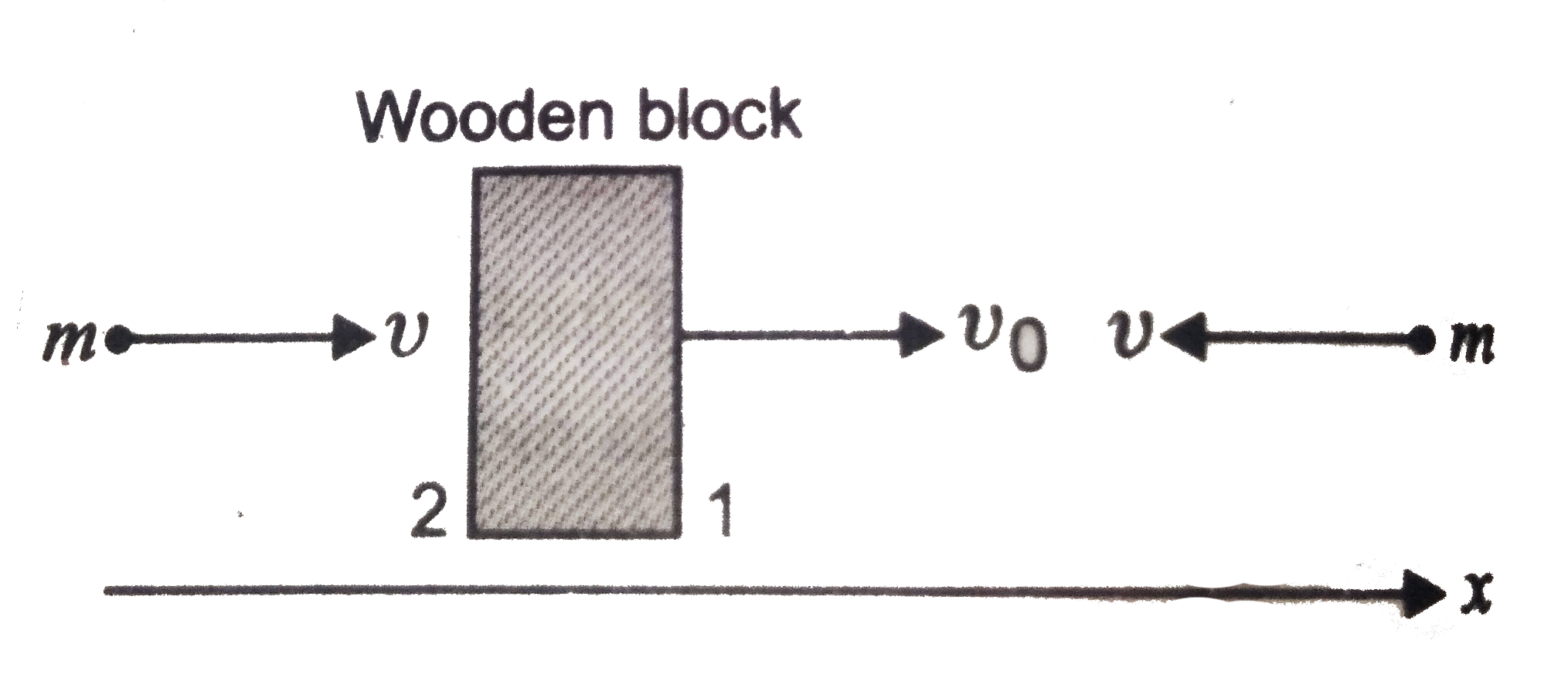
|
|