

Saved Bookmarks
This section includes 7 InterviewSolutions, each offering curated multiple-choice questions to sharpen your Current Affairs knowledge and support exam preparation. Choose a topic below to get started.
| 1. |
ML^(-1) T^(-2) is the dimensional formula of |
|
Answer» MODULUS of Elasticity |
|
| 2. |
Rain is falling vertically with a speed of 1ms^(-1). A woman rides a bicycle with a speed of 1.732ms^(-1) in east to west direction. What is the direction in which she should hold her umbrella? |
Answer» Solution :In Fig. `v_(r)` represents the velocity of rain and `v_(b)`, the velocity of the bicycle, the woman is riding. Both these velocities are with respect to the GROUND. Since the woman is riding a bicycle, the velocity of rain as experienced by  her is the velocity of rain relative to the velocity of the bicycle she is riding. That is `V_(rb)=V_(r)-V_(b)` This relative velocity VECTOR as shown in Fig. makes an angle `theta` with the vertical. It is given by `tantheta=(v_(b))/(v_(r))=(sqrt(3))/(1)=sqrt(3)=60^(@)` Therefore, the woman should HOLD her umbrella at an angle of about `60^(@)` WIHT the vertical TOWARDS the west. |
|
| 3. |
What are harmonics ? |
|
Answer» Solution :NOTES of FREQUENCY which are INTERVAL multiples of the FUNDAMENTAL frequency (or) If naturanl frequencies are written as integral MULTIPLE of fundamental freqencies, then the frequencies are called harmonics. |
|
| 4. |
The largest and the shortest of the earth from the sun are r_(1)" and "r_(2). Its distance from the sun when it is at perpendicular to the major axis of the orbit drawn from the sun is |
|
Answer» `(r_(1)+r_(2))/(4)` |
|
| 5. |
A vessel of volume V contains a mixture os n_1 mol of nitrogen and n_2 mol of oxygen at temperature T. The molecular weights of nitrogen and oxygen are M_1 and M_2 respectively. Considering the gases are ideal, find the pressure and average molecular weight of the gas mixture. |
|
Answer» |
|
| 6. |
A uniform ring is rotating about vertical axis with angular velocity omega initally. A point insect (S) having the same mass as that of the ring starts walking from the lowest point P_(1) and finally reaches the point P_(2) (as shown in figure). What is the final angular velocity of the ring ? . |
|
Answer» `((1)/(2) MR^(2)) OMEGA = ((1)/(2) MR^(2) + MR^(2)) omega'` `((1)/(2) MR^(2)) omega = ((3)/(2) MR^(2)) omega' rArr omega' = (omega)/(3)`. |
|
| 7. |
Moment of inertia of a thin uniform disc about an axis passing through the center lying on the plane (along diameter is) |
|
Answer» `MR^(2)` |
|
| 8. |
In a car lift, compressed air exerts a force F on a small piston having a radius of 5 cm. This pressure is transmitted to a second piston of radius 15 cm. If the mass of the car to be lifted is 1350 kg, what is F? |
|
Answer» `1.5xx103N` |
|
| 9. |
Two identical smooth balls are projected from points O and A on the horizontal ground with same speed of projection. The angle of projection in each case is 30^(@).The distance between O and A is 100 m. The balls collide in mid-air and return to their respective points of projection. If the coefficient of restitution is 0.7, find the speed of projection of either ball (in m//s) correct to nearest integer. (Take g = 10 ms^(-2) and sqrt(3)=1.7) |
|
Answer» `implies50/(ucos30^(@))+50/(0.7ucos30^(@))=(2usin30^(@))/10impliesu~~38m//s` |
|
| 10. |
A particle of mass 'm' is suspended from the ceiling through a string of length L. The particle moves in a horizontal circle of radius r. The speed of the particle is |
|
Answer» `(RG)/(SQRT(L^2 - r^2))` |
|
| 11. |
A carnot engine operates with source at 127^(@)C and sink at 27^(@)C. If the source supplies 40 KJ of heat energy, the work done by the engine is |
|
Answer» 1 KJ |
|
| 12. |
A piston of cross-sectional area 100cm^(2) is used in a hydraulic press to exert a force of 10^(7) dyne on water. The cross-sectional area of the other piston which supports a truck of mass 200 kg is, |
|
Answer» `1.96cm^(2)` |
|
| 13. |
Four particles each of mass 'm' are located at the four corners of a square of side 'a'. If the the system is revolving in a uniform circle due to there is mutual force if attraction, then the angular velocity of each particle is |
|
Answer» `SQRT((GM(2sqrt(2)+1))/(a^3))` |
|
| 14. |
The speed of a projectile at its maximum height is (3sqrt(3))/(2) times its initial speed. If the range of the projectile is p times the maximum height attained by it, then p = |
|
Answer» `4//3` |
|
| 15. |
Which of the following is a correct relation for soilds? |
|
Answer» `alpha==2/3beta` |
|
| 16. |
Three samples of the same gas A, B and C (gamma = 3//2) have equal volume initially. Now, the volume of each sample is doubled. For A, the process is adiabatic , for B, it is isobaric and for C, the process is isothermal. If the final pressures are equal for all the three samples, the ratio of their initial pressures is |
|
Answer» `2:1:sqrt(2)` For A, the process is ADIABATIC (`PV^(gamma)` = CONSTANT) For B, the process is isobaric `:. P_(B) = P` For C, the process is isothermal (PV = constant) `:. P_(C)(V) = P(2V)` or `P_(C ) = 2P` Hence `P_(A) : P_(B) : P_(C ) = 2^(3//2) : 1: 2 = 2sqrt(2) : 1: 2` |
|
| 17. |
What does torque measured in rotational motion? |
| Answer» SOLUTION :TORQUE is a measure of how MUCH a force ACTING on an object causes that object to ROTATE. i.e. It indicates effectiveness of force. | |
| 18. |
If black wire of platinum is heated, then its colour first appear red, then yellow and finally white. It can be understood on the basis of |
|
Answer» WIEN's displacement law |
|
| 19. |
(A) Images of objects giving white light by lenses are coloured. ( R) Thick lenses can be assumed to be combination of many prism hence they shows chromatic aberration. |
|
Answer» Both A and R are true and R is the CORRECT EXPLANATION of A |
|
| 20. |
How does the coefficient of viscosity of a gas change with temperature ? |
|
Answer» Solution :In case of gases coefficient of viscosity increases with increase in temperature. Reason: In gases viscosity is due to EXCHANGE of momentum between gas molecules in DIFFERENT LAYERS. As temperature increases velocity of gas molecules will increase. So exchange of momentum will increase. As a result coefficient of viscosity will increase. |
|
| 21. |
Find out the results of the following operations. (i) 117.3 xx 0.0024 "" (ii) 9.27 div 41 (iii) 42 xx 0.041 "" (iv) 124.2 + 52.487 (v) 124.2 - 52.487 "" (vi) sqrt(58.97) (vii) (17.5)^(2). |
|
Answer» Solution :(i) 0.0024 has 2 SIGNIFICANT FIGURES. Hence 117 .3 is rounded off to have `2 + 1 = 3` significant figures . It becomes 117 only. Now `117 xx 0.0024 = 0.2808` This is to be rounded off to have two significantfigures only. The result is 0.28. (ii) 41 has only 2 significant digits. Hence 9.27 can have 2 + 1 = 3 significant digits. It has 3 significant digits only. No need for rounding off. `(9.27)/( 41) = 0.2260975` This is to be rounded off to two significant digits. The result is 0.23. (iii) Both number have two significant digits. `42 xx 0.041 = 1.722`. This is to be rounded off to 2 significant digits. The result is 1.7. (iv) As this is a SUM, we have to consider decimal places. 124.2 has only one decimal place. Hence 52.487 is to be rounded off to `1+1 =2` decimal places. It becomes as 52.487 = 52.49 Now 124.2 + 52.49 = 176.69. This is to be rounded off to one decimal place. The result is as 176.69 = 176.7. (v) Here again, we have `124.2 ""52.487 = 124.52.49 = 71.71` This is to be rounded off to one decimal place The result is 71. 7. (vi) `sqrt(58.97) = 7.679` This has GOT the same number of significant digits (4) as 58.97. (vii) `(17.5)^(2) = 306.25`. The original number 17.5 has only 3 significant digits. And hence the result will be 306 (Here we have to consider the significant figures) . |
|
| 22. |
The effectiveness of the brake of a car does not depend on the area of contact of the brakeshoewith the rim of the wheel - explain. |
| Answer» Solution :A car brake is applied to generate a frictional FORCE against the rolling of thewheel and thereby to decrease the VELOCITY of the car. Frictional force does not depends on the nature of the surfaces in contact and the normal REACTION. The area of contact of the brake has no effect on its functioning. | |
| 23. |
A flat rectangular surface of dimension 15" cm"xx2" cm" is placed perpendicular to the direction of radiations (electromagnetic waves) falling over it. Surface absorbs half of radiation and reflects remaining half. Total momentum transfeered to the surface in 1s is 3xx10^(-4)kg-ms^(-1). The emissive power of source of radiation will be |
|
Answer» `10^(8)Wm^(-2)` |
|
| 24. |
What does not change in the field of central force? |
|
Answer» POTENTIAL energy ` :. TAU = (dL)/(dt) = 0 RARR L ` = constant |
|
| 25. |
A ball of mass m is dropped from a cliff of height H. The ratio of its kinetic energy to the potential energy when it is fallen through a height 3/4 H is |
|
Answer» `3:4` `E_H=mgH` LET `v_h` be velocity of the ball at height h `(=3/4H)` `therefore` Total mechanical energy at height h, `E_h=mgh+1/2mv_h^2` According to law of CONSERVATION of mechanical energy, `E_H=E_h, mgH = mgh+1/2mv_h^2` `v_h^2=2g(H-h)` Required ratio of kinetic energy to POTENTIAL energy at height h is `K_h/V_h=(1/2mv^2h)/(mgh) =(1/2m2g(H-h))/(mgh)=(H/h-1)=1/3` |
|
| 26. |
Given X = (Gh//c^(3))^(1//2), where G, h and c are gravitational constant, Planck's constant and the velocity of light respectively. Dimensions of X are the same as those of |
|
Answer» MASS `:. [X]= [([M^(-1)L^(3)T^(-2)][ML^(2)T^(-1)])/( [LT^(-)])^(3)]^(1//2)= [L]` |
|
| 27. |
The bob A of a pendulum released from 30^(@) to the vertical hits another bob B of the same mass at rest on a table as shown in figure . How high does the bobA rise after the collision ? Neglect the size of the bobs and assume the collision to be elastic . |
|
Answer» Solution :When ball A reaches bottom oint its velocity is HORIZONTAL , hence ,we can use law of conservation of linear momentumin the horizontal direction . (a) Two balls have same massand the collisionbetween them iselasti c , therefore , ball A transfers its entire linear momentum to ball B . Hence , BALLA will come to at rest after collision .  (b) SPEED with which bob B starts moving = Speed with which bob A hits bob B ` = sqrt(2gh)` `= sqrt(2xx9.8 xx1)` ` = sqrt(19.6)` `= 4.42 ` m/s |
|
| 28. |
An electric bulb has a filameent of surface area 20" cm"^(2). The filament is raised to a temperature of 1727^(0)C, when a current passes through it. If Stefan.s constant is 5.7xx10^(-8)W//m^(2)k^(4) and the emissivity of the filament is 0.5, the electric power being consumed to maintain this temperature is |
|
Answer» 456 W |
|
| 29. |
An ideal diatomic gas (gamma = 7/5)undergoes a process in which its internal energy relates to thevolume as U = alpha sqrtVwhere alpha is a constant. a) Find the work performed by the gas to increase its internal energy by 100 Jb) Find the molar specific heat of the gas. |
|
Answer» |
|
| 30. |
Show that for a simple harmonic motion, the phase difference between. (a) displacement and velocity is (pi)/(2) radian or (b) velocity and acceleration is (pi)/(2) radian or 90^(@). (c) displacement and acceleration is pi radian or 180^(@) |
|
Answer» SOLUTION :(a)The displacement of the particle EXECUTING simple harmonic MOTION `y=A sin omegat` Velocity of the particle is `v= A omega cos omega t` `=A omega sin (omega t+(pi)/(2))` The PHASE difference between displacement and velocity is `(pi)/(2)` (b) The velociy of the particle is `v=A omega cos omega t` Acceleration of the particle is `a=-A omega^(2) sin omega t` The phase difference between velocity and acceleration is `(pi)/(2)` (C) The displacement of the particle is `y =A sin omega t` Acceleration of the particle is `a=-A omega^(2) sin omega t` `=A omega^(2) sin (omega t+pi)` The phase difference between displacement and acceleration is `pi`. |
|
| 31. |
A ball dropped from the 9th story of a multi - storeyed building reaches the ground in 3 second. In the first second of its free fall, it passes through storeys, where n is equal to ( Take g=10 m s^(-2)) |
|
Answer» Solution :`9y =1/2 XX 10 xx 3 xx 3 or y=5m` Again, `n xx 5 =1/2 xx 10 xx 1 xx 1 =5` or n=1 |
|
| 32. |
A bob of mass m, suspended by a string of length L_(1), is given a minimum velocity required to complete a full circle in the vertical plane, At the highest point, it collides elastically with another bob of mass m suspended by a string of length L_(2) which is initially at rest. Both the strings are massless and inextensible. If the second bob, aftercollision acquires the minimum speed required to complete a full circle in the vertical plane, the ration L_(1)//L_(2) is |
|
Answer» 2 |
|
| 33. |
Obtain the equation of work by variable force in one dimension . |
|
Answer» Solution :A force whose direction or magnitude or both change with time is a variable force . A constant force is rare .It is the variable force which is more commonly encountered . Here in figure , a plot of a varying force in one DIMENSION versus displacement `F(x)to (x) ` is shown .  If the displacement `Deltax` is small ,the force F(x) as approximately constant and the WORK done is then area under area the curve of graph `F(x) to Deltax`. Total work done is the sum of the areas of shaded rectangles ,which is written as `W = sum_(x_(i))^(x_(f))F(x) Deltax` Here ,the sum is from intial to final position . If the displacement are allowed to approach zero . then the number of TERMS in the sum increases without limit , but the sum approaches a definite value equal to the area under the curve . ` :. ` Woek done in shole path , `W = lim_(Deltal to0) sum_(x_(i))^(x_(f))F(x) Deltax` `= int_(x_(i))^(x_(f)) F(x) dx ` HENCE ,where lim stands for the limit of the sum when `Deltax` tends to zero . thus , for a varying force the work done can be EXPRESSED as a definite integral of force over displacement . |
|
| 34. |
Milk and water of equal mass are taken in two similar vessels at room temperature. Both of them are to be heated from the room temperature to a certain higher temperature. Which will take less heat and why? |
|
Answer» Solution :Let mass of milk = m = mass of WATER Increase in temperature of milk = t = increase in temperature TRUE of water Let specific heats of milk and water be `s_(m) and s_(w)`. Heat absorbed by milk, `H_(m)=ms_(m)t` Heat absorbed by water, `H_(w)=ms_(w)t` `because""s_(m) LT s_(w),""H_(m)lt H_(w)` So, less heat is REQUIRED to warm milk. |
|
| 35. |
Match the following {:("Column-I ","Column-II"),("A) Linear combination of two SHMs","P) " T = sqrt(R/g)" (R is radius of the earth) "),("B) "y = A sin omega_1t +Asin (omega_2 t + phi),"Q) SHM for equal frequencies and amplitude "),("C) Time period of a pendulum of infinite length ","R) Super position may not always be an SHM "),("D) Maximum value of time period an oscillating pendulum","S) Amplitude will be "sqrt(2)A"for " omega_1 = omega_2 " and phase difference of " pi/2):} |
|
Answer» |
|
| 36. |
A plank of mas M and length L is at rest on as frictionless floor. The top surface of the plank has friction. At one end of it a man of mass m is standing as shown in figure. If the man walks towards the other end the find the distance, which the plank moves a till the man reaches the centre of the plank. b. till the man reaches the other end of the plank. |
Answer» Solution :METHOD 1: The corresponding situation can be better explained with the help of figure. CONSIDER the MAN and the plank as a system of which no external force ia acting. The centre of mass of the system must remain stationary. The only interaction force between the man and the plank is the friction as shown in figure, due to which of the man walks along the plank and the friction on plank would be in opposite direction, due to which pland moves towards left, such that the centre of mass of the plank plus man REMAINS at rest. just before the motion started, the initial distance of the centreof mass from the centre of the plank is`x_(c)=(mxxL/2+Mxx0)/(m+M)=(mxxL/2)/(m+M)` 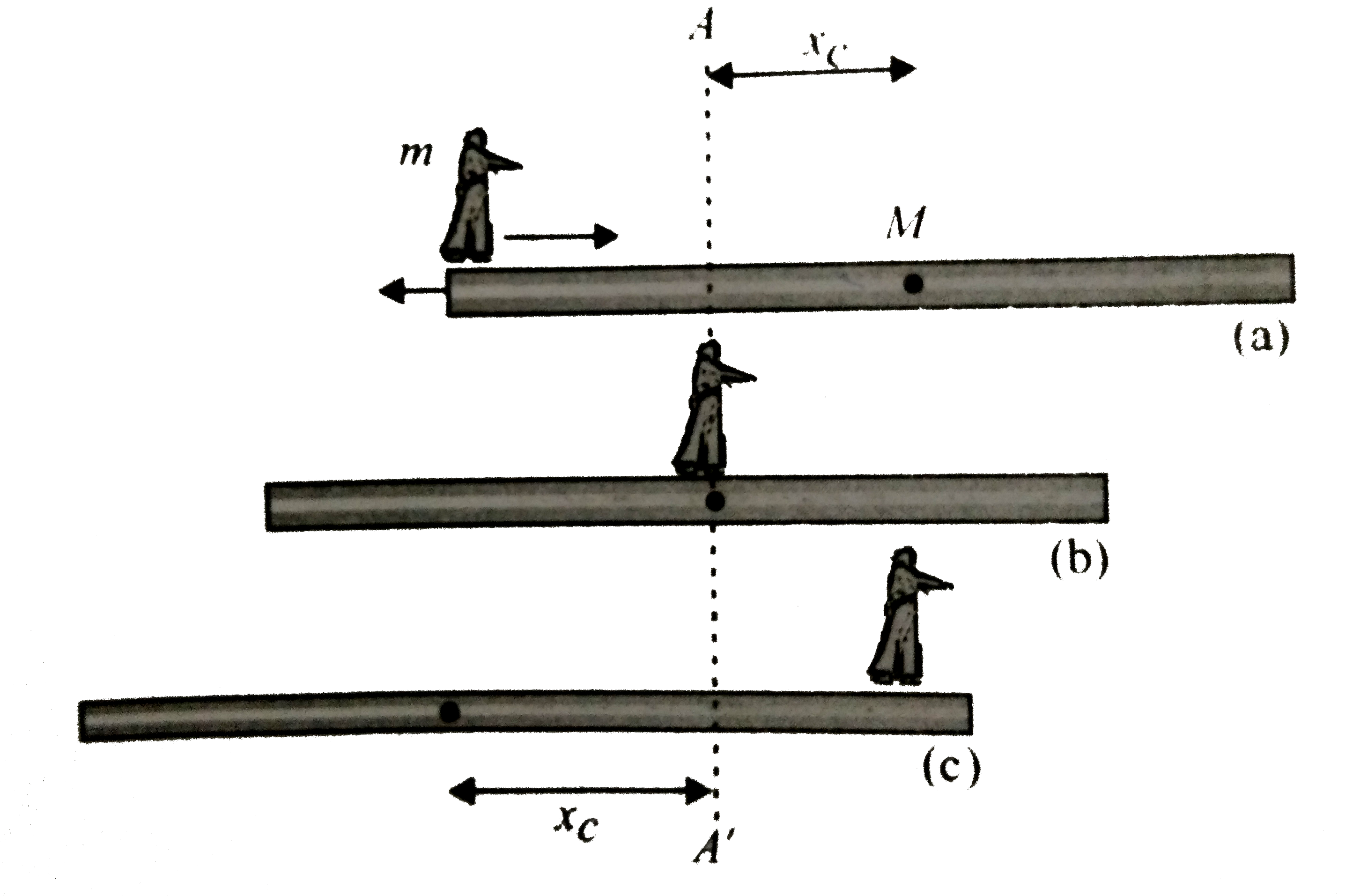 initially the centre of mass of the system is on line `"AA"'` as shown in figure. During motion of the man, this centre of mass must remain at this line only . As the man moves towares ramains on `"AA"'`. Thus, when the man reaches the centre of the plank, the plank's centre must also reach the same point so that the centre of mass is the same position. Up to this instant the plank moves by a distance `x_(c)`. Similarly, when the man reaches the other end, plank has to move towards left further by `x_(c)` to maintain the position of centre of mass. As there is no external force on the system (`"man" +"plank"`) and the system is initially at rest, there should not be movement of centre of mass of the system during the motion of the man. 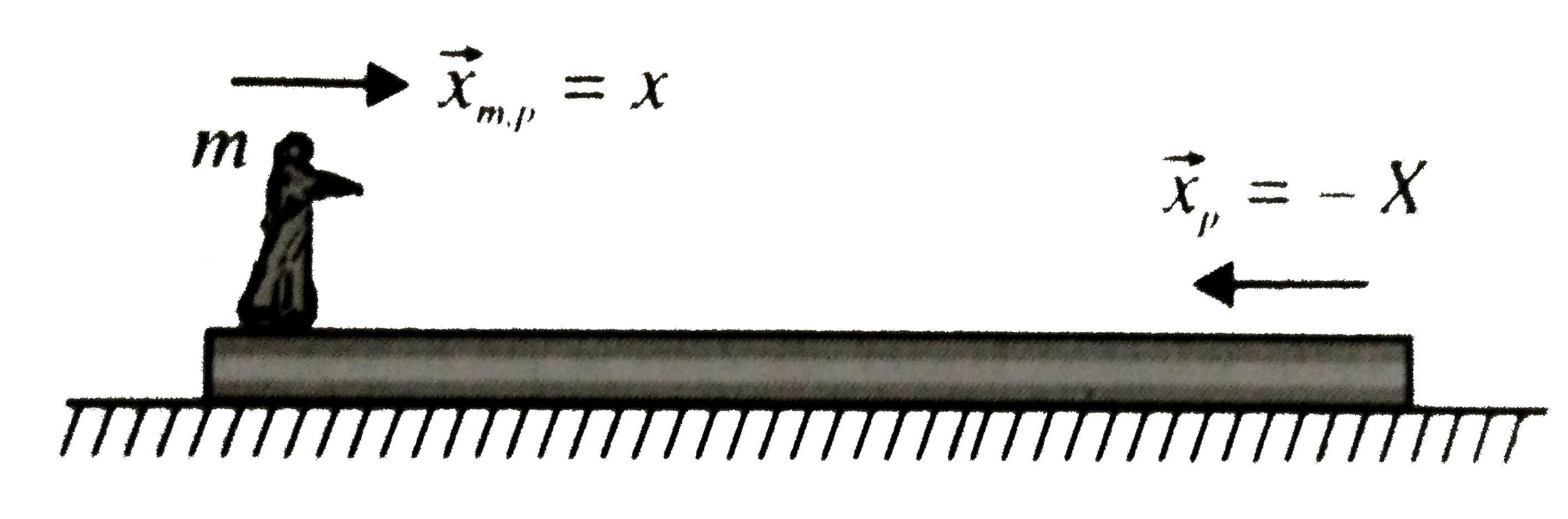 The displacement of centre of mass is `/_\x_(CM)` and is given by `/_\x_(CM)=(m/_\vecx_m+M/_\vecx_(p))/(m+M)`............i `implies /_\vecx_(m)=/_\vecx_(m,p)+/_\vecx_(p)=(x-X)` where `/_\vecx_(p)=-X` (towards left) As` /_\vecx_(CM)=0`, from eqn i `0=(m(x-X)-MX)/(m+M)impliesX=(mx)/(m+M)` a When `x=L/2` displacement of BLOCK `X=(mL/2)/(m+M)` b. when `x=L`, displacement of block `X=(mL)/(m+M)` |
|
| 37. |
Water is flowing continuously from a tap having an internal diameter 8xx10^(-3). The water velocity as it leaves the tap is 0.4ms^(-1). The diameter of the water stream at a distance 2xx10^(-1)m below the tap is close to : |
|
Answer» `7.5xx10^(-3)m` |
|
| 38. |
Light waves are…. And …… |
| Answer» SOLUTION :Non-mechanical and TRANSVERSE. | |
| 39. |
Ultrasonic, Infrasonic and audible waves travel through a medium with speeds V_(u),V_(i) and V_(a) respectively, then |
|
Answer» `V_(U), V_(i) and V_(a)` are NEARLY EQUAL |
|
| 40. |
A heavy block of length b and height h is placed at rest on a rough inclined plane of inclination theta with the horizontal, as shown in figure. |
Answer» Solution :a. The free body DIAGRAM of the block is shown in figure. 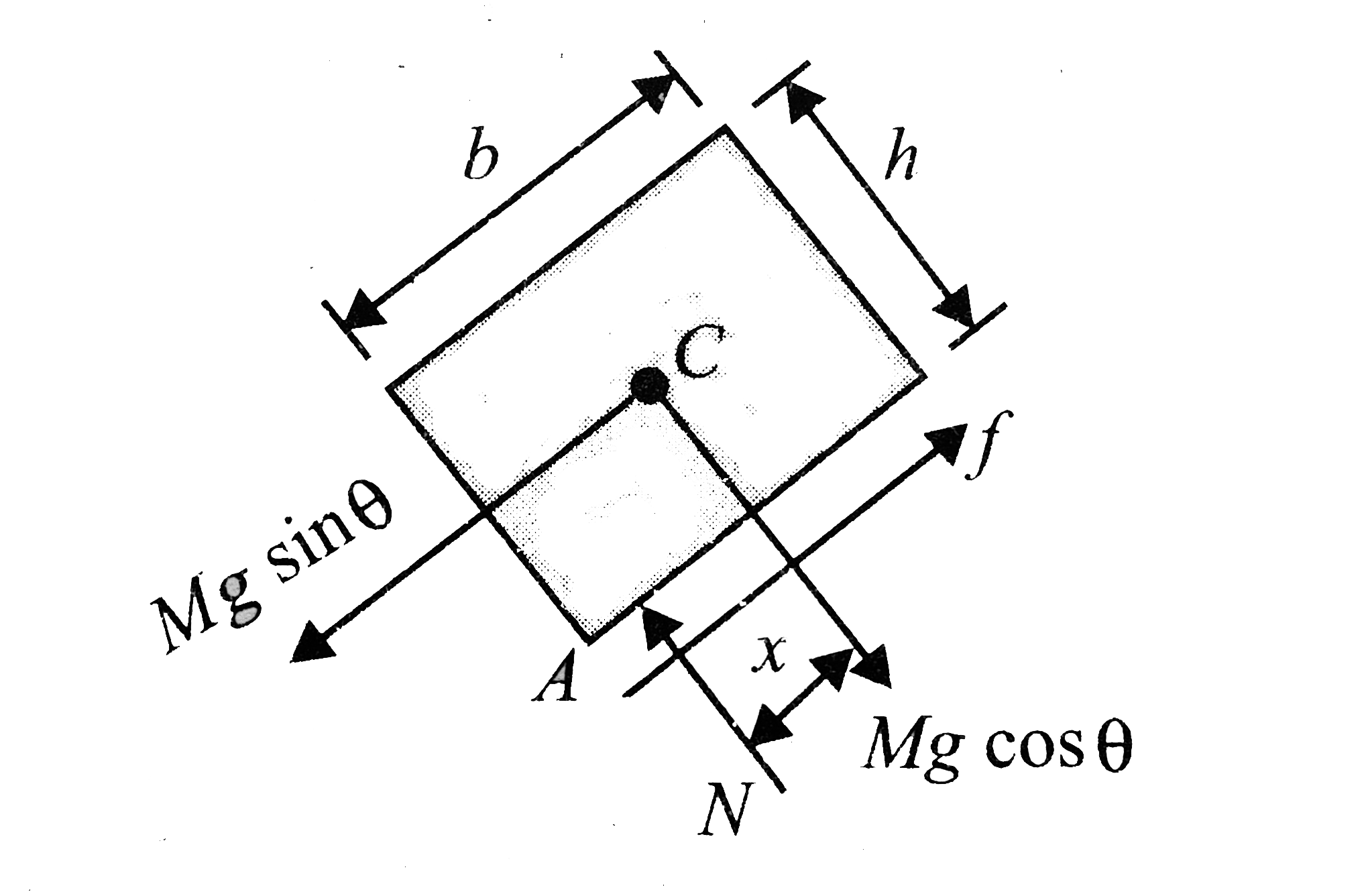 Note that the point of application of the NORMAL reaction `N` is displaced through `x` in the downward direction. It has to porduce a clockwise torque about the centre of mass that MAY balance the anticlockwise torque produced by the friction force. There are two tendencies of the block:to slide down to rotate (or topple) about the point `A` For translation equation `sumvecF=0` `f=Mgsintheta`.......i `N=mgcostheta`...........ii For rotational equilibrium `sum vectau_(C)=0` `NXX x=fxxh/2impliesMgcosthetaxx x=(fh)/2` `implies f=(2Mgcosthetaxx x)/h` If the block topples over about `A, x=b/2` Hence, `(bMgcostheta)/h`......iii From EQN if block do not slide down `fltmuN` `Mgsintheta,muyxxMgcosthetaimpliestanthetalemu` or we can say if the block `multtantheta` from eqn iii if the block topples before sliding, `flemu(Mgcostheta)` `(bMgcostheta)/hlemuMgcosthetaimpliesb/hlemu` Hence if the block topples before sliding `mugeb/h` |
|
| 41. |
What is the angle between hat(i) + hat(j) + hat(k) and hat(j)? |
|
Answer» `0^(@)` |
|
| 42. |
In the figure shown a block B of mass m can slide on a fixed horizontal smooth plane. A solid sphere A of radius r of the same mass rolls without sliding on the block B. The angular acceleration of the sphere is 10g/xr where 'x' is |
|
Answer» |
|
| 43. |
A siren placed at a railway platfrom is emitting a sound of 5kHz . A passenger sitting in a moviing train A records a frequency of 5.5 kHz while the train A approaches the siren . During his return journey in a different train B he records a frequency of 6.0 kHz while approaching the same siren . What is the ratio of the velocity of train B to that of train A ? |
|
Answer» |
|
| 44. |
Why are the passengers thrown outwards when a car suddenly takes a circular turn ? |
| Answer» SOLUTION :DUE to INERTIA of DIRECTION. | |
| 45. |
In carnot engine efficiency is 40% at hot reservoir temperature T. For efficiency to be 50%, whatwill be the temperature of hot reservoir ? |
| Answer» ANSWER :D | |
| 46. |
Chooseappropriatefree body diagram forthe particleexperiencingnet acclerationalong negative y direction |
|
Answer»
|
|
| 47. |
Three identical spheres each of radius R are placed touching each other so that their centres A, B and C lie on a straight line the position of their centre of mass from A is |
|
Answer» `(2R)/(3)` |
|
| 48. |
A Carnot engine has an efficiency of 25%. It operates between reservoirs of constant temperatures with temperature difference of 80^@C. The temperature of the sink is |
|
Answer» `-25^@C` |
|
| 49. |
A wooden stick of length L, radius Rand density has a small metal piece of mass m (of neglible volume) attached to its one end. Find the minimum value for the mass m that would make the stick float vertically in equilibrium in a liquid of density sigma(gtrho) |
| Answer» SOLUTION :`PIR^(2)L SQRT(sigmarho)-RHO` | |
| 50. |
What is motion? Mention different types of motions. |
|
Answer» Solution :When a BODY changes its POSITION with respect to time relative to ANOTHER body then body is said to be in motion relation to another body. Following are the various type of motions : 1. Straight LINE motion. 2. Projectile motion. 3. Periodic motion. 4. Oscillatory motion. 5. Simple harmonic motion. 6. Uniform motion. 7. Non uniform motion. |
|


