

Saved Bookmarks
This section includes 7 InterviewSolutions, each offering curated multiple-choice questions to sharpen your Current Affairs knowledge and support exam preparation. Choose a topic below to get started.
| 1. |
A vehicle of mass 20 kg is moving with a velocity of 4ms^(-1). Find the magnitude of the force that is to be applied on the vehicle so that the vehicle have a velocity of 1ms^(-1) after travelling a distance of 20 m. |
| Answer» ANSWER :C | |
| 2. |
Calculate the work done in blowing a soap bubble of radius 2cm. Surface tension of soap solution =7xx10^(-2)Nm^(-1) |
|
Answer» Solution :`r=2cm=2xx10^(-2)m` Surface TENSION `S=7xx10^(-2)Nm^(-1)` work done = surface area of soap bubble X surface tension `=8pir^(2)S` `=8xx(22)/(7)xx(2xx10^(-2))^(2)xx7xx10^(-2)=7.04xx10^(-4)J` |
|
| 3. |
A mass is whirled in a circular path with an angular momentum L. If the length of string and angular velocity, both are doubled, the new angular momentum is |
|
Answer» L |
|
| 4. |
A vehicle covers first half of its total distance at a speed 20 kmph. And the other half of the distance at 40 kmph. The mean speed over the entire distance. |
| Answer» Answer :D | |
| 5. |
f a shear force of 300 N is applied on a cube of side 40 cm, find the displacement of the top surface of the cube. The rigidity modulus of the material is 5xx10^(10)N//m^(2) |
|
Answer» SOLUTION :`eta=("shearing stress")/("shearing strain")=(300//0.4xx0.4)/(theta)`, since area of the face of the cube`=(40xx40) cm^(2)` `5xx10^(10)=(30000)/( 16 theta) :. theta=(3)/(80xx10^(6))` displacement of the surface x=,But `(x)/(L) tan theta= theta` since `theta` is small `:. (x)/(0.4)=(3)/(80xx16^(6)) or x=(12)/(8xx10^(7))=0.15xx10^(-7)m ` So displacement of surface is `0..15xx10^(-7)m` |
|
| 6. |
A ball of 200 g is at one end of a string of length 20 cm. It is revolved in a horizontal circle at an angular frequency of 6 rpm. Find (i) the angular velocity, (ii) the linear velocity, (iii) the centeripetal acceleration, (iv) the centeripetal force and(v) the tension in the string. |
|
Answer» Solution :(i) The angular velocity, `omega = (2pi N)/(t)=(2pi xx 6)/(60)=(pi)/(5)=0.6284 rad s^(-1)` (ii) The linear velocity, `v = r omega` `= 0.20xx0.6284` `= 0.1257 ms^(-1)` (iii) The centripetal ACCELERATION, `a_(c )=r omega^(2)` `= 0.20xx(0.6284)^(2)` `= 0.0790 ms^(-2)`. (iv) The centripetal force, `F_(c )=mr omega^(2)` `= 0.200xx0.20xx(0.6284)^(2)` `= 0.0158 N`. (v) The tension in the string `= 0.0158 N`. |
|
| 7. |
Column-1 represents potential energy graph for certain system. Column-2 gives statement related to graphs. |
|
Answer» |
|
| 8. |
In Q.107, after the car is overtaken by the motorycle, it will again overtake the motorcycle at what time, from t = 0? |
|
Answer» 8 sec `t = 3,8` |
|
| 9. |
What is dynamic lift and explain the role of dynamic lift during the take off an aeroplane. |
| Answer» SOLUTION :PRESSURE difference exact the force. So that AEROPLANE take off. | |
| 10. |
The rotational speed of a wheel of diameter 8.4 cm is 4 rps. When a steel object having mass 250 g is held tightly at the edge of the wheel, it applies a force of 0.5 kg along the tangent of the wheel. If 90% of the work done is converted into heat and absorbed by the object, then what will be the rise in temperature of the object in 1 min? Specific heat of steel = 0.12 cal cdot g^(-1) cdot^(@)C^(-1) and J = 4.2 J cdot cal^(-1). |
|
Answer» |
|
| 11. |
Two particles are projected in air with speed u at angles theta_(1) and theta_(2) (both acute) to the horizontal, respectively. If the height reached by the first particle is greater thant that of the second, then which one of the following is correct? |
|
Answer» `theta_(1)gttheta_(2)` |
|
| 12. |
The pressure p of a gas is plotted against its absolute temperature T for two different constant volumes V_(1) and V_(2) where V_(1) gt V_(2). P is plotted on the y-axis and T on the x-axis |
|
Answer» The curve for `V_(1)` has GREATER slope than the curve for `V_(2)` |
|
| 13. |
The mass of a litre of gas is 1.562 g at 0^(0)C under a pressure of 76 cm of mercury. The temperature is increased to 250^(0)C and the pressure to 78 cm of mercury. What is the mass of one litre of the gas under new conditions ? |
|
Answer» Solution :`(P_(1))/(rho_(1)T_(1)) = (P_(2))/(rho_(2) T_(2))` (or) `rho_(2) = (P_(2) T_(1)rho_(1))/(P_(1)T_(2)) = (78 xx 273 xx 1.562)/(76 xx 523) = 0.8366` g /LIT `therefore` Mass of l Jitre of the GAS under new conditions is 0.8366 g. |
|
| 14. |
A cannon shell moving along a straight line bursts into two parts. Just after the burst one part moves with momentum 40 Ns making an angle 30^(@) with the original line of motion. The minimum momentum of the other part of shell just after the burst is 10x (in Ns). Find 'x' value |
|
Answer» |
|
| 15. |
An experiment is performed to obtain the value of acceleration due to gravity g by using a simple pendulum of length L. In this experiment time for 100 oscillations is measured by using a watch of 1 second least count and the value is 90.0 seconds. The length L is measured by using a meter scale of least count 1 mm and the value is 20.0 cm. The error in the determination of g would be: |
|
Answer» 0.017 |
|
| 16. |
Explain the elastic potential energy of spring and obtain an expression for this energy . (a) |
|
Answer» Solution :Consider an elastic spring ,obeying Hook.s law with NEGLIGIBLE mass whose one end is tied rigidly to a wall as shown in figure . At the other end of the spring a block has been tied and it restring on a smooth horizontal surface . We shall for the sake of SIMPLICITY restrict the motion of the block in the X - direction . In the normal position of the spring , the position of the block is taken as x=0 ,this is shown as figure (a) When the block is pulled and the length of spring + x is INCREASED a restoring force `F_(S)` is producedin the springwhich tries to bring the spring back to its normal position .the restoring force (spring force ) is produced when the spring is COMPRESSED .This is shown in figure (b) and (c) . The restoring force is directly proportional to the change in the length of the spring and is in the direction opposite to the change in the length . This law of force for the spring is called Hook.s law . ` :. F_(S) = - kx ` where k is the springconstant or force constant of the spring Spring constant`k = (F_(S))/x` (magnitude ) , its unit is `Nm^(-1)` The spring is said to be stiff if k is large and soft if it is small . Suppose that the block is pull outwards as in figure (b) . if the extension is `x_(m)` the work done by the spring force is , `W_(S) =int_(0)^(x_(m)) F_(S)dx = - int_(0)^(x_(m)) ""[ :. F_(S)=- kDeltax]` `=-k[(x^(2))/2]_(0)^(x_(m))` `=k[(x^(2))/2-0]` `=-(kx_(m)^(2))/2`  This expression may also be obtained by considereing the area of the triangle as in figure (d). The work done by the external PULLING force F is positive since it overcomes the spring force . If spring is compressed as shown in figure (c) with a displacement `x_(c) ( lt 0)` .The spring force dows work `W_(S) = - (kc_(c)^(2))/2` while the external force F does work + `(kx_(c)^(2))/2` `W_(S) = - int_(x_(i))^(x_(f))" kx dx" = - k [(x^(2))/2]_(x_(i))^(x_(f))` `W_(S) =(kx_(i)^(2))/2 - (kx_(f)^(2))/2 ` Hence , the work done by the spring force depends only on the end points . If the block is pulled from `x_(i)` and allowed to return to`x_(i)` the work done by spring force , `W_(S) =-int_(x_(i))^(x_(i))" kx dx" = - k int_(x_(i))^(x_(i)) "x dx" = - k [(x^(2))/2]_(x_(i))^(x_(i))` ` = - k[ (x_(i)^(2))/2-(x_(i)^(2))/2]` `= 0 ` Hence , the work done by the spring force in a cycle process is zero and so spring force is conservative . |
|
| 17. |
The elastic energy stored per units volume in astreched wire is |
|
Answer» `(1)/(2)(("STRESS"))/(Y)` |
|
| 18. |
A solid sphere (mass 2 M) and a thin hollow spherical shell (mass M) both of the same size, roll down an inclined plane, then |
|
Answer» SOLID SPHERE will reach the bottom FIRST |
|
| 19. |
In atest experiment on a model aeroplane in a wind tunnel , the flow speeds on the upper and lower surfaces of the wing are 70ms^(-1)and63ms^(-1) respectively . What is the lift on the wing if its area is 2.5m^(2) ? Take the density of air to be 1.3kgm^(-3). |
|
Answer» Solution :Let `v_(1),v_(2)` be the speeds on the upper and lower surface of the WING of aeroplane and `P_(1)andP_(2)` is the pressure on upper and lower surface of the wing respectively and height from ground are `y_(1)andy_(2)` respectively. `thereforev_(1)=70ms^(-1),v_(2)=63ms^(-1)`, `y_(1)=y_(2),RHO=1.3kgm^(-3)` From Bernoulli.s equation, `P_(1)+(1)/(2)rhov_(1)^(2)+rhogh_(1)=P_(2)+(1)/(2)rhov_(2)^(2)+rhogh_(2)` `thereforeP_(1)-P_(1)=(1)/(2)rho(v_(1)^(2)-v_(2)^(2)) ""[becauseh_(1)=h_(2)]` `therefore`Upward froce on wings, `F=(P_(2)-P_(1))A` `thereforeF=(1)/(2)rho(v_(1)^(2)-v_(2)^(2))A` `=(1)/(2)xx1.3xx[70^(2)-63^(2)]xx2.5` `=(1)/(2)xx1.3xx[4900-3969]xx2.5` `=(1.3)/(2)xx931xx2.5` `=1512.9N` `=1.513xx10^(3)N` |
|
| 20. |
A stone tied to a piece of string whirled in a vertical circle with uniform speed, in what position of the stone in the tension in the string greatest? |
|
Answer» in the highest POSITION of the stone |
|
| 21. |
A conducting cylindrical shell inner radius R_(1) maintained at a temperature T_(1) and outer radius R_(2) maintained at a temperature T_(2) respectively. Thermal conductivity of the shell varies with distance from the axis as K=(alpha)/(r^(2)). where alpha is constant. The temperature as a function of distance R from the axis of the cylinder is |
|
Answer» `T_(1)-((R^(2)-R_(1)^(2))(T_(2)-T_(1)))/(R_(2)^(2)-R_(1)^(2))` |
|
| 22. |
A transverse harmonic wave on a string is described byy (x , t) = 3 . 0 sin ( 36 t + 0 . 0 18 x + (pi)/(4) ) where x and y are cm and t in s.The positive direction of x is from left to right .What is the initial phase at the origin ? |
|
Answer» |
|
| 23. |
Give an example each for a body where the centre of mass lies inside the body and outside the body. |
| Answer» Solution :The centre of MASS of a solid SPHERE lies at its centre and is inside the body. The centre of mass of a dough nut or an ANNULAR DISC is at is centre which lies outside the body. | |
| 24. |
When the length of a wire obeying Hooke's law increases by x as it is stretched, the speed of soundemitted from this wire is v . If the length of the wire is increased further of 1 . 5 x , what will be the speed of sound emitted from it ? |
|
Answer» |
|
| 25. |
A body is projected horizontally from the top of a tower with a velocity of 30 m/s. The velocity of the body 4 seconds after projection is (g = 10 ms^(-2)) |
|
Answer» `40 MS^(-1)` |
|
| 26. |
The relation time 1 and distance x is t= alpha x^(2) beta x. Where alphaand beta are constants. The retardation is |
|
Answer» `2 ALPHA V^(3)` |
|
| 27. |
Two particle are oscillating along two close parallel straight lines side by side, with the same frequency and amplitude. They pass each other, moving on opposite directions when their displacement is half of the amplitude. The mean positions of the two particles lie on a straight line perpendicular to the paths of the two particles. The phase difference is......... |
|
Answer» `0` For first particle `x= (A)/(2)` `A sin (omega t+phi_(1))= (A)/(2)` `therefore sin (omega t+ phi_(1))= (1)/(2) = sin (pi)/(6)` `therefore phi_(1) = (pi)/(6)"""……"(1)` For second particle moving in OPPOSITE motion `therefore phi_(2) = pi -(pi)/(6)` `= (5pi)/(6)"""........."(2)` Phase DIFFERENCE `phi_(2)- phi_(1) = (5pi)/(6)- (pi)/(6)` `=(4pi)/(6)= (2pi)/(3)`. |
|
| 28. |
Of the following …………….. Has dimensions. |
|
Answer» strain |
|
| 29. |
It is raining at a speed of5 ms^(-1)at an angle 37^@to vertical, towards east. A man is moving to west with a velocity of 5 ms^(-1).The angle with the vertical at which he has to hold the umbrella to protect himself from rain is |
|
Answer» `TAN^(-1) (2)` to west |
|
| 30. |
A metal wire of diameter 1 mm is held on two knifeedges separated by a distance of 50 cm.The tension in the wire is 100 N . The wire, vibrationwith itfundamental frequency together with a vibrating tuning fork, produces 5 beats per second . The tension in the wire is then reduced to 81 N .Now , when the two are excited, beats are heard again atthe same rate . Calculate (i) the frequency of the tuning fork, (ii) the density of the meterial of the wire . |
|
Answer» |
|
| 31. |
When a ship floats in water, its one fifth volume remains submerged. The maximum weight that can be placed on the ship is 10,000 tons. Calculate the weight the empty ship (g=10ms^(-2)). |
|
Answer» <P> Solution :Let the weight of ship be .W. kgf & volume `V m^(3)`. Density of ship `=(W/V)kgfm^(-3)`Given `(V_(rho))_(g)=(W/V)kgfm^(-3)` `i.e. rho=rho_(w)/(5)"but"(10^(7)+W)=(V)rho_(w)g` i.e, `(10^(6)+M)g=vrho_(w)g" where "W=Mg and 10^(7)=10^(6)g` i.e, `10^(6)+M=(M/p)p_(w)" where "(M/P)=V` i.e, `10^(6)=M((rho_(w))/(rho)-1)=(M(rho_(w)-p))/(rho)` `therefore M=(10^(6)rho)/(rho_(w)-rho)=((10^(6)(rho_(w))/(5)))/(rho_(w)-(rho_(v))/(5)) xx (5)/(4rho_(w))` i.e, `M=0.25 xx 106=250 TONS` Weight of emptly ship=250 ton FORCE. |
|
| 32. |
A uniform rope with length L and mass m is held at one end and whirled in a horizontal circle with angular velocity omega. You can ignor the force of gravity on the rope. Find the time required for a transverse wave to travel from one end of the rope to the other. Hint: int (dx)/(sqrt(a^(2) - (x^(2)))) = sin^(-1)((x)/(a)) |
|
Answer» or `-int_(0)^(T)dT = (m)/(L)omega^(2) int_(X = L)^(x)x dx` `:. -T = (m)/(L)omega^(2) ((x^(2))/(2) - (L^(2))/(2))` or `T = (momega^(2))/(2L)(L^(2) - x^(2))` `v=sqrt((T)/(mu))` sqrt(((momega^(2))/(2L)(L^(2) - x^(2)))/(m//L))` `=omegasqrt((L^(2) - x^(2))/(2))` or `(dx)/(dt) = (omega)/(sqrt(2))sqrt(L^(2) - x^(2))` `:. int_(0)^(t) dt = sqrt(2)/(omega)int_(0)^(L)(dx)/(sqrt(L^(2) - x^(2)))` `:. t = sqrt(2)/(omega)[SIN^(-1)((x)/(L))]_(0)^(L)` `=sqrt(2)/(omega)*(pi)/(2) = (pi)/(sqrt2omega)` |
|
| 33. |
A Fahrenheit thermometer reads 113^(@)F while a fualty celsius thermometer reads 44^(@)C. The correction required to be applied to the celsius thermometer is |
|
Answer» `-1^(@)C` |
|
| 34. |
When a block is suspended by means of spring the restoring force per unit displacement of the block is called |
|
Answer» FORCE constant |
|
| 35. |
Statement I : In rotational plus translational motion of a rigid body different particles of the rigid body may have different velocities but they will have same accelerations. Statement II : Translational motion of a particle is equivalent to the translational motion of rigid body. |
|
Answer» Statement I is TRUE, statement II is true , statement II is a correct explanation for statement I. |
|
| 36. |
Define mean free path and write down its expression. |
|
Answer» Solution :The average distance travelled by the molecule between collisions is called mean FREE PATH `(LAMBDA).` `lambda=(KT)/(sqrt2 pi d^(2) P)` |
|
| 37. |
The uniform circular motion in general can be described as a combination of two simple harmonic motions. |
|
Answer» Acting PERPENDICULAR to each other |
|
| 38. |
Two shms are represented by the equations, y_1 = 15 sin 6t and y_2 = 18 sin (6t + pi/4). If the vibrating particles have the same mass find (i) ratio of maximum velocities (ii) ratio of time periods and (iii) ratio of total energies. |
|
Answer» Solution :Amplitude of the first shm `= a_1, = 15` cm Amplitude of the second shm `= a_2, = 18 cm` Angular VELOCITY `= OMEGA= 6` rad/s Time period `=(2pi)/omega=(2pi)/6=pi/3s` Let the mass of each particle m Ratio of maximum value of velocities of the PARTICLES `=(a_1omega)/(a_2omega)=a_1/a_2=15/18=6/6` Ratio of PERIODS `=(pi//3)/(pi//3)=1` Ratio of total energies `=(1//2momega^2a_1^2)/(1//2momega^2a_2^2)=15^2/18^2=25/36` |
|
| 39. |
Choose appropriate free body diagram for the particle experiencing net acceleration along negative y direction. (Each arrow mark represents the force acting on the system). |
|
Answer»

|
|
| 40. |
A child running a temperature if 101^(@)F is given an antipyrine (i.e. a medicine that lowers fever) which causes an increase in the rate of evaporation of sweat from his body. If the fever is brought down to 98^(@)F in 20 min, what is the average rate of extra evaporation caused, by the drug. Assume the evaporation mechanism to be the only way by which heat is lost The mass of the child is 30 kg. The specific heat of human body water, and latent heat of evaporation of water at that temperature is about "580 cal g"^(-1). |
|
Answer» SOLUTION :Here mass of BOY m = 30 kg Decrease in fever (temperature) of boy `Deltatheta=101^(@)F-98^(@)F` `=3^(@)F` `:.Deltatheta=(3xx5)/(9)=(5^(@))/(3)C` Specify heat of HUMAN body `c=4.2xx10^(3)" J kg"^(-1)" "^(@)C^(-1)` Latent heat of vaporization `L=580" cal g"^(-1)` `=580xx4.2xx10" J kg"` Suppose mass of sweating in 20 minutes by vaporization from body of boy = m. Time taken by sweet to convert into steam heat required to vaporize the sweat of mass m. `Q=m.L=m.xx580xx4.2xx10^(3)m^(-1)J . . . (1)` Heat lost by boy due to decrease in fever `Q.="mc "Deltatheta` `:.Q.=30xx4.2xx10^(3)xx5/3` `=2.1xx10^(5)J`. . . (2) Required heat for vaporization Q = heat lost by boy Q. `:.m.xx580xx4.2xx10^(3)=2.1xx10^(5)` `:.m.=(2.1xx10^(5))/(580xx4.2xx10^(3))` `:.m.=0.0862` kg `:.` Rate of vaporization of sweating `=(m.)/(t)` `=(0.0862)/(20)` `=0.0431" kg minute"^(-1)` `=4.31" g minute"^(-1)` |
|
| 41. |
Find the moment of inertia of ring about an axis passing through the centre and perpendicular to its plane. |
|
Answer» SOLUTION :A uniform circular RING of radius R and mass M rotating is fixed AXIS passing through its centre, perpendicular to its plane of rotation with constant angular velocity `omega`. Every mass element of this thing is at a distance R from the centre. Hence it rotates with `Romega` linear speed. KINETIC energy of ring `K=(1)/(2)Mv^(2)` `K=(1)/(2)MR^(2)omega^(2)` Equating this, with equation `K=(1)/(2)Iomega^(2)`, `therefore I=MR^(2)` |
|
| 42. |
(A) : A disc released from the top of a fixed inclined plane rolls down without sliping if the inclined plane is rough only (R) : Friction does no work in pure rolling |
|
Answer» Both 'A' and 'R' are TRUE 'R' is the correct explanation of 'A' |
|
| 43. |
If the displacement of a simple harmaonic oscillators is half of its amplitude at an instant PE of the oscillator is |
|
Answer» 75% of TOTAL ENERGY |
|
| 44. |
Which of the following numbers has the maximum number of significant figures? |
|
Answer» 0.02456 KG |
|
| 45. |
The dimensionis of universal gravitational constant is |
|
Answer» `ML^(2)T^(-2)` |
|
| 46. |
The variation in length of a substance along three principal directions, with temperature is shown in the fig . The average superficial expansivity of the substance is |
|
Answer» `40.00 XX 10^(-5)//°C` |
|
| 47. |
A boypresses a book againstthe front wall suchthat the bookdo not move the force of frictionbetween the wall and the book is |
| Answer» Answer :d | |
| 48. |
A gas takes part in two thermal processes in which it is heated from the same initial state to the same final temperature. The P-V diagram for these two processes are indicated by straight lines 1-3 and 1-2 in figure. Find out in which process the amount of heat supplied to the gas is larger. |
| Answer» SOLUTION :In PROCESS 1-3, HEAT RECEIVED is LARGER | |
| 49. |
A bead of mass m kept at the top of a smooth hemispherical wedge of mass M and radius R, is gently pushed towards right. As a result, the wedge slides due left Find the a. speed of the wedge b. magnitude of velocity of the beard relative to the wedge. |
Answer» Solution :Applying work energy theorem 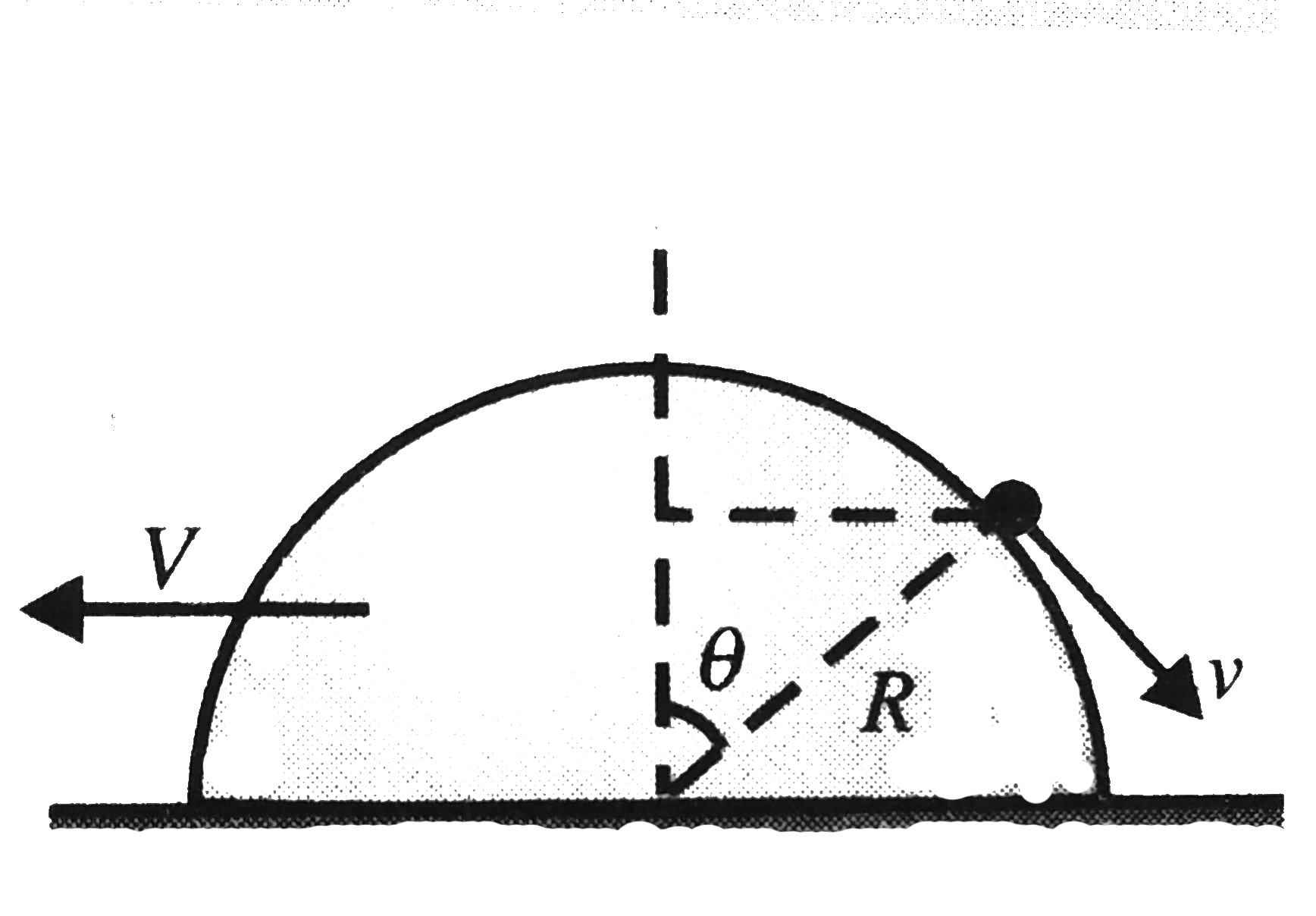 `W_("gravity")=/_\K'+/_\K_C`…………..i `/_\K'=` change in `KE` w.r.t centre of mass from and `/_\K_C=` change in kinetic energy of centre of mass w.r.t ground. Let `v` is the velocities of ball wilth respect to wedge and `V` is the velocity of wedge. Linear mometum will be conserved in the horizontal DIRECTION . Hence `MV=(vcostheta-V)` `implies V=(mvcostheta)/((m+M))` ...............ii The velocity of centre ofmas will be zero in horizontal direction but the velocity of centre of mass will change in vertical direction . `(v_(cm))_y=(mvsintheta)/((m+M))` .............iii Now applying WE theorem `-mgR(1-costheta)=1/2muv^(2)+1/2(m+M)v_(cm,y)^(2)` Here `mu=(mM)/((m+M))` and `v_(cm,y)=(mvsintheta)/((m+M))` which GIVES `v=sqrt((2(M+m)gR(1-costheta))/((M+Msin^(2)THETA)))` and from eqn ii `V=sqrt((2m^(2)gR(1-costheta)cos^(2)theta)/((M+m)(M+Msin^(2)theta)))` |
|
| 50. |
(A) : A body can have acceleration even if its velocity is zero at a given instant of time. (R ) : A body is momentarily at rest when it reverses its direction of motion |
|
Answer» Both (A) and (R ) are TRUE and (R ) is the CORRECT explanation of (A) |
|


