

Saved Bookmarks
This section includes 7 InterviewSolutions, each offering curated multiple-choice questions to sharpen your Current Affairs knowledge and support exam preparation. Choose a topic below to get started.
| 1. |
Write any three applications of viscosity. |
| Answer» Solution :(i) The oil used as a lubricant for heavy MACHINERY parts should have a high viscous coefficient. To select a suitable lubricant, we should know its viscosity and how it varies with TEMPERATURE. [Note: As temperature increases, the viscosity of the liquid decreases]. Also, it helps to choose OILS with LOW viscosity used in car engines (light machinery). (ii) The highly viscous liquid is used to damp the motion of some instruments and is used as brake oil in hydraulic brakes. (iii) Blood circulation through arteries and veins depends upon the viscosity of fluids (iv) Millikan conducted the oil drop experiment to detennine the CHARGE of an electron. He used the knowledge of viscosity to determine the charge . | |
| 2. |
Describe Simple HarmonicMotion as a projection of uniform circular motion. |
|
Answer» Solution :(i) Let us CONSIDER a particle of mass m moving with uniform SPEED v along the circumference of a circle whose radius is r in anti-clockwise direction (as shown in Figure). (ii) It is assumed thatthe oriin with the centre O of the circle. (iii) If `omega` is the ANGULAR displacement of the particle at any instant of time t, then `theta= omegat`.By projecting the uniform circular motion on its diameter a simple harmonic motion is obtained. (iv) This mass that we can associate a map (or a relationship) between uniform circular (or revolution) motion to vibratory motion. (v) Conversely. any vibratory motion or revolution can be mapped touniform circular motion. The position of a particle moving on a circle is projected on to its vertical diameter or on to a line parallel to vertical diameter. (vi) Similarly, we can do it for horizontal axis or a line parallel to horizontal axis. Example : Let us consider a spring mass system (or oscillation of pendulum) as shown in figure. When the spring moves up and down (or pendulum moves to and fro), the motion of the mass of bob is mapped to points on the circular motion of the circular motion.  THUS, if a particle undergoes uniform circular motion then the projection of the particle on the diameter of the circle (or on a line paralle to the diameter) traces straightline motion that is simpleharmonic in nature. The circle is known as reference circle of the simple harmonic motion. |
|
| 3. |
The handle of a door is at a distance 40cm from axis of rotation. If a force 5Nis applied on the handle in a direction 30. with plane of door, then the torque is |
| Answer» Answer :B | |
| 4. |
Resonance is an example of |
|
Answer» FORCED OSCILLATION |
|
| 5. |
A force of 10 N inclined to the horizontal at an angle of 60^(@) acts on a body of mass 2 kg. If the body can move in gorizontal direction only find its acceleration. |
|
Answer» `2.5 m//sec^(2)` |
|
| 6. |
(A): A load bearing bar is usually constructed in 'I' shape.(R): This shape reduces the weight of the beam with out sacrificing the strength. |
|
Answer» Both (A) and (R) are TRUE and (R) is the CORRECT explanation of (A) |
|
| 7. |
A particle is projected vertically up and another is let fall to meet at the same instant. If they have velocities equal in magnitude when they meet, the distances travelled by them are in the ratio of |
|
Answer» `1:1` |
|
| 8. |
Give two examples of periodic motion which are not oscillatory ? |
|
Answer» SOLUTION :1. Motion of seconds hand of a watch. 2. Motion of FAN blades which are rotating with CONSTANT ANGULAR velocity `.omega.` . For these two cases they have constant centrifugal acceleration which does not change with rotation so it is considered as S.H.M. |
|
| 9. |
A merry -go-round , made of a ring-like platform of radiusR and mass M, is revolving with angular speed omega . A person of mass M is standing on it . At one instant , the person jumps off the round , radially away from the centre of the round . The speed of the round afterwards is |
|
Answer» `2 OMEGA` |
|
| 10. |
A body thrown up with a velocity reaches a maximum height of 50 m. Another body with double the mass thrown up with double the initial velocity will reach the maximum height of |
|
Answer» 100 m |
|
| 11. |
Satement (A) : Water can be boiled in a thin paper box without even charring the paper Statement (B) : In winter , woolen clothes keeps us wanner compared to cotten clothes. |
|
Answer» A is tr11le B is FALSE |
|
| 12. |
A vertical cylinder contains an ideal gas enclosed, at a pressure of 2 atmospheres, by means of a freely moving piston containing weights. The cylinder is placed on a left. Which rises with an acceleration of g/3. Find the fractional change in volume of the gas. Does the gas gets compressed ? |
|
Answer» |
|
| 13. |
The dimensional formula of coefficient of kinematic viscosity is |
|
Answer» `M^(0)L^(-1) T^(-1)` |
|
| 14. |
The centre of mass of two particles with masses 2kg and 6 kg located at (1,1,1), (2,2,1) respectively has the coordinates |
|
Answer» `((7)/(4),(7)/(4),(7)/(4))` |
|
| 15. |
The mass ofa star is 3.98 xx 10^30 kg and its radius is 106 km. It rotates.about its axis with an angular speed of 10^(-6) rad/s. Calculate the speed of the star when it collapses to a radius of 10^4 km ? Assume the moment of inertia of the star to be 2/5 mr^(2). |
| Answer» SOLUTION :`I_(1)omega_(1)=I_(2)omega_(2), (2//5)mr_(1)^(2) XX 10^(-6)=(2//5) mr_(2)^(2) xx omega_(2),r_(1) = 10^(6) km , r_(2) = 10^(4) km, omega_(2) = 10^(-2) "rads"^(-1)` | |
| 16. |
A uniform rope of length L lies on a table. If the coefficient of friction is mu, the maximum fractional length of the hanging part of the rope from the edge of the table without sliding down is |
|
Answer» `L//MU` |
|
| 17. |
Answer the questions on the basis of given information A molecule of gas collides with the wall of a container elastically. The total momentum imparted to the wall in time Deltaton the area A of the wall due ton molecules of velocity is |
|
Answer» `nmv_(X)^(2)ADeltat` |
|
| 18. |
Answer the questions on the basis of given information A molecule of gas collides with the wall of a container elastically. The expression of pressure due to the collision of molecules of velocity v_(x)is |
|
Answer» `nmv_(X)^(2)` |
|
| 19. |
Answer the questions on the basis of given information A molecule of gas collides with the wall of a container elastically. The general expression of pressure due to a gas is Where overset(-)(V^(2)) is mean of the square speed of a molecule |
|
Answer» `(1)/(2)nmoverset(-)(V)^(2)` |
|
| 20. |
Answer the questions on the basis of given information A molecule of gas collides with the wall of a container elastically. Momentum imparted to the wall due to collision of the molecule is |
|
Answer» x COMPONENT |
|
| 21. |
A 10 kW drilling machine is used to drill a bore in a small aluminium block of mass 8.0 kg. How much is the rise in temperature of the block 'in 2.5 minutes, assuming 50% of power is used up in heating the machine itself or lost to the surroundings ? Specific heat of aluminium 0.91 J g ^(-1) ""^(@)C ^(-1). |
| Answer» SOLUTION :`50% of 10 xx 10^(3) xx 2.5 xx 60 = ` MCDT `= 8 xx 0.91 xx 10 ^(3) xx dT = 103.02K` | |
| 22. |
Three vectoreach of magnitude A are acting at a point such that angle between any two consecuitve vectors in same plane is 60^(@) Themagniude of their resultant is |
|
Answer» 2A 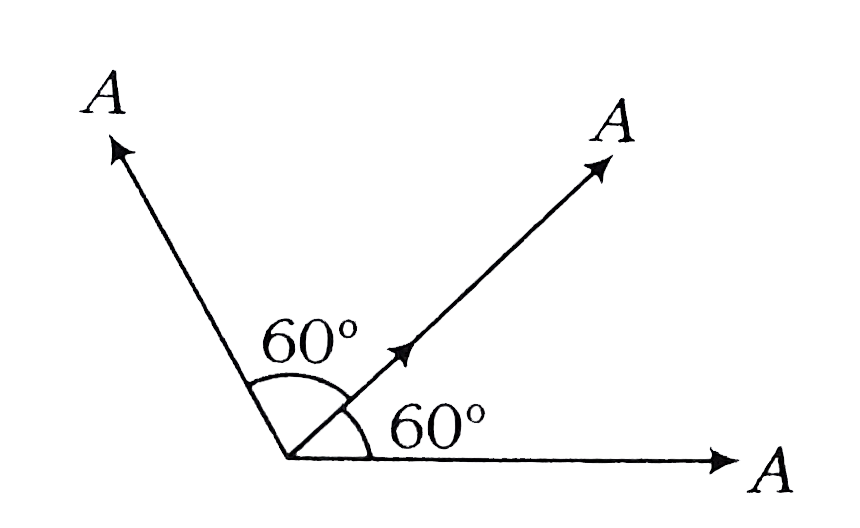
|
|
| 23. |
The molar specific heat for water molecules |
|
Answer» 3R |
|
| 24. |
Total energy of particle performing SHM depends on |
|
Answer» AMPLITUDE, TIME PERIOD |
|
| 25. |
A circular hole of radius 1 cm is drilled in a brass sheet at 20^(0)C. If the sheet is heated to 120^(0)C what will bethe diameter of the hole? (alpha for brass =18xx10^(-6)" "^(0)C^(-1)) |
|
Answer» |
|
| 26. |
What will be the effect on the weight of a body placed on the surface on the Earth, if Earth suddenly stops rotating? |
|
Answer» no effect |
|
| 27. |
Identify the correct answer.When a very long rod suspended in air will break under its own weight. The maximum length of the rod will depend ona) Breaking stress b) Density c) Cross-sectional area d) Acceleration due to gravity |
|
Answer» a,b,c |
|
| 28. |
A block A of mass 2 kg rests on another block B of mass 8 kg which rests on a horizontal floor . The coefficient of friction between A and B is 0.2 while that between B and floor is 0.5 . When horizontal force F = 25 Nis applied on the block B , the force of friction between A and B is (in N) . |
|
Answer» as `"" f_(L) = mu N = (5)/(10) XX 100 = 50 N "" [F lt f_(L)]` 
|
|
| 29. |
Answer the questions on the basis of given information A molecule of gas collides with the wall of a container elastically. Only ... A ... of the velocity of the molecule changes after collision. Here, A refers to |
| Answer» Answer :A | |
| 30. |
A rigid body is made of three identical thin rods, each of length .L. fastended together in the form of the letter .H.. The body is free to rotate about a horizontal axis that runs along the length of one of the legs of .H.. The body is allowed to fall from rest from a position in which the plane of .H. is horizontal. What is the angular speed of the body when the plane of .H. is vertical ? |
|
Answer» Solution :The moment of inertia of the system about the axis is `I=(4)/(3)mL^(2)`. By conservation of mechanical energy the lose in PE of BODY is equal to the gain in rotational KE. `therefore (3)/(2) MGL =(1)/(2)((4)/(3)mL^(2))OMEGA^(2)` on SOLVING `omega=(3)/(2)sqrt((g)/(L))` 
|
|
| 31. |
A uniform rod of length 1 is kept vertically on a horizontal smooth surface at a point O. If it is rotated slightly and released, it falls down on the horizontal surface. The lower end will remain |
|
Answer» at O |
|
| 32. |
When a light is incident at one end of wood with qurtz. At a small angle, then refracted light falls on the wall of the fibre at an angle |
|
Answer» EQUAL to CRITICAL angle |
|
| 33. |
A thin uniform rod AB of mass m=1.0 kg makes translationally motion with acceleration a=2.0" m/s"^(2) due to two anti-parallel force F_(1) and F_(2). The distance between the point at which these forces are applied is equal to a = 20 cm. Besides, it is known that f_(2)=5.0 N. Find the length of the rod in m. |
|
Answer» 1m |
|
| 34. |
Mark the correct options. |
|
Answer» A system X is in thermal equilibrium with Y but not with Z. System Y and Z may be in thermal equilibrium with each other. |
|
| 35. |
"Slope of x tot graph may be negative". Is this true or false ? |
| Answer» Solution :True. If the VELOCITY of the object is NEGATIVE. (i.e. Slope is DOWNWARD), then slope of `X tot ` graph will be negative. | |
| 36. |
Assertion: An earthquake will not cause uniform damage to all building in an affected area, even if they are built with the same strength and materials. Reason: The one with its natural frequency close to the frequency of seismic wave is likely to be damaged less. |
|
Answer» If both assertion and reson are true and reason is the correct explanation of assertion |
|
| 37. |
When a car of 3 mass 1000 kg is moving with a velocity of 20 ms^(-1) on a rough horizontal road, its engine is switched off. How far does the car move before it comes to rest if the coefficient of kinetic friction between the road and tyres of the car is 0.75 ? |
|
Answer» SOLUTION :Here `V = 20 ms^(-1), mu_(K)=0.75, g=10ms^(-2)` Stopping distance `S = (v^(2))/(2mu_(K)g)=26.67 m` |
|
| 38. |
What is Reynold's number ? Give its significance. |
|
Answer» Solution :It is a dimensionless NUMBER which DETERMINES the nature of the flow of fluid through a Reynold.s number pipe. is given by, `R_(c)= (rho V D)/(eta)` `R_(c) LT 1000`-stream line `R_(c) GT 2000`-- turbulent `1000 lt R_(c) lt 2000`-- unsteady |
|
| 39. |
Rest and motion are relative terms. Explain. |
| Answer» SOLUTION :Yes. .A body may be at rest relative to one OBJECT and at the same TIME it may be in motion relative to ANOTHER object. For example, a passenger sitting in a moving bus is at rest with RESPECT to his fellow passenger but he is in motion with respect to a man standing outside the bus. | |
| 40. |
A cubical wooden box is hanged in a room by keeping the 15 kg ice in it. Inner length of box is 50 cm and thickness is 7.5 mm. Time taken by whole ice at 0^(@)C to mellt will be. . ..For wood, K=6xx10^(-4)" cal s"^(-1)" cm"^(-1)" "^(@)C^(-1). Outer temperature is 25^(@)C, located heat of fusion of ice is 80 cal/g : |
|
Answer» 2000 s `Q=KA(((T_(1)-T_(2)))/(L))t` but `Q=mL^(1)` `:.mL_(f)=KA((T_(1)-T_(2))/(L))t` `:.t=(mL_(f))/(KA(T_(1)-T_(2)))` Here `m=15` kg = 15000 g latent heat of fusion `L_(f)=80" cal/g"` `L=7.5` MM `=0.75` cm `K=6xx10^(-4)" cal s"^(-1)" cm"^(-1)" "^(@)C^(-1)` `A=6(l^(2))=6xx(50xx10^(-2))^(2)=6xx0.25` `A=1.5" cm"^(2)` `T_(1)-T_(2)=25^(@)C` `:.t=(15000xx80xx0.75)/(6xx10^(-4)xx1.5xx25)` `=(900000)/(225)` `:.t=4000s` |
|
| 41. |
Compute the position of an oscillating particle when its kinetic energy and potential energy are equal. |
|
Answer» Solution :SINCE the kinetic energy and POTENTIAL energy of the oscillating particle are equal, `(1)/(2)momega^(2)(A^(2)-X^(2))=(1)/(2)momega^(2)x^(2)` `implies A^(2)-x^(2)=x^(2)` `implies 2x^(2)=A^(2)impliesxpm(A)/(sqrt(2))` |
|
| 42. |
The coefficient of friction between a block and plane is (1)/(sqrt3)If the inclination of the plane gradually increases, at what angle will the object begin to slide? |
|
Answer» Solution :SINCE the COEFFICIENT of FRICTION is `(1)/(sqrt3)` ` tan THETA = (1)/(sqrt3) rArr theta = 30^@` |
|
| 43. |
A system goes from P to Q by two different paths in the P-V diagram as shown in figure. Heat given to the system in path 1 is 1100 J, the work done by the system along path 1 is more than path 2 by 150 J. The heat exchanged by the system in path 2 is |
|
Answer» 800 J |
|
| 44. |
If 'H' is the height of liquid in a cylindrical container and 'h' is the height of orifice (hole) in the cylinder, then give the formula for (i) Velocity of efflux and (ii) Horizontal range of the jet. |
| Answer» SOLUTION :Velocity of EFFLUX= ` v=sqrt(2gh)` and HORIZONTAL range `X= 2 sqrt(h(H -h))`. | |
| 45. |
What is the main difference between forced oscillations and resonance ? |
| Answer» Solution :The frequency of external periodic force is DIFFERENT from the natural frequency of the oscillator in case of forced OSCILLATION but in RESONANCE TWO FREQUENCIES are equal. | |
| 46. |
Which of the following points is the likely position of the centre of mass of the system shown in Fig. |
|
Answer» A |
|
| 47. |
A block of mass 4 kg is suspended through two light spring balances A and B. Then A and B will read respectively . |
|
Answer» 4 kg and 0 kg |
|
| 48. |
A large wooden plate of area 10m floating on the surface of a river is made to move horizontally with a speed of 2m/s by applying a tangential force. River is om deep and the water in contact with the bed is stationary. Then choose correct statement (Coefficient of viscosity of water =10^(-3)N^(-s)//m^(2)) |
|
Answer» VELOCITY gradient is `2S^(-1)` |
|
| 49. |
(A) : All oscillatory motions are necessarily periodic motion in conservative fields but all periodic motion are not oscillatory (R) : Simple pendulum is an example of oscillatory motion. |
|
Answer» Both 'A' and 'R' are TRUE and R' is the correct explanation of 'A' |
|
| 50. |
A satellite is revolving in a circular orbit at a height 'h' from the earth's surface (radius of earth R, h lt lt R). The minimum increases in its orbital velocity required, so that the satellite could escape from the earth's gravitational field, is close to : (Neglect the effect of atmosphere) |
|
Answer» `SQRT(GR)( sqrt(2)-1)` |
|