

Saved Bookmarks
This section includes 7 InterviewSolutions, each offering curated multiple-choice questions to sharpen your Current Affairs knowledge and support exam preparation. Choose a topic below to get started.
| 1. |
The temperature of a gas is -68^(@)C.To what temperature should it be heated so that (a)the average translational KE of the molecules be double (b)the root mean square velocity of the molecules be doubled? |
|
Answer» Solution :(a)According to kinetic theory of gases,average TRANSLATIONAL KE ofa molecule is given by `E=(3)/(2)kT` so that `(E_(2))/(E_(1))=(T_(2))/(T_(1)),2=(T_(2))/(T_(1))` so `T_(2)=2T_(1)`=2[273+(-68)]=410K (b)According to K inetic theory of gases,TMS speed of gas molecules is given by `v_(rms)=sqrt((3RT)/(M))` so that `((V_(rms))_(2))/((V_(rms))_(1))=sqrt((T_(2))/(T_(1)))implies2=sqrt((T_(2))/(T_(1)))` `therefore T_(2)=4T_(1)`=4[273+(-68)]=820K,`t_(2)=547^(@)C` |
|
| 2. |
A bullet fired vertically up from the ground reaches a height 40 m in its path from the ground and it takes further time 2 seconds to reach the same point during descent. The total time of flight is (g=10 ms^(-2)) |
|
Answer» 4s |
|
| 3. |
Two similar springs P and Q have spring constants K_p and K_Q, such that K_p > K_Q. They are stretched first by the same amount (case a), then by the same force (case b). The work done by the springs W_P and W_Q are related as, in case (a) and case (b) respecitively |
|
Answer» `W_P GT W_Q , W_Q gt W_P` Case (a) : Elongation (X) in each spring is same. `W_P = 1/2 K_px^2 , W_Q = 1/2 K_Q x^2 :. W_P > W_Q` Case (b) : Force of elongation is same. So, `x_1 = F/(K_P) and x_2 = F/(K_Q)` `W_P = 1/2 K_p x_1^2 = 1/2 (F^2)/(K_P) , W_Q = 1/2 K_Q x_2^2 = 1/2 (F^2)/(K_Q)` `:. W_P < W_Q` . |
|
| 4. |
The radii of two planets are R_1 and R_2 and their densities are rho_1 and rho_2 respectively. Then find ratio of acceleration due to gravity on the planets. |
|
Answer» SOLUTION :`IMPLIES` ACCORDING to G `=4/3 piGRrho` `g_1/(g_2) = (4/3piGR_1rho_1)/(4/3piGR_2rho_2)=(R_1rho_1)/(R_2rho_2)` |
|
| 5. |
If co-efficient of friction is sqrt(3) then what will be the angle between two surface ? |
|
Answer» Solution :f= CO - efficientof friction N=normalforce `MU= ( f ) /(n )TANTHETA` `theta = TAN ^(-10 (SQRT(3))` `theta = 60^(@)` |
|
| 6. |
A constant force F=20N acts on a block of mass 2 kg which is connected to two blocks of masses m_(1) = 1.0 kgand m_(2) = 2 kg as shown in Calculate the accelerations produced in ball the three blocks Assume pulleys are frictionless and weightless . |
|
Answer» Solution :The free body diagrams of three blocks of masses `M,m_(1)` and `m_(2)` are shown in Eduations of MOTION of three blocks are `Ma = F - T`…(i) `m_(1) a_(1) = 2 T - m_(1) g` …(ii) `m_(2)a_(2) = m_(2)g - T `…(iii) Now if mass `M` MOVES to the LEFT through a distance X and mass `m_(2)` moves downwards through the same distance x then the distance travelled by mass `m_(1)` is 2x upwards Therefore sum ofthe accelerations of M and `m_(2)` is double the acceleration of `m_(1)` `a + a_(2) = 2 a_(1)` From (i) `T = F - Ma = 20 - 2 a ` ...(iv) ltbr) From (iii) `T = m_(2)g - m_(2) a_(2) = 2xx 9.8 - 2 a_(2)` ...(v) From (ii), `2 T = m_(1) a_(1) + m_(1) g = 1 a_(1) + 9.8 ` ...(vi) Add (v) and (vi) `2 T = (20 -2a) + (19.6 -2 a_(2)) = 39.6 -2 (a+ a_(2)) = 39.6-4 a_(1)`...(VII) Using (vii),` a_(1) + 9.8 = 39.6 - 4 a_(1) ` ` a_(1) = 39.6 - 9.8 = 29.8 ` `a_(1) = (29.8)/(5) = 5.96 m//s^(2)` From (vii) ` 2 T = 5.96 + 9.8 = 15.76 ` ` T = (15.76)/(2) ` From (iv) ` 2 a_(2) = 19.6 - T = 19.6 - 7.88 = 11.78 ` `a_(2) = (11.78)/(2)` From (iv) ` a =2 a_(1) - a_(2) = 2 xx 5.96 - 5.89 = 11.92 - 5.89 = 6.03 m//s^(2)` 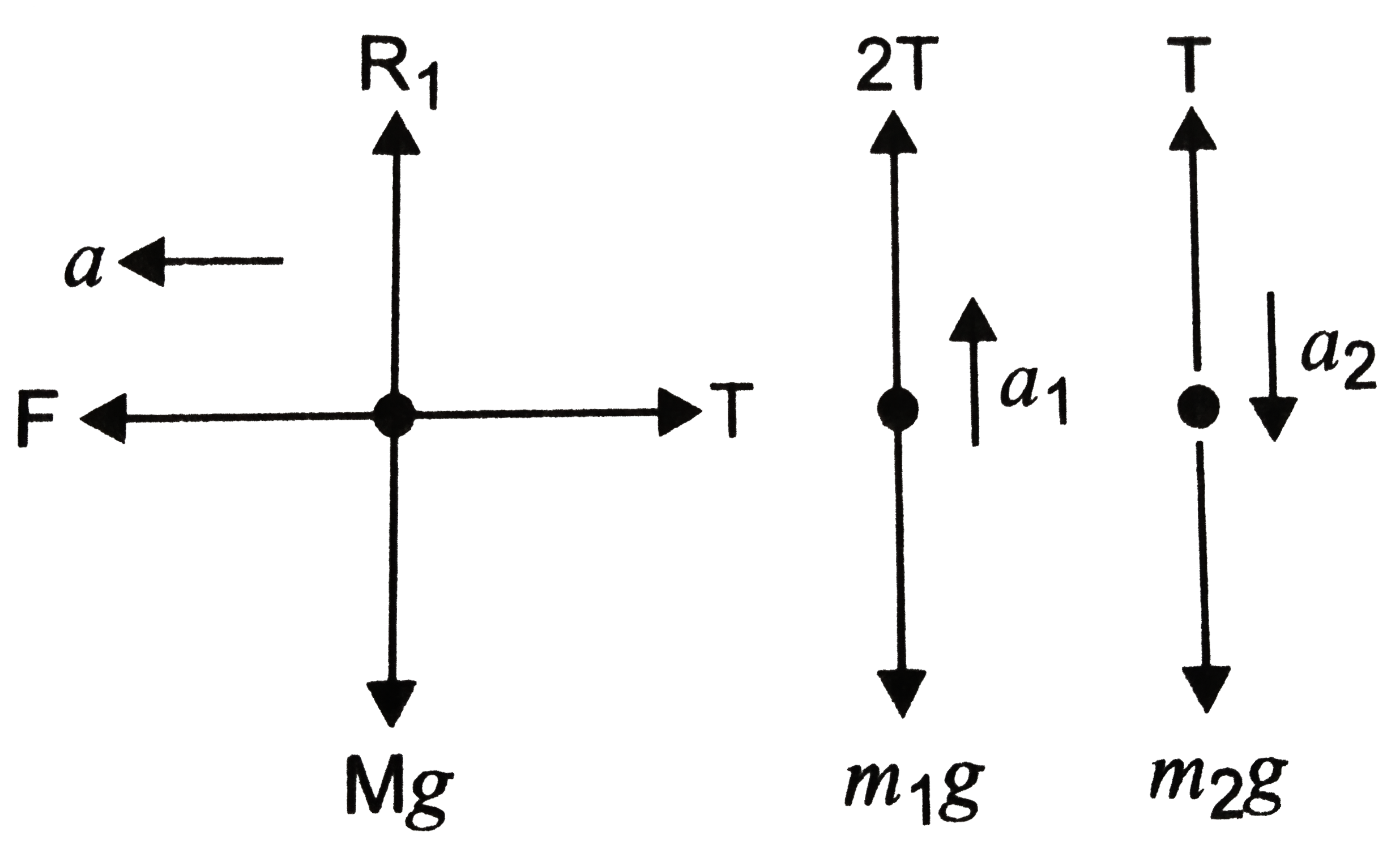 . .
|
|
| 7. |
A capillary tube of diameter 0.4mm is dipped in a beaker containing mercury. If density of mercury is 13.6xx10^(3)kg//m^(3), surface tension 0.49Nm^(-1), angle of contact 135^(@) the depression of the meniscus in the capillary tube will be |
|
Answer» `0.13m` |
|
| 8. |
Hot rice can be touched with hand while the vessel containing it cannot be touched. Explain |
| Answer» Solution :Hot rice COOKED in a VESSEL can be touched with fingers while the vessel cannot be touched. Rice isa BAD conductor of HEAT and the vessel (made of metal) is a good conductor of heat. When hot rice is touched with the fingers, very small amount of heat will be conducted. | |
| 9. |
Check dimensional consistency of given equation. |
|
Answer» Solution :For example `x=x_(0)=v_(0)t+(1)/(2)at^(2)` Here, x is distance coveredby object in time t. `x_(0)`=initial position of object during motion x= FINAL position `v_(0)`= initial VELOCITY a= acceleration `LHS=x=M^(0)L^(1)T^(0)` In RHS tere are three terms, `x_(0)=M^(0)L^(1)T^(0)` `v_(0)t=[L^(1)T^(-1)T^(1)]=M^(0)L^(1)T^(0)` In `(1)/(2)at^(2)` is constant term which is dimensionless. `:.at^(2)=[M^(0)L^(1)T^(-2)][T^(2)]` `=M^(0)L^(1)T^(0)` Here all terms in given equation have same dimension. Hence, given equation, `x=x_(0)+v_(0)t+(1)/(2)at^(2)` is dimensionally consistence. (Dimensionally VALID). Test of consistency of dimension tells us no more no less than test of consistency of units. If equation fails consistency test it is proved wrong, but if it passes it is not proved RIGHT Thus, a dimensionally correct equation NEED not be actually an exact (correct) equation but al dimensionally wrong (incorrect) equation must be wrong. |
|
| 10. |
(A): Spring balances show wrong readings after they has been used for a long time(R): On using for a long time, spring balances loose its elastic strength |
|
Answer» Both (A) and (R) are TRUE and (R) is the CORRECT explanation of (A) |
|
| 11. |
If E is a rotational kinetic energy then angular momentum is |
|
Answer» `sqrt(2IE)` |
|
| 12. |
Between two similar thermometers, one is filled with mercury and another with alcohol of the same volume at 0^(@)C. The gap for each degree in the mercury thermometer is l and that in the alcohol thermometer is l^('). Show that l/l^(')=(gamma-3alpha)/(gamma_(1)-3alpha) "where " gamma= coefficient of real expansion of mercury,gamma_(1)= coefficient of real expansion of alcohol and alpha= coefficient of linear expansion of glass. |
|
Answer» Solution :In both thermometers, let the area of cross-section of the TUBE be A and the volume of the BULB be V. For `1^(@)` rise in temperature in MERCURY thermometer, apparent expansion of mercury = volume of length l of the tube i.e. `""V=(gamma-3alpha) times 1=l times A " " [ therefore gamma^(.)=gamma-gamma_(g)] "...(1)"` Similarly, for `1^(@)` rise in temperature in alcohol thermometer, `""V(gamma_(1)-3alpha) times 1=l^(.) times A"...(2)"` Dividing (1) by (2) we GET, `(l times A)/(l^(.) times A)=(V(gamma-3alpha))/(V(gamma_(1)-3alpha)) " or, "l/l^(.)=(gamma-3alpha)/(gamma_(1)-3alpha).` |
|
| 13. |
A person moves in sea water by terminal velocity with electronic digital watch, then what is the effect in measurement of time of water proof watch? |
| Answer» Solution :No, EFFECT OBSERVED, because time obtained by the watch is independent with gravitational and BUOYANT FORCES. | |
| 14. |
Give an example of a motion for which both the acceleration and velocity are negative? |
| Answer» SOLUTION :In CASE of a FREELY FALLING BODY . | |
| 15. |
Define the term : Trade wind. |
|
Answer» Solution :The equatorial and polar regions of the earth receive unequal solar heat. Air at the earth.s surface NEAR the equator is hot while the air in the upper atmosphere of the poles is cool. In the absence of any other factor, a CONVECTION current would be set up. The air at the equatorial surface rising and moving out towards the poles, descent and STREAM in towards the equator. The rotation of the earth, however, modifies this convection current. Because of this, air close to the equator has an eastward speed of 1600 km/h, while it is ZERO close to the poles. As result, the air descends not at the poles but at `30^(@)N` (North) latitude and returns to the equator. This is called trade wind. The steady surface wind on earth blow in from northeast towards the equator, the so called is trade wind. |
|
| 16. |
1 g steam at 100^(0)C is passed in an insulating vessel having 1 g ice at 0^(0)С. Find the equllibrium combosition of the mixture. Neglecting heat capacity of the vessel. |
|
Answer» Solution :Heat AVAILABLE from steam (changes from steam to water) `= ML = 1 xx 540 = 540` cal Het gained by ice to change into water and then rise its temperature to `100^(0)C = m_("ice")L + m_("wa") cDeltaT = 1 xx 80 + 1 xx 1 xx (100 - 0) = 180` cal. The above calculations show that some part of steam will CONDENSE to change the ice into water at `100^(0)C`. Let m be the mass of steam CONDENSED, then `m xx 540 = 180 or m = (180)/(540)=1/3g` , Final CONTENTS : ice = 0g water `= 1 + 1/3 = 4/3 g` steam `= 1 - 1/3=2/3g`. |
|
| 17. |
What provides the restoring force for simple harmonic oscillations in the following cases : Column of Hg in U-tube |
| Answer» SOLUTION :WEIGHT of DIFFERENCE COLUMN | |
| 18. |
The efficiency of an ideal gas with adiabatic exponent 'gamma' for the shown cyclic process would be |
|
Answer» <P>`((2ln2-1))/(GAMMA//(gamma-1))` `W_(CA)=+2nRT_(0)ln2` `DeltaQ_(BC)=nC_(p)DeltaT=(nRgammaT_(0))/(gamma-1)` HENCE, efficiency `((2ln2-1))/(gamma//(gamma-1))` |
|
| 19. |
Two satellites S_1 and S_2are revolving round a planet in coplanar and concentric circular orbits of radii R_1 and R_2in the same direction respectively. Their respective periods of revolution are 1 hr and 8 hr. The radius of the orbit of satellite S_(1)is equal to 10^4km. Their relative speed when they are closest, in kmph is: |
|
Answer» `(PI)/2 xx10^(4)` |
|
| 20. |
A diverging meniscus lens of radii of curvatures 25cm and 50cm has a refractive index 1.5. Its focal length length is |
| Answer» Answer :B | |
| 22. |
The centre of mass of three bodies each of mass 1 kg located at the points (0,0), (3, 0) and (0, 4) in the x-y plane is |
|
Answer» `((4)/(3) , 1)` `(x_(2) , y_(2)) = (3 , 0) ,m_(3) - 1 kg , (x_(3) , y_(3)) = (0,4)` `X_(CM) = (m_(1) x_(1) + m_(2) x_(2) + m_(3) x_(3))/(m_(1) + m_(2) + m_(3)) = (1 xx 0+ 1xx 3 + 1 xx 0)/(1 + 1 + 1) = 1` `Y_(CM) = (m_(1) y_(1) + m_(2) y_(2) + m_(3) y_(3))/(m_(1) + m_(2) + m_(3)) = (1 xx 0 + 1 xx 0 + 1 xx 4)/(1 + 1 + 1) = (4)/(3)` The coordinates of centre of MASS are `(1 , (4)/(3))` |
|
| 23. |
In the figure given two processes A and B are shown by which a thermodynamics system goes from initial state F. If DeltaQ_(A) and are respectively the heats supplied to the system then |
|
Answer» `DeltaQ_(A)=DeltaQ_(B)` |
|
| 24. |
The diameter of a circle is 2.486m. Calculate the area enclosed by the circle to appropriate significant figures. ( pi=3.1416) |
|
Answer» 5 |
|
| 25. |
Distance covered by free falling object in given time is directly proportional to time. |
|
Answer» |
|
| 26. |
In the equation(P+(a)/(V^(2)))(V-b) = RT,, the SI unit of a is |
|
Answer» `Nm^(2)` Thus SI unit of a is `Nm^(-2) m^(6)` or `Nm^(4)` |
|
| 27. |
In which mode of vibration does the density of the medium vary ? |
| Answer» Solution :The DENSITY of the MEDIUM VARIES in the LONGITUDINAL mode of vibration. | |
| 28. |
The length of a straight line is measured a number of times by a number of observes . The following are the results of these measurements. Decide precision and accuracy. Actual length = 3.785 cm pm 0.001cm 1st set of measurement 3.8 cm , 3.9 cm , 3.7 cm 2nd set of measurements 3.478 cm , 3.479 cm , 3.478 cm , 3.478 cm , 3.479 cm 3 rd set of measurement 3.55 cm , 3.65 cm , 3.45 cm , 3.45 cm , 3.35 cm 4th set of measurements 3.784 cm , 3.785 cm , 3.784 cm , 3.785 cm , 3.784 cm |
|
Answer» Solution :FIRST set of MEASUREMENTS are accurate because it is CLOSEST to the actual VALUE but not precise. Second set of MEASURMENTS are not accurate but it is most precise because the readings are reproducible. Third set of measurements are neither accurate nor precise. Fourth set of measurements are accurate as well as precise. |
|
| 29. |
Figure shows a weight of 30kg suspended at end of cord and a weight of 70 kg applied at other end of the cord passing over a pulley . Neglecting weight of rope and pulley find the tension in the cord and acceleration of the system (g10ms^(-2)) |
|
Answer» |
|
| 30. |
A stone tied to the end of the string 100 cm long is whirled in a horizontal circle with a constant speed. If the stone makes 30 revolution in 15 s. Calculate the magnitude and direction of acceleration of the stone. |
|
Answer» |
|
| 31. |
AB is the optic axis of a lens. Lens is not shown in the figure. O and I are the position of object and image. Then match of following. |
|
Answer» |
|
| 32. |
Name the three effect (applications) of superpositin of waves. |
|
Answer» Solution :(i) Space (or spatial) INTERFERENCE (also known as Interference) (ii) Time (or TEMPORAL) Interference (also known as Beats) (III) CONCEPT of STATIONARY waves. |
|
| 33. |
A crow is sitting on a branch of tree whose co-ordinates are (1,2,3) . A hunter is standing on the ground . Represent the position of the crow with respect to the hunter . |
|
Answer» Solution :Formula : `LET vec (r) = XHAT(i) + yhat(j) + zhat(k)` The position of vector of CROW `vec(r) = (1) hat(i) +(2) hat(j) +(3) hat(k)` The position of vector of a hunter `s_(1) = ohat(i) + ohat(j) + o hat(k)` The position of vector of crow with respect to hunter is `vec(r) = hat(i) + 2 hat(j) + 3 hat(k)` |
|
| 34. |
One Fermi is........ |
| Answer» Solution :`10^(-15)` m | |
| 35. |
Calculate the total translational KE of 3 molecules of an ideal gas at 227^0 C. |
| Answer» SOLUTION :`1.87xx10^4` J | |
| 36. |
A simple pendulum has a time period T_1 when it oscillates on the earth's surface and T_2 when it taken a height 'R' above the earth's surface, where 'R' is the radius of the earth. The value of T_2//T_1 is |
| Answer» ANSWER :D | |
| 37. |
During blood transfusion the needle is inserted in a vein where gauge pressure is p_(g) and atmospheric pressure is p. At what height must the blood container be placed so that blood may just enter the vein. Given density of blood is p. |
|
Answer» <P> SOLUTION :`P_(g)=PGH``h=(P_(g))/(pg)` |
|
| 38. |
Calculate the time in which a layer of ice 6 cm thick, on the surface of a pond will increase in thickness by 2 mm. Temperature of the surrounding air =-20^(@) "C" , L = 333 "KJ kg"^(-1) Conductivity of ice =0.08cal s−1cm−1∘C−1.. |
|
Answer» |
|
| 39. |
A hunter has a machine gun that can fire 50g bullets with a velocity of 900ms^(-1) . A 40 kg tiger springs at him with a velocity of 10 mS^(-1). How many bullets must the hunter fire into the tiger in order to stop him in his track? |
|
Answer» Solution :Mass of BULLET, `m=50g=0.05kg`,Velocity of bullet, `v=900 ms^(-1)` Mass of TIGER, `M=40 kg`,Velocity of tiger, `V=10 ms^(-1)` LET n be number of bullets reqired to be pumped into the tiger to stop him in his track. If the bullets and the tiger are supposed to constitute one isolated SYSTEM , then the magnitude of the momentum of n bullets should be equal to the MAGNITUDEOF momentum of the tiger. `:. nxxmv=MV "(or)" n=(MV)/(mv) :. n =(40xx10)/(0.05xx900)=8.89=9` |
|
| 40. |
Calculate the maximum extension of the spring in the following two cases. Also calculate period of oscillation in each case. (a) |
|
Answer» Solution :`ma-KY` `"so that"a=(-ky)/(m)"and "(y)/(a)=|-(m)/(k)|` Hence `T=2pisqrt((y)/(a))` may be written as`""T=2pi sqrt((m)/(k))` Maximum extension of the spring will be .y. (b) `ma=-2KY`  `"so that"(y)/(a)=|-(m)/(2k)|""{:("Altermaively"),(mua=-ky),("where "MU=(m_(1)m_(2))/(m_(1)+m_(2))=(m)/(2)):}` `&T=2pisqrt((y)/(a))""{:(THEREFORE (ma)/(2)=-ky),("or ma "=-2ky):}` `T=2pisqrt((m)/(2k))""ma=-k(2y)` Maximum extension of the spring will be .2y.. |
|
| 41. |
The angular displacement of a particle is given by theta=t^(3)+ t^(2)+ t+1 then, its angular velocity at t = 2sec is ……….. rad s^(-1) |
|
Answer» 27 |
|
| 42. |
A car is moving in a circular horizontal track of radius 10 m with a constant speed of 10ms^(-1). A plumb bob is suspended from the roof of the car by a light rigid rod of length 1 m. The angle made by the rod with track is |
|
Answer» |
|
| 43. |
Substances that elongate considerably and undergo plastic deformation before they break are known as |
|
Answer» BRITTLE - SUBSTANCES |
|
| 44. |
Absorbing and emitting powers of a body are 10 and 8 respectively. Then (Ideal Black Body) IBB emissivity will be. . . . . |
|
Answer» `0.2` Here, `e=8,a=10` `:.epsilon=e/a` `=(8)/(10)` `=0.8` |
|
| 45. |
What is the gain in potential energy of the water column in case of rise of water in glass capillary tube? What is the work done by surface tension ? Assume that the angle of contact between glass and water is 0^@. |
|
Answer» Solution :Rise of WATER inside the capillary tube of RADIUS r is, `h=(2Tcos theta)/(rho g r)=(2T)/(rho gr)` [ where T = SURFACE TENSION, `theta=` angle of contact`0^@` ,`rho` = density of water ] Mass of watercolumn of height `h, m =pir^2 h rho` The height of centre of mass of the water column `=h/2` `therefore` The gain in potential energy, `U=mgxxh/2=1/2 pi r^2 rho gh^2` `=1/2pi r^2 rho g xx (4T^2)/(rho^2g^2r^2)=(2piT^2)/(rhog)` The work done by surface tension, `W2pi r h Tcos theta=2pi r xx(2T)/(rho g r)xxTxxcos0^@=(4pi T^2)/(rho g)` |
|
| 46. |
A body of mass 5kg rests on a rough horizontal surface of coefficient of friction 0.2. The body is pulled through a distance of 10m by a horizontal force of 25N. The kinetic energy acquired by the body is (g=10 ms^(-2)) |
| Answer» ANSWER :C | |
| 48. |
The inclined surfaces of two movable wedges of the same mass M are smoothly conjugated with the horizontal plane as shown in figure. A.small block of mass m slides down the left wedge from a height h. To what maximum, height will the block rises on the right wedge. |
|
Answer» |
|
| 49. |
A highly conducting solid sphere of radius R, density rho and specific heat s is kept in an evacuated chamber. A parallel beam of electromagnetic radiation having uniform intensity I is incident on its surface. Assume that the surface of the sphere is perfectly black. Calculate the rate of increase of temperature |
|
Answer» `(3(I-2sigmaT^(4)))/(2R rho s)` |
|
| 50. |
A hexagonal pencil of mass M and sides length a has been placed on a rough incline having inclination thetaFriction is large enough to prevent sliding. If at all the pencil moves, during one full rotation each of its 6 edges, in turn, serve as instantaneous axis of rotation. (a) Show that for theta gt 30^(@)the pencil cannot remain at rest. (b) For inclination of incline theta lt 30^(@)the pencil will not roll on its own. A sharp impulse J is given to the pencil parallel to the incline at its upper edge (see figure). Friction does notallow the pencil to slide but it begins to rotate about the edge through A with initial angular speed omega_(0). Find omega_(0). Moment of inertia of the pencil about its edge is I. (c) Find minimum value of J so that the pencil will turn about A, and B will land on the incline. (d) If kinetic energy acquired by the pencil just after the impulse is K_(0), find its kinetic energy just before edge B lands on the incline |
|
Answer» (c) `omega = sqrt(2Mga)/(I)(1-cos(30^(@)-THETA)))` (d) `K = K_(0) + Mga sin theta` |
|