Saved Bookmarks
This section includes 7 InterviewSolutions, each offering curated multiple-choice questions to sharpen your Current Affairs knowledge and support exam preparation. Choose a topic below to get started.
| 1. |
Two discs A and B are mounted coaxially on a vertical axle. The discs have moments of inertia I and 2I respectively about the common axis. Disc A isimparted an initial angular velocity 2omega using the entire potential energy of a spring compressed by a distance x_(1). Disc B is imparted an angular velocity omega by a spring having the same spring constant and compressed by a distance x_(2). Both the discs rotate in the clockwise direction. A small object of uniform density rolls up a curved surface with an initial velocitiy v. It reaches upto a maximum height of (3v^(2))/(4g) with respect to the initial position. The object is: |
|
Answer» ring |
|
| 2. |
Choose the correct alternative:In an inelastic collision of two bodies, the quantities which do not change after the collision are the total kinetic energy/total linear momentum of the system of two bodies. |
| Answer» Answer :A | |
| 3. |
If T_1, T_2, and T_3 are the time periods of a given pendulum on the surface of the earth, at a depth 'h' in a mine and at an altitude 'h' above the earth's surface respectively, then |
|
Answer» `T_1 = T_2 = T_3` |
|
| 4. |
A copper calorimeter contains 82 g of water at 16^(@)C. When 4000 cal of heat is supplied to it, the temperature rises to 41^(@)C. Find the water equivalent of the calorimeter. Also find its mass. (specific heat capacity of copper is 0.42 "J/g"^(@)C) |
|
Answer» |
|
| 5. |
The measured length and breadth of a rectangle are written as (5.7 +- 0.1) cm and (3.4 +- 0.2) cm respectively. Calculate the area of the rectangle with error limits. |
|
Answer» SOLUTION :Given `l` = 5.7 cm and `Deltal 0.1 `cm , b = 3.4 cm and `Delta` b = 0.2cm. The area of the rectangle WITHOUT ERROR LIMIT is, A = `lxxb = (5.7 xx3.4) "cm"^(2) = 19.38 "cm"^(2) ~~ 19.4 "cm"^(2)` Next the fractional error in A is `(DeltaA)/(A)=(Deltal)/(l)+(Deltab)/(b)=(0.1)/(5.7)+(0.2)/(3.4)~~(0.02+0.06)=0.8` `:." " DeltaA=0.8xxA~~0.08xx19.4"cm"^(2)~~1.6 "cm"^(2)` Hence the area of the rectangle with error limit is `(19.4 pm 1.6 ) "cm"^(2)` |
|
| 6. |
Eleven forces each equal to 5N act on a particle simultaneously. If each force makes an angle 30° with the next one, the resultant of all forces is |
|
Answer» 15N |
|
| 7. |
State the expression for net compliance of a system containing n springs connected in Series |
| Answer» SOLUTION :When N springs are connected in series net compliance `C_(S) = overset(n) UNDERSET(i=1)sum C_(i)` | |
| 8. |
A particle moves in the plane xy with constant acceleration a directed along the negative y-axis. The equaiton of motion of the particle has the form y = px - qx^(2) where p and q are positive constants. Find the velocity of the particle at the origin of corrdinates. |
|
Answer» SOLUTION :GIVEN that `y = px - qx^(2)` `:. (dy)/(DX) = p (dx)/(DT)-q.2x(dx)/(dt)` and `(d^(2)y)/(dt^(2)) =p (d^(2)x)/(dt^(2)) -2qx(d^(2)x)/(dt^(2))-2q ((dx)/(dt))^(2)` or `-a =- 2q ((dx)/(dt))^(2) =-2qv_(x)^(2)` `:. (d^(2)x)/(dt^(2)) =0` and `(d^(2)y)/(dt^(2)) =-a` `:. v_(x)^(2) = (a)/(2q)` or `v_(x) = sqrt((a)/(2q))` Further, `((dy)/(dt))_(x=0) = p(dx)/(dt)` or `v_(p) =pv_(x) :. v_(p) = psqrt(((a)/(2q)))` Now `v - sqrt((v_(x)^(2)+v_(y)^(2))) =sqrt(((a)/(2q)+(ap^(2))/(2q)))rArr` `v=sqrt([(a(p^(2)+1))/(2q)])` |
|
| 9. |
The spring mass system oscillating horizontally. What will be the effect on the time period if the spring is made to oscillate vertically? |
| Answer» SOLUTION :In both the POSITIONS, the TIME PERIOD will REMAIN the same. | |
| 10. |
A wire of linear mass density lambda (kg//m) is bent intoan arc of a circle of radius R subtending an angle 2 theta_(0) at the centre. Calculate the moment o inertia of this circular arc about an axis passing through its midpoint (M) and perpendicular to its plane. |
|
Answer» |
|
| 11. |
Show that the pressure produced due to fluid column depend on the height of fluid column and density of fluid. |
Answer» Solution :Consider a fluid at REST in a container . DENSITY of fluid is `rho` and height of fluid column is h as SHOWS in figure. The weight of the fluid in the cylinder W=mg…(1) but MASS of fluid m= volume `XX` density `=Ahrho` `thereforew=(Ahrhog)`.....(2) The pressure produced at the bottom of container due to this weight is `P=("Weight W")/("Area A")``thereforeP=(Ahrhog)/(A)` `thereforeP=hrhog` ...(3) This equation show that pressure produced due to fluid column dependon the heigh of fluid column h and density of fluid `rho`. |
|
| 12. |
A liquid initially at 75^(0)C cools to 55^(0)C in 12.5 minutes and to 45^(0)C in 10 minutes. Which of the following temperatures is not that of the surroundings |
|
Answer» `45^(0)C` |
|
| 13. |
(A) : The hard boiled egg and raw egg can be distinguished on the basis of spining of both. (R ) : The moment of inertia of hard boiled egg is more as compare to raw egg. |
|
Answer» Both 'A' and 'R' and TRUE and 'R' is the correct explantation of 'A' |
|
| 14. |
A particle A suffers an elastic collision with a particle B which is at rest initially, then after the collision. Identify the incorrect statement. |
|
Answer» they can move in OPPOSITE direction |
|
| 15. |
The opening near the bottom of the vessel has an area A. A disc is held against the opening to keep the liquid, from running out. Let F_1 be the net force on the disc applied by liquid and air in this case. Now the disc is moved away from the opening a short distance. The liquid comes out and strikes the disc inelastically. Let F_2 be the force exerted by liquid in this condition then F_1 // F_2 is |
|
Answer» `1/2` |
|
| 16. |
A block of mass 6kg is lowered with the help of a rope of negligible mass through a distance of 20 cm with an acceleration of 1.96 ms^(-2) Work done by the rope on the block is |
|
Answer» 940.8j |
|
| 17. |
A boy recalls the relativistic mass wrongly as m=m_0/sqrt(1-v^2) Using dimensional method put the missing 'C' at proper place. |
| Answer» Solution :Here `[M]=[M_0]`. So the denominator MUST be dimensionless. Also `V^2` cannot be subtracted from the dimensionless CONSTANT 1. So `v^2`should be DIVIDED by `C^2` as to make it dimensionlessHence the CORRECT FORM of the relation `M=(m_0)/sqrt(1-v^2/C^2)` | |
| 18. |
startingformresta cars moves with unifrom acceleration and attians a velocity of 20 ms^(-1) and 4 s. It then moves what a unifromvelocity of 20 ms^(-1) for 6s. The brakesare appliedand the car is brought to rest in 10s under unifrom retardation . Drawthe velocity groupfor themotion. using theis graph , find (i) the acceleration ofthe car duringthe frist4 s (ii)ua retardation during the last 10 s and (iii) the totaldistance traveledby the car . |
|
Answer» |
|
| 19. |
When two waves interfere,is there a loss of energy? |
| Answer» SOLUTION :When two waves INTERFERE,there is no LOSS of energy.Energy is only redistributed. | |
| 20. |
A particle is subjected to SHM as given by equationsx_1 = A_1 sin omegatand x_2 = A_2 sin (omega t + pi//3).The maximum acceleration and amplitude of the resultant motion are it a_("max") and A,respectively , then |
|
Answer» `a_("MAX") = omega^2sqrt(A_1^2 + A_2^2 +A_1A_2)` |
|
| 21. |
A disc of mass 2 kg and radius 0.2 m is rotating with angular velocity 30 "rad s"^(-1). What is angular velocity, if a mass of 0.25 kg is put on periphery of the disc ? |
|
Answer» 24 RAD `s^(-1)` `tau=0` `rArr (dL)/(dt) = 0 rArr L = I omega =` constant `r rArrI_(1)omega_(1)=I_(2)omega_(2)rArr(1)/(2)Mr^(2)omega_(1)=(1)/(2)(M+2m)r^(2)omega_(2)`....(i) Here, `M=2kg,m=0.25kg,r=0.2m,omega_(1)=30 "rad s"^(-1)` Hence, we get after putting the given values in Eq. (i) `(1)/(2)xx2xx(0.2)^(2)xx30=(1)/(2)xx(2+2xx0.25)(0.2)^(2)xxomega_(2)` or `1.2=0.05omega_(2)or omega_(2)=24 "rad s"^(-1)`. |
|
| 22. |
vec(A)+ vec(B) = 2hat(i) and vec(A) - vec(B) = 4 hat(i) then angle between vec(A) and vec(B) is |
|
Answer» `180^(@)` |
|
| 23. |
Two bodies with moment of inerita I_(1) and I_(2) (I_(2) gt I_(1)) are rotating with same angular momentum . If K_(1) and K_(2) are their kinetic energies, then |
|
Answer» `K_(2) gt K_(1)` |
|
| 24. |
The magnitude of the Sun's gravitational field as experienced by Earth is |
|
Answer» same over the YEAR |
|
| 25. |
(A) : If an earth satellite moves to a lower orbit, there is some dissipation of energy but the satellite speed increases (R) : The speed of satellite is a constant quantity in any orbit |
|
Answer» Both (A) and (R) are true and (R) is the correct EXPLANATION of (A) |
|
| 26. |
In a nuclear reactor a neutron of high speed (typically 10^(7)ms^(-1)) must be slowed to 10^(3)ms^(-1) so that it can have a high probability of interacting with istope ""_(92)^(235)U and causing it to fission. Show that a neutron can lose most of its kinetic energy in an elastic collision with a light nuclei like euterium or carbon which has a mass of only a few times the neutron mass. |
|
Answer» SOLUTION :The initial kinetic ENERGY of the neutron is `K_(1i)=(1)/(2)m_(1)v_(1i)^(2)rArr K_(1F)=(1)/(2)m_(1)v_(1f)^(2)=(1)/(2)m_(1)((m_(1)-m_(2))/(m_(1)+m_(2)))^(2)v_(1i)^(2)` The fractional kinetic energy lost is `f_(1)=(K_(1f))/(K_(1i))=((m_(1)-m_(2))/(m_(1)+m_(2)))` While the fractional kinetic energy gained by the moderating nuclei `K_(2f)//K_(1i)` is `f_(2)=1-f_(1)` (elastic collision) `=(4m_(1)m_(2))/((m_(1)+m_(2))^(2))` For deutrium `m_(2)=2m_(1)` and we obtain `f_(1)=1//9 = 11 %` while `f_(1)=8//9=89%`. Almost 90% of the neutrons energy is transfered to the duterium. For carbon `f_(1)=71.6%` and `f_(2)=28.4%`. In practice, however, this numner is SMALLER SINCE head - on collisions are rare. |
|
| 27. |
A capacitance C is connected to two equal resistance as shown in the figure. Then |
|
Answer» at the time of charging of CAPACITOR time CONSTANT the CIRCUIT is 2CR |
|
| 28. |
the displacement of particle is given byX= a_(0) + (a_(1)t)/(2)-(a_(2)t^(2))/(3). What is its acceleration? |
|
Answer» `(2a_(2))/(3)` VELOCITY `V = (dx)/(DT)` `= (d)/(dt) (a_(0) +(a_(1)t)/(2)-(a_(2)t^(2))/(3))` `v = (a_(1))/(2)- (2a_(2)t)/(3)` Acceleration `a = (dv)/(dt) = (d)/(dt) ((a_(1))/(2) - (2a_(2)t)/(3))` `= (-2a_(2))/(3)` |
|
| 29. |
If earth contracts to half its radius, what would be the length of the day ? |
| Answer» SOLUTION :The MOMENT of INERTIA of the EARTH about its own AXIS, I=2/5`MR^2`. | |
| 30. |
In the figure shown if coefficient of friction is mu, then m_(2) will start moving upwards if |
|
Answer» `(m_(1))/(m_(2)) gt sin THETA - mu COS theta` `implies"" (m_(1))/(m_(2))gt sintheta+ mu cos theta` |
|
| 31. |
The moment of the force, vec(A)xxvec(B)=vec(B)xxvec(A), at (2,0,-3), about the point (2,-2,-2) is given by |
|
Answer» `-8hat(i)-4hat(J)-7hat(K)` |
|
| 32. |
A shell of mass 0.1 kg is fired by a gun of mass 100 kg. If the muzzle speed of the shell is 30 ms^(-1), what is the recoil speed of the gun ? |
|
Answer» |
|
| 33. |
A geostationary satellite is orbiting the earth at a height of 6R above the surface of the earth. The time period of another satellite at a height of 2.5R from the surface of the earth is |
| Answer» ANSWER :D | |
| 34. |
Find odd one out…………… |
|
Answer» NEWTON |
|
| 35. |
When a force 1N acts on 1kg mass at rest for 1s, its final momentum is P. When 1N force acts on 1kg mass at rest through a distance 1m, its final momentum is P. The ratio of P to P is |
| Answer» ANSWER :B | |
| 36. |
If a bullet is suddenly stopped the rise in teperature is independent of |
|
Answer» MASS of the BULLET |
|
| 37. |
In the musical octave ‘Sa’, ‘Re’, ‘Ga’ |
|
Answer» The frequency of the note ‘Sa’ is greater than that of‘Re’, ‘Ga’ |
|
| 38. |
What is strain ? Explain longitudinal strain (epsi). |
|
Answer» Solution :If a solid body under external force, its dimension CHANGE by three ways: (1) In length (2) in volume and (3) in shape The fractional changes in dimension of body is known as strain LONGITUDINAL Strain : The deforming force PRODUCES a fractional change in length is known as longitudinal strain. If the original length Lis of the body and F is the deforming force its change in length is `DeltaL,` then longitudinal strain `epsi _(l) = (DeltaL)/(L)` If the length increases the corresponding longitudinal strain is CALLED tensile strain and if the length decreases then the corresponding strain is called compressive strain. 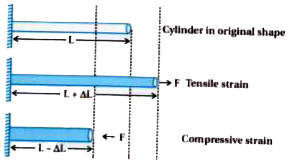
|
|
| 39. |
A ball of mass m= 1 kg falling vertically with a velocity v_(0) = 2 m/s strikes a wedge of mass M = 2 kg kept on a smooth, horizontal surface as shown in figure The coefficient of restitution between the ball and the wedge is e = (1)/(2). Find the velocity of the wedge and the ball immediately after collision. |
|
Answer» |
|
| 40. |
A particle move along the parabolic pathx=y^(2)+2y+2 in such a way that the y-component of velocity vector remain 5m//sduring the motion. The magnitude the acceleration of the particle is k(25)//sec.where 'k' is |
|
Answer» |
|
| 41. |
If the earth suddenly contracts to one third of its present radius, how much would the day be shortened ? |
| Answer» SOLUTION :21 HR, 20 MIN | |
| 42. |
It is well known that a raindrop falls under the influence of the downward gravitational force and the opposing resistive force. The latter is known to be proportional to the speed of the drop but is otherwise undetermined. Consider a drop of mass 1.00g falling from a height 1.00km. It hits the ground with a speed of 50.0 ms^(-1). What is the work done by the unknown resistive force? |
|
Answer» Solution :The change in kinetic energy of the drop is `triangleK= (1)/(2)mv^(2)-0` `=(1)/(2)xx10^(-3)xx50xx50 = 1.25 J` where we have assumed that the drop is INITIALLY at REST. Assuming that g is a constant with a value `10 m"/"s^(2)`, the work DONE by the gravitational force is, `W_(g)= mgh` `=10^(-3)xx10xx10^(3)= 10.0 J`. |
|
| 43. |
A stone is dropped freely while another thrown vertically downward with an initial velocity of 4 m/s from the same point simultaneously. The distance of separation between them will become 30 m aftera time of |
|
Answer» 8 sec |
|
| 44. |
(A) : Always |(dbarv)/(dt)|=(d)/(dt)|vecv|, where vecv hasits usual meaning (R ) : Acceleration is rate of change of velocity. |
|
Answer» Both (A) and (R ) are true and (R ) is the CORRECT explanation of (A) |
|
| 45. |
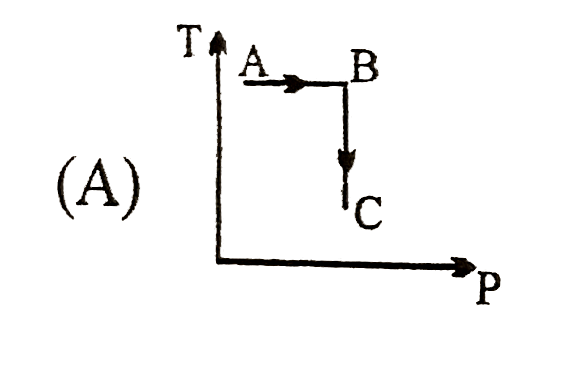
A process is shown in the diagram. Which of the following curves may represent the same process? |
|
Answer»
BC `rarr` isothermal |
|
| 46. |
You are on a frictionless horizontal plane. How can you get off if no horizontal force is exerted by pushing against the surface ? |
|
Answer» by jumping |
|
| 47. |
Column I represents workdone by forces and Column II represents change in kinetic energy DeltaK, change in potential energy DeltaU, change in mechanical energy DeltaE, then match the following |
|
Answer» |
|
| 48. |
The speed of a motor increses from 1200 rpm to 1800 rpm in 20S. How many revolutions does it make in this period of time ? |
|
Answer» 400 |
|
| 49. |
A satellite of moon revolves around it in a radius n times the radius of moon (assume radius of moon= R) Due to cosmic dust, it experience a resistance F = alphav^(2). Find how long will it stay in the orbit (mass of satellite is m, mass of moon is M) |
|
Answer» `(m)/(alphasqrt((GM)/(R)))SQRT(n)` |
|
| 50. |
A particle of mass m is executing osillations about the origin on the x -axis.Its P.E. is U(x)=K|x|^(3), where k is a positive constant. If the amplitude of oscillation is a then how does its time period T vary with amplitude. |
|
Answer» Solution :`U(x)=k|x|^(3)""F=(dU)/(dx)=3kx^(2)` At EXTREME POSITONS `x=+-a` `F=maomega^(2)=3KA^(2)` `OMEGA prop sqrt(a)"" :. Tprop 1/(sqrt(a))` Hence `T prop ("amplitude")^(-1//2)` |
|