

Saved Bookmarks
This section includes 7 InterviewSolutions, each offering curated multiple-choice questions to sharpen your Current Affairs knowledge and support exam preparation. Choose a topic below to get started.
| 1. |
Several spherical drops of a liquid of density 'd' and radius 'r' coalesec to form a single drop of radius 'R'. If all the energy released is converted into K.E. Then the velocity acquired by the drop is |
|
Answer» `sqrt((6T)/(d)((1)/(R)-(1)/(R)))` |
|
| 2. |
The escape velocity on a planet is v. If the radius of the planet contracts to (1/4)^(th) the present value without any change in its mass, then the escape velocity becomes |
|
Answer» v |
|
| 3. |
A uniform rod (mass m, length L) and a simple pendulum (light rod of length 'l' and bob of point mass m) are released under gravity with one end hinged about a horizontal axis as shown. They take time t_(1) and t_(2) respectively to become vertical for the first time. Neglect air resistance. |
|
Answer» `(t_(1))/(t_(2))=SQRT((2L)/(3L))` |
|
| 4. |
What is the principle of Rocket propulsion? |
|
Answer» |
|
| 5. |
A bomb moving in a parabolic path explodes into two fragments of equal masses. The acceleration of the centre of mass of the fragments when both are in air is equal to |
| Answer» Answer :C | |
| 6. |
For the wave described in the displacement (y) versus (t) graphs for x = 0, 2 and 4 cm. What are the shapes of these graphs ? In which aspects does the oscillatory motion in a travelling wave differ from one point to another : amplitude, frequency or phase ? |
|
Answer» Solution :`y(x, t) = 3 sin [36 t + 0.018 x + (pi)/(4)]` For x = 0 `y(0, t) = 3 sin [36 t + 0.018 xx 0 + (pi)/(4)]` `= 3 sin [36 t + (pi)/(4)]` `OMEGA = 36, (2pi)/(T) = 36` `T = (2pi)/(36) or T = (pi)/(18)` sec. For different values of t, the CALCULATED values of y are tabulated as `{:(t,0,T//8,2 T//8,3 T//8,4 T//8, 5 T//8, 6 T//8, 7 T//8,T),(y,(3)/(sqrt(2)),3,(3)/(sqrt(2)),0,(-3)/(sqrt(2)),-3,(-3)/(sqrt(2)),0,(3)/(sqrt(2))):}` 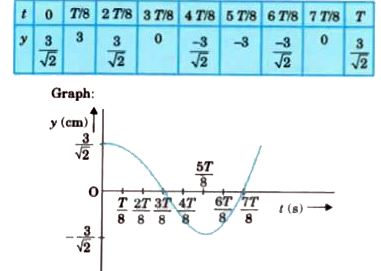 Similarly, we can get (y, t) GRAPHS for x = 2 cm and x = 4 cm. All the curves are SINUSOIDAL in nature. They have same amplitude, same frequency but different initial phase. |
|
| 7. |
The loudness and pitch of a sound note depends on ………… |
|
Answer» INTENSITY and FREQUENCY |
|
| 8. |
Can we apply the relations, beta=2alpha and gamma=3alpha for anisotropic solids? |
|
Answer» Solution :No, these relations are applicable for isotropic solids. For anisotropic solids. For anisotropic solids, `beta=alpha_(1)+alpha_(2) and gamma=alpha_(1)+alpha_(2)+alpha_(3)` where `alpha_(1), alpha_(2), alpha_(3)` are the COEFFICIENTS of linear expansion along THREE mutually perpendicular AXES. |
|
| 9. |
(A) : Cavendish weighed the sun. (R) : The measurement of 'G' by Cavendish experiment combined with knowledge of 'g' of 'R' enables on to estimates mass of earth. |
|
Answer» Both (A) and (R) are TRUE and (R) is the correct EXPLANATION of (A) |
|
| 10. |
The ratio of radii of two cylindrical rods of same material is 2 :1 and ratio of their lengths is 2:3 . Their ends are maintained at same temperature difference. If rate of flow of heat in the longer rod is 2 Cal s^(-1), then that in the shorter rod will be |
|
Answer» 4 Cal `s^(-1)` |
|
| 11. |
Choose the correct option AxxB=C (i)C is perpendicular to A (ii) C is perpendicular to B (iii) C is perpendicular to (A+B) (iv) C is perpendicular to (AxxB) |
|
Answer» Only (i) and (ii) are correct It is clear from the figure that `C` is PERPENDICULAR to `A` and `B`, and `C` is paraller to `AxxB` 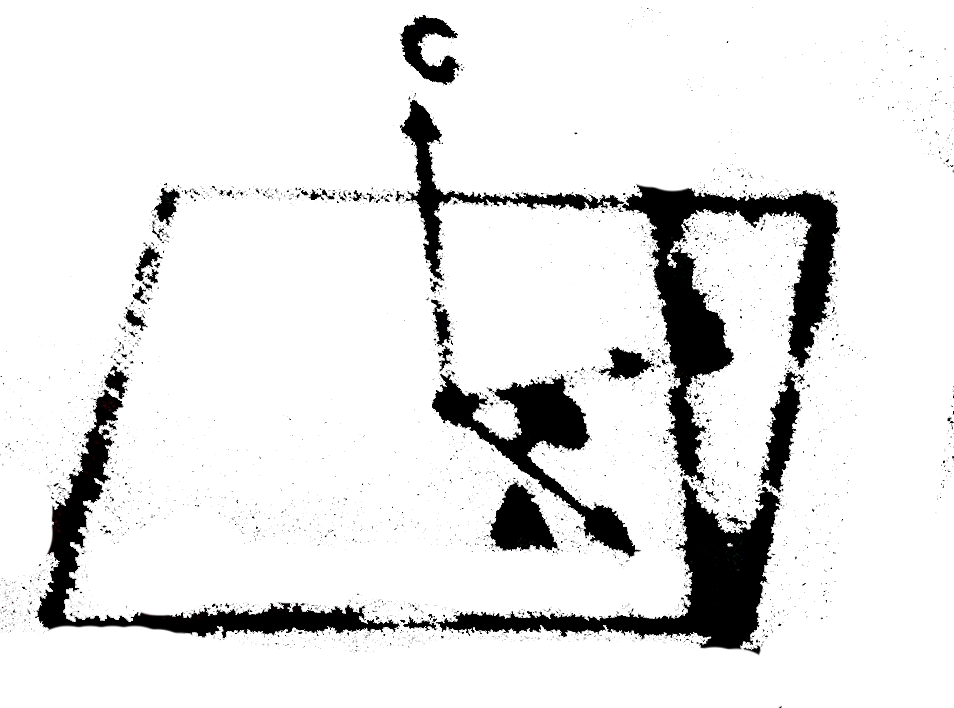
|
|
| 12. |
Deduce Avogadro's law based on kinetic theory. |
|
Answer» Solution :AVOGADRO's law: (i) This law states that at constant temperature and pressure, EQUAL volumes of all gases contain the same number of molecules. For two DIFFERENT gases at the same temperature and pressure, according to kinetic theory of gases, From equation `P=(1)/(3)(N_(1))/(V)m_(1)bar(v_(1)^(2))=(1)/(3)(N_(2))/(V)m_(2)bar(v_(2)^(2))""...(1)` where `bar(v_(1)^(2))` and `bar(v_(2)^(2))` are the mean square speed for two gases and `N_(1)andN_(2)` are the number of gas molecules in two different gases. (ii) At the same temperature, average kinetic energy per molecules is the same for two gases. `(1)/(2)m_(1)bar(v_(1)^(2))=(1)/(2)m_(1)bar(v_(2)^(2))""...(2)` Dividing equation (1) by (2) we get `N_(1)=N_(2)` (iii) This is Avogadro's law. It is sometimes referred to as Avogadro's hypothesis or Avogadro's Principle. |
|
| 13. |
Water rises to a height of 6cm in a capillary tube if T=7.2xx10^(-2)Nm^(-1) and g=10ms^(-2), the radius of the tube is |
|
Answer» `0.24mm` |
|
| 14. |
What is the basic aim of science ? |
|
Answer» Solution :The BASIC aim of SCIENCE is to SEARCH for truth. The science analyses the verious phenomena occurring in the universe and the laws governing them. |
|
| 15. |
When 1m, 1kg and 1min. Are taken as the fundamental units, the magnitude of force is 36 units. What will be the value of this force is CGS system? |
|
Answer» `10^3` DYNE |
|
| 16. |
The function sin^2Omegat represents |
|
Answer» aperiodic,but not SHM with a PERIOD `2pi/Omega` |
|
| 17. |
Derive velocities after the collision in terms of velocities before collision in elastic collision in one dimension case. |
Answer» Solution :Consider two elastic bodies of masses `m_(1)` and `m_(2)` moving in a straight line (along positive x direction) on a frictionless horizontal surface.  (i) In order to have collision, we assume that the mass `m_(1)` moves facter than mass `m_(2)`, i.e., `u_(1)gt u_(2)`. For elastic collision, the total linear momentum and kinetic energies of the two bodies before and after collision must remain the same. From the law of conservation of linear momentum, Total momentum before collision `(p_(i))` = Total momentum after collision `(p_(f))` Further, `m_(1)u_(1)+m_(2)u_(2)=m_(1)v_(1)+m_(2)v_(2) ""`....(1) or `m_(1)(u_(1)-v_(1))=m_(2)(v_(2)-u_(2)) ""`....(2) For elastic collision, Total kinetic energy before collision `KE_(i)` = Total kinetic energy after collision `KE_(f)`, `(1)/(2)m_(1)u_(1)^(2)+(1)/(2)m_(2)u_(2)^(2)=(1)/(2)m_(1)v_(1)^(2)+(1)/(2)m_(2)v_(2)^(2) ""`....(3) After simplifying and rearranging the terms, `m_(1)(u_(1)^(2)-v_(1)^(2))=m_(2)(v_(2)^(2)-u_(2)^(2))` Using the formula `a^(2)-b^(2)=(a+b)(a-b)`, we can rewrite the above equation as `m_(1)(u_(1)+v_(1))(u_(1)-v_(1))=m_(2)(v_(2)+u_(2))(v_(2)-u_(2))`....(4) Dividing equation (4) by (2) gives, `(m_(1)(u_(1)+v_(1))(u_(1)-v_(1)))/(m_(1)(u_(1)-v_(1)))=(m_(2)(v_(2)+u_(2))(v_(2)-u_(2)))/(m_(2)(v_(2)-u_(2)))` `u_(1)+v_(1)=v_(2)+u_(2)` Rearranging `u_(1)-u_(2)=v_(2)-v_(1) ""` ...(5) Equation (5) can be reqritten as `u_(1)-u_(2)=-(v_(1)-v_(2))` This means that for any elastic HEAD on collision, the relative speed of the two elastic bodies after the collision has the same magnitude as before collision but in opposite direction. Further note that this result is independent of mass. Reqriting the above equation for `v_(1)` and `v_(2)`, `v_(1)=v_(2)+u_(2)-u_(1) ""`.....(6) or `v_(2)=u_(1)+v_(1)-u_(2) ""`....(7) To find the final velocities `v_(1)` and `v_(2)` : Substituting equation (7) in (2) gives the velocity of `m_(1)` as `m_(1)(u_(1)-v_(1))=m_(2)(u_(1)+v_(1)-u_(2)-u_(2))` `m_(1)(u_(1)-v_(1))=m_(2)(u_(1)+v_(1)-2u_(2))` `m_(1)u_(1)-m_(1)v_(1)=m_(2)u_(1)+m_(2)v_(1)-2m_(2)u_(2)` `m_(1)u_(1)-m_(2)u_(1)+2m_(2)u_(2)=m_(1)v_(1)+m_(2)v_(1)` `(m_(1)-m_(2))u_(1)+2m_(2)u_(2)=(m_(1)+m_(2))v_(1)` or`v_(1)=((m_(1)-m_(2))/(m_(1)+m_(2)))u_(1)+((2m_(2))/(m_(1)+m_(2)))u_(2) ""`....(8) Similarly, by substituting equation (6) in (2) or substituting equation (8) in (7), we get the final velocity of `m_(2)` as `v_(2)=((2m_(1))/(m_(1)+m_(2)))u_(1)+((m_(2)-m_(1))/(m_(1)+m_(2)))u_(2) ""`....(9) Case 1 : When bodies has the same mass, i.e, `m_(1)=m_(2)`, equation (8) `rArr v_(1)=(0) u_(1)+((2m_(2))/(2m_(2)))u_(2)` `v_(1) = u_(2)""`...(10) equation (9)`rArr v_(2)=((2m_(1))/(2m_(1)))u_(1)+(0)u_(2)` `v_(2)=u_(1) ""`....(11) Equations (10) and (11) show that in one dimensional elastic collision, when two bodies of equal mass collide after the collision their velocities are exchanged. Case 2 : When bodies have the same mass, i.e., `m_(1)=m_(2)` and second body (usually called target) is at rest `(u_(2)=0)`, By substituting `m_(1)=m_(2)` and `u_(2)=0` in equations (8) and (9). we get, from equation (8) `rArr v_(1)=0 ""`....(12) from equation (9) `rArr v_(2)=u_(1) ""`...(13) Equations (12) and (13) show that when the first body comes to rest the second body moves with the initial velocity of the first body. Case 3 : The first body is very much lighter than the second body `(m_(1)lt lt m_(2), (m_(1))/(m_(2))lt lt 1)` then the ratio `(m_(1))/(m_(2))~~ 0`. and also if the target is at rest `(u_(2)=0)` Dividing numerator and denominator of equation (8) by `m_(2)`, we get `v_(1)=(((m_(1))/(m_(2))-1)/((m_(1))/(m_(2))+1))u_(1)+((2)/((m_(1))/(m_(2))+1))(0)` `v_(1)=((0-1)/(0+1))u_(1)` `v_(1)=-u_(1) ""`....(14) Dividing numerator and denominator of equation (9) by `m_(2)`, we get `v_(2)=((2(m_(1))/(m_(2)))/((m_(1))/(m_(2))+1))u_(1)+((1-(m_(1))/(m_(2)))/((m_(1))/(m_(2))+1))(0)` `v_(2)=(0)u_(1)+((1-(m_(1))/(m_(2)))/((m_(1))/(m_(2))+1))(0)` `v_(2)=0 ""`...(15) Equation (14) implies that the first body which is lighter returns back (rebounds) in the opposite direction with the same initial velocity as it has a negative sign. The equation (15) implies that the second body which is heavier in mass continues to remain at rest even after collision. For example, if a ballis thrown at a fixed wall, the ball will bounce back from the wall with the same velocity with which it was thrown but in opposite direction. Case 4 : The second body is very much lighter than the first body `(m_(2)lt lt m_(1),(m_(2))/(m_(2))lt lt 1)` then the ratio `(m_(2))/(m_(1))=0`. ans also if the target is at rest `(u_(2)=0)`. Dividing numerator and denominator of equation (8) by `m_(1)`, we get `v_(1)=((1-(m_(2))/(m_(1)))/(1+(m_(2))/(m_(1))))u_(1)+((2(m_(2))/(m_(1)))/(1+(m_(2))/(m_(1))))(0)` `v_(1)=((1-0)/(0+1))u_(1)+((0)/(1+0))(0)` `v_(1)=u_(1) ""`....(16) Similarly, Dividing numerator and denominator of equation (14) by `m_(1)`, we get `v_(1)=((2)/(1+(m_(2))/(m_(1))))u_(1)+(((m_(2))/(m_(1))-1)/(1+(m_(2))/(m_(1))))(0) v_(2)=((2)/(1+0))u_(1)` `v_(2) = 2 u_(1) ""` ....(17) The equation (16) implies that the first body which is heavier continues to move with the same initial velocity. The equation (17) suggests that the second body which is lighter will move with twice the initial velocity of the first body. It means that the lighter body is thrown away from the point of collision. |
|
| 18. |
A barometer tube 90 cm long contains some air above mercury. The reading is 74.5 cm when the true pressure is 76 cm and the temperature is 15^(0)C. If the reading is observed to be 75.8 cm on a day when the temperature is 5^(0)C, what is the true pressure ? |
|
Answer» <P> Solution :Initial volume of the air,`V_(1)` = (LENGTH of the barometer TUBE - reading ) A = (90 - 74.5) A `cm^(3) = (15.5) A cm^(3)` Initial pressure of the air, `P_(1)` = True pressure - reading = 76.0 - 74.5 = 1.5 cm Initial temperature, `T_(1) = 273 + 15 = 288 K`. Final volume , `V_(2) = (90.0 - 75.8)A = 14.2 A cm^(3)` Final temperature , `T_(2) = 273 + 5 = 278` K `(P_(1) V_(1))/(T_(1)) = (P_(2)V_(2))/(T_(2)) = (1.5 xx 15.5_(1))/(288) = (P_(2)xx 14.2)/(278)` `P_(2)= (1.5 xx 15.5 xx 278)/(14.2 xx 288) = 1.58`cm The pressure = Reading + pressure of the air = 75.8 + 1.58 = 77.38 cm |
|
| 19. |
A ball is projected vertically up from the ground surface with an initial velocity of u = 20 m//s. O is a fixed point on the line of motion of the ball at a height of H = 15 m from the ground. Plot a graph showing variation of distance (s) of the ball from the fixed point O, with time (t). [Take g = 10m//s2]. Plot the graph for the entire time of flight of the ball. |
|
Answer» |
|
| 20. |
The velocity v reached by a car of mass m at certain distance from the starting point driven with constant Power P is such that |
|
Answer» `v ALPHA (3p)/(m)` |
|
| 21. |
The fundamental frequency in a string increases in the ratio 1 : 4 on increasing the tension by 10 kg wt. Calculate the initial tension of the string. |
|
Answer» |
|
| 22. |
A capillary tube immersed in water is taken to moon, where the value of acceleration of gravity is g/6. What happens to the rise of the liquid (h) on the moon? |
| Answer» SOLUTION :Height BECOMES 6h, provided the capillary TUBE is that LONG. If it is not that long, it rises to the height of the capillary tube. | |
| 23. |
Two simple pendulums of length 5m and 10m respectively are given small linear displacement in one direction at the same time. They will be again in the same phase when the pendulum of shorter length has completed oscillations. |
|
Answer» 1 |
|
| 24. |
Given , epsilon-L(di)/(dt)=iR, find the value ofi at any time t in terms of constantepsilon, L and R. At t=0 , i=0 . |
|
Answer» Solution :We have , `epsilon-L (DI)/(dt)=iR` or `(epsilon -iR)=L (di)/(dt)` or `(di)/((epsilon-iR))=(dt)/(L) "" ` ...(i) Integrating both sides of the equation (i), we get `INT (di)/((epsilon-iR))= int (dt)/(L)` Here LIMIT of time varies from 0 to t and corresponding limits of i varies from 0 to i. ` :. "" int_(0)^(i)(di)/((epsilon-iR))=int _(0)^(t) (dt)/(L)` For integration of LHS, substitute ` epsilon-iR=z` Also `"" (d)/(di)(epsilon-iR)=(DZ)/(di)` or `(0-R)=(dz)/(di)` `:. "" di=(dz)/((-R))` and ` int _(0)^(t)(di)/((epsilon-iR)) = int _(0)^(i) (dzl(-R))/(z)` ` =((1)/(-R)) int_(0)^(i) (dz)/(z)` `=((1)/(-R))|ln z|_(0)^(i)` `=((1)/(-R))|ln (epsilon-iR)|_(0)^(i)` `=((1)/(-R)){ln(epsilon-iR)-ln(epsilon-0)}` `=((1)/(-R)) ln ((epsilon-iR))/(epsilon)" " ` ...(ii) and RHS` int_(0)^(t) (dt)/(L)=((1)/L))|t|_(0)^(t)=(1)/(L)(t-0)` `=(t)/(L)` From equation (i) and (ii) , we have `(-(1)/(R)) ln ((epsilon-iR)/(epsilon))=(t)/(L)` or ` " " ln((epsilon-iR)/(epsilon))=-(R)/(L)t` or ` ((epsilon-iR)/(epsilon))=e^(-(Rt)/(L))` or `" " i=(epsilon)/(R)(1-e^(-(tR)/(L)))` |
|
| 25. |
(A) : A bus moving dur north takes a turn and starts moving towards west with same speed. There will be no change in the veclocity of bus. ( R) : Velocity gradient is not a vector quantity. |
|
Answer» Both (A) and ( R) are ture and ( R) is the CORRECT explanation of (A) |
|
| 26. |
The graph show the behaviour of a length of wire in the region for which the substance obeys Hooke.s law. P and Q represent. |
|
Answer» P = applied FORCE, Q = extension |
|
| 27. |
A sphere of mass 50xx10^(-3) kg moving with a velocity of 2ms^(-1) hits another sphere which is at rest. Assuming the collision to be head - on collision and if they stick together after collision and move in the same direction with a velocity of 0.5 ms^(-1), find the mass of the second sphere. |
|
Answer» SOLUTION :`m_(1)=50xx10^(-3)kg, u_(1)=2 MS^(-1), u_(2)=0`, `v=0.5 ms^(-1), v=v_(1)=v_(2)=0.5 ms^(-1)`. `m_(1)u_(1)+m_(2)u_(2)=(m_(1)+m_(2))v` `(50xx10^(-3))(2)+m_(2)(0)=[(50xx10^(-3))+m_(2)]0.5` `m_(2)=(50xx10^(-3)xx2-50xx10^(-3)xx0.5)/(0.5)` `= ((100-25))/(0.5)xx10^(-3)=150xx10^(-3)kg` |
|
| 28. |
What is an elastic collision? |
| Answer» Solution :A collision in which LINEAR momentum and kinetic ENERGY of the INTERACTING SYSTEM are CONSERVED, is known as an elastic collision. | |
| 29. |
A film of water is formed between two straight parallel wires of length 10cm each separated by 0.5 cm. If their separation is increased by 1 mm while still maintaining their parallelism how much work will have to be done of water. Surface tension of water = 72 xx10^(-2)Nm^(-1) |
|
Answer» `7.22 xx 10^(-6) J` |
|
| 30. |
The ratio of the dimension of Planck's constant and that of the moment of inertia is the dimension of : |
|
Answer» Velocity |
|
| 31. |
Lens maker formula is applicable to |
|
Answer» THIN lenses are paraxial RAYS which subtend very small ANGLES with the principal axis. |
|
| 32. |
Velocity of the body on reaching the ground is same in magnitude in the following cases (a) a body projected vertically from the top of tower of height .h. with velocity .u. (b) a body thrown down wards with velocity .u. from the top of tower of height .h. ( c) a body projected horizontally with a velocity .u. from the top tower height .h. (d) a body dropped from the top tower of height .h. |
|
Answer» a, d, C and d are CORRECT |
|
| 33. |
Two rods of the same area of cross-section, but of length l_(1) and l_(2) and conductivites K_(1) and K_(2) are joined in series. Show that the combination is equivalent of a material of conductivity K = (l_(1)+l_(2))/((l_(1)/(K_(2)))+((l_(2))/(K_(2)))) |
|
Answer» `(##RES_HAT_PHY_XI_C03_E01_006_A01##)` `:. (theta_(1) -theta) +(theta -theta_(1)) = (theta_(1)- theta_(2))` i.e `(Q)/(t) (l_(1))/(K_(1)A) +(Q)/(t).(l_(2))/(K_(2)A) = (Q)/(t) ((l_(1)+l_(2)))/(K_(2)A)` `rArr (l_(1))/(K_(1)) +(l_(2))/(K_(2)) = (l_(1)+l_(2))/(K_(eq)) :. K_(eq)= (l_(1)+l_(2))/((l_(1)/(K_(1))+l_(2)/(K_(2))))` |
|
| 34. |
Can Bernoulli's equations be used to describe the flow of water through a rapid in a river? Explain. |
| Answer» SOLUTION :No, Bernoulli.s PRINCIPLE APPLIES to STREAMLINE FLOW only. | |
| 35. |
When the wheels of a car are bogged down in mud, why cannot the car move forward? |
| Answer» SOLUTION :The car engine rotates the wheels, and DUE to friction between the road and the wheels the car moves forward. When the friction cannot provide a sufficient reaction FORCE, the engine cannot make the car MOVE forward by rotating the wheels, they continue to rotate in thesame place WITHOUT any translation. | |
| 36. |
In the question number 82, the maximum permissible speed to avoid slipping is |
|
Answer» `18.6"MS"^(-1)` `=38.6ms ^(-1)` |
|
| 37. |
The potential energy of a diatomic molecule is given as U = (a)/(x^(12)) - (b)/(x^(6)). Find the (i) stable equilibrium distance of separation between two atoms, (ii) force on each atom as the function of separating distance x. |
|
Answer» SOLUTION :(i) LET us assume that the stable equilibrium separation between the atoms is `x_(0)`, where the potential energy U is miniumum. To find `x_(0)`, we take the derivative of U and equate it to zero , That MEANS `(dU)/(dx) = 0` where `U = (a)/(x^(12)) - (B)/(x^(6))` Then, we have `- (12 a)/(x_(0)^(13)) + (6b)/(x_(0)^(7)) = 0` This gives `x_(0) = ((2a)/(b))^(1//6)` (ii) The force between the atoms at any value of x is `F = - (dU)/(dx) = - (d)/(dx) ((a)/(x^(12))-(b)/(x^(6))) = (12A)/(x^(13)) - (6b)/(x^(7))`. 
|
|
| 38. |
Two wires are made of the same material and have the same volume. The first wire has cross sectional area A and the second wire has cross sectional area 3A. If the length of the first wire is increased by Deltal on applying a force F, how much force needed to stretch the second wire by the same amount ? |
|
Answer» F `THEREFORE y=(FV)/(A^2Deltal)` `therefore F=(yA^2 Al)/V`, y , `Deltal` and V CONSTANT `therefore F prop A^2` `therefore F_2/F_1=(A_2/A_1)^2 = ((3A)/A)^2=9` `therefore F_2=9F "" [ because F_1=F]` |
|
| 39. |
What are the energies possessed by a liquid ? Write down their equations. |
|
Answer» Solution :A liquid in motion possesses FOLLOWING three types of energy . (i) Kinetic energy : It is the energy possessed by a liquid by virtue of its motion. K.E. = `1/2 m v^2` K.E. per unit MASS = `(1/2 mv^2)/(m) = (v^2)/2` (ii) Potential energy : It is the energy possessed by a liquid by virtue of its HEIGHT above the GROUND level. P.E. = mgh P.E. per unit mass `= (mgh)/(m) = GH` (iii) Pressure energy = It is the energy possessed by a liquid by virtue of its pressure. Pressure energy per unit mass `= P/(m//v)` |
|
| 40. |
A uniforum elastic plank moves over a smooth horizontal plane due to a constant force F distributed uniformuly over the end face. The surface of the end face is equal to S, and youngs modulus of the material is Y. Find the compressive strain of the plank in the direction of the acting force |
|
Answer» |
|
| 41. |
The mean radius of earth is R, its angular speed on its own axis is omega and the acceleration due to gravity at earth's surface is g. What will be the radius of the orbit of a geostationary satellite ? |
|
Answer» `(R^(2)G//OMEGA^(2))^(1//3)` |
|
| 42. |
A uniform wire of length L is bent in the form of a circle. The shift in its centre of mass is |
|
Answer» `(L)/(PI)` |
|
| 43. |
During the collision a relatively large force acts on each colliding particle for a relatively -- - time |
|
Answer» SHORT |
|
| 44. |
What ar the two types of projectile motion ? |
|
Answer» Solution :(i)PROJECTILE given an INITIAL velocity in the HORIZONTAL DIRECTION (horizontal projection). Projectile given an initial velocity at an angle to the horizontal (angular projection). |
|
| 45. |
A simple pendulum of length 0.2m has bob of mass 5gm, it is pulled aside through an angle 60° from the vertical. A spherical body of mass 2.5 gm is placed at the lowest position of the bob. When the bob is released it strikes the spherical body and comes to rest. What is the velocity of the spherical body ? (g = 9.8 ms^(-2) (in m/s) |
|
Answer» 1.4 |
|
| 46. |
If C and R represent capacitance and resistance respectively, then write dimensional formula of RC |
|
Answer» `M^(0)L^(0)T^(-1)` `("ohm" xx "AMPERE"xx "SECOND")/("ampere" xx "ohm")`= second `:. [RC]=M^(0)L^(0)T^(1) [ :.` coulomb= ampere `xx` second] |
|
| 47. |
A bullet of mass 10 gm moving with a horizontal velocity 100 m/s passes through a wooden block of mass 100 gm. The block is resting on a smooth horizontal floor. After passing through the block the velocity of the bullet is 10m/s the velocity of the emerging bullet with respect to the block is |
|
Answer» 10 m/s |
|
| 48. |
A telescope objective of focal length 1m forms a real image of the moon 0.92cm in diameter. Calculate the diameter of the moon taking its mean distance for the earth to be 38 times 10^4 km . IF the telescope uses an eyepiece of 5cm focal length. What would be the distance between the two lenses for (i) the final image to be formed at infinity (ii) the final image (virtual) at 25 cm from the eye. |
|
Answer» SOLUTION :`f_0=1m` object distance from the objective = distance of the moon from the earth `=3.8 times 10^5 km =3.8 times 10^8m`, image distance from the objective =FOCAL length of the objective =1 m, image size= image diameter=`0.92 times 10^-2m` object size= object diameter i.e., diameter of the moon=? We know that, `(Object diameter)/(Imag e diameter)= (Object distance)/(Imag e distance)` `(Diameter for moon)/(Im ag e diameter)= (3.8 times 10^8)/1` `therefore` Diameter of the moon =`3.8 times 10^8 times ` Image diameter `=3.8 times 10^8 times 0.92 times 10^-2 m=3.496 times 10^6m=3496km` (i) For NORMAL adjustment, the distance between the two lenses `f_0+f_a=100+5=105cm` (ii) FOr the final image at 25CM from the eye, the distance between the two lenses `=f_0+((Df_e)/(D+f_e))=100+ ((25 times 5)/(25+5))=104.2cm` |
|
| 49. |
Two bodies of masses 4 kg and 6 kg connected by means of a light string are lying on a smooth horizontal surface. A horizontal pulling force is applied on the lighter body. Two seconds later the string connecting the two masses is cut. After two more seconds if the velocity of the heavier mass is 2 ms^(-1), the force initially applied is |
|
Answer» 10N |
|
| 50. |
Two SHM 's are represented by the relations x=4 sin (80t+pi //2) and y=2 cos (60+pi//2). The ratio of their time periods is |
|
Answer» `2:1` |
|