

Saved Bookmarks
This section includes 7 InterviewSolutions, each offering curated multiple-choice questions to sharpen your Current Affairs knowledge and support exam preparation. Choose a topic below to get started.
| 1. |
Explain why an air bubble in water rises from bottom to top and grows in size? |
| Answer» Solution :We know that fluid moves from higher PRESSURE to LOWER pressure and in a fluid, pressure increases with depth, so, pressure at the top (`=P_(0)`) is less than that at the bottom `(=P_(0)+hthog)`. And so, the air bubble moves from bottom to top. It cannot move sideways as the pressure at the same level in a fluid is same. Furthermore in COMING from bottom to top, pressure of air inside the bubble also decreases. Then in ACCORDANCE with Boyle.s law volume of the bubble increases.`(ppro(1)/(V))` | |
| 2. |
the motion of planet insolar system is an example of |
|
Answer» CONSERVATION of energy |
|
| 3. |
A large tank is filled with water up to a height h. Water emerges through a hole near the bottom of the tank. Find the ratio of the time intervals in which water falls down from height h to h/2 and from h/2 to zero. |
| Answer» SOLUTION :`1:(sqrt-1)` | |
| 4. |
The moment of inertia of a uniform semi circular disc of mass M and radius .r. about a line perpendicular to the plane of disc through the centre is: |
|
Answer» `MR^(2)` |
|
| 5. |
The differential equation representing the SHM of a particle is (9 d^2 y)/(dt^2)+ 4y = 0. The time period of the particle is given by |
|
Answer» `PI/3 `SEC |
|
| 7. |
The formula for value of horizontal velocity of water coming from hole at the bottom at a height h from the surface of water is …… |
|
Answer» |
|
| 8. |
A nail is located at a certain distance vertically below the point ofsuspension of a simple pendulum . The pendulum bob is released from a position where the string makes an angle of 60^@ with the vertical. When the thread of the pendulum gets obstructed by the nail, if the bob can perform a complete rotation with the nailas centre ,find out the distance of thenail from the point of suspension. |
|
Answer» |
|
| 9. |
Relationship between P, V and E for a gas is |
|
Answer» `P=3/2 EV` |
|
| 10. |
Define frequency of wave motion. |
| Answer» Solution :The NUMBER of waves crossing a point or a PLANE in one second is KNOWN as the frequency of WAVE motion. | |
| 11. |
The gravitational field at some point in space is vecg= 3hati+4hatj N"/"kg. The force exerted on a 2kg mass placed at that point is |
|
Answer» `5N, 53^(@)` with x-axis |
|
| 12. |
The first law of thermodynamics incorporates the concepts of a) Conservation of energy b) Conservation of heat c) Conservation of work d) Equivalence of heat and work |
|
Answer» only a, d are correct |
|
| 13. |
The SI unit of g/G is ....... |
|
Answer» `kg//m^2` `G = (GM)/R^2` `:. g/G = M/R^2 = (kg)/m^2` |
|
| 14. |
A block of mass 4 kg is kept over a rough horizontal surface. The coefficient of friction between the block and the surface is 0.1. At t = 0, 3 hatim/s velocity is imparted to the block and simultaneously 2(-hati) Nforce starts acting on it. The displacement in first 5s is n xx hati where n is |
|
Answer» |
|
| 15. |
A ballof mass 100 g was thrownvertically upwards with a velocity of 49 m*s^(-1). At the same time another identical ball was dropped, to fall along the same path from a height of 98 m. After some time, the two balls collided and got stuck together. This combined mass then fell to the ground. How long was the combined mass in motion? |
|
Answer» Solution :Suppose the balls COLLIDE at a height h above theground in time `t_1` .Analysing theupward motion of the1st ball , we get, `h=49 t_1-9.8 t_1^2//2` …….(1) Analysing the downward motion of the 2ND ball , we get, `98-h=9.8 t_1^2//2` .......(2) Fromequations (1) and (2) , `98=49 t_1 or, t_1=2s` At the time of collision let the velocityof the 1st ball be`v_1` and that of the 2nd ball be `v_2`. `therefore v_1=49-9.8xx2=29.4m*s^(-1)` (upward) `and v_2 =9.8xx2=19.6 m*s^(-1)` (downward) After collision, let THEVELOCITY of thecombined mass be V. Then ACCORDING tothe law ofconservation of momentum, `0.1xx29.4-0.1xx19.6=2xx0.1xxV` [indicating downward motion with a negative sign] or, `V=4.9m*s^(-1)` (upward) From equation (1) ,we get, `h=49xx2-9.8xx(2)^2//2=78.4m` If the COMBINED mass was inmotion for a time t, then from the relation `h=ut +1/2"gt"^2` we get, `-78.4=4.9 t-1/2xx9.8t^2, or, t^2-t-16=0` `therefore t=1/2(1 pm sqrt(1+4xx1xx16))` As t cannot be negative , we have ,t =4.53 s |
|
| 16. |
A body is projected up with a velocity up with avelocity equal to 3/4 of the escape velocity from the surface of the earth . The height it reaches is ( Radius of the earth = R ) |
|
Answer» `(10R)/9` |
|
| 17. |
Figure shows tow blocks A and B, each having a mass of 320 g connected by a light string passing over a smooth light puley. The horizontal surface on which the block A can slide is smooth. The blcok A is attached to a spring of lconstant 40 N/m whose other end is fixed to a support 40 cm the horizontal surface. Initially, the sprng is vertical and unstretched when the system is released to move. Find the velocity of theh block A at teh instnt it breaks of the surface below it. Take g=10 m/s^2. |
|
Answer» `h=40cm=0.4m,g=10m/sec^2` From the free body diagram, `kxcostheta=mg` (when the BLOCK breaks of R=0)` `RARR costheta=(mg)/(kx)` `rarr 0.4/(0.4+x=3.2/(40x)` `rarr 16x=3.2x+1.28` `rarr x=0.1m` So, `s=AB=SQRT((h+x^2)-h^2)` `=sqrt((0.5)^2-(0.4)^2)`=0.3m` Let the velocity of tebody at B be v change in K.E. work done (for the system) `(1/2mu^2+1/2mv^2)=-1/2kx^2+mgs` `rarr (0.32)xxv^2` `=-(1/2)xx40xx(1.0)^2+(0.2)xx10xx(0.3)` `rarr v=1.5m/sec` `From the ure `/_\l=h(sectheta-1)`........i From the energy conservation `mgs=2[1/2mv^2]+1/2K/_\l^2` ` mgh than theta =mv^2+1/2kh^2(sectheta-1)^2`.....ii From the law of motion at break of `mgkh(sectheta-1)costheta` `rarr 1-costheta=mg/KH` `rarr costheta=1-mg/kh` `or costheta=(kh-mg)/kh` or `costheta=(kh-mg)/kh` `=(40xx0.4-0.32xx10)/(40xx0.4)` `=0.8` PUTTING the value of `theta` in equation i, `0.32xx10xx0.4xx0.75` `=0.32v^2+1/240xx(0.4)^2(1.25-1)^2` `rarr 0.96=0.32v^2+0.2` `rarr `0.32v^2=0.72` `rarr v=1.5m/sec |
|
| 18. |
Calculate the work done in blowing a soap bubble of radius 2 cm. Surface tension of soap solution =7xx10^(-2)Nm^(-1) |
|
Answer» Solution :`r=2cm=2XX10^(-2)m` Surface tension `S=7xx10^(-2Nm^(-1)` Work done = surface area of SOAP bubble x surface tension `=8pir^(2)S` `=8xx22/7xx(2xx10^(-2))^(2)xx7xx10^(-2)=7.04xx10^(-4)J` |
|
| 19. |
If object distance u = (50.1 +-10.2) cm and image distance v = (20.1 +-0.2) cm, then find value of focal length with error. |
|
Answer» Solution :Focal length of SPHERICAL MIRROR, `(1)/(F)=(1)/(u)+(1)/(v)` `:.f=(uv)/(u+v)` `=((50.1(20.1))/(50.1+20.1))` `=(1007.01)/(70.2)` `=14.334` `14.3 CM` Relative ERROR, `(Deltaf)/(f)=(Deltau)/(u)+(Deltau)/(v)+(Delta(u+v))/(u+v)` `=(Deltau)/(u)+(Deltau)/(v)+(Deltau+Deltav)/(u+v)` `(Deltaf)/(14.3)=(0.2)/(50.1)+(0.2)/(20.1)+(0.2+0.2)/(50.1+20.1)` `=0.004+0.012+0.006` `=0.02` `:. Deltaf=0.02xx14.3` `=0.286` `=0.3` `:.`Focal length `f+-Deltaf=(14.3+-0.3) cm` |
|
| 20. |
Explain Kinetic friction. Write laws of kinetic friction. Define coefficient of kinetic friction. |
Answer» SOLUTION :Whenmagnitudeof FORCEACTINGON objectlyingon surfaceexceedsmaximumstaticfrictiontheobjectwillstartmovingin directionof externalforce. Hence valueof frictionforcewillreducelessthanmaximumstaticfrictional force. Frictionalforcewhichopposes relative motionbetweensurfaces incontactis calledkineticfrictionit isdenotedby `f_(x)` LAWSOF kineticfriction (i)Kineticfrictiondo notdependon area ofcontactbetweensurface (2)kineticfrictionforcedo notdependon relativevelocityof objectin motion kineticfrictionforceis PROPORTIONALTO normalforce `mu_(k)=`coefficientofkineticfriction`mu_(k) =(f_(k))/(N )` ifextermalforceappliedis reducedto zerothenaccelerationof objectwill bebe `-(f_(ik))/( m)`Henceitwillstopaftercoveringsome distance |
|
| 21. |
(A): No work is done by the centripetal force acting on a body moving along the circumference of a circle. (R ): At any instant, the motion of the body is along the tangent to the circle where as the centripetal force is along the radius vector towards the centre of the circle. |
|
Answer» Both 'A' and 'R' are TRUE and 'R' is the CORRECT explanation of 'A's |
|
| 22. |
Y_(g) and Y_(r) denotes the Young's modulus of glass and rubber respectively. Glass is more elastic than rubber hence .......... |
|
Answer» `Y_(g) =Y_(R)` `THEREFORE Y=K` `therefore K _(g) gt K _(r) IMPLIES Y_(g) gt Y_(r)` |
|
| 23. |
Two concentric spherical shells have masses M_1 nd M_2and radii R_1,R_2(R_(1) lt R_2)The force exerted by this system on a particle of mass m . If it is placed at a distance ((R_1+R_2)/2)from the centre . |
|
Answer» SOLUTION :The gravitational FORCE on .m. DUE to the SHELL of `M_2` is ZERO. The gravitational force on .m. due `(GM_1m)/(((R_1+R_2)/2))=(4GM_1m)/((R_1+R_2)^2)` 
|
|
| 24. |
Heat given to a system is 35 joules and work done by the system is 15 joules. The change in the internal energy of the system will be |
| Answer» Answer :B | |
| 25. |
Dimensions of 1/(mu_0 in_0) , where symbols have their usual meaning are |
|
Answer» `L^(-1) T` |
|
| 26. |
Find the number of revolutions made by a satellite close to the surface of the earth in one day. |
| Answer» SOLUTION :17 REVOLUTIONS | |
| 27. |
Assuming the surface tension of rain water to be 72 "dyne"//"cm", find the differnce of pressure inside and outside a rain drop of diameter 0.02 cm. What would this pressure difference amount to , if the drop were to be decreased by evaporation to a diameter of 0.0002 cm ? |
Answer» 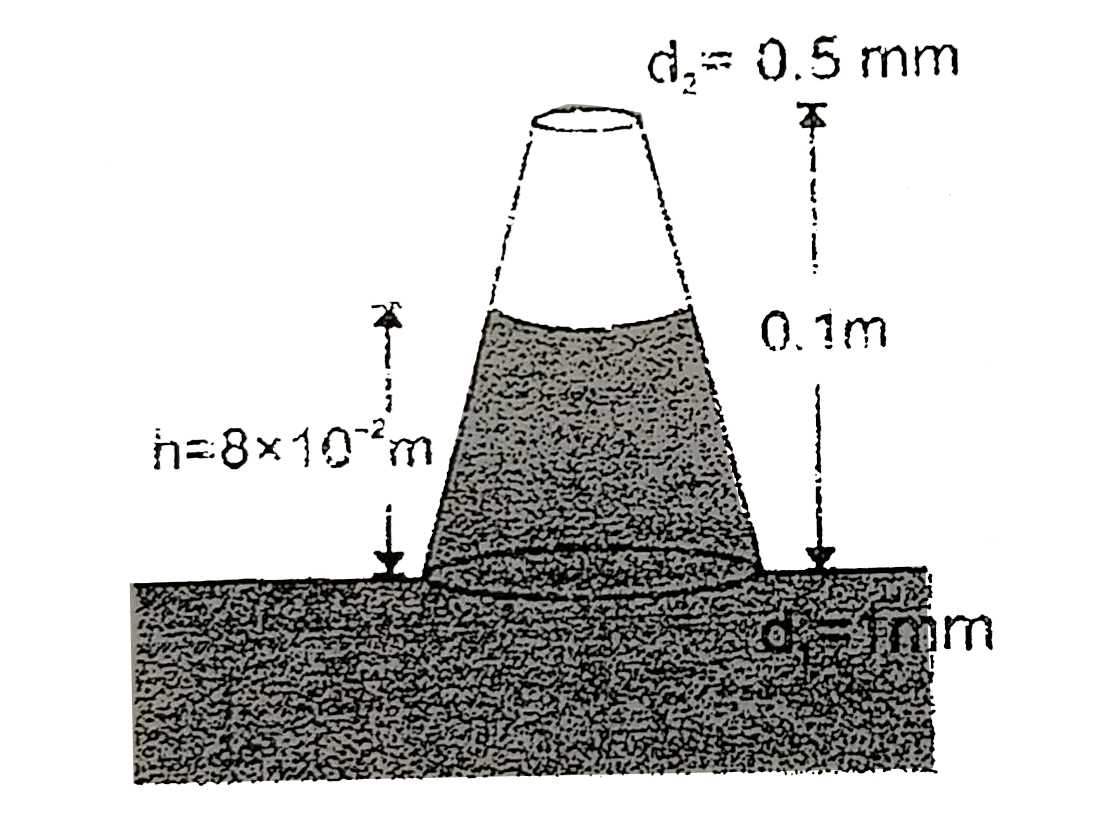 `r_(h) = r_(1)- ((r_(1) - r_(2))/(l))L`, `f_(h) = 0.5 XX 10^(-3) - ((0.5 xx 0.25))/(0.1) xx 10^(-3) xx 8 xx 10^(-2)` `= 0.3 xx 10^(-3) m, (2T_(0))/(r_(h)) = rhogh rArr T_(0) = ((1)/(14) xx 10^(4) xx 9.8 xx 8 xx 10^(-2) xx 0.3 xx 10^(-3))/(2)` `T_(0) = 0.084 N//m` , For Tube `'B'` For Temp `0^(@)C (2T_(0))/(r) = rhogh_(1) rArr r = (2T_(0))/(rhogh_(1))(2xx1xx0.084)/((1)/(14) xx 10^(4) xx 9.8 xx 6 xx 10^(-2))` `r = 0.40 xx 10^(-3)m rArr` For temp `50^(@)C (2T_(50))/(r) = rhogh` `T_(50) = (rhoghr)/(2) = ((1)/(14) xx 10^(4) 9.8 xx 5.5 xx 10^(-2) xx 0.4 xx 10^(-3))/(2)` `T_(50) = 0.077 N//m^(2) = (T_(50) - T_(0))/(50 - 0) = (0.077 - 0.084)/(50) = -1.4 xx 10^(-4) N//m^(@)C` Ans. - `1.4 xx 10^(-4) N//(m - .^(0)C)` |
|
| 28. |
Water is filled in a rectangular tank of size 3mxx2mxx1m. a. Find the total force exerted by the water on the bottom surface of the tank. b. cosider a vertical side of area 2mxx1m. Take a horizontal strip of wide deltax metre in this side, situated at a depth of x metre from the surface of water. Find the torque of the force calculate in part b. about the bottom edge of this side. e. Find the total torque by the water on the side about the bottom edge. neglect the atmospheric pressure and take =10ms^-2. |
|
Answer» `p=10^3kg/m^3,g=10ms^2` a. `f=Ahrhog` `=(3xx2xx1)x10^3xx10` `=6xx10^4=60000N` b. The force exerted by water on the strip of width `DELTAX` as shown `df=pxxA=(xrhog)xxA` `=(X)xx10^3x10xx2xdeltax` `=20000xxdeltaxN` `c. INSIDE the liquid force act in every DIRECTION due to adhesion `dt=Fxxr` `=20000xxdeltax(1-x)N` d. The total force by the water on that side is given by `F=int_0^120000 xdeltax` `rarr F=20000[x^2/2]_0^1` `=10000N` 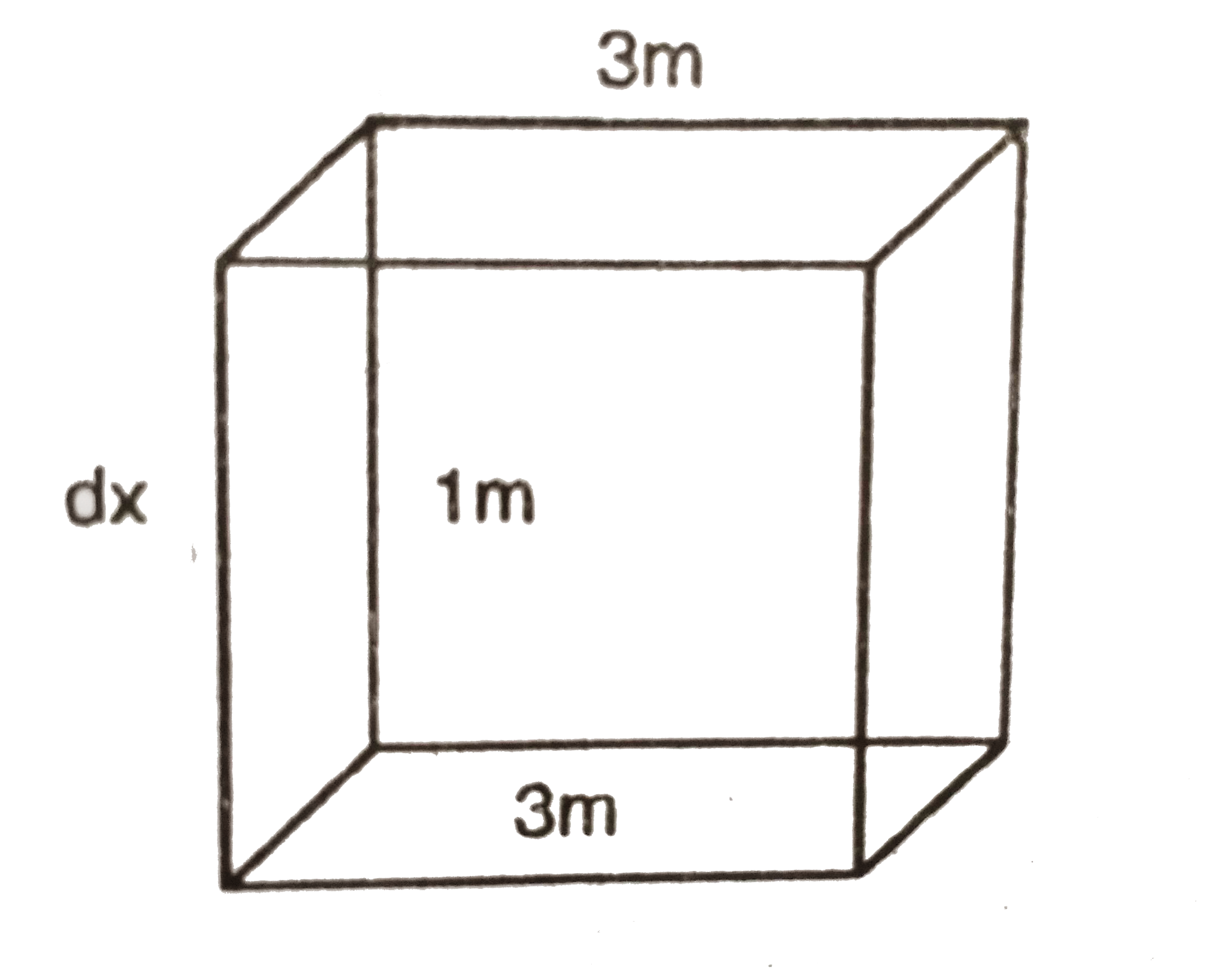 e. the torque by the water on that side will be `=tau=20000xxint_0^Ix deltax(1-x0` `=20000[x^2/2-x^3/3]_0^1` `=20000xx[1/2-1/3]` `=20000/6mN=10000/3mN` |
|
| 29. |
In thermodynamic process which of the following statements is not true ? |
|
Answer» In an isochoric PROCESS pressure remains constant. |
|
| 30. |
If the ratio of the specific heats of steam is 1.33 = and R = 8312J/kmole K find the molar heatcapacities of steam at constant pressure and constant volume. |
|
Answer» 33.5 KJ/kmole, 25.19 kJ /KG K MOLE |
|
| 31. |
A satellite close to the earth is in orbit above the equator with a period of rotation of 1.5 hours. If it is above a point P on the equator at some time, it will be above P again after time (a) 1.5 hours (b) 1.6 hours if is rotating from west to east (c) 24/17 hours if it is rotating from west to east (d) 24/17 hours if it is rotating from east to west |
|
Answer» a only |
|
| 32. |
What is the distance between consecutive compression and rarefaction in longitudinal waves ? |
| Answer» SOLUTION :`(LAMDA)/(2) ` where `lamda =` WAVELENGTH of given LONGITUDINAL waves. | |
| 33. |
Which of the following condition is sufficient for the simple harmonic motion? Where 'a -accelerationy-displacement |
|
Answer» `a=omegay` |
|
| 34. |
A 3 cm cube of iron has one face at 100^(0)C and the other in a block of ice at 0^(0)C. If k of iron = 0.2 CGS units and L for ice is 80 cal/gm, then the amount of ice that melts in 10 minutes is assume steady state heat transfer) |
| Answer» Answer :A | |
| 35. |
Angular momentum of the particle rotating with a central force is constant due to |
|
Answer» CONSTANT force |
|
| 36. |
A steel rod is 4 cm in diameter at 30°C. A brass ring has an interior diameter of 3.992 cm at 30° C. In order that the ring just slides on to the steel rod, the common temperature of the two rods should be ( alpha_(s) = 11 xx 10^(-6) //1^(@) C, alpha_(b) = 19 xx 10^(-6) // 1^(@) C) |
|
Answer» 200°C |
|
| 37. |
When a monochromatic point source of light is at a distance of 0.2 m from a photoelectric cell, the cut-offf voltage and the saturation current are respectively 0.4 V and 12 mA. If the same source is placed 0.4 m away from the photoelectric cell, then |
|
Answer» the STOPPING POTENTIAL will be 0.2 V |
|
| 38. |
If work done in increasing the size of soap film from 10 "cm " xx 6 "cmto " 10"cm " xx 11 "cm is" 2 xx 10^(-4) J, then the surface tension is |
|
Answer» `2 XX 10^(-2) "NM"^(-1)` |
|
| 39. |
If a gas is heated at constant pressure, then what percentage of total heat supplied is used up of external work ? (r=4/3) |
|
Answer» `25%` Gas is heated at constant pressure, `PDeltaV=nRDeltaT` `THEREFORE DeltaW=nRDeltaT` ….(1) heat given to the gas, `DeltaQ=eta C_P DeltaT` …(2) `therefore` By TAKING ratio of equ. (1) and (2), `(DeltaW)/(DeltaQ)=(nRDeltaT)/(nC_P DeltaT)=R/C_P` `=(C_P-C_V)/C_P [because R=C_P=C_V]` `=C_P/C_V-C_V/C_P` `=1-1/gamma` `=1-3/4` `=1/4` =25% |
|
| 40. |
The critical angular velocity w of a cylinder inside another cylinder containing a liquid at which its turbulence occurs depends on viscosity eta, density d and the distance x between the walls of the cylinders. Then w is proportional to |
|
Answer» `(ETA )/( X^(2) d)` |
|
| 41. |
Which of the following equations represents a simple harmonic wave ? |
|
Answer» `sinsquaret-cossquaret` |
|
| 42. |
Two heavy spheres each of mass 100 kg and radius 0.10 m are placed 1.0 m apart on a horizontal table. What is the gravitational field and potential at the mid point of the line joining the centres of the spheres? Is an object placed at that point in equilibrium ? If so, is the equilibrium stable or unstable ? |
|
Answer» Solution :Gravitational field at the mid-point of the line joining the centres of the two spheres ` = (GM)/((R//2)^2) (-hat r) + (GM)/((r//2)^2) hatr = 0` Gravitationalpotential at the mid point of the line joining the centres of the two spheres is ` V = (-GM)/(r//2) + ((-GM)/(r//2)) = (-4GM)/(r ) = (-4 xx 6.67 xx 10^(-11) xx 100)/(1.0) = -2.7 xx 10^(-8) J//kg ` As the EFFECTIVE force on the BODY placed at mid-point is ZERO, the body is in equilibrium. If the body is displaced a little towards either mass body from its equilibrium position, it will not return to its initial position of equilibrium. Hence, the body is in unstable equilibrium. |
|
| 43. |
A moving block having mass m, collides with another stationary block having mass 4 m. The lighter block comes to rest after collision. When the initial velocity of the lighter block is v, then the value of coefficient of restitution (e) will be |
|
Answer» 0.5 Intial VELCOITY of block of mass 4 m = 0 Final velocity of block of mass m = 0 . According to law of conservation of linear MOMENTUM, `MV = 4 m xx 0 = 4mv. + 0 " or " , v. = v/4` Coefficient of restitution, `e = ("Relative velocity of separation")/("Relative velocity of APPROACH") = (v//4)/v = 0.25`. |
|
| 44. |
Water is flowing through a horizontal tube having non-uniform area of cross section. If pressure difference between two points along a horizontal tube is 1.5 cm of mercury and speed of flow of water at a point of smaller cross section is 3 ms^(-1), then find the speed of water flow at the other point of larger cross section. Take g= "10 m/s"^(2). |
|
Answer» |
|
| 45. |
The spring of the watch when wound possesses………………..energy. |
|
Answer» kinetic |
|
| 46. |
Hailstones fall from a certain height. If only 1% of the hailstones melt on reaching the ground, find the height from which they fall (g = 10ms^(-2), L = 80 cal//g and 1 cal = 4.21) |
|
Answer» |
|
| 47. |
A uniform pressure p is applied on each face of a solid cube. What will be the rise in temperature of the cube so that it regains its original volume? (Given, bulk modulus = B and coefficient of volume expansion =gamma for the material of the cube.) |
|
Answer» <P>`p/((B-p)r)` |
|
| 48. |
A sphere of mass 2kg moving with a velocity collides elastically with another sphere which is at rest. If after the collision the first sphere moves in the same direction with its velocity reduced to one third of its initial velocity, find the mass of the second sphere |
|
Answer» Solution :Here `m_(1)= 2kg, u_(1)= u_(1), u_(2)= 0, v_(1)= (1)/(3) u_(1)` In ELASTIC COLLISIONS `v_(1) = ((m_(1)-m_(2))/(m_(1)+m_(2)))u_(1) + ((2m_(2))/(m_(1)+m_(2)))u_(2)` `=((2-m_(2))/(2+m_(2)))u_(1) + ((2m_(2))/(2+ m_(2))) xx 0` But `v_(1) = (1)/(3) u_(1) therefore (1)/(3) u_(1) = ((2-m_(2))u_(1))/(2+ m_(2))` `2 + m_(2) =6 -3m_(2), 4m_(2)=4 or m_(2)=1KG` |
|
| 49. |
Assuming Earth , an uniform sphere of mass M and radius R. At a point P inside Earth at a distance r measured from centre of Earth (r |
|
Answer» `(3)/(8)[1+(R^(2))/(R^(2))](GM)/(PIR^(3))` |
|
| 50. |
Draw schematic drawing of Cavendish's experiment for determination of universal gravitational constant G and obtain formula used in it. |
Answer» Solution :`implies` The value of the gravitational constant G can be determined experimentally and this was first DONE by CAVENDISH in 1798. The APPARATUS used is schematically shown in figure.  `implies` The bar AB has two small lead spheres attached at its ends. The bar is suspended from a rigid support by a fine wire. `implies`Two large lead spheres are brought CLOSE to the small ones but on opposite sides. The big spheres attract the nearby small one by equal and opposite force. There is no net force on the bar but only a torque which is clearly equal to F times the length of the bar, where F is the force of attraction between a big sphere and small sphere. As a result bar rotates about OM (wire). So, wire gets twisted till such time as the restoring torqueof the wire equals the gravitational torque. `implies`In this position sphere A and B remains stable and angle of twist `theta` can be measured. `implies`In this position of large sphere `S_1and S_2`or `S._1 and S._2` . is on to the line perpendicular line AB. `implies`Suppose, M and m are mass of large and small sphere respectively. In equilibrium the distance between their centre `= AS_(1)- BS_(2)= d`and in this position angle of twist is and torsion constant k and length of rod AB = l. `implies` Gravitational force on sphere A and B, `F = (GMm)/d^2` The restoring torque acting on sphere A and B, `TAU = FL` `tau = (GMm)/d^2 L ""...(1)` and restoring torqure produced in wire , `tau. = k theta ""...(2)` `:.` For equilibrium` tau = tau.` `(GMm)/d^2L= k theta` `:. G = (k thetad^2)/(MmL)"" ....(3)` `implies` Here, value of `theta` obtain by lamp and scale method and int `tau = k theta`if value of `tau`is known then angle of twist (due to torque t.) will be determined and hence `k = tau / theta`be calculated. `:.`In equation (3), by putting the value of right terms, value of G can be determined. `implies`By this experiment Cavendish found the value of `G = 6.67 xx 10^(-11) (Nm^2)/(kg^2)`and it is currently accepted. `implies` Dimensional formula of G is `M^(-1) L^(3) T^(-2)`. |
|