

Saved Bookmarks
| 1. |
For the wave described in the displacement (y) versus (t) graphs for x = 0, 2 and 4 cm. What are the shapes of these graphs ? In which aspects does the oscillatory motion in a travelling wave differ from one point to another : amplitude, frequency or phase ? |
|
Answer» Solution :`y(x, t) = 3 sin [36 t + 0.018 x + (pi)/(4)]` For x = 0 `y(0, t) = 3 sin [36 t + 0.018 xx 0 + (pi)/(4)]` `= 3 sin [36 t + (pi)/(4)]` `OMEGA = 36, (2pi)/(T) = 36` `T = (2pi)/(36) or T = (pi)/(18)` sec. For different values of t, the CALCULATED values of y are tabulated as `{:(t,0,T//8,2 T//8,3 T//8,4 T//8, 5 T//8, 6 T//8, 7 T//8,T),(y,(3)/(sqrt(2)),3,(3)/(sqrt(2)),0,(-3)/(sqrt(2)),-3,(-3)/(sqrt(2)),0,(3)/(sqrt(2))):}` 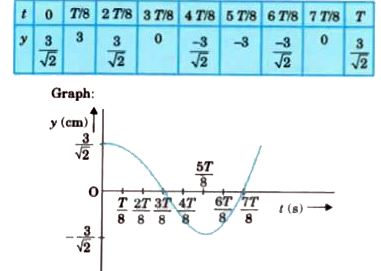 Similarly, we can get (y, t) GRAPHS for x = 2 cm and x = 4 cm. All the curves are SINUSOIDAL in nature. They have same amplitude, same frequency but different initial phase. |
|