

Saved Bookmarks
This section includes 7 InterviewSolutions, each offering curated multiple-choice questions to sharpen your Current Affairs knowledge and support exam preparation. Choose a topic below to get started.
| 1. |
Coagultion is the process by which the dispersed phase of a colloid is made to aggregate and thereby separate from the continuous phase. The minimum concentration of an electrolyte in milli-moles per litre of the electrolyte solution which is required to cause the coagulation of colloidal sol is called coagulation value. Therefore higher is the coagulating power of effective ion, smaller will be the coagulation value. Coagulation value of the electrolyte alpha 1/("coagulating power") The coagualtion value of different electrolytes are different. This behaviour can be easily understood by hardy-schulze rule which states. "The greater is the valency of the effective ion greater is its precipitating power." The coagulation of colloidal particles of the sol can be caused by : |
|
Answer» HEATING |
|
| 2. |
.Identify the products B and C and write their formulae. |
Answer» SOLUTION :
|
|
| 3. |
Classify the following amines as primary, secondary and teritary. |
Answer» SOLUTION :PRIMARY amines: SECONDARY amines:`(C_6H_5)_2NH` Tertiary amine: 
|
|
| 4. |
Coaguolation of egg white one boiling is an example of denaturation of protein. Explain it in terms of structural changes. |
| Answer» Solution :When white of an egg is boiled , the SOLUBLE globular protein albumin PRESENT in it is converted into insoluble fibrous protein. During this denaturation (i) biological activity is lost and (ii), secondary and tertiary structures of albumin protein are DESTROYED while the primary structure (representing the sequence of `alpha`-amino acids) remains INTACT. | |
| 5. |
Classify the following amines as primary, secondary or tertiary : (iii) (C_(2)H_(5))_(2)CHNH_(2)"(iv) "(C_(2)H_(5))_(2)NH |
| Answer» Solution :(i) `1^(@), " (II) "3^(@)," (iii) "1^(@)" (iv) " 2^(@)` | |
| 6. |
Coagultion is the process by which the dispersed phase of a colloid is made to aggregate and thereby separate from the continuous phase. The minimum concentration of an electrolyte in milli-moles per litre of the electrolyte solution which is required to cause the coagulation of colloidal sol is called coagulation value. Therefore higher is the coagulating power of effective ion, smaller will be the coagulation value. Coagulation value of the electrolyte alpha 1/("coagulating power") The coagualtion value of different electrolytes are different. This behaviour can be easily understood by hardy-schulze rule which states. "The greater is the valency of the effective ion greater is its precipitating power." As_2S_3 sol is negatively charged, capacity to precipitate it is highest in which ion ? |
|
Answer» `K_2SO_4` |
|
| 8. |
What is coagulation ? |
|
Answer» `K^(+)` |
|
| 9. |
Coagulation of protein is known as |
|
Answer» DEHYDRATION |
|
| 12. |
Coagulation of egg white on boiling is an example of denaturation of protein. Explain it in terms of structural changes. |
| Answer» SOLUTION :Protein albumin PRESENT in EGG WHITE gets denatured i.e., `2^(@) & 3^(@)` structure are destroyed and `1^(@)` structure is retained. | |
| 14. |
Coagulation of blood takes place by |
|
Answer» FERRIC alum |
|
| 15. |
Co^(3+) is present in vitamin B_(12) otherwise chemically called................. |
|
Answer» |
|
| 16. |
Classify the following amine as 1^@ , 2^@or 3^@ and give its IUPAC name. |
| Answer» SOLUTION :`3^@`AMINE, N-Ethyl-4-isopropyl-N-methylbenzenamine | |
| 17. |
Classify the following alcohols as 1^@,2^@,and3^@ and give their IUPAC names. (a) CH_3-CH_2 - CH(OH)CH_2- overset(Br)overset(|)C(CH_3)_2(b) (C_2H_5)_3COH (C ) CH_2 = C(CI)- CH (OH) CH_3(d) |
Answer» SOLUTION :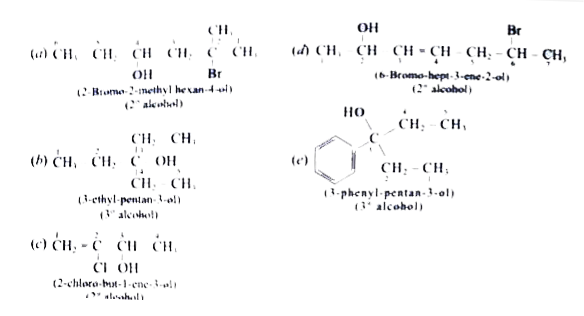
|
|
| 18. |
Classify synthetic detergents giving an example in each case. |
|
Answer» Solution :(i) Anionic detergents Detergents in which the larger ion is an ANION are called anionic detergents. They are SALTS of sulphonic acid, e.g., `CH_(3)(CH_(2))_(10)CH_(2)SO_(3)^(-)N^(+)` . (ii) Cationic detergents : Detergents in which the larger ion is a cation are called cationic detergents. They are quaternary ammonium salts of LONG chain tertiary amines. For EXAMPLE, `[CH_(3)(CH_(2))_(15)N(CH_(3))_(3)]^(+)` (iii) Non-ionic detergents : Detergents which do not contain ions are called non-ionic detergents. For example, `CH_(3)(CH_(2))_(16)COO(CH_(2)CH_(2)O)nCH_(2)CH_(2)OH ` |
|
| 19. |
Classify quartz and glass into the type of solids they are. What makes the two substances different from each other ? |
| Answer» SOLUTION :QUARTZ is a crystalline solid while GLASS is an amorphous solid. In quartz, a regular and PERIODICALLY REPEATING pattern is observed over a long range while in glass, this regular pattern is observed over a short range. | |
| 20. |
CO_2 on reaction with C_2H_5MgBr and H_2O gives : |
|
Answer» Ethane |
|
| 21. |
Classify solids on basis of electrical conductivities. |
|
Answer» Solution :Solids exhibit conductivities from `10^(-20) ` to `10^7 "ohm"^(-1) m^(-1)`. This are classified as : (i) Conductors (ii) Insulators and (iii) Semi conductors (i) Conductors : The solids with conductivities ranging between `10^4` to `10^7 ohm^(-1)m^(-1)` are called conductors. Metals have conductivities in the order of `10^7 "ohm"^(-1) m^(-1)` and hence they are good conductors. (ii) Insulators : These are the solids with very low conductivities ranging between `10^(-20)` to `10^(-10) ohm^(-1) m^(-1)`. EX. : Wood, Plastics etc. (iii) Semiconductors : These are the solids with conductivities in the intermediate range from `10^(-6)` to `10^4 "ohm"^(-1)m^(-1)` . The conductivity of semiconductor is mainly because of defects or impurities present in it. The conduction of electricity in metals and semiconductors is explained by Bond Theory. Certain transition metal oxides show differences in electrical properties :  `ReO_3` has appearance and conductivity SIMILAR to copper. |
|
| 22. |
Co^(2+) + KCN (not in excess) to precipitate. Select the correct statement(s) with respect to the precipitate. |
|
Answer» It is yellow in colour `Co(CN)_(2)darr +4CN^(-)("excess")to [Co(CN)_(6)]^(4-)` (brown solution) `[Co(CN)_(6)]^(4-)+4H^(+)to Co(CN)_(2)darr +4HCN` |
|
| 23. |
Classify each ofthe following as being either a ptype or a n-type semiconductor. a) Ge dopped with In b) Si dopped with B . |
|
Answer» SOLUTION :a) GE dopped with In`RARR`p-type, B) SI dopped with B`rarr`p-type |
|
| 24. |
CO_(2) molecule is not isostructural with : |
|
Answer» `HgCl_(2)` |
|
| 26. |
Classify each of the following solids as molecular, ionic, network (covalent), metallic or amorphous : (i) I_2 (ii) Tetraphosphorus decaoxide (P_4O_(10)) (iii) P_4 (iv) S_8 (v) Plastic (vi) Brass (vii) SiC (viii) Graphite (ix) Rb (x)Si (xi) Ammonium phosphate (xii) LiBr (xiii) Wax (xiv) Ice (xv) Solid CO_2 (xvi) Al (xvii) Naphthalene (xviii) CsCl (rir) Sugar (xx) SiO_2, (xxi) Glass |
| Answer» SOLUTION :Molecular solids : (i), (ii), (iii), (iv), (xiii), (xiv), (xv), (xvii), (xix) , Ionic solids : (xi), (xii), (xviii) : Network (covalent) solids : (vii), (viii), (x), (xx) METALLIC solids : (vi), (IX), (xvi), AMORPHOUS solids : (v), (XXI). | |
| 27. |
CO_2 is not used in : |
|
Answer» MAKING `Na_2CO_3` |
|
| 28. |
Classify each of the following solids as ionic, metallic, molecular, network (covalent) or amorphous. (i) Tetra phosphorus decoxide (P_4O_10) (ii) Ammonium phosphate (NH_4)_3PO_4 (iii) SiC "" (viii) Brass (iv) I_2 "" (ix) Rb (v) P_4 "" (x) LiBr (vi) Plastic "" (ix) Si (vii) Graphite . |
|
Answer» SOLUTION : Molecular solids : `P_4O_10, I_2` and P_4` Ionic solids : `(NH_4)_3PO_4` and LiBr Metallic solids : Brass, Rb Network (covalent) solids : SIC, Graphite and Si Amorphous solids : Plastic. |
|
| 29. |
Classify each of the following solids as ionic, metallic, molecular, network (covalent) or amorphous. (i) Tetra phosphorous decoxide (P_(4)O_(10))(ii) Ammonium Phosphate (NH_(4))_(3),PO_(4)) (iii) Sic (iv) I_(2) (v) P4 (vi) Plastic (vii) Graphite (viii) Brass (ix) Rb (x) LiBr (xi) Si |
|
Answer» Solution :(i) Tetraphosphorous decoxide `(P_(4)O_(10))=` Molecular SOLID (ii) Ammonium phosphate `(NH_(4))_(3)PO_(4)=` Ionic solid (III) `SiC=` Covalent solid (iv) `I_(2)=` Molecular solid (v) P4 = Molecular solid (VI) Plastic = AMORPHOUS solid (vii) Graphite = Covalent solid (viii) Brass = Metallic solid (ix) RB = Metallic solid (x) `LiBr =` Ionic solid (xi) `Si=` Covalent solid |
|
| 30. |
Classify each of the following solids as ionic, metallic, molecular, network (covalent) or amor- phous : {:("(i) Tetra phosphorus decoxide "(P_(4)O_(10)),"(ii) Ammonium phosphate "(NH_(4))_(3)PO_(4)),("(iii) Sic ",(iv) I_(2)),("(v) "P_(4),"(vi) Plastics"),("(vii) Graphite","(viii) Brass"),("(ix) Rb","(x) LiBr"),("(xi) Si",):} |
|
Answer» Solution :SUBSTANCES belonging to different categories are grouped as under : Ionic SOLIDS : `(NH_(4))_(3)PO_(4)`, LiBr Metallic solids : BRASS, Rb Molecular solids : `P_(4)O_(10), I_(2), P_(4)` Network (covalent) SOLID : Graphite, SiC, Si Amorphous solids : Plastics. |
|
| 32. |
Classify each of the following complexes as either high or low spin. Explain your answers[Co(H_(2)O)_(6)]^(2+),mu=4.6B.M.and[Co(CN)_(6)]^(4-),mu=1.9 B.M.Fe(NO_(2))_(6)]^(4-),mu=0.0 B.M.and[Fe(H_(2)O)_(6)]^(3+),mu=5.94 B.M. |
|
Answer» Solution :ntains `Co^(2+)` ion in an octahedral field. Obviously, the compound `[Co(H_(2)0)_(6)]^(2+)` is high spin having a MAGNETIC moment value of 4.6 B.M. whereas `(Co(CN)_(6)]^(4-)` is low spin with a magnetic moment value of 1.9 B.M. (ii) The complex `[Fe(NO_(2))_(6)]^(4-)` CONTAINS `Fe^(2+)` which belongs to a `d_(6)` system. As the magnetic moment of the complex is zero, it indicates that all the six d-electrons are paired up. Hence the compound is low spin. On the other hand, the magnetic moment of 5.94 B.M. for the complex `Fe(H_(2)O)_(6)]^(3+)` CORRESPONDS to FIVE unpaired electrons in Fe. It indicates there is no pairing of d-electrons of `Fe^(3+)` ion, hence the complex is high spin. |
|
| 33. |
CO_(2) is isostructural with : |
|
Answer» 1. `SnCl_(2)` |
|
| 34. |
Classify each of the following nuclides as either "beta(._(-1)^(0)beta) emitter " , or " positron (._(+1)^(0)beta) emitter " : {:(._(20)^(49)Ca,._(5)^(8)B,._(13)^(30)Al,,),(._(80)^(195)Hg,._(67)^(150)Ho,._(36)^(94)Kr,,):} Note : ._(36)^(84) Kr ,_(80)^(200) Hgand ._(67)^(165)Ho are stable |
|
Answer» |
|
| 35. |
CO_2 is called dry ice or drycold because : |
|
Answer» It WETS the surface |
|
| 36. |
Classify each of the following as either a p- type or an n-type semi-conductor. (i) Ge doped with In (ii) B doped with Si. |
|
Answer» SOLUTION :.(i) p-type semi-conductor (II) n-type semi-conductor. |
|
| 38. |
Classify each of the following as being either a p-type or a n-type semiconductor : (i) Ge doped with In (ii) Si doped with B. |
|
Answer» Solution : (i) Ge doped with In FORM a p-type semi-conductor as Ge is group-13 element with three ELECTRONS in VALANCE shell. (ii) Si doped with B GIVES p-type semi-conductor as B is group-13 element with three valance electrons. |
|
| 40. |
Classify each of the following as being either a p-type or a n-type semiconductor : (i) Ge doped with In (ii) B doped with Si. |
|
Answer» Solution :(i) p-type SEMICONDUCTOR, because group 14 element is doped with group 13 element. An electron DEFICIT hole is CREATED. (ii) n-type semiconductor, BEAUSE group 13 element is doped with group 14 element. A free electron will become available. In general, an element doped with an element of the following group produces n-type semiconductor while an element doped with an element of the previous group creates a p-type semiconductor. |
|
| 41. |
CO_2 has the same geometry as: (A) HgCI_2 (B)NO_2 (C )SnCl_4 (D) C_2H_2. |
|
Answer» A and C |
|
| 42. |
Classify colloids where the dispersion medium is water. State their characteristics and write an example of each of these classes. |
|
Answer» Solution :When the dispersion medium is water, we can CLASSIFY colloids into (i) Hydrophilic colloids (II) Hydrophobic colloids Hydrophilic colloids : Hydrophilic colloids are water attracting IE, they have affinity for water. An important characteristic of such colloids is that if the dispersion medium (water) is separated from the dispersed phase, the sol may be obtained again by SIMPLY remixing with water. These sols are quite stable and cannot be easily coagulated. Examples Gum, gelatine, rubber, etc. Hydrophobic colloids : Hydrophobic colloids are water repelling. When simply mixed with water. They do not form the sol. Their colloidal solutions are obtained by SPECIAL methods. These sols are unstable and are easily coagulated by the addition of small amounts of electrolytes. Lyophobic sols require stabilising agents for their preservation. Examples, Metals and their sulphides. |
|
| 43. |
CO_2gas along with solid (Y) is obtained when sodium salt (X) is heated. (X) is again obtained when CO_2gas is passed into aqueous solution of (Y). (X) and (Y) are respectively |
|
Answer» `Na_2CO_3, Na_2O` `underset(Y)(Na_2CO_3) + H_2O + CO_2to underset(X)(2NaHCO_3)` |
|
| 44. |
Classify colloids where the dispersion medium is water. State their characteristics and write an example of each. |
| Answer» | |
| 45. |
Co^(2+)(aq.)+SCN^(-)(aq.)to"Complex"(X) Ni^(2+)(aq.)+"Dimethylglyoxime"overset(NH_4OH)to"Complex"(Y). The coordination number of cobalt and nickel in complexes X and Y is four. Select the correct statement for the complexes (X) and (Y) . |
|
Answer» (X) is paramagnetic with two unpaired electrons  `Y=[NI(DMG)_2]`:Nickel is in +2 oxidation state and dmg is chelating ligand. So,  `[ni(dmg)_2]` shows intra molecular H-bonding as shown below . Reaction involved : `Co^(2+)(aq)+4SCN^(-)(aq)to[Co(SCN)_4]^(2-)(aq)` blue colour complex. 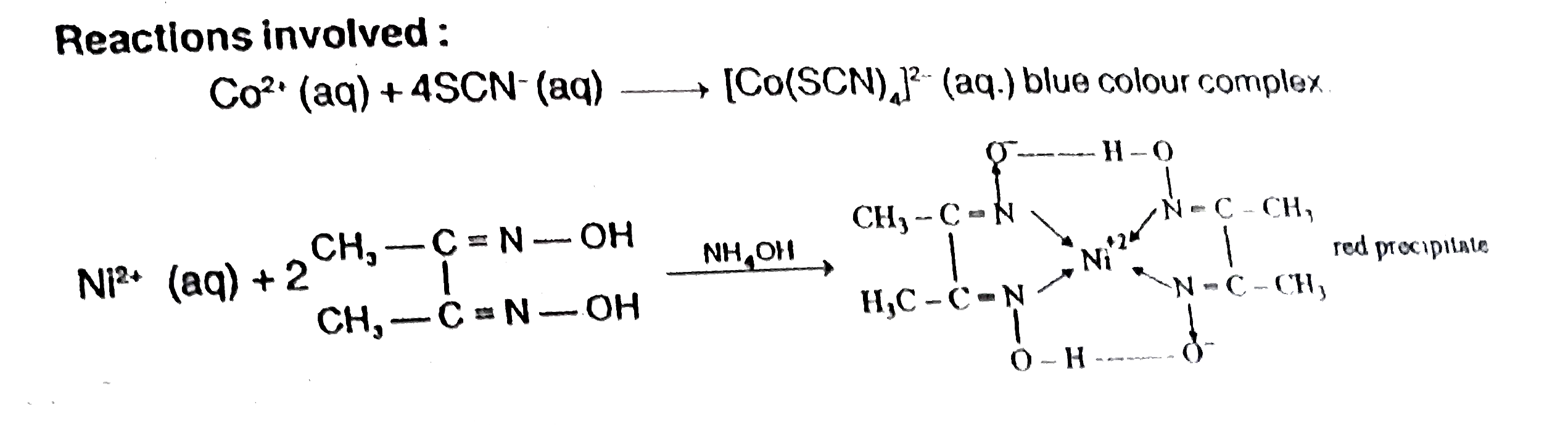
|
|
| 46. |
Co^(2+)(aq.)+SCN^(-)(aq.)to"Complex"(X) Ni^(2+)(aq.)+"Dimethylglyoxime"overset(NH_4OH)to"Complex"(Y). The coordination number of cobalt and nickel in complexes X and Y is four. The geometry of complexes (X) and (Y) are respectively : |
|
Answer» TETRAHEDRAL and square PLANAR  `Y=[Ni(dmg)_2]`:NICKEL is in +2 oxidation state and dmg is chelating ligand. So, 
|
|
| 47. |
Co^(2+)(aq.)+SCN^(-)(aq.)to"Complex"(X) Ni^(2+)(aq.)+"Dimethylglyoxime"overset(NH_4OH)to"Complex"(Y). The coordination number of cobalt and nickel in complexes X and Y is four. The IUPAC name of the complexes (X) and (Y) are respectively: |
|
Answer» Tetrathiocyanato-S-cobalt(II) and BIS(dimethylglyoximate) NICKEL(II) |
|
| 48. |
Classification of aliphatic amines and alcohols is different. Comment |
|
Answer» Solution :Classification of primary, secondary and tertiary alcohols is BASED on the nature of CARBON ATOM to which hydroxyl group is attached. `-CH_(2)-OH(1^(@)" alcohol")`,  Classification of primary, secondary and tertiary amines is based on the nature of NITROGEN atom to which alkyl group is attached. 
|
|
| 49. |
Co^(2+)(aq)+SCN^(-)(aq)toComplex (X) Ni^(2+)(aq.)+"Dimethylglyoxime"overset(NH_4OH)toComplex (Y). The coordination number of cobalt and nickel in compleses X and Y are four. Select the correct statement for the complexes (X) and (Y). |
|
Answer» (X) is PARAMAGNETIC with two UNPAIRED electrons  `Y=[Ni(dmg)_2]`:Nickel is in +2 oxidation state and dmg is chelating ligand.So,  `[Ni(dmg)_2]` shows INTRA molecular H-bonding as shown below. Reaction involved: `Co^(2+)(aq)+4SCN^(-)(aq)to[Co(SCN)_4]^(2-)(aq.)` blue COLOUR complex. 
|
|