Saved Bookmarks
This section includes 7 InterviewSolutions, each offering curated multiple-choice questions to sharpen your Current Affairs knowledge and support exam preparation. Choose a topic below to get started.
| 1. |
Classify the following into artificial sweetners, preservatives , soap , detergent : Sodium palmitate, sucrolose, salt of sorbic acid, cetytrimethylammonium bromide. |
| Answer» Solution :Sodium palmitate-soap , Sucrolose - artificial sweetener , Salt of sorbic acid - PRESERVATIVE , Cetyltrimethylammonium BROMIDE - DETERGENT . | |
| 2. |
Classify the following into antihistamine, antacid, tranquilliser, antibiotic drug : penicillin, meprobamate, terfenadine, ranitidine. |
| Answer» SOLUTION :Penicillin - ANTIBIOTIC : MEPROBAMATE - tranquilizer : TERFENADINE - antihistamine RANITIDINE - antacid. | |
| 3. |
Classify the following into acid, base and amphiprotic in terms of protonic concept. Н_(2)РО_(2)(ii) H_(2)PO_(3) (iii) H_(2)APO_(4)(iv) HPO_(3) (V) HPO_(4) (vi) NH_(4) (vii) CH_(3)COOH_(2) |
|
Answer» SOLUTION : ACIDIC (vi). (VII) Basic) (iv) |
|
| 4. |
CoCl_(3).6NH_(3) can form 4 different types of complexes (According to Werner). Which of the following cannot exhibit optical isomerism as well as geometrical isomerism ? |
|
Answer» `[Co(NH_(3))_(5)Cl]Cl_(2)-" Purple colour "` |
|
| 5. |
Classify the following halogen derivatives of alkanes : CHBr_(3), CH_(3)I, CH_(3)-underset(CH_(3))underset(|)overset(Cl)overset(|)C-H, CH_(3)-underset(Br)underset(|)overset(Br)overset(|)C-CH_(3) |
|
Answer» Solution :MONOHALOGEN derivatives of ALKANES or alkyl HALIDES :<BR>`CH_(3)I,CH_(3)-underset(CH_(3))underset(|)overset(Cl)overset(|)C-H` (2) DIHALOGEN derivatives of alkanes: `CH_(3)-underset(Br)underset(|)overset(Br)overset(|)C-CH_(3)` (3) Trihalogen derivatives of alkanes : `CHBr_(3)` |
|
| 6. |
Classify the following groups as o-/p-or m-directing group and activating or deactivating group: (i) -NO_2 |
| Answer» SOLUTION :`-NO_2` (DEACTIVATING and m-directing ), | |
| 7. |
CoCl_(3).5NH_(3).H_(2)Ois a pink solid,the solution of this salt is also pink and forms 3 mol of AgCl with silver nitrate solution. On heatingpink solid, it loses one water molecule and forms purple solid having the same ratio of Co: NH_(3) :Clas that of pink solid. The purple solid when dissolved in water and treated with silver nitrate forms 2 mol of AgCl. Draw the structures and name the pink and purple solids. |
|
Answer» Solution :(1) Since the COMPLEX of FORMULA `CoCl_(3).5NH_(3).H_(2)O` in the solution FORMS 3 mol AGCL , the complex contains `3Cl^(-)` in the outer ionisation sphere and the formulaof the pink coordination compound should be , `[Co(NH_(3))_(5)(H_(2)O)]Cl_(3)`. `[Co(NH_(3))_(5)H_(2)O]Cl_(3) hArr[Co(NH_(3))_(5)H_(2)O]^(3+) +3Cl^(-)` `3AgNO_(3) + 3Cl^(-) hArr 3AgCl_((S)) + 3NO_(3)^(-)` (2) On heating, the pink solid loses one `H_(2)O` molecules and in the aqueous solution gives 2 mol `AgCl`, with same ratio of `Co:NH_(3)`, the purple coordination compound should be, `[Co(NH_(3))_(5)Cl]Cl_(2)` having the same ratio of `Co:NH_(3)(1:5)` `[Co(NH_(3))_(5)Cl]Cl_(2) hArr [Co(NH_(3))_(5)Cl]^(2+)+2Cl^(-)` `2AgNO_(3) + 2Cl^(-) hArr 2AgCl_((S)) + 2NO_(3)^(-)`. 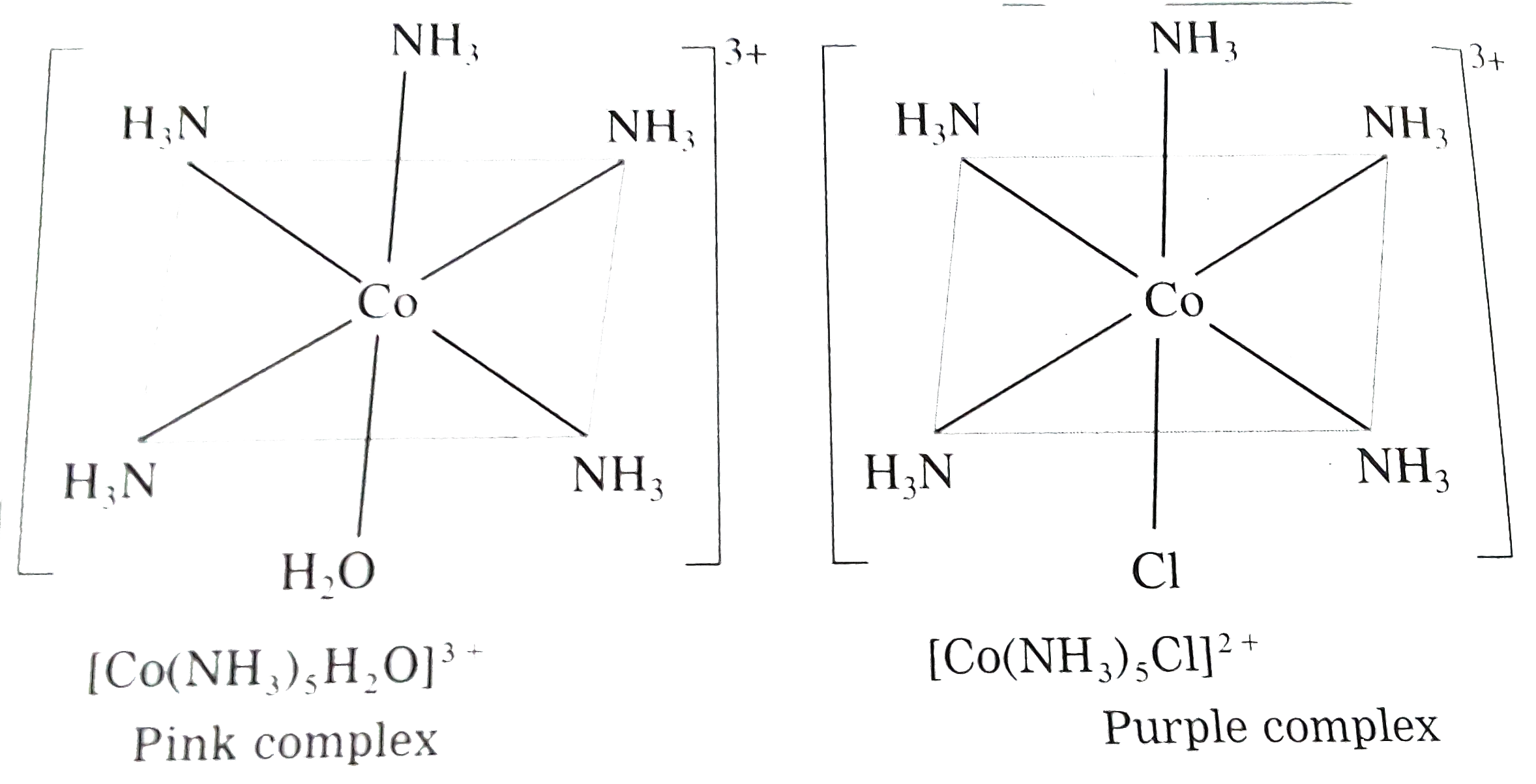 IUPAC names of complexes : Pink complex `[Co(NH_(3))_(5)H_(2)O]Cl_(3)` : Aquapentaamminecobalt (III) Chloride. Purple complex `[Co(NH_(3))_(5)Cl]Cl_(2)` : Pentaamminechloridocobalt(III) chloride. |
|
| 8. |
Classify the following compounds as primary, secondary and tertiary halies.(i) 1-Bromobut-2-ene(ii) 4-Bromopent-2-ene (iii) 2-Bromo-2-methylpropane |
|
Answer» SOLUTION :(i)`CH_(3)-underset("H")underset("|")("C")=underset("H")underset("|")("C")-OVERSET(1^(@))(C )H_(2)-Br "" 1^(@)` - Halide (ii)`CH_(3)-underset(" Br")underset("|")(overset(2^(@))(C ))H-CH-CH_(3) ""2^(@)-` Halide (iii)`CH_(3)-overset(" Br")overset("|")underset(" "CH_(3))underset("|")(overset(""3^(@))("C"))-CH_(3) ""3^(@)-`Halide |
|
| 9. |
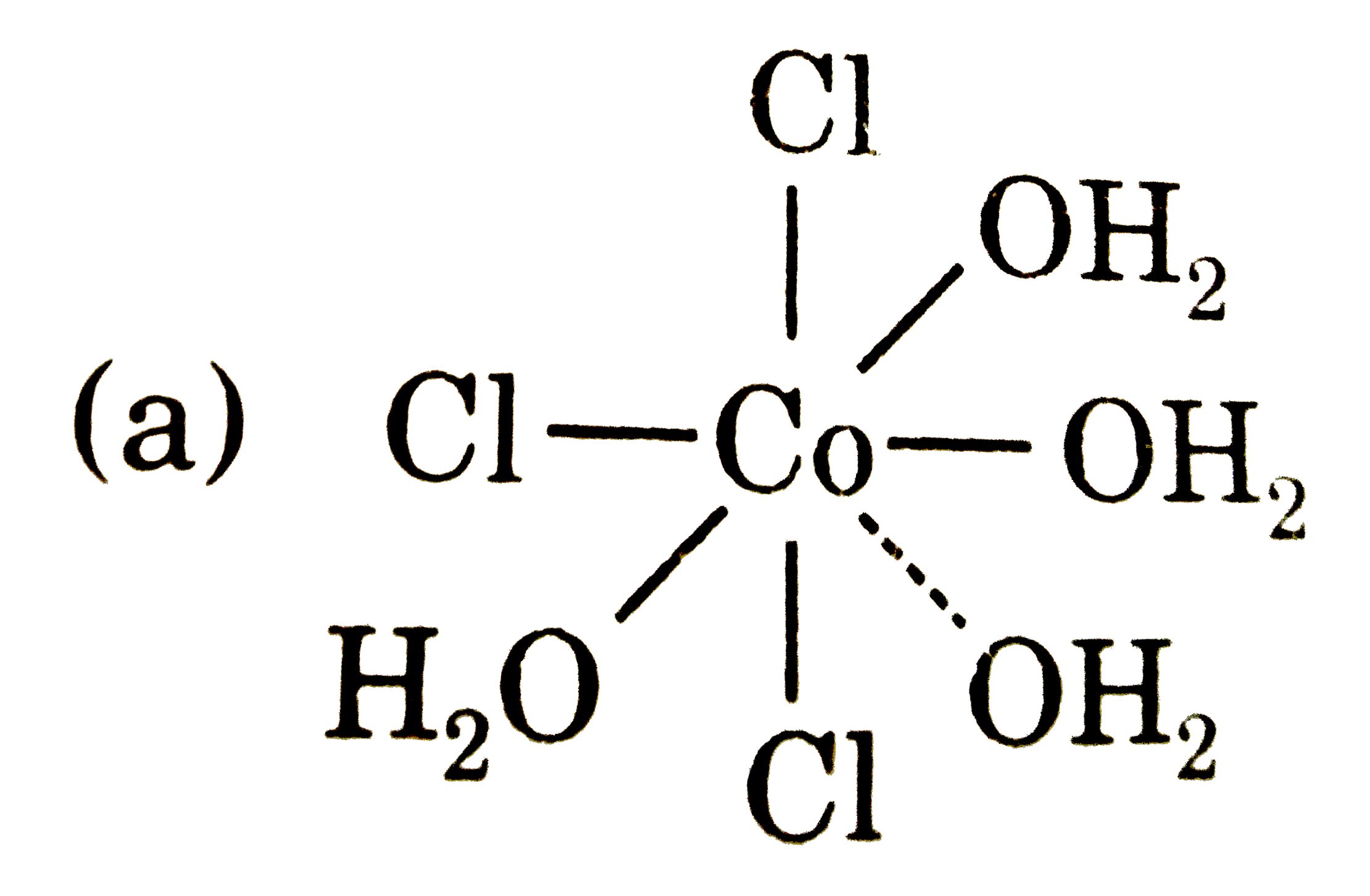
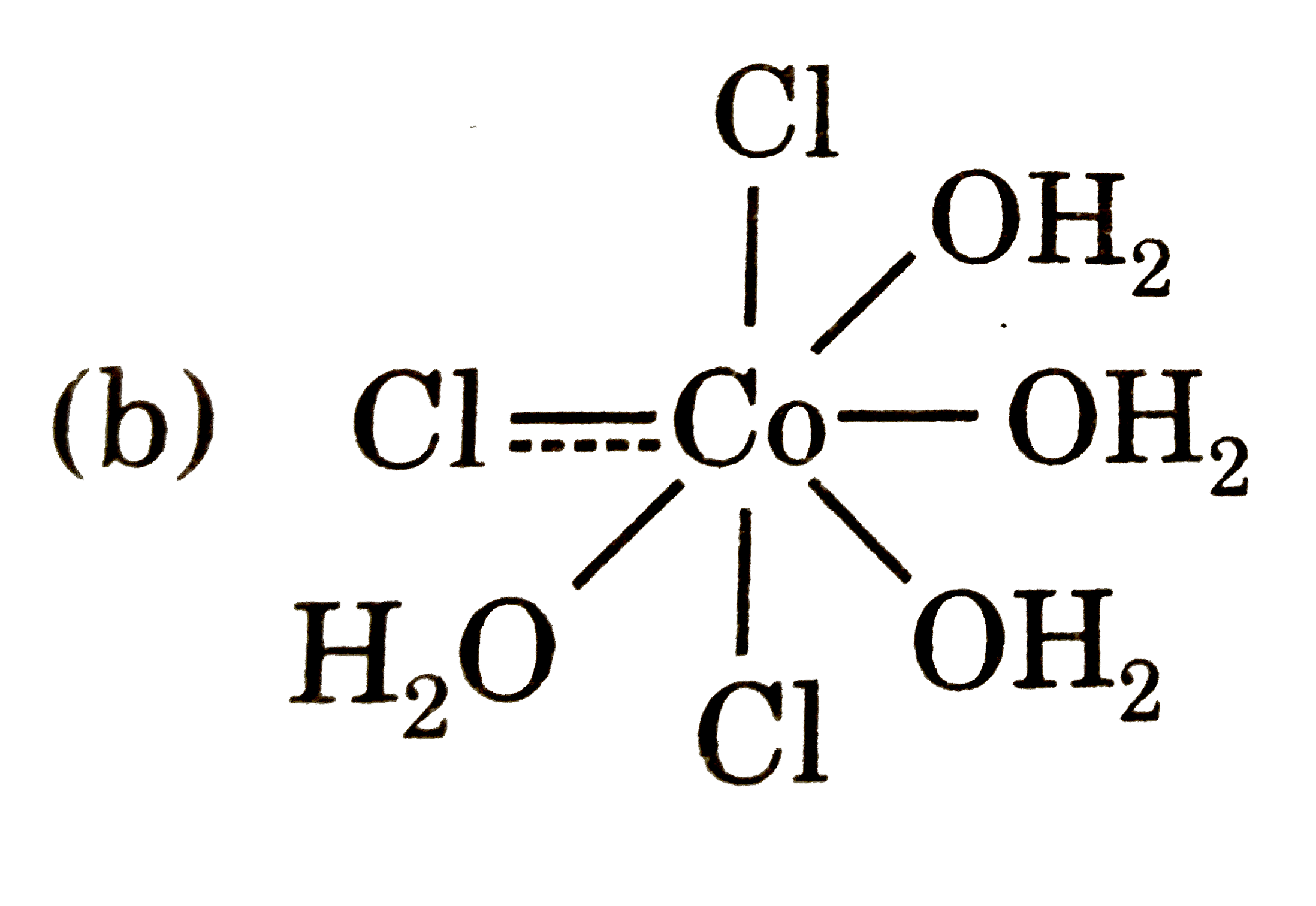
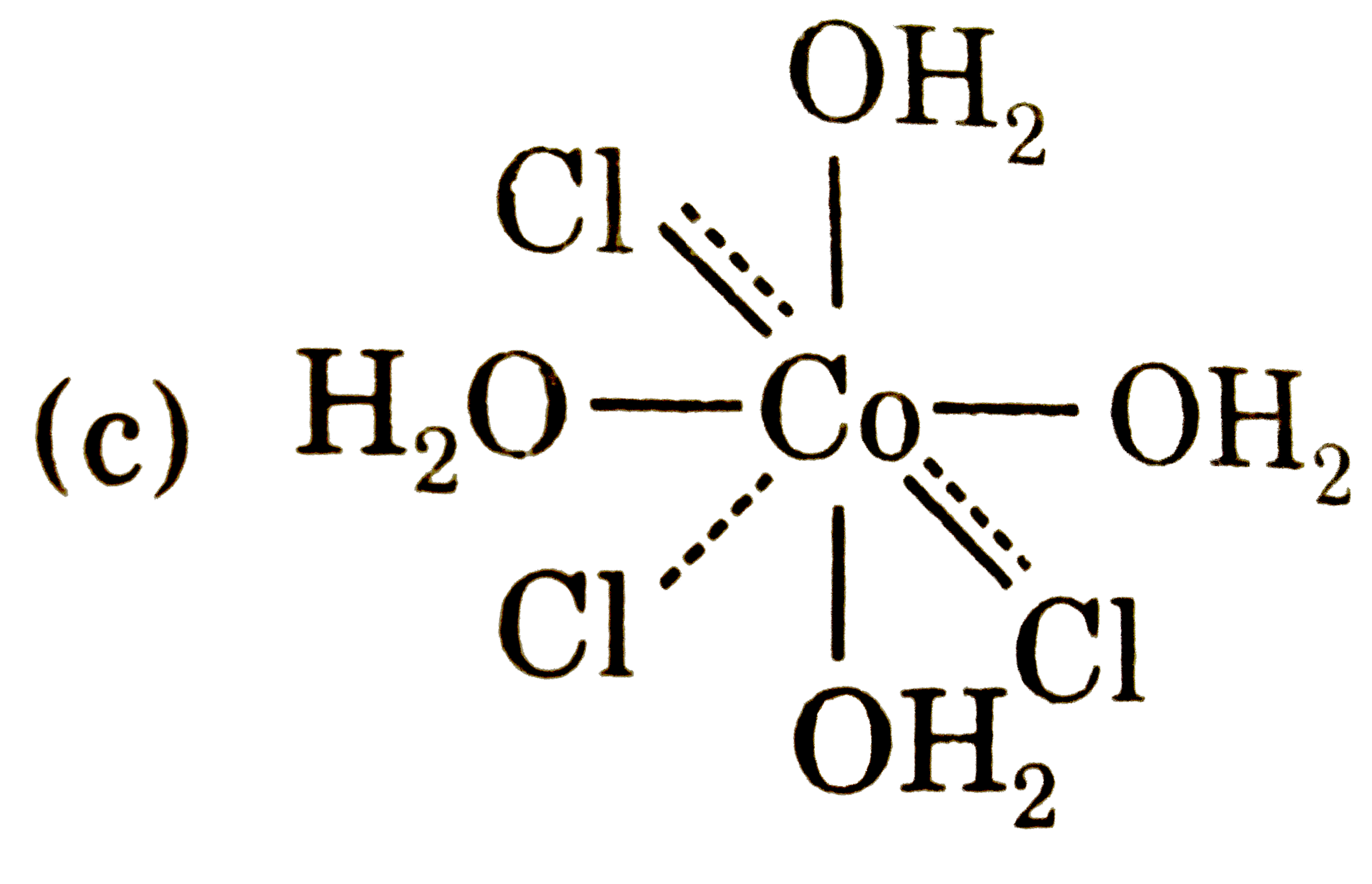
CoCl_(3).4H_(2)O is an anyhydrous binary solute hence its Werner's representation is : |
|
Answer»
|
|
| 10. |
Classify the following compounds as primary, secondary and tertiary halides. (i) 1-Bromobut-2-ene (ii) 4-Bromopent-2-ene (iii) 2-Bromo-2-methylpropane. |
|
Answer» Solution :(i) `UNDERSET("1-Bromobut-2-ene "(1^(@)" Alkyl halide"))(CH_(3)CH=CH-overset(1^(@))(C)H_(2)Br)` (ii) `underset("4-Bromopent-2-ene "(2^(@)" Alkyl halide"))(CH_(3)-overset(2^(@))(C)HBr-CH=CH-CH_(3))` (iii) `underset("2-Bromo-2-methylpropane "(3^(@)" Alkyl halide"))(CH_(3)-underset(CH_(3))underset(|)overset(CH_(3))overset(|)(.^(3^(@))C)-Br)` |
|
| 11. |
CoCl_3 . xNH_3 exhibits geometrical isomerism. What is the value of x? |
| Answer» Solution :The value of x MAY be 3 and 4. `CoCl_3 . 3NH_3` exhibits facial- meridional isomerism . `[CO(NH_3)_4Cl_2]CL` exhibits cis-trans geometrical isomerism. | |
| 12. |
Classify the following compounds as aromatic, anti-aromatic or non-aromatic compounds: (a) Cyclopropenyl cation (b) Naphthalene (c) Furan Pyrrole (e) Pyridine (f) Cycloctatetraene (g) 1,3,5-Cycloheptatriene. |
Answer» Solution :(a)  is aromatic as the rin is planar `4n+2=2pi -" electrons "( n= 0)` `pi`electrons are delocalized. (b)  It has planar structure with delocalized ` (4*2+2) or 10pi` electrons obeys Huckel.s rule. It is aromatic. (c)  The O atom and each of the four C atoms are in `sp^(2)` hybridized STATE forming a flat pentagonal structure. One of two lone PAIRS of electrons of the O atom is in `sp^(2)` orbital which is in the PLANE of ring and does not contribute towards aromatic sextet and the other in p orbital. Four p orbitals of four C atoms each containing `pi` electron and the filled p orbital of O are parallel to each other and perpendicular to the plane of furan. Therefore, furan has 4p electrons from four C atoms and 2p electrons from the O atom, i.e. it has six delocalized `pi` electrons which isa Huckel number. Hence,it is an aromatic compound. It has also resonance stablilzation as shown below:  (d)  Huckel number of delocalized `pi-` electrons are present in a planar cyclic structure Hence, it is aromatic. Here, lone PAIR of H- atom is contributing to aromatic sextet. (e)  Since there are 6 delocalized p-electrons in planar hexagonal structure of pyridine, it is aromatic. (f)  Cyclootatetraene has 8 `pi-` electrons. It has a puckered ring structure and proper overlap of `pi-`electrons are not possible . Hence , it is not an aromatic compound. (g)  It has `4xx1+2=6 pi-` electrons but they are not delocalized. Hence, it is non-aromatic. |
|
| 13. |
[CoCl_(2)(NH_(3))_(4)]^(+)+Cl^(-) to [CoCl_(3)(NH_(3))_(3)]+NH_(3). If in this reaction two isomers of the produt are obtained, which is true for the iniital (reactant) complex: |
|
Answer» COMPOUND is in CIS-form 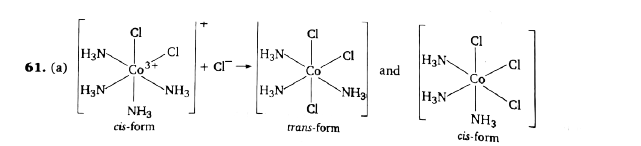
|
|
| 14. |
Classify the following carbohydrates into Monosaccharides , disaccharide , Oligosaccharide , Polysaccharide : (1) Glucose(2) Starch(3) Sucrose(4) Maltose(5) Galactose(6) Lactose(7) Ribosome . |
Answer» SOLUTION :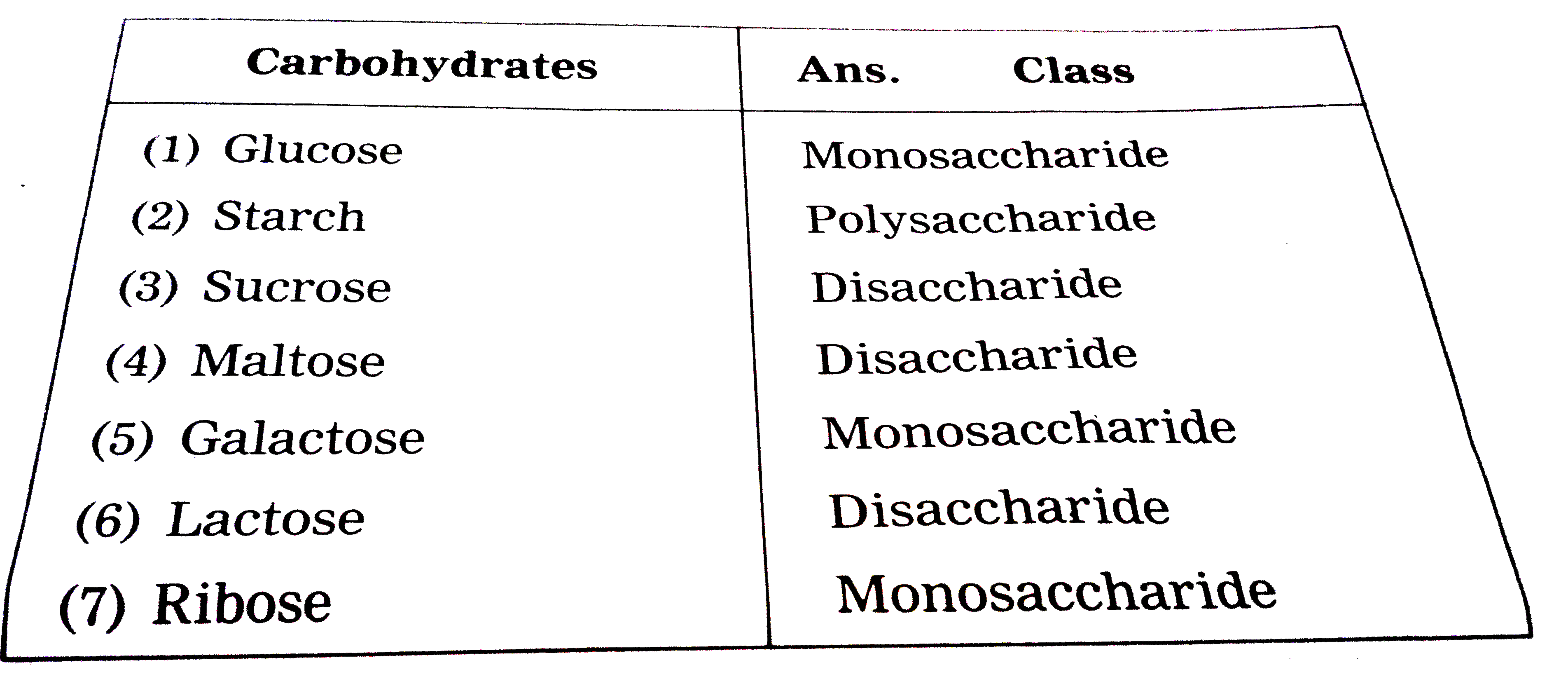
|
|
| 15. |
[CoCl_(2) (NH_(3))_(4)]^(+)Cl^(-)( green)and[CoCl_(2)(NH_(3))_(4)]^(+)Cl^(-)( violet ) have identicalformulaCoCl_(3) .4NH_(3), butdistinctproperties.Suchcompounds are called….A … here,A refers to |
|
Answer» ISOMERS (violet ) haveidenticalformula` CoCl_(3) .4NH_(3) `butdistinctproperties .Suchcompounds are calledisomers . |
|
| 16. |
Classify the following as primary, secondary and tertiary alcohols. (i) CH_3-underset(CH_3)underset(|)overset(CH_3)overset(|)C-CH_2OH(ii) H_2C = CH - CH_2OH(iii) CH_3 - CH_2 - CH_2 - OH |
|
Answer» SOLUTION :PRIMARY alcohols: (i) `CH_3 - UNDERSET(CH_3) underset(|)overset(CH_3) overset(|)C- CH_2OH`(ii) `H_2C = CH - CH_2OH`(iii) `CH_3 - CH_2 -CH_2 -OH` SECONDARY alcohols: 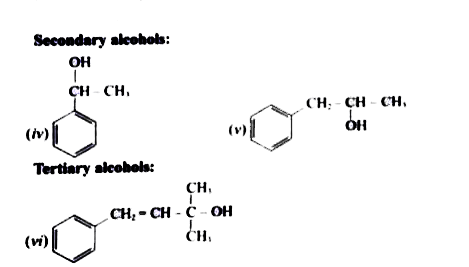 Tertiary alcohols: 
|
|
| 17. |
Classify the following as primary, secondary and tertiary alcohols : (i) CH_(3)-overset(CH_(3))overset("|")underset(CH_(3))underset("|")"C "-CH_(2)OH (ii) H_(2)C=CH-CH_(2)OH (iii) CH_(3)-CH_(2)-CH_(2)-OH |
| Answer» SOLUTION :PRIMARY alcohols : (i), (ii), (III), Secondary alcohols: (IV)(v), Tertiary alcohols : (VI). | |
| 18. |
[CoCl_(2)(NH_(3))_(4)]^(+) +Cl^(-) to [CoCl_(3)(NH_(3))_(3)] + NH_(3) If in the above reaction only one isomer of the product is obtained, which is true for the initial (reactant) complex : |
|
Answer» compound is in CIS FORM 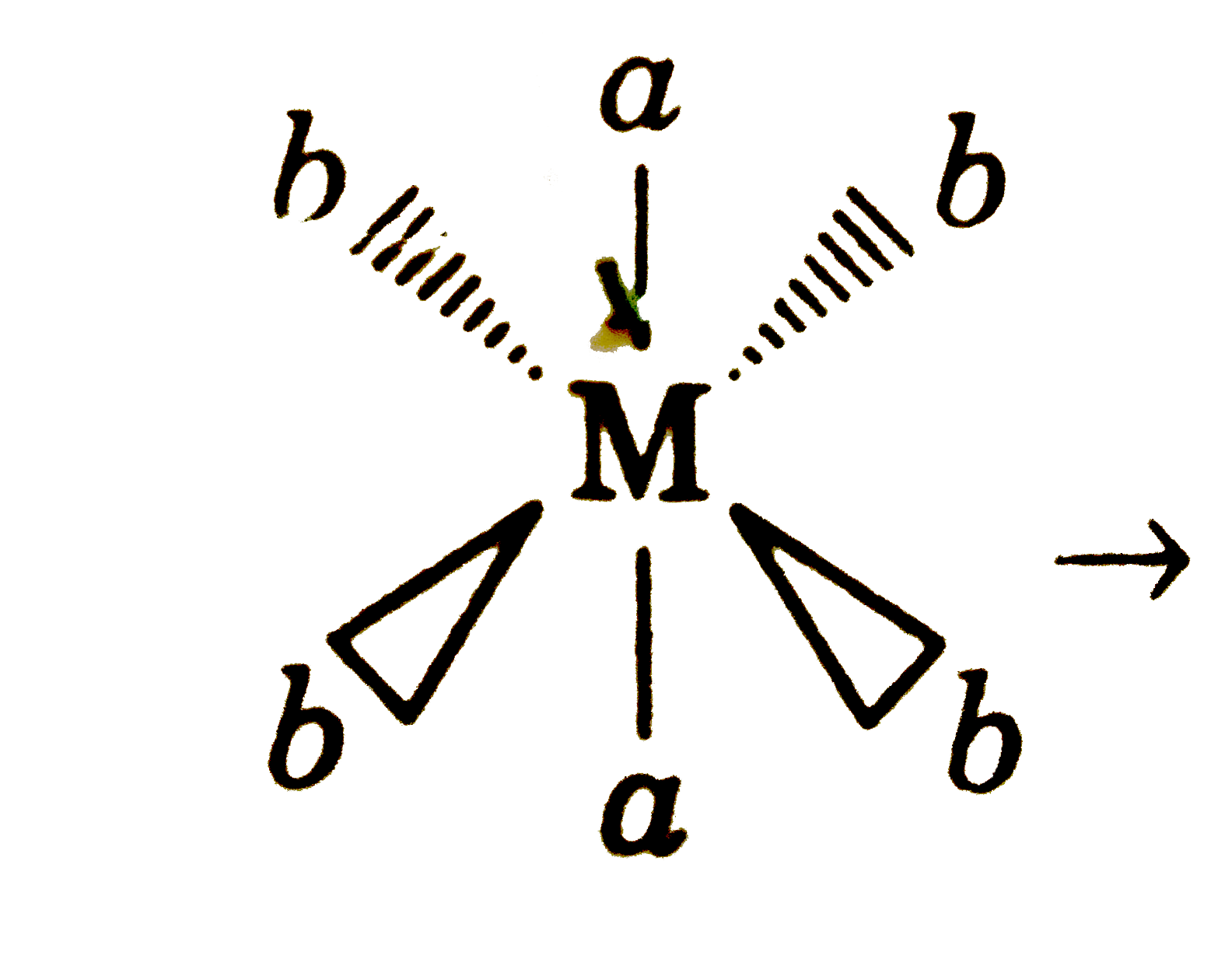 to only one possible because all 'B' position are IDENTICAL. to only one possible because all 'B' position are IDENTICAL.
|
|
| 19. |
Classify the following as primary alcohols, secondary alcohols and tertiary alcohols. (i) CH_(3)-underset(CH_(3))underset(|)overset(CH_(3))overset(|)(C)-CH_(2)OH (ii) H_(2)C=CH-CH_(2)OH (iv) CH_(3)-CH_(2)-CH_(2)-OH |
| Answer» SOLUTION :(i) PRIMARY (ii) Primary (III) Secondary (iv) Primary | |
| 21. |
Classify the following as linear, branched or cross linked polymers (a) Bakelite (b) Nylon (c) polythene |
| Answer» Solution :(a) Bakelite - cross LINKED polymer (B) Nylon - Linear polymer (C) Polythene - Linear polymer | |
| 22. |
[CoCl_(2)(en)_(2)]Br will show : |
|
Answer» COORDINATION position isomerism |
|
| 23. |
Classify the following as linear, branched or cross linked polymers a) Bakelite b) Nylon c) polythene |
|
Answer» Solution :(a) BAKELITE -crosslinkedpolymer (B)NYLON - linearpolymer (c )POLYTHENE -linearpolymer |
|
| 24. |
CoCl_(2) + KNO_(2) + CH_(3)COOH to [X] +H_(2)O +KCl + CH_(3)COOK +NO (Unbalenced equation) |
|
Answer» `X` is a yellow crystalline solid INSOLUBLE in water. So `[X]` is `K_(3)[Co(NO_(2))]_(6)` It is called Fischer's reagent, `[Co(III)(NO_(2))_(6)]^(3-)` has `d^(2)sp^(3)` HYBRIDISATION and is diamagnetic . It `IUPAC` name is potassium hexanitrito-`N`-cobaltate`(III)`. |
|
| 25. |
Classify the following as electrophiles and nucleophiles: (a) CN^(-) (b) H_(2)O (c) Br^(+) (d) NO_(2)^(-) (e) overset(+)NO_(2) (f) CH_(3)OH (g) H_(2)C=CH_(2) (h) RCOCl (i) H_(2)N-OH (j) :(C Cl_(2) (k) H_(3)O^(+) (l) NH_(3) (m) BF_(3) (n) AlCl_(3) (o) OH^(-) (p) R_(3)N |
|
Answer» |
|
| 26. |
CoCl_(2) is |
|
Answer» pink |
|
| 27. |
Classify the following as cationic detergents, anionic detergents or non-ionic detergent CH_3(CH_2)_2CH_2OSO_3^(-)Na^(+) |
| Answer» SOLUTION :ANIONIC DETERGENT | |
| 28. |
Classify the following as cationic detergents, anionic detergents or non-ionic detergent |
| Answer» SOLUTION :Non-ionic DETERGENT | |
| 29. |
CoCI_(2) givesbluecolourwith NH_(4)SCN duetoformation of |
|
Answer» `(NH_(4))_(2)[CO(SCN)_(4)]` |
|
| 30. |
Classify the following as cationic detergents, anionic detergents or non-ionic detergent [CH_3-(CH_2)_15N(CH_3)_3]^(+)]Br^(-) |
| Answer» SOLUTION :CATIONIC DETERGENT | |
| 31. |
Cocaine is hallucinogen used widely How many chiral carbon does it have. |
Answer» 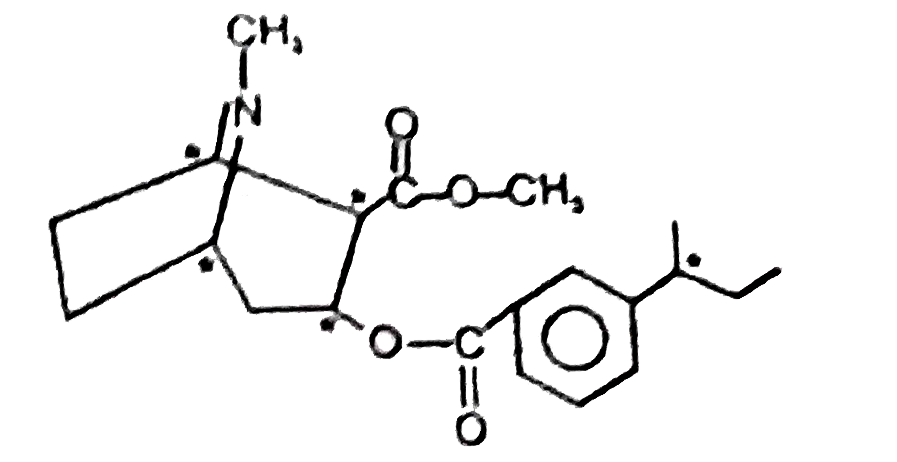
|
|
| 32. |
Classify the following as amorphous or crystalline solids: polyurethane, naphthalene, benzoic, acid, teflon, potassium nitrate, cellophane, polyvinyl chloride, fibre glass, copper. |
| Answer» Solution :Amorphous solids: polyurethane, teflon, CELLOPHANE, polyvinyl chloride, fibre glass. Crystalline solids: naphthalene, benzoic ACID, `KNO_3` COPPER. | |
| 33. |
Cocaine is : |
|
Answer» Vitamin |
|
| 34. |
Classify the following as amorphous or crystalline solids : Polyurethane, naphthalene, benzoic acid, teflon, potassium nitrate, cellophane, polyvinyl chloride, fibre glass, copper. |
| Answer» SOLUTION :AMORPHOUS solids: Polyurethane, teflon, cellophane, polyvinyl CHLORIDE, fibre glass. Crystalline solids: BENZOIC acid, naphthalene, potassium nitrate, COPPER. | |
| 35. |
Cobalt (III) chloride forms several octahedral complexes with ammonia. Which of the following will not give test for chloride ions with silver nitrate at 25^@C ? |
|
Answer» `CoCl_3 . 5NH_3` |
|
| 36. |
Classify the following as amorphous or crystalline solids : Polyurethane, naphthalene, benzoic acid, teflon, potassium nitrate, cellophane, polyvinyl chloride, fibre glass and copper. |
|
Answer» Solution :The above MENTIONED SUBSTANCES are classified as under : Crystalline SOLIDS `""` Amorphous solids BENZOIC acid`""`Polyurethane Potassium nitrate`""` Naphthalene Copper`""` Teflon Cellophane Polyvinyl chloride FIBRE glass |
|
| 37. |
Cobalt (III) chloride forms several octahedral complexes with ammonia. Which of the following will not give test for chloride ions with silver nitrate at 25^(@)C ? |
|
Answer» `CoCl_(3).5 NH_(3)` `[Co(NH_(3))_(5)Cl]Cl_(2), [Co(NH_(3))_(6)]Cl_(3)`, `[Co(NH_(3))_(3)Cl_(2)]` and `[Co(NH_(3))_(4)Cl_(2)]Cl` THUS, only (c) does not have any ionizable chloride ion. |
|
| 38. |
Classify the following as alkyl, allyl and vinyl halides (i) CH_(2)CH=CFCH_(2)CH_(3) (ii). (CH_(3))_(2)C ClCH_(3) (iii). CH_(2)=CHCH_(2)I (iv). . |
|
Answer» Solution :(i). Vinyl fluride (II). Alkyl chloride (III). Allyl iodide (iv). Vinyl chloride and alkyl BROMIDE. |
|
| 39. |
Classify the following as addition and condensation polymers : Terylene, Bakelite, polyvinyle chloride, Polythene. |
|
Answer» SOLUTION :Addition polymers : POLYTHENE, polyvinyle chloride CONDENSATION polymers : TERYLENE, Bakelite |
|
| 41. |
Classify the following as addition and condensation polymers : Terylene , Baklite , Polyvinyl chloride , Polythene. |
|
Answer» Solution :ADDITION Polymers : POLYVINYL CHLORIDE , polythene . CONDENSATION polymers : Terylene bakelite. |
|
| 42. |
Coating of zinc on iron objects is commonly known as: |
|
Answer» Electroplating |
|
| 43. |
Coaltar is a main source of : |
|
Answer» AROMATIC compounds |
|
| 44. |
Classify the following as addition and condensation polymers: Terylene, Bakelite, Polyvinyl chloride, Polythene. |
| Answer» Solution :ADDITION POLYMERS: POLYVINYL chloride, POLYTHENE, CONDENSATION polymers : Terylene, bakelite. | |
| 45. |
Coal-tar is main source of |
|
Answer» AROMATIC compounds |
|
| 46. |
Classify the following as addition and condensation polymers : Terylene, Bakelite, Polyvinyl chloride, Polythene |
|
Answer» SOLUTION :Addition POLYMERS : POLYVINYL CHLORIDE and polythene. CONDENSATION polymers : Terylene and bakelite. |
|
| 47. |
Classify the following as acid (or) base using Arrhenius concept (i) HNO_3 (ii)Ba(OH)_2 (iii) H_3 PO_4 (iv)CH_3 COOH |
|
Answer» SOLUTION :ACID: (i) `HNO_3""(iii) H_3PO_4` `(IV) CH_3COOH` Base : `(ii) Ba(OH)_2` |
|
| 49. |
Coal is a potential source for ammonia. Comment. |
| Answer» Solution :Coal on destructive DISTILLATION gives coal tar, which also contains ammonical liquor. When the liquid is TREATED with MILK of lime and steam is blown, ammonia gas is EVOLVED. Concentrated ammonia solution can be prepared by dissolving in steam directly. A fertiliser ammonium sulphate is obtained when ammonia is absorbed in `H_(2)SO_(4)`. | |
| 50. |
Classify the following as acid (or) base using Arrhenius concept HNO_3 (ii) Ba(OH)_2 (iii) H_3PO_4 (iv) CH_3COOH |
|
Answer» Solution :`HNO_3:` Nitric acid dissociates to give hydrogen IONS in water `THEREFORE HNO_3` is acid (ii) `BA(OH)_2`: Barium HYDROXIDE , dissociates to give hydroxyl ions in water `therefore Ba(OH)_2`is base. (iii) `H_3PO_4`: Orthophosphoric acid ,dissociates to give hydrogen ions in water. `therefore H_3PO_4` in acid. (IV) `CH_3COOH`: Acetic acid, dissociates to give hydrogen ions in water. `therefore CH_3COOH` is acid. |
|