

Saved Bookmarks
This section includes 7 InterviewSolutions, each offering curated multiple-choice questions to sharpen your Current Affairs knowledge and support exam preparation. Choose a topic below to get started.
| 1. |
Arrange the following : (i)Increasing order of thermal stability HOCl, HClO_(2), HCIO_(3), HCIO_(4). (ii)Increasing acid strength HCIO, HCIO_(2), HCIO_(3), HCIO_(4) (iii)Increasing reducing nautre F^(-),Cl^(-),Br^(-),I^(-) (iv)Increasing oxidation number of iodine I_(2),HI,HIO_(4).ICI. (v)Increasing acid strength HOF, HOCl, HOBr, HOI. (vi) Increasing oxidising power F_(2),Cl_(2),Br_(2),I_(2) (vii)Increasing acid strength HF, HCl, HBr, HI. (viii)Increasing electronegativity F,Cl, Br,I. |
|
Answer» (ii)`HCIOltHCIO_(2)ltHCIO_(3)ltHCIO_(4)` (III)`F^(-)ltCl^(-)ltBr^(-)ltI^(-)` (iv)`HIltI_(2)ltIclltHIO_(4)` (v)`HOIltHOBrltHOClltHOF` (vi)`I_(2)ltBr_(2)ltCl_(2)ltF_(2)` (vii)`HFltHClltHBrltHI` (On the basis of their bond DISSOCIATION energies) (viii)`IltBrltClltF` |
|
| 2. |
Arrange the following (i) In increasing order of solubility in water C_(6)H_(5)NH_(2),(C_(2)H_(5))_(2)HN,C_(2)H_(5)NH_(2) (ii) In increasing order of basic strength (a) aniline , p- toludine and p- nitroaniline (b) C_(6)H_(5)NH_(2), C_(6)H_(5)NHCH_(3),C_(6)H_(5)NH_(2),p-Cl-C_(6)H_(4)-NH_(2) (iii) .In decreasing order of basic strength in gas phase C_(2)H_(4)NH_(2), (C_(2)H_(5))_(2)NH,(C_(2)H_(4))_(3)N and NH_(3) (C_(2)H_(4)OH,(CH_(3))_(2)NH,C_(2)H_(5)NH_(2) (v) In decreasing order to the pk_(b) values C_(2)H_(5)NH_(2),C_(6)H_(5)NHCH_(3),(C_(2)H_(4))_(2)NH and CH_(3)NH_(2) (vi) Increasing order of basc strength C_(6)H_(4)NH_(2),C_(6)H_(5)N(CH_(3))_(2),(C_(6)H_(5))_(2)NH and CH_(3)NH_(2) (vii) In decreasing order of basic strength |
|
Answer» Solution :i. Solubility decreases with increase in molecular mass of amines due to increase in the size fo a hydrophobic hydrocarbon part and with decrease in the number of H-atoms on the N-atom which undergo H-bonding. Now among the given compounds `C_(6)H_(5)NH_(2)` has the highest molecular mass of 93 followed by `(C_(2)H_(5))_(2)NH` with molecular mass of 73 with `C_(2)H_(5)NH_(2)` has the lowesst molecular mass of 45. Thus the solubililty increases in the order in whcih molecular mass decreases. `C_(6)H_(5)NH_(2)lt(C_(2)H_(5))_(2)NHltC_(2)H_(5)NH_(2)` (ii) a. Theelectron donating groups increases the basic strength of amines while the electron- withdrawing groups decrease the basic strength of amines. Therefore p-nitroanilne is the weakest base followed by aniline while p- toluidine, which has methyl group andtherefore it is the strongest base. Basic strength increases in the order. P-nitro aniline `lt` aniline `lt` p-toluidine b. Chlorine atom has both -I effect and +R effect since -I effect out weights the +R effect, therefore p-chloro aniline is weak base than aniline. Alkyl groups are electron-donating groups. As a result the electron DENSITY on the nitrogen atom increases in the ethyalamine and thus they can donate lone pair of electrons more easily. Therefore Ethylamine is more base than aromatic amines. Due to delocalization of lone pair of electrons of the N-atom over the benzene ring, `C_(6)H_(5)NH_(2)` and `C_(6)NHCH_(3)` are far less basic than `C_(2)H_(5)NH_(2)`. Further due to +I effect of the `CH_(3)` group, `C_(6)_(5)NHCH_(3)` is little more basic than `C_(6)H_(5)NH_(2)`, Therefore increasing order basic strength is `P-Cl-C_(5)H_(4)-NH_(4)ltC_(6)H_(5)NH_(2)ltC_(6)H_(5)NHCH_(3)ltC_(2)H_(5)NH_(2)` (iii). In the gas phase, solvent effects i.e., stabilization of the conjugate acids due to H- bonding, are absent. Therefore, in the gas phase, basic strength mainly depends upin the +I effect of the alkyl groups. Since the +I effect increases wtih the number of alky groups, therefore the basic strength of the amines decreases as the number of ethyl groups decreases from three in `(C_(2)H_(5))(3)N` to two `(C_(2)H_(5))_(2)NH` to one in `C_(2)H_(5)NH_(2)` and zero in `NH_(3)`. `:.` Basic strength in the gas phase decreases in the order is `(C_(2)H_(5))_(3)Ngt(C_(2)H_(5))_(2)NgtC_(2)H_(5)NH_(2)gtNH_(3)` iv. Since the electro negativity of O is higher than that of N, therefore, alcohols form stronger H-bonds than amines. In other words, the boiling points ofalcohols are higher than those of amines of comparabel molecular masses. Therefore the boiling point of `C_(2)H_(5)OH(46)` is higher than those of `(CH_(3))_(2)NH(45)` and `C_(2)H_(5)NH_(2)(45)`. Further since the EXTENT of H-bonding depends upon the number of N-atoms on the N-atom. Therefore `1^(@)`- amines with two H- atoms on the N-atom have higher boiling points than `2^(@)` - amines having only one H-atom. Therefore the boiling point of `C_(2)H_(5)NH_(2)` is higher than that of `(CH_(3))_(2)`. `:.` Increasing order of boiling point is `(CH_(3))_(2)NHltC_(2)H_(5)NH_(2)lt C_(2)H_(5)OH` v. Dueto delocalization of lone pair of electrons of the N-atom over the benzene ring, `C_(6)H_(5)NHCH_(3)` is far less basic than `C_(2)H_(5)NH_(2),(C_(2)H_(5))_(2)NH` and `CH_(3)NH_(2)` among `C_(2)H_(5)NH_(2))` and `(C_(2)H_(5))_(2)NH,(C_(2)H_(5))_(2)` is more basic than `C_(2)H_(5)NH_(2)` due to greater +I effect of the two `C_(2)H_(5)` groups and stabilization of its conjugate acid by H-bonding. Compare to Ethyl and methyl group, `C_(2)H_(5)` group has more +I effect than `CH_(3)`- group Therefore methylamine is weak base than ethylamine. Combining all these facts relative basic strengt of these four amines decreases in the orderl, `(C_(2)H_(5))_(2)NHgtC_(2)H_(4)NH_(2)gtCH_(3)NH_(2)gtC_(6)H_(5)NHCH_(3)` Since a stronger base has a lower `pK_(b)` value therefore `pK_(b)` values decrease in the reverse order. `C_(6)H_(5)NHCH_(3)gtCH_(3)NH_(2)gtC_(2)H_(5)NH_(2)gt(C_(2)H_(5))_(2)NH` Due to delocalization of lone pair of electrons of the N-atom over the benzene ring, all aromatic amines are less basic than alkylamines i.e. `CH_(3)NH_(2)` Presence of electron donating groups `(-CH_(3))` on the N-atom increases the basicity of substituted aniline with respect to `C_(6)H_(5)NH_(2)`. In `(C_(6)H_(5))_(2)NH`, the lone pair of electrons on the N-atom is delocalized over two benzene rings instead of one in `C_(6)H_(5)NH_(2)`, therefore `(C_(6)H_(5))_(2)NH` is much less basic than `C_(6)H_(5)NH_(2)`. Combining all the three trends TOGETHER, the basic strength of the four amines increasing in the order: `(C_(6)H_(5))_(2)NHltC_(6)H_(5)NH_(2)ltC_(6)H_(5)N(CH_(3))_(2)ltCH_(3)NH_(2)` Aliphatic amines are more basic than aromatic amines. Therefore `CH_(3)CH_(2)NH_(2)` and `CH_(3)NH_(2)` are more basic. Among the ehtylamine and methylamine, ethylamine was experienced more +1 effect than methylamine and hence ethylamine is more basic than methylamine. Nitrogroup has a powerful electron withdrwing group and they have bot -R effect as well as -I effect. As a result all the nitro anilines are weaker bases than aniline. In P-nitroaniline  both -R effect and -I effect of the `NO_(2)` group decrease the basicity. both -R effect and -I effect of the `NO_(2)` group decrease the basicity. Therefore decreasing order of basic strength is 
|
|
| 3. |
Arrange the following : (i) In decreasing order of pKb values : C_(2)H_(5)NH_(2), C_(6)H(5)NHCH_(3), (C_(2)H_(5))_2NH and C_(6)H_(5)NH(2) (ii) In increasing order of basis strength : (a) Aniline , p-nitroaniline and p-toluidine (b) C_(6)H_(5)NH_(2), C_(6)H_(5)NHCH_(3), C_(6)H_(5)CH_(2)NH_(2) (iii) In decreasing order of basis strength: C_(6)H_(5)NH_(2), C_(6)H_(5)NH(CH_(3))_(2), (C_(2)H_(5))_(2)NH, CH_(3)NH_(2) (iv) Decreasing order of basis strength in gas phase : C_(2)H_(5)NH_(2), (C_(2)H_(5))_(2)NH, (C_(2) H_(5))_(3)N andNH_(3) (v) Increasing order of boiling point : C_(2)H_(5)OH, (CH_(3))_(2)NH, C_(2)H_(5)NH_(2). |
|
Answer» Solution :(i) `C_(6)H_(5)NH_(2) GT C_(6)H_(5)NHCH_(3)gt C_(2)H_(5)NH_(2)gt (C_(2)H_(5))_(2)NH` (ii) (a) p-nitroaniline LT aniline lt p-toluidine (b) `C_(6)H_(5)NH_(2) lt C_(6)H_(5)NHCH_(3) lt C_(6)H_(5)CH_(2)NH_(2)` (III) `(C_(2)H_(5))_(2)NH gt CH_(3)NH_(2) gt C_(6)H_(5)N(CH_(3))_(2) gt C_(6)H_(5)NH_(2)` (iv) `(C_(2)H_(5))_(3)N gt (C_(2)H_(5))_(2)NH gt C_(2)H_(5)NH_(2) gt NH_(3)` (v) `(CH_(3))_(2)NH lt C_(2)H_(5)NH_(2) lt C_(2)H_(5)OH ` |
|
| 4. |
Arrangethe following : (i) In increasing order of their basic strength : C_(6)H_(5)-NH_(2), CH_(3)-CH_(2)-NH_(2), CH_(3)-NH-CH_(3) In increasing order of solubility in water : CH_(3)-NH_(2), (CH_(3))_(3)N, CH_(3)-NH-CH_(3) |
|
Answer» SOLUTION :(i)` C_(6)H_(5)-NH_(2) LT CH_(3)-CH_(2)-NH_(2) lt CH_(3)-NH-CH_(3)` (ii) `(CH_(3))_(3)N lt (CH_(3))_(2)NH lt CH_(3)-NH_(2)` |
|
| 5. |
Arrange the following : (i) In increasing order of basic strength : C_(6)H_(5)-NH_(2), CH_(3)-CH_(2)-NH_(2), C_(6)H_(5)-NH-CH_(3) In increasing order of boiling point : ""C_(2)H_(5)OH, CH_(3)-CH_(2)-NH_(2), CH_(3)NHCH_(3) |
|
Answer» SOLUTION :(i) `C_(6)H_(5)-NH_(2)-NH_(2) lt C_(6)H_(5)-NH-CH_(3) lt CH_(3)-CH_(2)-NH_(2)` (ii) `CH_(3)NHCH_(3) lt CH_(3)-CH_(2)-NH_(2) lt C_(2)H_(5)OH` |
|
| 6. |
Arrange the following: (i) in decreasing order of pK_(a) values C_(2)H_(5)NH_(2),C_(6)H_(5)NHCH_(3),(C_(2)H_(5))_(2)NH and C_(6)H_(5)NH_(2). (ii) in increasing order of basic strength C_(6)H_(5)NH_(2),C_(6)H_(5)N(CH_(3))_(2),(C_(2)H_(5))_(2)NH and CH_(3)NH_(2). |
|
Answer» Solution :(i) Due to delocalization of lone pair of electrons of the N-atom over the BENZENE RING, `C_(6)H_(5)NH_(2) and C_(6)H_(5)NHCH_(3)` are far less basic than `C_(2)H_(5)NH_(2) and (C_(2)H_(5))_(2)NH`. Further, due to +I-effect of the `CH_(3)` group, `C_(6)H_(5)NHCH_(3)` is little more basic than `C_(6)H_(5)NH_(2)`. among `C_(2)H_(5)NH_(2) and (CH_(2)H_(5))_(2)NH,(C_(2)H_(5))_(2)NH` is more basic than `C_(2)H_(5)NH_(2)` due to greater +I-effect of the two `C_(2)H_(5)` groups and stabilization of its conjugate acid by H-bonding. combining all these facts, the relative basic strength of these four amines decreases in the order: `(C_(2)H_(5))_(2) NH gt C_(2)H_(5)NH_(2) gt C_(6)H_(5)NHCH_(3) gt C_(6)H_(5)NH_(2)`. Since a stronger base has a lower `pK_(b)` value, therefore, `pK_(a)` values decrease in the reverse order: `C_(6)H_(5)NH_(2) gt C_(6)H_(5)NHCH_(3) gt C_(2)H_(5)NH_(2) gt (C_(2)H_(5))_(2)NH`. (ii) We have ALREADY explained in Ans. (i) Above that the relative basic strength of the amines, `C_(6)H_(5)NH_(2),C_(6)H_(5)NHCH_(3) and (C_(2)H_(5))_(2)NH` decreases in the order: `(C_(2)H_(5))_(2)NH gt C_(6)H_(5) NHCH_(3) gt C_(6)H_(5)NH_(2)`. Conversely, the basic strength of these amines increases in the order: `C_(6)H_(5)NH_(2) lt C_(6)H_(5)NHCH_(3) lt (C_(2)H_(5))_(2)NH` Among `CH_(3)NH_(2) and (C_(2)H_(5))_(2)NH`, primarily due to the greater +I-effect of the two `C_(2)H_(5)` groups over one `CH_(3)` group, `(C_(2)H_(5))_(2)NH` is more basic than `CH_(3)NH_(2)`. thus, the basic strength of the four amines increases in the order: `C_(6)H_(5)NH_(2) lt C_(6)H_(5)NHCH_(3) lt CH_(3)NH_(2) lt (C_(2)H_(5))_(2)NH`. |
|
| 7. |
Arrange the following : (i) IN increasing order of basic strength : C_6 H_5 NH_2 , C_6 H_5 NH - CH_3 , C_6 H_5 - CH_2 - NH_2 (ii) In increasing order of boiling point : C_4 H_9 -NH_2 , (C_2H_5)_2 NH, C_2 H_5 N (CH_3)_2 |
|
Answer» SOLUTION :`(i) C_6 H_5 NH_2 LT C_6 H_5 NH - CH_3 lt C_6 H_5 - CH_2 - NH_2` (ii) `C_2 H_5 N (CH_3)_2 lt (C_2 H_5)_2 NH lt C_4 H_9 - NH_2` |
|
| 8. |
Arrange the following (i) -CHO,-COCH_(3),-COOH,-COCl,-CONH_(2),-COOCH_(3),-COO^(-) in dereasing order of nucleophilic addition. (ii) CH_(3),CHO,CH_(3)COCH_(3),HCHO,C_(2)H_(5)COCH_(3)in decreasing order of nucleophilic addition. (iii)CH_(3)COCH_(2)CHO,CH_(3)COCH_(3),CH_(3)CHO,CH_(3)COCH_(2)COCH_(3) in increasing order of expected enol content. (iv) CH_(3)CHO,C_(6)H_(5)CHO,(CH_(3))CO,FCH_(2)CHO in decreasing order of reactivity in decreasing order of reactivity |
|
Answer» Solution :(i) The tendency of nucleophilic addition INCREASES with increases of positive partial CHARGE on the carbonyl carbon atom. `-COCIgt-CHOgt-COCH_(3)gt-COOCH_(3)gt-CONH_(2)gt-CONH_(2)gt-COOHgt-COO^(-)` (ii) `HCHOgtCH_(3)CHOgtCH_(3)COCH_(3)gtCH_(3)COC_(2)H_(5)` (III) `CH_(3)CHOltCH_(3)COCH_(3)ltCH_(3)COCH_(2)CHOltCH_(3)COCH_(2)COCH_(3)` (iv) `FCH_(2)CHOgtCH_(3)CHOgtC_(6)H_(5)CHOgt(CH_(3))_(2)CO` 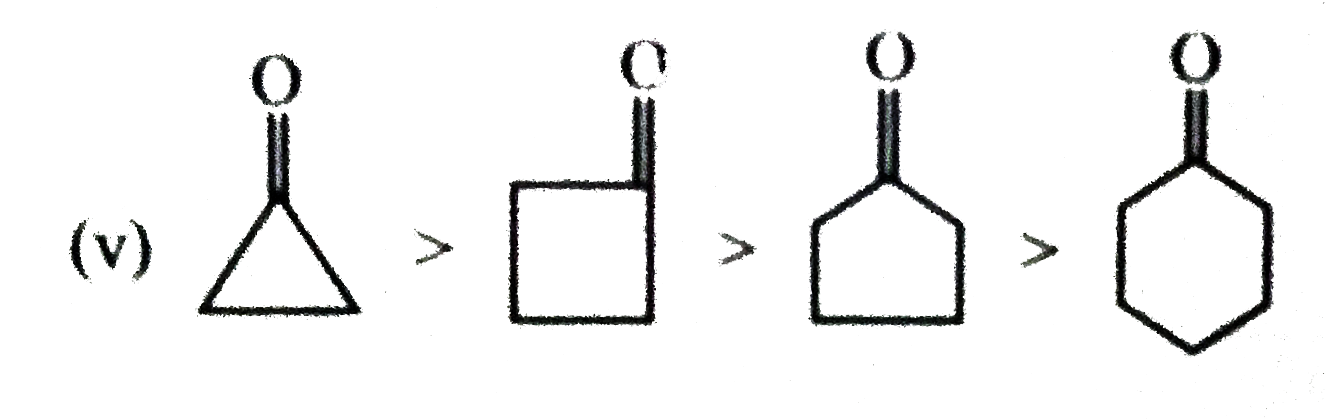
|
|
| 9. |
Arrange the following (I) CH_3CH_2CH_2CH_2Cl (II) CH_3CH_2-CHCl-CH_3 (III) (CH_3)_2CHCH_2Cl (IV) (CH_3)_3C-Cl in order of decreasing tendency towards SN^2 reaction. |
|
Answer» IgtIIIgtIIgtIV |
|
| 10. |
Arrange the following halides in order of increasing S_(N)2 reactivity: CH_(3)Cl, CH_(3)Br, CH_(3)CH_(2)Cl,(CH_(3))_(2)CHCl. |
|
Answer» Solution :As the size of the ALKYL group increases, `S_(N)2` reactivity decreases. Further, C-BR bond being weaker is easier to break than C-CL bond. Therefore, the overall increasing `S_(N)2` reactivity follows the ORDER: `(CH_(3))_(2)CHCl lt CH_(3)CH_(2) Cl lt CH_(3)Cl lt CH_(3)Br`. |
|
| 11. |
Arrange the following hydrides of Group 16 elements inthe increasing order ofthermal stability. H_(2)O, H_(2)S, H_(2)Se, H_(2)Te |
|
Answer» Solution :THERMAL stability increases in the ORDER : `H_(2)O LT H_(2)S lt H_(2)Se lt H_(2)Te lt H_(2)PO` |
|
| 12. |
Arrange the following halides in increasing order of SN^(2) reactivity.CH_(3)Br, CH_(3)CH_(2)Cl, CH_(3)Cl, (CH_(3))_(2)CHCl |
|
Answer» `(CH_(3))_(2)CHCL LT CH_(3)CH_(2)Cl lt CH_(3)Cl lt CH_(3)BR` |
|
| 13. |
Arrange the following groups in decreasing activating order : (i) -NR_(2) (ii) -Me (iii) NHAc (iv) -OH |
|
Answer» `I GT IV gt III gt II` |
|
| 14. |
Arrange the following group of acids in decreasing order of acidity ,(1) Ethanoic acid(2) Methanoic acid (3) Butanoic acid (4) Propanoic acid |
|
Answer» `2gt1gt4gt3` |
|
| 15. |
Arrange the following group in order of their nucleophilic strength :- |
|
Answer» `AgtBgtCgtD` |
|
| 16. |
Arrange the following group in order of their decreasing leaving ability: |
|
Answer» `AgtDgtBgtC` |
|
| 17. |
Arrange the following esters in the decreasing order of alkaline hydrolysis: (i) HCOOCH_(3),CH_(3)COOCH_(3),(CH_(3))_(3)C-COOH_(3),(CH_(3))_(2)CHCOOCH_(3) (ii) CH_(3)COOCH_(3),CH_(3)COOC(CH_(3))_(3),CH_(3)COOCH(CH_(3))_(2),CH_(3)COOC_(2)H_(5) |
|
Answer» SOLUTION :(i) `HCOOCH_(3)gtCH_(3)COOCH_(3)GT(CH_(3))_(2)CHCOOCHgt(CH_(3))_(3)C-COOCH_(3)` (ii) `CH_(3)COOCH_(3)gtCH_(3)COOCH_(3)gtCH_(3)COOC_(2)H_(5)gtCH_(3)COOCH(CH_(3))_(2)gtCH_(3)COOC(CH_(3))_(3)` |
|
| 18. |
Arrange the following elements in the order of increasing atomic radius N, O, F and Ne. |
| Answer» SOLUTION :`F LT O lt N lt NE` | |
| 19. |
Arrange the following elements in the increasing order of their first ionisation enthalpy : Li, Be, Na, Mg. |
| Answer» SOLUTION :`NA LT LI lt MG lt Be` | |
| 20. |
Arrange the following elements in the decreasing order of their electronegativity : Si, N, F, Cl . |
| Answer» SOLUTION :`F GT CL gt N gt SI` | |
| 21. |
Arrange the following elements according to their percentage proportion present in earth crust. |
| Answer» Answer :B | |
| 22. |
Arrange the following electrolytes in the increasing order of coagulating power for ferric hydroxide sol |
|
Answer» Ilt IIlt IIIlt IV |
|
| 23. |
Arrange the following diagrams in correct sequence of steps involved in the mechanism of catalysis, in accordance with modern adsorption theory. |
|
Answer» (i) (ii) (iii) (iv) (v) (ii) Reactant moleccules GET adsorbed on the surface of catalyst. (iii) Reactant molecules form an INTERMEDIATE |
|
| 24. |
Arrange the following compunds in increasing order of solubility in water: C_(6)H_(5)NH_(2), (C_(2)H_(5))_(2)NH, C_(2)H_(5)NH_(2) |
| Answer» Solution :`C_(6)H_(5)NH_(2), LT (C_(2)H_(5))_(2)NH, lt C_(2)H_(5)NH_(2)` | |
| 25. |
Arrange the following cyano complexes in decreasing order of their magnetic moment. |
|
Answer» `[Cr(CN)_(6)]^(3-)GT [Mn(CN)_(6)]^(3-)gt [Fe(CN)_(6)]^(3-) gt [Co(CN)_(6)]^(3-)` |
|
| 26. |
Arrange the following compounds ini increasing order of dipole moment. CH_(3)CH_(2)CH_(3),CH_(3)CH_(2)NH_(2),CH_(3)CH_(2)OH |
| Answer» Solution :Since O is more ELECTRONEGATIVE than N, THEREFORE, DIPOLE moment of ETHYL alcohol is higher than that of ethylamine. Propane, however, has the least dipole moment since it is almost a non-polar molecule. Thus, the dipole moment increases in the order: `CH_(3)CH_(2)CH_(3) lt CH_(3) CH_(2) NH_(2) lt CH_(3)CH_(2)OH`. | |
| 27. |
Arrange the following compounds in the order of increasing boiling points : (i)CH_3 CN "" (ii) CH_3 Cl ""(iii) CH_3 NC |
| Answer» SOLUTION :`CH_3 CL gtCH_3 NCLT CH_3 CN` | |
| 28. |
Arrange the following compounds in the order of increasing boiling point:Ethanol,propan-1-o1, Butan-1-o1, Butan-2-o1. |
| Answer» SOLUTION :ETHANOL, Propan-1-o1, Butan-2-o1, Butan-1-o1. | |
| 29. |
Arrange the following compounds in the increasing order of their densities. |
|
Answer» `(i)LT(ii)lt(iii)lt(iv)` |
|
| 30. |
Arrange the following compounds in the inereasing order of their acid strength. propan-1-o1, 2,4, 6-trinitrophenol, 3-nitrophenol, 3.5-dinitrophenol. phenol. 4-methyiphenol |
|
Answer» Solution :Phenols are stronger acids than alcohols because the phenoxide ion left after the removal of proton is stabilized by resonance while the alkoxide ion left after the removal of a proton fromalcohol is not stabilized. Thus propan-1-ol is much weaker acid than any phenol. Thus propan-1-ol is a much weaker acid than any phenol. We know that ELECTRON donating groups decrease the acidic character and stronger is the electron donating group, weaker is the phenol. Compare to propan-1-ol, 4-methyl phenol is stronger acidic character. But comparing phenol and 4-methyl phenol, phenol is stronger acidic. Since electron withdrawing groups increase the acidic character of phenols and the effect is more pronounced at the para position than at the meta position. Therefore 4- NITRO phenol is a stronger acid than 3-nitro phenol. Further as the number of electron withdrawing groups increases the acidic strength further increases. Therefore 2, 4, 6 - trinitro phenol is a strongeracid than 3, 5-dintiro phenol. It may be noted here that although the two nitro groups in 3, 5-dinitro phenol are at m-position with respect to OH group, their combined effect is however greater than one nitro group at p-position. Therefore 3, 5-dinitro phenol is a stronger acid than 4-nitro phenol. Thus, the overall increasing order of acid strength is: Propan-1-ol <4-methyl phenol < phenol< 3-nitrophenol<3, 5-dinitro phenol < 2, 4, 6-trinitro phenol. |
|
| 31. |
Arrange the following compounds in the increasing order of their densities. . |
|
Answer» `(i) lt (ii) lt (iii) lt (IV)` |
|
| 32. |
Arrange the following compounds in the increasing order of their boiling points. (i). |
|
Answer» `(ii) lt (i) lt (iii)` |
|
| 33. |
Arrange the following compounds in the increasing order of their boiling points. Acetone, n-propyl alcohol, ethyl methyl ether, n-butane. |
| Answer» SOLUTION :n-butane LT ETHYL methyl ETHER lt acetone lt n-propyl alcohol. | |
| 34. |
Arrange the following compounds in the increasing order of their boiling points. CH_3CHO, CH_3CH_2OH, CH_3OCH_3, CH_3CH_2CH_3 |
|
Answer» |
|
| 35. |
Arrange the following compounds in the increasing order of their basic strength. CH_(3)NIFNa^(+),C_(2)H_(5)NH_(2),(ISOC_(3)H_(2))_(3) and CH_(3)CONH_(2) |
| Answer» SOLUTION :`CH_(3)ICONH_(2) < (iso-C_(3)H_(2))_(3) N`<`C_(2)H_(5)NH_(2) < CH_(3)NH^(-) Na^(+)` | |
| 36. |
Arrange the following compounds in the increasing order of their acidic strength : i. m - nitrophenolii.m - cresol iii. Phenoliv. m -chlorophenol |
|
Answer» `ii lt iv lt iii lt i` 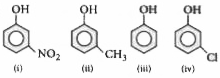 Nitro group has both - R effectand - I effect , but - R effect PREDOMINATES . Due to stronger electron with drawing nature of - `NO_(2)` group , PHENOXIDEION is stabilized more . Hence nitrophenol is more ACIDIC thanphenol. Methyl group destabilizes the phenoxide ION by + I effect and hyperconjugation . Hence m - cresol is weakeracidthan phenol . - R effect of nitrogroup is stronger than - I effect of chlorine, hence m - nitrophenol is moreacidic than m - childphenol . Therefore the correct order of acidicstrength ism - nitrophenol `GT` m - chlorophenol `gt` phenol `gt ` . |
|
| 37. |
Arrange the following compounds in the increasing order of their acidic strength (i) m-nitrophenol (ii) m-cresol (iii) phenol (iv) m-chlorophenol |
|
Answer» `ii lt IV lt iii lt` `i` |
|
| 38. |
Arrange the following compounds in the descending order of their pK_a valuesa) 2,4,6-trinitrophenol b) 3,4-dimitrophenol c) m-nitrophenol d) p-cresol e) phenol |
|
Answer» `a GT B gt C gt e gt d ` |
|
| 39. |
Arrange the following compounds in the decreasing order of reactivity towards S_(N)2 displacement reaction and give reasons in support of your answer: (a) C_(2)H_(5)Br , C_(2)H_(5)I, C_(2)H_(5)Cl (b) (CH_(3))_(3)CBr , CH_(3)CH_(2)CHBrCH_(3), CH_(3)CH_(2)CH_(2)CH_(2)Br . |
|
Answer» Solution :(a) `C-I ` I bond is weaker than C - Br bond which is weaker than C-Cl bond. The second step in `S_(N)2`REACTION is the BREAKING of carbon-halogen bond. Weaker the bond, easier is it to break it and greater will be the reactivity of the `S_(N)2`reaction. Hence, the decreasing order of reactivity towards `S_(N)2`displacement reaction will be `C_(2)H_(5)I gt C_(2)H_(5)Br gt C_(2)H_(5)Cl ` (b) `underset("Tertiary halide") ((CH_(3))_(3)CBr)"" underset("SECONDARY halide") (CH_(3)CH_(2)CHBrCH_(3)) "" underset("PRIMARY halide")(CH_(3)CH_(2)CH_(2)Br) ` Primary halide Primary halides offer the least steric HINDERANCE to the attachment of the nucleophile to the carbon atom, followed by secondary halide followed by tertiary halide. Hence, the decreasing order of reactivity towards `S_(N)2`reaction will be: `CH_(3)CH_(2)CH_(2)CH_(2)Br gt CH_(3)CH_(2)CHBrCH_(3) gt (CH_(3))_(3)CBr` |
|
| 40. |
Arrange the following compounds in increasing order of their acid strength: Propane-1-ol, 2, 4, 6-trinitrophenol, 3-nitrophenol, 3,5-dinitrophenol , phenol, 4-methylphenol. |
|
Answer» `a lt b lt c lt E lt d ` |
|
| 41. |
Arrange the following compounds in the decreasing of their boiling points and solubilitiy in H_(2)O. a.(I) Methanol(II) Ethanol(III) Propan-1-ol(IV) Butan-1-oI(V) Butan-2-oI(VI) Pentane-1-oI b. (I) Pentanol(II) n-Butane(III) Pentanal(IV) Ethoxy ethane c. (I) Pentane(II) Pentane-1,2,3,-triol(III) Butanol d. (I) Butane(II)Butanol(III) Pentanol e. (I) Pentan-1-oI(II)2-Methyl butan-2-oI(III)3-Methyl butan-2-oI f.(I) n-Butyl alcohol(II) sec-Butyl alcohol(III)t-Butyl alcohol |
|
Answer» Solution :a.Boiling point order:`VI gt IV gt V gt III gt II gt I` Solubility order:`I gt II gt III gt V gt IV gt VI` Explanation:All of them are alcohols, so all have H-bonding. As the molecular mass and surface area increase, the boiling point increase and solubility decreases.Out of (IV) and (V) , there is branching in (V) and has less surface area than (IV), so the boiling of (IV) gt (V), but solubility of (V) gt (IV). b.Boiling point order: `I gt III gt IV gt II Solubility order:`I gt III gt IV gt II` In (I), there is H-bonding, in (II) (aldehyde), dipoledipole INTERACTION, in (III) (ether), slightly polar due to EN of O, and in (IV) (alkane), van der Waals interaction (non-polar). c.Boiling point order:`II gt III gt I` Solubility order:`II gt III gt I` In (II), three `(---OH)` GROUND, more H-bonding, in (II), one Waals interaction. d.Boiling point order:`III gt II gt I` Solubility order:`II gt III gt I` Both (II) and (III) have H-bonding, but molecular mass of (III) gt (II), hence the given boiling point order. Solubility of (II) gt (III), because in (III), size of R-group non-polar (hydrophobic part) is larger, hence the given solubility order. e.Boiling point order:`I gt II gt III` Solubility order :`III gt II gt I` (I) 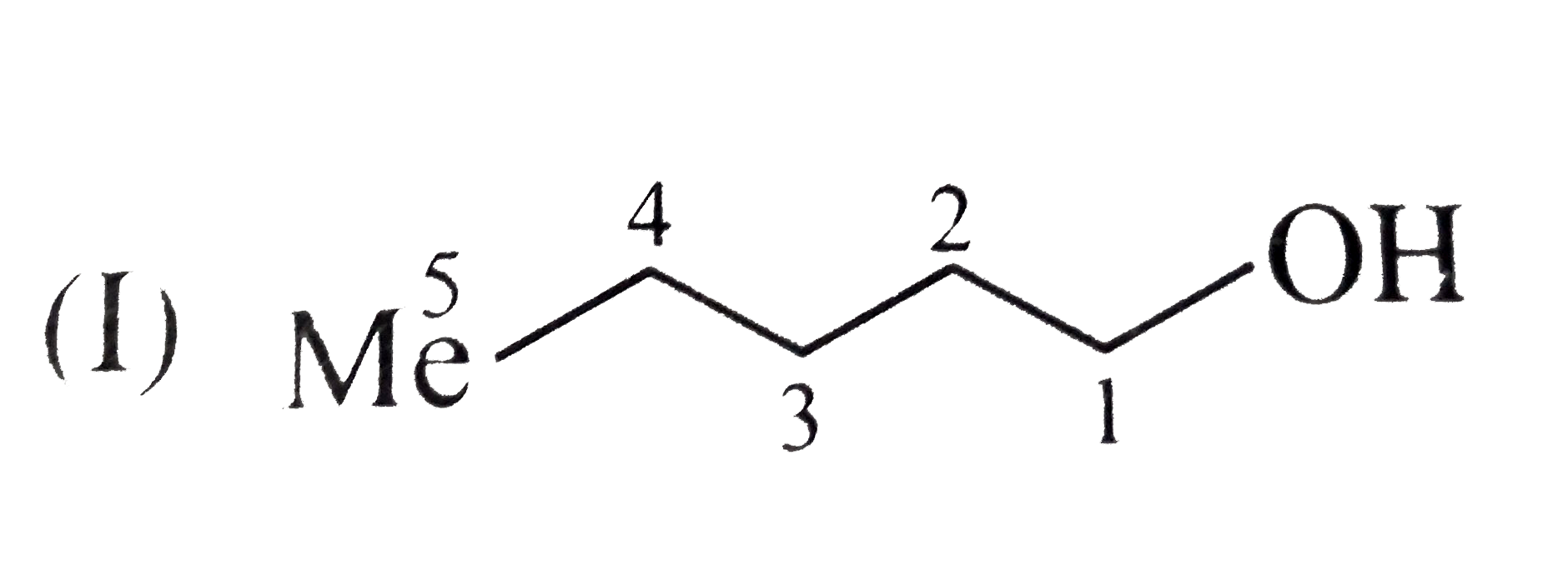 (II) (II)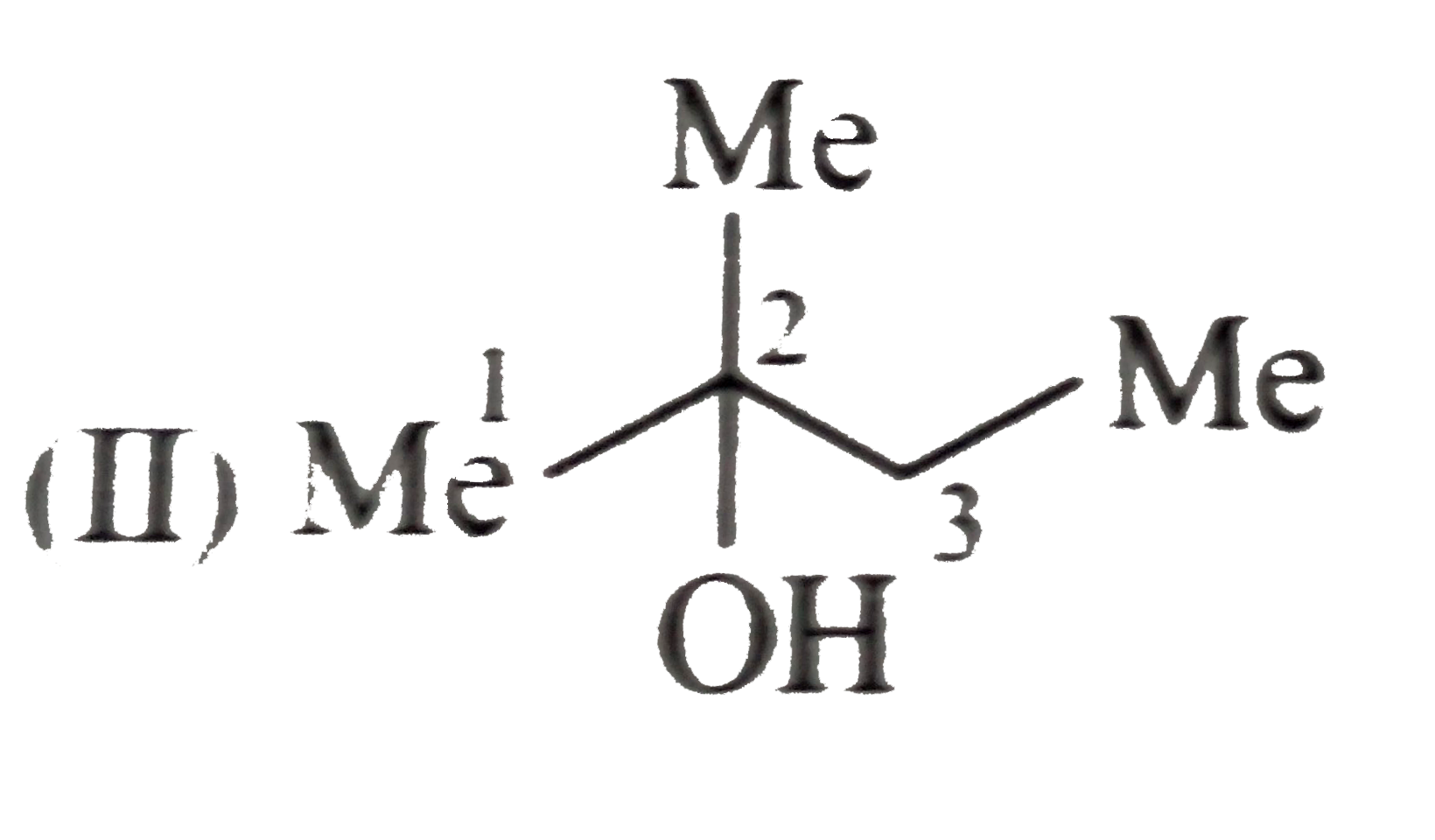 (III)  All alcohols have H-bonding, same molecular MASSES, but branching increases form(I) to (II). Their shape becomes more compact and spherical and therefore less surface contact is available for van der Waals attractive FORCE. So, boiling point decreases and solubility in `H_(2)O` increase. f.Boiling point order :`I gt II gt III` Solubility order :`III gt II gt I` All aclcohols have H-bonding. Surface area of `(I) gt (II) gt III` . Hence, the boiling point and solubility order are as given above. |
|
| 42. |
Arrange the following compounds in order of their decreasing reactivity with an electrophile : (i) Chlorobenzene (ii) 2, 4-dinitrochlorobenzene (iii) p-nitrochlorobenzene |
|
Answer» `III GT II gt i` |
|
| 43. |
Arrange the following compounds in order of increasing S_(N)1 reactivity:CICH_(2)CH = CHCH_(2)CH_(3)(I), CH_(3)overset(CI)overset(|)(C)=CHCH_(2)CH_(3)(II), CH_(3)CH = CHCH_(2)CHCH_(3)(III) |
| Answer» SOLUTION :The ORDER of INCREASING `S_(N)1` reactivity is : II < III < I. | |
| 44. |
Arrange the following compounds in order of increasing solubility (i) MgF_(2) (ii) CaF_(2) (iii) BaF_(2) |
|
Answer» `(i) LT (II) lt (III)` |
|
| 45. |
Arrange the following compounds in order of increasing reactivity towards nucleophilic addition reaction (AAK_MCP_37_NEET_CHE_E37_025_Q01) |
|
Answer» `(II) LT (I) lt (III)` |
|
| 46. |
Arrange the following compounds in order of increasing reactivity towards nitration (AAK_MCP_35_NEET_CHE_E35_012_Q01) |
|
Answer» (ii) lt (i) lt (III) lt (IV) |
|
| 47. |
Arrange the following compounds in order of increasing E2 reactivity (dehudrobromination): (CH_3)_(2)CHBr(I),(CH_3)_(3)CBr(II), CH_(3)CH_(2)Br(III). |
| Answer» SOLUTION :`III < I < III | |
| 48. |
Arrange the following compounds in order of increasing dipole moment . Toluene (I) m-dichlorobenzene (II) o-dichlorobenzene (III) . P-dichlorobenzene (IV) . |
|
Answer» `IltIVltIIltIII` 
|
|
| 49. |
Arrange the following compounds in order of increasing dipole moment : Toluene (I), m-dichlorobenzene (II), o-dichlorobenzene (III), p-dichlorobenzene (IV) |
|
Answer» `IltIVltIIltIII` |
|