

Saved Bookmarks
This section includes 7 InterviewSolutions, each offering curated multiple-choice questions to sharpen your Current Affairs knowledge and support exam preparation. Choose a topic below to get started.
| 1. |
Arrange the following compounds in order of incraesing S_(N)2 reacitivity and explain: (i) 2-bromo-2-methylbutane, 1-bromopentane, 2-bromopentane. |
|
Answer» Solution :`underset(2-"brome"-2-"methylbutane"(3^@))(CH_(3)-underset(Br)underset(|)overset(CH_3)overset(|)(C)-CH_(2)CH_(3))``underset(1-"bromopentane"(1^@))(CH_(3)CH_(2)CH_(2)CH_(2)CH_(2)Br)` `underset(1-"bromopentane"(1^@))(CH_(3)underset(Br)underset(|)CH-CH_(2)CH_(2)CH_(3))` The `S_(N)2` reacitivity of ALKYL halides depends on the steric hindrance at the reactingcentre. The tendency of nucleophilic attack increases with decrease in steric crowding. The steric hindrance in `S_(N)2` transition state PROGRESSIVELY increases from primary `(1^@)` halide to TERTIARY `(3^@)` halide. Thus, the `S_(N)2` reactivity of to tertiary `(3^@)` halide. Thus, the `S_(N)2` reactivity of these compounds follows the order: 1-bromopentane > 2-bromopentane > 2-bromo-2-methylbutane. |
|
| 2. |
Arrange the following compounds in increasnig order of their boiling CH_(3)CH_(2)CH_(2)CHO,CH_(3)CH_(2)CH_(2)CH_(2)OH,C_(2)H_(5)OC_(2)H_(5),CH_(3)CH_(2)CH_(2)CH_(2)CH_(3). |
|
Answer» Solution :The molecular masses of all these compounds are comparable: `CH_(3)CH_(2)CH_(2)CHO(72),CH_(3)CH_(2)CH_(2)CH_(2)OH(74),C_(2)H_(5)-O-C_(2)H_(5)(74),CH_(3)CH_(2)CH_(2)CH_(2)CH_(3)(72)`. Butan-1-ol, i.e., `CH_(3)CH_(2)CH_(2)CH_(2)OH` UNDERGOES extensive intermolecular H-bonding, therefore, its boling POINT is the highest. Butanal is more polar than ethoxyethane, therefore, dipole-dipole interactions are stronger in `CH_(3)CH_(2)CH_(2)CHO` than in `C_(2)H_(5)OC_(2)H_(5)` and hence the b.p. of `CH_(3)CH_(2)CH_(2)CHO` is highest than that of `C_(2)H_(5)OC_(2)H_(5)`. further due to the presence of oxygen atom the molecules of `C_(2)H_(5)OC_(2)H_(5)` are little less symmetrical than those of n-pentane as a result, VAN der waals forces of attraction between molecules of `C_(2)H_(5)OC_(2)H_(5)` are slightly lower than those between molecules of n-pentane. hence, the b.p. of n-pentane is little higher than that of `C_(2)H_(5)OC_(2)H_5`. thus, the overall increasing order of boiliing points is: `C_(2)H_(5)OC_(2)H_(5) lt CH_(3)CH_(2)CH_(2)CH_(2)CH_(3) lt CH_(3)CH_(2)CH_(2)CHO lt CH_(3)CH_(2)CH_(2)CH_(2)OH` Please note that in N.C.E.R.T. test book, this order has been wrongly written as: `CH_(3)CH_(2)CH_(2)CH_(2)CH_(3) lt C_(2)H_(5)OC_(2)H_(5) lt CH_(3)CH_(2)CH_(2)CHO lt CH_(3)CH_(2)CH_(2)CH_(2)OH`. |
|
| 3. |
Arrange the following compounds in increasing orderr of boiling point. Propan-1-ol, butan-1-ol, butan-2-ol, pentan-1-ol |
|
Answer» Propan-1-ol, butan-2-ol, butan-1-ol, pentan-1-ol |
|
| 4. |
Arrange the following compounds in increasing order of their reactivity in nucleophilic addition reactions. (i) Ethanal, propanal, propanone, butanone |
|
Answer» (Aldehydes are more reactive than KETONES, REACTIVITY decreases with increases in size of alkyl groups) |
|
| 5. |
Arrange the following compounds in increasing order of their reactivity in nucleophilic addition reactions. (ii) Benzaldehyde, P-Tolualdehyde, P-Nitrobenzaldehyde Acetophenone |
|
Answer» (PRESENCE of electron withdrawing GROUP such as `-NO_2` INCREASES the reactivity of carbonyl group and presence of electron donating group such as `-CH_3` decreases it reactivity) |
|
| 6. |
Arrange the following compounds in increasing order of their reactivity in nucleophilic addition reactions. (i) Ethanal, Propanal, Propanone, Butanone (ii) Benzaldehyde, p - Tolualdehyde, p - Nitrobenzaldehyde, Acetophenone |
|
Answer» <P> SOLUTION :(i) Butanone < Propanone < Propanal < ETHANAL(ii) Acetophenone < p - Tolualdehyde < Benzaldehyde < p - NITROBENZALDEHYDE |
|
| 7. |
Arrange the following compounds in increasing order of their reactivity in nucleophilic addition reactions Ethanal (I), Propanal (II), Propanone (III), Butanone (IV) |
|
Answer» `III LT II lt I lt IV`  (b) Steric effect: In FORMALDEHYDE, there is no alkyl group while in all other aldehydes there is one alkyl group, so here the nucleophilic attack is relatively more easy, but in ketones there are two alkyl groups attached to carbonyl group and these cause hindrance to the attacking group. This factor is also called steric hindrance (crowding). In other words, as the hindrance increases, the reactivity decreases accordingly. Thus, the order of reactivity is: `I gt II gt III gt IV`. |
|
| 8. |
Arrange the following compounds in increasing order of their reactivity in nucleophilic addition reactions. Ethanal, Propanal, Propanone, Butanone |
|
Answer» Butanone LT PROPANONE lt PROPANAL lt Ethanal |
|
| 9. |
Arrange the following compounds in increasing order of their property as indicated: (i) CH_(3)COCH_(3),C_(6)H_(5)COCH_(3),CH_(3)CHO (ii) Cl-CH_(2)-COOH,F-CH_(2)-COOH,CH_(3)-COOH (acidic character) |
|
Answer» Solution :(i) `C_(6)H_(5)COCH_(3)gtCH_(3)COCH_(3)gtCH_(3)CHO` (ii) `CH_(3)-COOH lt Cl-CH_(2)-COOHlt F -CH_(2)-COOH` |
|
| 10. |
Arrangethe following compounds in increasing order of their property as indicated : (i) Acetaldehyde, Acetone, Di - tery - butyl ketone, Methyl tert - butyl ketone (reactivity towards HCN) CH_(3)CH_(2)CH(Br)CH_(2)COOH,(CH_(3))_(2)CHCOOH,CH_(3)CH_(2)CH_(2)COOH(" acid strength"). (iii) Benzoic acid, 4 - Nitrobenzoic acid, 3, 4 - Dinitrobenzoic acid, 4 - Methoxybenzoic acid (acid strength). |
Answer» Solution :(i) The reactivity towards HCN addition decreases as the `+I-` effect of the ALKYL group increases and the steric hindrance to the nucleophilic attack by `CN^(-)` increases. Di - tert - butyl KETONE offers the MAXIMUM steric hindrance and has maximum `+I-` effect. Therefore, it has the least reactivity.  tery - Butylmethyl ketone also offers a lot of steric hindrance and `+I-` effect. But, it is a more reactive than Di - tery - butyl ketone. Acetaldehyde is most reactive. Order of reactivity is : `"Di - tery - butyl ketone "lt "tert - Butyl methyl ketone" lt "Acetone" lt "Acetaldehyde"` 2)CHCOOH` is a weaker acid than `CH_(3)CH_(2)CH_(2)COOH`. Further `-I-` effect decreases with distance, therefore, `CH_(3)CH_(2)CH(Br)COOH` is a STRONGER acid than `CH_(3)CH(Br)CH_(2)COOH`. Thus, the overall acid strength increases in the order : `CH_(3)-overset(CH_(3))overset("|")"CH"-COOH lt CH_(3)CH_(2)CH_(2)-COOH lt CH_(3)-underset (Br)underset(|)CH-CH_(2)-COOH lt CH_(3)-CH_(2)-underset(Br)underset(|)CH-COOH` (iii) Since electron - donating groups decrease the acid strength, 4 - methoxybenzoic acid is a weaker acid than benzoic acid. Since electron - withdrawing group increase the acid strength, 4 - nitrobenzoic acid and 3, 4 - dinitrobenzoic acids are stronger acids than benzoic acid. Further due to the presence of an additional `NO_(2)` group at m - position w.r.t. `COOH` group, 3, 4 - dinitrobenzoic acid is a stronger acid than 4 - nitrobenzoic acid. Thus, the overall acid strength increases in the order : `"4 - Methoxybenzoic acid" lt " Benzoic acid " lt "4 - Nitrobenzoic acid "lt 3, 4 - "Dinitrobenzoic acid."` |
|
| 11. |
Arrange the following compounds in increasing order of their property as indicated: (i) Acetaldehyde, Acetone, DI-tert-butyl ketone, Methyl tert-butyl ketone (reactivity towards HCN). (ii) CH_(3)CH_(2)CH(Br)COOH,CH_(3)CH(Br)CH_(2)COOH,(CH_(3))_(2)CHCOOH,CH_(3)CH_(2)CH_(2)COOH (acid strength). (iii) Benzoic acid, 4-Nitrobenzoic acid, 3,4-Dinitrobenzoic acid, 4-Methoxybenzoic acid (acid strength). |
Answer» Solution :(i) The reativity towards HCN addition decreases at the +I-effect of the alkyl group/s increases and/or the steric hindrance to the nucleophilic attach by `CN^(-)` at the carbonyl carbon increases. Thus, the reactivity decreases inthe order. 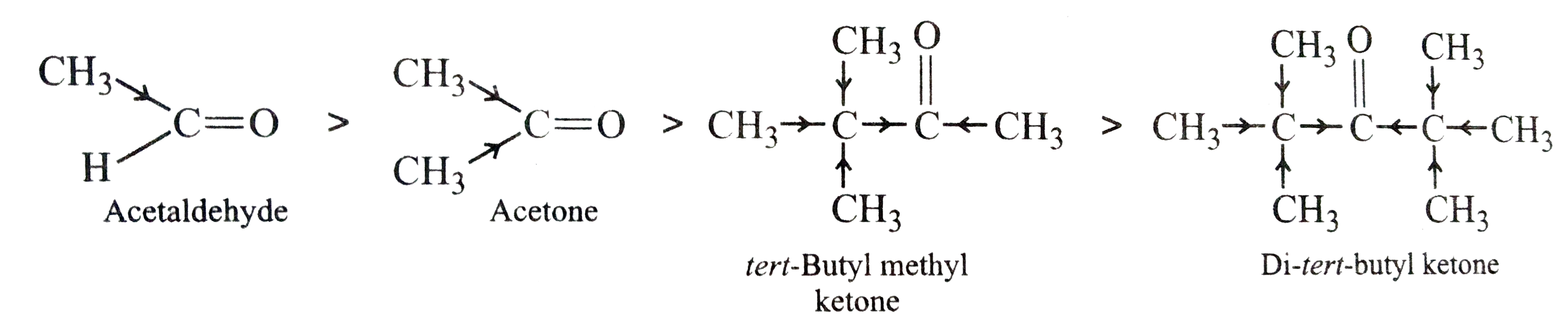 In other words, reactivity increases in the REVERSE order, i.e., Di-tert-butyl ketone lt tert-butyl methyl ketonelt acetonelt acetaldehyde. (ii) we KNOWN that +I-effect decreases while -I-effect increases the acid strength of carboxylic acids. Since +I-effect of isopropyl group is more tha the of n-propyl group, therefore, `(CH_(3))_(2)CHCOOH` is a weaker acid than `CH_(3)CH_(2)CH_(2)COOH`. Further Since -I-effect decreases with distance, therefore, `CH_(3)CH_(2)CH(Br)COOH` is a stronger acid than `CH_(3)CH(Br)CH_(2)COOH`. thus, the overall acid strength increases in the order: `CH_(3)-overset(CH_(3))overset(|)(C)H-COOH lt CH_(3)CH_(2)CH_(2)- COOH lt CH_(3)-UNDERSET(Br)underset(|)(C)H-CH_(2)-COOH lt CH_(3)-CH_(2)-underset(Br)underset(|)(C)H-COOH` (iii) Since electron-donating GROUPS decrease the acid strength, therefore, 4-methoxybenzoic acid is a weaker acid than benzoic acid. Further since electron-withdrawing groups inicrease the acid strength, therefore, both 4-nitrobenzoic acid and 3-4-dinitrobenzoic acids are stronger acids than benzoic acid further due to the presence of an additional `NO_(2)` group at m-position w.r.t. `COOH` group, 3,4-dinitrobenzoic acid is a little stronger acid than 4-nitrobenzoic acid. thus, the overall acid strength increases in the order: 4-Methoxybenzoic acidltBenzoic acidlt4-Nitrobenzoic acidlt3,4-Dinitrobenzoic acid. |
|
| 12. |
Arrange the following compounds in increasing order of their densities: |
|
Answer» SOLUTION :Density of COMPOUND increases with the increse in the molecular mass. Therefore, the correct oder of INCREASING densities is: (i)lt(ii)lt(III)lt(iv). |
|
| 13. |
Arrange the following compounds in increasing order of their boilnig points: CH_(3)CH_(2)CH_(2)CH_(2)OH,CH_(3)CH_(2)COCH_(3),CH_(3)CH_(2)OCH_(2)CH_(3). |
|
Answer» Solution :The four compounds have comparable molecular masses: `CH_(3)CH_(2)CH_(2)CHO(72),CH_(3)CH_(2)CH_(2)CH_(2)OH(74),CH_(3)CH_(2)COCH_(3)(72) and CH_(3)CH_(2)OCH_(2)CH_(3)(74)`. Amongst compounds having comparable molecular masses, alcohols have the highest b.p. due to INTERMOLECULAR H-bonding, i.e., `CH_(3)CH_(2)CH_(2)CH_(2)OH` has the highest boiling POINT. the boiling points of `CH_(3)CH_(2)CH_(2)CHO,CH_(3)CH_(2)OCH_(2)CH_(3) and CH_(3)CH_(2)COCH_(3)` DEPEND upon their RELATIVE dipole moments. since dipole moments of these three compounds decrease in the order: ketonesgtaldehydesgtethers., therefore, their boiling points also decrease in the same order, i.e., b.ps. decrease in order: `CH_(3)COCH_(2)CH_(3) GT CH_(3)CH_(2)CH_(2)CHO gt CH_(3)CH_(2)OCH_(2)CH_(3)`. thus, the boiling points of the four compounds decrease in the order: `CH_(3)CH_(2)CH_(2)OH gt CH_(3) COCH_(2)CH_(3) gt CH_(3) CH_(2)CH_(2) CHO gt CH_(3)CH_(2)OCH_(2)CH_(3)` |
|
| 14. |
Arrange the following compounds in increasing order of their boiling points.(i) (ii) CH_(3)CH_(2)CH_(2)CH_(2)Br(iii) H_(3)C-overset(CH_(3))overset("|")underset("Br ")underset("| ")("C ")-CH_(3) |
|
Answer» `(ii)LT(i)lt(iii)` |
|
| 15. |
Arrange the following compounds in increasing order of their boiling points: CH_(3)CHO,CH_(3)CH_(2)OH,CH_(3)OCH_(3),CH_(3)CH_(2)CH_(3). |
| Answer» Solution :The molecular masses of all these compounds are comparable: `CH_(3)CHO(44),CH_(3)CH_(2)OH(46),CH_(3)COCH_(3)(46),CH_(3)CH_(2)CH_(3)(44).` `CH_(3)CH_(2)OH` undergoes extensive intermolecular H-bonding. Therefore, it EXISTS as an associated MOLECULE and hence its b.p. is the highest (351 K). `CH_(3)CHO(mu=2.72D)` is more polar than `CH_(3)OCH_(3) (mu=1.18D)`, therefore, dipole-dipole interactions are stronger in `CH_(3)CHO` than in `CH_(3)OCH_(3)` and hence the boiling point of `CH_(3)CHO(293K)` is MUCH higher than that of `CH_(3)OCH_(3)(249K)`. Further molecules of `CH_(3)CH_(2)CH_(3)` have only weak van der waals FORCES while the molecules of `CH_(3)OCH_(3)` have little stronger dipole-dipole interactions and hence the b.p. of `CH_(3)OCH_(3)` is higher (249K) than that of `CH_(3)CH_(2)CH_(3)(231K)`. thus, the overall increasing order of boiling points is: `CH_(3)CH_(2)CH_(3) lt CH_(3)OCH_(3) lt CH_(3)CHO lt CH_(3)CH_(2) OH`. | |
| 16. |
Arrange the following compounds in increasing order of their boiling points : CH_(3)CHO, CH_(3)CH_(2)OH, CH_(3)OCH_(3), CH_(3)CH_(2)CH_(3) |
|
Answer» Solution :The molecular masses of all these compounds are comparable : `CH_(3)CHO(4), CH_(3)CH_(2)OH(46), CH_(3)COCH_(3)(46),CH_(3)CH_(2)CH_(3)(44). CH_(3)CH_(2)OH`displayes extensiveintermolecular H - bonding. Therefore, it exists as an ASSOCIATED molecule molecule and hence its BOILING point is the highest (351K). `CH_(3)CCHO` has a higher VALUE of dipole moment (2.72 D) than `CH_(3)OCH_(3)` (1.18 D). Therefore, dipole - dipole interactions are stronger in `CH_(3)CHO` than in `CH_(3)OCH_(3)` and hence the boiling point of `CH_2CHO` is much higher thant that of `CH_3OCH_3.CH_3CH_3CH_3` shows only weak van der Walls.s fores. `CH_3OCH_3` has some dipole -dipole interactions and hence the boiling point of `CH_3OCH_3` is higher than that of `CH_3CH_2CH_3` . Thus, the increasing order of boiling points of the compounds is : `CH_3CH_2CH_3 < CH_3OCH_3 < CH_3CHO < CH_3CH_2OH`. |
|
| 17. |
Arrange the following compounds in increasing order of their boiling point (i) (CH_(3))_(2) CH_(2) CH_(2) - Br(ii) CH_(3) - (CH_(2))_(3) - Br(iii) (CH_(3))_(3)C - Br |
| Answer» Answer :C | |
| 18. |
Arrange the following compounds in increasing order of their boiling points. CH_(3)CHO,CH_(3)CH_(2)OH,CH_(3)OCH_(3),CH_(3)CH_(2)CH_(3) |
| Answer» Solution :`CH_(3)-CH_(2)-CH_(3)lt CH_(3)-O-CH_(3) lt CH_(3)CHO lt CHO_(3)CH_(2)OH`. | |
| 19. |
Arrange the following compounds in increasing order of their acid strength : Propan-1-ol, 2,4,6-trinitrophenol, 3-nitrophenol, 3,5-dinitrophenol, phenol, 4-methylphenol |
| Answer» SOLUTION :Propan-1-ol, 4-methylphenol, PHENOL, 3-nitrophenol, 3,5-dinitrophenol, 2,4,6 TRINITROPHENOL. | |
| 20. |
Arrange the following compounds in increasing order of S_(N)1 reactivity. (i) ClCH_(2)CH = CHCH_(2)CH_(3), CH_(3)C(Cl) = CHCH_(2)CH_(3), CH_(3)CH = CHCH_(2)CH_(2)Cl , CH_(3)CH = CHCH(Cl)CH_(3) (ii) CH_(3)CH_(2)Br, CH_(2) = CHCH(Br)CH_(3), CH_(2) = CHBr, CH_(3)CH(Br)CH_(3) (iii) (CH_(3))_(3)C Cl , C_(6)H_(5)C(CH_(3))_(2)Cl , (CH_(3))_(2)CHCl , CH_(3)CH_(2)CH_(2)Cl |
|
Answer» Solution :The REACTIVITY for Spi reactivity follows the order : `(i) CH_(3) - underset(I)underset(Cl)underset(|)C = CH - CH_(2) - CH_(3) lt CH_(3) - CH = underset(II) (CH - CH_(2) - CH_(2)Cl)lt ClCH_(2) - CH = underset(III) CH - CH_(2) - CH_(3)lt CH_(3) - CH = CH - underset(IV)underset(Cl)underset(|)CH - CH_(3) ` IVshows maximum reactivity because the carbocation is stabilised by resonance (CONJUGATION from double bond). I is least reactive because the carbocation is least stable, being linked to double bond directly. (ii) `CH_(2) = CHBr lt CH_(3)CH_(2)Br lt CH_(3) - underset(Br)underset(|)CH - CH_(3) lt CH_(3) = CH - underset(Br)underset(|)CH - CH_(3) ` This is againbased upon the STABILITY of the carbocation . (iii) `CH_(3)CH_(2)CH_(2)Cl lt (CH_(3))_(2)Cl lt (CH_(3))_(2)CHCl lt (CH_(3))_(3) C Cl lt C_(6)H_(5) - underset(CH_(3))underset(|)overset(Cl)overset(|)C - CH_(3)` The carbocation from `C_(6)H_(5)C(CH_(3))_(2)Cl ` is stabilised to the maximum extent. |
|
| 21. |
Arrange the following compounds in increasing order of solubility in water. C_(6)H_(5)NH_(2),(C_(2)H_(5))_(2)NH_(3),C_(2)H_(5)NH_(2). |
| Answer» Solution :The EXTENT of H-bonding and HENCE solubility in water DECREASES as the steric hindrance due to the size of alkyl/aryl groups INCREASES. THUS, solubility increases in the order: `C_(6)H_(5)NH_(2) lt (C_(2)H_(5))_(2)NH lt C_(2)H_(5)NH_(2)`. | |
| 22. |
Arrange the following compounds in increasing order of their acid strength: |
| Answer» SOLUTION :Propan-1-ol: 2, 4, 6-trinitrophenol, nitrophenol, 3,5-dinitrophenol: phenol: 4-methylphenol.M.C.E.R.L Ans. Increasing order of acid STRENGTH is : Propan-1-ol, 4-methylphenol, phenol, 3-nitrophenol, 3, 5-dinitrophenol, 2, 4, 6-trinitrophenol. | |
| 23. |
Arrange the following compounds in increasing order of rate of reaction towards nucleophilic substitution : |
|
Answer» I lt II lt iii |
|
| 24. |
Arrange the following compounds in increasing order of their acid strength: Propan-1-ol, 2,4-6-trinitrophenol, 4-nitrophenol, 3-nitrophenol, 3,5-dinitrophenol, phenol, 4-methylphenol (pcresol), 4-methoxyphenol. |
| Answer» Solution :(i) Phenols are stronger acids than alcohols, because the PHENOXIDE ion left after the removal of a proton is stabilized by RESONANCE while the alkoxide ion left after the removal of a proton from ALCOHOL is not stabilized. Thus, propan-1-ol is a much weaker acid than any phenol, i.e., 4-methylphenol, 4-methoxyphenol, 4-nitrophenol, 3-nitrophenol, 3,5-dinitrophenol, and 2,4,6-trinitrophenol. we know that electron-donating groups decrease the acidic character and stronger is the electron we know that electron-donating groups decrease the acidic character and stronger is the electron-donating GROUP, weaker is the phenol. since methoxy group (on a benzene ring) is a stronger electron-donating group than methyl group, therefore, 4-methoxyphenol is a weaker acid than 4-methylphenol and both are weaker acids than phenol. Since electron-withdrawing groups increase the acidic character of phenols, and the effect is more pronounced at the p-position than at the m-position, therefore, 4-nitrophenol is a stornger acid than 3-nitrophenol. further as the number of electron-withdrawing groups increases, the acidic strength further increases, therefore, 2,4,6-trinitrophenol is a stronger acid than 3,5-dinitrophenol. it may be noted here than although the two nitro groups in 3,5-dinitrophenol are at m-position w.r.t. OH group, their combined effect is, however, greater than one nitro group at p-postion. therefore, 3,5-dinitrophenol is a stronger acid than 4-nitrophenol. thus, the overall increasing order of acid strength is: propan-1-ollt4-methoxyphenollt4-methylphenolltphenollt3-nitrophenollt4-nitrophenollt3,5-dinitrophenollt2,4,6-trinitrophenol. | |
| 25. |
Arrange the following compounds in increasing order of rate of reaction towards nucleophilic substitution : |
| Answer» Answer :C | |
| 26. |
Arrange the following compounds in increasing order of C-OH bond length: methanol, phenol, p-ethoxyphenol |
|
Answer» `" phenol" LT "METHANOL" lt "p-methoxyphenol"` So, partial double bond CHARACTER develops in C-OH bond of phenol and p-ethoxyphenol but in case of p-ethoxyphenol, resonance is poor as compared to phenol. So, bond LENGTH follows the order : `"methanol" gt "p-ethoxyphenol" gt "phenol"` |
|
| 27. |
Arrange the following compounds in increasing order of dipole moment : ""CH_(3)CH_(2)CH_(3), CH_(3)CH_(2)OH, CH_(3)CH_(2)NH_(2) |
|
Answer» `""CH_(3)CH_(2)CH_(3) lt CH_(3)CH_(2)NH_(2) lt CH_(3)CH_(2)OH` |
|
| 28. |
Arrange the following compounds in increasing order of boiling point : Propan-1-ol, Butan-1-ol, Butan-2-ol, Pentan-1-ol |
|
Answer» Propan-1-ol, Butan-2-ol, Butan-1-ol, Pentan-1-ol |
|
| 29. |
Arrange the following compounds in increasing order of acidity and give a suitable explanation. Phenol, o-nitrophenol, o-cresol. |
| Answer» Solution :Due to -I and -R-effect of the `NO_(2)` group, o-nitrophenol is a stronger acid than phenol but do to +I-effect of the `CH_(3)` group, o-cresol is a weaker acid than phenol. Thus, acid strength of these THREE phenols increases in the order: o-cresolltphenollto-nitrophenol. | |
| 30. |
Arrange the following compounds in decreasing ordres fo K_(eq) for hydrate formation |
|
Answer» |
|
| 31. |
Arrange the following compounds in decreasing order of their basicity? . |
|
Answer» (III) `a gt b gt c gt d`. |
|
| 32. |
Arrange the following compounds in decreasing order of their acidic strength : Propan-1-ol, 3,5-Dinitrophenol, phenol, 2,4,6- Trinitrophenol, 3-Nitrophenol and 4-methylphenol. |
|
Answer» SOLUTION : DECREASING order of acidic strength: 2, 4, 6- TRINITROPHENOL > 3,5-Dinitrophenol > 3-5 Nitrophenol > Phenol > 4-Methylphenol > Propan-1-ol |
|
| 33. |
Arrange the following compounds in decreasing order of acidity. H_(2)O,ROH,HC-=CH |
|
Answer» SOLUTION :A STRONGER acid displaces a weaker aciid fromm its SALT, since `H_(2)O` displaces ROH from RONa and both `H_(2)O` and ALCOHOL displace acetylene from sodium acetylide, therefore, water is the strongest, followed by alcohol while acetylene is the weakest acid. in other words, acidity decreases in the order: `H_(2)O gt ROH gt HC-=CH` `underset("Stronger acid")(H_(2)O)+underset("Sod. alkoxide")(RONa)to underset("Weaker acid")(R-OH)+NaOH` `underset("Stronger acid")(H_(2)O)+underset("Sod. acetylide")(HC-=CN a)to underset("Weaker acid")(HC-=CH)+NaOH` `underset("Stronger acid")(ROH)+underset("Sod. acetylide")(HC-=CN a)to underset("Weaker acid")(HC-=CH)+RON a` |
|
| 34. |
Arrange the following compounds in decreasing order of acidity : H_(2)O, ROH, HC-=CH |
| Answer» SOLUTION :`H_(2)O GT ROH gt HC -=CH` | |
| 35. |
Arrange the following compounds in decreasing order of acidity: H_(2)O, R- OH, HC -=CH |
|
Answer» Solution :The order of acidity is : `H_(2)O, R- OH, HC -=CH` `to`The acidic strength increases with the increase in the electronegativity of atom and stability of the anion. The alcohol is a weak acid because the alkyl group destabilizes the alkoxide ion (conjugate base of the alcohol). In CASE of ETHYNE, the hydrogen is bonded to less electronegative atom, i.e., carbon whereas in water, the hydrogen is bonded to more electronegative element OXYGEN. So, the water is maximum acidic. |
|
| 36. |
Arrange the following compounds in an increasing order of basic strengths in their aqueous solutions : NH_3 , CH_3 NH_2, (CH_3)_2NH, (CH_3)_3 N |
| Answer» SOLUTION :`NH_3 LT (CH_3)_3NltCH_3 NH_2 lt (CH_3)_2 NH` | |
| 37. |
Arrange the following compounds in an increasing order of their reactivity in nucleophilic addition reaction : ethanal, propanal, propanone, butanone. |
| Answer» SOLUTION :`"BUTANONE"lt "PROPANONE"lt"propanal"lt"ETHANAL."` | |
| 38. |
Do as directed : (i) Arrange the following compounds in the increasing order of their basic strength in aqueous solution: CH_3NH_2,(CH_3)_3N,(CH_3)_2NH. (ii) Identify 'A' and 'B' (iii) Write equation of carbonylamine reaction. |
| Answer» SOLUTION :`NH_3 LT (CH_3)_3NltCH_3 NH_2 lt (CH_3)_2 NH` | |
| 39. |
Arrange the following compounds in an increasing order of basic strengths in their aqueous solutions : ""NH_(3), CH_(3)NH_(2), (CH_(3))_(2)NH, (CH_(3))_(3)N |
|
Answer» |
|
| 40. |
Arrange the following compounds in an increasing order of basic strength. Aniline, p-nitroaniline, p-toluidene. |
| Answer» SOLUTION :p-nitroaniline `LT` ANILINE `lt` p-toluidene. | |
| 41. |
Arrange the following compounds as directed : (i) In increasing order of solubility in water : (CH_3)_2.NH,CH_(3) NH_(2), C_(6) H_(5)NH_(2) (ii) In decreasing order of basic strength in aqueous solution : (CH_3)_3 N, (CH_3)_2 NH, CH_(3) NH_2 (iii) In increasing order of boiling point : (C_(2) H_(5))_(2) NH, (C_(2) H_(5))_(3)N, C_(2) H_(5) NH_(2) |
|
Answer» Solution :(i) Increasing order of solubility in water : `C_(6) H_(5) NH_(2) lt (CH_(3) )_(2) NH lt CH_(3) NH_(2)` (II) Decreasing order of basic strength in aqueous solution : `(CH_(3))_(2) NH GT CH_(3) NH_(2) gt (CH_(3))_(3) N` (III) Increasing order of boiling point : `(C_(2) H_(5))_(3) N lt (C_(2) H_(5) )_(2) NH lt C_(2) H_(5) NH_(2)` |
|
| 42. |
Arrange the following compounds according to their expected boiling points, with the lowest boiling point first, and explain your answer. Notice that the compounds have similar molecular weights. |
|
Answer» Solution :The order of increasing boiling points is : PENTANE `lt` DIETHYL ether `lt` sec-butyl ALCOHOL Pentane has no polar groups and has only dispersion FORCES holding its molecules together. It would have the lowest boiling point. Diethyl ether has the polar ether group that provides dipole-dipole forces which are greater than dispersion forces, meaning it would have a higher boiling point than pentane. sec-Butyl alcohol has an -OH group that can form strong hydrogen bonds: therefore, it would have the highest boiling point. |
|
| 43. |
Arrange the following compounds according to reactivity towards nucleophillic substitution reaction with reagents mentioned :- 4-nitrochlorobenzene> 2,4 dinitrochlorobemzene > 2,4,6, trinitrochlorobenzene with CH_(3)Ona |
| Answer» SOLUTION :2,4,6, trinitrochlorobenzene > 2,4 dinitrochlorobemzene > 4- NITROCHLOROBENZENE | |
| 44. |
Arrange the following compound in order of increasing dipole moment : (I) 1, 3, 5-Trichloro benzene (II) 1, 2, 4-Trichloro benzene (III) 1, 2, 3, 4-Tetrachloro benzene (IV) P-dichloro benzene |
|
Answer» `I=IV lt II lt III`  Dipolemnt moment ORDER `=III gt II gt I=IV` |
|
| 45. |
Arrange the following complexes in the increasing order of their molar conductivity : (a) K[Co(NH_(3))_(2)(NO_(2))_(4)] (b) [Cr(NH_(3))_(5)(NO_(2))]_(3)[Co(NO_(2))_(6)]_(2) (c ) Mg[Cr(NH_(3))(NO_(2))_(5)] (d) [Cr(NH_(3))_(3)(NO_(2))_(3)] |
Answer» Solution : ORDER of MOLAR conductivity (d) `lt` (a) `lt` (c ) `lt` (b) (Though (a) and (c ) give same NUMBER of ions but charges on ions in (c ) is double than on ions from (a)) |
|
| 46. |
Arrange the following compound for their reactivity toward nucleophilic substitution with HBr ? |
|
Answer» `AgtBgtCgtD` |
|
| 47. |
Arrange the following complexes in the increasing order of conductivity of their solution : [Co(NH_(3))_(3)Cl_(3)],[Co(NH_(3))_(4)Cl_(2)]Cl,[Co(NH_(3))_(6)]Cl_(3),[Cr(NH_(3))_(5)Cl]Cl_(2). |
|
Answer» Solution :`[Co(NH_(3))_(3)Cl_(3)]lt[CR(NH_(3))_(5)Cl]Cl lt[Co(NH_(3))_(5)Cl]Cl_(2)lt[Co(NH_(3))_(6)]Cl_(3)` This is the ORDER because ions produced are 0, 2, 3 and 4 RESPECTIVELY. |
|
| 48. |
Arrange the following compoound according to d_(C) order : (P) C_(2)F_(4)""(Q) C_(2)H_(4) (R ) [PtCl_(3)(C_(2)H_(4))]^(-) |
|
Answer» `PgtQgtR` |
|
| 49. |
Arrange the following compound in decreasing order of boiling point (i) propan-1-ol (ii) butane-1-ol (iii) butan-2-ol (iv) pentan-1-ol |
|
Answer» a) i GT iii gt ii gt iv |
|
| 50. |
Arrange the following complexes in the increasing order of conductivity of their solution: [Co(NH_(3))_(3)Cl_(3)], [Co(NH_(3))4Cl_(2)]Cl, [Co(NH_(3))_(6)]Cl_(3), [Cr(NH_(3))5Cl]Cl_(2). |
| Answer» SOLUTION :`[Co(NH_(3)_(3)Cl_(3)] < [Co(NH_(3))_(4)Cl_(2)]CL < [Cr(NH_(3))_(5)Cl]Cl_(2) < [Co(NH_(3))_(6)]Cl_(3)`. | |