

Saved Bookmarks
This section includes 7 InterviewSolutions, each offering curated multiple-choice questions to sharpen your Current Affairs knowledge and support exam preparation. Choose a topic below to get started.
| 1. |
Arrange the following in increasing order of their atomic radius : Na,K, Mg, Rb |
|
Answer» M LT K lt NA lt RB |
|
| 2. |
Arrange the following in increasing order of their acid strength: methylamine, dimethylamine, aniline, N-methylaniline. |
| Answer» Solution :The BASICITY of the given amines increases in the ORDER: anilineltN-methylanilineltmethylamineltdimethylamine. Therefore, their acid strength increases in the REVERSE order of their BASIC strength, i.e., dimethylamineltmethylamineltN-methylanilineltaniline. | |
| 3. |
Arrange the following in increasing order of their acidity? o-cresol(a), salicyclic acid(b), phenol( c) |
|
Answer» `cltaltb`  Electron RELEASING GROUPS `(-CH_(3), -OCH_(3), -NCH_(3)` etc) intensify the negative charge of phenoxide ion, i.e., destablises it hence decrease ionization of parent phenol. Therefore DECREASES acidity while electronwith drawing groups `(-NO_(2), -COOH, -CHO` etc.) INCREASES acidity. |
|
| 4. |
Arrange the following in increasing order of tensile strength : Nylon-6,Buna-S,Polythene |
|
Answer» SOLUTION :INTERMOLECULAR forces of attraction is a measure of the tensile STRENGTH of a polymer. Since elastomers have the weakest intermolecular forces of attraction followed by plastics while FIBRES have the strongest forces of attraction. In other words. intermolecular forces of attraction increase in the order : ELASTROMERS `lt` plastics `lt` fibres, i.e., (i) Neoprene `lt` Polythene `lt` Terylene (ii) Bnua `lt` Polystyrene `lt` Terylene |
|
| 5. |
Arrange the following : In increasing order of solubility in water : C_(6)H_(5)NH_(2), (C_(2)H_(5))_(2)NH, C_(2)H_(5)NH_(2). |
|
Answer» Solution :Solubility decreases with INCREASE in molecular mass of AMINES due to increase in the size of the HYDROPHOBIC hydrocarbon part and with decrease in the number of H-atoms on the N-atom which undergo H-bonding. Now among the given COMPOUNDS, `C_(6)H_(5)NH_(2)` has the highest molecular mass followed by `(C_(2)H_(5))_(2)NH` while `C_(2)H_(5)NH_(2)` has the lowest molecular mass. Thus, the solubility increases in the order in which molecular mass decreases, i.e., `""C_(6)H_(5)NH_(2) lt (C_(2)H_(5))_(2)NH lt C_(2)H_(5)NH_(2)`. |
|
| 6. |
Arrange the following in increasing order of reactivity towards sulphonation with fuming sulphuric acid: benzene, toluene, methoxybenzene, chlorobenzene. |
| Answer» Solution :Reactivity in electrophilic substitution REACTIONS increases as the electron DENSITY in the benzene ring increases. Now since METHOXY `(-OCH_(3))` group is a stronger electron-donating group than methyl `(-CH_(3))` group, therefore, METHOXYBENZENE is more reactive than toluene and both are more reactive than benzene. further, since chlorine has -I-effect, therefore, chlorobenzene is less reactive than even benzene. thus, the overall reactivity towards sulphonation increases in the ORDER: chlorobenzeneltbenzenelttolueneltmethoxybenzene. | |
| 7. |
Arrange the following in increasing order of reactivity towards nucleophilic addition. HCHO,CH_(3)CHOandCH_(3)COCH_(3) |
| Answer» SOLUTION :The order of REACTIVITY of aliphatic carbonyl COMPOUNDS TOWARDS the nucelophilic addition REACTION is, `HCHOgtCH_(3)CHOgtCH_(3)COCH_(3)`. | |
| 8. |
Arrange the following in increasing order of mononitration: (##FIITJEE_CHE_MB_08_C03_E01_005_Q01.png" width="80%"> |
Answer» SOLUTION :
|
|
| 9. |
Arrange the following in increasing order of freezing point: 0.2 M NaOH, 0.2M Na_(2)Co_(3), 0.1M AgNO_(3), 0.1M (NH_(4))_(2), SO_(4), FeSO_(4),H_(2)O. |
| Answer» Solution : `0.2M Na_(2)CO_(3) LT 0.1M(NH_(4))_(2) SO_(4).FeSO_(4).6H_(2)O lt 0.2M NAOH lt 0.1 M AgNO_(3)` | |
| 10. |
Arrange the following in increasing order of boiling points: (i) C_(2)H_(5)OC_(2)H_(5),C_(4)H_(9)COOH,C_(4)H_(9)OH (ii) C_(3)H_(7)CHO,CH_(3)COC_(2)H_(5),C_(2)H_(5)COOCH_(3),(CH_(3)CO)_(2)O |
|
Answer» Solution :(i) `C_(2)H_(5)OC_(2)H_(5)ltC_(4)H_(9)OHltC_(4)H_(9)COOH` (ii) `CH_(3)H_(7)CHOltCH_(3)COC_(2)H_(5)ltC_(2)H_(5)COOCH_(3)lt(CH_(3)CO)_(2)O` |
|
| 11. |
Arrange the following : In increasing order of boiling point : C_(2)H_(5)OH, (CH_(3))_(2)NH, C_(2)H_(5)NH_(2). |
|
Answer» Solution :Electronegativity of O is HIGHER than that of N, therefore, alcohols from stronger H-bonds than amines. In other words, the boiling points of alcohols are higher than those of amines of comparable molecular masses. Therefore, the boiling point of `C_(2)H_(5)OH` is higher than those of `(CH_(3))_(2)NH" and "C_(2)H_(5)NH_(2)`. Further, the extent of H-bonding depends upon the number of H-atoms on the N-atom. Therefore, `1^(@)` amines with two H-atoms on the N-atom have higher boiling points than `2^(@)` amines (of comparable molecular mass) having only one H-atom. The boiling point of `C_(2)H_(5)NH_(2)` is, therefore, higher than that of `(CH_(3))_(2)NH`. Thus, the boiling points of the given three compounds increase in the order : `""(CH_(3))_(2)NH lt C_(2)H_(5)NH_(2) lt C_(2)H_(5)OH`. |
|
| 12. |
Arrange the following in increasing order of basicity: H_(2)O,OH^(-),CH_(3)OH,CH_(3)O^(-) |
| Answer» Solution :Consider the reaction, `CH_(3)O^(-)+H_(2)OtoCH_(3)OH+OH^(-)`. Since a stronger BASE displaces a weaker base from its COMPOUNDS, THEREFORE, `CH_(3)O^(-)` is a stronger base than `OH^(-)` ion and `CH_(3)OH` is a stronger base than `H_(2)O`. Thus, the order of INCREASING basicity is: `H_(2)O,CH_(3)OH,OH^(-),CH_(3)O^(-)` | |
| 13. |
Arrange the following. In increasing order of basic strength in gas phase (C_2H_5)CH_2, (C_2H_5)NH, (C_2H_5)_5N " and " NH_3. |
| Answer» SOLUTION :`(C_2H_5)_3N GT (C_2H_5)_2NH gt C_2H_5NH_2 gt NH_3`. | |
| 14. |
Arrange the following : In increasing order of basic strength : C_(6)H_(5)NH_(2), C_(6)H_(5)N(CH_(3))_(2), (C_(2)H_(5))_(2)NH" and "CH_(3)NH_(2). |
|
Answer» Solution :Refer to (i) above. Relative basic strength of the amines, `C_(6)H_(5)NH_(2), C_(6)H_(5)NHCH_(3)" and "(C_(2)H_(5))_(2)NH` decreases in the ORDER : `""(C_(2)H_(5))_(2)NH gt C_(6)H_(5)NHCH_(3) gt C_(6)H_(5)NH_(2)` CONVERSELY, the basic strength of these amines increase in the order : `""C_(6)H_(5)NH_(2) lt C_(6)H_(5)NHCH_(3) lt (C_(2)H_(5))_(2)NH` Among `CH_(3)NH_(2)" and "(C_(2)H_(5))_(2)NH`, due to the GREATER +I-effect of the two `C_(2)H_(5)` groups over one `CH_(3)` GROUP, `(C_(2)H_(5))_(2)NH` is more basic than `CH_(3)NH_(2)`. Thus, the basic strength of the four amines follows the order : `C_(6)H_(5)NH_(2) lt C_(6)H_(5)NHCH_(3) lt CH_(3)NH_(2) lt (C_(2)H_(5))_(2)NH` |
|
| 15. |
Arrange the following. In increasing order of basic strength C_6H_5NH_2,C_6H_5NHCH_3, C_6H_5NH_2, P-Cl-C_6H_4-NH_2 |
| Answer» SOLUTION :`p-Cl-C_6H_4-NH_2 LT C_6H_5NH_2 lt C_6H_5NHCH_3`. | |
| 16. |
Arrange the following : In increasing order of basic strength : (a) Aniline, p-nitroaniline and p-toluidine (b) C_(6)H_(5)NH_(2), C_(6)H_(5)NHCH_(3), C_(6)H_(5)CH_(2)NH_(2). |
|
Answer» Solution :(a) The electron-donating groups increase while the electron-withdrawing groups decrease the basic strength of amines. Therefore, p-nitroaniline is the weakest base followed by aniline while p-toluidine is the strongest base. THUS, basicity increase in the order : `"p-nitroaniline "LT " aniline "lt " p-toluidine. "` (b) In `C_(6)H_(5)NH_(2)" and "C_(6)H_(5)NHCH_(3)`, N is directly attached to the benzene ring. Therefore, the lone pair of electrons on the N-atom is delocalised over the benzene ring. Therefore, both `C_(6)H_(5)NH_(2)" and "C_(6)H_(5)NHCH_(3)` are weaker bases than `C_(6)H_(5)CH_(2)NH_(2)`. DUE to +I-effect of the `CH_(3)` GROUP, `C_(6)H_(5)NHCH_(3)` is a stronger bases than `C_(6)H_(5)NH_(2)`. Thus, basic strength increases in the order : `""C_(6)H_(5)NH_(2) lt C_(6)H_(5)NHCH_(3) lt C_(6)H_(5)CH_(2)NH_(2)` |
|
| 17. |
Arrange the following in increasing order of basic strength: CH_3NH_2, (CH_3)_2NH,(CH_3)_3N, C_6H_5CH_2NH_2 |
| Answer» SOLUTION :`C_6H_5NH_2ltC_6H_5CH_2NH_2lt(CH_3)_3NltCH_3NH_2lt(CH_3)_2NH` | |
| 18. |
Arrange the following in increasing order of basic strength: C_2H_5NH_2, C_6H_5NH_2,NH_3,C_6H_5CH_2NH_2, and (C_2H_5)_2NH |
| Answer» SOLUTION :`C_6H_5NH_2ltNH_3ltC_6H_5CH_2NH_2ltC_2H_5NH_2lt(C_2H_5)_2NH` | |
| 19. |
Arrange the following in increasing order of basic strength: C_2H_5NH_2, (C_2H_5)_2NH,(C_2H_5)_3N,C_6H_5NH_2 |
| Answer» SOLUTION :`C_6H_5NH_2ltC_2H_5NH_2lt(C_2H_5)_3Nlt(C_2H_5)_2NH` | |
| 20. |
Arrange the following in increasing order of basic character: MnO, MnO_(2),Mn_(2)O_(7) |
| Answer» Solution :BASIC character of oxides decreases with increase in oxidation number. Therefore, INCREASING ORDER of basic character is `Mn_(2)O_(7) lt MnO_(2) lt MnO` | |
| 21. |
Arrange the following in increasing order of base strength in gas phase: (C_(2)H_(5))_(3)N, C_(2)H_(5)NH_(2), (C_(2)H_(5))_(2)NH |
| Answer» Solution :`C_(2)H_(5)NH_(2) lt (C_(2)H_(5))_(2)N lt (C_(2)H_(5))_(3)N`. | |
| 22. |
Arrange the following in increasing order of acidic character: CrO,Cr_(2)O_3 and CrO_3. |
|
Answer» Solution :Acidic character of oxides INCREASES with increase in oxidation STATE of the metal. Therefore, INCREASING order of acidic strength is `CrO lt Cr_(2)O_(3) lt CrO_(3)` |
|
| 23. |
Arrange thefollowing inincreasing order of acidiccharacter ?CrO_(3) , CrO ,Cr_(2) O_(3) |
|
Answer» SOLUTION :`CRO LT Cr_(2)O_(3)lt CrO_(3)` Higherthe oxidation statemorewill be the acidiccharacter . |
|
| 24. |
Arrange the following in increasing order of acid strength: ClCH_(2)COOH,CH_(3)CH_(2)COOH,ClCH_(2)CH_(2)COOH,(CH_(3))_(2)CHCOOH,CH_(3)COOH |
|
Answer» Solution :SINCE the +I-effect of alkyl groups decreases in the order: `(CH_(3))_(2)CH- gt CH_(3)CH_(2)- gt CH_(3) -`, therefore, ACID strength increases in the order : `(CH_(3))_(2)CHCOOH lt CH_(3)CH_(2) COOH lt CH_(3)COOH` Further, since -I-effect decreases with distance, therefore, `ClCH_(2)CH_(2)COOH` is a weaker acid than `ClCH_(2)COOH`. combining these two trends, the acid strength increases in the order: `(CH_(3))_(2)CHCOOH lt CH_(3)CH_(2)COOH lt CH_(3)COOH lt ClCH_(2)CH_(2)COOH lt ClCH_(2)COOH`. |
|
| 25. |
Arrange the following in increasing order basic strength : (i) C_(6)H_(5)-NH_(2), C_(6)H_(5)CH_(2)-NH_(2), C_(6)H_(5)NH-CH_(3) (ii) |
|
Answer» Solution :(i) `C_(6)H_(5)-NH_(2) lt C_(6)H_(5)NH-CH_(3) lt C_(6)H_(5)CH_(2)-NH_(2)` (ii) 
|
|
| 26. |
Arrange the following in increasing order as directed. (a) (i) [CoCl_(3)(NH_(3))_(3)],""(ii)[CoCl(NH_(3))_(5)]Cl_(2),""(iii)[Co(NH_(3))_(6)]Cl_(3), "" (iv) [CoCl_(2)(NH_(3))_(4)]Cl- Molar conductance (b) C,N,O,F (halogen)-tendency of sigma donation. ( c) Br^(-),S^(2-),NO_(2)^(-),CO,CN^(-),NH^(3),NO^(3)^(-)-strength of ligands. |
|
Answer» |
|
| 27. |
Arrange the following in increasing orde of base strength : methylamine, dimethylamine , aniline , N-methylamiline . |
|
Answer» SOLUTION :The increasing ORDER of basic strength : ANILINE `LT N`-METHYLANILINE lt Methylamin lt dimetghylamine . |
|
| 28. |
Arrange the following in incrasing order of electrophilic strength: |
|
Answer» |
|
| 29. |
Arrange the following in decresing order of basic strenght |
|
Answer» SOLUTION :(i) Aliphatic amines are more basic than aromatic amines. Therefore `CH_(3)CH_(2)NH_(2)` and `CH_(3)NH_(2)` are more basic. Among the ethylamine and methylamine, ethylamine was experienced more `+I` EFFECT than methylamine and HENCE ethylamine is more basic than methylamine. (II) Nitrogroup has a powerful electron withdrawing group and they have both-R effect as well as-I effect. As a result, all the nitro anilines are weaker bases than aniline. In P-nitroaniline 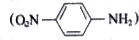 both-R effect and-I effect of the `NO_(2)` group decrease the basicity. (iii) Therefore decreasing ORDER of basic strength is,  Ethylamine `gt` Methylamine `gt` Aniline `gt` p - nitro aniline |
|
| 30. |
Arrange the following in decreasing order of their S_(N)2 reactivity :(iii) H_(2)C=CH-CH_(2)-Cl(iv) CH_(3)CH_(2)CH_(2)Cl |
|
Answer» `(IV)GT(III)gt(i)gt(ii)` |
|
| 31. |
Arrange the following in decreasing order of their C=C bond length |
|
Answer» `IIgtIVgtIgtIII` |
|
| 32. |
Arrange the following in decreasing order of their boiling points. (a) n-butane (b) n-pentane (c) 2-methylbutane (d) 2, 2-dimethylpropane |
|
Answer» `a gt b gt C gt d` C (n - pentane) `gt` B (2-methylbutane) `gt` D (2, 2-dimethylpropane) `gt` A (n-butane). |
|
| 33. |
Arrange the followingin decreasingorderof their boilingpoints. (A ) n- butane(B) 2 - methybultane (C ) n - petane(D ) 2 , 2 - dimethylpropane |
|
Answer» `A GT B gt C gt D ` |
|
| 34. |
Arrange the following in decreasing order of their basic strength C_(6)H_(5)NH_(2),C_(2)H_(5)NH_(2),(C_(2)H_(5))_(2)NH,NH_(3). |
|
Answer» Solution :DUE to +I-effect of the alkyl groups, `(C_(2)H_(5))_(2)NH` is a stronger BASE than `C_(2)H_(5)NH_(2)` and both of these are stronger bases than `NH_(3)`. However, due to delocalization of lone pair of electrons present on nitrogen ver the benzene ring, `C_(6)H_(5)NH_(2)` is a WEAKER base than aliphatic amines and ammonia. Thus, the BASIC strength of the given amines DECREASES in the order: `(C_(2)H_(5))_(2)NH gt C_(2)H_(5)NH_(2) gt NH_(3) gt C_(6)H_(5)NH_(2)`. |
|
| 35. |
Arrange the following in decreasing order of their basic strength. C_6H_5NH_2, C_2H_5NH_2,(C_2H_5)_2NH,NH_3 |
| Answer» SOLUTION :`(C_2H_5)_2NH.C_2H_5NH_3>C_6H_5NH_2` | |
| 36. |
Arrange the following in decreasing order of their basic strength: ammonia, triethylamine, aniline, ehtylamine and diethylamine. |
| Answer» SOLUTION :Diethylaminegttriethylaminegtethylaminegtammoniagtaniline. | |
| 37. |
Arrange the following in decreasing order of their acidic strength and give reason for your answer: CH_(3)CH_(2)OH,CH_(3)COOH,ClCH_(2)COOH,FCH_(2)COOH,C_(6)H_(5)CH_(2)COOH |
|
Answer» Solution :The DECREASING order of the acidic strength is `FCH_(2)COOHgtClCH_(2)COOHgtC_(6)H_(5)CH_(2)COOHgtCH_(3)COOHgtCH_(3)CH_(2)OH` (i) Alcohols are weaker ACIDS than carboxy compounds (ii) A halogen ATTACHED to the a carbon next to carboxy group makes it more acidic because of -I effect. Fluorine has greaterinductive effect than chlorine `C_(6)H_(5)CH_(2)`- group has smaller +I effect compared to `CH_(3)`- |
|
| 38. |
Arrange the following in decreasing order of their acidic strength and give reason for your answer. CH_(3)CH_(2)OH,CH_(3)COOH,ClCH_(2)COOH,FCH_(2)COOH,C_(6)H_(5)CH_(2)COOH. |
|
Answer» Solution :Since -I-effect of F is much STRONGER than that of Cl, therefore, `FCH_(2)COOH` is a stronger acid than `ClCH_(2)COOH`. Further, `C_(6)H_(5)` group has a weak -I-effect though much weaker than those of F and Cl, therefore, `C_(6)H_(5)CH_(2)COOH` is a stronger acid than `CH_(3)COOH` but weaker than `FCH_(2)COOH` and `ClCH_(2)COOH`. now `NH_(3)COOH` is a much stronger acid than `CH_(3)CH_(2)OH` because `CH_(3)COO^(-)` ION left after the loss of a proton is stabilized by resonance but no such STABILIZATION is possible for `CH_(3)CH_(2)O^(-)` ion (obtained after loss of a proton from `CH_(3)CH_(2)OH`). thus, the overall, acidic strength DECREASES in the ORDER: `FCH_(2) COOH gt ClCH_(2)COOH gt C_(6)H_(5)COOH gt CH_(3)COOH gt CH_(3)CH_(2)OH`. |
|
| 39. |
Arrange the following in decreasing order of their acidic character: (i) p-CH_(3)O-C_(6)H_(4)OH, (ii) p-NO_(2)-C_(6)H_(4)OH, (iii) C_(6)H_(5)OH |
|
Answer» |
|
| 40. |
Arrange the following in decreasing order of their acidic character : (i) (ii) C_(6)H_(5)OH(iii) |
| Answer» SOLUTION :(III) > (II) > (i) | |
| 41. |
Arrange the following. In decreasing order of the pK_b values C_2H_5NH_2,C_6H_5NHCH_3,(C_2H_5)_2NH " and "CH_3NH_2 |
| Answer» SOLUTION :`C_6H_5NH_2 GT C_6H_5NHCH_3 gt C_2H_5NH_2 gt (C_2H_5)_2NH`. | |
| 42. |
Arrange the following : In decreasing order of the pK_(b) values : C_(2)H_(5)NH_(2), C_(6)H_(5)NHCH_(3), (C_(2)H_(5))_(2)NH" and "C_(6)H_(5)NH_(2). |
|
Answer» Solution :Due to delocalisation of lone pair of electrons of the N-atom over the benzene ring, `C_(6)H_(5)NH_(2)" and "C_(6)H_(5)NHCH_(3)` are FAR less basic than `C_(2)H_(5)NH_(2)" and "(C_(2)H_(5))_(2)NH`. Further, due to +I-effect of the `CH_(3)` group, `C_(6)H_(5)NHCH_(3)` is little more basic than `C_(6)H_(5)NH_(2)`. Among `C_(2)H_(5)NH_(2)" and "(C_(2)H_(5))_(2)NH, (C_(2)H_(5))_(2)NH` is more basic than `C_(2)H_(5)NH_(2)` due to GREATER +I-effect of the two `C_(2)H_(5)` GROUPS. The relative basic strength of these FOUR amines shows the order : `""(C_(2)H_(5))_(2)NH gt C_(2)H_(5)NH_(2) gt C_(6)H_(5)NHCH_(3) gt C_(6)H_(5)NH_(2)` As `pK_(b)` varies inversely as the basic strength, `pK_(b)` follows the order : `"" C_(6)H_(5)NH_(2) gt C_(6)H_(5)NHCH_(3) gt C_(2)H_(5)NH_(2) gt (C_(2)H_(5))_(2)NH` |
|
| 43. |
Arrange the following in decreasing order of the boiling points: CH_(3)CH_(2)CH_(2)CH_(2)OH,CH_(3)CH_(2)OCH_(2)CH_(3).CH_(3)CH_(2)CH_(2)COOH. |
|
Answer» Solution :Due to MUCH stronger H-bonds in carboxylic acids than in alcohols, the boilig points of carboxylic acids are much higher than the boiling points of the corresponding alcohols. HOWEVER, due to absence of H-bonding in ethers, the boiling points of ethers are much lower than alcohols and carboxylic acids of cojmparable molecular masses. THUS, the boiling DECREASES in the order: `CH_(3)CH_(2)CH_(2)COOH gt CH_(3) CH_(2)CH_(2)CH_(2)OH gt CH_(3)CH_(2)OCH_(2) CH_(3)`. |
|
| 44. |
Arrange the followingin decreasing order of ((m)/(o + p)) ratio. a. I. PhCH_(3), II. PhCBr_(3) III. PhCHBr_(2), IV. PhCH_(2)Br b. I. PhCH_(3), II. PhCBr_(3) III. PhCCl_(3), IV. PhCl_(3) c. I. ArN^(o+)R_(3) , II. ArCH_(2)N^(o+) R_(3) III. ArCH_(2)CH_(2)N^(o+) R_(3) |
|
Answer» Solution :GREATER the reactivity of the substiuent for `m-` direactor greater is the `((m)/(o + p))` ratio. `(I) gt (III) gt (IV)gt (I)` b. Reactivity of halogens is controlled by `-I` effect but orientation is controlledby `+R` effect. Reacticityorder is `I gt Br gt Cl gt F`. `(-CX_(3))` is `m-` director, but `(-CH_(3))` is `o-` and `p-` diredctor. `(IV) gt (II) gt (III) gt (I)`. e. (overset(o+)(-N)R_(3))` is `m-` director. `(I) gt (II) gt (III)`. |
|
| 45. |
Arrange the following in decreasing order of boiling point : (I) CH_(3)CH_(2)CH_(2)OH(II) CH_(3)CH_(2)CH_(2)NH_(2) (III) CH_(3)-underset(CH_(3))underset(|)N-CH_(3)(IV) CH_(3)CH_(2)-NH-CH_(3) (V) CH_(3)CH_(2)CH_(2)CH_(3) |
|
Answer» `IgtIIgtIVgtIIIgtV` |
|
| 46. |
Arrange the following : In decreasing order of basic strength in gas phase : C_(2)H_(5)NH_(2), (C_(2)H_(5))_(2)NH, (C_(2)H_(5))_(3)N" and "NH_(3). |
|
Answer» Solution :In the gas phase, basic strength mainly depends upon the +I-effect of the alkyl GROUPS. +I-effect increases with the NUMBER of alkyl groups, therefore, the basic strength of the amines DECREASES as the number of ethyl groups decreases from 3 in `(C_(2)H_(5))_(3)N` to 2 in `(C_(2)H_(5))_(2)NH` to 1 in `C_(2)H_(5)NH_(2)` and zero in `NH_(3)`. Thus, basic strength in the gas phase decreases in the order : `(C_(2)H_(5))_(3)N gt (C_(2)H_(5))_(2)NH gt C_(2)H_(5)NH_(2) gt NH_(3)` |
|
| 47. |
Arrange the following in decreasing order of basicity: |
Answer» SOLUTION :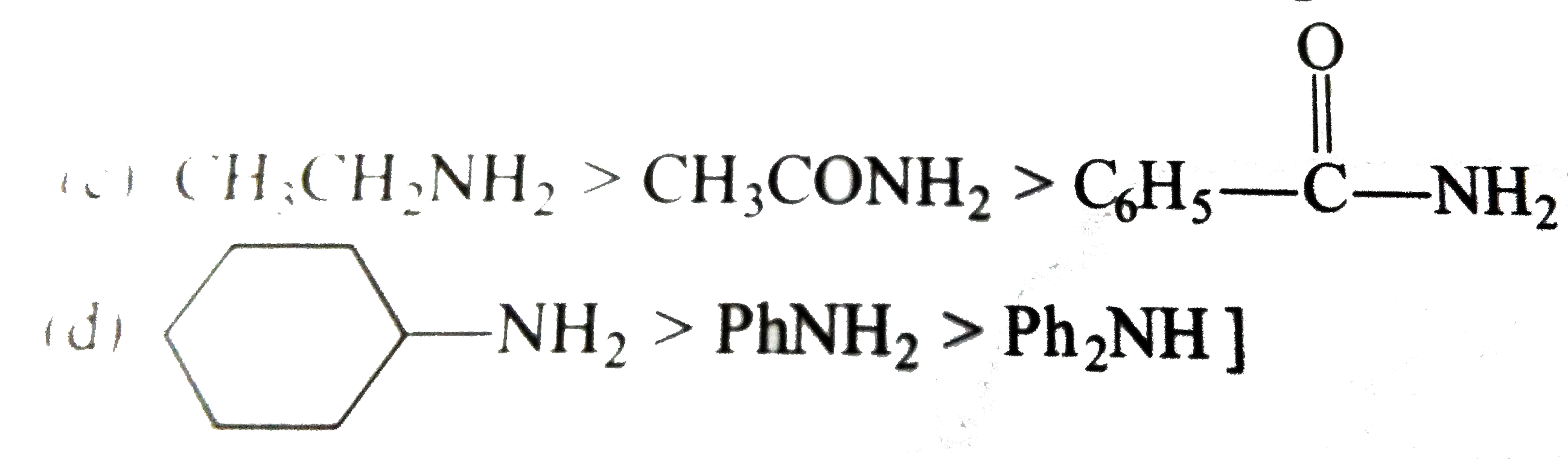
|
|
| 48. |
Arrange the followingin decreasing order of acidic character: |
Answer» SOLUTION :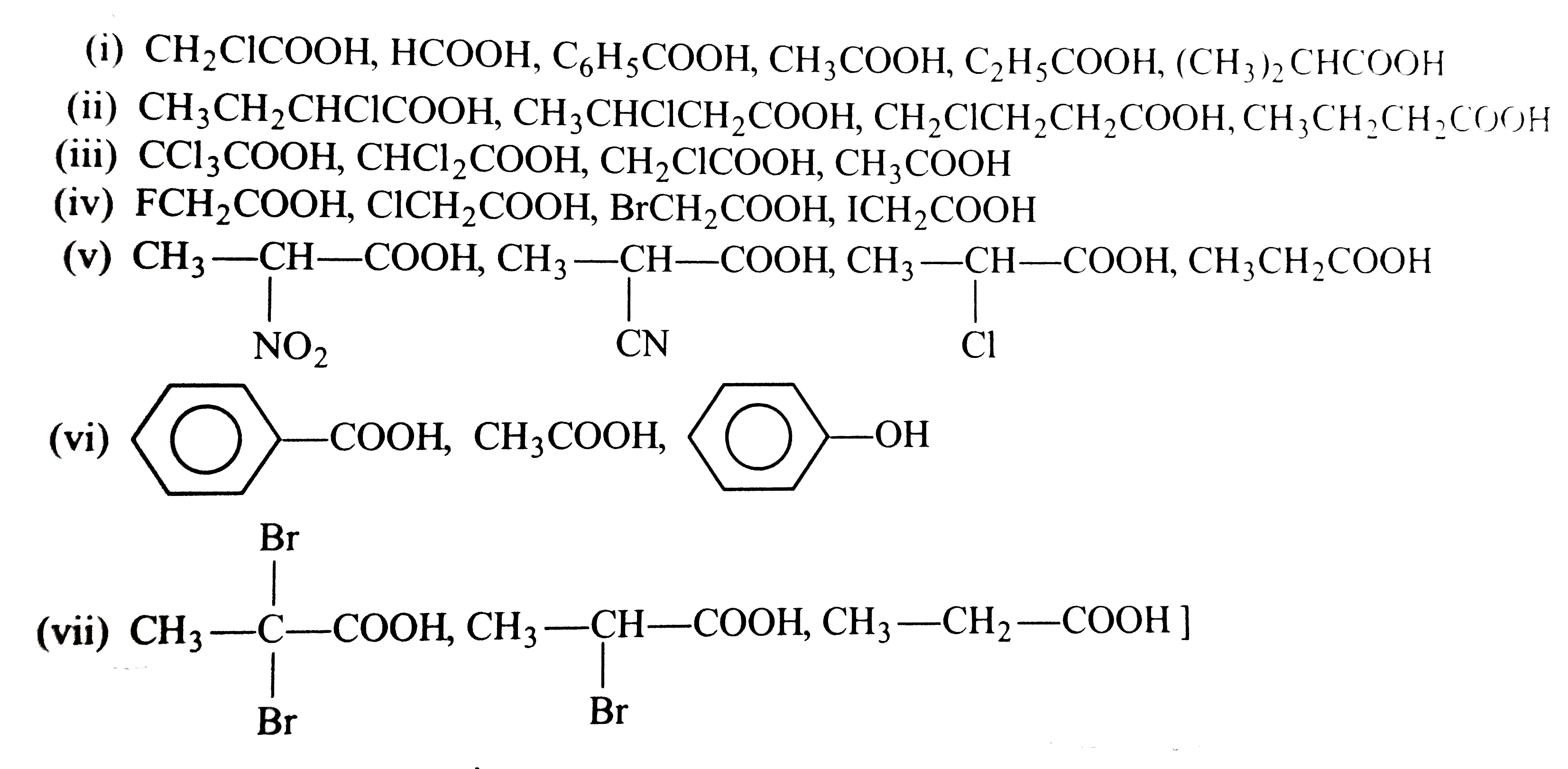
|
|
| 49. |
Arrange the following in decreasing order of acid catalysed estrification: CH_(3)CH_(2)COOH, (CH_(3))_(2)CHCOOH,(CH_(3))_(2)"CC"OOH |
| Answer» SOLUTION :`CH_(3)CH_(2)COOHgt(CH_(3))_(2)CHCOOHgt(CH_(3))_(2)"CC"OOH` | |
| 50. |
Arrange the followingillustrationin orderof increasing acidity: (i) HCOOH, ClCH_(2)COOH, CH_(3)COOH (ii)CH_(3)COOH, (CH_(3))_(2)CHOOH , (CH_(3))_(3)C CO OH (iii) ClCH_(2)C O OH, Cl_(2)CHO OH, CH_(3)CO OH . (iv)ClCH_(2)CO OH, CH_(3)CH_(2)COOH ,ClCH_(2)CH_(2)COOH,(CH_(3))_(2) CHOCOOH, CH_(3)COOH (V) CH_(3)COOH, Cl_(2)CHCOOH, CH_(3)CH_(2)COOH,Cl_(2)C COOH, ClCH_(2)COOH. |
|
Answer» Solution :(i) `CH_(3)COOH LT HCOOH ltClCH_(2)COOH` (ii) `(CH_(3))_(3)C COOH lt (CH_(3))_(2) CHOOH lt CH_(3)COOH` (iii) `ClCH_(2)COOH lt Cl_(2)CHCOOH lt Cl_(3)COOH` (IV) `(CH_(3))_(2)CHCOOH lt CH_(3) CH_(2) COOH lt CH_(3)COOH lt CICH_(2)CH_(2)COOHlt CICH_(2) COOH` (v) `CH_(3)CH_(2)COOH lt CH_(3) COOH ltCICH_(2) lt CICH_(2)COOH lt Cl_(2) CHCOOH lt Cl_(3)C COOH` |
|