

Saved Bookmarks
This section includes 7 InterviewSolutions, each offering curated multiple-choice questions to sharpen your Current Affairs knowledge and support exam preparation. Choose a topic below to get started.
| 1. |
Arrange the following in the increasing order of stability. CH_(3)CH_(2)CH=CH_(2), CH_(3)CH=CHCH_(3)(cis), CH_(3)CH=CHCH_(3)" (trans)" |
| Answer» SOLUTION :`CH_(3)CH_(2)CH=CH_(2) lt (CH_(3))CH=CH_(2)CH_(3)" (CIS)" lt (CH_(3))_(2)C=CH_(2) lt CH_(3)CH=CHCH_(3)" (TRANS)"` | |
| 2. |
Arrange the following in the increasing order of basicity. C_6 H_5 NH_2, C_6 H_5 N (CH_3)_2 , (C_2 H_5)_2 NH, CH_3 NH_2. |
|
Answer» SOLUTION :The INCREASING order of basicity is : `C_6H_5NH_2 lt C_6 H_5 N(CH_3)_2 lt CH_3 NH_2 lt (C_6H_5)_2 NH`. |
|
| 3. |
Arrange the following in the order of boiling points: (A) n-Butyl amine, (B) Secondary butyl amine, (C ) Isobutyl amine and (D) Tertiary butyl amine |
| Answer» Solution :The order of BOILING POINTS is :D As the length of the carbon chain increases, van DER Waals forces, ATTRACTIONS increase and boiling point increases. | |
| 4. |
Arrange the following in the increasing order of basicity. C_6H_5 NH_2, C_6 H_5 NHCH_3 , C_6H_5 N(CH_3)_2 |
|
Answer» SOLUTION :The increasing order of BASICITY is : `C_6 H_5NH_2 LT C_6 H_5NHCH_3 lt C_6 H_5 N (CH_3)_2` |
|
| 5. |
Arrange the following in the decreasing order of their reactivity towards nucleophilic addition reaction : HCHO , CH_(3) COCH_(3), CH_(3) CHO |
| Answer» Solution :`HCHO gt CH_(3) CHO gt CH_(3) COCH_(3)` | |
| 6. |
Arrange the following in the decreasing order of their basic strength in aqueoussolutions : ""CH_(3)NH_(2), (CH_(3))_(2)NH, (CH_(3))_(3)N" and "NH_(3) |
|
Answer» `""(CH_(3))_(2)NH GT CH_(3)NH_(2) gt (CH_(3))_(3)N gt NH_(3)` |
|
| 7. |
Arrange the following in the decreasing order of their basic strength: (i) Aniline, ortho, meta and para toluidines (ii) Benzyl amine and aniline (iii) Aniline and cyclohexylamine and (iv) Aniline, N-methylaniline and N, N-dimethylaniline |
Answer» SOLUTION :
|
|
| 8. |
Arrange the following in the decreasing order of dipole moment: CH_3 CHO ,(CH_3)_2 CO ,CH_3 COOH |
| Answer» SOLUTION :`CH_3 COCH_3gtCH_3 CHOgt CH_3 COOH ` | |
| 9. |
Arrange the following in the decreasing order of basic strength: CH_(3)CH_(2)CH_(2)NH_(2), CH_(2) = CH- CH_(2)NH_(2) and CH -= - CH_(2) NH_(2) |
|
Answer» Solution :The order of basic strength is : `CH_(3)CH_(2)CH_(2)NH_(2) gt CH_(2)=CH-CH_(2)NH_(2) gt CH= C CH_(2)NH_(2)` Alkyl group is electron RELEASING and STABILISES the CONJUGATE acid of PROPYL amine. Alkenyl and alkynyl groups connected to `-CH_(2)NH_(2)` are electron withdrawing group and destabilise the conjugate acid of `CH_(2)=CHCH_(2)NH_(2)` and `CH-=C CH_(2)NH_(2)`, HENCE they become weak base. |
|
| 10. |
Arrange the following in the decreasing order of basic strength: (a) C_(2)H_(5)NH_(2), C_(6)H_(5)NHCH_(3), (C_(2)H_(5))_(2)NH and C_(6)H_(5)NH_(2) (b) C_(2)H_(5)NH_(2), (C_(2)H_(5))_(2) NH and (C_(2)H_(5))_(3)N (c ) (C_(2)H_(5))_(2)NH, C_(6)H_(5)NH_(2), C_(2)H_(5)NH_(2) and NH_(3) |
|
Answer» SOLUTION :a) `(C_(2)H_(5))_(2)NH GT C_(2)H_(5)NH_(2) gt C_(2)H_(5)NHCH_(2) gt C_(6)H_(5)NH_(2)` b) `(C_(2)H_(5))_(2)NH gt (C_(2)H_(5))_(3)Ngt C_(2)H_(5)NH_(2)` c) `(C_(2)H_(5))_(2)NH gt C_(2)H_(5)NH_(2) gt NH_(3) gt C_(6)H_(5)NH_(2)`. |
|
| 11. |
Arrange the following in order of property indicated for each set. (a) F_(2),Cl_(2),Br_(2),I_(2) increasing bond dissociation enthalpy. (b) HF,HCI,HBr,HI increasing acid strength. (iii) NH_(3),PH_(3),ASH_(3),SbH_(3),BiH_(3). Increasing base strength. |
|
Answer» Solution :(a)`I_(2)ltF_(2)ltBr_(2)ltCl_(2)` (B) `HFltHClltHBrltHI` `Bi H_(3)ltSbH_(3)ltAsH_(3)ltPH_(3)ltNH_(3)` |
|
| 12. |
Arrange the following in order of their reactivity towards CH_(3)MgBr? (I) H_(3)C-underset(O)underset(||)(C)-H (II) C Cl_(3)-underset(O)underset(||)(C)-H (III) H_(3)C-underset(O)underset(||)(C)-CH_(3) (IV)Ph-underset(O)underset(||)(C)-CH_(3) |
|
Answer» `IgtIVgtIIIgtII` |
|
| 13. |
Arrange the following in order of their increasing reactivity toward HCN CH_(3)CHO, CH_(3)COCH_(3)., HCHO, C_(2)H_(5)COCH_(3). |
| Answer» Solution :`C_(2)H_(5)COCH_(3) lt CH_(3)COCH_(3) lt CH_(3)CHO" M H"-CHO` | |
| 14. |
Arrange the following in order of their increasing reactivity in nucleophilic substitution reactions: CH_(3)F,CH_(3)I,CH_(3)Br,CH_(3)Cl |
| Answer» Solution :Reactivity INCREASES as the carbon-halogen BOND dissociation energy DECREASES, i.e., `CH_(3)F lt CH_(3)Cl lt CH_(3)Br lt CH_(3)I`. | |
| 15. |
Arrange the following in order of their Increasing reactivity in nucleophilic subsitution reactions : CH_(3)F, CH_(3)I, CH_(3)Br, CH_(3)Cl |
|
Answer» <BR> ANSWER :`CH_(3)F < CH_(3) CI < CH_(3)Br < CH_(3)I` |
|
| 16. |
Arrange the following in order of their increasing masses in grams? (i) One atom of silver (ii) One gram-atom of nitrogen (iii) One mole of calcium (iv) One mole of oxygen molecules (v) 10^(23) atoms of carbon and (vi) One gram of iron. |
|
Answer» Solution :(i) 1 mole of Ag atoms = 108 g `=6.022xx10^(23)` atoms i.e., mass of `6.022xx10^(23)" atoms of Ag = 108 g"therefore"Mass of 1 atom of Ag"=(108)/(6.022xx10^(23))=1.793xx10^(-22)g` (ii) Mass of one gram atom of N = At. Mass of grams = 14.0 g (iii) Mass of one mole of CA = At. Mass in grams = 40.0 g (IV) Mass of one mole of oxygen molecules = Mol. mass in grams = 32.0 g (v) 1 mole of C atoms = 12 g `=6.022xx10^(23)` atoms, i.e., Mass of `6.022xx10^(23)` atoms of C = 12.0 g `therefore"Mass of " 10^(23)" atoms of C"=(12)/(6.022x10^(23))xx10^(23)=1.993g` (vi) Mass ofiron = 1.0 g (Given) Thus, the ORDER of increasing MASSES is : One atom of silver lt one gram of iron lt `10^(23)` atoms of carbon lt one gram-atom of nitrogen lt one mole of oxygen lt one mole of calcium. |
|
| 17. |
Arrange the following in order of their increasing basicity: p-toluidine, N,N-dimethyl-p-toluidine, p-nitroniline, aniline. |
| Answer» SOLUTION :Electron-donating groups i.e., ALKYL groups in the RING and on the N-atom increase the basicity while electron-withdrawing groups such as nitro group in the ring decrease the basicity. Thus, the basicity of the given amines INCREASES in the order : p-nitroanilineltanilineltp-toluidineltN,N-dimethyl-p-toluidine. | |
| 18. |
Arrange the following in order of their decreasing acidic strength ? |
|
Answer» `IgtIIgtIIIgtIV` |
|
| 19. |
Arrange the following in order of their decreasing thermal conductivity |
|
Answer» AL,Ag,Cu |
|
| 20. |
Arrange the following in order of property indicated forset: HF, HCl, HBr, HI - decreasing bond enthalpy |
| Answer» Solution :`HF GT HCL gt HBr gt HL` | |
| 21. |
Arrange the following in order of property indicated for each set: (i) HCI, HI, HBr, HF - Decreasing thermal stability. (ii) Xe, He, Kr, Rn, Ne -Decreasing order of electron gain enthalpy. |
|
Answer» Solution :(i) DECREASING thermal STABILITY is as follows : `HF gt HCl gt HBR gt HI` (ii) Decreasing order of ELECTRON gain enthalpy is as under : `Ne gt Kr gt Xe gt Rn gt He ` |
|
| 22. |
Arrange the following in order of property indicated for each set : (i) F_(2), Cl_(2), Br_(3), I_(2) - increasing bond dissociation enthalpy. (ii) HF, HCl, HBr, HI - increasing acid strength. (iii) NH_(3), PH_(3), AsH_(3), SbH_(3), BiH_(3) - increasing base strength. |
|
Answer» Solution :(i) Bond dissociation enthalpy should decrease as the bond distance INCREASES from `F_(2) "to" I_(2)` due to the corresponding increase in the size of the atom as we move from F to I. However, the F-F bond dissociation enthalpy is smaller than that of Cl-Cl and even smaller than that of BR-Br. This is due to the reason that the F atom is very small and hence the three lone pairs of electrons on each F atom repel the bond pair holding the F-atoms in `F_(2)` molecules. Thus, the bond dissociation enthalpy increases in the order : `I_(2) lt F_(2) lt Br_(2) lt Cl_(2)` (ii) The relative acid strength of HF, HCl, HBr and HI DEPENDS upon their bond dissociation enthalpies. Since the bond dissociation enthalpy, of H-X bond decreases from H-F to H-I as the size of atom increases from F to I. Therefore, the acid strength increases in the opposite order, i.e., the acid strength increases in the order : HF lt HCl lt HBr lt HI. (iii) Due to the presence of a lene pair of electrons on the central atom in `NH_(3), PH_(3), AsH_(3), SbH_(3) and BiH_(3)`, all behave as Lewis BASES. However, as we move from `NH_(3)` to `BiH_(3)`, the size of the atom increases. As a result, the lone pair of electrons occupies a larger volume. In other words, the electron density on the central atom decreases and hence the basic strength decreases as we move from `NH_(3)` to `BiH_(3)` Thus the basic strength increases in the order : `BiH_(3) lt SbH_(3) lt AsH_(3) lt PH_(3) lt NH_(3)`. |
|
| 23. |
Arrange the following in order of increasing molar conductivity. (i) Mg[Cr(NH_(3))(Cl)_(5)] (ii)[Cr(NH_(3))_(5)Cl]_(3)[CoF_(6)]_(2) (iii) [Cr(NH_(3))_(3)Cl_(3)] |
|
Answer» SOLUTION :These complexes can ionise in solution as : `MG[Cr(NH_(3))(Cl)_(5)]=Mg^(2+)+[Cr(NH_(3))(Cl)_(5)]^(2-)` `[Cr(NH_(3))_(5)Cl]_(3)[CoF_(6)]_(2)=[Cr(NH_(3))_(5)Cl]^(2+)+[CoF_(6)]^(3-)` `[Cr(NH_(3))_(3)Cl_(3)]=` does not ionize As the number of IONS in solution increases, their molar conductivity also increases. Therefore, conductivity follows the order : `[Cr(NH_(3))_(3)Cl_(3)] lt [Cr(NH_(3))_(5)Cl]_(3)[CoF_(6)]_(2) lt Mg[Cr(NH_(3))(Cl)_(5)]` |
|
| 24. |
Arrange the following in order of increasing molar conductivity (i) .Mg [Cr (NH_3) (Cl) _5] (b)[Cr(NH_3)_5Cl]_3[CoF_6]_2 (iii)[Cr(NH_3) _3 Cl_3] |
|
Answer» Solution :(i) ` [Cr(NH_3) _5 CL )_3 [COF_6]_2` (ii).` [Cr(NH_3)_3Cl_3]` (iii) ` MG[Cr(NH_3)(Cl)_5]` |
|
| 25. |
Arrange the following in order of increasing ease towards nucleophilic substitution. 4-chloronitrobenzene, chlorobenzene, 2,4,6-trinitrochlorobenzene, 2,4-dinitrochlorobenzene. |
| Answer» SOLUTION :As the number of electron-withdrawing `NO_(2)` groups increases at o- and p-positions, the STABILITY of the intermediate carbanion increases and HENCE reactivity towards nucleophilic SUBSTITUTION increases in the same order, i.e., Chlorobenzenelt4-chloronitrobenzenelt2,4-dinitrochlorobenzenelt2,4,6 trinitrochlorobenzene. | |
| 26. |
Arrange the following in order of increasing boiling point: (i) CH_(3)CH_(2)CH_(2)CH_(2)Br (ii) (CH_(3))_(3)CB r (iii) (CH_(3))_(2)CHCH_(2)Br. |
| Answer» Solution :The b.p. increases as the BRANCHING decreases (or the SURFACE AREA increases), i.e., `(CH_(3))_(3)CB R lt (CH_(3))_(2)CHCH_(2)Br lt CH_(3)CH_(2)CH_(2)CH_(2)Br`. | |
| 27. |
Arrange the following in order of increasing acidity: (i) Propanoic acid, chloroethanoic acid, 3-bromo-propanoic acid and trichloroacetic acid. (ii) 2-Fluorobutanoic acid, 2-iodobutanoic acid, 2-bromobutanoic acid and butanoic acid. (iii) (iii) Acetic acid, 2-methyl propanoic acid, 2,2-dimethyl propanoic acid. (iv) Oxalic acid, malonic acid, succinic acid, glutaric acid. (v) C_(6)H_(5)COOH, p-OHC_(6)H_(4)COOH, p-CH_(3)C_(6)H_(4)COOH, p-CIC_(6)H_(4)COOH, p-BrC_(6)H_(4)COOH, p-NO_(2)C_(6)H_(4)COOH. |
Answer» SOLUTION :
|
|
| 28. |
Arrange the following in order of increasing basic strength. |
|
Answer» (`AAK_MCP_36_NEET_CHE_E36_018_A01`) |
|
| 29. |
Arrange the following in order of increasing base strength. NH_(3), PH_(3), AsH_(3), SbH_(3), BrH_(3) |
Answer» Solution :The basis character of these hydrides depends UPON the strength of the additional element-hydrogen bond formed when the hydride accepts a proton.  On moving down the group, the size of the element increases and th strength of the E-H bond decreases. CONSEQUENTLY, the TENDENCY of the hydride to accept a proton decreases and hence the BASIC strength decreases down the group, i.e., `NH_(3) gt PH_(3) gt AsH_(3) gt SbH_(3) gt BiH_(3)`. |
|
| 30. |
Arrange the following in order of increasing acidity: |
Answer» SOLUTION :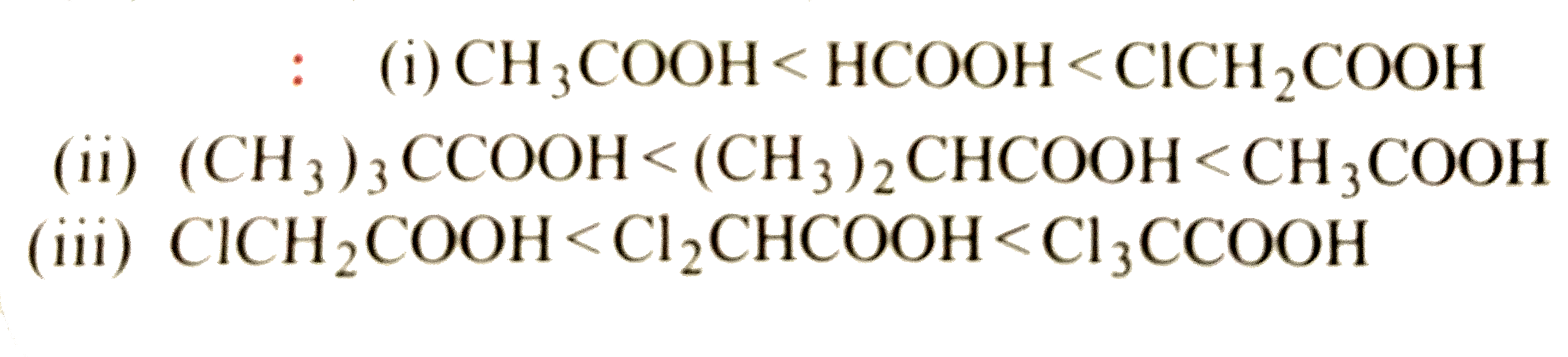 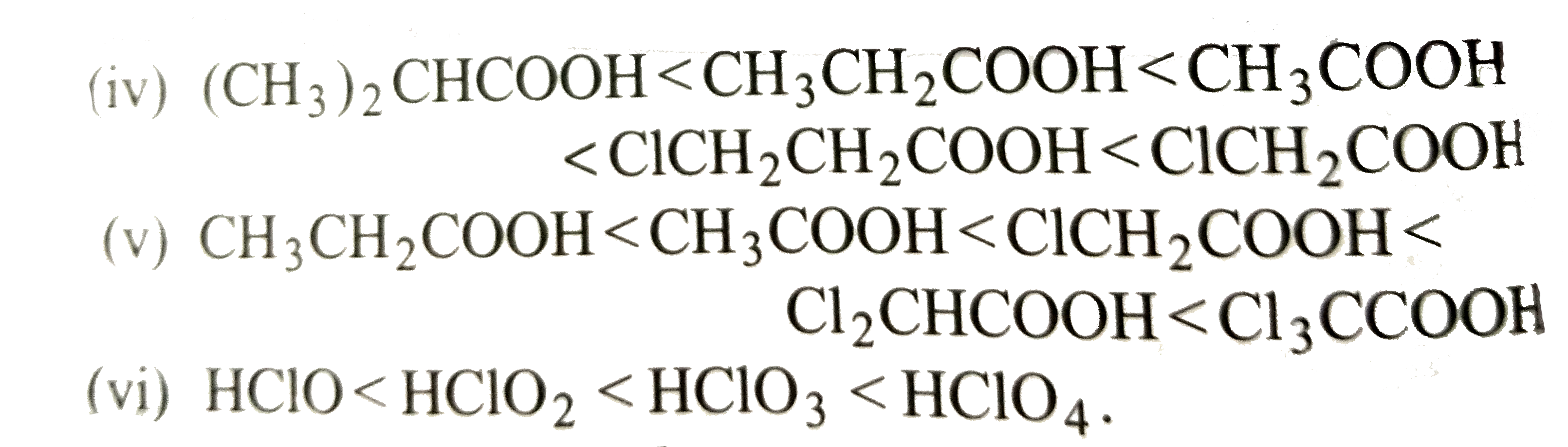
|
|
| 31. |
Arrange the following in order of increasing acid character : H_(2)O, H_(2)S, H_(2)Se, H_(2)Te |
| Answer» Solution :As the size of the element (E) increas from O to Te, the bond length of the H-X bond increases and hence bond dissociation enthalpy of the H-E bond decreases. In other words, the tendency of the H-E bond to DISSOCIATE to give `H^(+)` IONS inncreases from `H_(2)O` to HeTe. As a RESULT, ACID strength increases from `H_(2)O` to `H_(2)Te`, i.e., acid strength increases in the ORDER : `H_(2)O lt H_(2)S lt H_(2)Se lt H_(2)Te`. | |
| 32. |
Arrange the following in order of decreasing thermal stability : HCI, HI, HBr, HF |
| Answer» SOLUTION :THERMAL stability decreases as the strength of H-X bond decreases which, in turn, decreases as the size of the HALOGEN increases, i.e., `HF gt HCI gt HBr gt HI`. | |
| 33. |
Arrange the following in order of decreasing reactivity towards S_(N^(2)) reactions: CH_(3)CH_(2)CH_(2)Cl(I),CH_(3)CH_(2)-CHCl-CH_(3)(II)(CH_(3))_(2)CHCH_(2)Cl(III),(CH_(3))_(3)C-Cl(IV) |
|
Answer» IgtIIIgtIIgtIV |
|
| 34. |
Arrange the following in order of decreasing number of unpaired electrons ? (P) [Fe(H_(2)O)_()_6)]^(2+)""(Q) [Fe(CN)_(6)]^(3-) (R) [Fe(CN)_(6)]^(4-)""(S) [Fe(H_(2)O)_(6)]^(3+) |
|
Answer» <P>S, P, Q, R 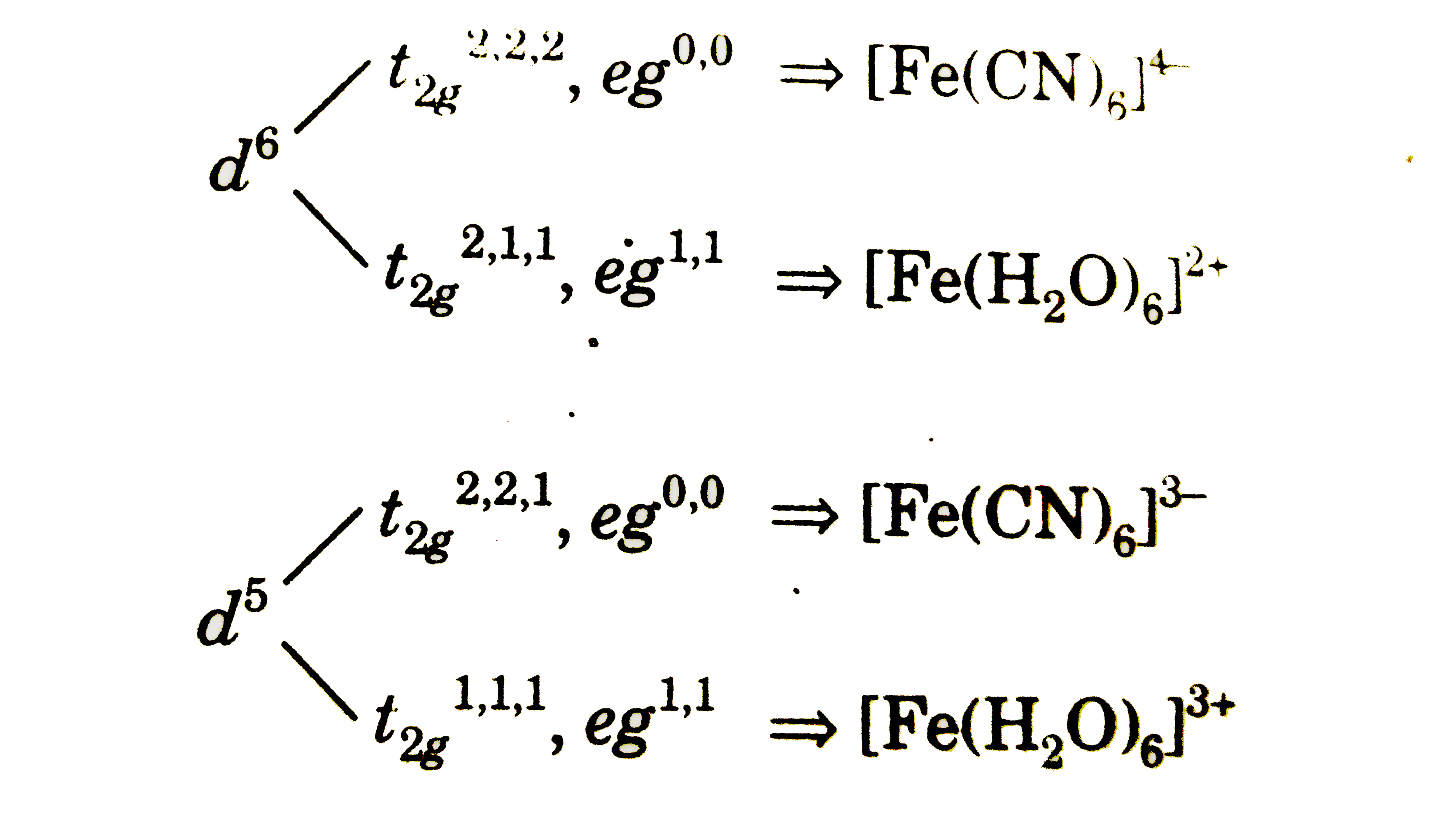
|
|
| 35. |
Arrange the following in increasing order of total number of possible adjecent bond angles? |
|
Answer» `"CCl"_(4) gt SF_(6) gt IF_(7)` |
|
| 36. |
Arrange the following in increasing order of their melting point. (1) Nylon 2,2, (2)Nylon 2,4, (3)Nylon2,6, (4)Nylon 2,10 |
|
Answer» 1,2,3,4 |
|
| 37. |
Arrange the following in increasing order of their reactivitty in nucleophilic addition reactions : (i) Ethananl, Propanal, Propanone, Butanone. (ii) Benzaldehyde, p - Tolualdehyde, p - Nitrobenzaldehyde, Acetophenone. [Hint : Consider steric effect and electronic effect.] |
Answer» Solution : (i) As we move from `"ethanal " to "propanal " to "propanone " to " butanone"`, the inductive effect of the alkyl GROUP increases. As a result, electron density on the carbon atom of the carbonyl group progressively decreases and hence attack by the nucleophile BECOMES weaker and weaker. Thus, the reactivity increases in the order : butanone  On the other hand, in p- nitrobenzaldehyde, the `NO_2` group is a powerful electron-withdrawing group. It withdraws electrons, by RESONANCE thereby decreasing the electron-density on the carbon atom of the carbonyl group. This facilitates the attack of the nucleophile and hence makes it more reactive than benzaldehyde.  Therefore, the reactivity of the given compounds increases in the order: Acetophenone < p-tolualdehyde < benzaldehyde < p-nitrobenzaldehyde. |
|
| 38. |
Arrange the following in increasing order of their penetrating power. (alpha, beta, gamma, X-rays). |
|
Answer» `ALPHA`-RAYS lt `BETA`-rays lt `gamma`-rays lt X -rays |
|
| 39. |
Arrange the following polymers in increasing order of their intermolecular forces : (i) Nylon 6, 6 (ii)Buna-S (iii) Polythene |
|
Answer» I,II,III |
|
| 40. |
Arrange the following in increasing order of their boiling points. CH_(3)CHO,CH_(3)COOH,CH_(3)CH_(2)OH |
|
Answer» Solution :`underset("Acetaldehyde")(CH_(3)-overset(O)overset(||)(C)-H)""underset("Acetic ACID")(CH_(3)-overset(O)overset(||)(C)-OH)""underset("Ethyl alcohol")(CH_(3)-CH_(2)-OH)` Acetaldehyde `(CH_(3)CHO)` does not contain a H atom attached to O atom but acetic acid `(CH_(3)COOH)` and ethyl alcohol `(CH_(3)CH_(2)OH)` have. As a RESULT, `CH_(3)CHO` does not form H-bonds but `CH_(3)COOH` and `CH_(3)CH_(2)OH` form H-bonds. consequently, the b.p. of `CH_(3)CHO` is much LOWER than those of `CH_(3)COOH` and `CH_(3)CH_(2)OH`.  But acetic acid due to its dimeric structure forms stronger H-bonds, than ethyl alcohol and HENCE b.p. of ethyl alcohol is lower than that of acetic acid. Combining both the trends the b.ps. of these three compounds increase in the order: `CH_(3)CHO(294K) lt CH_(3)CH_(2)OH (351K) lt CH_(3)COOH (393K)` |
|
| 41. |
Arrange the following in increasing order of their heat of combustion : |
|
Answer» `PltQltRltSltT` 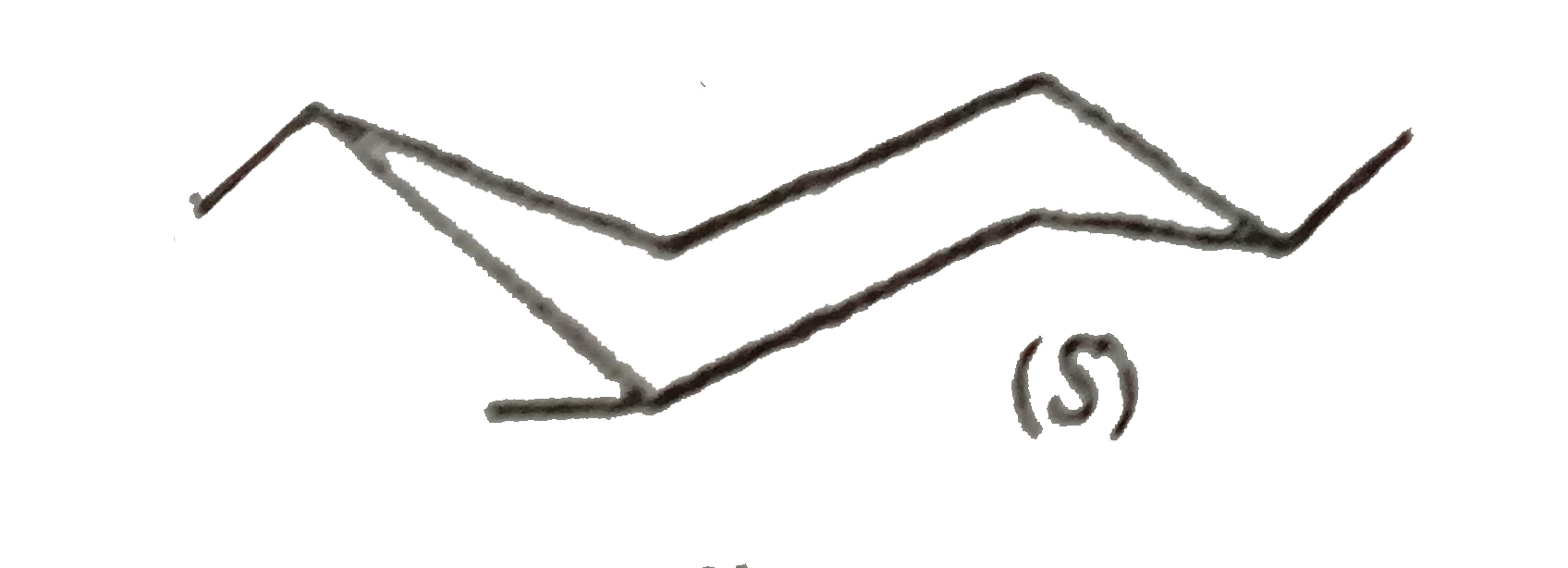
|
|
| 42. |
Arrange the following in increasing order of their basic strength (i) C_(2)H_(5)NH_(2),C_(6)H_(5)NH_(2),NH_(3),C_(6)H_(5)CH_(2)NH_(2) and (C_(2)H_(5))_(2)NH (ii) C_(2)H_(5)NH_(2),(C_(2)H_(5))_(2)NH,(C_(2)H_(5))_(3)N,C_(6)H_(5)NH_(2) (iii) CH_(3)NH_(2),(CH_(3))_(2)NH,(CH_(3))_(3)N,C_(6)H_(5)NH_(2),C_(6)H_(5)CH_(2)NH_(2). |
|
Answer» Solution :(i) `C_(6)H_(5)NH_(2)`, N is directly linked to the benzene ring and hence the LONE pair of electrons on the N-atom is delocalized over the benzene ring. In contrast, N in `C_(6)H_(5)CH_(2)NH_(2)` is not directly linked to the benzene ring and hence its lone pair is not delocalized over the benzene ring. in other words, the lone pair of electrons on the N-atom in `C_(6)H_(5)CH_(2)NH_(2)` is more easily available for protonation than that on the N-atom in `C_(6)H_(5)NH_(2)`. thus, `C_(6)H_(5)CH_(2)NH_(2)` is more basic than `C_(6)H_(5)NH_(2)`. Now due to -I-effect of the `C_(6)H_(5)` group, electron DENSITY on the N-atom in `C_(6)H_(5)CH_(2)NH_(2)` is lower than that on the N-atom in `C_(2)H_(5)NH_(2)`, therefore, `C_(2)H_(5)NH_(2)` is more basic than `C_(6)H_(5)CH_(2)NH_(2)`. Lowerver, both the them are stronger bases than `NH_(3)`. further due to +I-effect of the two `C_(2)H_(5)` `C_(2)H_(5)` groups in `(C_(2)H_(5))_(2)NH` as compared to one in `C_(2)H_(5)NH_(2),(C_(2)H_(5))_(2)NH` is a stronger base than `C_(2)H_(5)NH_(2)`. thus, the overall basic strength increases in the order: `C_(6)H_(5)NH_(2) lt NH_(3) lt C_(6)H_(5)CH_(2)NH_(2) lt C_(2)H_(5)NH_(2) lt (C_(2)H_(5))_(2)NH` (ii) In `C_(2)H_(5)NH_(2),(C_(2)H_(5))_(2)NH and (C_(2)H_(5))_(3)N`, the +I-effect of the `C_(2)H_(5)` group/s increases the electron density on the N-atom. however, in `C_(6)H_(5)NH_(2)`, the electron density on the N-atom decreases due to delocalization of the lone pair of electrons over the benzene ring. therefore, all the three ethylamines are more basic than `C_(6)H_(5)NH_(2)`. The relative basic strength of `C_(2)H_(5)NH_(2),(C_(2)H_(5))_(2)NH and (C_(2)H_(5))_(3)N` depends upon the STABILIZATION of their corresponding conjugate acids (formed as a result of accepting a proton from water) by a number of factors such as H-bonding, steric hindrance of the alkyl groups and +I-effect of the alkyl groups. All of factors such as H-bonding, steric hindrance of the alkyl groups and +I-effect of the alkyl groups. all these factors are favourable for `2^(@)` amines, therefore, `(C_(2)H_(5))_(2)NH` is a stronger base than `C_(2)H_(5)NH_(2) and (C_(2)H_(5))_(3)N`. since `C_(2)H_(5)` group is bigger, it exerts some steric hindrance to H-bonding. therefore, stabilization of the conjugate acid derived from `(C_(2)H_(5))_(3)N` due to +I-effect is greater than the stabilization of the conjugate acid derived from `C_(2)H_(5)NH_(2)` by H-bonding i.e.,  Therefore, `(C_(2)H_(5))_(3)N` is more basic than `C_(2)H_(5)NH_(2)`. The overall basic strength of the four amines increases in the order: `C_(6)H_(5)NH_(2) lt C_(2)H_(5)NH_(2) lt (C_(2)H_(5))_(3) lt (C_(2)H_(5))_(2) NH` (iii) As explained in answer (i) above, `C_(6)H_(5)CH_(2)NH_(2)` is more basic than `C_(6)H_(5)NH_(2)`. now due to +I-effect of the `CH_(3) ` groups , th electron density on the N-atom in `CH_(3)NH_(2),(CH_(3))_(2)NH and (CH_(3))_(3)N` increases. however, in `C_(6)H_(5)NH_(2) and C_(6)H_(5)CH_(2)NH_(2)` electron density on the N-atom decreases due to electron-withdrawig resonance effect (i.e., -R-effect) of the `C_(6)H_(5)` group in `C_(6)H_(5)CH_(2)NH_(2)`. therefore, all the three METHYLAMINES are more basic than `C_(6)H_(5)NH_(2) and C_(6)H_(5)CH_(2)NH_(2)`. now, the relative basicstrength of `CH_(3)NH_(2),(CH_(3))_(2)NH` and `(CH_(3))_(3)N` depends upon the stabilization of their conjugate acids (formed as a result of accepting a proton from `H_(2)O`) by a number of factors such as H-bonding, steric hindrance of the alkyl groups and -I-effect of the alkyl groups. all these such as H-bonding, steric hindrance of the alkyl groups and +I-effect of the alkyl groups. all these factors are favourable for `2^(@)` amines, therefore, `(CH_(3))_(2)NH` is a stronger base than `CH_(3)NH_(2) and (CH_(3))_(3)N`. since `CH_(3) ` group is the smallest, it does not exert any steric hindrance. therefore, stabilization of the conjugate acid derived from `CH_(3)NH_(2)` due to H-bonding is greater than that of the conjugate acid derived from `(CH_(3))_(3)N` due to +I-effect of the three `CH_(3)` groups, i.e.,  . . Therefore, `CH_(3)NH_(2)` is a stronger base than `(CH_(3))_(3)N`. thus, the overall basic strength of the five amines increases in the order: `C_(6)H_(5)NH_(2) lt C_(6)H_(5) CH_(2)NH_(2) lt (CH_(3))_(3) N lt CH_(3)NH_(2) lt (CH_(3))_(2)NH`. |
|
| 43. |
Arrange the following in increasing order of their basic strength : (i) C_(2)H_(5)NH_(2), C_(6)H_(5)NH_(2), NH_(3), C_(6)H_(5)CH_(2)NH_(2)" and "(C_(2)H_(5))_(2)NH. (ii) C_(2)H_(5)NH_(2), (C_(2)H_(5))_(2)NH, (C_(2)H_(5))_(3)N, C_(6)H_(5)NH_(2). (iii) CH_(3)NH_(2), (CH_(3))_(2)NH, (CH_(3))_(3)N, C_(6)H_(5)NH_(2), C_(6)H_(5)NH_(2). |
|
Answer» Solution :(i) In `C_(6)H_(5)NH_(2)`, the lone pair of electrons on the N-atom is delocalised over the BENZENE ring. In contrast, N in `C_(6)H_(5)CH_(2)NH_(2)` is not directly LINKED to the benzene ring and hence its lone pair is not delocalised over the benzene ring. In other WORDS, the lone pair of electrons on the N-atom in `C_(6)H_(5)CH_(2)NH_(2)` is more easily available than that on the N-atom in `C_(6)H_(5)NH_(2)`. Thus, `C_(6)H_(5)CH_(2)NH_(2)` is more basic than `C_(6)H_(6)NH_(2)`.Due to +I-effect of `C_(2)H_(5)` group, `C_(2)H_(5)NH_(5)` is more basic than `C_(6)H_(5)CH_(2)NH_(2)`. However, both of them are stronger bases than `NH_(3)`. Further due to +I- effect of the two `C_(2)H_(5)` groups in `(C_(2)H_(5))_(2)NH` as compared to one in `C_(2)H_(5)NH_(2), (C_(2)H_(5))_(2)NH` is a stronger base than `C_(2)H_(5)NH_(2)`. Thus, the basic strength increases in the order : `""C_(6)H_(5)NH_(2) lt NH_(3) lt C_(6)H_(5)CH_(2)NH_(2)lt C_(2)H_(5)NH_(2) lt (C_(2)H_(5))_(2)NH` (ii) In `C_(2)H_(5)NH_(2), (C_(2)H_(5)NH" and "(C_(2)H_(5))_(3)N`, the +I-effect of the `C_(2)H_(5)` group/s increases the electron density on the N-atom. However, in `C_(6)H_(5)NH_(2)`, the electron density on the N-atom is smaller due to delocalisation of the lone pair of electrons over the benzene ring. Therefore, all the three ethylamines are more basic than `C_(6)H_(5)NH_(2)`. In aqueous solution the relative basic strength of `C_(2)H_(5)NH_(2), (C_(2)H_(5))_(2)NH" and "(C_(2)H_(5))_(3)` dependsupon the stabilisation of their cations (formed as a result of accepting a proton from WATER) by a number of factors such as H-bonding, steric hindrance of the alkyl groups and +I-effect of the alkyl groups. All these factors are favourable for `2^(@)` amines, therefore, `(C_(2)H_(5))_(2)NH` is a stronger base than `C_(2)H_(5)NH_(2)" and "(C_(2)H_(5))_(3)N`. Since `C_(2)H_(5)` group is bigger, it exerts some steric hindrance to H-bonding. Therefore, stabilisaton of the cation derived from `(C_(2)H_(5))_(3)N` due to +I-effect is greater than the stablisation of the acid derived from `C_(2)H_(5)NH_(2)` by H-bonding, i.e.,  Therefore, `(C_(2)H_(5))_(3)N` is more basic than `C_(2)H_(5)NH_(2)`. Thus, the basic strength of the four amines increases in the order : `""C_(6)H_(5)NH_(2) lt C_(2)H_(5)NH_(2) lt (C_(2)H_(5))_(3)N lt (C_92)H_(5))_(2)NH`. (iii) Due to greater availability of electrons, `C_(6)H_(5)CH_(2)NH_(2)` is more basic than `C_(6)H_(5)NH_(2)`. Due to +I-effect of the `CH_(3)` groups, the electrons density on the N-atom in `CH_(3)NH_(2), (CH_(3))_(2)NH" and "(CH_(3))_(3)N` increases. However, in `C_(6)H_(5)NH_(2)" and "C_(6)H_(5)CH_(2)NH_(2)` electron density on the N-atom is smaller due to electron-withdrawing resonance effect of the `C_(6)H_(5)` group in `C_(6)H_(5)NH_(2)` and due to electron-withdrawing inductive effect (i.e., -I-effect) of the `C_(6)H_(5)` group in `C_(6)H_(5)CH_(2)NH_(2)`. Therefore, all the three methylamines are more basic than `C_(6)H_(5)NH_(2)` and `C_(6)H_(5)CH_(2)NH_(2)`. Basic strengths of `CH_(3)NH_(2), (CH_(3))_(2)NH" and "(CH_(3))_(3)N` depends upon the stabilisation of their cations (formed as a result of accepting a proton from `H_(2)O`) by a number of factors such as H-bonding, steric hindrance of the alkyl groups and +I-effect of the alkyl groups. All these factors are favourable for `2^(@)` amines, therefore, `(CH_(3))_(2)NH` is a stronger base than `CH_(3)NH_(2)" and "(CH_(3))_(3)N`. Stabilisation of the cation derived from `CH_(3)NH_(2)` due to H-bondingis greater because of one `CH_(3)` group than that of the conjugate acid derived from `(CH_(3))_(3)N` due to the presence of three `CH_(3)` groups. Thus,  Therefore, `CH_(3)NH_(2)` is a stronger base than `(CH_(3))_(3)N`. The overall basic strength of the five amines is in the order : `""C_(6)H_(5)NH_(2) lt C_(6)H_(5)CH_(2)NH_(2) lt (CH_(3))_(3)N lt CH_(3)NH_(2) lt (CH_(3))_(2)NH` |
|
| 44. |
Arrange the following in increasing order of their boiling points: C_(2)H_(5)NH_(2),C_(2)H_(5)OH,(CH_(3))_(3)N |
|
Answer» Solution :Boiling points depend upon the extent of H-bonding which, in turn, depends upon: (i) electronegativity of element carrying the H-atoms and (ii) the number of H-atoms on it. Since O is more electronegative than N, therefore, O forms STRONGER H-bonds than. In other words, b.p. of `C_(2)H_(5)OH` is higher than those of `C_(2)H_(5)NH_(2)` and `(CH_(3))_(3)N`. further, `C_(2)H_(5)NH_(2)`carries two H-atoms on N but `(CH_(3))_(3)N` does not carry any H-atom on N. therefore,`C_(2)H_(5)NH_(2)` forms H-bonds but `(CH_(3))_(3)N` does not. in other words, b.p. of `C_(2)H_(5)NH_(2)`is higher than that of `(CH_(3))_(3)N`. thus, the overall b.ps of the three COMPOUNDS INCREASE in the order: `(CH_(3))_(3)N lt C_(2)H_(5)NH_(2) lt C_(2)H_(5)OH` |
|
| 45. |
Arrange the following in increasing order of their basic strength :(i) C_(2)H_(5)NH_(2), C_(6)H_(5)NH_(2), C_(6)H_(5)CH_(2)NH_(2) and (C_(2)H_(5))_(2)NH(ii) C_(2)H_(5)NH_(2), (C_(2)H_(5))_(2)NH, (C_(2)H_(5))_(3)N, C_(6)H_(5)NH_(2) (iii) CH_(3)NH_(2), (CH_(3))_(2)NH, (CH_(3))_(3)N, C_(6)H_(5)NH_(2),C_(6)H_(5)CH_(2)NH_(2) |
|
Answer» Solution :(i)` C_(6)H_(5)NH_(2) ltC_(6)H_(5)CH_(2)NH_(2) ltC_(2)H_(5)NH_(2)lt(C_(2)H_(5))_(2)NH` (II) `C_(6)H_(5)NH_(2)ltC_(2)H_(5)NH_(2) lt(C_(2)H_(5))_(3) N lt(C_(2)H_(5))_(2) NH ` (iii) `C_(6)H_(5)NH_(2) lt C_(6)H_(5)CH_(2)NH_(2)lt (CH_(3))_(3) N lt CH_(3)NH_(2)lt (CH_(3))_(2)NH ` |
|
| 46. |
Arrange the following in increasing order of their basic strength : (i) C_(2)H_(5)NH_(2), C_(6)H_(5)NH_(2), NH_(3), C_(6)H_(5)CH_(2)NH_(2) and (C_(2)H_(5))_(2)NH (ii) C_(2)H_(5)NH_(2), (C_(2)H_(5))_(2)NH, (C_(2)H_(5))_(3)N, C_(6)H_(5)NH_(2) (iii) CH_(3)NH_(2), (CH_(3))_(2)NH, (CH_(3))_(3)N, C_(6)H_(5)NH_(2), C_(6)H_(5)CH_(2)NH_(2) |
|
Answer» Solution :(i) `(C2)H_(5))_(2)NH gt C_(2)H_(5)NH_(2) gt C_(6)H_(5)CH_(2)NH_(2) gt C_(6)H_(5)NH_(2) gt NH_(3)` Due to +I effect of the two `C_(2)H_(5)` -groups in `(C_(2)H_(5))_(2)NH` as COMPARED to one in `C_(2)H_(5)NH_(2)` the lone pair on N is more available in `(C_(2)H_(5))_(2)NH` than `C_(2)H_(5)NH_(2)` and therefore, `(C_(2)H_(5))_(2)NH` is more BASIC than `C_(2)H_(5)NH_(2)`. Now aromatic amine, `C_(6)H_(5)NH_(2)` is less basic than both `(C_(2)H_(5))_(2)NH` and `C_(2)H_(5)NH_(2)` due to -I effect of `C_(6)H_(5)` -group. Due to the presence of `C_(6)H_(5)` -group, the electron density on the N atom becomes lower and hence less basic. Comparing `C_(6)H_(5)NH_(2)` and `C_(6)H_(5)CH_(2)NH_(3)`, N is directly bonded to the benzene ring and hence the lone pair of electrons on the N atom is delocalised over the benzene ring. In contrast, N in `C_(6)H_(5)CH_(2)NH_(2)` is not directly bonded to the benzene ring and hence its lone pair is not delocal ised over the benzene ring. Therefore, the lone pair of electrons on N atom in `C_(6)H_(5)CH_(2)NH_(2)` is more easily available for protonation than that on the N atom in `C_(6)H_(5)NH_(2)`. Hence `C_(6)H_(5)CH_(2)NH_(2)` is more basic than `C_(6)H_(5)NH_(2)`. Hence, the CORRECT order of basic character. (ii) Due to increase in +I INDUCTIVE effect of `C_(2)H_(5)` -group, the electron density on N-atom increases and therefore, the basic character is expected to increase as `C_(2)H_(5)NH_(2) gt (C_(2)H_(5))_(2)NH gt (C_(2)H_(5))_(3)N`. In `C_(6)H_(5)NH_(2)`, the electron density on the N atom decreases due to the delocalisation of the lone pair of electrons over the benzene ring. Therefore, all the three ethyl amines are more basic than `C_(6)H_(5)NH_(2)`. Though `(C_(2)H_(5))_(3)` N is expected to be more basic than `(C_(2)H_(5))_(2)NH`, it is less basic because of steric hindrance to H-bonding for solvation of conjugate acid derived from `(C_(2)H_(5))_(3)` N. Therefore, `(C_(2)H_(5))_(3)N` is less basic than `(C_(2)H_(5))_(2)NH` but more basic than `C_(2)H_(5)NH_(2)`. So, the correct order of basic strength is : `(C_(2)H_(5))_(2)NH gt (C_(2)H_(5))_(3)N gt C_(2)H_(5)NH_(2) gt C_(6)H_(5)NH_(2)`. (iii) As explained in answer (i), `C_(6)H_(5)NH_(2)` is less basic than `C_(6)H_(5)CH_(2)NH_(2)` and all methyl amines are more basic than these amines due to +I effect of `-CH_(3)` group sanswer (ii)]. However, `(CH_(3))_(3)` N is less basic than `(CH_(3))_(2)NH` and `CH_(3)NH_(2)` due to steric hindrance and less stabilization by H-bonding. Therefore, the correct order is : `(CH_(3))_(2)NH gt CH_(3)NH_(2) gt (CH_(3))_(3)N gt C_(6)H_(5)CH_(2)NH_(2) gt C_(6)H_(5)NH_(2)` |
|
| 47. |
Arrange the following in increasing order of their basic strength :CH_3NH_2 , (CH_3)_2 NH , (CH_3)_3N, C_6 H_5NH_2,C_6 H_5CH_2 NH_2 |
| Answer» Solution : As explained in answer (i), `C_6 H_5 NH_2` is less basic than `C_6 H_5 CH_2 NH_2` and both these amines are less basic than the THREE methylamines. Out of three methylamines, `(CH_3)_2NH` is more basic than `(CH_3)_3N` due to greater steric hinderance and less solvation of `(CH_3)_3 overset(+ )NH` ion. It is also less basic than `CH_3 NH_2` due to greater steric hinderance and less solvation. Thus, the correct order of basic STRENGTH is: ` C_6 H_5NH_2ltC_6 H_5CH_2 lt NH_2lt (CH_3)_3 NHlt CH NH_2lt(CH_3)_2 NH` | |
| 48. |
Arrange the following in increasing order of their basic strength :C_2 H_5 NH_2. C_6H_5NH_2 ,CH_2and(C_2 H_5) NH |
| Answer» Solution :Due to the +I effect of `C_2 H_5` group, `(C_2 H_3)_2NH` (having two `C_2 H_5` GROUPS attached to N) is more basic than `C_2 H_5 NH_2`. Nowaromatic AMINES, i.e., `C_6 H_5 NH_2` and `C_6 H_5 CH_2 NH_2` are less basic than `C_2 H_5 NH_2`due to -I effect of `C_6H_5 ` group. Out of `C_6 H_5 NH_2`and `C_6 H_5 CH_2 NH_2, C_6 H_5 NH_2` in which `C_6 H_5` group is directly linked to `NH_2` group is less basic than `C_6 H_5 CH_2 NH_2`. This is because thelone PAIR of electrons on nitrogen atoms is delocalized over the BENZENE ring resulting in decrease in electron density on nitrogen. Therefore, the lone pair of electrons on N atom in `C_6 H_5 CH_2 NH_2` is more easily available for protonation than that on the N-atom in `C_6 H_5 NH_2`. Hence, `C_6 H_5 CH_2 NH_2 ` is more basic than `C_6 H_5 NH_2`. Therefore, the correct order of the basic character is :`C_6 H_5 NH_2lt C_6CH_2 NH_2ltC_2H_5NH_2lt (C_2 H_5) NH ` | |
| 49. |
Arrange the following in increasing order of their basic strength : C_2H_5 NH_2 ,(C_2H_5)_2 NH, (C_2 H_5)_3 N, C_5 H_5NH_2 |
| Answer» Solution :Due to +I effect of `C_2 H_5`group, the electron density on nitrogen atom increases. Hence, the basic character of `C_2 H_5 NH_2`,`(C_2 H_5 ) NHand(C_2 H_5) _3 N ` is expected to follow the order : ` C_2 H_5NH_2lt (C_2H_5)_2 NHlt(C_2 H_5)_3NH` In `C_6 H_5 NH_2`, the electron density on the N atom decreases due to the DELOCALIZATION of the lone pair of electrons over the benzene ring. Hence, `C_6 H_5 NH_2` is a weaker base than all the three ethylamines, though `(C_2 H_5 )_3N` is expected to be more basic than `(C_2 H_5 )_2 NH`, it is less basic because the stability of ALKYL substituted ammonium ions depends upon the resultant of +I effect, steric hinderance and solvation of ions due to the INCREASE in the number of alkyl GROUPS which result into much crowding and makes the attack of protons DIFFICULT and stabilization of alkyl substituted ammonium ion by solvation. Larger the size of the ion, lesser will be the solvation. Hence, larger size of the ion reduces the stability and decreases basic strength. In case of primary and secondary amines, inductive effect dominates and `(C_2 H_5 )_2NH` is more basic than `C_2 H_5 NH_2`. Hence, `(C_2 H_5 )_3N` is less basic than `(C_2 H_5 )_2NH` but is more basic than `C_2 H_5 NH_2`. Therefore, the correct order of basic strength is ` C_6H_5NH_2ltC_2 H_5 NH_2lt(C_2 H_5 )_3 Nlt(C_2 H_5) _2 NH` | |