

Saved Bookmarks
This section includes 7 InterviewSolutions, each offering curated multiple-choice questions to sharpen your Current Affairs knowledge and support exam preparation. Choose a topic below to get started.
| 1. |
Arrange the following in increasing order of intermolecular forces. Polystyrene, Terylene, Buna-S |
| Answer» SOLUTION :Buna-S < POLYSTYRENE < TERYLENE | |
| 2. |
Arrange the following polymers in the increasing order of their intermolecular forces Neoprene,Polyvinyl chloride,Nylon 6 |
| Answer» SOLUTION :NEOPRENE`lt`Polyvinyl CHLORIDE `lt`Nylon 6 | |
| 3. |
Arrange the following polymers in the increasing order of their intermolecular forces. Buna-S, Polythene, Nylon 6,6 |
| Answer» SOLUTION :BUNA -S`LT`POLYTHENE`lt`NYLON 6,6 | |
| 4. |
Arrange the following polymers in increasing order of their intermolecular forces. Nylon-6,6, Buna-S, Polythene |
| Answer» SOLUTION :`"Buna-S" LT "POLYTHENE" lt "NYLON"-6,6`. | |
| 5. |
Arrange the following polymers in increasing order of their intermolecular forces. (i) Nylon6,6 Buna -S, Polythene. (ii) Nylon 6, Neoprene , Polyvinyl chloride. |
|
Answer» Solution :Elastomers or RUBBER have the weakest intermoecular forces of attaraction followed by plastics while fibres have the strongest forces of attaraction, thus, the increasing INTERMOLECULAR forces of attraction follows the order : Elastomer `lt` Plastic `lt` Fibre, i.e., (i) BUNA -S, Polythene , Nylon 6,6 (II) Neoprene , Polyvinyl chloride , Nylon 6. |
|
| 6. |
Arrange the following polymers in increasing order of their intermolecular forces. (i) (Nylon-6, 6, Buna-S, Polythene. (ii) Nylon-6, Neoprene, Polyvinyl chloride. |
|
Answer» SOLUTION :INTERMOLECULAR forces are the weakest in elastomers and strongest in fibres. The increasing order of intermolecular forces is : Elastomers ` lt `PLASTICS `lt `Fibres Thus, the increasing order of intermolecular forces in the given polymers is: (i) Buna-S `lt ` Polythene `lt` Nylon-6, 6 (II) Neoprene `lt ` Polyvinyl chloride `lt` Nylon-6 |
|
| 7. |
Arrange the following polymers in increasing order of their intermolecular forces: (i) Nylon 6, 6, Buna-s, Polythene. (ii) Nylon 6, Neoprene, Polyvinyl chloride. |
|
Answer» SOLUTION :Elastomers or rubbers have the WEAKEST intermolecular FORCES of attraction followed by plastics while fibres have the strongest forces of attraction. Thus, the increasing intermolecular forces of attraction FOLLOWS the order :Elastomer `lt`Plastic`lt` Fibre. (i) Buna-S, POLYTHENE, Nylon 6, 6. (ii) Neoprene, Polyvinyl chloride, Nylon 6. |
|
| 8. |
Arrangethe followingpolymers in increasingorder of tensile strenght : Nylon 6, Buna - S, Polythene. |
|
Answer» SOLUTION :Increasingorderof tensilestrenghtof the given polymers is . BUNA - S `LT ` Polythene `lt` Nylon 6. |
|
| 9. |
Arrange the following polymers in an increasing order of intermolecular forces , fibre, plastic , elastomer . |
|
Answer» ELASTOMER `LT` FIBRE `lt` PLASTIC |
|
| 10. |
Arrange the following polymer in their decreasing order of their molar mass. a= Nylon-66, b= Buna S and c = Polythene |
|
Answer» `a gt b gt C (B) |
|
| 11. |
Arrange the following oxyacids of chlorine in decreasing orderof their thermal stability. Givereason. HOClO, HOCl, HClO_(4), HOClO_(2) |
| Answer» SOLUTION :`HOCl GT HOClO gt HOClO_(2) gt HClO_(4)` because, thermal stability increases with INCREASE in OXIDATION state of halogen. | |
| 12. |
Arrange the following nucleophiles in the order of their nucleophilic strength. |
|
Answer» `OH^(-)gtCH_(3)COO^(-)gtCH_(3)O^(-)gtC_(6)H_(5)O^(-)` |
|
| 13. |
Arrange the following nucleophiles in the decreasing order of nucleophilicty- |
|
Answer» 2 - ethylalanine `H_(5)C_(2)-overset(NH_(2))overset(|)underset(CH_(3))underset(|)(C)-COOH` (Chiral) 2 -methylglycine, `CH_(3)-overset(NH_(2))overset(|)underset(H)underset(|)(C)-COOH` (Chiral) 2 -hydroxymethylserine, `HOCH_(2)overset(NH_(2))overset(|)underset(CH_(2)OH)underset(|)(C)-COOH` (Arhiral) 
|
|
| 14. |
Arrange the following molecules in the increasing order of their intermolecular forces. (i) Terylene , Polythene , Neoprene , (ii) Polystyrene , Terylene , Buna -S |
|
Answer» Solution :INTERMOLECULAR FORCES of attraction is a measure of the tensile strength of a polymer. Since elastomers have the weakest intermolecular forces of attraction followed by plastics while FIBRES have the strongest forces of attraction. In other words. intermolecular forces of attraction increase in the order : elastromers `lt` plastics `lt` fibres, i.e., (i) Neoprene `lt` Polythene `lt` Terylene (ii) Bnua `lt` POLYSTYRENE `lt` Terylene |
|
| 15. |
Arrange the following molecules has highest dipole moment ? (i) CH_3Br(ii) CH_3CH_2Br (iii) CH_3CH_2CH_2Br (iv) CH_3CH_2CH_2CH_2Br |
|
Answer» `(i) GT (ii) gt (III) gt (IV)` |
|
| 16. |
Arrange the following metals in the roder in which they displace each other from the solution of their salts: Al,Cu,Fe,Mg and Zn |
| Answer» SOLUTION :Mg,Al,ZN,FE,Cu,Ag | |
| 17. |
Arrange the following metals in the order in which they displace each other from the solution of their salts. Al, Cu, Fe, Mg and Zn |
| Answer» Solution : CONSULTING the table of electrochemical series, the METALS can be ARRANGED as under :Mg, Al, Zn, FE, Cu, AG | |
| 18. |
Arrange the following metals in the increasing order of reducing power: Li,Zn,Sn,Fe,Cu,Ag. E_(Li)^(0)=-3.045V , ""E_(Zn)^(0)=-0.762V, E_(Sn)^(0)=-0.140V, ""E_(Fe)^(0)=-0.441V, E_(Cu)^(0)=+0.337V, "" E_(Ag)^(0)=+0.779V, |
|
Answer» `AgltCu ltFeltSnltZnltLi` |
|
| 19. |
Arrange the following metals in the order in which they displace each other : Al, Cu, Fe, Mg, Zn. |
|
Answer» SOLUTION :The ORDER in which they DISPLACE each other is : `MggtAlgtZngtFegtCu` |
|
| 20. |
Arrange the following is decreasing order of their acidic strength. Give explanation for the arrangment. C_(6)H_(5)COOH,FCH_(2)COOH,NO_(2)CH_(2)COOH. |
|
Answer» SOLUTION :Due to the presence of +ve charge on the nitrogen atom of `NO_(2)` group, the I-effect of `-NO_(2)` group is much stronger than that of F. therefore, `O_(2)NCH_(2)COOH` is a stronger acid than `FCH_(2)COOH`. `C_(6)H_(5)` group, on the other HAND, has a WEAK -I-effect and hence `C_(6)H_(5)COOH` is a weaker acid than both `FCH_(2)COOH` and `NO_(2)CH_(2)COOH`. thus, the overall acidic STRENGTH decreases in the order: `O_(2)NCH_(2)COOH gt FCH_(2)COOH gt C_(6)H_(5)COOH`. |
|
| 21. |
Arrange the following increasing order of their boiling point: C_(4)H_(9)-NH_(2),(C_(2)H_(5))_(2)NH,C_(2)H_(5)N(CH_(3))_(2). |
| Answer» Solution :BOILING points depends upon the extent of H-bonding which, in TURN, depends upon the number of H-atoms present on the N-atom. Since `C_(4)H_(9)NH_(2)` has two, `(C_(2)H_(5))NH` has one and `C_(2)H_(5)(CH_(3))_(2)` has no hydrogen linked to nitrogen, therefore, boiling points decrease as the extent H-bonding DECREASES, i.e., boiling points decrease in the ORDER: `C_(4)H_(9)NH_(2) t (C_(2)H_(5))_(2)NH gt C_(2)H_(5)N(CH_(3))_(2)`. | |
| 22. |
Arrange the following. Increasing order of basic strength C_6H_5NH_2,C_6H_5N(CH_3), (C_2H_5)_2NH " and "CH_3 NH_2 |
| Answer» SOLUTION :`C_6H_5NH_2 LT C_6H_5NHCH_3 lt CH_3NH_2 lt (C_2H_5)_2NH`. | |
| 23. |
Arrange the following in the order of their increasing basic character in solution : ""NH_(3), EtNH_(2), EtNH, Et_(3)N |
|
Answer» |
|
| 24. |
Arrange the following in the order or property indicated for each set(a) F_2, Cl_2, Br_2, I_2Increasing bond dissociation enthalpy. (b) HF, HCI, HBr, HI Increasing acid strength. (c ) NH_3 ,PH_3 , AsH_3 , SbH_3, BiH_3Increasing base strength. |
|
Answer» Solution :(a) `I_2 LT F_2 lt Br_2 lt Cl-2` (b)HF < HCl < HBr < HI (C) `BiH_3 lt SbH_3 lt AsH_3 lt PH_3 lt NH_3` This is because bond ENERGY increases. |
|
| 25. |
Arrange the following in the order of their decreasing electrode potential Mg,K,Ba,Ca |
|
Answer» K,Ba,Ca,MG |
|
| 26. |
Arrange the following in the order of property indicated for set : NH_3, PH_3 , AsH_3, SbH_3, BiH_3 - increasing base strength . |
|
Answer» Solution : Due to the presence of a lone pair of electrons on the central atom in `NH_3, PH_3, AsH_3, SbH_3 and BiH_3` all behave as Lewis bases. As we MOVE from `NH_3 " to " BiH_3` the size of the atom increases. As a result, the lone pair of electrons OCCUPIES a larger volume. Therefore, the electron DENSITY on the central atom decreases and hence the BASIC strength decreases as we move from `NH_3 " to " BiH_3`. INCREASING order of basic strength can be written as: `BiH_3 lt SbH_3 lt AsH_3 lt PH_3 lt NH_3` |
|
| 27. |
Arrange the following in the order of the property indicated for each set : F_(2), Cl_(2), Br_(2), I_(2) (Increasing bond dissocation energy) |
| Answer» Solution :`F_(2)` has exceptionally low bond dissociation ENTHALPY. Lone PAIRS in `F_(2)` molecule are much CLOSER to each other than in `Cl_(2)` molecule. Stronger electron-electron repulsions among the lone pairs in `F_(2)` molecule MAKE its bond dissociation enthalpy exceptionally low, `I_(2) < F_(2) < Br_(2) < Cl_(2)` | |
| 28. |
Arrange the following in the order of property indicated for set : HF,HCl, HBr, HI - increasing acid strength. |
|
Answer» Solution :The relative acid strength of HF, HCI, HBr and HI depends upon their BOND dissociation enthalpies. Bond dissociation enthalpy of H-X bond DECREASES from H-F to H-I as the size of HALOGEN atom increases. Therefore, the acid strength increases in the opposite order: `HF lt HCl lt HBr lt HI` |
|
| 29. |
Arrange the following in the order of property indicated for set : F_2,Cl_2 , Br_2, I_2 - increasing bond dissociation enthalpy . |
|
Answer» Solution :Bond DISSOCIATION enthalpy is expected to decrease as the bond distance between the atoms increases from `F_2` to `I_2` due to the corresponding increase in the size of the ATOM. However, we observe that the F - F bond dissociation enthalpy is smaller than that of Cl - Cl and EVEN smaller than that of Br - Br. This is due to the reason that the F atom is very small, the THREE lone pairs of electrons on each F atom repel the bond pair holding the F-atoms in `F_2` molecule. Thus, the bond dissociation enthalpy increases in the order : `I_2 lt F_2 lt Br_2 lt Cl_2` |
|
| 30. |
Arrange the following in the order of property indicated against each set : (i) HF, HCl, HBr, Hl- increasing bond dissociation enthalpy. (ii) H_(2)O, H_(2)S H_(2)Se, H_(2)Te- increasing acidic enthalpy. (ii) H_(2)O, H_(2)S, H_(2)SE, H_(2)Te- increasing acidic character. |
|
Answer» Solution :(i) `HI lt H-Br lt H-Cl lt H-F` (ii) `H_(2)O lt H_(2)S lt H_(2)SE lt H_(2)Te` |
|
| 31. |
Arrange the following in the order of property indicated for each set : (i) F_2, Cl_2, Br_2I_(2)- increasing bond dissociation enthalpy. (ii) HF, HC1, HBr, HI - increasing acid strength. (iii) NH_3, PH_3, AsH_3, SbH_3, BiH_3 - increasing base strength. |
|
Answer» Solution :(i) Increasing BOND dissociation `RARR I_(2) lt F_(2) lt Br_(2) lt Cl_(2)` (ii) Increasing acid strength `rArr HF lt HCl lt HBr lt HL` (iii) Increasing BASE strength `rArr BiH_(3) lt SbH_(3) lt AsH_(3) lt PH_(3) lt NH_(3)` |
|
| 32. |
Arrange the following in the order of increasing mass (atomic mass: O = 16, Cu = 63, N = 14) I. one atom of oxygenII. one atom of nitrogen III. 1 xx 10^(-10_mole of oxygen IV. 1xx 10^(-10)mole of copper |
|
Answer» II lt I lt III lt IV ` = (16)/(6.022 xx 10^23)` `= 2.66 xx 10^(-23) g ` II. Mass of 1 atom of nitrogen ` = (14)/(6.022 xx 10^23)` ` = 2.32 xx 10^(-23)g ` III. Mass of `1 xx 10^(-10) ` mol of oxygen `= 16 xx 10^(-10) g` IV. Mass of ` 1xx 10^(-10) ` mol of copper ` = 63 xx 10^(-10) g ` `therefore ` order of INCREASING atomic mass : `II lt II lt III lt IV` |
|
| 33. |
Arrange the following in the order of increasing boiling points . CH_3CH_2CH_2CHO(A), CH_3CH_2CH_2CH_2OH(B), CH_3CH_2OCH_2CH_3(C). CH_3CH_2CH_2CH_2CH_3(D) . |
|
Answer» Solution :Molecular masses of COMPOUNDS A,B, C and D are almost samae (72 - 74) . COMPOUND (B) is an alcohol, ASSOCIATED with extensive inter molecular hydrogen bonding . Hence its boiling point is highest .(A) an aldehyde, is more polar than (C), which is an ETHER. (D) is an alkane and possesses only weak van der Waals forces. Hence its boiling point is least . Hence the boiling POINTS orderis : `B gt A gt C gt D` |
|
| 34. |
Arrange the following in the order of increasing boiling points. CH_(3)CH_(2)CHO(A), CH_(3)CH_(2)CH_(2)CH_(2)OH(B), CH_(3)CH_(2)OCH_(2)CH_(3)(C), CH_(3)CH_(2)CH_(2)CH_(3)(D). |
| Answer» Solution :Molecular masses of COMPOUNDS A, B, C and D are almost same (72-74). Compound (B) is an alcohol, associated with extensive inter molecular hydrogen bonding. HENCE its BOILING point is HIGHEST . (A) is an aldehyde. (A) is more polar than (C ), which is an ether. (D) is an alkane and possesses only weak van der Waals forces. Hence its boiling point is least. Hence the ORDER of boiling points is: `B gt A gt C gt D` | |
| 35. |
Arrange the following in the order of increasing bond dissociation enthalpy : HF, HCl, HBr, HI. |
| Answer» SOLUTION :As the size of the atom (X) increases from F to I, the bond LENGTH of the H-X bond increases and consequently bond DISSOCIATION enthalpy of the H-X bond DECREASES. In other bonds, bond dissociation enthalpy increases in the ordr : `HI lt HBr lt HCl lt HF` | |
| 36. |
Arrange the following in the increasing order of their solubility in n-octane based on solute-solvent interaction: |
|
Answer» `KCL lt CH_(3)CN ltCH_(3)OH lt` Cyclohexane |
|
| 37. |
Arrange the following in the increasing order of their reactivity towards nucleophilic addition reactions: C_(6)H_(5)COCH_(3),CH_(3)CHO,CH_(3)COCH_(3). |
Answer» Solution :Due to electron-donating inductive effect (+I-effect) of the two `CH_(3)` groups in `CH_(3)COCH_(3)` as compared to SMALLER +I-effect of one `CH_(3)` group in `CH_(3)COCH_(3)`, the magnitude of the +ve charge on the carbon atom of the CARBONYL group in `CH_(3)CHO` is more than in `CH_(3)COCH_(3)`. as a result, nucleophilic ADDITION reactions occur more readily in `CH_(3)CHO` than in `CH_(3)COCH_(3)`. 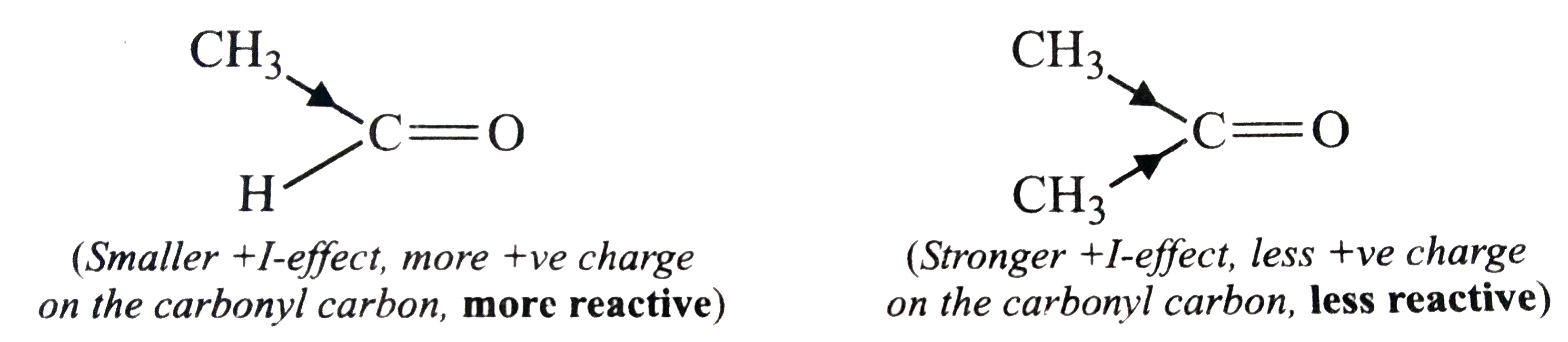 In `C_(6)H_(5)COCH_(3)`, the electron-donating RESONANCE effect (+R-effect) of the benzene ring reduces the +ve charge on the carbon atom of the carbonyl group. since +R-effect of benzene ring is more pronounced than +I-effect of the `CH_(3)` group, therefore, magnitude of the +ve charge on the carbon atom of the carbonyl group in `C_(6)H_(5)COCH_(3)` is reduced to a much greater extent than in `CH_(3)CHO` and `CH_(3)COCH_(3)`. As a result, `C_(6)H_(5)COCH_(3)` is much LESS reactive than `CH_(3)CHO` and `CH_(3)COCH_(3)`. 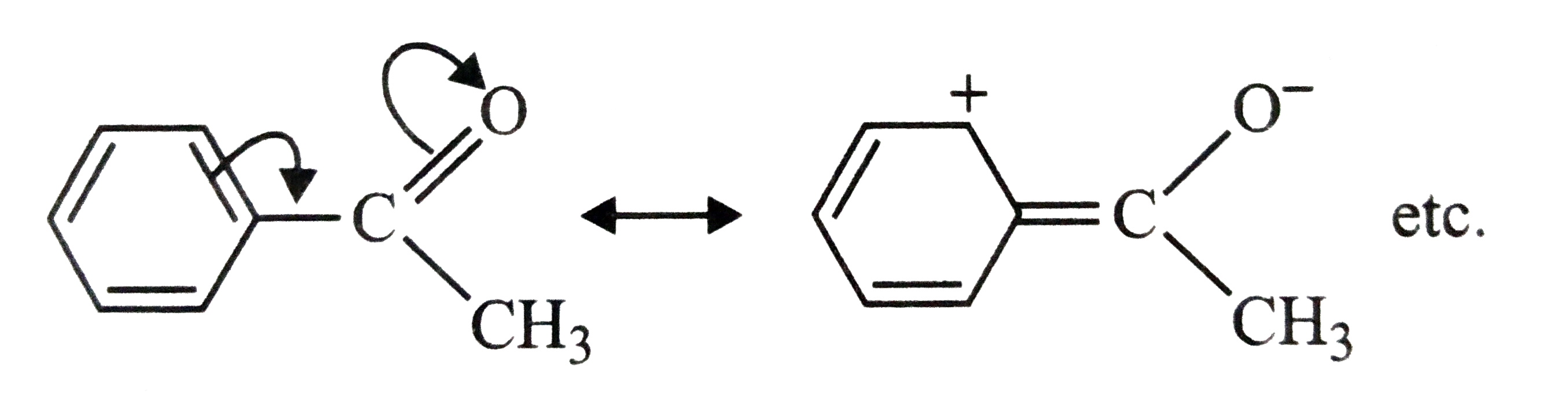 Thus, the overall reactivity of these three compounds towards nucleophilic addition reactions increases in the order: `C_(6)H_(5)COCH_(3) lt CH_(3)COCH_(3) lt CH_(3)CHO` |
|
| 38. |
Arrange the following in the increasing order order of their bond order : O_(2), O_(2)^(+), O_(2)^(-)and O_(2)^(2-) : |
|
Answer» `O_(2)^(- -) , O_(2)^(-),O_(2)^(+),O_(2)` `(sigma 1 s)^(2)(sigma ^(**)1S)^(2)(sigma 2 s)^(2)(sigma^(**)2s)^(2)(sigma 2p_(2))^(2)(pi2p_(x))^(2)(pi2p_(y))^(2)(pi^(**)2p_(x))^(1)(pi^(**)2p_(x))^(1)(pi^(**)2p_(y))^(1)` `:.` B.O. of `O_(2)=1/2(10-6)=2` Molecular orbital electronic configuration fo `O_(2)^(+)` is `(sigma 1s)^(2)(sigma^(**)1s)^(2)(sigma 2s)^(2)(sigma^(**)2s)^(2)(sigma2p_(z))^(2)(pi2p_(x))^(2)(pi2p_(y))^(2)(pi^(**)2p_(x))^(2)(pi^(**)2p_(y))^(1)` `:.` B.O. of `O_(2)^(-)=1/2(10-7)=1.5` Molecular orbital electronic configuration of `O_(2)^(2-)` is `(sigma 1s)^(2)(sigma^(**)1s)^(2)(sigma2s)^(2)(sigma^(**)2s)^(2)(sigma2p_(z))^(2)` `(pi2p_(x))^(2)(pi2p_(y))^(2)(pi^(**)2p_(7))^(2)` `:.` B.O. of `O_(2)^(2-)=1/2(10-8)=1.0` `:.` INCREASING of B.O.is `O_(2)^(2-)ltO_(2)^(-)ltO_(2)ltO_(2)^(+)` |
|
| 39. |
Arrange the following in the increasing order of their boiling points : CH_(3) CHO, CH_(3) COOH, CH_(3) CH_(2) OH |
|
Answer» Solution :Increasing order of BOILING POINTS is as under `:` `CH_(3) CHO lt CH_(3) CH_(2) OH lt CH_(3) COOH ` |
|
| 40. |
Arrange the following in the increasing order of their boiling point and give a reason for your ordering (i) Butan-2-ol, Butan -1-ol, 2-methylpropan -2-ol (ii) Propan -1-ol, propan -1,2,3-triol, propan -1,3- diol, propan -2-ol |
|
Answer» Solution :(i) Boiling points increases regularly as the molecular mass increases DUE to a corresponding INCREASE in their Van der waal.s force of attraction. Among isomeric alcohols `2^@` - alcohols have lower boiling points than `1^@` alcohols due to a corresponding decreases in the extent of H-bonding because of STERIC hindrance. Thus the boiling POINT of Butan 2- OL is lower than that of Butan -1-ol. Overall increasing order of boiling points is, 2-methylpropan-2-ol < Butan-2- ol < Butan -1-ol (ii) `2^@` -lcohols have lower boiling points than `1^@` -alcohols due to a corresponding decrease in the extent of H-bonding because of steric hindrance. Therefore Propan -1-ol has higher boiling point than Propan -2-o1. Hydrogen group increases, boiling point also increases. `:.` overall increasing order of boiling points is, propan -2-ol |
|
| 41. |
Arrange the following in the increasing order of their boiling point and give a reason for your ordering : "Propan -1-ol, propan - 1, 2, 3 - triol, propan -1, 3 - diol, propan - 2- ol" |
|
Answer» Solution :`2^(@)` alcohols have lower BOILING points than `1^(@)-` alcohols due to a corresponding decrease in the extent of H - BONDING because of steric hindrance. Therefore Propan -1 ol has higher boiling point than Propan -2- ol. Hydrogen group increases, boiling point also increases. `therefore"Overall increasing ORDER of boiling points is,"` `"propan -2- ol" LT " Propan -1- ol" lt " propan 1,3 - diol" lt "propan -1, 2, 3- triol"` |
|
| 42. |
Arrange the following in the increasing order of their boiling point and give a reason for your ordering (i) Butan -2-ol, Butan -1-ol, 2- methylpropan -2-ol (ii) Propan -1-ol, propan -1,2,3-triol, propan-1,3-diol, propan -2-ol |
|
Answer» Solution :Boiling points increases regularly as the molecular mass increases due to a corresponding increase in their Van DER waal.s FORCE of attraction. AMONG ISOMERIC ALCOHOLS `2^(@)` -alcohols have lower boiling points than `1^(@)`-alcohols due to a corresponding decreases in the extent of H-bonding because of steric hindrance. Thus the boiling point of Butan -2- ol is lower than that of Butan -1-ol. Overall increasing order of boiling points is, 2-methylpropan-2-ol < Butan-2-ol < Butan -1-ol |
|
| 43. |
Arrange the following in the increasing order of their basic strength : (i) (CH_3)_3 N(ii) CH_3 NH_2 (iii) NH_3 |
| Answer» SOLUTION :` (II)GT (i) gt (III)` | |
| 44. |
Arrange the following in the increasing order of their basic strengths : CH_(3)NH_(2),(CH_(3))_(2)NH,(CH_(3))_(3)N,NH_(3) |
|
Answer» `NH_(3)lt(CH_(3))_(3)NltCH_(3)NH_(2)lt(CH_(3))_(2)NH` Methyl amines are stronger bases than `NH_(3)` due to the +I effect of `-CH_(3)` group. Thus greater the number of methyl GROUPS, more will be the basicity of the amine due to greater availability of ELECRON density on NITROGEN. Thus, the expected order is `NH_(3)ltCH_(3)NH_(2)lt(CH_(3))_(2)NHlt(CH_(3))_(3)N`. However, in tertiary amines, crowding of alkyl groups covers nirogen atom from al sides making the approach and bonding by `H^(+)` relatively DIFFICULT, thus the electrons are there but the PATH is blocked resulting in reduced basicity, thus the order of increasing basicity is: `NH_(3)lt(CH_(3))_(3)NltCH_(3)NH_(2)lt(CH_(3))_(2)NH`. |
|
| 45. |
Arrange the following in the increasing order of their basic strength : (i) (CH_3)_3 NH(ii) CH_2 NH_2 (iii) NH_3 |
| Answer» SOLUTION :` (II)GT (i) gt (III)` | |
| 46. |
Arrange the following in the increasing order of their basic strength CH_(3)NH_(2), (CH_(3))_(2)NH, (CH_(3))_(3)N, NH_(3) |
|
Answer» `NH_(3) lt (CH_(3))_(3)N lt (CH_(3))_(2)NH lt CH_(3)NH_(2)` the reason why the actual order is different from the expected order can be explained as follows : The basicity of an amine in aqueous solution does not entirely depend upon the electron density on the N-atm but also depends upon the STABILITY of the conjugate acid formed by accepting a proton from the solution. The stability of the conjugate acid, in turn, depends upon the extent of H-bonding. Obviously, greater the number of H-atoms on N-atom, more stable is the conjugate acid. thus, the conjugate acid of a `1^(@)` amine is the most stable since it has three H-atoms which can form H-bonds with `H_(2)O`, the conjugate acid of the `2^(@)` amine is less stable since it has two H-atoms while that of the `3^(@)` amines is the least stable since it has only one H-atom which can form H-bonds with `H_(2)O` as shown below :  Thus, on the basis of the stability of the conjugate acid ALONE, the basic strength of amines in aqueous solution FOLLOW the order : `1^(@)` Amine `gt 2^(@)` Amine `gt 3^(@)` Amine, i.e., `RNH_(2) gt R_(2)NH gt R_(3)N` In actual practice, these two opposing factors balance each other in case of `2^(@)` amines. This makes `2^(@)` amines to be strongest `3^(@)` Amines are weaker bases than `2^(@)` amines since their conjugate acids are less stable than those of `2^(@)` amines while `1^(@)` amines are less basic than `2^(@)` amines since the electron density on the N-atom is less and hence the lone pair of ELECTRONS is less easily available for protonation. |
|
| 47. |
Arrange the following in the increasingorder of the property indicated : (i) Benzoic acid, 4-Nitrobenzoic acid, 3,5-dinitrobenzoic acid, 4-Methoxybenzoic acid (acid strength) (ii) Acetaldehyde, Acetone , Di-tertbutylketone. Methylterbutyl keton ( Reactivity towards HCN ) . |
|
Answer» Solution :(i) The increassing order of acid strength is `:` 4-Methoxybenzoic acid `lt ` Benzoic acid `lt ` 4-Nitrobenzoic acid `lt ` 3,5-Dinitobenzoic acid (ii)  Smaller the steric hinderance to the nucleophile`CN^(-)` , GREATER will be the REACTIVITY. Hence, the reactivity towards HCN in increasing order will be  or Di-tertbutyl ketone `lt `Methylterbutyl ketone `lt ` ACETONE `lt `Acetaldehyde |
|
| 48. |
Arrange the following in the increasing order of stability. CH_(3)CH_(2)CH=CH_(2), CH_(3)CH=CHCH_(3)(cis), CH_(3)CH=CHCH_(3)" (trans)" |
| Answer» SOLUTION :`CH_(3)CH_(2)CH=CH_(2) lt (CH_(3))CH=CH_(2)CH_(3)" (CIS)" lt (CH_(3))_(2)C=CH_(2) lt CH_(3)CH=CHCH_(3)" (trans)"` | |
| 49. |
Arrange the following in the increasing order of stability. CH_(3)CH_(2)CH=CH_(2), CH_(3)CH=CHCH_(3)(cis), CH_(3)CH=CHCH_(3)" (trans)" |
| Answer» Solution :`CH_(3)CH_(2)CH=CH_(2) lt (CH_(3))CH=CH_(2)CH_(3)" (CIS)" lt CH_(3)CH=CHCH_(3)" (TRANS)"` | |
| 50. |
Arrange the following in the increasing order of their (a) CaCO_(3), BaCO_(3),MgCO_(3), BeCO_(3) (Thermal stability) (b) CaMnO _(4), BaMnO_(4), MgMnO_(4), BeMnO_(4) (Solubility in water) (c ) NaCl, MgCl_(2),SiCl_(4), AlCl_(3) (ionic character) |
|
Answer» Solution :(a) `BeCO_(3)lt MgCO_(3) lt BaCO_(3)` (b) `BaMnO_(4) lt CaMnO_(4) lt MgMnO_(4) lt BeMnO_(4)` (C) `SiCl _(4) lt AlCl_(3) lt MgCl _(2) lt NACL` |
|