

Saved Bookmarks
This section includes 7 InterviewSolutions, each offering curated multiple-choice questions to sharpen your Current Affairs knowledge and support exam preparation. Choose a topic below to get started.
| 1. |
Aluminium is most abundant in earth crust yet it is obtained from bauxite because |
|
Answer» BAUXITE is avilable in larger QUANTITY |
|
| 2. |
Aluminium is mainly extracted from : |
|
Answer» Magnetite |
|
| 3. |
Aluminium is extracted from alumina (Al_2O_3) by electrolysis of a molten mixture of |
|
Answer» `Al_2O_3+HF +NaAlF_4` |
|
| 4. |
Aluminium is extracted from alumina (Al_(2)O_(3)) by electrolysis of a molten mixture of |
|
Answer» `Al_(2)O_(3)+HF+NaAlF_(4)` |
|
| 5. |
Aluminium is extracted from alumina (Al_(2)O_(3)) by electrolysis of a molten mixture of ………. |
|
Answer» `Al_(2)O_(3)+KF+Na_(3)AlF_(6)` |
|
| 6. |
Aluminium is extracted from alumina (Al_(2)O_(3)) by electrolysis of a molten mixture of : |
|
Answer» `Al_(2)O_(3)+HF+NaAlF_(4)` |
|
| 7. |
Aluminium isextractedfromalumina (Al_2 O_3)byelectrolysisofa moltenmixture of |
|
Answer» ` Al_2O_3 + HF + NaAlF_4` |
|
| 8. |
Aluminium is diagonally related to: |
|
Answer» Li |
|
| 9. |
Aluminium is diagonally related to (in periodic table) |
|
Answer» Li |
|
| 10. |
Aluminium (III) chloride froms a dimer because |
|
Answer» HIGHER coordination number can be achieved by aluminium |
|
| 11. |
Aluminium (III) chloride forms a dimer because : |
|
Answer» aluminium has high ionisation energy |
|
| 12. |
Aluminium hydroxide, magnesium hydroxide, erythromycin, cimetidine, ranitidine. |
| Answer» Solution :ERYTHROMYCIN. It is ANTIMICROBIAL WHEREAS OTHERS are antacids. | |
| 13. |
Aluminium hydroxide is soluble in excess of sodium hydroxide forming the ion |
|
Answer» `AlO_(2)^(+3)` |
|
| 14. |
Aluminium forms [AlF_(6)]^(3-)ion but boron does not form [BF_(6)]^(3-)ion. |
|
Answer» SOLUTION :Maximum co-ordination NUMBER of boron is four as it does not have d-orbitals, while the maximum COORDINATION number of aluminium is 6. Thus, Al forms `[AlF_(6)]^(3-)`ion while boron does not form `[BF_(6)]^(3-)` ion. |
|
| 15. |
Aluminium forms : |
|
Answer» ELECTROVALENT COMPOUNDS only |
|
| 17. |
Aluminium displaces hydrogen from dilute HCl whereas silver does not. The e.m.f. of a cell prepared by combining Al//Al^(3+) and Ag//Ag^(+) is 2.46V. The reduction potential of silver electrode is +0.80V. The reduction potential of aluminium electrode is |
|
Answer» `+1.66V` `Al+3Ag^(+) to Al^(3+)+3Ag` `E_(cell)=E_("cathode")^(@)-E_("anode")^(@)` `=E_(Ag^(+)//Ag)^(@)-E_(Al^(3+)//Al)^(@)` `2.46=0.80-E_(Al^(3+)//Al)^(@)` or `E_(Al^(3+)//Al)^(@)=-1.66V` |
|
| 18. |
Aluminium displaces hydrogen from dilute HCl whereas silver does not. The e.m.f. of a cell prepared by combining Al//Al^(3+) and Ag//Ag^(+)is 2.46 V. The reduction potential of silver electrode is + 0.80 V. The reduction potential of aluminium electrode is |
|
Answer» `+1.66 V ` |
|
| 19. |
Aluminium displaces hydrogen from dilute HCl whereas silver does not. The e.m.f. of a cell prepared by combining Al//Al^(3+) and Ag//Ag^(+) is 2.46V. The reduction potential of silver electrode is +0.80V. The reduction potential of aluminium electrode. |
|
Answer» `+1.66V` `E_(cell)^(o)=E_("cathode")^(o)-E_("anode")^(o)=E_(Ag^(+)//Ag)^(o)-E_(Al^(3+)//Al)^(o)` `2.46=0.8-E_(Al^(3+)//Al)^(o),E_(Al)^(o)=0.8-2.46=-1.66V`. |
|
| 20. |
Aluminium displaces hydrogen from acids but copper does not. A galvanic cell prepared by combining Cu//Cu^(2+) and Al//Al^(3+) has an e.m.f. of 2.0 V at 298 K. if the potential of copper electrode is +0.34V, that of aluminium is |
|
Answer» `+1.66V` |
|
| 21. |
Aluminium displaces hydrogen from acids, but copper does not. A galvanic cell prepared by combining Cu| Cu^(2+) and Al|Al^(3+) has an emf of 2.0 V at 298 K. If the potential of copper electrode is + 0.34 V, that of aluminium electrode is |
|
Answer» `-2.3 V ` `E_(cell)^(@) = E_((Cu^(2+) |Cu))^(@) - E_((Al^(3+)|Al))^(@)` `2.00 = 0.34 - E_((Al^(3+)|Al))^(@)` `THEREFORE E^(@) (Al^(3+)|Al) = 0.34 - 2.0 = -1.66 V` |
|
| 22. |
Aluminium displaces hydrogen from dilute HCI whereas silver does not Thee.m.f. of a cell prepared by combiningAl/Al ^3+and Ag/Ag ^+is 2.46 V. The reduction potential of silver electrode is + 0.80 V. The reduction potential of aluminium electrode |
|
Answer» `+1.66V` |
|
| 23. |
Aluminium displaces hydrogen from acids, but copper does not. A galvanic cell prepared by combining Cu//Cu^(2+) and Al//Al^(3+)has an emf of 2.0 V at 298K. If the potential of copper electrode is +0.34V, that of Aluminium electrode is |
|
Answer» `-2.3V` |
|
| 24. |
Aluminium displaces hydrogen from acids, but copper does not. A galvanic cell prepared by combining Cu//Cu^(2+) and Al//Al^(3+) has an emf of 2.0V at 298K. If the potential of copper electrode is +0.34V and that of Aluminium electrode is |
|
Answer» `-2.3V` `Al|Al^(2+)||C u^(2+)|CU` `E_("CELL")=E_(Cu^(2+))+_(//Cu)-E_(Al^(3))+_(//Al)` `2.0V== 0.34V-E_(Al^(3+)//Al)` `E_(Al^(3+)//Al)=0.34V-2.0V=-1.66V` |
|
| 25. |
Aluminium displaces hydrogen from acids but copper does not. A galvainc cell prepared by combining Cu//Cu^(2+) and Al//Al^(3+) has an emf of 2.0 V at 298 K. If the potential of copper electrode is +0.34 then that of the aluminiumelectrode is: |
|
Answer» `+1.66`V |
|
| 26. |
Aluminium displaces hydrogen from acid, but copper does not. A Galvanic cell prepared by combining Cu//Cu^(2+) and Al//Al^(3+) has an emf of 2.0V at 298K. If the potential of copper electrode is 0.34V, that of aluminium electrode is |
|
Answer» `-1.66V` `=E^(@) (CU^(+2)//Cu) - E^(@) (Al^(+3)//Al) = 2V` `rArr E^(@) (Al^(+3)//Al) = -2 + 0.34 = -1.66V` |
|
| 27. |
Aluminium crystallizes in an fcc structure. Atomic radius of the metal is 125 pm. What is the length of the edge of the unit cell ? |
|
Answer» Solution : For a face centred CUBIC CLOSE PACKED structure, Radius (r) = `a// 2sqrt2` `:.` LENGTH of the side of the unit cell, `a = 4/sqrt2 r = 2sqrt2 r = 2xx 1.4142 xx 125 xx 10^(-12) m = 3.535 xx 10^(-10) m` = 353.5 pm |
|
| 28. |
Aluminium crystallizes in an fcc structure. Atomic radius of the metal is 125 pm. How many such unit cells are there in 1 m^3 of aluminium? |
|
Answer» Solution :Volume of ONE UNIT cell = `a^3 = (3.54 xx 10^(-10))^3 m^3 = 4.436 xx 10^(-29) m^3` Number of unit cells in 1.0 `m^3` of Al (1.0 m) = `((0.1 m^3))/((4.436 xx 10^(-29) m^3))=2.25 xx 10^(28)` |
|
| 29. |
Aluminium crystallizes in an fcc structure. Atomic radius of the metal is 125 pm. Calculate the edge length of the unit cell of the metal. |
|
Answer» SOLUTION :`a = 2 sqrt(2) R` `a = 2 sqrt(2) xx 125` a = 353.5 pm |
|
| 30. |
Aluminium crystallizes in a face-centred cubic unit cell with an edge length of 4.094 A. Calculate the approximate Avogadro constant. |
|
Answer» |
|
| 31. |
Aluminium crystallizes in an FCC structare. Atomic radius of the metal is 125pm. Calculate the edge length of unit cell of the metal. |
|
Answer» SOLUTION :The RELATIONSHIP between a and R (RADIUS of the SPHERE) is `a=2sqrt2xxr=2sqrt2xx125="353.5pm"` |
|
| 32. |
Aluminium crystallizes in a cubic lattice with an edge of 404 pm and density of metal is 2.70 g/ cm^(3). What type of cubic is formed by aluminium ? |
|
Answer» Solution : If there is "n" aluminium atoms per unit cell : `Density (rho)=(NM)/(N_(A)a^(3))` `implies`2.70=`(nxx270)/(6.023xx10^(23)(4.04xx10^(-8)cm))^(3)` `impliesn=6.023xx10^(22)(4.04xx10^(-8))^(-3)= 3097~~4` Hence, Al forms face-centred cubic (FCC) lattice. the coordination number of Al in FCC is 12 i.e., each Al atom has twelve other Al atoms in its nearest neighbour. 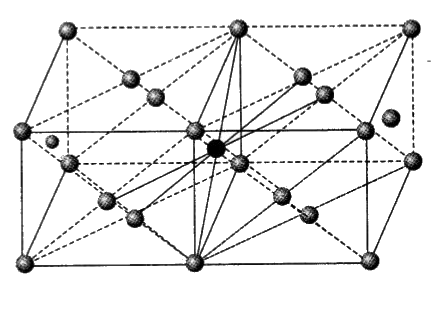 An atom of aluminium (SOLID BLACK) PRESENT on the centre of middle vertical face is equidistant from the twelve adjoining atoms, hence, coordination number of an atom in FCC arrangement is twelve. |
|
| 33. |
Aluminium crystallizes in a cubic close packed structure. Its metallic radius is 125pm. Calculate the edge length of unit cell. |
|
Answer» SOLUTION :`"GIVEN,Radius (r ) = 125 pm"` `"Edge LENGTH of UNIT cell (a)"=?` Since aluminium crystallizes in Face CENTERED cubic `r=(asqrt2)/(4)(or) r=(a)/(2sqrt2)` `a=rxx2xxsqrt2` `=125xx2xx1.414` `a=353.5" pm"` |
|
| 34. |
Aluminium crystallizes in a ccp structure. Its metallic radius is 125pm. The number of unit cells in 1.00 cm^(3) of Al are |
|
Answer» `2.27 xx 10^(22)` `a = 2 sqrt(2) R = 2 xx 1.414 xx 125 = 353.5 `pm or `353.5 xx 10^(-10) `cm Volume of unit CELL `= ( 353.5 xx 10^(-10))^(3)` `= 4.42 xx 10^(23) cm^(3)` No. of unit cells in 1 `cm^(3)` |
|
| 35. |
Aluminium crystallises in a cubic close-packed structure. Its metallic radius is 125 pm. (i) What is the length of the side of the unit cell ? (ii) How many unit cells are there in 1.00 "cm"^3 of aluminium ? |
|
Answer» Solution :Aluminum CRYSTALLIZE in a cubic close-packed structure. Its metallic radius is 125 pm. (i) In a cubic close-packed structure the edge length `(a) = 2sqrt(2)r` `= 2 xx 1.41 xx 125` = 354 pm. (ii) Volume of UNIT cell `= a^3 = (354)^3 xx 10^(-30) "cm"^3` `therefore` Number of unit CELLS in `1 "cm"^3` of aluminium`= (1)/((354)^3 xx 10^(-30))` `= 2.25 xx 10^(22)`. |
|
| 36. |
Aluminium crystallises in a cubic close-packed structure. Its metallic radius is 125 pm. (i) What is the length of the side of the unit cell ? (ii) How many unit cells are there in 1.00 cm^(3) of aluminium ? |
|
Answer» Solution :(i) Cubic close - packing is the same as FACE - centred cubic. For fcc, `a=2sqrt2r = 2xx4.414xx125=354" PM"` (ii) Volum e of UNIT cell `=(354xx10^(-10)CM)^(3)=4.44xx10^(-23)cm^(3)` Number of unit cells in `1cm^(3)=(1)/(4.44xx10^(-23))=2.25xx10^(22)` |
|
| 37. |
Aluminium crystallies in a cubic close packed structure. Radius of the atom in the metal is 125 pm. (i) What is the length of the side of the unit cell ? (ii) How many unit cells are there in 1 cm^(3) of aluminium ? |
|
Answer» Solution :r = 125 pm = `125 xx 10^(-10)` CM (i) For ccp, edge length of unit cell, `a = (4R)/(sqrt(2))` `= (4 xx 125 xx 10^(-10))/(1.414)` = `353.60 xx 10^(-10)` cm `= 354 xx 10^(-10)` cm (ii) NUMBER of unit cells in 1 `cm^(3)` `= ("Total volume")/("Volume of 1 unit cell" (a^(3)))` `= (1 cm^(3))/((354 xx 10^(-10))^(3))` `= 2.254 xx 10^(22)` Unit cells |
|
| 38. |
Aluminium containing alumina as impurity can be refined by poling or not. Why? |
| Answer» SOLUTION :Aluminium containingaluminacannot be refined by poling. Aluminium is more ELECTROPOSITIVE , thushydrocarbonsreleased from green wood poles and CARBON cannot reduce ALUMINA. | |
| 40. |
Aluminium can be prepared by: |
|
Answer» ELECTROLYTIC REDUCTION of aluminia in presence of Cryolite & fluorspar. |
|
| 41. |
Aluminium becomes passive in nitric acid because it : |
|
Answer» IS a noble metal |
|
| 42. |
Aluminium appears like gold when it is mixed with : |
| Answer» Answer :B | |
| 43. |
Aluminiumamalgam usedas areducingagent,isobtainedby : |
|
Answer» Dippingaluminiumfoilinmercuricchloridesolution |
|
| 44. |
Alumininum is prepared in large quantities by |
|
Answer» HEATING cryolite in alimited equantity of air |
|
| 45. |
Alumina with considerable impurity of silica is purified by ....... |
|
Answer» Hall-Heroult process `SiO_2 + 2C to Si + 2CO` |
|
| 46. |
Alumina on heating with carbon in nitrogen atmosphere gives : |
|
Answer» AL +CO |
|
| 47. |
Alumina may be converted into anhydrous aluminium chloride by: |
|
Answer» Heating it with CONC. HCl |
|
| 48. |
Alumina is the nature of : |
|
Answer» Acidic |
|