

Saved Bookmarks
This section includes 7 InterviewSolutions, each offering curated multiple-choice questions to sharpen your Current Affairs knowledge and support exam preparation. Choose a topic below to get started.
| 1. |
Amine are more basic than : |
|
Answer» ALCOHOLS |
|
| 2. |
Amides with no substitution on nitrogen react with tht: solution of bromine or chlorine in NaOH or KOH to yield aminei through a reaction called as Hofmann's degradation. R-overset(O)overset(||)(C )-NH_(2)+Br_(2)+4NaOH overset(H_(2)O)rarr R-NH_(2)+2NaBr+Na_(2)CO_(3)+2H_(2)O Amides can be reduced to amines having same number of carbon atoms R-overset(O)overset(||)C-NH_(2)-underset(LiAlH_(4))overset([H])toR-CH_(2)-NH_(2) Carbon dioxide gas is released in above mentioned reaction |
|
Answer» 1 |
|
| 3. |
Amineare basic is natureaccording to |
|
Answer» Arrhenioustheory |
|
| 4. |
Amides with no substitution on nitrogen react with tht: solution of bromine or chlorine in NaOH or KOH to yield aminei through a reaction called as Hofmann's degradation. R-overset(O)overset(||)(C )-NH_(2)+Br_(2)+4NaOH overset(H_(2)O)rarr R-NH_(2)+2NaBr+Na_(2)CO_(3)+2H_(2)O Amides can be reduced to amines having same number of carbon atoms R-overset(O)overset(||)C-NH_(2)-underset(LiAlH_(4))overset([H])toR-CH_(2)-NH_(2) Benzamide when treated with Br_(2) in presence of NaOH gives aniline. |
|
Answer» 1 |
|
| 5. |
Amides on treatment with Br_2 and KOH form the amines having the underline(" same number of carbon atoms"). |
| Answer» Solution :Amides on TREATMENT with Br2 and KOH FORM the amines having LESS NUMBER of carbon ATOMS. | |
| 6. |
Amides may be converted into amines by reaction named after |
|
Answer» Perkin |
|
| 7. |
Amides may be converted into amines by reaction named after : |
|
Answer» Perkin |
|
| 8. |
Amides are least reactive of the acid derivatives towards_____reactions. |
| Answer» SOLUTION :NUCLEOPHILIC ACYL SUBSTITUTION. | |
| 9. |
Amides can be converted into amines by |
|
Answer» HOFFMANN bromamide reaction |
|
| 10. |
Amino acids are amphoteric in nature. Explain. |
|
Answer» SOLUTION :Amides behave both as weak acid as well as weak base and thus show AMPHOTERIC character. This can be proved by the following reactions. Acetamide (as base) reacts with hydrochloric acid to form salt `underset("Acetamide")(CH_(3)-overset(O)overset(||)(C)-NH_(2))+HCl tounderset("Acetamide hydrochloride")(CH_(3)-overset(O)overset(||)(C)-overset(+)(NH_(3))Cl^(-))` Acetamide (as acid) reacts with SODIUM to form sodium salt and hydrogen GAS is liberated. `underset("Acetamide")(2CH_(3)-overset(O)overset(||)(C)-NH_(2))+Natounderset("Sodium acetamide")(2CH_(3)-overset(O)overset(||)(C)-overset(+)(NH)Na)+H_(2)` |
|
| 11. |
Amides are: |
|
Answer» AMPHOTERIC |
|
| 13. |
Amide group is present in |
|
Answer» Lipids `(-NH-underset(R)underset(|)(C)H-ubrace(underset(O)underset(||)(C)-NH-underset(R)underset(|)(C)H)_("Amide orppeptide BOND")-underset(O)underset(||)(C)-)_(n)` |
|
| 14. |
(a)Me_(3)CCH_(2)CH(Cl)Ph., (b)MeC(Et)_(2)CH_(2)Cl (c)MeCH=C(Br)CH_(2)Me_(2),(d)m-ClC_(6)H_(4)CH_(2)CHMe_(2) (e)p-I-C_(6)H_(4)CH(Me)Et (f)p-FCH_(2)C_(6)H_(4)CH_(2)Cme_(3) (g)MeCH=CHC(Cl)Me_(2),(h)MeC(Br)(et)Et (i)MeCH=CHc(Cl)Me_(2),(j)EtC(Me)_(2)CH_(2)Br (k)Me_(2)CHCH(Br)Me ,(L)BRCH_(2)C-=CCH_(2)Cl (m)CHF_(2)BrClF ,(n)(CBr_(3))_(3)CBr) (o)MeC(p-BrC_(6)H_(4))_(2)CH(Cl)Me ,(p)Me_(3)CCH=ClC_(6)H_(4)Cl-m |
Answer» SOLUTION :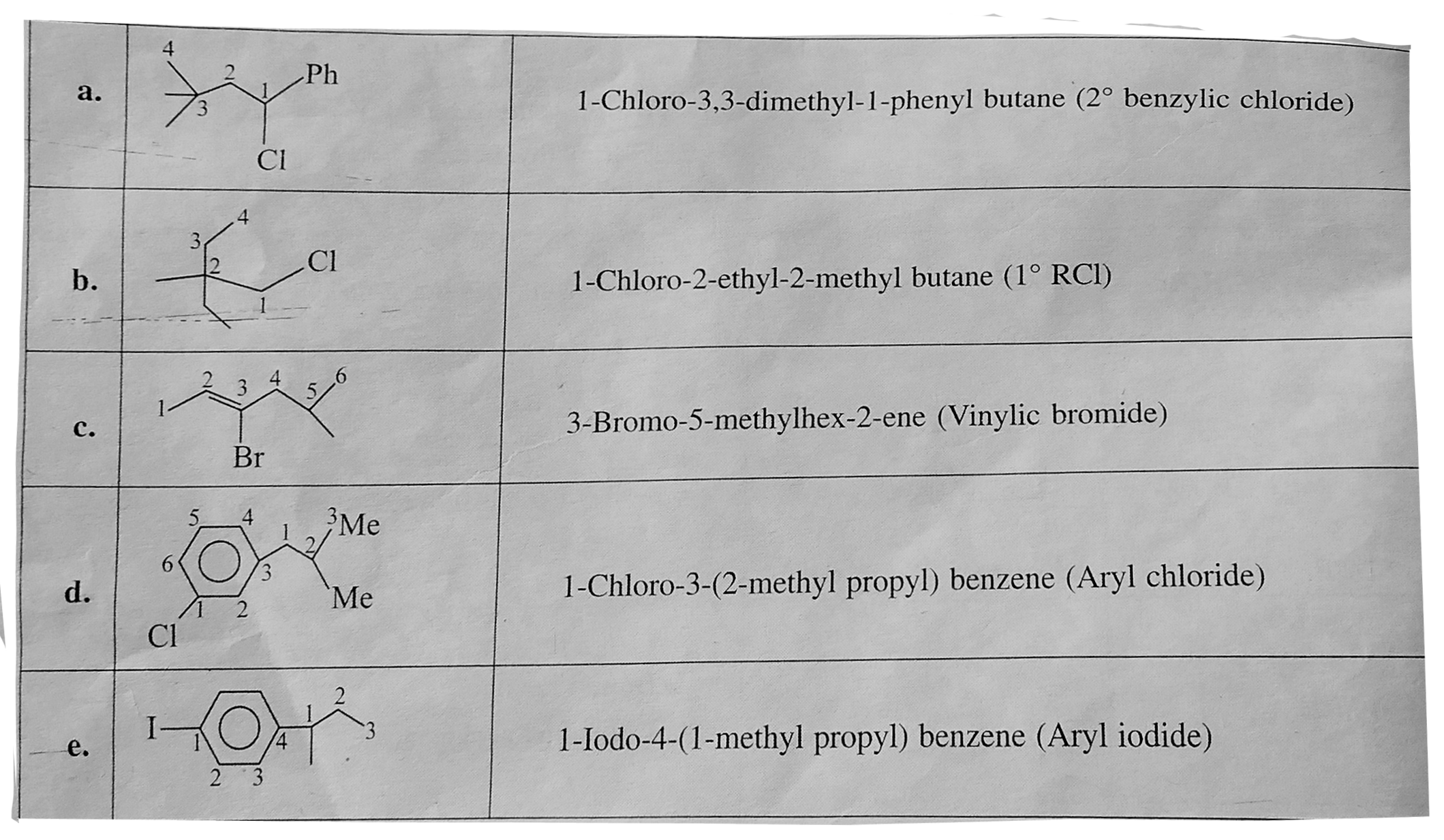 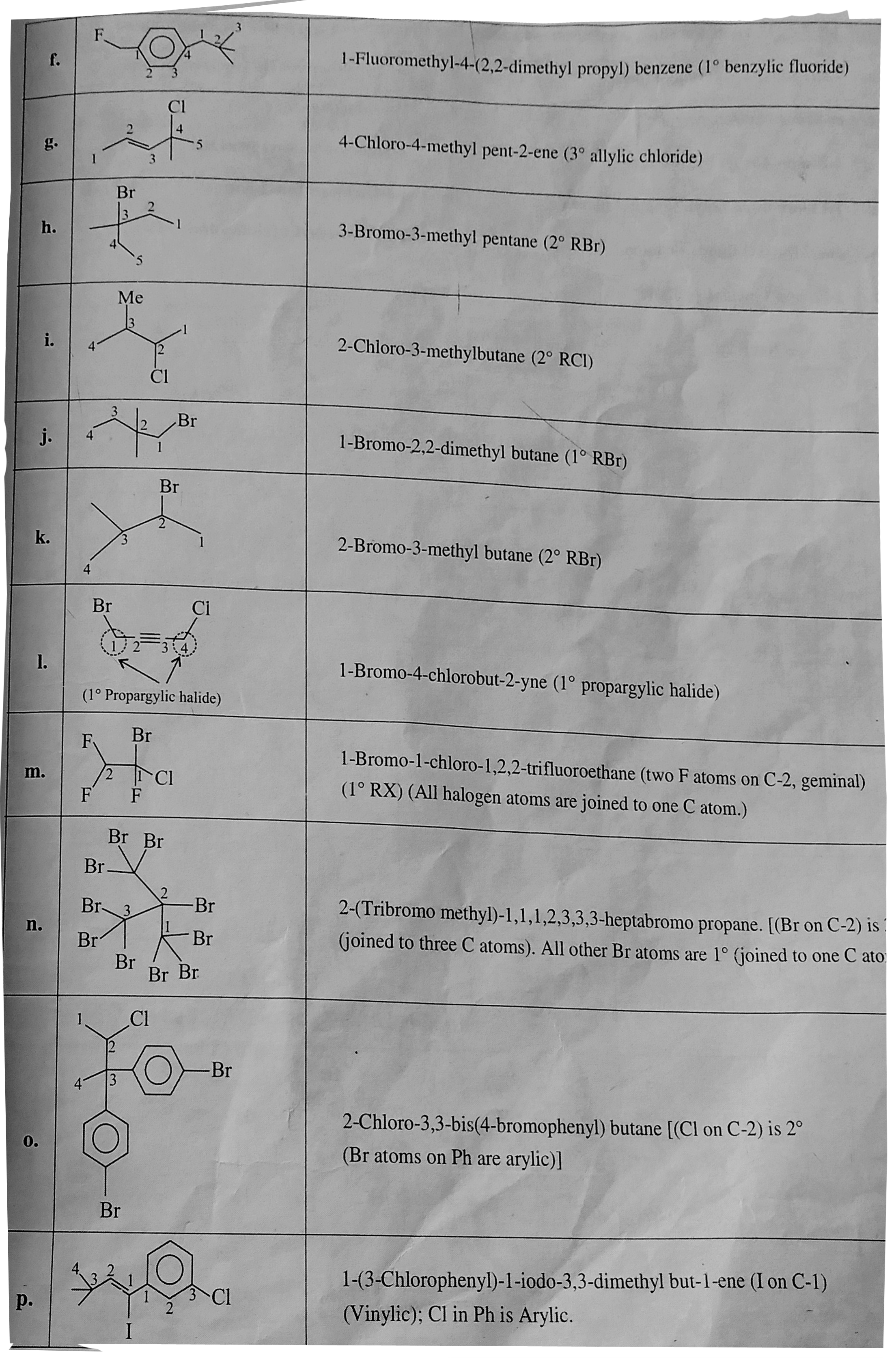
|
|
| 15. |
(a)Metallurgy-Extraction of metals(b)Clay-Ore of Al (C )Na-Native element (d)Ore-Gangue |
| Answer» SOLUTION :(a)Metallurgy-Extraction of METALS | |
| 16. |
Amatol is blasting material which is obtained by mixing TNT with |
|
Answer» `NH_(4)Cl`<BR>`NH_(4)Br` |
|
| 17. |
Amalgams are: |
|
Answer» Always solid |
|
| 18. |
Find out the incorrect pair (a)Magnetite-Fe_(3)O_(4) (b)Malachite-CuCO_(3).Cu(OH)_(2) (c )Horn silver-Ag_(2)S (d)Stefinite-Ag_(2)SbS_(4) |
| Answer» SOLUTION :(C )Horn silver-`Ag_(2)S` | |
| 19. |
A_(m)^(@) value cannot be determined by extraploting, the plot between A_(m) verses C^(1//2) for the compound. |
|
Answer» `KCl` |
|
| 20. |
(A)Lyophilic colloids are called as reversible sols.(R ) Lyophilic sols are liquid loving . |
|
Answer» Both (A) and (R ) are TRUE and (R ) is the correct explanation of (A) |
|
| 21. |
Aluminothermy used for the spot welding of large iron sturctures is based upon the fact that |
|
Answer» As COMPARED to IRON, aluminium has greater AFFINITY for oxygen |
|
| 22. |
Aluminothermy used for the spot welding of large iron structures is based upon the fact that : |
|
Answer» As compared to IRON, aluminium has GREATER AFFINITY for OXYGEN |
|
| 23. |
Aluminothermic process is usedinthe metallurgy of |
|
Answer» Pb |
|
| 24. |
Aluminothermic process is used for the extraction of metals whose oxides are : |
|
Answer» fusible |
|
| 25. |
Aluminothermic process is used for the extraction of metals, whose oxides are : |
|
Answer» Fusible |
|
| 27. |
Alumino-thermy is a process involving : |
|
Answer» REDUCTION of OXIDE of a metal by HEATING with sodium |
|
| 28. |
Aluminothermic process is used for the extraction of metals, whose oxides are |
|
Answer» FUSIBLE |
|
| 29. |
Alumino-thermic process is used for metallurgy of |
|
Answer» Pb |
|
| 30. |
Aluminium vessels should not be washed with materials containing washing soda because : |
|
Answer» Washing soda is expensive |
|
| 31. |
Aluminium vesselsshouldnot be washed with material containing washing soda because |
|
Answer» WASHINGSODA reactswith aluminium to FORM solublemeta-aluminate. |
|
| 32. |
Aluminiumsulphate (X) is slightlyinsoluble in water it isconvertedintosolublesulphateby using Na_(2)CO_(3) in theprecipitateof sodiumcarbonateextract .Moleof Na_(2)CO_(3)required forconplateconversionof 1 moleof (X) intosolubleis |
| Answer» Answer :C | |
| 33. |
Aluminiumreacts with NaOH and forms compound 'X'. If the coordination number of aluminium in 'X' is 6, the correct formula of X is |
|
Answer» `[Al(H_(2)O)_(4)(OH)_(2)]^(+)` |
|
| 34. |
Aluminium oxide may be electrolysed at 1000^(@)C to furnish aoluminium metal (At. Mass=27amu,1 faraday=96,500) Al^(3+)+3e^(-)toAl^(0) To prepare 5.12 kg of aluminium metal by this method would require |
|
Answer» `5.49xx10^(7)C` of electricity `3xx96500C` `because` gm of Al is obtained by passing a current of `3xx(96500)/(27)C`. `therefore5.12xx10^(3)gm` of Al is obtained by passing a current of `3xx(96500)/(27)xx5.12xx1000` `=1.83xx10^(7)Cxx3=5.49xx10^(7)C`. |
|
| 35. |
Aluminium oxide may be electrolysed at 100^(@)C to furnish aluminium metal (atomic mass=27 amu). The cathodic reaction is : Al^(3+)+3e^(-) to Al To prepare 5.12 kg of aluminium metal by this reaction would require : |
|
Answer» `549xx10^(7)" C"` of electricity To deposit 27 G of Al metal, electricity needed `=3xxF` To deposit 5120 g of Al metal, electricity needed `=(3F)/((27 g))xx(5120 g)` `=568.89 F=5.49xx10^(7)" C "` |
|
| 36. |
Aluminium oxide contains 52.9% aluminium and carbon dioxide contains 27.27% carbon. Assuming the validity of the law of reciprocal proportions , calculate the percentage of aluminium in aluminium carbide. |
| Answer» Solution :From the DATA, it is observed that the RATIO of masses of ALUMINIUM and carbon in aluminium carbide should be 3:1 or its simple multiple, Hence, percentage of aluminium in aluminium carbide `=(3)/(4)xx100=75.0` | |
| 37. |
Aluminium metals is frequecntly used as areducingagent for theextractionof metals suchas chromium or manganese from thetheirrespectiveoxides , why ? |
|
Answer» |
|
| 39. |
Aluminium is used for making cooking utensils. Which of the following properties of aluminium are responsible for the same ? (i) Good thermal conductivity (ii) Good electrical conductivity (iii) Ductility (iv) High melting point |
|
Answer» IONIC solids |
|
| 40. |
Aluminium is used for making alloys because of its ___________ |
|
Answer» RESISTANCE to corrosion |
|
| 41. |
Aluminium is stable in air and water inspite of the fact that it is reactive metal. The reason is that a thin film of its oxide is formed on its surface which useful that in industry, it is purposely deposited by an electrolytic process called anodising. Reaction of aluminium with oxygen is highly exothermic and is called thermicreaction. 2Al(s)+3//2O_(2)(g)toAl_(2)(s),DeltaH=-1670kJ Thermite reaction finds applications in the metallurgical attraction of many metals form theri oxides and for welding of metals. The drawback is that to start the reaction, high temperature is required for whcih an ignition mixture is used. The reaction which is not involved in thermite process: |
|
Answer» `3Mn_(3)O_(4)+8Al to 9Mn+4Al_(2)O_(3)` |
|
| 42. |
Aluminium is stable in air and water inspite of the fact that it is reactive metal. The reason is that a thin film of its oxide is formed on its surface which useful that in industry, it is purposely deposited by an electrolytic process called anodising. Reaction of aluminium with oxygen is highly exothermic and is called thermicreaction. 2Al(s)+3//2O_(2)(g)toAl_(2)(s),DeltaH=-1670kJ Thermite reaction finds applications in the metallurgical attraction of many metals form theri oxides and for welding of metals. The drawback is that to start the reaction, high temperature is required for whcih an ignition mixture is used. Anodising can be done be electrolysing dilute H_(2)SO_(4) with aluminium as anode. This results in: |
|
Answer» The formation of `Al_(2)(SO_(4))_(3)` on ther surface of aluminium anode |
|
| 43. |
Aluminium is produced on a large scale by electrolysis of alumina, dissolved in fused cryolite and a little fluorspar are respectively ___________. |
|
Answer» `Na_(3)AIF_(6)` and `CaF_(2)` |
|
| 44. |
Aluminium is producedby theelectrolysisof …I ..in the presence of …ii… fill in theblanks I & II with appropriate words |
|
Answer» I aluminium oxide II zeolite |
|
| 45. |
Aluminium is not present in which of the following mineral : |
|
Answer» Cryolite |
|
| 46. |
Aluminium is not used : |
|
Answer» In THERMITE welding |
|
| 47. |
Aluminium is not used |
|
Answer» In silvery paints |
|
| 48. |
Aluminium is obtained by : |
|
Answer» REDUCING `Al_2O_3` with coke |
|
| 49. |
Aluminium is more reactive than Fe. But Al is less easily corroded than iron because |
|
Answer» Al is NOBLE metal |
|